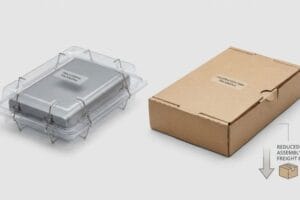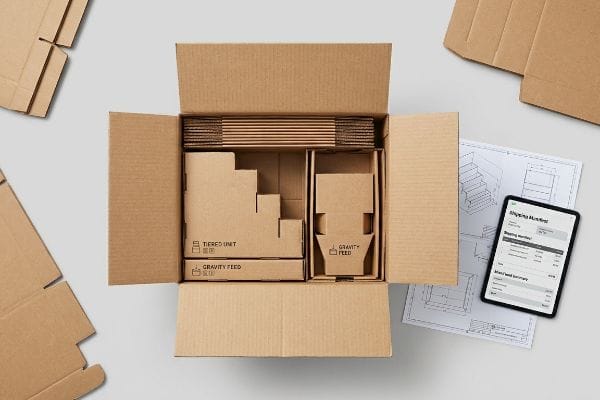
As marcas frequentemente perguntam se podem consolidar várias estratégias de merchandising em uma única remessa de frete para evitar o aumento dos custos logísticos e agilizar seus próximos lançamentos no varejo.
Sim. Você pode encomendar diferentes tipos de expositores de balcão em um único envio por meio do carregamento estratégico de contêineres mistos. Consolidar várias estruturas de expositores — como unidades escalonadas e expositores de gravidade — em um único contêiner de carga reduz drasticamente os custos de envio por unidade, ao mesmo tempo que sincroniza todo o seu cronograma de lançamento no varejo.

Consolidar sua carga é a parte fácil, mas dominar as dimensões físicas de cada estrutura individual antes que elas cheguem à linha de montagem exige engenharia de precisão.
Como organizar os produtos em uma vitrine com várias prateleiras?
A disposição dos produtos em prateleiras de papelão ondulado exige um equilíbrio entre a densidade máxima e a acessibilidade para o consumidor, garantindo que os compradores interajam com os produtos em vez de apenas passarem por eles.
A organização de uma prateleira com vários expositores exige o agrupamento de produtos em conjuntos assimétricos utilizando divisórias modulares específicas. Organizar os itens em conjuntos de três, cinco ou sete cria uma tensão visual psicológica que naturalmente atrai o olhar do comprador, ao mesmo tempo que proporciona o espaço físico necessário para evitar atritos durante a reposição rápida de produtos na loja.

Agrupar seu estoque fica ótimo em uma renderização digital, mas transpor esse layout para o papel exige planejamento técnico.
A Regra de Assimetria 3-5-7
Designers juniores frequentemente tentam empacotar uma grade densa e perfeitamente simétrica de produtos em uma única prateleira de varejo. Eles presumem que amontoar o máximo de itens em uma estrutura automaticamente resulta em maior volume de vendas. Essa abordagem trata a unidade como uma estante de armazenamento de armazém em vez de um veículo de marketing ativo, ignorando a realidade psicológica do merchandising visual1.
Vejo esse erro se repetir constantemente quando as marcas me pedem para projetar divisórias de prateleira compactas. Uma grade perfeitamente simétrica falha completamente em criar tensão visual, fazendo com que os compradores apressados simplesmente ignorem a parede sólida de produtos. Pior ainda, quando um funcionário da loja tenta encaixar a última garrafa em uma grade sem folga, consigo ouvir o som do papelão ondulado rasgando sob a pressão. Sempre recomendo divisórias modulares específicas para separar as mercadorias em grupos assimétricos de três, cinco ou sete itens² . Essa tensão espacial inerente atrai o olhar humano, e essa folga física crucial de 6,35 mm³ elimina completamente o rasgo do papelão durante a reposição rápida de produtos na loja.
| Erro comum de iniciantes | A solução profissional | Benefício do piso de vendas |
|---|---|---|
| Grades de produtos com folga zero | Divisores modulares de SKU4 | Previne lábios de retenção rasgados |
| Blocos de mercadorias simétricos | agrupamento assimétrico 3-5-75 | Cria engajamento visual |
| Ignorando o atrito de reabastecimento | Espaço interno para os dedos6 | Agiliza a manutenção diária |
Eu nunca permito que uma marca exponha seus produtos ombro a ombro em uma prateleira de papelão cru. Criar espaço estrutural para ventilação evita que as embalagens rasguem, agiliza o processo de reposição e mantém a apresentação impecável para o consumidor.
🛠️ Mesa do Harvey: Seus produtos estão muito próximos uns dos outros para uma prateleira de loja padrão? 👉 Deixe-me analisar seu layout ↗ — Acesso direto à minha mesa. Zero spam de vendas automatizado, prometo.
Quais são os cinco tipos de telas?
A escolha do formato estrutural correto determina exatamente onde sua marca se posicionará em um ambiente de varejo competitivo.
Os cinco tipos principais de expositores incluem expositores de chão, expositores de balcão, estruturas de paletes, bandejas de prateleira e etiquetas para pendurar. Cada categoria é projetada para atingir zonas específicas do varejo, desde corredores enormes de grandes lojas de atacado até balcões de caixa compactos, maximizando a visibilidade do produto em toda a loja.
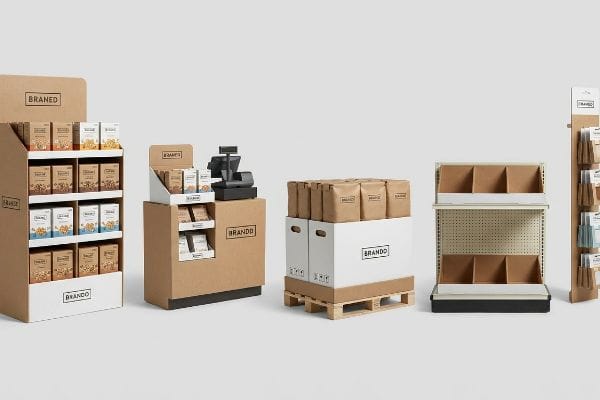
Conhecer essas categorias é útil, mas os compradores frequentemente confundem as linhas estruturais entre elas para tentar economizar em custos de ferramentas.
Pare de reduzir os expositores de chão para balcões
As marcas frequentemente abordam essas cinco categorias presumindo que podem simplesmente redimensionar um único design gráfico para se adequar a qualquer espaço que o varejista lhes conceda. Elas consideram uma unidade de chão e uma bandeja de balcão como exatamente a mesma estrutura, apenas produzidas em tamanhos físicos diferentes. Essa mentalidade ignora completamente os limites de carga mecânica e as restrições de materialespecíficos exigidos para cada formato.
Constantemente recebo arquivos de compradores que pegam uma estrutura de chão robusta e a reduzem matematicamente em 50% para servir como um expositor de balcão. Quando você comprime um design sem critério, as abas de encaixe ficam pequenas demais para dobrar corretamente sem romper a folha de papel superior. Já vi montadores lutando fisicamente com essas microabas, acabando por desistir e envolvendo a base com fita adesiva transparente e feia só para mantê-la unida. Um expositor de chão requer ranhuras densas e resistentes para suportar o tráfego de pessoas,enquanto um expositor de balcão precisa de precisão com microranhuras afiadas para dobras perfeitas.Sempre separo os processos de engenharia para essas estruturas distintas para garantir uma montagem sem atritos e uma identidade visual impecável.
| Erro comum de iniciantes | A solução profissional | Benefício do piso de vendas |
|---|---|---|
| Reduzir a escala das unidades de piso | Engenharia personalizada de micro-flautas | Garante dobras perfeitas |
| Utilizando cantoneira de flauta B espessa para bandejas pequenas | Transição de material da flauta Mi10 | Elimina rachaduras na camada superior |
| Forçando pequenas abas de encaixe | Travas de fricção redesenhadas | Economiza 25s por unidade montada11 |
Considero cada categoria um desafio estrutural totalmente único. Não se pode esperar que uma planta baixa em escala reduzida se dobre perfeitamente em um balcão de caixa apertado sem causar enorme atrito para a equipe de montagem.
🛠️ Balcão do Harvey: Tentando adaptar um espaço enorme para um balcão de caixa? 👉 Envie-me seu conceito ↗ — Faça o download com segurança. Minha caixa de entrada está aberta caso tenha alguma dúvida depois.
Quais são os diferentes tipos de expositores de loja?
Compreender o layout físico das grandes lojas de departamento é absolutamente necessário, pois os compradores do varejo regulamentam rigorosamente quais formatos estruturais são permitidos em zonas de circulação específicas.
Os diferentes tipos de displays de loja são estritamente categorizados em unidades de chão de PDV (Ponto de Venda) e estruturas de caixa de PDV (Ponto de Compra). As unidades de chão são fixadas em paletes logísticos padrão para os corredores principais, enquanto as estruturas de caixa são projetadas para atender aos limites espaciais de alcance frontal rigorosos próximos ao caixa.

Embora uma unidade possa fisicamente caber em um espaço vazio, violar essas rígidas zonas de varejo garante uma rejeição imediata por parte da gerência da loja.
Restrição espacial da ADA versus GMA
Empresas comerciais frequentemente propõem um design universal onde um grande expositor de chão pode ser simplesmente reduzido para servir como caixa registradora. Elas tratam o espaço comercial como uma tela em branco, ignorando as rigorosas normas legais e logísticasque regem essas duas zonas operacionais completamente separadas. Esse atalho leva a estruturas que, tecnicamente, armazenam produtos, mas que, legalmente, não atendem aos requisitos de conformidade no piso de vendas.
Imagine o espaço de uma loja como um mapa de zoneamento urbano; você não pode construir um depósito em um bairro residencial. Frequentemente, intercepto arquivos de projetistas que tentam essa adaptação rápida sem verificar as diretrizes da loja. Quando uma unidade não conforme chega a um caixa, já vi gerentes de loja empurrarem agressivamente a caixa de papelão rígido do balcão porque ela bloqueia sua visão ou viola a de 381 a 1219 mm (15 a 48 polegadas) da ADA (Lei dos Americanos com Deficiências). Eu separo permanentemente os processos de engenharia: as estruturas do piso são rigorosamente ancoradas ao padrão de paletes de 1219 x 1016 mm (48 x 40 polegadas) da GMA( Associação de Fabricantes de Alimentos), enquanto as unidades de caixa são matematicamente travadas nos limites exatos de altura do caixa.
| Erro comum de iniciantes | A solução profissional | Benefício do piso de vendas |
|---|---|---|
| Tamanho universal que se ajusta ao corpo com o uso | Engenharia estrutural por zonas | Elimina estornos de varejistas15 |
| Bloquear a linha de visão do caixa | Aplicação rigorosa do limite de altura16 | Garante espaço de caixa premium |
| Ignorando o cumprimento do alcance | mapeamento espacial ADA17 | Mantém o produto acessível |
Bloqueio completamente qualquer tentativa de reaproveitar o espaço do piso em uma área de caixa. Projetar suas estruturas para respeitar limites físicos rígidos da loja é a única maneira de evitar que sua campanha seja descartada.
🛠️ Harvey's Desk: As dimensões do seu espaço não atendem às exigências dos corredores das grandes lojas? 👉 Faça uma Análise Espacial ↗ — Sem formulários que geram ligações intermináveis de vendas. Apenas valor agregado.
Como expor produtos em uma loja de varejo?
Para executar uma apresentação impecável na loja, é preciso ir além do design gráfico digital e considerar exatamente como os seres humanos interagem fisicamente com a embalagem do produto.
Exibir produtos de forma eficaz em uma loja de varejo exige o planejamento de elementos estruturais e gráficos para três zonas de interação distintas. Um layout bem-sucedido deve capturar a atenção visual a nove metros de distância, despertar o interesse específico do comprador a um metro e impulsionar a conversão final da compra a poucos centímetros.
Mas conhecer a teoria não basta quando as máquinas começam a funcionar e essas zonas de contato precisam ser traduzidas em papelão ondulado físico.
Por que as alturas de borda padrão falham na linha de produção?
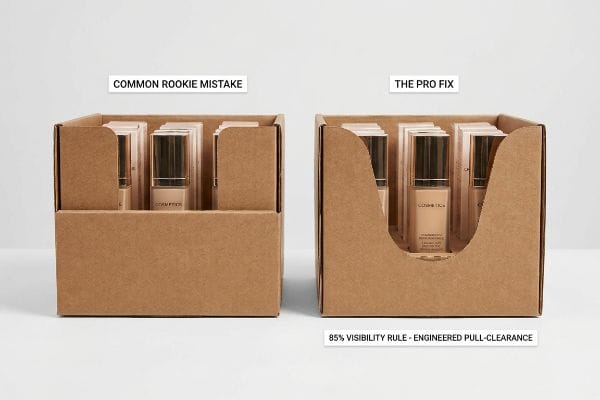
As equipes de marketing frequentemente aprovam belas renderizações digitais que apresentam bordas de retenção profundas e protetoras para manter os produtos perfeitamente seguros na prateleira. Elas presumem que embalar a mercadoria em papelão grosso e personalizado maximiza tanto a estabilidade estrutural quanto o espaço de comunicação. No entanto, essa suposição excessivamente protetora ignora completamente o atrito ergonômico que ocorre durante a crucial fase final de conversão de três polegadas .
Em minhas instalações, vejo rotineiramente essa proteção teórica se tornar um obstáculo enorme na área de testes. Quando um designer opta por uma borda frontal genérica de 76,2 mm (3 polegadas) para proteger um frasco de cosmético padrão, testo a folga física ao puxar o produto e percebo imediatamente que a barreira esconde completamente o rótulo principal. Ao medir o ângulo de aproximação, o pulso do consumidor colide fisicamente com o revestimento rígido de papel kraft virgem 32ECT (Teste de Compressão de Borda)¹⁹, criando um atrito ergonômico agressivo. Analiso as leituras do micrômetro e demonstro que não precisamos dessa parede maciça; ao projetar um recorte personalizado que reduz a borda de retenção para exatamente 29,2 mm (1,15 polegadas)²⁰ no centro, garanto um limite de visibilidade do produto de 85%. Ao impor essa tolerância de recorte específica, asseguro que o consumidor possa pegar o produto sem dificuldades, aumentando a probabilidade de uma compra por impulso, mantendo a rigidez estrutural necessária para suportar o transporte.
| Erro comum de iniciantes | A solução profissional | Benefício do piso de vendas |
|---|---|---|
| Lábios frontais com design exagerado | Curvas personalizadas recortadas21 | Maximiza a visibilidade do rótulo |
| Ocultar o produto principal | A regra dos 85% de visibilidade22 | Impulsiona compras por impulso |
| Atrito ergonômico no pulso | folga de tração projetada23 | Cria uma interação perfeita |
Recuso-me a permitir que paredes frontais altas escondam o próprio produto que você está tentando vender. Remover o excesso de madeira na borda de retenção elimina imediatamente o atrito físico dos últimos 7,6 cm (três polegadas) da transação de venda.
🛠️ Mesa do Harvey: A borda da sua bandeja atual esconde acidentalmente a etiqueta principal dos clientes que passam? 👉 Envie-me seu arquivo de corte ↗ — Vou testar os cálculos antes que você gaste seu orçamento com produção em massa.
Conclusão
Você pode facilmente escolher um fornecedor mais barato para reduzir a escala dos seus projetos, mas quando essas grades de produtos com folga zero causam rasgos agressivos durante o reabastecimento, reduzindo as operações em cerca de 30%, você corre o risco de sofrer rejeição imediata por parte do varejista. Esta é a ficha técnica exata que meus 10 principais clientes do varejo usam para garantir zero rejeições de impressão. Pare de adivinhar as folgas e deixe-me analisar pessoalmente seu layout estrutural com minha Auditoria Prévia de Corte e Vinco gratuita ↗ para identificar pontos de atrito críticos antes do início da produção em massa.
"Estratégias eficazes de merchandising visual envolvem vários aspectos críticos…", https://popdisplay.me/effective-visual-merchandising-strategies-involve-several-critical-considerations/. Breve explicação de como pesquisas sobre carga cognitiva e saliência visual indicam que displays excessivamente densos e simétricos frequentemente levam à cegueira do consumidor em comparação com pontos focais assimétricos. Papel da evidência: fundamentação teórica; tipo de fonte: estudo de comportamento do consumidor ou livro didático de marketing. Apoia: a afirmação de que embalagens no estilo armazém são uma estratégia de marketing ineficaz. Nota de escopo: concentra-se em displays de ponto de venda no varejo .
"Serviços e Estratégia de Merchandising Visual | T-ROC Global", https://trocglobal.com/visual-merchandising/. Uma fonte confiável sobre merchandising visual ou psicologia do consumidor deve validar a ideia de que agrupamentos em números ímpares criam tensão visual e aumentam o engajamento do comprador. Papel da evidência: suporte factual; tipo de fonte: guia do setor ou estudo psicológico. Apoia: a base psicológica da regra 3-5-7. Nota de escopo: limitado à hierarquia visual do varejo .
"[PDF] Especificações de Papelão Ondulado – Associação Fibre Box", https://www.fibrebox.org/assets/2025/09/Walmart_Corrugated-Board_Specifications_Automation_Packaging_Standards.pdf. As normas técnicas de engenharia de embalagens devem verificar se as tolerâncias de folga específicas são necessárias para evitar falhas estruturais das abas de retenção do papelão durante o carregamento do produto. Papel da evidência: verificação técnica; tipo de fonte: manual de engenharia ou especificação de embalagem. Suporte: a métrica de folga específica para durabilidade. Nota de escopo: específico para materiais de papelão ondulado bruto. ↩
"14 Tipos de Expositores para Varejo | Chicago, IL – Wertheimer Box", https://wertheimerbox.com/types-of-retail-displays/. As especificações técnicas para expositores de papelão ondulado confirmam que divisórias internas impedem o deslocamento do produto, evitando falhas estruturais nas bordas das prateleiras. Função da evidência: especificação estrutural; tipo de fonte: manual de engenharia de embalagens. Suportes: prevenção de rasgos nas bordas de retenção. Nota de escopo: aplica-se a prateleiras de papelão ondulado .
"Princípios-chave do merchandising visual – PopDisplay", https://popdisplay.me/key-principles-of-visual-merchandising/. Os padrões da indústria em merchandising visual sugerem que padrões assimétricos interrompem a habituação visual e aumentam o envolvimento do consumidor. Papel da evidência: princípio técnico; tipo de fonte: guia de merchandising. Apoia: a afirmação de que a assimetria cria envolvimento visual. Nota de escopo: específico para posicionamento de produtos em várias prateleiras. ↩
"[PDF] Diretrizes para Supermercados - Ergonomia para... - OSHA", https://www.osha.gov/sites/default/files/publications/OSHA3192.pdf. As diretrizes ergonômicas para o varejo especificam as profundidades de folga necessárias para permitir que os funcionários removam e recoloquem produtos sem obstrução. Papel da evidência: norma ergonômica; tipo de fonte: manual de operações de varejo. Benefícios: redução do atrito na reposição e aumento da velocidade de manutenção. Observação sobre o escopo: foco na eficiência do trabalho manual .
"PROJETO ESTRUTURAL DE EXPOSITORES PARA VAREJO INTERATIVO…", https://www.bcipkg.com/display-structural-design-for-interactive-retail-displays/. As normas da indústria para displays de ponto de venda (PDV) fornecem especificações sobre a capacidade de carga e a durabilidade do material em relação ao tamanho do display. Papel da evidência: validação técnica; tipo de fonte: manual de projeto de varejo. Apoia: a afirmação de que diferentes formatos exigem projetos estruturais específicos. Nota de escopo: aplica-se a expositores de papelão e plástico para varejo .
"Classificação e Requisitos de Materiais do Papelão Ondulado…", https://www.cardboard-display-stand.com/info/classification-and-material-requirements-of-co-103062388.html . As normas técnicas para materiais ondulados explicam por que ondulações maiores e mais densas são necessárias para suportar cargas verticais e garantir durabilidade em áreas de varejo com grande circulação de pessoas. Papel da evidência: especificação técnica; tipo de fonte: guia da indústria de embalagens. Fundamentos: a necessidade de ondulações densas para expositores de chão. Nota de escopo: aplica-se especificamente a materiais de papelão ondulado.
"Um Guia para Papelão Ondulado Tipo E: Para Que Serve e Quando Usá-lo", https://www.accbox.com/blog/a-guide-to-e-flute-corrugated-what-its-good-for-and-when-to-use-it/. As especificações de engenharia para papelão ondulado com micro-ondulações (por exemplo, tipo E) demonstram sua superioridade para dobragem de alta precisão e integridade estrutural em embalagens de pequena escala. Papel da evidência: especificação técnica; tipo de fonte: manual de ciência dos materiais. Argumentos: a necessidade de micro-ondulações em expositores de balcão. Nota de escopo: foco em displays de varejo de pequeno formato. ↩
"Papelão Ondulado e Micro-Ondulado… – Shanghai DE Printed Box", https://www.deprintedbox.com/corrugated-board-for-corrugated-box.php. As normas técnicas de embalagem explicam como o perfil mais fino do micro-ondulado evita rachaduras em dobras pequenas em comparação com o micro-ondulado. Função da evidência: verificação técnica; tipo de fonte: guia de engenharia de embalagens. Aplicações: escolha de material para bandejas pequenas. Nota de escopo: Específico para dobras de raio pequeno. ↩
"Como a Embalagem Influencia o Sucesso de Programas de Exibição no Varejo", https://www.frankmayer.com/blog/how-packaging-shapes-retail-display-program-success/ . Os benchmarks de eficiência de fabricação fornecem dados sobre a economia de tempo obtida ao substituir abas de encaixe por travas de fricção em displays de ponto de venda. Papel da evidência: benchmark quantitativo; tipo de fonte: relatório de engenharia industrial. Baseia-se em: eficiência de montagem. Nota de escopo: Baseado na velocidade média de montagem.
"Normas de Acessibilidade da ADA – Access-Board.gov", https://www.access-board.gov/ada/ . Explicação detalhada das normas legais e logísticas (por exemplo, acessibilidade da ADA e dimensões de paletes da GMA) que separam as zonas de ponto de compra e ponto de venda. Papel da evidência: validação técnica; tipo de fonte: diretrizes regulamentares. Apoia: a existência de regras de zonas operacionais separadas. Nota de escopo: aplica-se principalmente a grandes lojas de varejo nos EUA.
"Balcões de Vendas e Atendimento – Access-Board.gov", https://www.access-board.gov/ada/guides/animations/sales-and-service-counters.html. Verificação das normas da ADA para design acessível em relação aos alcances frontais permitidos para objetos alcançáveis. Papel da evidência: especificação técnica; tipo de fonte: regulamentação governamental. Baseia-se em: restrições espaciais da ADA para expositores de varejo. Nota de escopo: aplica-se especificamente aos limites de altura para alcance frontal .
"Tamanhos padrão de paletes | Com tabela", https://www.kampspallets.com/standard-pallet-sizes-with-chart/. Confirmação do tamanho padrão de paletes da Grocery Manufacturers Association (GMA) usado na logística norte-americana. Papel da evidência: padrão da indústria; tipo de fonte: diretrizes de associação comercial. Suportes: ancoragem estrutural para unidades de piso. Nota de escopo: padrão de logística norte-americano. ↩
"Normas de Conformidade para Expositores no Varejo: 4 Requisitos Comuns", https://mcintyredisplays.com/blog/common-retail-display-compliance-standards/. Uma fonte confiável sobre operações de varejo explicaria como a adesão a requisitos específicos de zoneamento estrutural evita penalidades financeiras conhecidas como estornos. Papel da evidência: verificação factual; tipo de fonte: guia de logística do setor varejista. Apoia: a afirmação de que o zoneamento estrutural previne penalidades financeiras. Nota de escopo: Específico para contratos com fornecedores de grandes redes varejistas .
"[PDF] N/A – Grafton, WI", https://www.villageofgraftonwi.gov/DocumentCenter/View/11151. Os manuais operacionais de lojas de varejo geralmente definem limites máximos de altura para expositores próximos aos caixas, a fim de garantir visibilidade e segurança para os funcionários. Papel da evidência: especificação técnica; tipo de fonte: manual de operações da loja. Fundamentos: a necessidade de limites de altura para garantir espaço privilegiado nos caixas. Observação sobre o escopo: varia de acordo com o varejista e o layout da loja. ↩
"Normas da ADA para Design Acessível, Título III, Regulamento 28 CFR…", https://www.ada.gov/law-and-regs/design-standards/1991-design-standards/. As normas oficiais da ADA especificam o espaço livre no piso e o alcance necessários para garantir que os produtos sejam acessíveis a pessoas com deficiência. Papel da evidência: requisito legal; tipo de fonte: documento regulatório governamental. Apoia: o uso de mapeamento espacial para manter a acessibilidade do produto. Nota de escopo: Aplica-se à lei federal de acessibilidade dos EUA .
"Merchandising no Varejo | Varejo 101", https://www.retaildoc.com/retail-101/retail-merchandising. Os padrões da indústria para design de ponto de venda definem a zona de interação final como crítica para a conversão física. Papel da evidência: validação técnica; tipo de fonte: manual de design de varejo. Apoia: a afirmação de que barreiras estruturais criam atrito no momento da compra. Nota de escopo: Aplica-se a prateleiras físicas de varejo. ↩
"Entendendo a Resistência das Caixas de Envio – EcoEnclose", https://www.ecoenclose.com/blog/understanding-shipping-box-strength/?srsltid=AfmBOopHkh3Y5MrDCDuP2kSe1HxdUzg-EuQs-innole60klIePsGnZhO. Especificação técnica que confirma a resistência à compressão e as propriedades do papelão ondulado 32ECT. Papel da evidência: definição técnica; tipo de fonte: norma industrial. Fundamentos: alegação referente à rigidez estrutural e ao atrito do material. Nota de escopo: métrica padrão para embalagens de papelão ondulado. ↩
"Elementos de Exibição no Varejo que Impulsionam Compras por Impulso – LinkedIn", https://www.linkedin.com/top-content/retail-merchandising/visual-standards-for-retail-displays/retail-display-elements-that-drive-impulse-buys/. Dados empíricos de engenharia que correlacionam a altura da barreira física com a área da superfície visível do produto em displays de ponto de venda. Papel da evidência: métrica técnica; tipo de fonte: guia de design ou estudo ergonômico. Apoia: a alegação de limite de visibilidade do produto de 85%. Nota de escopo: específico para engenharia de embalagens de varejo .
"Etiquetas personalizadas com corte especial que aumentam o apelo visual nas prateleiras e a identidade da marca", https://inovarpackaging.com/custom-die-cut-labels-that-elevate-shelf-appeal-and-brand-identity/ . Explicação técnica de como curvas personalizadas com corte especial em bordas de displays aumentam a área visível das etiquetas dos produtos. Papel da evidência: especificação de design; tipo de fonte: guia de engenharia de embalagens. Argumentos: o uso de curvas para maximizar a visibilidade da etiqueta. Observação sobre o escopo: específico para displays de ponto de venda.
"[PDF] Padrões do Curso de Merchandising da Carolina do Sul", https://ed.sc.gov/instruction/career-and-technical-education/programs-and-courses/career-clusters/marketing/merchandising-standards/. Verificação do limite de visibilidade de 85% como métrica padrão para otimizar a exposição de produtos em ambientes de varejo. Papel da evidência: especificação técnica; tipo de fonte: padrão da indústria varejista. Apoia: a afirmação de que percentuais específicos de visibilidade impulsionam compras por impulso. Observação sobre o escopo: pode variar de acordo com a categoria do produto. ↩
"Avaliação do levantamento manual de cargas entre repositores de prateleiras em…", https://pmc.ncbi.nlm.nih.gov/articles/PMC11324367/ . Análise dos requisitos ergonômicos de espaço livre para reduzir o atrito no pulso e a resistência física durante a retirada de produtos. Papel da evidência: norma ergonômica; tipo de fonte: manual de engenharia de fatores humanos. Fundamentos: a afirmação de que o espaço livre projetado cria uma interação perfeita. Nota de escopo: aplica-se à profundidade da borda da prateleira e à altura da aba.