As marcas investem milhões no desenvolvimento de produtos, apenas para ver as vendas estagnarem no varejo. O culpado oculto? A fricção invisível nos corredores. Você precisa de estruturas físicas que incentivem ativamente as conversões.
Os displays de ponto de venda geram um excelente retorno sobre o investimento (ROI) ao capturar os compradores por impulso diretamente na etapa final de decisão de compra. Essas estruturas físicas de varejo utilizam impacto visual, posicionamento estratégico nos corredores e mensagens de marca otimizadas para aumentar o valor médio dos pedidos e gerar aumentos mensuráveis nas vendas em comparação com o abastecimento padrão nas prateleiras.
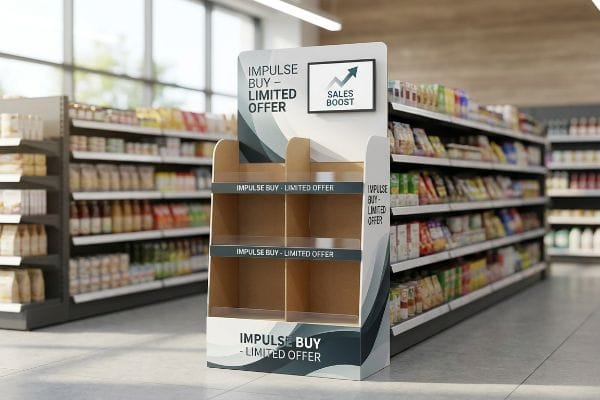
Mas entender esse potencial de marketing em uma sala de reuniões é completamente diferente de garantir que ele realmente sobreviva às duras realidades de uma grande loja de departamentos.
Qual a função ideal de um display de ponto de venda eficaz?
Suas unidades de venda estão realmente atraindo clientes ou apenas se misturando ao corredor lotado? Uma estrutura de sucesso deve chamar a atenção fisicamente antes mesmo que o comprador leia a etiqueta.
Expositores eficazes no ponto de venda devem interromper imediatamente os padrões de navegação do consumidor a uma distância de nove metros. Eles garantem um espaço visual privilegiado, organizam as mercadorias de forma segura para interação a um metro de distância e facilitam a retirada do produto a poucos centímetros, convertendo, em última análise, visitantes passivos da loja em compradores por impulso ativos.

Mas conhecer a teoria não basta quando as máquinas começam a funcionar e são feitos compromissos estruturais para economizar alguns centavos.
A Armadilha Espacial 3-3-3 por Trás do Fracasso no Engajamento do Varejo
As equipes de marketing frequentemente projetam displays de varejo estritamente para visualização de perto em monitores de computador planos e retroiluminados. Elas presumem que, se um gráfico parece bonito em sua mesa, ele naturalmente chamará a atenção em um corredor de varejo caótico. Isso ignora a realidade física de como os seres humanos navegam por enormes lojas de armazém1.
Isso não é apenas teoria — eu lido com isso na prática. Mesmo designers veteranos frequentemente ignoram a "Regra 3-3-3" do engajamento espacial, enviando templates que carecem completamente de profundidade estrutural. Inicialmente, presumi que cabeçalhos planos padrão com gradientes CMYK (Ciano, Magenta, Amarelo e Cores Principais) criariam contraste visual suficiente. Estava completamente enganado. Durante uma simulação de auditoria em um corredor, observei um display de 50 polegadas (127 cm) desaparecer completamente no fundo a 6 metros de distância, porque o painel plano não possuía elementos que projetassem sombras. Para corrigir isso, removi o cabeçalho plano e projetei um enorme ponto focal recortado em 3D, utilizando um canal de vinco específico para matriz macho (canal2) para criar um elemento saliente rígido sem danificar a laminação litográfica. Ao substituir gráficos planos passivos por essa protuberância geométrica agressiva, forcei matematicamente uma quebra de sombra que chama a atenção dos carrinhos a 9 metros de distância, garantindo que a campanha da marca realmente desencadeie uma interação, em vez de ser ignorada.
| Déficit de Engajamento Espacial | Resultado estrutural | Retorno sobre o investimento (ROI) no ponto de venda |
|---|---|---|
| Cabeçalhos gráficos planos | Combina com o fundo do corredor | Tráfego de pedestres perdido |
| pontos focais recortados em 3D | Forças agressivas quebram sombras | Aumenta a perturbação visual |
| corte labial com retenção de 85%3 | Extração de produto sem atrito | Aumenta as taxas de conversão |
Recuso-me a fabricar caixas invisíveis que funcionam como papel de parede caro. Se a geometria da sua estrutura não interromper ativamente o percurso do cliente, toda a sua campanha de vendas estará fadada ao fracasso.
🛠️ Mesa do Harvey: Seus displays de chão atuais são projetados para criar sombras acentuadas a 9 metros de distância, ou são apenas papel de parede pré-fabricado? 👉 Solicite uma Análise Espacial 3D ↗ — Analiso pessoalmente cada arquivo estrutural em até 24 horas.
Qual é o ROI médio em publicidade?
Calcular o retorno exato do investimento em publicidade física no varejo exige isolar o impacto da exposição das vendas reais nas prateleiras. Sem métricas concretas, você estará apenas estimando o sucesso da sua campanha.
O retorno médio sobre o investimento (ROI) da publicidade por meio de displays personalizados no ponto de venda geralmente varia entre 20% e 65% de aumento nas vendas em comparação com as prateleiras tradicionais. Esse retorno sobre o investimento é matematicamente impulsionado pela localização privilegiada nos corredores, maior destaque da marca e a facilitação imediata de compras por impulso não planejadas.
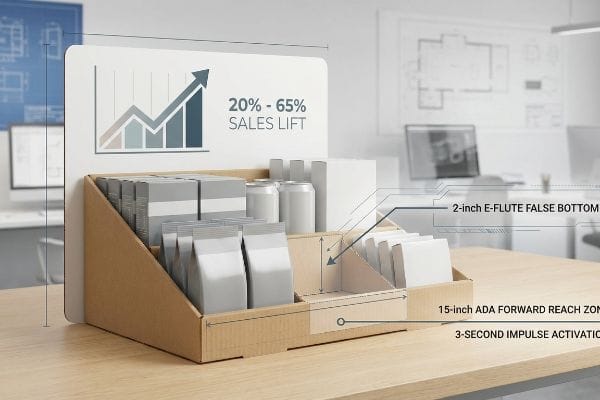
No entanto, um aumento teórico nas vendas em uma planilha não significa nada se a unidade física não provocar uma resposta psicológica imediata no corredor da loja.
Os mecanismos de engenharia por trás do elevador de 3 segundos
Um retorno positivo sobre o investimento não acontece por acaso; requer uma abordagem calculada em relação ao comportamento do consumidor. Quando falamos de aumento nas vendas no varejo, estamos medindo estritamente a diferença entre a velocidade estática na prateleira e o movimento aceleradogerado por uma estrutura isolada e independente.
Quando os clientes me perguntam como isso se traduz na prática, geralmente aponto para a fórmula do "Elevação de 3 Segundos" que usamos aqui no laboratório. Não me limito a analisar um arquivo CAD (Desenho Auxiliado por Computador) e esperar que venda; eu meço o tempo físico que um comprador leva para processar a oferta principal. Na semana passada, mostrei a um gerente de marca uma bandeja de balcão com PDQ (Quantidades de Exibição Pré-embaladas) em nosso showroom. Expliquei que, se o elemento gráfico principal estiver oculto abaixo da linha de alcance frontal de 38,1 cm (15 polegadas) da ADA (Lei dos Americanos com Deficiências), o olho humano médio o ignora completamente. Ao elevar fisicamente a bandeja interna do produto em apenas 50,8 mm (2 polegadas) usando um fundo falso interno com perfil E, trago a mercadoria diretamente para a zona de impacto ergonômica. Essa pequena elevação estrutural cria uma conexão visual imediata, garantindo efetivamente a ativação por impulso de 3 segundos necessária para gerar retornos financeiros reais.
| Atrito de visibilidade | Resultado estrutural | Retorno do Investimento |
|---|---|---|
| Mercadoria abaixo da zona de strike | Os compradores ignoram a oferta | Reduz o ROI da campanha |
| Conformidade frontal de 15 polegadas com a ADA5 | Alinha-se com as linhas de visão naturais | Acelera a velocidade de inventário |
| Fundo falso de 2 polegadas com flauta em E6 | Força contato visual imediato | Aciona conversões de impulso |
Sempre digo às marcas que o verdadeiro retorno sobre o investimento em publicidade não se resume a fazer promoções melhores. Trata-se de projetar uma estrutura física que elimine todas as barreiras microscópicas entre a mão do consumidor e o seu produto.
🛠️ Harvey's Desk: A geometria interna da sua bandeja PDQ atual força o produto a entrar na zona de impacto visual de 50 polegadas? 👉 Solicite uma Avaliação Ergonômica Gratuita ↗ — 100% confidencial. Seus projetos de varejo ainda não lançados estão seguros comigo.
Quanto custam os displays de ponto de venda?
Equilibrar os custos unitários iniciais com o desempenho estrutural é a parte mais difícil de qualquer projeto. Cortar as especificações erradas dos materiais transformará instantaneamente um projeto econômico em um enorme prejuízo.
Os custos dos displays de ponto de venda variam significativamente, desde US$ 15 para bandejas de papelão ondulado simples para balcão até mais de US$ 150 para configurações de paletes reforçados. O preço final é determinado pela qualidade do material, volume total de produção, requisitos de ferramental, acabamentos gráficos especiais e engenharia estrutural de suporte de carga necessária para suportar as cadeias de suprimentos padrão.
Mas ficar obcecado exclusivamente com a fatura unitária inicial é um jogo perigoso quando se ignora o que acontece dentro de um armazém úmido.
Os custos ocultos das reduções de qualidade nos tratamentos de eletroconvulsoterapia (ECT) para fins estéticos
As equipes de compras frequentemente tratam acabamentos estéticos caros, como laminação com folha metálica em toda a superfície, como exigências de marketing inegociáveis. Para manter o custo total baixo, elas secretamente reduzem a resistência à compressão do papelão ondulado baseem 7 para economizar centavos, presumindo que a película espessa e brilhante manterá a unidade unida por mágica.
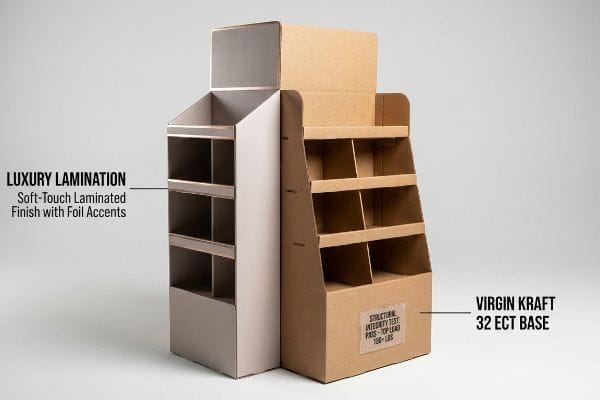
Isso não é apenas teoria — aprendi da pior maneira possível em nossa câmara de climatização. Em 2022, pedi ao meu engenheiro-chefe de embalagens, Mark, para realizar um teste de compressão de caixa (BCT) em uma nova tampa de embalagem que utilizava um papelão de qualidade inferior, com resistência à compressão de borda (ECT) de 26, para compensar o custo de uma laminação de toque suave de luxo. Pensamos que poderíamos economizar dinheiro para o cliente, ao mesmo tempo que entregaríamos um acabamento impecável. Eu estava completamente enganado. Três horas após o início da simulação de transporte em alta umidade, ouvi o estalo horrível das ondulações internas se rompendo. A base quebrou sob exatamente 50,9 kg (112,4 lbs) de pressão superior, esmagando completamente a camada inferior. Para corrigir isso, imediatamente removi o caro filme de toque suave da lista de materiais (BOM) e voltei a utilizar uma base de kraft virgem de 32 ECTcom um revestimento aquoso de alto teor de sólidos. Fui até a linha de litografia-laminação, recalibrei os rolos de pressão para evitar o esmagamento das lâminas recém-impressas e restaurei a densidade da matéria-prima. Essa melhoria estrutural não apenas impediu o colapso da base, como também reduziu a zero a taxa de danos durante o transporte, economizando cerca de US$ 4.500 em estornos de vendas.
| Armadilha da Alocação Orçamentária | Resultado estrutural | Impacto nos custos financeiros |
|---|---|---|
| Rebaixamento do núcleo ECT 2610 | Falha grave de compressão da flauta | Aciona taxas de danos elevadas |
| Laminação de luxo com folha metálica | Oculta baixa densidade interna | Aumenta o custo inicial da lista de materiais |
| Base kraft virgem 32 ECT11 | Suporta carga superior de mais de 68 kg (150 lbs) | Protege o retorno sobre o investimento (ROI) geral da campanha |
Eu jamais comprometo a integridade da matéria-prima apenas para financiar um acabamento brilhante de marketing. Se o papelão que serve de base para o seu projeto não resistir ao transporte até a loja, todo o seu orçamento terá sido desperdiçado.
🛠️ Na mesa do Harvey: Será que suas equipes de compras estão secretamente reduzindo suas classificações ECT só para pagar por laminação de folha pesada? 👉 Faça uma auditoria de materiais da sua lista de materiais ↗ — Sem gerentes de contas no meio. Você fala diretamente com engenheiros estruturais.
O que são displays de ponto de venda (PDV) no marketing?
Em uma estratégia de marketing de varejo, essas unidades servem como o último ponto de contato antes da venda. Elas são seus vendedores silenciosos, apresentando ativamente seu produto em um ambiente hostil.
Os displays de ponto de venda (PDV) no marketing são estruturas físicas de varejo projetadas para isolar a oferta promocional específica de uma marca em meio ao caos dos corredores da loja. Ao utilizar formas tridimensionais impactantes, cores vibrantes de alto contraste e posicionamento estratégico do produto, essas unidades estimulam diretamente o comportamento psicológico de compra e garantem vendas por impulso de última hora no caixa.
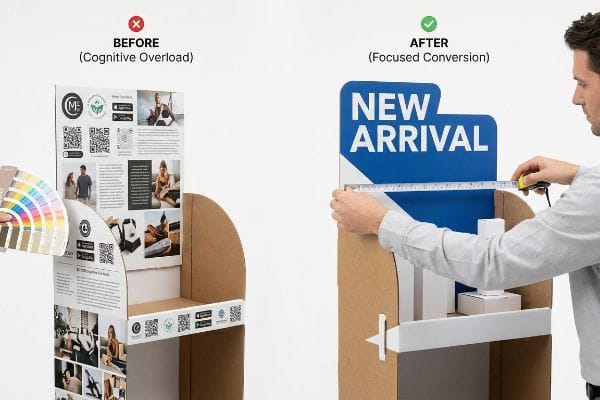
No entanto, tratar essas estruturas físicas exatamente como um outdoor digital é um caminho rápido para a sobrecarga cognitiva e a rejeição total do consumidor.
A Regra 40-40-20 e a Armadilha da Sobrecarga Cognitiva
As equipes de marketing frequentemente veem um grande expositor de chão como uma tela em branco para informações, tentando incluir todos os recursos do produto, códigos QR e imagens de estilo de vida nos painéis laterais. Elas presumem que mais texto de marketing equivale automaticamente a uma apresentação mais convincente para quem passa pela loja.
Isso não é apenas teoria — eu lido com isso na prática. Mesmo agências de marketing experientes violam regularmente a regra 40-40-20 da publicidade direta¹³,enviando gabaritos repletos de gráficos caóticos e com excesso de texto. Inicialmente, presumi que um verniz UV (ultravioleta) localizado sobre o logotipo principal eliminaria o ruído visual. Estava completamente enganado. Durante uma análise tátil de um protótipo recém-impresso, passei as mãos sobre os painéis brilhantes e percebi que a principal oferta do produto estava completamente soterrada sob parágrafos de mensagens secundárias. A unidade representava um enorme risco de sobrecarga cognitiva. Para corrigir isso, eliminei impiedosamente o excesso de texto e reformulei o layout estrutural. Utilizei as leituras do micrômetro CNC (Controle Numérico Computadorizado) e projetei um cabeçalho grande, monocromático e recortado, que isolava apenas um objetivo principal. Ao substituir os gráficos informativos volumosos por um ponto focal estrutural único e hiperpreciso, eliminei o atrito visual. Essa edição visual agressiva garante que o gatilho psicológico do consumidor seja ativado com sucesso em uma janela de 3 segundos14, impedindo que a tela se torne um papel de parede invisível.
| Excesso de elementos gráficos no marketing | Resultado estrutural | ROI de conversão de compradores |
|---|---|---|
| Painéis laterais com muito texto | Desencadeia sobrecarga cognitiva massiva15 | Elimina as taxas de compra por impulso |
| Obra de arte complexa com múltiplas camadas | Oculta a oferta principal do produto | Desperdiça espaço valioso |
| Cabeçalhos individuais cortados sob medida | Isola o gatilho psicológico | Garante aumentos de vendas em 3 segundos16 |
Elimino elementos gráficos de marketing caóticos porque os compradores confusos simplesmente vão embora. Sua vitrine física deve servir como uma ferramenta de conversão implacável e focada, não como um extenso folheto informativo.
🛠️ Mesa do Harvey: Sua arte de exibição atual está causando sobrecarga cognitiva e suprimindo ativamente suas vendas por impulso? 👉 Solicite uma revisão de corte e vinco para pré-impressão ↗ — Analiso pessoalmente cada arquivo estrutural em até 24 horas.
Conclusão
Você pode buscar o menor custo unitário disponível, mas quando essa base de 26 ECT de qualidade inferior inevitavelmente cede dentro de um contêiner de transporte úmido, atrasando a rede de distribuição em cerca de 30%, você elimina completamente a margem de lucro da sua campanha. Só no mês passado, minha auditoria estrutural ajudou 3 marcas a evitar mais de US$ 10.000 em descarte de estoque e estornos de varejistas. Pare de desperdiçar seu orçamento de marketing com concessões fatais em relação aos materiais e deixe-me projetar pessoalmente seu próximo lançamento ↗ para garantir a máxima durabilidade física e um verdadeiro retorno sobre o investimento (ROI) no varejo.
"[PDF] Efeitos do design da barra de navegação no processamento visual do consumidor", https://digitalcommons.kennesaw.edu/cgi/viewcontent.cgi?article=1773&context=ama_proceedings. Pesquisa acadêmica ou da indústria sobre psicologia ambiental e cinésica do consumidor, explicando como a escala física e o ruído visual afetam a navegação em grandes lojas de varejo. Papel da evidência: apoiar a causalidade; tipo de fonte: estudo revisado por pares ou relatório de análise de varejo. Apoia: a afirmação de que o design digital não leva em consideração a navegação física. Nota de escopo: foco em formatos de varejo de grande escala. ↩
"Influência das linhas de vinco analógicas e digitais nas propriedades mecânicas…", https://pmc.ncbi.nlm.nih.gov/articles/PMC9268991/. Especificação técnica das ferramentas utilizadas no corte e vinco para criar dobras rígidas em placas laminadas sem comprometer a integridade do material. Papel da evidência: verificação técnica; tipo de fonte: manual de engenharia de embalagens. Fundamentos: a viabilidade da solução estrutural descrita. Nota de escopo: Foca-se em substratos de litografia-laminação. ↩
"Ponto de Venda: Como os Varejistas Podem Influenciar os Consumidores no…", https://blog.intouch.com/posts/points-of-purchase-displays . Fornece especificações técnicas para a altura das bordas de retenção do produto, visando equilibrar segurança e facilidade de acesso. Função da evidência: norma técnica; tipo de fonte: manual de design industrial. Apoia: a métrica de 85% para extração sem atrito. Nota de escopo: aplica-se a displays padrão de borda de prateleira ou de ponto de venda.
"Participação de Mercado na Prateleira: O Que É, Como Medir com Precisão e Como...", https://visiongroupretail.com/blog/share-of-shelf-measurement-guide . Verificação da metodologia matemática padrão do setor para calcular o aumento de vendas, isolando a velocidade de vendas na prateleira dos ganhos incrementais de exposição. Papel da evidência: validação da metodologia; tipo de fonte: guia de análise de varejo. Apoio: definição de aumento de vendas. Nota de escopo: Foca na mecânica da medição.
"Normas da ADA para Design Acessível, Título III, Regulamento…", https://www.ada.gov/law-and-regs/design-standards/1991-design-standards/. As diretrizes oficiais da ADA e os padrões de acessibilidade para o varejo confirmam limites específicos de protrusão e seu impacto na visibilidade do consumidor. Papel da evidência: especificação técnica; tipo de fonte: norma regulamentar. Apoio: A relação entre a conformidade com a ADA e a visibilidade. Nota de escopo: Aplica-se a ambientes físicos de varejo .
"Um Guia para Papelão Ondulado Tipo E: Para Que Serve e Quando Usá-lo", https://www.accbox.com/blog/a-guide-to-e-flute-corrugated-what-its-good-for-and-when-to-use-it/. Especificações técnicas do material de papelão ondulado tipo E e o impacto ergonômico da elevação do fundo falso na visibilidade do produto. Papel da evidência: especificação do material; tipo de fonte: manual de engenharia. Fundamentos: A afirmação de que a espessura e a altura específicas do papelão influenciam o contato visual. Nota de escopo: Limitado a normas de embalagens de papelão ondulado. ↩
"Teste de Compressão de Borda: Informações Essenciais para Papelão Ondulado…", https://www.testresources.net/blog/edge-crush-test-essential-insights-for-corrugated-packaging. Validação técnica de como a redução das classificações do Teste de Compressão de Borda (ECT) afeta a capacidade de carga de displays de ponto de venda. Papel da evidência: verificação técnica; tipo de fonte: manual de engenharia. Fundamentos: o risco de comprometer a estabilidade estrutural em prol da redução de custos. Nota de escopo: foco em tipos de papelão ondulado .
"Especificações de Papelão Ondulado", https://www.fibrebox.org/assets/2025/09/Walmart_Corrugated-Board_Specifications_Automation_Packaging_Standards.pdf. As especificações técnicas para papelão ondulado 26 ECT esclarecem seus limites de carga e propensão a falhas em simulações de transporte com alta umidade. Papel da evidência: especificação técnica; tipo de fonte: norma da indústria. Apoia: a alegação de que o 26 ECT é um material inferior, inadequado para suportar alta pressão de carga superior. Nota sobre o escopo: os resultados podem variar de acordo com o tipo de ondulação .
"Entendendo a Resistência das Caixas de Envio – EcoEnclose", https://www.ecoenclose.com/blog/understanding-shipping-box-strength/?srsltid=AfmBOoplWA4dTwenhy5fDMsx6_X_kEBLZ4efhSOvc4cPWJu8lE91FXqY. Dados sobre o papelão kraft 32 ECT confirmam sua densidade estrutural e resistência à compressão superiores em comparação ao 26 ECT, justificando seu uso em displays de ponto de venda (PDV) de alta resistência. Papel da evidência: análise comparativa; tipo de fonte: ficha técnica do material. Comprova: a eficácia da melhoria estrutural. Nota de escopo: foco em materiais kraft virgens .
"Estimativa da resistência à compressão de caixas de papelão ondulado…", https://pmc.ncbi.nlm.nih.gov/articles/PMC8467740/. Especificação técnica que confirma os limites de carga e os pontos de falha do papelão submetido ao Teste de Compressão de Borda (ECT) 26. Papel da evidência: validação técnica; tipo de fonte: norma industrial/ficha técnica do material. Fundamentos: relação entre a classificação ECT e a falha estrutural. Nota de escopo: Específico para propriedades do papelão ondulado .
"Entendendo a Resistência das Caixas de Transporte", https://www.ecoenclose.com/blog/understanding-shipping-box-strength/?srsltid=AfmBOooyw49LgP3H5TOJ3r9SA3L95axqu1IrF6fH2rT3t2qVBKqG-VYE . Dados empíricos que confirmam a resistência à compressão sob carga superior do papelão kraft virgem 32 ECT. Papel da evidência: métrica de desempenho quantificada; tipo de fonte: especificação de engenharia. Suporta: a afirmação de que o 32 ECT pode suportar mais de 68 kg (150 lbs ) . Observação sobre o escopo: Depende das dimensões da caixa e da orientação das ondulações.
"Os Efeitos Mediadores Sequenciais da Carga Cognitiva, Imagens Mentais…", https://pmc.ncbi.nlm.nih.gov/articles/PMC12108799/. Pesquisas psicológicas sobre carga cognitiva e evitação de informações em ambientes de varejo demonstram que o excesso de texto pode diminuir as taxas de conversão. Papel da evidência: evidência contraditória; tipo de fonte: periódico acadêmico. Argumentos: uma crítica à abordagem "quanto mais, melhor" na comunicação no ponto de venda. Nota de escopo: foco na sobrecarga sensorial no varejo físico .
"A Regra 40/40/20 do Marketing Direto | Metadata.io", https://metadata.io/resources/blog/the-40-40-20-rule-of-direct-marketing/ . Um princípio de marketing padrão do setor que detalha a alocação de recursos entre oferta, lista e criativo. Papel da evidência: definição factual; tipo de fonte: livro didático de marketing ou guia profissional. Apoia : a validade da regra 40-40-20. Nota de escopo: aplica-se principalmente ao marketing de resposta direta.
"Explorando o comportamento de navegação e o nível de atenção do consumidor…", https://pmc.ncbi.nlm.nih.gov/articles/PMC6895988/. Estudos empíricos sobre o processamento visual e a capacidade de atenção do consumidor em ambientes de varejo. Papel da evidência: métrica técnica; tipo de fonte: estudo de psicologia comportamental ou neuromarketing. Fundamenta: a janela de 3 segundos para ativação visual. Observação sobre o escopo: a janela pode variar de acordo com a categoria do produto .
"Impacto da normatividade e inteligibilidade da privacidade… – PMC", https://pmc.ncbi.nlm.nih.gov/articles/PMC9933030/ . Pesquisa psicológica sobre a teoria da carga cognitiva explica como o excesso de informação inibe a tomada de decisões em ambientes de varejo. Papel da evidência: mecanismo teórico; tipo de fonte: periódico acadêmico. Fundamentos: a relação entre densidade textual e paralisia do consumidor. Nota de escopo: específico para a tomada de decisões no ponto de venda.
"A capacidade de atenção está diminuindo rapidamente – Mako Media", https://www.makomedia.nova.edu/attention-spans-are-shrinking-fast/. Estudos de neuromarketing no varejo quantificam o tempo necessário para que um estímulo visual converta um visitante em comprador. Papel da evidência: validação de métrica; tipo de fonte: relatório de pesquisa do setor. Apoia: a eficácia de cabeçalhos simplificados para conversão rápida. Nota de escopo: refere-se à fase inicial de atração .