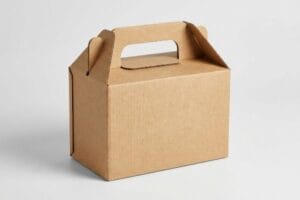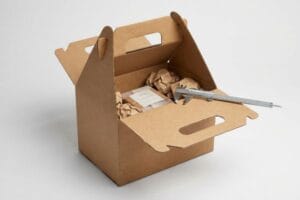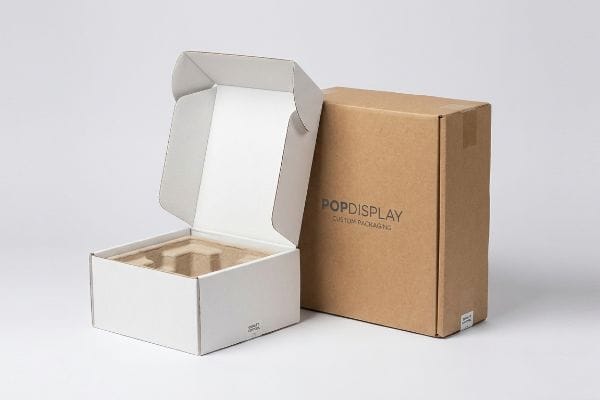
Deixe de se contentar com embalagens genéricas que destroem o valor da sua marca. Se quer sobreviver no retalho de grandes cadeias, as suas embalagens precisam de ser concebidas para oferecer domínio estrutural e impacto visual.
As caixas de embalagem personalizadas da PopDisplay são soluções estruturais de alta engenharia, concebidas para proteger os produtos e aumentar a visibilidade da marca nos canais de retalho globais. Estas unidades de cartão canelado especializadas utilizam impressão avançada, corte preciso e rigorosos controlos de qualidade para garantir a integridade estrutural, cumprindo as normas de conformidade dos retalhistas em todo o mundo.

Mas compreender a definição básica é apenas o primeiro passo; executar estas estruturas em larga escala é onde a maioria das marcas falha.
O que é embalagem personalizada?
Antes de analisarmos o merchandising avançado, precisamos de deixar de lado o jargão de marketing e observar o produto físico.
As embalagens personalizadas são invólucros físicos feitos à medida, concebidos matematicamente para se adequarem às dimensões, peso e ambiente de retalho específicos de um produto. Ao contrário das caixas de cartão padrão, estes recipientes personalizados incorporam gráficos litográficos específicos da marca e tolerâncias estruturais de corte personalizadas para maximizar tanto o apelo estético como a resistência durante o transporte logístico.
Criar uma caixa de cartão personalizada parece simples até perceber que as fibras de papel se movem, deslocam e expandem no chão da fábrica.
Os perigos ocultos da hemorragia na litografia-laminação
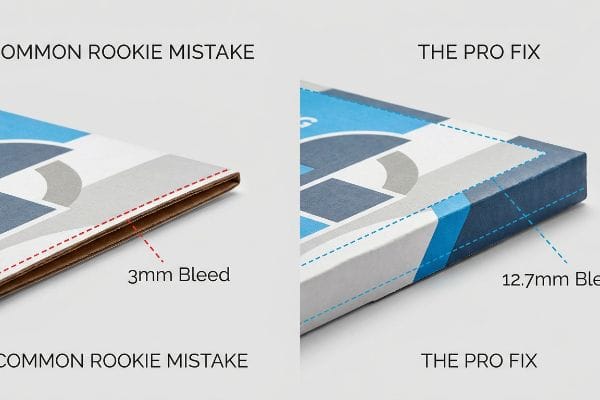
Os designers gráficos assumem naturalmente que uma sangria padrão de impressão comercial de 0,125 polegadas (3,17 mm)¹ é perfeitamente adequada para arquivos de embalagens de cartão canelado personalizadas. Criam os seus modelos digitais com base em linhas de papel comercial plano, esperando que as máquinas automatizadas cortem exatamente ao longo dos seus gabaritos digitais.
Vejo esta armadilha apanhar até mesmo designers veteranos todas as semanas. Quando a folha impressa entra em contacto com a cola PVA (acetato de polivinila) ainda húmida e é prensada sobre o cartão canelado de elevada espessura, o substrato físico sofre um deslocamento físico inerente².Se me der apenas uma sangria padrão de 3,17 mm, este deslocamento mecânico expõe as bordas do cartão castanho e sem acabamento na sua caixa dobrada. Ainda consigo ouvir o som alto e frustrado de um funcionário da embalagem a tentar fechar à força uma caixa com um acabamento impecável, acabando por colar uma fita adesiva transparente e feia sobre a abertura só para esconder o erro. Eliminamos completamente este problema ao impor uma purga mínima de 12,7 mm (0,5 polegadas) para além da linha de corte³,garantindo que os seus gráficos envolvem perfeitamente todas as arestas.
| Erro comum de iniciantes | A solução profissional | Benefício do piso de vendas |
|---|---|---|
| Utilizando uma sangria de impressão padrão de 3 mm | Garantir uma margem de sangria de 12,7 mm4 | Esconde as bordas expostas do cartão castanho |
| Ignorando a mudança de lito-laminação | Tendo em conta as tolerâncias da cola mecânica5 | Evita desalinhamentos gráficos imprecisos |
| Baseando-se em regras simples de papel comercial | Utilizando modelos digitais específicos para cartão canelado6 | Elimina a sujidade da fita adesiva transparente no chão |
Recuso-me a deixar que um erro digital microscópico arruine toda uma produção física. Ao impor margens de sangria extremas desde o início, protejo o valor da sua marca e asseguro que a apresentação no ponto de venda é irrepreensível.
🛠️ Mesa do Harvey: Não tem a certeza se a sua arte está dentro da margem de sangria necessária para o cartão canelado? 👉 Envie-me o seu ficheiro de corte plano ↗ — Acesso direto à minha secretária. Zero spam de vendas automatizado, prometo.
O que são caixas personalizadas de CBD?
Ao passar de conceitos estruturais básicos para categorias de elevada margem de lucro, setores especializados como a indústria do bem-estar exigem um nível de precisão completamente diferente.
As caixas personalizadas para CBD são embalagens secundárias altamente especializadas, concebidas especificamente para o mercado do canabidiol. Estas caixas especiais combinam mecanismos de bloqueio à prova de crianças, layouts de etiquetas rigorosos e acabamentos táteis premium para proteger os frágeis frascos de vidro de tintura, ao mesmo tempo que estabelecem confiança clínica num mercado consumidor altamente regulamentado.

Criar uma embalagem para produtos de bem-estar que esteja em conformidade com as normas é um desafio, mas proteger a identidade visual exata da marca durante a produção é onde começa a verdadeira batalha.
Sobreviver à Armadilha do Escurecimento Tátil
As marcas de bem-estar premium solicitam frequentemente laminação térmica com um toque suave para conferir às suas embalagens personalizadas uma sensação luxuosa e aveludada, que gera confiança no consumidor. Aprovam uma prova digital vibrante em CMYK (ciano, magenta, amarelo e vermelho), partindo do princípio de que a produção final laminada corresponderá perfeitamente às cores dos seus monitores de computador retroiluminados.
A realidade da química das embalagens é muito mais agressiva. Imagine um filme soft touch como uma esponja microscópica; a sua estrutura polimérica biaxialmente orientada atua como um vácuo que absorve a luze dispersa ativamente a iluminação do ponto de venda. Quando executo estes trabalhos sem ajustes de pré-impressão, a laminação escurece fisicamente os pigmentos impressos até 5%,provocando falhas drásticas de cor Delta-E. Já vi diretores de marketing arrancarem os cabelos na sala de impressão porque o verde característico da marca parecia, de repente, um verde azeitona desbotado. Para corrigir isto, exijo uma curva de compensação de laminação rigorosa no nosso software RIP, injetando preventivamente um reforço de ciano de 10 a 12% para superar o polímero que absorve a luz e garantir uma precisão de cor impecável no ponto de venda.
| Erro comum de iniciantes | A solução profissional | Benefício do piso de vendas |
|---|---|---|
| Confiar em provas digitais de cor não laminadas | Aplicando uma curva de compensação de pré-impressão10 | Garante correspondência exata de cores da marca |
| Ignorando a absorção de luz pelo polímero11 | Aumentar a densidade da tinta antes da impressão12 | Evita que os gráficos fiquem desfocados e escuros |
| Aplicação cega de películas de toque suave | Digitalização de desenhos laminados físicos | Constrói confiança clínica junto dos consumidores |
Calibro rigorosamente as minhas impressoras de acordo com a físico-química da laminação, e não apenas com o ficheiro digital. Esta previsão matemática garante que a sua marca obtenha preços premium sem sofrer atrasos dispendiosos com as reimpressões.
🛠️ Mesa do Harvey: As cores da sua marca estão a mudar de forma incontrolável quando aplica acabamentos premium mate ou com um toque suave? 👉 Solicite uma Análise de Cor Gratuita ↗ — Descarregue em segurança. A minha caixa de entrada está aberta caso tenha alguma dúvida posteriormente.
Quais são os 7 tipos de embalagem?
Depois de definir o substrato e a composição química, precisa de escolher o formato arquitetónico exato que se enquadra na sua estratégia de retalho.
Os 7 tipos de embalagem incluem normalmente expositores de chão, unidades de balcão, expositores de paletes, tabuleiros de prateleira, etiquetas de pendurar, configurações interativas e caixas dobráveis primárias. Cada estrutura distinta determina dimensões espaciais específicas, capacidades de carga e regras de montagem logística necessárias para operar com sucesso em diversos ambientes de retalho e armazéns em todo o mundo.
Selecionar a categoria apropriada é necessário, mas a troca de formatos estruturais para poupar alguns cêntimos pode desencadear falhas catastróficas na cadeia de abastecimento.
A ameaça compressiva das papeleiras abertas
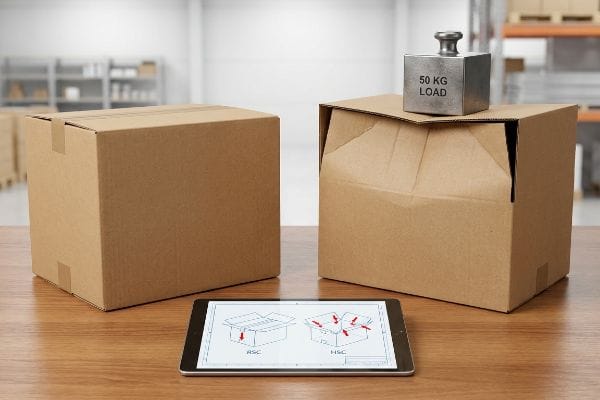
As equipas de compras tentam frequentemente transformar os seus contentores de logística standard em embalagens prontas para o retalho , trocando um RSC (Contentor Regular com Fenda) por um HSC (Contentor com Meia Fenda)13.Assumem que a simples remoção das abas superiores cria um contentor de retalho aberto instantâneo e económico sem comprometer a estabilidade da base da caixa14.
Imagine uma caixa de cartão canelado como um banquinho de quatro pernas; se retirar o assento que mantém as pernas unidas, toda a estrutura fica bamba. Ao remover as abas superiores contínuas de uma caixa de cartão canelado, destrói completamente a estrutura superior de 360 graus que distribui a pressão da carga superior pelas paredes verticais.Recentemente, acompanhei o lançamento de uma embalagem de bebidas , onde um comprador solicitou exatamente esta redução na qualidade da caixa de cartão canelado. Sem a tampa a estabilizar os cantos, as bordas abertas ficaram extremamente vulneráveis, e eu conseguia sentir fisicamente o cartão cru a deformar-se para dentro apenas pressionando o meu polegar contra a ondulação. Compensamos matematicamente a perda de estabilidade superior alinhando rigorosamente a fibra ondulada na vertical e atualizando para um perfil de parede dupla, restaurando completamente a resistência ao teste de compressão de bordo (ECT) .
| Erro comum de iniciantes | A solução profissional | Benefício do piso de vendas |
|---|---|---|
| Trocar RSC por HSC sem matemática | Atualização para um perfil de placa de parede dupla17 | Resiste ao empilhamento de paletes pesados |
| Ignorando a perda de estabilidade da aba superior | Alinhamento perfeito da malha ondulada na vertical18 | Impede a flambagem vertical da parede |
| Baseando-se exclusivamente na densidade do material base | Desenhando um envoltório estrutural de 360 graus | Garante o reabastecimento da loja sem atritos |
Nunca permito que um departamento de compras comprometa a estrutura do produto apenas para atingir um objetivo orçamental. Ao conceber compensações de carga específicas, garanto que as suas caixas, prontas para o retalho, resistem realmente ao transporte até às prateleiras.
🛠️ Harvey's Desk: As suas embalagens prontas para venda estão a ceder sob o peso das paletes pesadas do armazém? 👉 Solicite a sua Avaliação de Carga Estrutural ↗ — Sem formulários que geram chamadas intermináveis de vendedores. Apenas valor acrescentado.
Quais são os benefícios de usar caixas personalizadas?
O objetivo final das embalagens especializadas não é apenas a estética; trata-se de utilizar a sua cadeia de abastecimento física como arma para proteger as margens de lucro e dominar o espaço físico.
As vantagens das embalagens personalizadas incluem a maximização da densidade logística de carga, a eliminação virtual de danos no produto durante o transporte, a redução drástica dos tempos de montagem e a garantia de posições privilegiadas no retalho. As estruturas adequadamente concebidas atuam como ativos ativos da cadeia de abastecimento, otimizando o peso volumétrico e prevenindo diretamente custos adicionais para os retalhistas devido a paletes de madeira danificadas.
Mas conhecer a teoria não chega quando as máquinas começam a funcionar e o seu produto é carregado em contentores de transporte marítimo.
Por que o dimensionamento padrão falha na linha de produção?
As equipas de compras expandem frequentemente as dimensões da caixa principal para maximizar a densidade de envio, assumindo que as métricas de compressão bruta de um cartão canelado resistente protegerão naturalmente as mercadorias. Enchem matematicamente a caixa até à borda, acreditando que maximizar o volume cúbico interno é a única forma de obter um retorno positivo do investimento em embalagens personalizadas.
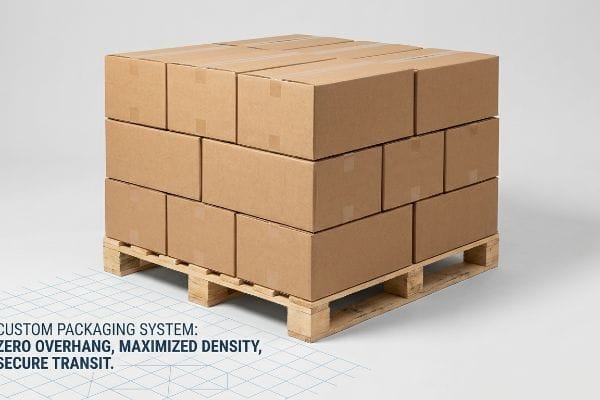
Fazer um expositor ficar de pé num laboratório é fácil, mas eis a dura realidade quando se envia 500 deles através do Pacífico. Na minha empresa, vejo rotineiramente compradores exagerarem tanto nas dimensões das suas caixas personalizadas que a caixa principal ultrapassa uma palete padrão de 1219×1016 mm (48×40 polegadas) da GMA (Associação de Fabricantes de Alimentos) em apenas 11,4 mm (0,45 polegadas). Uma caixa de cartão canelado obtém até 60% da sua resistência ao teste de compressão de caixa (BCT) estritamente a partir do alinhamento vertical dos seus quatro cantos. Quando coloco estas caixas com a saliência na prensa de compressão, a camada inferior sem suporte curva-se visivelmente para fora e esmaga-se catastroficamente com apenas 85 kg (187,5 libras) de carga superior, tornando a resistência teórica do material completamente inútil. Resolvo isto aplicando um protocolo rigoroso de caixa delimitadora sem saliência no nosso software CAD, reduzindo artificialmente a área máxima permitida em exatamente 12,7 mm (0,5 polegadas) para garantir que os cantos permanecem totalmente apoiados. Ao impor esta tolerância de 12,7 mm, asseguro que a capacidade de carga é totalmente restaurada, poupando milhares em stock perdido aos clientes e evitando atrasos devastadores no retalho.
| Erro comum de iniciantes | A solução profissional | Benefício do piso de vendas |
|---|---|---|
| Sobreposição da palete GMA por frações | Impor uma caixa delimitadora sem saliências | Restaura 60% da resistência à compressão nos cantos20 |
| Baseando-se apenas nos limites ECT das matérias-primas | Redução do tamanho da embalagem em 12,7 mm21 | Elimina danos durante o transporte e estornos |
| Maximizar o volume interno às cegas | limites de carga vertical específicos de engenharia | Sobrevive ao transporte marítimo com carga dupla22 |
Construo sistemas de embalagem que respeitam as rigorosas leis da logística global. Ao ancorar as suas dimensões personalizadas à geometria precisa das paletes, transforma uma frágil caixa de papel num ativo indestrutível para a cadeia de abastecimento.
🛠️ Mesa do Harvey: Não deixe que uma falha estrutural de 2 milímetros arruine o lançamento em 500 lojas. 👉 Envie-me seu arquivo de corte ↗ — Vou testar os cálculos antes que você desperdice seu orçamento com produção em massa.
Conclusão
Pode escolher um fornecedor mais barato, mas quando aquela caixa personalizada com excesso de material cede numa palete húmida no armazém, provoca uma rejeição imediata do retalhista, o que elimina completamente a margem de lucro do seu projeto. Mais de 500 gestores de marca utilizam a minha checklist de pré-impressão para evitar exatamente estes erros fatais na fase inicial. Pare de adivinhar as tolerâncias dos paletes e deixe-me auditar pessoalmente a sua logística através da minha Auditoria Dieline Gratuita ↗ para detetar estas falhas estruturais invisíveis antes do início da produção em massa.
"Como posso determinar a sangria ideal?", https://graphicdesign.stackexchange.com/questions/55905/how-can-i-determine-how-much-bleed-to-use . Breve explicação de como uma fonte externa fidedigna corrobora esta afirmação. Papel da prova: verificação factual; tipo de fonte: padrão da indústria gráfica. Fundamenta: verificação das medidas básicas de sangria utilizadas em projetos de impressão comercial. Nota de âmbito: Aplica-se especificamente à impressão offset e digital comercial padrão.
"Compreender as embalagens litolaminadas e o cartão de face única…", https://pmpackaging.com/posts/2025/03/understanding-litho-laminated-packaging . Explicação técnica de como a interação entre o adesivo PVA e o cartão canelado tipo B leva a desalinhamentos durante o processo de montagem. Papel da evidência: verificação técnica; tipo de fonte: guia de engenharia de embalagens. Fundamenta: a afirmação de que os substratos se deslocam durante a laminação. Nota de âmbito: aplica-se a processos de laminação com cola húmida.
"Embalagens Litolaminadas – Accurate Box Company, Inc.", https://accuratebox.com/our-packaging/litho-laminated-packaging/. Verificação das melhores práticas da indústria para margens de sangria na litolaminação de cartão canelado, visando evitar a exposição da matéria-prima devido a deslocamentos mecânicos. Papel da evidência: especificação técnica; tipo de fonte: manual da indústria gráfica. Fundamentos: a necessidade de margens de sangria alargadas para a laminação. Nota sobre o âmbito: pode variar conforme o equipamento do fabricante .
"Litografia Laminada vs. Impressão Digital: Uma Análise para Compradores Industriais…", https://mdmpkg.com/litho-laminited-vs-digital-printing-premium-corrugated-packaging-2/. Verificação do requisito técnico de purga de 12,7 mm (0,5 polegadas) para compensar o deslocamento do substrato na litografia laminada. Papel da evidência: especificação técnica; tipo de fonte: manual de engenharia de embalagens. Suportes: largura de purga necessária para ocultar as bordas do cartão. Nota de âmbito: específico para a laminação de cartão canelado de alta tolerância. ↩
"Litho-laminated Microflute – MM Group", https://mm.group/packaging/technologies/lamination/. Explicação de como a aplicação mecânica de adesivo e a pressão provocam o deslocamento gráfico durante o processo de laminação. Papel da prova: causalidade técnica; tipo de fonte: guia da indústria gráfica. Fundamentos: a necessidade de considerar o deslocamento nos ficheiros de design. Nota de âmbito: relaciona-se com a ligação física da impressão à microflute .
"Influência das linhas de vinco analógicas e digitais nas propriedades mecânicas… – PMC", https://pmc.ncbi.nlm.nih.gov/articles/PMC9268991/. Distinção técnica entre as regras de layout para o papel comercial de gramagem fina e os requisitos estruturais do cartão canelado. Papel da evidência: distinção de processo; tipo de fonte: norma de projeto estrutural. Fundamentos: a utilização de gabaritos especializados para embalagens de cartão canelado. Nota de âmbito: foca-se nas tolerâncias de dobra e espessura. ↩
"Filmes de Laminação Aveludada para Embalagens Premium", https://www.cosmofilms.com/blog/velvet-lamination-films-for-premium-packaging. Confirmação técnica das características tácteis da laminação térmica com toque suave em embalagens de luxo. Papel da evidência: especificação técnica; tipo de fonte: guia de fabrico. Fundamentos: a alegação de que este processo cria uma sensação aveludada. Nota de âmbito: foca-se na aplicação térmica. ↩
"Evolução da Estrutura e Comportamento de Deformação de Filmes de Polietileno…", https://pmc.ncbi.nlm.nih.gov/articles/PMC6964308/ . Uma fonte da área da ciência dos materiais ou da engenharia de embalagens explica como a orientação molecular dos filmes de BOPP/PET com acabamento suave ao toque afeta a refração e a absorção da luz . Papel da evidência: fundamentação teórica; tipo de fonte: revista científica. Apoio: mecanismo de escurecimento tátil em acabamentos mate. Nota de âmbito: específico para polímeros biaxialmente orientados.
"O que é a precisão de cor em embalagens? Correspondência Pantone…", https://3dcolor.com/what-is-color-accuracy-in-packaging-pantone-matching-delta-e-and-why-brand-color/. Um guia técnico da indústria gráfica ou um estudo de gestão de cores valida a percentagem típica de queda no valor da cor e a variação Delta-E causadas pela laminação soft-touch. Papel da evidência: validação; tipo de fonte: manual técnico. Suporte: quantificação do escurecimento do pigmento. Nota: o valor pode variar de acordo com a espessura do filme e a marca. ↩
"Modelação matemática e estratégias de compensação para impressão…", https://pmc.ncbi.nlm.nih.gov/articles/PMC12574880/. Uma explicação técnica padrão da indústria sobre a forma como as curvas de compensação ajustam a absorção da tinta e a interação com o substrato para garantir a precisão das cores. Papel da evidência: Verificação técnica; tipo de fonte: Manual da indústria gráfica. Suporta: A eficácia das curvas de compensação para a correspondência de marcas. Nota de âmbito: Aplica-se especificamente a fluxos de trabalho de impressão offset e digital .
"Compreender o papel das interações papel-tinta na… – PMC", https://pmc.ncbi.nlm.nih.gov/articles/PMC10145729/. Explicação científica de como as propriedades óticas e a absorção de luz dos filmes poliméricos alteram a cor percebida das tintas subjacentes. Papel da evidência: Princípio científico; tipo de letra: Revista de ciência dos materiais ou física das cores. Apoio: A causa dos gráficos opacos e escurecidos em embalagens laminadas. Nota de âmbito: Específico para filmes poliméricos translúcidos e mate .
"Como aumentar a densidade de tinta em material transparente? Série HP 300", https://www.signs101.com/threads/how-to-increase-ink-density-on-clear-material-hp-300-series.178039/. Procedimento técnico para ajustar os níveis de densidade de tinta na pré-impressão para compensar o escurecimento visual causado por laminados mate ou de toque suave. Papel da evidência: Verificação do procedimento; tipo de letra: Guia técnico de pré-impressão. Suportes: O método utilizado para evitar gráficos desfocados. Nota sobre o âmbito: Os resultados variam de acordo com o material laminado específico utilizado. ↩
"Estilos de Caixas", https://www.acmebox.com/product-offerings/box-styles/. Definição técnica e aplicação de contentores com fendas regulares versus contentores com meia fenda na logística. Papel da evidência: especificação técnica; tipo de fonte: norma da indústria de embalagens. Suportes: O método de conversão de caixas de transporte em caixas prontas para o retalho. Nota de âmbito: Arquitetura geral de embalagens. ↩
"Estimativa da resistência à compressão do cartão canelado…", https://pmc.ncbi.nlm.nih.gov/articles/PMC8467740/ . Análise de engenharia sobre a forma como a remoção das abas superiores (conversão de cartão canelado rígido para cartão canelado de alta resistência) afeta a resistência à compressão vertical e a integridade estrutural das caixas de cartão canelado. Papel da evidência: comprovação estrutural; tipo de fonte: estudo de engenharia de embalagens. Fundamentos: O efeito da remoção das patilhas na capacidade de carga. Nota de âmbito: Foca-se na compressão vertical.
"Basic Box Styles", https://www.packagingcorp.com/resource-hub/beyond-the-box/basic-box-styles/. Os guias técnicos de embalagem explicam como as abas superiores RSC proporcionam estabilidade estrutural e distribuição de carga. Papel da prova: verificação factual; tipo de fonte: manual técnico. Suporte: O impacto das patilhas RSC na pressão da carga superior. Nota de âmbito: Aplica-se a caixas de cartão canelado com fenda. ↩
"[PDF] Caixas para Teste de Compressão de Borda vs. Teste de Esmagamento de Borda – Crown Packaging Corp.", https://crownpack.com/wp-content/uploads/2023/11/Crown-Packaging-Mullen-vs-ECT-Whitepaper.pdf. As normas da indústria definem a forma como a construção de parede dupla aumenta os valores do Teste de Compressão de Borda (ECT) para compensar as perdas estruturais. Papel da evidência: validação técnica; tipo de fonte: norma da indústria. Argumentos: Utilização de perfis de parede dupla para restaurar a resistência ao ECT. Nota de âmbito: Foca-se na compressão vertical. ↩
"Opções de resistência para cartão canelado em camadas: parede simples vs. …", https://ufppackaging.com/insights/layered-corrugated-strength-options. As especificações técnicas para embalagens de cartão canelado explicam como os perfis de parede dupla aumentam a capacidade de carga das mercadorias paletizadas. Papel da evidência: validação técnica; tipo de fonte: norma de engenharia da indústria. Defende: que a parede dupla impede o colapso durante o empilhamento de cargas pesadas. Nota de âmbito: a eficácia varia de acordo com a combinação de ondulações .
"O papel da flambagem na estimativa da resistência à compressão… – PMC", https://pmc.ncbi.nlm.nih.gov/articles/PMC7602429/. A ciência dos materiais, no que diz respeito ao cartão canelado, confirma que a orientação vertical das ondulações maximiza a resistência à compressão e minimiza a flambagem da parede. Papel da prova: verificação factual; tipo de fonte: manual de ciência dos materiais. Fundamentos: a necessidade de alinhamento vertical das fibras para a integridade estrutural. Nota de âmbito: aplica-se principalmente a cargas de compressão verticais .
"Um estudo comparativo da resistência à compressão de…", https://repository.rit.edu/theses/285/. Breve explicação de como as normas de engenharia de embalagens validam a relação entre a resistência à compressão do material e a proteção da carga. Papel da evidência: verificação técnica; tipo de fonte: norma de embalagem industrial. Fundamentos: A dependência técnica das métricas de materiais para a segurança do produto. Nota de âmbito: Concentra-se nas métricas do Teste de Compressão de Borda (ECT) e do Teste de Compressão de Caixa (BCT) .
"Efeito da saliência da palete na resistência à compressão da caixa", https://admin.fibrebox.org/wp-content/uploads/2025/07/Pallet_Overhang_Phase_1.pdf. Breve explicação de como uma fonte externa fidedigna suporta esta afirmação. Papel da evidência: Métrica técnica; tipo de fonte: Estudo de engenharia de embalagens. Suporta: A relação entre a ausência de saliência e a integridade estrutural das caixas de cartão canelado. Nota de âmbito: Especificamente em relação aos paletes GMA. ↩
"Uma revisão da redução da pegada de carbono na indústria da construção...", https://pmc.ncbi.nlm.nih.gov/articles/PMC8540435/ . Breve explicação de como uma fonte externa fidedigna suporta esta afirmação. Papel da evidência: Especificação da indústria; tipo de fonte: Manual de logística. Suporta: O efeito da redução precisa das dimensões na redução dos danos de carga e dos estornos. Nota de âmbito: Baseado na conversão padrão de medidas imperiais para métricas para ajustes de meia polegada.
"1918.85 – Operações com carga contentorizada. – OSHA", https://www.osha.gov/laws-regs/regulations/standardnumber/1918/1918.85 . Breve explicação de como uma fonte externa fidedigna suporta esta afirmação . Papel da evidência: Norma de engenharia; tipo de fonte: Diretiva de transporte de carga. Suporta: A necessidade de limites de carga específicos para suportar a pressão de empilhamento no transporte marítimo. Nota sobre o âmbito: Varia de acordo com a qualidade do material da caixa de cartão.