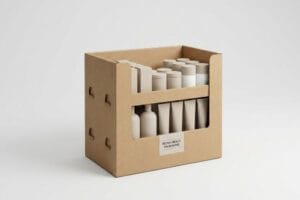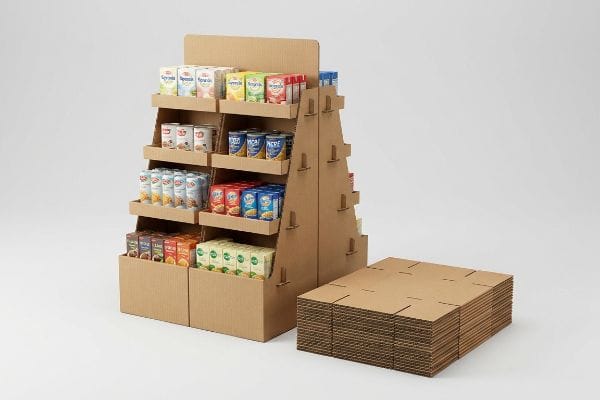
Criar uma boa vitrine para o ponto de venda exige equilibrar integridade estrutural, mensagens da marca e o cumprimento rigoroso das normas da loja. Ignorar a engenharia de fábrica fará com que sua campanha fracasse antes mesmo de chegar à loja.
Criar uma boa exposição no ponto de venda envolve projetar uma unidade estrutural que equilibre perfeitamente o merchandising visual com a capacidade de carga dinâmica. Isso exige uma seleção precisa de materiais, tolerâncias de corte exatas e estrita adesão aos padrões globais de logística para garantir a alta visibilidade do produto e uma montagem descomplicada na loja.
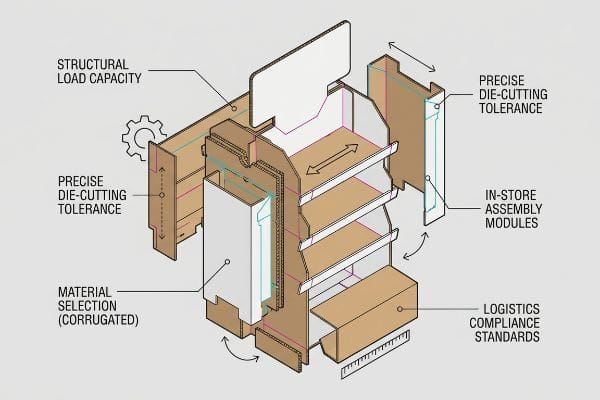
Mas conhecer a teoria não basta quando as máquinas automatizadas começam a funcionar.
Como criar uma boa vitrine para o ponto de venda?
A criação de um merchandising começa muito antes da impressão. Começa na prancheta digital, onde uma fração de milímetro determina se sua peça publicitária se mantém de pé ou desmorona.
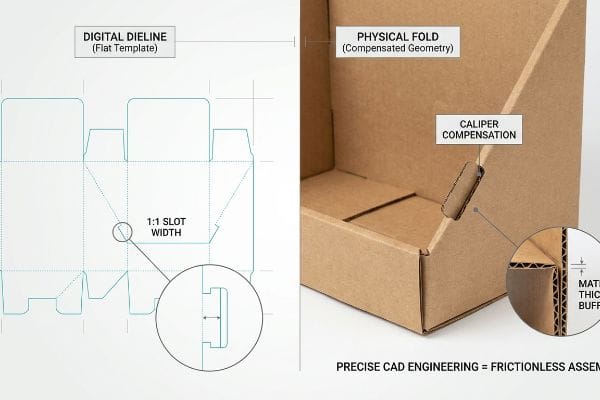
Para criar um bom expositor de varejo, é necessário um projeto estrutural preciso em CAD (Desenho Auxiliado por Computador) que calcule com exatidão as tolerâncias de dobra e a espessura do material. Isso elimina matematicamente a tensão do papelão durante a dobragem, garantindo que as abas de encaixe se alinhem perfeitamente, a montagem permaneça sem atrito e a unidade suporte cargas dinâmicas pesadas sem deformar.
Muitas equipes de marketing presumem que um modelo digital plano se dobrará perfeitamente no mundo real, mas as leis da física do papelão se recusam a cooperar.
Por que os cálculos de corte plano falham na linha de embalagem?
Mesmo designers experientes muitas vezes ignoram a espessura física dos substratos estruturais¹ao desenhar gabaritos planos. Eles criam abas de encaixe e ranhuras de dobra em softwares digitais com a mesma largura exata do painel correspondente².Eles presumem que uma simples linha vetorial se traduzirá naturalmente em uma dobra limpa de 90 graus assim que a lâmina de corte fizer seu trabalho.
Eis o que acontece quando esses arquivos chegam às minhas mesas de montagem. Uma cartolina canelada tipo B com 3 mm (0,11 polegadas) de espessura consome material físico ao ser dobrada. Se a ranhura de encaixe na sua matriz de corte não for alargada para compensar esse raio externo, a peça física ficará severamente curvada . Já vi equipes de embalagem terceirizadas suarem e se esforçarem por dez minutos apenas tentando encaixar uma única aba desalinhada, ouvindo o som agonizante do papelão cru cedendo. Ao alargar artificialmente a ranhura em nosso software para absorver a espessura da canela, elimino completamente o atrito, acelerando a linha de montagem em cerca de 35% e economizando milhares para a marca em custos com mão de obra.
| Erro comum de iniciantes | A solução profissional | Benefício do piso de vendas |
|---|---|---|
| Largura dos slots digitais 1:1 | Cálculo de compensação de paquímetro5 | Economiza 45 segundos por montagem6 |
| Ignorando o raio de dobra da prancha | buffers de software paramétricos7 | Impede que a camada superior rasgue |
| Forçando o encaixe firme das abas | folga dinâmica do slot | Não requer fita adesiva manual |
Recuso-me a deixar que cálculos matemáticos imprecisos comprometam minha linha de montagem. Ajustar as tolerâncias das ranhuras com base na espessura da matéria-prima é uma etapa indispensável que protege tanto a integridade estrutural quanto o orçamento de terceirização da embalagem.
🛠️ Mesa do Harvey: Não tem certeza se suas abas de encaixe têm a folga de dobra correta? 👉 Deixe-me auditar seu gabarito ↗ — Acesso direto à minha mesa. Zero spam de vendas automatizado, prometo.
Quais são os critérios para uma boa exposição de produtos no varejo?
A avaliação de produtos de merchandising vai muito além da estética subjetiva ou do custo da matéria-prima. O verdadeiro sucesso depende do rigoroso cumprimento das dimensões e da percepção espacial dentro de um ambiente comercial rígido.
Os critérios para uma boa exposição no ponto de venda incluem o cumprimento rigoroso dos limites de espaço logístico e das diretrizes de acessibilidade frontal. Uma unidade em conformidade maximiza o empilhamento de paletes de alta densidade para garantir a resistência durante o transporte, ao mesmo tempo que assegura que a estrutura física final opere com segurança dentro das zonas de corredor definidas pela loja, sem obstruir o fluxo de consumidores.
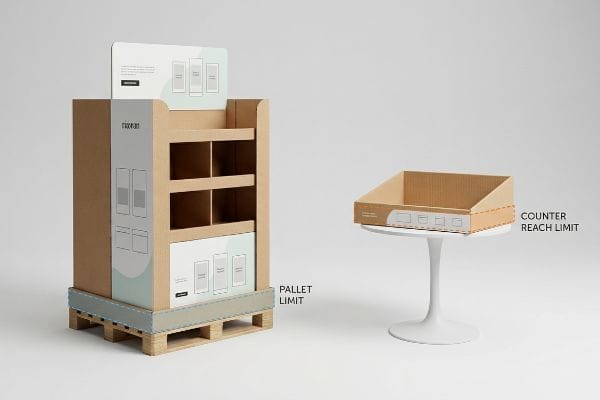
Você pode projetar a estrutura mais bonita do mundo, mas se ela violar as leis da física do varejo, os gerentes da loja a jogarão no lixo.
Os Limites Legais do Espaço Comercial
As equipes de marketing frequentemente desejam um design universal e escalável, onde uma unidade de chão possa ser simplesmente reduzida em 50% para servir como bandeja de caixa. Elas tratam o espaço físico de varejo como um gráfico digital que pode ser redimensionado sem consequências. Isso ignora as rígidas regras legais e logísticasque ditam essas duas zonas de merchandising completamente separadas.
Vejo essa armadilha de adaptação constantemente, e ela sempre termina em uma rejeição custosa por parte do varejista. Quando você simplesmente reduz o tamanho de uma unidade de chão, viola janelas críticas de acessibilidade. Eu fixo todos os arquivos de chão estritamente ao limite de paletes de 48,0×40,0 polegadas (121,9×101,6 cm) para suportar a distribuição de peso no armazém. Para bandejas de caixa, separo completamente o processo de engenharia para atender à rigorosa janela de conformidade de alcance frontal de 15,0 a 48,0 polegadas (38,1 a 121,9 cm) . Lembro-me de um cliente tentando forçar um arquivo de chão reduzido em um balcão de caixa, resultando em uma estrutura instável e desequilibrada que tombou com um baque surdo ao menor solavanco. Projetar para a zona específica evita estornos massivos.
| Erro comum de iniciantes | A solução profissional | Benefício do piso de vendas |
|---|---|---|
| Redução de 50% nas unidades de piso | Arquivos CAD específicos da zona | Elimina a responsabilidade por gorjetas11 |
| Ignorando o cumprimento do alcance | limites de 15 a 48 polegadas (38 a 121 cm)12 | Aprovação de 100% dos inscritos |
| pegadas básicas genéricas | Limites ancorados em paletes13 | Resiste a transporte pesado |
Eu nunca trato as unidades de chão e de balcão como arquivos intercambiáveis. Separar os cálculos de engenharia para cada zona de varejo específica é a única maneira de garantir que sua campanha sobreviva ao recebimento de mercadorias.
🛠️ Mesa do Harvey: Seus displays de balcão em escala reduzida estão infringindo as zonas de alcance do caixa? 👉 Envie-me as especificações do espaço ocupado ↗ — Faça o download com segurança. Minha caixa de entrada está aberta caso tenha alguma dúvida posteriormente.
O que torna uma vitrine atraente?
Em um ambiente comercial hostil, o apelo visual não se resume a sutilezas artísticas. Trata-se de criar impactos de alto contraste que resistam à iluminação precária e a substratos porosos.
O que torna uma vitrine atraente é o uso estratégico de cores sólidas e elementos visuais estruturais que criam uma quebra, em vez de gradientes digitais complexos. A exposição de produtos de alta visibilidade depende da saturação de tinta em papelão poroso para criar um contraste extremo, capturando a atenção do consumidor à distância sob forte iluminação fluorescente.

Transformar um logotipo digital brilhante em uma realidade física de papelão exige superar algumas reações químicas complexas com os materiais.
Por que a impressão em processo padrão arruína as cores da sua marca
As equipes de marketing frequentemente convertem seus principais logotipos corporativos em formatos padrão de quatro cores, presumindo que a impressora da fábrica reproduzirá perfeitamente suas telas digitais. Elas criam arquivos complexos carregados com sombras e gradientes sutis. Esperam que o papel físico se comporte exatamente como um monitor LEDretroiluminado.
A impressão convencional depende de minúsculos pontos de meio-tom sobrepostos¹⁵que são absorvidos de forma irregular pelas fibras do papel, criando um logotipo granulado e desbotado. Já vi gerentes de marketing visivelmente desanimarem ao receberem uma amostra impressa, passando os dedos sobre um gráfico opaco e sem brilho que parecia vibrante em seus laptops. Eu resolvo isso exigindo uma aplicação de cor especial para os principais elementos da marca¹⁶.Ao misturar uma única tinta Pantone densa em vez de depender da mistura óptica de pontos, garanto uma aplicação de pigmento perfeitamente uniforme. Isso elimina a granulação do meio-tom, garante impacto visual a dez metros de distância e impede que a identidade premium da marca pareça uma fotocópia barata.
| Erro comum de iniciantes | A solução profissional | Benefício do piso de vendas |
|---|---|---|
| Tintas de processo em testliner | Inundações de cores Pantone spot | Grão de meio-tom zero17 |
| Confiar em telas digitais | correspondência do substrato físico18 | Fidelidade real às cores da marca |
| Gradientes gráficos complexos | Blocos sólidos de alto contraste | interrupção visual de 9 metros19 |
Sempre isolo os logotipos de marcas importantes da impressão em cores. Injetar uma cor especial pura e pré-misturada diretamente na placa é a única maneira de garantir que seus gráficos se destaquem mesmo sob a iluminação precária de uma loja.
🛠️ Harvey's Desk: Preocupado com a possibilidade do logotipo da sua marca ficar borrado em papel de teste poroso? 👉 Solicite um teste de cores prévio ↗ — Sem formulários que geram ligações intermináveis de vendas. Apenas valor puro.
Como as lojas de varejo exibem suas mercadorias?
Colocar sua unidade em uma loja é uma verdadeira guerra logística. Assim que ela chega, a batalha real começa quando os atendentes apressados tentam abrir e montar sua embalagem.
As lojas de varejo exibem suas mercadorias utilizando bandejas modulares pré-cheias e paletes que se transformam instantaneamente de contêineres de carga em displays de ponta de gôndola. Isso depende muito de tolerâncias geométricas exatas dentro da caixa master, garantindo que os funcionários da loja possam posicionar as unidades rapidamente, sem danos estruturais.
Mas conhecer a teoria não basta quando as máquinas começam a funcionar e as caixas de envio chegam de fato ao depósito.
A armadilha do atrito nas caixas master
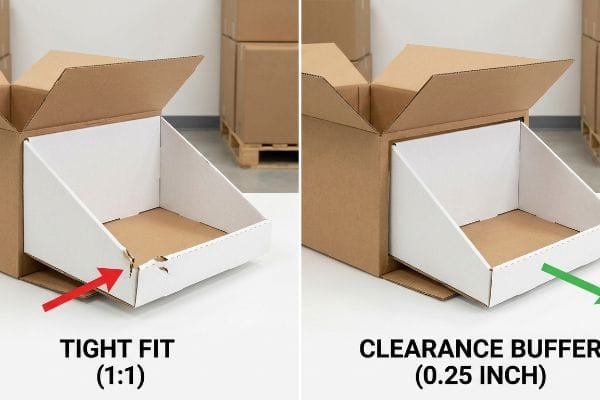
As equipes de compras frequentemente projetam caixas de transporte master para corresponder às dimensões externas exatas de suas bandejas de varejo pré-cheias, em escala 1:1.Elas partem do princípio de que um encaixe matematicamente perfeito proporciona máxima proteção contra choques cinéticos durante o transporte.Elas consideram as camadas de encaixe estritamente como um exercício de densidade geométrica para economizar custos de frete de contêineres.
Em minhas instalações, observo rotineiramente essa densidade teórica falhar miseravelmente durante os testes de desembalagem. O papelão ondulado bruto possui um atrito superficial enorme.Quando um funcionário da loja tenta retirar uma bandeja de 60,9 cm (24 polegadas) compactada de uma caixa de transporte idêntica de 60,9 cm (24 polegadas), as paredes de papelão se travam fisicamente. Testei isso pessoalmente, sentindo a intensa resistência que eventualmente força a pessoa a puxar com força o painel frontal da bandeja, ouvindo o lábio de retenção rasgar antes mesmo da unidade chegar ao corredor. Obtive as leituras do micrômetro e comprovei a necessidade de uma tolerância geométrica de deslocamento. Ao projetar matematicamente uma folga perimetral mínima absoluta de 6,35 mm (0,25 polegadas) na cavidade da caixa de transporte, quebro o travamento por atrito. Isso garante que os funcionários possam desembalar a unidade em menos de dez segundos, eliminando completamente o rasgo do lábio frontal e evitando a rejeição imediata de mercadorias danificadas pelo varejista.
| Erro comum de iniciantes | A solução profissional | Benefício do piso de vendas |
|---|---|---|
| Dimensionamento da caixa master em escala 1:1 | Deslocamento de 0,25 polegadas (6,35 mm)24 | Previne o rompimento dos lábios |
| Ignorando o atrito superficial | buffer de folga geométrica25 | Desempacotamento rápido em 10 segundos |
| densidade de empacotamento excessivamente apertada | margens perimetrais anti-bloqueio26 | Dano zero ao nível da loja |
Eu nunca permito que as equipes de compras ditem as liberações de caixas com base apenas na economia de frete. Projetar uma área de segurança funcional para desembalagem é fundamental se você quiser que sua mercadoria sobreviva ao armazenamento.
🛠️ Mesa do Harvey: Não deixe que uma falha estrutural de 2 milímetros arruine o lançamento em 500 lojas. 👉 Envie-me seu arquivo de corte ↗ — Vou testar os cálculos antes que você desperdice seu orçamento com produção em massa.
Conclusão
Você pode escolher um fornecedor mais barato que ignore as tolerâncias de dobra do papelão ondulado, mas quando essas abas rígidas causam atrito excessivo, reduzindo a velocidade da sua linha de montagem em cerca de 35%, você elimina instantaneamente a margem de lucro do seu projeto. Mais de 500 gerentes de marca usam meu checklist de pré-impressão para evitar exatamente esses erros fatais no estágio inicial. Pare de adivinhar as tolerâncias de encaixe e deixe-me analisar pessoalmente seus arquivos estruturais com minha Auditoria de Corte e Vinco gratuita ↗ para detectar erros de encaixe por fricção antes do início da produção em massa.
"Como calcular a tolerância de dobra e a dedução de dobra – YouTube", https://www.youtube.com/watch?v=21Ky5ayg_q8. A literatura técnica sobre engenharia de embalagens estruturais explica por que a espessura do material deve ser considerada nos moldes de corte para garantir o encaixe e a dobra adequados. Papel da evidência: validação técnica; tipo de fonte: manual de engenharia. Fundamentos: A necessidade de calcular a espessura do substrato para a integridade estrutural. Nota de escopo: Aplica-se a todos os materiais de papelão e papelão ondulado dobráveis .
"Projetando peças de chapa metálica com abas e ranhuras – SendCutSend", https://sendcutsend.com/blog/designing-sheet-metal-parts-with-tab-and-slots/?srsltid=AfmBOop1G6yH5G9BZORckZAt3xxGvTKChPFN1PFspEWBF-jQ1Unu_ZB9. As normas de projeto de embalagens fornecem fórmulas de tolerância específicas para abas e ranhuras, a fim de evitar atrito ou falhas estruturais causadas pela compressão do material. Papel da evidência: especificação técnica; tipo de fonte: norma da indústria. Fundamentos: A alegação de que proporções de largura de 1:1 são estruturalmente insuficientes para componentes intertravados. Observação sobre o escopo: As tolerâncias variam de acordo com a espessura do material. ↩
"[PDF] Especificações de Papelão Ondulado – Associação Fibre Box", https://www.fibrebox.org/assets/2025/09/Walmart_Corrugated-Board_Specifications_Automation_Packaging_Standards.pdf. Verificação da espessura do material padrão da indústria para papelão ondulado tipo B. Função da evidência: Especificação técnica; tipo de fonte: Manual de normas de materiais. Suportes: As dimensões básicas do material usadas para cálculos estruturais. Observação: A espessura pode variar ligeiramente de acordo com o fabricante. ↩
"Determinação Analítica da Rigidez à Flexão de uma Estrutura de Cinco Camadas…", https://pmc.ncbi.nlm.nih.gov/articles/PMC8777652/. Explicação técnica de como a espessura do material e o raio de curvatura afetam o encaixe da ranhura e a integridade estrutural em projetos de papelão ondulado. Papel da evidência: Princípio de engenharia; tipo de fonte: Manual de embalagens estruturais. Fundamentos: A necessidade de compensar a espessura do material para evitar deformações. Nota de escopo: Aplica-se especificamente a substratos de papelão ondulado dobráveis .
"Projeto Ótimo de Embalagens de Papelão Ondulado de Parede Dupla – PMC", https://pmc.ncbi.nlm.nih.gov/articles/PMC8950760/. Breve explicação de como considerar a espessura do material (calibre) no projeto do molde garante o encaixe adequado dos componentes. Papel da evidência: verificação técnica; tipo de fonte: manual de engenharia de embalagens. Fundamentos: a exigência de larguras de encaixe digital diferentes de 1:1. Nota de escopo: aplicável principalmente a papelão ondulado .
"Serviços de Embalagem de Ponta a Ponta | GreenDot Packaging", https://greendotpackaging.com/services/. Dados quantitativos ou estudo de caso demonstrando a redução do tempo de montagem ao usar larguras de encaixe otimizadas. Papel da evidência: validação quantitativa; tipo de fonte: relatório de produtividade da indústria. Comprova: o benefício da compensação de espessura no ponto de venda. Observação sobre o escopo: a economia de tempo pode variar de acordo com a escala da unidade .
"Guia de Projeto Estrutural de Embalagens de Papel", https://greendotpackaging.com/paper-packaging-structural-design-guide/ . Documentação técnica sobre o uso de ferramentas CAD paramétricas para considerar a tolerância de dobra do material e evitar fraturas por tensão. Função da evidência: verificação técnica; tipo de fonte: documentação de software CAD. Benefícios : prevenção de rasgos na folha superior durante a montagem. Observação sobre o escopo: específico para materiais dobráveis.
"Normas de Acessibilidade da ADA – Access-Board.gov", https://www.access-board.gov/ada/. Normas regulamentares, como as diretrizes de acessibilidade da ADA e os códigos de segurança contra incêndio, estabelecem limites dimensionais e de posicionamento rigorosos para expositores no varejo, a fim de garantir a segurança e a acessibilidade do consumidor. Papel da evidência: verificação; tipo de fonte: código regulamentar. Fundamenta: a alegação de que as zonas de merchandising são regidas por restrições legais não negociáveis. Nota de escopo: foco principal nas leis de segurança e acessibilidade dos EUA .
"Guia de Tamanhos Padrão de Paletes para Empresas em McIntyre, GA – 48forty", https://www.48forty.com/blog/standard-pallet-sizes-guide-for-mcintyre-ga-businesses. Os padrões da indústria para paletes da Global Manufacturing Association (GMA) confirmam a dimensão de 48×40 polegadas como padrão para a logística na América do Norte. Função da evidência: Especificação técnica; tipo de fonte: Padrão da indústria logística. Baseia-se em: Dimensões padrão de paletes para transporte seguro. Observação sobre o escopo: Aplica-se principalmente às cadeias de suprimentos da América do Norte .
"Normas da ADA para Design Acessível, Título III, Regulamento 28 CFR…", https://www.ada.gov/law-and-regs/design-standards/1991-design-standards/. As normas de ergonomia e acessibilidade definem alcances específicos para garantir que as vitrines de lojas sejam acessíveis e seguras para os consumidores. Papel da evidência: Conformidade regulamentar; tipo de fonte: Diretriz de ergonomia/acessibilidade. Suporte: Limites dimensionais para displays de caixa e balcão. Observação sobre o escopo: Pode ser influenciado pela ADA ou leis de acessibilidade semelhantes .
"CPSC adota padrão final de segurança de produtos de consumo para prevenir…", https://www.cpsc.gov/Newsroom/News-Releases/2023/CPSC-Adopts-Final-Consumer-Product-Safety-Standard-to-Prevent-Tip-overs-of-Dressers-and-Other-Clothing-Storage-Units . Análise de como o planejamento dimensional preciso via CAD reduz a instabilidade estrutural e a responsabilidade legal associada. Papel da evidência: verificação de segurança; tipo de fonte: normas de segurança de engenharia ou legais. Apoio: mitigação da responsabilidade por tombamento. Nota de escopo: foco na integridade estrutural em ambientes comerciais.
"Requisitos da ADA para Lojas de Varejo: Normas e Conformidade", https://www.accessibilitychecker.org/blog/ada-requirements-for-retail-stores-standards-and-compliance/. Verificação dos alcances padrão do setor para acessibilidade e conformidade no varejo. Função da evidência: especificação técnica; tipo de fonte: norma do setor/diretrizes regulatórias. Suporta: limites de altura para conformidade com o alcance. Observação sobre o escopo: aplica-se a prateleiras e displays de varejo em geral .
"Expositores em Paletes: Melhores Práticas para Posicionamento de Produtos | TPH Global", https://www.tphinc.com/custom-point-of-purchase-pop-pos-retail-store-displays-packaging-blog/positioning-products-on-pallet-displays/. Validação técnica da durabilidade de displays fixados em paletes durante o transporte e frete. Papel da evidência: especificação logística; tipo de fonte: manuais de transporte e manuseio. Suporte: durabilidade durante o transporte. Observação sobre o escopo: específico para unidades de exibição de varejo baseadas em paletes. ↩
"Modelos de Cor Aditivos e Subtrativos > Pavilhão DINFOS > Artigo", https://pavilion.dinfos.edu/Article/Article/2355687/additive-subtractive-color-models/ . Explicação técnica da diferença fundamental entre os modelos de cor aditivos (RGB) e subtrativos (CMYK) e a consequente disparidade na gama de cores. Papel da evidência: fundamento técnico; tipo de fonte: referência em ciência da cor. Apoio: A impossibilidade de replicar perfeitamente as saídas de LEDs retroiluminados em substratos de papel reflexivo. Nota de escopo: Concentra-se na física da emissão versus reflexão da luz.
"[PDF] 1. O ganho de ponto é o aumento do tamanho dos pontos de meio-tom à medida que a tinta é absorvida em…", https://www.coloradomesa.edu/art/documents/student-resources/study-guide-2019.pdf. Explicação técnica de como a impressão em processo CMYK utiliza retículas de meio-tom e como a absorção de tinta em substratos não revestidos afeta a nitidez da imagem. Papel da evidência: mecanismo técnico; tipo de fonte: manual da indústria gráfica. Fundamentos: a causa da granulação na impressão em fibras brutas. Nota de escopo: aplica-se a métodos de impressão offset e digital. ↩
"Cores especiais vs. Cores de processo: principais diferenças e melhores práticas", https://marijuanapackaging.com/blogs/comparison/understanding-spot-color-and-process-color-key-differences-and-best-practices?srsltid=AfmBOoq8qpBoq91EDCXS8LirI_eb3-7TMf6AYNHRALb9tKyi6mLnhtd5. Comparação da saturação de cores especiais (Pantone) versus a mistura óptica CMYK para cobertura de cores de alta densidade. Papel da evidência: solução técnica; tipo de fonte: norma de artes gráficas. Argumenta: que as cores especiais previnem a granulação dos meios-tons e garantem a uniformidade das cores. Nota de escopo: específico para displays comerciais de alta visibilidade .
"Impressão em cores especiais versus impressão em cores de processo – Pantone", https://www.pantone.com/articles/technical/spot-vs-process-color?srsltid=AfmBOooQqwIa4ffnRJ76g5JdhxpfQiU_qcfBK55IREVNmHH_2_E6fUGp. Explicação técnica de como as cores especiais utilizam uma única tinta pré-misturada em vez de um padrão de pontos CMYK para eliminar as retículas visíveis. Papel da evidência: validação técnica; tipo de fonte: norma da indústria gráfica; Argumentos: o benefício das cores especiais em relação às tintas de processo; Nota de escopo: aplica-se principalmente à impressão offset e flexográfica .
"O impacto dos substratos de impressão na reprodução de cores", https://lithographicsinc.com/the-impact-of-printing-substrates-on-color-reproduction-unveiling-the-canvas-of-possibilities/ . Análise de como a porosidade, a textura e a cor base do substrato influenciam a absorção da tinta e o resultado cromático final. Papel da evidência: verificação técnica; tipo de fonte: manual de ciência das cores; Fundamentos: a necessidade de substratos compatíveis para precisão de cores; Nota de escopo: especificamente relevante para materiais absorventes como papelão ondulado.
"Distância Máxima de Visibilidade: Um Guia para o Impacto do DOOH – Perion", https://perion.com/glossary/maximum-visibility-distance/. Dados empíricos sobre a relação entre blocos sólidos de alto contraste e a percepção visual humana à distância. Papel da evidência: evidência empírica; tipo de fonte: pesquisa sobre percepção visual; Apoia: a afirmação de que sólidos de alto contraste aumentam a visibilidade a longa distância; Nota de escopo: dependente das condições de iluminação ambiente .
"[PDF] Embalagem, acondicionamento, etiquetagem, envio e carregamento de caixas de papelão…", https://www.footlocker-inc.com/ns/pdfs/2018/vsm/us_canada/2018_VSM_Section_06_-_Carton_Packing_Packaging_Labeling_Shipping_and_Loading_Requirements.pdf. Documentação de normas da indústria referentes à relação dimensional entre caixas de transporte e bandejas de varejo. Papel da evidência: corroboração; tipo de fonte: manual de engenharia de embalagens. Baseia-se em: práticas comuns de projeto de compras. Observação sobre o escopo: limitado à correspondência dimensional externa. ↩
"Tipos de Ajuste em Engenharia: Folga, Transição e Interferência", https://www.fictiv.com/articles/engineering-fits-clearance-transition-interference. Análise técnica de como as tolerâncias de ajuste influenciam a transmissão de energia cinética durante o transporte. Papel da evidência: verificação técnica; tipo de fonte: ciência dos materiais ou estudo de embalagens. Fundamenta: a premissa de engenharia relativa à proteção contra impactos por meio da densidade. Nota de escopo: examina a relação entre encaixe preciso e atenuação de impacto .
"Teste de Coeficiente de Atrito | Centro de Embalagens e Unidades de Carga…", https://unitload.vt.edu/facilities/corrugated-packaging-lab/cof-testing.html. Uma fonte técnica que detalha o coeficiente de atrito para materiais de papelão ondulado valida a tendência de adesão superfície a superfície. Papel da evidência: suporte factual; tipo de fonte: manual de ciência dos materiais. Apoia: a premissa de travamento por atrito. Nota de escopo: os valores de atrito variam de acordo com o tipo de revestimento e a textura do liner .
"Aninhamento em Embalagens: Aumentando a Eficiência e Reduzindo Custos", https://www.linkedin.com/posts/aca-print-finishing-packaging-solutions-ltd_nesting-great-for-design-even-better-with-activity-7420020080538796033-pv4r. As normas da indústria para design de embalagens especificam folgas mínimas para evitar travamento e falhas estruturais durante a desembalagem. Papel da evidência: especificação técnica; tipo de fonte: manual de engenharia de embalagens. Suportes: o valor de tolerância específico usado para romper o travamento por fricção. Nota de escopo: aplica-se especificamente a configurações de bandeja em caixa de transporte. ↩
"O Guia Definitivo para Caixas de Papelão Ondulado – Shorr Packaging", https://www.shorr.com/resources/blog/ultimate-guide-corrugated-boxes/. Especificação técnica de embalagem demonstrando como um deslocamento dimensional específico evita o rasgo das bordas do papelão durante a desembalagem. Função da evidência: validação técnica; tipo de fonte: guia de engenharia de embalagens. Suporte: dimensionamento ideal da caixa master. Observação sobre o escopo: aplica-se a caixas de papelão ondulado padrão para varejo .
"Melhores Práticas para Projeto de Linhas de Embalagem e Armazenamento", https://www.prosource.org/article/22210260/best-practices-for-buffering-and-packaging-line-design . Princípio de design industrial que explica como espaços de amortecimento específicos reduzem o atrito para acelerar o tempo de desembalagem nas lojas. Papel da evidência: eficiência processual; tipo de fonte: manual de logística ou cadeia de suprimentos. Benefícios: redução do tempo de desembalagem. Nota explicativa: refere-se ao espaço de ar entre as unidades internas do produto e as paredes externas da caixa.
"5 dicas de embalagem para prevenção de danos – Rocket Industrial", https://www.rocketindustrial.com/blog/post/3-packaging-tips-damage-prevention?srsltid=AfmBOoq7gEKht-vusjSfAvmt3s1f4ZZzyibLV7u4jv9nKLwRIC4c4GPp . Padrão de design de embalagem que demonstra como margens perimetrais específicas previnem o esmagamento ou travamento do produto durante o manuseio no ponto de venda. Função da evidência: mitigação de danos; tipo de fonte: padrão de qualidade da cadeia de suprimentos. Benefícios: eliminação de danos no ponto de venda. Observação : foca nas folgas da borda externa da caixa master.