Você não pode se dar ao luxo de perder toda a sua operação de varejo devido a displays que desabam e estoque destruído. A diferença entre a sobrevivência física e o desastre financeiro reside estritamente na engenharia estrutural.
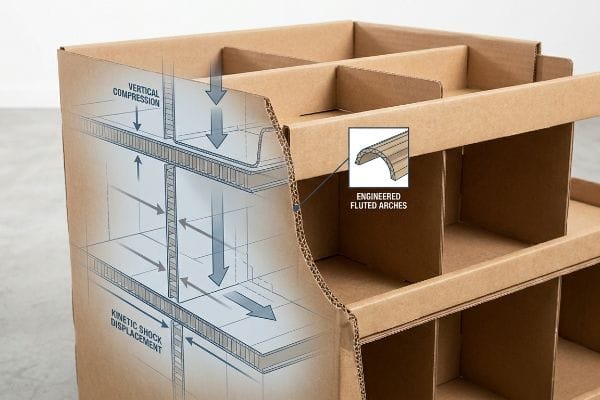
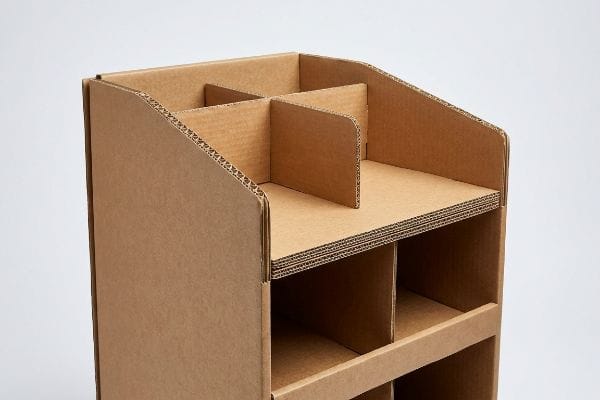
As caixas de exibição de papelão ondulado são estruturas de embalagem secundária de alta engenharia que utilizam arcos de papelão canelado para suportar cargas pesadas no varejo. Ao dissipar o impacto cinético e a compressão vertical, essas unidades de ponto de venda densas garantem uma integridade estrutural rigorosa, assegurando que as mercadorias resistam ao rigoroso transporte marítimo internacional e aos ambientes agressivos das grandes lojas.
Mas entender o conceito básico de papelão ondulado é inútil se você não souber como esses materiais realmente se comportam sob o estresse catastrófico da cadeia de suprimentos.
Qual é a resistência ao estouro de uma caixa de papelão ondulado?
Uma caixa pode parecer resistente em suas mãos, mas a resistência estática não significa nada até que ela enfrente o impacto dinâmico da logística global de frete.
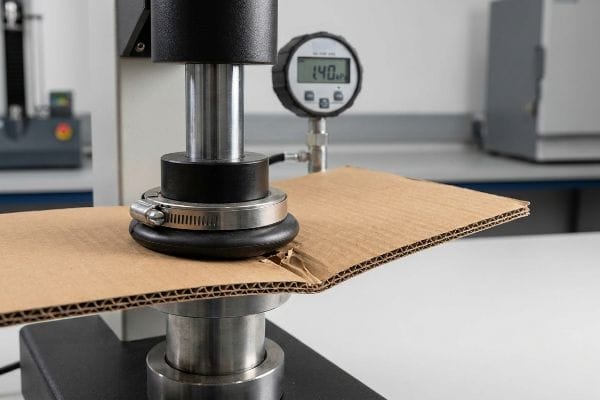
A resistência à ruptura de uma caixa de papelão ondulado mede a força física exata necessária para perfurar a face plana do papelão. Avaliada por meio de um teste de Mullen, essa métrica quantifica a resistência do substrato bruto a impactos localizados internos e externos antes que o núcleo ondulado sofra uma falha mecânica completa.
No entanto, conhecer os limites teóricos de uma folha plana não protege automaticamente a sua apresentação final depois de dobrada e carregada com mercadorias pesadas.
Os mecanismos de engenharia por trás da resistência à ruptura de Mullen
Quando os clientes me perguntam o que significa, de fato, resistência à ruptura, eu comparo com a tensão da pele de um tambor. Ela mede precisamente quanta pressão física concentrada a parede plana de papel pode suportarantes de se romper violentamente. No meu laboratório, usamos um diafragma hidráulico para aplicar pressão crescentediretamente na lateral de uma amostra de papelão bruto, o que nos fornece uma classificação Mullen de referência.
Mas é aqui que até mesmo designers veteranos muitas vezes ignoram um enorme ponto cego. Na semana passada, eu estava mostrando nossas instalações de teste a um novo gerente de produto, e ele presumiu que uma alta pontuação de resistência à ruptura garantia que toda a sua área de exposição no chão era indestrutível. Apontei para uma placa perfeitamente intacta de 32ECT (Teste de Compressão de Borda)³ e expliquei que, embora ela não se rompa facilmente se uma empilhadeira bater nela, essa resistência plana é completamente diferente da geometria dinâmica necessária para suportar a compressão por carga superior⁴.Eu sempre separo a resistência do material da durabilidade do sistema, garantindo que nunca confie puramente em métricas planas para prever o desempenho 3D no chão do armazém.
| Fase de Avaliação de Mullen | Resultado estrutural | ROI de referência |
|---|---|---|
| Teste de substrato bruto | Verifica os limites de resistência à perfuração5 | Previne danos localizados por impacto |
| Tradução de Geometria | Mapeia a força plana para uma forma 3D6 | Reduz significativamente o desperdício de materiais |
| Queda na simulação ISTA7 | Comprova a resistência dinâmica do conjunto | Garante a sobrevivência total da carga |
Eu nunca confio na classificação teórica de uma folha de matéria-prima para garantir a segurança de uma unidade de varejo totalmente montada. Exijo testes físicos de todo o sistema para assegurar que a geometria final realmente suporte a realidade brutal do manuseio em armazém.
🛠️ Mesa do Harvey: Você sabe se o seu fornecedor está testando seus displays como unidades totalmente montadas ou apenas fornecendo as especificações dos materiais? 👉 Solicite uma Auditoria de Lista de Materiais ↗ — Eu analiso pessoalmente cada arquivo estrutural em até 24 horas.
Como aumentar a resistência de uma caixa de papelão ondulado?
Adicionar mais camadas de papelão barato não salvará uma vitrine com problemas estruturais; apenas destruirá suas margens logísticas e aumentará o volume de seus envios.
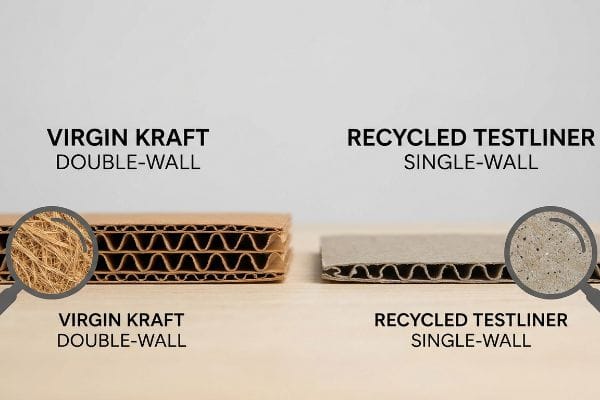
Aumentar a resistência de uma caixa de papelão ondulado exige o aumento da densidade das fibras do papel e o alinhamento preciso da orientação das ondulações. Ao optar por revestimentos de papel kraft virgem ou integrar reforços arquitetônicos de parede dupla, os engenheiros podem ampliar drasticamente a capacidade de compressão vertical sem adicionar volume excessivo à embalagem final.
Mas conhecer a teoria não basta quando as máquinas começam a funcionar e as equipes de compras, focadas no orçamento, exigem materiais 100% reciclados.
Por que o Testliner 100% reciclado falha na linha de produção?
É uma armadilha comum que apanha até mesmo equipas de compras experientes quando exigem materiais totalmente reciclados para cumprir quotas de sustentabilidade rigorosas. Assumem que o testliner reciclado altamente processado possui exatamente a mesma rigidez física que o cartão novo, ignorando completamente a realidade mecânica microscópica da repolpação do papel onde as fibras ficam fisicamente exaustas8.
Isso não é apenas teoria — lido com isso rotineiramente na linha de testes. Recentemente, um cliente exigiu papelão 100% reciclado para uma tampa de extremidade de uma garrafa de bebida , e seu fornecedor anterior concordou tacitamente. A princípio, presumi que um perfil de ondulação mais grosso, feito de material reciclado, suportaria o peso. Estava completamente enganado. Durante a simulação ISTA (International Safe Transit Association) 3A, vi a base quebrar a 85 kg (187,5 lbs) na mesa vibratória, porque as fibras de celulose recicladas em excesso estavam estruturalmente esgotadas e curtas demais para manter os arcos canelados. Descartei as suposições da agência e mudei para uma melhoria com material híbrido. Ao injetar exatamente 30% de kraft virgem de fibra longa estritamente na ondulação B, que suporta a carga, senti um aumento imediato na resistência tátil do papelão. Essa correção química e mecânica direcionada restaurou completamente a classificação de compressão exigida. Ao impor essa proporção híbrida, assegurei que a integridade estrutural resistisse ao empilhamento duplo de cargas, eliminando o risco de esmagamento e economizando milhares em estornos de varejistas para a marca.
| Pivô do substrato | Resultado físico | Retorno sobre o investimento financeiro/de conformidade |
|---|---|---|
| Injeção de Kraft Virgem 30% | Restaura o comprimento da fibra do papel | Impede o esmagamento total da unidade |
| Melhoria estrutural da flauta B | Solidifica arcos de sustentação de carga | Protege a marca de estornos |
| Matriz de Material Híbrido | Equilibra pontos fortes e objetivos ecológicos | Aprovado em rigorosas auditorias de varejistas |
Recuso-me a deixar que quotas cegas de sustentabilidade destruam a capacidade de carga dinâmica de uma unidade em alto mar. Engenharia de verdade significa encontrar a proporção exata de materiais que satisfaça tanto as exigências ambientais quanto as implacáveis forças gravitacionais.
🛠️ Harvey's Desk: Seus displays estão se deformando secretamente porque seu fornecedor depende exclusivamente de fibras de papel recicladas e desgastadas? 👉 Solicite uma Simulação de Tensão Estrutural 3D ↗ — 100% confidencial. Seus projetos de varejo ainda não lançados estão seguros comigo.
Como verificar a qualidade de uma caixa de papelão ondulado?
A qualidade não pode ser avaliada observando uma prova digital brilhante em um monitor; ela precisa ser comprovada sob o violento estresse mecânico de máquinas de produção pesada.
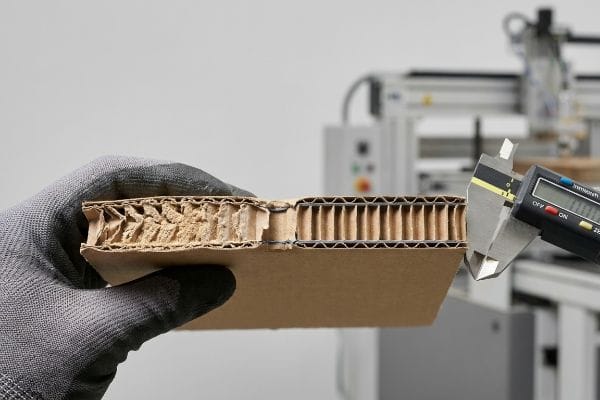
A verificação da qualidade das caixas de papelão ondulado envolve avaliações rigorosas de sua resistência mecânica ao esmagamento das bordas, teor de umidade e tolerâncias precisas de vinco. Os engenheiros de garantia da qualidade medem fisicamente a compressão das ondulações após a laminação para verificar se as máquinas de corte automatizadas não fraturaram as fibras críticas do papel necessárias para a resistência à carga vertical superior.
Mas conhecer a teoria não basta quando as máquinas começam a funcionar e microfraturas ocultas comprometem toda a base estrutural.
Os danos ocultos do corte com matriz de aço
As marcas frequentemente presumem que uma dobra visualmente perfeita em uma caixa cortada significa que a integridade estrutural subjacente está perfeitamente intacta. Elas ignoram completamente o violento impacto mecânico do processo de vinco, onde lâminas de aço sem corte forçam fibras de papel grossas e rígidas a se dobraremem 90 graus em uma fração de segundo.
Isso não é apenas teoria — aprendi da maneira mais difícil. Em 2021, pedi ao meu engenheiro-chefe de embalagens, Mark, para imprimir um novo lote de bandejas pesadas para lojas de atacado usando um papelão plano padrão. Achei que poderia economizar tempo de preparação dispensando os canais de vinco personalizados na impressora. Três dias depois, na câmara climática, ouvi o estalo horrível da ondulação B se deformando. Arranquei a folha superior impressa de uma amostra reprovada e senti as ondulações internas, esmagadas e pulverizadas, que haviam sido completamente destruídas pela força bruta da lâmina de aço. O papelão havia perdido toda a sua resistência à compressão justamente nos cantos críticos de sustentação. Para corrigir isso, imediatamente solicitei um ajuste mecânico urgente na fábrica. Instalei canais de vinco de matriz fêmea de polímero específicos diretamente na placa de corte. Essa bigorna personalizada controlava com precisão como as fibras de kraft virgem se esticavam durante o impacto em alta velocidade, preservando as curvaturas internas. Esta calibração de ferramentas de 0,14 polegadas (3,5 mm) ¹³ não apenas impediu o colapso da base; eliminou completamente a necessidade de fita adesiva manual secundária, reduzindo o tempo de montagem em 35 segundos por unidade e diminuindo drasticamente os custos de mão de obra.
| Calibração de máquinas | Resultado físico | ROI da montagem |
|---|---|---|
| Instalação de matriz polimérica14 | Atua como uma bigorna controlada | Impede o esmagamento interno da flauta |
| Ajuste de tensão da régua de aço15 | Impede microfraturas nas fibras do papel | Elimina o trabalho manual de aplicação de fita adesiva |
| Perfil de Pontuação Dinâmica16 | Garante dobras perfeitas a 90 graus | Reduz drasticamente o tempo de montagem |
Nunca confio numa dobra visualmente perfeita sem antes inspecionar fisicamente as ranhuras internas em busca de danos mecânicos ocultos. A calibração precisa da máquina é a única barreira entre um projeto estrutural bem-sucedido e uma falha catastrófica no armazém.
🛠️ Mesa do Harvey: Será que o equipamento de corte e vinco do seu fornecedor atual está danificando secretamente os cantos estruturais das suas caixas de transporte? 👉 Solicite uma Auditoria de Viabilidade de Linha de Corte e Vinco ↗ — Sem intermediários. Você fala diretamente com engenheiros estruturais.
Quais são as desvantagens do papelão ondulado?
O papelão é extremamente versátil, mas sua espessura física e natureza porosa introduzem variáveis de fabricação significativas que os projetistas amadores frequentemente deixam de calcular.
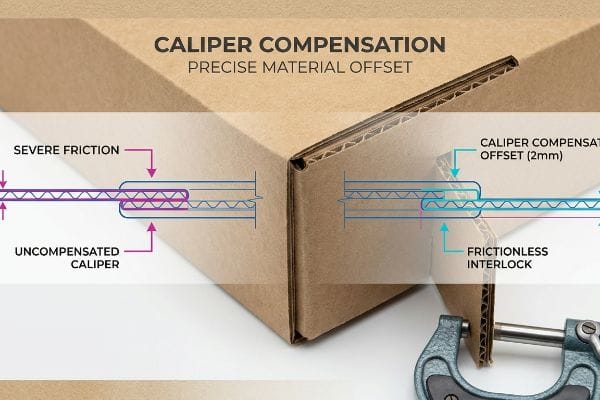
As desvantagens do papelão ondulado incluem sua vulnerabilidade inerente à absorção de umidade e sua espessura física, que dificulta a montagem precisa das abas. As bordas onduladas sem vedação podem absorver rapidamente a umidade ambiente, enquanto a espessura excessiva do material causa atrito severo nas abas, retardando o processo de embalagem e comprometendo a estabilidade estrutural final.
Mas conhecer a teoria não basta quando as máquinas começam a funcionar e os arquivos de projeto rígidos colidem com a física imprevisível dos materiais.
O gargalo da linha de corte de "compensação de calibrador"
Os designers gráficos frequentemente tratam o papelão como uma tela fina e bidimensional em seus softwares CAD (Desenho Auxiliado por Computador), ignorando completamente sua espessura física. Quando eles planejam as abas de encaixe para uma unidade de piso 3D, eles não percebem que dobrar uma placa de 0,12 polegadas (3 mm) de espessura consome material17, alterando drasticamente as dimensões físicas das ranhuras de travamento finais.
Isso não é apenas teoria — lido com isso na linha de testes sempre que um cliente envia um projeto de bandeja plana para a agência. Recentemente, um grande comprador do varejo enviou um projeto de bandeja enorme que parecia impecável na tela. A princípio, presumi que a equipe de engenharia deles havia calculado corretamente as tolerâncias de curvatura para a pesada tela de 18 canais em C. Estava completamente enganado. Quando minha equipe de embalagem terceirizada (3PL) tentou montar o primeiro protótipo, os encaixes estavam muito apertados. Arranquei a folha superior da junção e senti o atrito severo travando os painéis, fazendo com que toda a tela se curvasse violentamente, ficando fora de esquadro. Em vez de recorrer a clipes de plástico caros para consertar a bagunça, fiz as medições com o micrômetro. Provei que não precisava de peças de plástico volumosas — eu só precisava de um ajuste de material hiperpreciso. Matematicamente, aumentei a largura de cada encaixe em exatamente 0,08 polegadas (2 mm) 19 para absorver o raio externo da dobra. Ao impor rigorosamente essa compensação de calibragem, assegurei um processo de montagem sem atrito e sem rasgos, eliminando completamente a necessidade de peças moldadas por injeção e reduzindo o custo do material da unidade.
| Pivô de tolerância de engenharia | Resultado físico | Retorno sobre o investimento (ROI) de atendimento |
|---|---|---|
| Compensação de deslocamento do calibrador | Absorve a espessura da placa de 3 mm20 | Impede completamente o arqueamento estrutural21 |
| Alargamento de ranhura sem atrito | Garante um encaixe suave das abas | Reduz drasticamente o tempo de co-embalagem |
| Eliminação de peças de plástico | Garante a construção monomaterial22 | Reduz custos excessivos de materiais na lista de materiais |
Os moldes digitais não conseguem ditar as tolerâncias físicas de uma embalagem de alta resistência. O papelão ocupa espaço real quando dobrado, e impor cálculos rígidos em ondulações espessas garante uma falha catastrófica na montagem.
🛠️ Mesa do Harvey: Seus parceiros de armazém estão constantemente tendo dificuldades para encaixar abas de papelão mal projetadas durante a montagem rápida? 👉 Solicite um redesenho paramétrico em CAD ↗ — Analiso pessoalmente cada arquivo estrutural em até 24 horas.
Conclusão
Você pode escolher o fornecedor de papelão mais barato do mercado, mas quando essas fibras recicladas, estruturalmente desgastadas, inevitavelmente colapsarem na mesa vibratória, você corre o risco de destruir todo o seu estoque e aniquilar completamente a margem de lucro do projeto. Essa mesma revisão de engenharia detectou recentemente um erro fatal de tolerância de 2 mm em um grande lançamento nacional antes da produção. Pare de desperdiçar seu orçamento de marketing com displays estruturais defeituosos e deixe-me projetar pessoalmente seu próximo lançamento ↗ para garantir a máxima resistência física e a conformidade com as normas de varejo sem problemas.
"Teste de Resistência à Ruptura – Centro de Embalagens e Projeto de Carga Unitária", https://www.unitload.vt.edu/facilities/corrugated-packaging-lab/bursting-strength-testing.html. Uma norma técnica oficial definiria a resistência à ruptura como a resistência de um material à ruptura sob uma pressão hidráulica específica. Papel da evidência: definição; tipo de fonte: norma técnica. Fundamentos: A definição física de resistência à ruptura. Nota de escopo: Relaciona-se especificamente aos parâmetros do teste Mullen .
"[PDF] TESTADORES DE RUPTURA MULLEN®", https://admin.sdlatlas.com/public/content/cms/Replacing_Diaphragm_Mullen.pdf?_t=1745505605. As especificações do equipamento para testadores Mullen confirmam o uso de um diafragma hidráulico para exercer pressão localizada em uma amostra. Papel da evidência: verificação da metodologia; tipo de fonte: manual técnico. Suporte: O funcionamento mecânico do teste. Nota de escopo: Limitado ao aparelho de teste baseado em diafragma. ↩
"Caixas de Papelão Ondulado 32 ECT", https://www.papermart.com/p/corrugated-boxes/161020?srsltid=AfmBOorxAQxqbBGyetzRnThK96iWwgo37Lphi0G8CdMmdhaph28TgDxf. Especificação técnica do papelão ondulado 32 ECT, detalhando sua resistência à compressão vertical e capacidade de carga padrão da indústria. Papel da evidência: especificação técnica; tipo de fonte: padrão da indústria. Fundamentos: o uso do 32 ECT como referência para compressão estrutural. Observação: os valores de ECT variam de acordo com o tipo de ondulação e a gramatura do revestimento .
"Caixas de Teste de Mullen vs. Caixas de Teste de Compressão de Borda", https://crownpack.com/wp-content/uploads/2023/11/Crown-Packaging-Mullen-vs-ECT-Whitepaper.pdf. Explicação técnica que distingue entre resistência ao estouro (resistência à perfuração) e resistência à compressão (resistência ao esmagamento vertical). Papel da evidência: distinção conceitual; tipo de fonte: manual de engenharia de embalagens. Apoia: a afirmação de que as métricas de resistência plana não predizem o desempenho estrutural 3D. Nota de escopo: aplica-se à mecânica do papelão ondulado .
"Teste de Resistência à Ruptura", https://unitload.vt.edu/facilities/corrugated-packaging-lab/bursting-strength-testing.html . Especificações técnicas de normas de embalagem (como a TAPPI) que explicam como o teste do substrato bruto estabelece os limites de resistência à perfuração e à ruptura. Papel da evidência: verificação técnica; tipo de fonte: norma da indústria. Apoia: o propósito do teste do substrato. Nota de escopo: aplica-se especificamente à fase de matéria-prima.
"Estimativa da resistência à compressão de papelão ondulado…", https://pmc.ncbi.nlm.nih.gov/articles/PMC8467740/. Princípios de engenharia que descrevem a tradução matemática da resistência à ruptura em 2D para a capacidade de carga estrutural de uma caixa 3D dobrada. Papel da evidência: metodologia de engenharia; tipo de fonte: livro didático revisado por pares. Fundamentos: o processo de tradução geométrica. Nota de escopo: sujeito a variações com base no projeto da caixa. ↩
"Procedimentos de Teste – Associação Internacional de Trânsito Seguro", https://ista.org/test_procedures.php. Protocolos oficiais da Associação Internacional de Trânsito Seguro (ISTA) que detalham como os testes de queda simulada validam a resistência dinâmica de embalagens montadas. Papel da evidência: norma regulatória; tipo de fonte: organização do setor. Apoia: a eficácia dos testes da ISTA para a sobrevivência da carga. Nota de escopo: específico para as normas de teste da ISTA .
"Efeito da adição de nanocelulose nas propriedades mecânicas do papel", https://pmc.ncbi.nlm.nih.gov/articles/PMC10780965/. Explicação técnica de como ciclos repetidos de reciclagem degradam o comprimento e a resistência das fibras de celulose, reduzindo a integridade estrutural do papel. Papel da evidência: validação técnica; tipo de fonte: periódico de ciência dos materiais. Apoia: a afirmação de que as fibras recicladas perdem rigidez física. Nota de escopo: específico para processos de repolpação mecânica .
"Embalagens de papelão ondulado com design inovador para…", https://bioresources.cnr.ncsu.edu/resources/corrugated-board-packaging-with-innovative-design-for-enhanced-durability-during-transport/. Explicação técnica de como ciclos repetidos de reciclagem reduzem o comprimento da fibra de celulose, comprometendo a estabilidade estrutural do papelão ondulado. Papel da evidência: verificação técnica; tipo de fonte: periódico de ciência dos materiais. Fundamentos: a relação entre a degradação da fibra e a falha estrutural. Nota de escopo: Princípio geral da reciclagem de papel. ↩
"Resistência à Compressão de Embalagens de Papelão Ondulado com Baixa …", https://pmc.ncbi.nlm.nih.gov/articles/PMC10054506/. Dados empíricos que demonstram como a introdução de fibras kraft virgens aumenta a resistência ao teste de esmagamento de borda (ECT) e a capacidade de compressão vertical. Papel da evidência: validação quantitativa; tipo de fonte: norma de engenharia de embalagens. Apoia: o benefício de misturas de fibras híbridas para a integridade estrutural. Nota de escopo: específico para benchmarks de porcentagem de fibra. ↩
"O Passado, o Presente e o Futuro do Corte e Vinco de Papelão Ondulado", https://sunautomation.com/the-past-present-and-future-of-corrugated-die-cutting/. Explicação técnica de como o vinco com lâmina de aço cria tensão mecânica e potencial fratura das fibras no papelão ondulado. Papel da evidência: mecanismo técnico; tipo de fonte: guia de engenharia de embalagens industriais. Argumenta: que os processos de vinco podem comprometer a integridade estrutural. Nota de escopo: refere-se especificamente ao papelão ondulado .
"Influência das linhas de vinco analógicas e digitais nas propriedades mecânicas…", https://pmc.ncbi.nlm.nih.gov/articles/PMC9268991/ . Documentação técnica que explica como as matrizes de vinco de polímero previnem o esmagamento das fibras e preservam a integridade das ondulações em papelão ondulado. Papel da evidência: validação técnica; tipo de fonte : manual de engenharia da indústria. Fundamentos: a eficácia dos canais da matriz na proteção das curvaturas internas. Nota de escopo: específico para ondulações tipo B ou perfis de papelão ondulado similares.
"Modelos de projeto para embalagens de papelão ondulado", https://www.researchgate.net/profile/Ernesto_Mottola/publication/332763340_Design_models_for_corrugated_board_packaging/links/5cc861d792851c8d220ff540/Design-models-for-corrugated-board-packaging.pdf . Especificações de engenharia que verificam as medições de calibração padrão para matrizes de vinco tipo B , visando evitar esmagamento. Papel da evidência: verificação quantitativa; tipo de fonte: ficha técnica. Suportes: a medição específica utilizada para manter a resistência estrutural à carga. Nota de escopo: a calibração pode variar de acordo com a qualidade do papelão e a gramatura do revestimento.
"Como estabilizar a estrutura de papelão? – PopDisplay", https://popdisplay.me/how-to-make-a-cardboard-structure-stable/. Guia técnico completo que explica como matrizes poliméricas atuam como bigornas controladas para evitar a compressão das ondulações durante o corte e vinco. Função da evidência: especificação técnica; tipo de fonte: manual da indústria. Benefícios: prevenção do esmagamento interno das ondulações. Observação: especificamente para substratos de papelão ondulado .
"Corte com Lâmina de Aço – American Micro Industries", https://www.americanmicroinc.com/die-cutting/steel-rule-die-cutting/. Pesquisa técnica sobre a relação entre a tensão da lâmina e a integridade das fibras de celulose em papelão ondulado. Papel da evidência: comprovação em ciência dos materiais; tipo de fonte: periódico revisado por pares. Benefícios: prevenção de microfraturas nas fibras do papel. Nota de escopo: foco em processos de corte com lâmina de alta pressão .
"O Guia Definitivo para Caixas de Papelão Ondulado", https://www.shorr.com/resources/blog/ultimate-guide-corrugated-boxes/. Norma de fabricação que detalha como perfis de vinco ajustados garantem uma geometria de dobra precisa. Papel da evidência: norma de controle de qualidade; tipo de fonte: diretriz da indústria. Benefícios: garantia de dobras perfeitas a 90 graus. Observação sobre o escopo: aplicável a máquinas automatizadas de conversão de papelão ondulado .
"Determinação Analítica da Rigidez à Flexão de uma Estrutura de Cinco Camadas…", https://pmc.ncbi.nlm.nih.gov/articles/PMC8777652/. Um manual de embalagens industriais ou um guia de engenharia verificaria o princípio físico da tolerância à dobra, mostrando como a espessura do material (calibre) afeta as dimensões finais de uma dobra. Papel da evidência: verificação técnica; tipo de fonte: norma industrial. Apoia: a afirmação de que a espessura do material deve ser considerada no projeto da linha de corte. Nota de escopo: Aplica-se a substratos de papelão ondulado .
"Construções em Papelão: Cálculo da Tolerância de Dobra 1 – YouTube", https://www.youtube.com/watch?v=j1n5ojAbAic. Explicação técnica de como a espessura do material e os perfis de ondulação exigem tolerâncias de dobra específicas na engenharia de embalagens. Papel da evidência: validação; tipo de fonte: manual de engenharia de embalagens. Fundamentos: a necessidade de calcular o deslocamento do material durante a dobra. Nota de escopo: específico para dimensões de ondulação C. ↩
"Tolerâncias RSC para Montadores e Empacotadores de Caixas – AICC Now", https://now.aiccbox.org/rsc-tolerances-for-case-erectors-and-packers/. Especificações padrão da indústria para tolerâncias de ranhura em papelão ondulado, considerando a espessura do material e o raio de dobra. Função da evidência: verificação; tipo de fonte: norma técnica de projeto. Suporte: a medição específica usada para compensação da espessura, garantindo uma montagem sem atrito. Observação: a tolerância pode variar conforme a qualidade do papelão .
"Como a espessura do papelão impacta o desempenho de caixas dobráveis…", https://brownpackaging.com/how-board-caliper-impacts-folding-carton-performance-and-cost/. Normas técnicas de embalagem ou guias de engenharia verificariam se uma folga de 3 mm é uma tolerância padrão para tipos específicos de ondulação do papelão. Papel da evidência: especificação técnica; tipo de fonte: manual da indústria. Suportes: a dimensão específica necessária para a compensação da espessura. Observação: a espessura real varia de acordo com o tipo de ondulação (por exemplo, ondulação B, C ou E) .
"Projeto Ótimo de Embalagens de Papelão Ondulado de Parede Dupla – PMC", https://pmc.ncbi.nlm.nih.gov/articles/PMC8950760/ . Pesquisas de engenharia sobre mecânica estrutural em embalagens validariam como os deslocamentos da linha de corte mitigam a tensão e a curvatura do material. Papel da evidência: verificação de resultados; tipo de fonte: estudo de engenharia. Apoia: a eficácia da compensação na eliminação da deformação. Nota de escopo: A eficácia pode variar de acordo com a gramatura do papelão e a direção da dobra.
"Sustentabilidade e embalagens minimalistas andam de mãos dadas", https://popdisplay.me/sustainability-and-minimalist-packaging-go-hand-in-hand/. As diretrizes da indústria sobre design de embalagens sustentáveis confirmariam como a substituição de fechos plásticos por abas de papelão possibilita a monomaterialidade para reciclagem. Papel da evidência: norma de design; tipo de fonte: regulamentação ambiental. Apoia: a afirmação de que a remoção de componentes plásticos permite alcançar o status de monomaterial. Nota de escopo: Aplica-se somente se os adesivos utilizados também forem recicláveis .