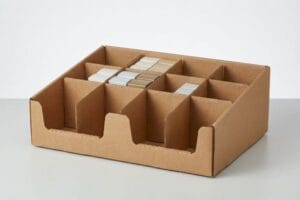
Launching a retail campaign without understanding the structural realities of your merchandising materials is a guaranteed way to bleed budget and frustrate store managers.
Learning about corrugated POP displays means understanding temporary, cost-effective retail structures designed to hold and promote merchandise. Made from layered paperboard, these freestanding or counter-mounted units drive impulse purchases, elevate brand visibility, and are easily recycled globally through standard supply chains after seasonal promotional campaigns end.
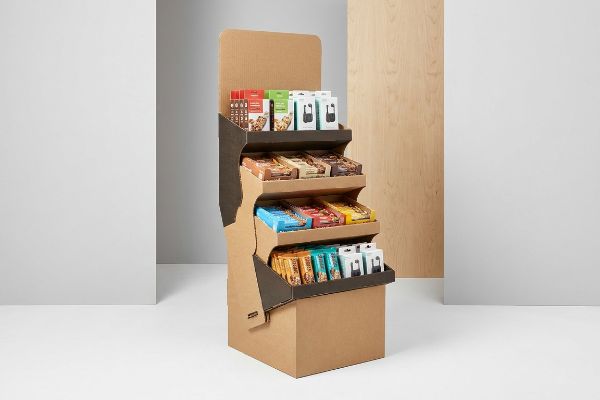
But knowing the basic definition won't save your campaign when the assembly line hits a physical bottleneck. Let's look at how these structures actually survive the retail floor.
What are the four basic types of displays?
Selecting the right structural format dictates whether your product gets premium aisle placement or ends up hidden in a dusty backroom corner.
The four basic display types include floor stands, countertop units, pallet merchandisers, and shelf trays. Floor stands occupy aisles, countertop units drive register impulse buys, pallet merchandisers hold bulk items, and shelf trays organize products directly on permanent store fixtures, all maximizing product visibility and access.

Understanding these formats is just step one, but getting them to balance correctly under heavy product loads is where things get complicated.
The Tipping Point of Countertop Formats
Many marketing teams instinctively choose countertop units for high-margin cosmetics or electronics because they sit right at the checkout register. The standard approach is to simply shrink a floor stand's graphics down into a small, vertical box, ignoring the physics of a raised surface.
I see this happen constantly when designers ignore the 2:3 depth-versus-height ratio rule1. A brand will send me a tall, top-heavy skincare unit, and when I load the physical sample on my desk, the slight flex of the raw paperboard causes the entire unit to tilt forward, bringing the heavy glass bottles dangerously close to falling. To fix this, I always engineer an extended easel back or a locked false bottom to shift the center of gravity downward. This simple structural anchor prevents the unit from tipping over and saves clients from costly retailer rejections.
| Common Rookie Mistake | The Pro Fix | Retail-Floor Benefit |
|---|---|---|
| Designing tall, top-heavy units | Adding an extended easel back2 | Prevents register tip-overs |
| Ignoring depth-to-height ratios | Enforcing a strict 2:3 ratio3 | Keeps heavy items stable |
| Relying on single-wall bases | Utilizing a locked false bottom4 | Stops bottom-tier sagging |
I never approve a countertop file until I physically load it and bump the desk. Over-engineering the back support is the only way I ensure your structure survives the chaotic environment of a busy checkout lane.
🛠️ Harvey's Desk: Are your countertop units mathematically balanced to handle your heaviest glass bottles? 👉 Send Me Your Flat Dieline File ↗ — Direct access to my desk. Zero automated sales spam, I promise.
What are the six display guidelines?
Retailers enforce strict spatial guidelines, but engaging the shopper requires a psychological framework that works at varying distances down the aisle.
The six display guidelines generally dictate strict structural footprint limits, clear brand messaging, high product visibility, easy consumer access, safe weight distribution, and simple assembly. Following these universal physical and visual rules ensures that merchandising structures pass strict retailer audits while effectively driving shopper engagement and sales.
Hitting those compliance checklists is mandatory, but checking a box doesn't mean the shopper will actually stop walking.
Mastering the 3-3-3 Spatial Engagement Rule
Brands frequently design their structural graphics while zoomed in5 on a backlit computer monitor. They assume that if a logo looks crisp from 12 inches (30.48 cm) away, the shopper will naturally gravitate toward it in a massive warehouse environment.
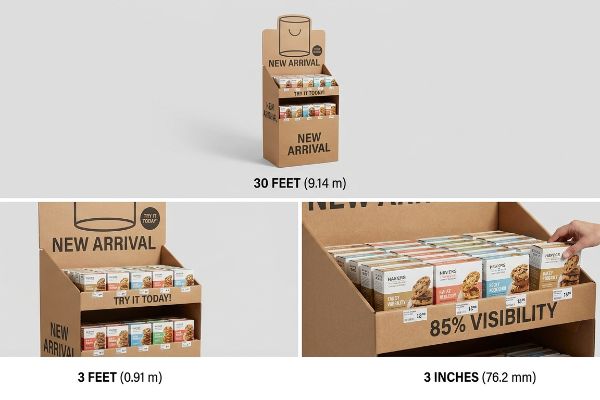
This causes a massive disconnect when the physical unit hits the floor. I constantly intercept artwork that is packed with tiny text, which turns into visual mud under harsh fluorescent lighting, forcing the shopper to squint just to read the price. To fix this, I enforce the 3-3-3 rule, ensuring your unit grabs attention from 30 feet (9.14 m) away with a bold die-cut, explains the offer at 3 feet (0.91 m), and allows tactile access at 3 inches (76.2 mm). The physical friction of a shopper trying to pull a product from a retaining lip that is too high kills conversions instantly, so we specifically cut the front tray to guarantee 85% product visibility.
| Common Rookie Mistake | The Pro Fix | Retail-Floor Benefit |
|---|---|---|
| Cramming paragraphs of text | Using one bold 30-foot hook | Stops aisle foot traffic |
| Hiding product behind high lips | Cutting trays for 85% visibility | Increases impulse grab rate |
| Designing strictly for screens | Testing under fluorescent light | Prevents washed-out colors |
I strip away the visual clutter because confused shoppers simply keep walking. By forcing your design to respect these physical distances, I ensure your campaign converts foot traffic into measurable sales.
🛠️ Harvey's Desk: Are your front retaining lips accidentally hiding your primary product labels from the shopper's view? 👉 Request a Spatial Audit ↗ — Download safely. My inbox is open if you have questions later.
What is a corrugated display?
Beyond just folded cardboard, these units are engineered mechanical structures designed to hold massive amounts of weight while maintaining a pristine cosmetic appearance.
A corrugated display is a temporary merchandising fixture constructed from layered paperboard featuring a fluted inner core. Engineered for optimal strength-to-weight ratios, these structures safely hold heavy retail goods, support vibrant custom graphics, and can be efficiently flat-packed for economical shipping to distribution centers worldwide.
The material looks simple from the outside, but orienting the hidden internal fibers incorrectly will cause a catastrophic failure.
The Hidden Physics of Grain Direction
A common assumption is that simply upgrading to a thicker board grade6 will automatically make a merchandiser stronger. Buyers often focus entirely on the external print quality, completely ignoring how the internal flutes are aligned within the die-cut template7.
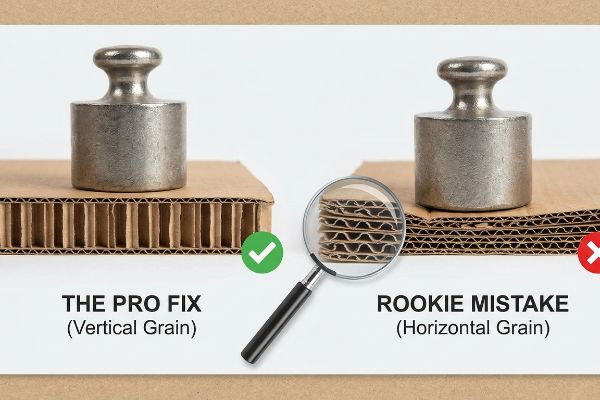
Think of corrugated flutes like tiny architectural pillars holding up a roof; if you turn a pillar on its side, it immediately snaps under pressure. I see this exact mistake when designers orient the grain horizontally to fit more pieces onto a single sheet of material to save a few pennies, and when I physically press down on these panels, the board yields with a sickening crunch. My absolute rule of thumb is to strictly orient the grain vertically on all load-bearing walls. This mathematically maximizes stacking strength and completely eliminates bottom-tier sag during freight transit.
| Common Rookie Mistake | The Pro Fix | Retail-Floor Benefit |
|---|---|---|
| Orienting board grain horizontally | Forcing vertical grain alignment8 | Prevents load-bearing collapse |
| Relying strictly on thicker board | Engineering the flute direction9 | Saves wasted material costs |
| Optimizing sheet space over strength | Prioritizing vertical corner support10 | Survives heavy transit vibration |
I refuse to compromise the structural integrity of your unit just to squeeze one extra piece onto a cutting sheet. Aligning the physics correctly from day one means your merchandise arrives on the floor intact.
🛠️ Harvey's Desk: Not sure if your current die-lines have the grain direction mapped vertically for maximum compression strength? 👉 Let Me Inspect Your Files ↗ — No forms that trigger endless sales calls. Just pure value.
What are retail pop displays?
Point-of-Purchase units are the final conversion engines in a physical store, standing precisely where consumers make their ultimate buying decisions.
Retail POP displays are strategic merchandising structures placed near checkout counters or high-traffic aisles to trigger immediate impulse purchases. By disrupting the normal shopping pattern with bold graphics and accessible product placement, these units effectively convert passive browsers into active buyers during their final store journey.
But knowing the theory isn't enough when the machines start running and your beautifully designed structure faces the brutal reality of warehouse logistics.
The Pallet Overhang and BCT Collapse
Procurement teams often maximize their master carton dimensions to fit just a few more units inside, assuming a heavy-duty board's raw compression metrics will protect the goods. They design these shippers in a vacuum, focusing solely on the internal product rather than the physical environment of a distribution center.
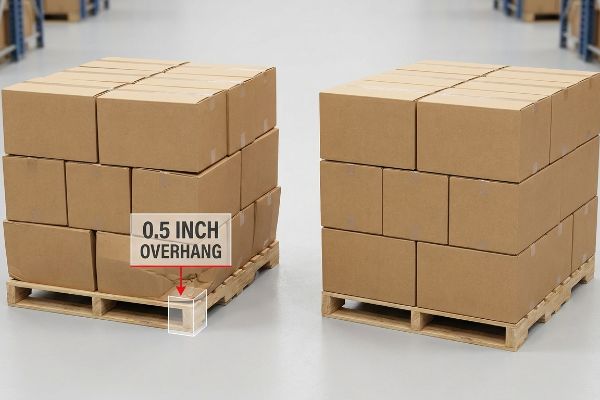
This isn't just theory—I see this happen on the testing floor when a master carton overhangs a standard 48×40 inch (1219.2×1016 mm) GMA11 (Grocery Manufacturers Association) pallet by just 0.5 inches (12.7 mm). A box derives up to 60% of its vertical strength12 specifically from its four corners, and when I load these overhanging boxes into the compression chamber, those unsupported corners carry zero load. I strictly enforce a zero-overhang bounding box in our CAD (Computer-Aided Design) software, mathematically shrinking the footprint by 12.7 mm to guarantee the corners remain fully supported on the wood deck. By enforcing this micro-adjustment, I ensure the master carton maintains its full BCT (Box Compression Test) strength, saving clients thousands in LTL (Less-Than-Truckload) transit damages.
| Common Rookie Mistake | The Pro Fix | Retail-Floor Benefit |
|---|---|---|
| Overhanging the wood pallet base | Enforcing zero-overhang bounds | Prevents master carton crushing |
| Ignoring vertical corner compression | Anchoring corners to the deck | Maintains 60% structural strength13 |
| Maximizing box volume blindly | Adjusting CAD footprint by 12.7 mm14 | Stops costly retailer chargebacks |
I rely on precise spatial math, not hope, to get your products safely through the supply chain. Shaving off half an inch in the design phase is the exact difference between a successful rollout and a crushed shipment.
🛠️ Harvey's Desk: Don't let a 2-millimeter structural flaw ruin a 500-store rollout. 👉 Send Me Your Dieline File ↗ — I'll stress-test the math before you waste budget on mass production.
Conclusion
You can choose a cheaper vendor to save pennies on corrugated board, but when that overhanging master carton buckles under top-heavy warehouse weight, the resulting base-tier collapse will slow down the receiving line by an estimated 30% and trigger immediate retailer rejection. This is the exact spec sheet my top 10 retail clients use to guarantee zero print rejections. Stop guessing on pallet tolerances and let me personally run your files through my Free Dieline Pre-Flight Audit ↗ to catch fatal load-bearing errors before mass production begins.
"Standard Kitchen Countertop Height and Depth – LX Hausys", https://www.lxhausys.com/us/blog/kitchen-standard-countertop-height/. [An industry handbook or structural design guide for point-of-purchase displays would verify the recommended depth-to-height ratios to ensure freestanding stability]. Evidence role: technical specification; source type: industry manual. Supports: stability requirements for countertop units. Scope note: Specific to paperboard and lightweight display materials. ↩
"Preventing Foam and Flowers from Falling Off the Easel | TikTok", https://www.tiktok.com/@jolenesfloralexpression/video/7472575717859986718. [Retail display design standards document the use of extended easel backs to shift the balance point and prevent tipping of top-heavy units]. Evidence role: mechanical fix; source type: display design handbook. Supports: stability of top-heavy units. Scope note: applies to vertical support structures. ↩
"Chapter 9: Built-In Elements – Access-Board.gov", https://www.access-board.gov/ada/chapter/ch09/. [Packaging engineering manuals provide specific depth-to-height ratios to ensure the center of gravity remains stable for retail displays]. Evidence role: technical specification; source type: industry standard. Supports: structural stability for heavy items. Scope note: applicable to tabletop formats. ↩
"Lock Boxes: Loss Prevention Solutions | Marketing Impact Ltd.", https://displaypeople.com/products/loss-prevention/lock-boxes/. [Structural design guides for corrugated packaging explain how false bottoms distribute vertical loads to prevent sagging in bottom tiers]. Evidence role: structural solution; source type: packaging engineering guide. Supports: prevention of bottom-tier sagging. Scope note: specific to single-wall base designs. ↩
"Signage viewing distance – The Interpretive Design Company", https://interpretivedesign.com.au/faqs/signage-viewing-distance/. [Professional environmental graphic design guidelines identify the failure to simulate physical viewing distance during digital design as a common industry pitfall]. Evidence role: industry practice; source type: design manual. Supports: common design mistakes in retail. Scope note: specifically for large-scale retail environments. ↩
"Guide to Understanding Flutes in Corrugated Boxes – Gentlever", https://gentlever.com/flutes-types-sizes-and-thickness-in-corrugated-boxes/. [Technical literature on corrugated packaging explains that board thickness is secondary to flute orientation for load-bearing strength]. Evidence role: technical correction; source type: packaging engineering guide. Supports: the misconception that thickness alone increases strength. Scope note: Applies to vertical compression strength. ↩
"Understanding Shipping Box Strength – EcoEnclose", https://www.ecoenclose.com/blog/understanding-shipping-box-strength/?srsltid=AfmBOorjREQ-GI0XkgW3KTbts6n_9g4OdteJNODI77nm1nUAnF3ZKV5n. [Industry standards for die-cutting corrugated board specify that aligning flutes vertically maximizes stacking strength]. Evidence role: technical specification; source type: manufacturing manual. Supports: the critical nature of flute orientation in structural integrity. Scope note: focuses on structural engineering of displays. ↩
"Estimation of the Compressive Strength of Corrugated Board Boxes …", https://pmc.ncbi.nlm.nih.gov/articles/PMC8467740/. [Industry engineering manuals for corrugated packaging demonstrate that vertical flute orientation is critical for maximizing stacking strength and preventing structural collapse]. Evidence role: technical verification; source type: industry standard; Supports: the role of grain alignment in load-bearing capacity; Scope note: applies specifically to axial compression. ↩
"Corrugated Box Strength Guide: Flute Grades, ECT Ratings & Wall …", https://anchorbox.com/corrugated-box-strength/. [Materials science research indicates that optimizing flute orientation offers a higher strength-to-weight ratio than simply increasing board caliper, thereby reducing material waste]. Evidence role: technical verification; source type: scholarly journal; Supports: material cost savings through structural engineering; Scope note: focused on material efficiency. ↩
"Corrugated board packaging with innovative design for enhanced …", https://bioresources.cnr.ncsu.edu/resources/corrugated-board-packaging-with-innovative-design-for-enhanced-durability-during-transport/. [Logistics and packaging studies show that reinforced vertical corner posts mitigate the effects of harmonic vibrations and lateral shifts during transit]. Evidence role: technical verification; source type: logistics research; Supports: the ability of displays to survive heavy transit vibration; Scope note: pertains to reinforced shipping containers. ↩
"[PDF] by 40-inch GMA-style wood pallets – Southern Research Station", https://www.srs.fs.usda.gov/pubs/VT_Publications/05t10.pdf. [Official logistics standards from the Grocery Manufacturers Association verify the dimensional specifications for standard shipping pallets used in North American retail]. Evidence role: Fact check; source type: Industry standard. Supports: The baseline dimensions for calculating pallet overhang. Scope note: Specific to North American standards. ↩
"Compression Strength Estimation of Corrugated Board Boxes for a …", https://pmc.ncbi.nlm.nih.gov/articles/PMC9864211/. [Packaging engineering literature and Box Compression Test (BCT) analysis typically quantify how vertical loads are concentrated in the corners of corrugated containers]. Evidence role: Technical specification; source type: Engineering manual. Supports: The claim that corner stability is paramount to BCT strength. Scope note: Exact percentages may vary by board grade and flute type. ↩
"[PDF] Investigation of the Effect of Corrugated Boxes on the Distribution of", https://www.unitload.vt.edu/content/dam/unitload_vt_edu/graduate-research-and-subpages-pictures-and-docs/thesis-and-dissertations-/Clayton%20-%20ETD%20-%20Investigation%20of%20the%20Effect%20of%20Corrugated%20Boxes%20on%20the%20Distribution%20of%20Compression%20Stresses%20on%20the%20Top%20Surface%20of%20Wooden%20Pallets.pdf. [Packaging engineering data on Box Compression Test (BCT) values would quantify the percentage of load-bearing capacity lost when vertical corners are not properly supported]. Evidence role: quantitative verification; source type: technical packaging manual. Supports: the claim that anchoring corners preserves a specific percentage of structural integrity. Scope note: Strength retention may vary based on corrugated board grade and flute type. ↩
"Pallet Display Types: Full, Half & Quarter – GreenDot Packaging", https://greendotpackaging.com/understanding-pallet-display-types-full-half-and-quarter-pallet-displays/. [Retail compliance guidelines typically specify precise dimensional tolerances to ensure palletized displays fit within designated floor slots without overhang]. Evidence role: technical specification; source type: retail logistics standard. Supports: the use of a 12.7 mm (0.5 inch) offset to avoid retailer chargebacks. Scope note: This measurement is standard for US-based retail pallet footprints. ↩