Your brand is ready for the retail floor, but navigating the supply chain feels like a maze. A single misstep here delays launches and devours your profit margins instantly.
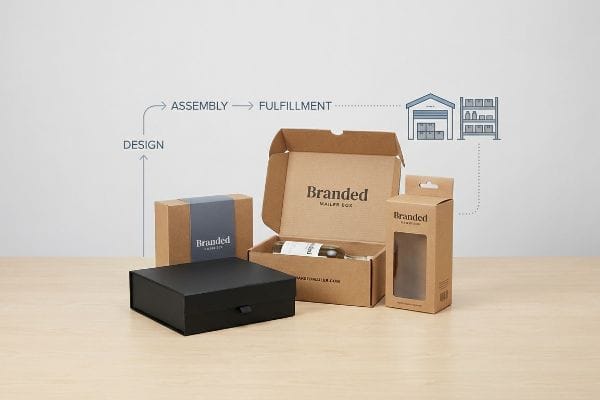
Contract packaging is a specialized service where third-party manufacturers handle the design, assembly, and fulfillment of your product. This includes creating retail-ready merchandisers, packing primary goods into secondary structures, and ensuring global logistics compliance, allowing brands to scale operations efficiently without investing in dedicated warehouse infrastructure.
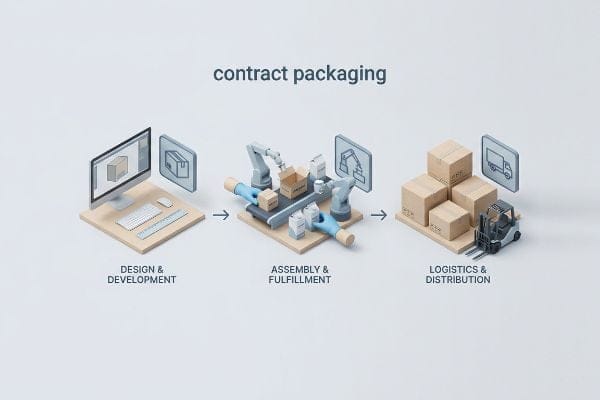
Understanding this ecosystem isn't just about outsourcing labor; it's about engineering a frictionless pipeline from my factory floor directly to the retailer's aisle.
What are the 5 P's of packaging?
Many teams treat packaging as a simple box, but true retail execution demands a strategic framework to survive competitive aisles.
The 5 P's of packaging are promote, position, present, provide, and protect. These fundamental pillars guide designers in creating structural solutions that capture consumer attention, communicate brand value clearly, display products securely, offer necessary product information, and defend goods against transit damage across global retail supply chains.
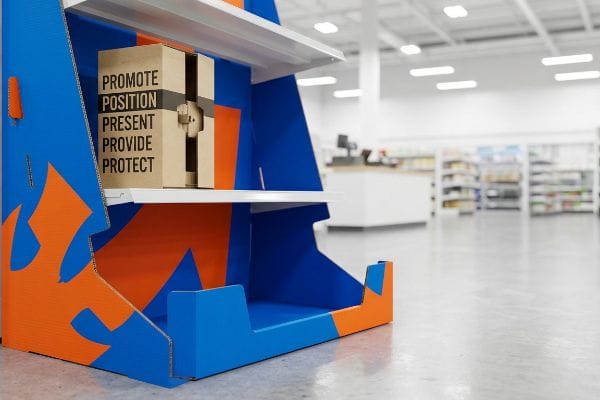
Knowing these pillars is helpful for theory, but executing the "Promote" and "Present" phases on a chaotic store floor is where most campaigns actually fail.
Mastering the 5 P's with the 3-3-3 Engagement Rule
Even experienced procurement teams often design retail merchandisers strictly for up-close viewing on high-definition monitors. They meticulously craft the "Provide" and "Position" elements with tiny, intricate text, assuming shoppers will stop and read every detail. However, this approach completely ignores the physical reality of how humans actually navigate big-box aisles1.
In my facility, I constantly see beautiful artwork that fails to pull foot traffic because it ignores the 3-3-3 spatial engagement rule2. The trap happens when brands forget that a corrugated display must disrupt visually from thirty feet away, engage interest at three feet, and drive the tactile conversion at three inches (7.62 cm). I once watched a brand manager realize their text-heavy design was invisible from down the aisle, resulting in a unit that shoppers physically ignored. To fix this, I engineered aggressive die-cut shapes and flooded the primary panels with high-contrast PMS (Pantone Matching System) spot colors. Hearing the loud, satisfying snap of a well-engineered locking tab as we adjusted the 50-inch (127 cm) strike zone3 proved the display was now ready to actively sell, cutting through the visual clutter and driving impulse purchases.
| Common Rookie Mistake | The Pro Fix | Retail-Floor Benefit |
|---|---|---|
| Tiny text for 30-foot viewing | Aggressive die-cut structural shapes | Grabs distant shopper attention |
| Muted CMYK background art | High-contrast PMS spot color floods | Prevents visual aisle blending |
| High retaining lips on shelves | Cutting the front lip by 85% | Increases physical product interaction |
I never rely on microscopic text to do the heavy lifting of a retail promotion. I engineer structural disruption that commands attention from across the store, ensuring your merchandiser actively pulls traffic rather than just holding inventory.
🛠️ Harvey's Desk: Are your current floor displays invisible from thirty feet away? 👉 Get A Structural Strategy Review ↗ — Direct access to my desk. Zero automated sales spam, I promise.
What are the 4 types of packaging?
Categorizing your physical assets correctly is the first step toward optimizing your logistics and preventing massive chargebacks from major retailers.
The 4 types of packaging are primary, secondary, tertiary, and ancillary. Primary holds the actual product, secondary groups individual units for retail display, tertiary protects bulk goods during palletized freight transit, and ancillary includes functional structural components like tapes, adhesives, labels, and protective cushioning materials.
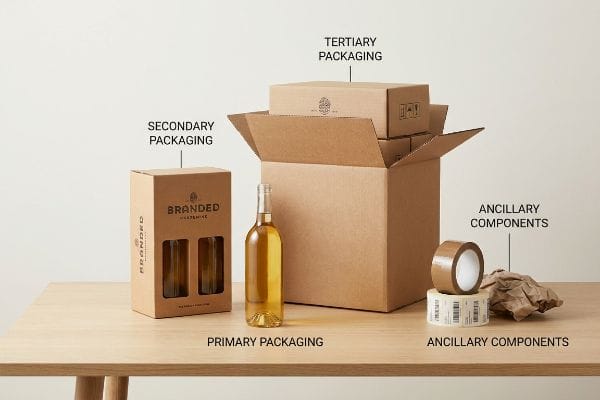
While the categories sound straightforward, transitioning from a protective tertiary shipper into a secondary retail-ready unit often creates structural nightmares.
Navigating the 4 Types: The RSC vs. HSC Dilemma
A frequent tactic to save raw material costs on secondary packaging is substituting standard, fully enclosed boxes with open-top variations. Brands want an instant retail bin, so they instruct their factory to slice off the top flaps, assuming the bottom structure will naturally retain its original compression strength during transit4.
Stripping away those top flaps transforms a sturdy RSC (Regular Slotted Container) into a highly vulnerable HSC (Half Slotted Container). I see this structural trap catch teams when they try to double-stack these open-top secondary units on a wood export pallet. Without the continuous upper enclosure stabilizing the vertical walls, the open corners lose their tension and bow outward under heavy top-loads. I remember testing one of these downgraded bins; pressing my hand against the unsupported rim, the stiff resistance of the virgin kraft board simply vanished, and the side wall buckled instantly. To fix this without reverting to a closed box, I mathematically aligned the internal fluting perfectly vertical to maximize the ECT (Edge Crush Test) rating. This simple pivot restored the compressive deficit, saving the client from devastating freight collapses while keeping the open-top convenience for the store clerks.
| Common Rookie Mistake | The Pro Fix | Retail-Floor Benefit |
|---|---|---|
| Slicing top flaps off boxes | Engineering specific HSC structural alignments5 | Creates instant shelf-ready bins |
| Ignoring vertical load pressure | Orienting flutes for maximum ECT6 | Prevents stacked pallet crushing |
| Using weak single-wall board | Upgrading to double-wall profiles7 | Secures heavy secondary merchandise |
I refuse to let a superficial cost-saving measure compromise the physical integrity of your secondary goods. By actively managing the flute orientation, I guarantee your open-top merchandisers survive the journey and arrive shelf-ready.
🛠️ Harvey's Desk: Wondering if your open-top retail cartons can actually survive a double-stacked transit? 👉 Request A Box Compression Audit ↗ — Download safely. My inbox is open if you have questions later.
What is contract packaging?
Outsourcing your physical assembly sounds like an easy win, but marrying printed cardboard with heavy primary goods requires exacting environmental foresight.
Contract packaging is a service where specialized facilities handle the physical kitting, packing, and final assembly of your goods. This operational partnership allows brands to seamlessly load primary items into secondary merchandisers, ensuring strict quality control, rapid high-volume turnaround, and immediate shipping readiness for regional distribution centers.
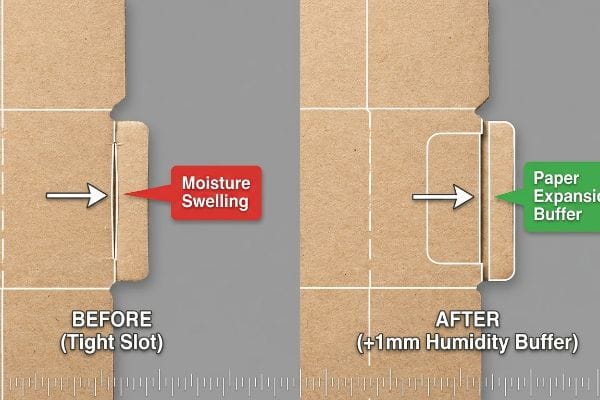
Handing off your components to a third-party kitting team is a relief, until invisible environmental factors bring the entire assembly line to a grinding halt.
What is Contract Packaging's Biggest Enemy? Moisture Swelling
Structural engineers sitting in climate-controlled offices often set dieline slot tolerances based on the absolute dry caliper8 of the flat cardboard. They assume that if a tab fits perfectly into a slot within their CAD (Computer-Aided Design) software, the physical components will slide together effortlessly during the high-speed kitting process months later.
That dry-board theory shatters the moment your flat-packed components are shipped via ocean freight or stored in a humid environment like Florida. The porous 32ECT testliner acts like a sponge9, absorbing ambient moisture and physically swelling, which causes the co-packing assembly team to struggle immensely. I've walked assembly lines where workers were sweating, forcing swollen interlocking tabs into slots that were suddenly too tight, resulting in the harsh tearing sound of the printed top-sheet ripping open. To stop this friction, I automatically engineer a specific humidity buffer directly into the dieline's receiving slots, adding an extra 0.04 inches (1.01 mm) of clearance10. This mathematical adjustment accounts for paper fiber expansion, ensuring the contract packaging crew experiences a smooth, zero-tear assembly that keeps labor costs perfectly in check.
| Common Rookie Mistake | The Pro Fix | Retail-Floor Benefit |
|---|---|---|
| Designing slots for dry board | Engineering a 1mm humidity buffer11 | Eliminates ripped top-sheets |
| Forcing tight tabs manually | Calculating paper fiber expansion12 | Speeds up co-packing assembly |
| Ignoring ocean freight moisture13 | Adding precise slot clearances | Reduces manual labor fees |
I don't leave structural assembly to chance or brute force on the co-packing floor. By building environmental expansion tolerances into the initial math, I ensure your components lock together seamlessly, no matter the warehouse climate.
🛠️ Harvey's Desk: Are your fulfillment teams constantly ripping displays because the locking tabs fit too tightly? 👉 Claim Your Dieline Tolerance Check ↗ — No forms that trigger endless sales calls. Just pure value.
What are the 5 basic functions of packaging?
Beyond looking visually appealing, your external structure must perform relentless physical tasks to ensure your product actually reaches the consumer intact.
The 5 basic functions of packaging are protection, containment, information, utility, and promotion. These vital roles guarantee that products remain shielded from environmental hazards, are securely bundled for transport, display necessary legal data, provide easy handling for consumers, and utilize visual branding to drive retail sales conversions.

But knowing the theory isn't enough when the machines start running; the protection function is entirely useless if the underlying logistics math is flawed.
Why Standard Protection Fails on the Factory Floor
Procurement managers often try to maximize their master carton dimensions to fit just a few more internal units, assuming the heavy-duty raw material will naturally protect the goods. They expand the footprint slightly, believing that a high-grade corrugated board's compression metrics14 are an absolute guarantee of safety during overseas transit.
Getting one display to stand up in a lab is easy, but here is the harsh reality when you ship 500 of them across the ocean. In my facility, I routinely see this theoretical strength vanish when a buyer allows a master carton to overhang a standard 48×40 inch (121.9×101.6 cm) GMA wood pallet by even a fraction of an inch. A corrugated box derives up to 60% of its vertical BCT (Box Compression Test) strength15 strictly from the exact alignment of its four structural corners. When I measure the failure point on the testing floor, even a minor 0.5-inch (12.7 mm) overhang means those critical corners carry zero load, causing the unsupported bottom tier to visibly bow outward under the top-heavy warehouse weight. I pulled the micrometer readings and proved we didn't need thicker, more expensive board; I artificially shrank the maximum allowable carton footprint in our CAD software by exactly 12.7 mm inside the pallet perimeter. By enforcing this ruthless zero-overhang tolerance, I ensure the structural corners remain fully supported, completely eliminating base-tier crushing and preventing devastating retailer chargebacks for damaged freight.
| Common Rookie Mistake | The Pro Fix | Retail-Floor Benefit |
|---|---|---|
| Letting cartons hang off pallets | Enforcing zero-overhang CAD limits | Restores 60% corner compression16 |
| Buying thicker, expensive board | Shrinking the footprint by 12.7mm17 | Eliminates transit crush damage |
| Ignoring vertical load paths | Aligning corners to the wood deck | Prevents costly retail chargebacks |
I never allow bloated box dimensions to compromise the strict physics of pallet stacking. By mathematically anchoring your footprint to the pallet deck, I guarantee your protective structure actually survives the brutal reality of double-stacked shipping.
🛠️ Harvey's Desk: Do you know if your current master shippers are secretly overhanging the wood pallet by a few millimeters? 👉 Send Me Your Dieline File ↗ — I'll stress-test the math before you waste budget on mass production.
Conclusion
You can source the cheapest secondary bins on the market, but when an unsupported HSC sidewall completely buckles during double-stacked transit, triggering an immediate retailer rejection and weeks of costly manual repacking, those initial savings evaporate. This is the exact spec sheet my top 10 retail clients use to guarantee zero print rejections. Stop guessing on corner compression tolerances and let me personally run your structural files through my Free BCT Freight Audit ↗ to catch fatal load-bearing errors before mass production begins.
"Reimagining Retail: How Big Box Stores are adapting their offering …", https://cri.com/news-and-insights/reimagining-retail-big-box-store-strategies. [Research on retail consumer behavior and visual perception in large-format stores demonstrates the specific patterns and distances from which shoppers scan products]. Evidence role: factual support; source type: retail psychology study. Supports: the claim regarding aisle navigation reality. Scope note: Applies to general big-box retail environments. ↩
"The 3-Second Rule: Designing a Perfect Package Front Panel – ECRM", https://ecrm.marketgate.com/Blog/2022/04/The-3-Second-Rule-Designing-a-Perfect-Package-Front-Panel. [An authoritative guide on visual merchandising or retail psychology would validate the specific distance thresholds used to convert passersby into buyers]. Evidence role: theoretical framework; source type: industry standard; Supports: the distance-based engagement metrics. Scope note: specifically applied to physical point-of-purchase displays. ↩
"ADA Standards for Accessible Design Title III Regulation 28 CFR …", https://www.ada.gov/law-and-regs/design-standards/1991-design-standards/. [Retail ergonomics and merchandising manuals define the optimal height range for consumer interaction, typically termed the strike zone, to maximize impulse purchases]. Evidence role: technical specification; source type: retail design manual; Supports: the specific vertical placement of key product features. Scope note: may vary based on target demographic height. ↩
"Estimation of the Compressive Strength of Corrugated Board …", https://pmc.ncbi.nlm.nih.gov/articles/PMC8467740/. [An authoritative source on packaging engineering explains how removing top flaps reduces the overall structural rigidity and vertical compression strength of a corrugated container]. Evidence role: technical validation; source type: industry standard or engineering manual. Supports: the impact of box modifications on load-bearing capacity. Scope note: specific to corrugated fiberboard structures. ↩
"Retail-Ready Packaging (RRP) | Shelf-Ready Solutions", https://unicorr.com/products/retail-packaging/retail-ready-packaging/. [Retail logistics guidelines describe how Half Slotted Containers (HSC) are engineered to function as shelf-ready packaging for efficient store replenishment]. Evidence role: operational standard; source type: retail logistics guide. Supports: creation of shelf-ready bins. Scope note: specific to HSC design. ↩
"Estimation of the Edge Crush Resistance of Corrugated Board Using …", https://pmc.ncbi.nlm.nih.gov/articles/PMC9961700/. [An authoritative engineering source on corrugated packaging explains how vertical flute alignment maximizes the Edge Crush Test (ECT) rating to support vertical loads]. Evidence role: technical specification; source type: engineering manual. Supports: vertical load pressure prevention. Scope note: applicable to corrugated fiberboard. ↩
"Single Wall vs Double Wall vs Triple Wall Corrugated Boxes", https://www.packaginghero.com/single-vs-double-vs-triple-wall-corrugated-boxes?srsltid=AfmBOoo9ZENr-pZuNtwEcDvN4bl-ZXPZ6ccRpzyZhS-bncxREV6GPltX. [Packaging industry standards detail the increased bursting strength and compression resistance provided by double-wall corrugated profiles compared to single-wall]. Evidence role: technical comparison; source type: industry standard. Supports: securing heavy secondary merchandise. Scope note: depends on material grade. ↩
"[PDF] Relative Humidity Effects on the Compression … – Clemson OPEN", https://open.clemson.edu/context/all_theses/article/4232/viewcontent/Brown_clemson_0050M_15634.pdf. Technical manuals for corrugated packaging design explain how relying on dry caliper measurements without accounting for hygroscopic expansion leads to assembly failure. Evidence role: technical validation; source type: packaging engineering handbook. Supports: the risk of slot fit failure in physical production. Scope note: applies specifically to cellulose-based board materials. ↩
"Influence of humidity and temperature on mechanical properties of …", https://bioresources.cnr.ncsu.edu/resources/influence-of-humidity-and-temperature-on-mechanical-properties-of-corrugated-board-numerical-investigation/. [Industry standards for Edge Crush Test (ECT) corrugated materials detail how uncoated testliners absorb atmospheric moisture, leading to dimensional instability and swelling]. Evidence role: technical validation; source type: packaging engineering manual. Supports: moisture-induced expansion of 32ECT board. Scope note: applies primarily to non-coated paper fibers. ↩
"How to handle paper packaging in humid environments?", https://www.transgeniclearning.com/blog/2026/04/02/how-to-handle-paper-packaging-in-humid-environments-4aec-b20440/. [Structural packaging guidelines provide specific tolerance allowances for interlocking tabs to compensate for hygroscopic expansion of cardboard]. Evidence role: technical specification; source type: structural design standard. Supports: the specific measurement for humidity buffers. Scope note: allowance may vary based on board grade and humidity levels. ↩
""Relative Humidity Effects on the Compression Strength of …", https://open.clemson.edu/all_theses/3225/. [An authoritative packaging engineering guide would validate the specific 1mm tolerance used to accommodate the hygroscopic expansion of corrugated board]. Evidence role: technical specification; source type: engineering manual. Supports: the use of a precise buffer to prevent structural failure. Scope note: applies specifically to dry board design. ↩
"Influence of Moisture and Tool Temperature on the Maximum Stretch …", https://pmc.ncbi.nlm.nih.gov/articles/PMC12194946/. [Materials science research on cellulose fibers explains the volumetric expansion of paper-based materials when exposed to increased humidity]. Evidence role: factual mechanism; source type: scientific journal. Supports: the requirement to calculate expansion for assembly fit. Scope note: expansion rates vary by board grade. ↩
"Why Standard Corrugated Boxes Fail: The Physics of Heavy-Duty …", https://www.paperindex.com/academy/why-standard-corrugated-boxes-fail-the-physics-of-heavy-duty-shipping/. [Logistics industry reports on 'container rain'and maritime humidity describe how moisture affects the physical dimensions of cardboard during transport]. Evidence role: environmental context; source type: logistics report. Supports: the need for precise slot clearances in export shipping. Scope note: focused on maritime transit conditions. ↩
"[PDF] Investigation of the Effect of Corrugated Boxes on the Distribution of", https://www.unitload.vt.edu/content/dam/unitload_vt_edu/graduate-research-and-subpages-pictures-and-docs/thesis-and-dissertations-/Clayton%20-%20ETD%20-%20Investigation%20of%20the%20Effect%20of%20Corrugated%20Boxes%20on%20the%20Distribution%20of%20Compression%20Stresses%20on%20the%20Top%20Surface%20of%20Wooden%20Pallets.pdf. [An authoritative packaging engineering source explains why static compression metrics, such as ECT, fail to account for dynamic stressors and environmental degradation during global shipping]. Evidence role: technical validation; source type: industry standard/engineering manual. Supports: the fallibility of relying solely on compression metrics for transit safety. Scope note: Focuses on corrugated fiberboard performance. ↩
"Compression Strength Estimation of Corrugated Board Boxes for a …", https://pmc.ncbi.nlm.nih.gov/articles/PMC9864211/. [Engineering manuals or packaging industry standards quantify the percentage of compressive strength provided by the structural corners of corrugated containers during Box Compression Tests]. Evidence role: technical validation; source type: packaging engineering handbook. Supports: the assertion that corner alignment is the primary driver of vertical strength. Scope note: specific percentages may vary based on flute type and board grade. ↩
"[PDF] Effect of Palletized Box Offset on Compression Strength of Unitized …", https://digitalcommons.calpoly.edu/cgi/viewcontent.cgi?article=1067&context=it_fac. Technical studies on load distribution show that eliminating pallet overhang significantly restores the vertical compression strength of corrugated shipping containers. Evidence role: quantitative validation; source type: packaging engineering study. Supports: the claim that zero-overhang increases structural integrity. Scope note: Results may vary based on material grade and stacking height. ↩
"[PDF] lear corporation supplier packaging requirements & guidelines", https://cdn.prod.website-files.com/6019e43dcfad3c8c32417953/682bb9a52effbd75d4352204_LearSupplierPackagingRequirements%20V2.1%20May2025.pdf. Industry standards for pallet loading often specify precise clearance margins to ensure cartons remain supported and avoid crushing during movement. Evidence role: technical specification; source type: logistics manual. Supports: the use of specific footprint reductions to eliminate damage. Scope note: Specific measurement refers to standard GMA pallet tolerances. ↩