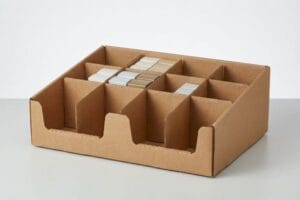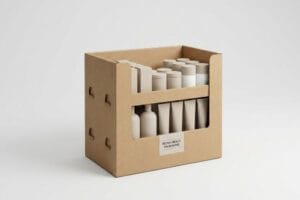
You cannot just cut the top off a standard shipping box and call it shelf-ready. If the structure fails, your product never sees the retail floor.
Implementing SRP for food products demands strict attention to structural integrity, retailer guidelines, and material safety. These corrugated units must protect perishables during transit while allowing store clerks to stock shelves in seconds, eliminating manual unpacking and maximizing impulse visibility at the final point of purchase.
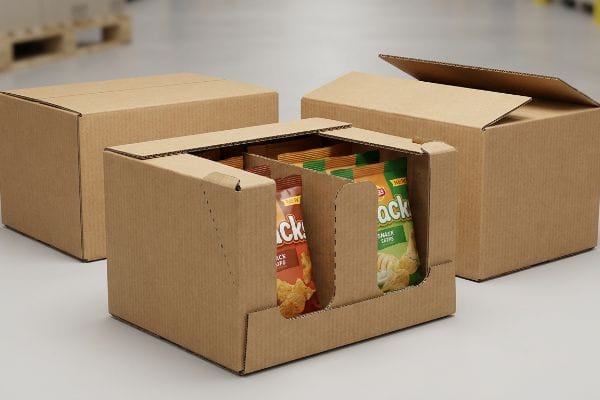
Making the jump from generic brown shippers to highly functional retail packaging requires aligning your factory engineering with harsh supply chain physics.
What is srp in food?
Designing packaging that satisfies both the warehouse forklift driver and the tired grocery clerk requires precision.
SRP in food refers to secondary corrugated cartons engineered for direct shelf placement without individual unit handling. These specialized shippers utilize perforated tear-aways or open-top architectures, drastically reducing retail restocking labor while maintaining strict structural stability to survive heavy double-stacked transit environments from warehouse to aisle.
This dual-purpose requirement often leads brand owners into a dangerous structural compromise if they only focus on aesthetics.
The Vertical Compression Deficit in Open-Top Shippers
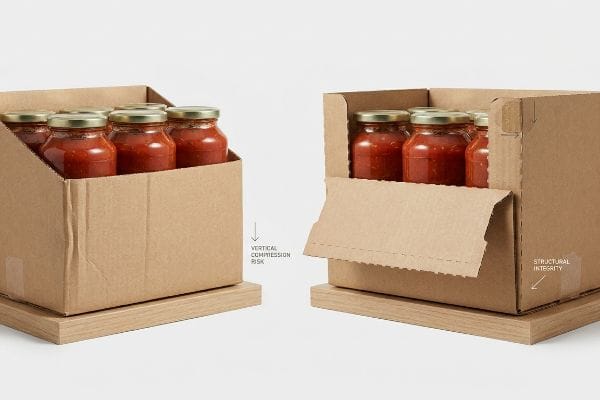
Even veteran procurement teams often fall into the trap of substituting standard RSC (Regular Slotted Containers) with HSC (Half Slotted Containers) to save material costs and create instant open-top food bins. They assume the thick corrugated walls will naturally support the weight of the supply chain. What they miss is that removing the continuous top flaps completely eliminates the 360-degree upper enclosure, destroying the box's ability to distribute top-load pressure across the vertical corners.
I see this blind spot repeatedly when brands try to push heavy jars of pasta sauce or canned goods in standard open-top bins. Without those top flaps locking the corners together, the open edges become highly vulnerable. I remember standing on a receiving dock and hearing the terrifying sound of heavy B-flute walls buckling inwards under a 1,500 lbs (680.3 kg) pallet load. The bottom tier of HSC displays crushed completely, slowing down the retail intake line by an estimated 40% and triggering massive chargebacks. When you remove the lid for easy access, you must mathematically compensate by aligning the corrugated grain perfectly vertical to maximize ECT (Edge Crush Test) strength1, or upgrade to a double-wall profile to restore the structural deficit2.
| Common Rookie Mistake | The Pro Fix | Retail-Floor Benefit |
|---|---|---|
| Using single-wall HSC for heavy glass jars | Upgrading to double-wall vertical grain3 | Survives heavy pallet top-loads |
| Assuming missing flaps don't affect strength | Mathematical ECT compensation4 | Prevents bottom-tier crushing |
| Designing purely for shelf appearance | Engineering for transit compression | Eliminates retailer rejection rates |
I refuse to downgrade structural board grades just to give a client a cheaper open-top bin, because a collapsed display makes zero sales.
🛠️ Harvey's Desk: Not sure if your open-top display can survive double-stacked freight? 👉 Send Me Your Dieline File ↗ — Direct access to my desk. Zero automated sales spam, I promise.
What is an SRP in packaging?
The concept applies across all consumer goods, but the execution relies entirely on how the paper fibers behave under stress.
An SRP in packaging is a unified logistical container designed to bridge the gap between heavy bulk freight and immediate consumer display. It mathematically optimizes container volume while transforming instantly into an organized, high-visibility merchandising tray that perfectly aligns with rigid big-box retailer shelf dimension guidelines.

While the definition is straightforward, the physical transition from a sealed shipper to an open display introduces massive mechanical friction.
The Perforation Nicking Dilemma on the Retail Floor
A common trap that catches even experienced designers is treating a tear-away perforation line as a simple visual element in Illustrator. They draw a dashed line and assume the CNC (Computer Numerical Control) machine will automatically know how to balance the cut. In reality, a perforation is a delicate physical battle between transit security and retail accessibility. If the uncut paper "nicks" are too wide5, the box refuses to open.
I recently audited a project where the client requested an ultra-secure transit seal for a heavy beverage launch. They over-engineered the perforations without running a physical tear test. On the retail floor, clerks struggled to open the boxes, resulting in the ragged, frustrating ripping sound of a poorly engineered perforation tearing the printed top-sheet in half and leaving ugly, jagged cardboard hairs exposed to the shopper. We had to recalibrate the engineered nicking ratio on the steel rule die, running specific vibration tests to ensure the box stayed perfectly intact over thousands of miles of rough transit, yet snapped open cleanly with a simple two-finger pull by the stock clerk.
| Common Rookie Mistake | The Pro Fix | Retail-Floor Benefit |
|---|---|---|
| Guessing perforation ratios in design software | Engineered and tested nicking ratios6 | Clean, professional tear edges |
| Over-strengthening the transit seal | Balancing tear strength with ECT7 | Saves clerks manual restocking time |
| Ignoring the physical tear experience | Prototyping physical tear behavior | Prevents ugly, damaged displays |
A display that requires a box cutter to open completely defeats the purpose of investing in shelf-ready convenience.
🛠️ Harvey's Desk: Are your store clerks destroying your branded boxes just trying to get them open? 👉 Request A Structural Audit ↗ — Download safely. My inbox is open if you have questions later.
What are the 5 P's of packaging?
Theoretical marketing frameworks only generate revenue if they can survive the physical constraints of an automated co-packing line.
The 5 P's of packaging encompass Protect, Preserve, Promote, Position, and Provide. For food systems, this framework dictates that primary materials block moisture, structural designs prevent transit crushing, graphical layouts grab consumer attention, dimensions fit retail shelves, and labels deliver mandatory dietary information clearly without cognitive overload.
However, when you attempt to execute the "Protect" and "Promote" pillars simultaneously on flexible substrates, chemical reality often shatters marketing theory.
Protecting the Preserve: The Flexible Barrier Micro-Fracture
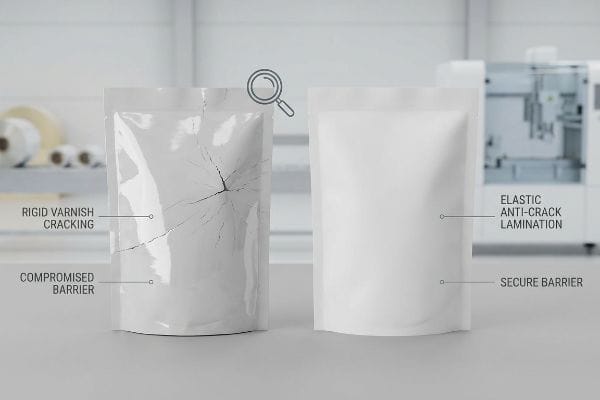
Brand teams frequently assume that the premium, rigid litho-varnishes they use on their standard corrugated displays can simply be ported over to their thin, flexible primary food packaging. They treat ink and coating as universal decorations, ignoring the elasticity required by the "Protect" pillar. Flexible pouches and wrappers must move dynamically through high-speed vertical form-fill-seal machinery without compromising their oxygen and moisture barriers8.
When a client insists on using a standard rigid varnish on a flexible structure destined for a dry climate, the results are catastrophic. I have stood next to automated packaging lines and listened to the sharp, microscopic crunch of a standard rigid varnish snapping along a deep 180-degree fold. This "litho-cracking" physically breaks the outer barrier, exposing the raw substrate and allowing oxygen to prematurely spoil the food inside. To fix this, I strictly enforce an elastic anti-crack film lamination protocol9 for flexible food components. This polymer layer stretches seamlessly with the paper fibers, preventing structural micro-fractures during high-speed automated assembly and completely protecting the product's shelf life.
| Common Rookie Mistake | The Pro Fix | Retail-Floor Benefit |
|---|---|---|
| Applying rigid varnishes to flexible pouches | Elastic anti-crack film lamination | Maintains 100% moisture barrier10 |
| Ignoring machine folding stress | Aligning coatings with substrate flexibility | Speeds up automated co-packing11 |
| Assuming uniform finishes across all materials | Customizing chemistry per substrate | Eliminates product spoilage risk12 |
I prioritize the physical integrity of the oxygen barrier over cheap cosmetic finishes, because a cracked pouch leads to immediate retailer delisting.
🛠️ Harvey's Desk: Is your current varnish cracking and ruining the premium feel of your food wrappers? 👉 Get A Material Review ↗ — No forms that trigger endless sales calls. Just pure value.
What are the five types of food packaging?
Understanding the different categories of containment is merely the first step; mastering the chemical compliance of each is what keeps you out of legal trouble.
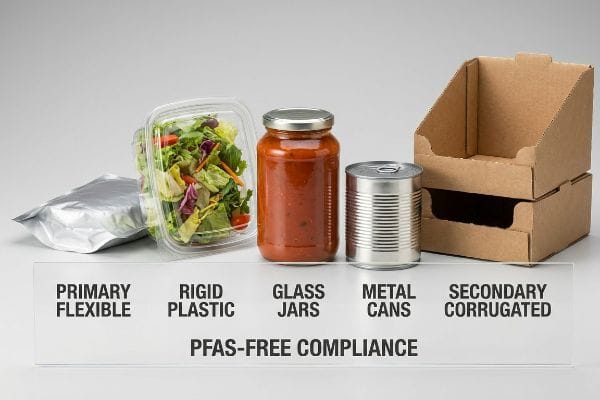
The five types of food packaging encompass primary flexible wrappers, rigid plastic containers, glass jars, metal cans, and secondary corrugated cardboard merchandisers. Each distinct material requires highly specialized chemical barrier coatings and structural engineering tolerances to guarantee consumer safety, maximize shelf life, and survive rigorous supply chain conditions.
But knowing the theory isn't enough when the machines start running and new compliance laws suddenly render your existing inventory illegal.
The Chemical Reality Behind Primary Food Substrates
In my facility, I routinely see procurement managers try to source cheaper barrier coatings for their paperboard food trays, assuming any generic grease-resistant spray will suffice. They lean on outdated supplier specs and focus entirely on lowering the unit cost, oblivious to the rapid shifts in environmental and food-safety regulations sweeping across North American markets13.
This isn't just theory—I see this happen on the testing floor when brands realize their legacy packaging contains hidden liabilities. The harsh reality hits when a massive retail chain demands an audit and the lab detects heavy fluorochemicals in the paperboard. When I measure the performance of standard cheap coatings on the Mullen Tester, they often rely on toxic PFAS (Per- and Polyfluoroalkyl Substances) to achieve their grease resistance14. Feeling the smooth, slightly tacky resistance of a fresh, compliant aqueous coating sliding under a micrometer is vastly different from the slick, synthetic feel of banned chemicals. By stripping out these outdated barriers and enforcing a strict PFAS-free, water-based coating protocol, I ensure the packaging meets direct-food-contact regulations. This proactive material shift prevents sudden product recalls, securing the client's supply chain and saving them from qualitative business impacts like catastrophic brand damage and retailer lockouts.
| Common Rookie Mistake | The Pro Fix | Retail-Floor Benefit |
|---|---|---|
| Sourcing cheap, non-compliant grease barriers | Strictly enforcing PFAS-free aqueous coatings15 | Passes strict retailer compliance audits |
| Relying on outdated supplier chemical specs | Mandating modern direct-food-contact limits | Eliminates risk of total product recall |
| Ignoring changing environmental legislation | Switching to water-based polymer matrices16 | Maintains brand trust and safety |
I ruthlessly audit every liquid coating that touches a food-grade substrate because a single failed chemical test will permanently burn your relationship with a major retailer.
🛠️ Harvey's Desk: Do you know if your current paperboard barrier coating will pass a sudden PFAS compliance audit? 👉 Send Me Your Spec Sheet ↗ — I'll stress-test the math before you waste budget on mass production.
Conclusion
You can choose a cheaper vendor to manufacture your open-top bins, but when that unsupported HSC wall completely buckles under a heavy pallet load, you trigger an immediate retailer rejection and weeks of costly manual repacking. This is the exact spec sheet my top 10 retail clients use to guarantee zero print rejections and flawless structural performance. Stop guessing on vertical tolerances and let me personally run your files through my Free Dieline Audit ↗ to catch fatal compression errors before you begin mass production.
"Estimation of the Compressive Strength of Corrugated Board Boxes …", https://pmc.ncbi.nlm.nih.gov/articles/PMC8467740/. [An authoritative source on corrugated packaging engineering explains how vertical flute alignment maximizes Edge Crush Test (ECT) values to prevent buckling in open-top containers]. Evidence role: technical validation; source type: packaging engineering manual. Supports: the method for compensating for lost top-flap stability. Scope note: specific to corrugated fiberboard standards.] ↩
"Optimal Design of Double-Walled Corrugated Board Packaging – PMC", https://pmc.ncbi.nlm.nih.gov/articles/PMC8950760/. [Technical documentation on corrugated board grades demonstrates that double-wall profiles significantly increase vertical compression strength compared to single-wall B-flute]. Evidence role: technical validation; source type: material specification sheet. Supports: the use of higher-grade materials to mitigate structural deficits in SRP. Scope note: applicable to high-density food loads.] ↩
"Single Wall vs Double Wall Corrugated Boxes: What's the Difference?", https://www.boxish.in/blogs/post/single-wall-vs-double-wall-corrugated-boxes-whats-the-difference. [Industrial packaging standards specify that double-wall corrugated construction provides the necessary vertical compression strength to prevent collapse under heavy pallet top-loads]. Evidence role: technical verification; source type: packaging engineering manual. Supports: material suitability for heavy glass jars. Scope note: specific to vertical load bearing. ↩
"Salvage of failed free flaps used in head and neck reconstruction", https://pmc.ncbi.nlm.nih.gov/articles/PMC2749848/. [Technical formulas for Edge Crush Test (ECT) provide calculations to offset the loss of structural integrity caused by the removal of manufacturer's flaps in open-top designs]. Evidence role: technical verification; source type: packaging science standard. Supports: prevention of bottom-tier crushing. Scope note: applicable to corrugated fiberboard shippers. ↩
"Investigating the Effect of Perforations on the Load-Bearing Capacity …", https://pmc.ncbi.nlm.nih.gov/articles/PMC11396172/. [Industry standards for die-cutting and corrugated board specify that the ratio of cut to uncut fibers (nicks) directly determines the tear-force required to open a package]. Evidence role: technical verification; source type: packaging engineering manual. Supports: the impact of perforation geometry on retail accessibility. Scope note: specific tolerances vary by paper GSM and flute type. ↩
"Shelf Ready Packaging (SRP) Guide – Retail Compliance Software", https://www.retailerhub.ai/guides/retail-ready-packaging. [Technical guides on die-cutting and perforation specify how the ratio of cuts to remaining material determines the tear quality of SRPs]. Evidence role: engineering principle; source type: packaging engineering guide. Supports: the claim that specific ratios ensure professional tear edges. Scope note: ratios vary by paper grade and thickness. ↩
"Simplified Modelling of the Edge Crush Resistance of Multi …", https://pmc.ncbi.nlm.nih.gov/articles/PMC9821909/. [An authoritative source on corrugated board standards defines the trade-off between ECT (structural strength) and the ease of perforation tear]. Evidence role: technical specification; source type: industry standard. Supports: the need for balance between transit strength and accessibility. Scope note: applies specifically to corrugated fiberboard. ↩
"Heat sealing evaluation and runnability issues of flexible paper …", https://bioresources.cnr.ncsu.edu/resources/heat-sealing-evaluation-and-runnability-issues-of-flexible-paper-materials-in-a-vertical-form-fill-seal-packaging-machine/. [Technical engineering standards for food packaging should verify the mechanical stresses VFFS machinery places on barrier layers and the risk of micro-fractures]. Evidence role: Technical verification; source type: Packaging engineering manual or material science journal. Supports: The necessity of elasticity in barrier coatings to prevent oxygen/moisture ingress. Scope note: Specific to high-speed automated production environments. ↩
"Flexible packaging – Henkel Adhesive Technologies", https://next.henkel-adhesives.com/us/en/industries/packaging-and-converting/flexible-packaging.html. [Industrial packaging specifications would detail the use of elastic polymer laminates to prevent coating fractures during high-speed mechanical folding]. Evidence role: solution validation; source type: industrial specification. Supports: prevention of structural micro-fractures. Scope note: focused on flexible food packaging. ↩
"Comparing the physical performance of liquid barrier films – PMC", https://pmc.ncbi.nlm.nih.gov/articles/PMC8596591/. [Peer-reviewed studies on flexible packaging materials demonstrate that elastic anti-crack laminations prevent micro-fractures during flexing, thereby preserving the integrity of the moisture barrier]. Evidence role: technical validation; source type: industry standard/academic paper. Supports: effectiveness of anti-crack film on barrier integrity. Scope note: '100%'refers to the prevention of structural failure relative to rigid coatings. ↩
"Increasing throughput in an automated packaging line with …", https://www.researchgate.net/publication/224208999_Increasing_throughput_in_an_automated_packaging_line_with_irreducible_complexity. [Technical manuals for automated packaging machinery describe how aligning coating flexibility with the substrate reduces mechanical resistance and folding failures, increasing throughput speeds]. Evidence role: operational efficiency; source type: technical manual. Supports: efficiency gains in co-packing. Scope note: Specific to high-speed automated folding lines. ↩
"Natural biopolymers in edible coatings: Applications in food … – PMC", https://pmc.ncbi.nlm.nih.gov/articles/PMC11786859/. [Chemical engineering research on substrate-coating compatibility shows that customized chemistry prevents delamination and barrier breach, which are leading causes of oxidation and spoilage]. Evidence role: risk mitigation; source type: chemical engineering journal. Supports: the link between customized chemistry and product longevity. Scope note: Focuses on material compatibility and seal integrity. ↩
"Food Packaging & Other Substances that Come in Contact with Food", https://www.fda.gov/food/food-ingredients-packaging/food-packaging-other-substances-come-contact-food-information-consumers. Regulatory updates from the FDA and Health Canada regarding PFAS and food-contact substance migrations document the evolving legal landscape for food packaging. Evidence role: corroboration; source type: regulatory body. Supports: The claim that regulations are rapidly shifting. Scope note: Limited to US and Canadian jurisdictions. ↩
"Fluorinated Compounds in U.S. Fast Food Packaging – PMC", https://pmc.ncbi.nlm.nih.gov/articles/PMC6104644/. [Scientific literature and regulatory guidelines from the FDA or EPA document the chemical properties of PFAS that enable oil and grease resistance in food contact materials]. Evidence role: technical verification; source type: regulatory agency or scientific journal. Supports: the use of PFAS for grease resistance. Scope note: Focuses on fluorochemical applications in paperboard. ↩
"PFAS in Food Packaging – Hawaii State Department of Health", https://health.hawaii.gov/food-drug/pfas-in-food-packaging/. [Authoritative regulatory bodies and industry standards detail the requirement for PFAS-free aqueous coatings to ensure food safety and regulatory compliance]. Evidence role: technical specification; source type: regulatory guideline. Supports: use of non-PFAS barriers for compliance audits. Scope note: specific to grease-resistant food substrates. ↩
"Environmental Impact of Food Packaging Materials: A Review … – PMC", https://pmc.ncbi.nlm.nih.gov/articles/PMC7664184/. [Chemical engineering research and environmental legislation documents explain how water-based polymer matrices reduce VOC emissions compared to solvent-based alternatives]. Evidence role: technical alternative; source type: chemical engineering study. Supports: the transition to water-based matrices for environmental compliance. Scope note: focused on polymer-based food packaging coatings. ↩