Understanding Pantone Colors: the Nature and Application of Pantone Shades

by Harvey in Printing & Manufacturing
Understanding Pantone Colors: the Nature and Application of Pantone Shades

You spend weeks finalizing the perfect brand shade on your monitor, only to see it look entirely different on the physical retail shelf. Color inconsistency kills consumer trust instantly.

Understanding Pantone colors requires a universal, standardized color reproduction system. The Pantone Matching System (PMS) relies on exact ink mixing formulas rather than digital pixels, guaranteeing that physical packaging, marketing materials, and retail displays maintain absolute color consistency across different global manufacturing facilities and printing substrates.

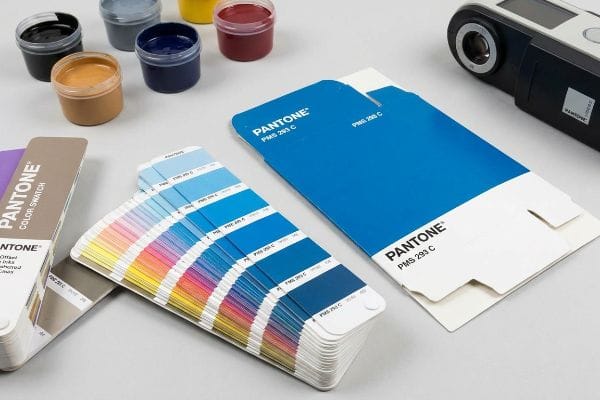
A collection of Pantone color tools, including a fan-shaped color swatch, two PMS 293 C blue cards, small jars of various colored inks, and a colorimeter.
Pantone Color Matching Tools

But knowing the theoretical definition of these shades is only half the battle. When you move from digital artboards to industrial printing presses, the physical reality of the materials dictates how those colors actually perform.

How Do You Explain the Color of a Pantone?

Explaining a color using digital screens is a recipe for disaster, because every monitor calibrates light differently.

How do you explain the color of a Pantone? It depends entirely on physical standardization. You explain it by referencing a specific, globally recognized ink formula code, ensuring printers mix exact physical pigments instead of relying on subjective visual interpretations from uncalibrated computer screens.

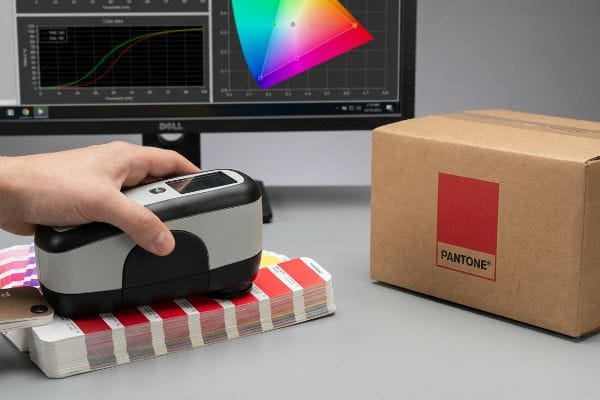
A hand holds a spectrophotometer over physical Pantone color swatches, ensuring accurate color calibration displayed on a Dell monitor, next to a Pantone-branded corrugated box.
Calibrating Pantone Colors

Translating that theoretical number into physical packaging requires strict environmental control on the factory floor.

The Spectrophotometer Truth: Calibrating the Color of a Pantone

Even veteran designers often overlook this blind spot when they approve artwork on their smartphones or office laptops. They assume the vibrant RGB (Red Green Blue) color they see digitally will seamlessly convert into physical ink on corrugated board1. This reliance on screen auto-correction creates a dangerous baseline for mass production.

I see this constantly when teams try to explain their brand's primary shade using an emailed screenshot. During one recent PDQ (Product Display Quarter-pallet) tray rollout, the client rejected our physical white sample because the blue looked "wrong" compared to their phone screen. The reality is that their mobile device was artificially saturating the image. To fix this, I strictly enforce physical swatch scanning using a spectrophotometer under certified D50 lighting conditions2. When I hear the loud, sharp beep of that scanner taking a reading, I know we are capturing the exact optical wavelength of the physical ink3. This removes all subjective debate and ensures the print accurately matches the true Pantone specification, saving weeks of back-and-forth email arguments.

Common Rookie MistakeThe Pro FixRetail-Floor Benefit
Approving colors on uncalibrated office monitors.Scanning swatches with a physical spectrophotometer4.Prevents costly full-batch print rejections.
Ignoring factory lighting conditions during review.Evaluating physical proofs under standardized D50 light booths5.Ensures the display looks identical across all store aisles.
Sending digital screenshots as color targets.Providing the exact PMS formula code6.Eliminates subjective visual guesswork entirely.

I refuse to guess what a client's monitor looks like. By relying strictly on spectrophotometer data, I guarantee that the physical ink hitting the board perfectly mirrors your master brand guidelines.

🛠️ Harvey's Desk: Are your digital proofs secretly betraying your physical print results? 👉 Request a Free Color Pre-Flight ↗ — Direct access to my desk. Zero automated sales spam, I promise.

Why Is Pantone 448 C the Ugliest Color?

Some colors are intentionally designed to be unappealing, but mishandling them in production can make them structurally unstable, too.

Why is Pantone 448 C the ugliest color? It is widely considered the ugliest because this specific dark, drab brown shade intentionally absorbs light and evokes negative psychological reactions. Consequently, global governments frequently use it on plain packaging to actively discourage the consumption of harmful tobacco products.

Dark brown cardboard floor displays, one scuffed, the other showcasing Anti-Scuff PP Lamination protection.
Scuff Protection Comparison

However, printing heavy, dark shades like this on large retail merchandisers introduces severe physical challenges during transit and assembly.

Protecting Dark Shades: The Anti-Scuff Reality for Pantone 448 C

Many brand teams assume that simply applying standard liquid varnishes over dark Pantone colors will provide enough protection for the retail aisle. They often specify these deep shades for premium or minimalist designs, completely ignoring how aggressive supply chain friction acts on large areas of solid, dark ink7.

It is a common trap that catches even experienced procurement teams. A client recently launched a seasonal floor display heavily featuring a deep, dark brown similar to Pantone 448 C. Because they opted for a standard finish, the abrasive friction from standard wooden pallets caused severe white scuff marks across the base before the unit ever reached the store. The raw corrugated dust literally ground into the dark ink, leaving it looking ruined and dirty. I immediately mandated our "Anti-Scuff" Matte Standard, applying a scratch-resistant Matte PP (Polypropylene) lamination8 over the dark areas. This elastic polymer film acts as an invisible shield against transit abrasion, ensuring the displays arrive pristine and eliminating the massive visual degradation that triggers instant retailer rejection.

Common Rookie MistakeThe Pro FixRetail-Floor Benefit
Using standard varnish on deep, solid colors.Applying scratch-resistant Matte PP lamination9.Prevents severe visual degradation during transit.
Ignoring the abrasive friction of rough shipping pallets.Engineering a physical polymer barrier over dark inks10.Eliminates white scuff marks on premium displays.
Assuming dark colors hide factory floor dust.Sealing the surface to repel corrugated micro-dust11.Keeps the merchandiser looking premium and clean.

I never let heavy, dark inks leave my facility without physical armor. Upgrading to an anti-scuff lamination completely neutralizes the abrasive reality of retail logistics, protecting your brand equity.

🛠️ Harvey's Desk: Are your premium dark designs showing up scratched and battered in the store aisle? 👉 Claim Your Free Lamination Audit ↗ — Download safely. My inbox is open if you have questions later.

Can Sherwin Williams Color Match Pantone?

Trying to cross-match commercial house paint with standardized printing inks is a common practice that often ends in severe visual misalignment.

Yes. Sherwin Williams color matches Pantone by utilizing advanced digital scanners to analyze a physical swatch and mix a highly accurate custom paint formula. However, the final visual result may vary slightly due to differences in paint sheen, base materials, and ambient lighting conditions.

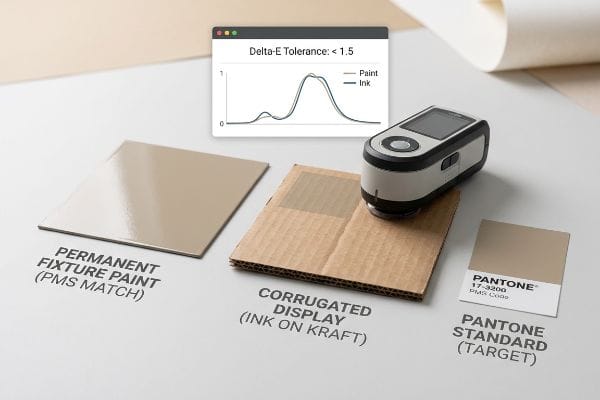
Permanent Fixture Paint (PMS Match), Corrugated Display (Ink on Kraft), and Pantone 17-3200 are measured by a colorimeter, showing Delta-E Tolerance: < 1.5.
Color Matching Delta-E

While a paint store can estimate a wall color, achieving strict compliance on retail packaging requires industrial-grade precision.

Beyond Paint Scanners: GMG Proofing to Color Match Pantone

Brand managers often try to synchronize their permanent store fixtures—which use powder-coated paint—with their temporary corrugated displays, assuming a simple visual match is sufficient. They rely on basic optical scans, forgetting that liquid paint and porous paperboard absorb and reflect light in entirely different ways12.

I have seen brands waste thousands of dollars trying to force a corrugated printer to match a physical painted metal bracket. In one instance, a client kept rejecting our print runs because the paper display lacked the glossy sheen of their custom-mixed paint, causing immense frustration on the assembly line. The harsh reality is that raw cellulose fibers simply do not behave like metal. To bridge this gap, I deploy advanced GMG Color Proofing systems that mathematically calculate the specific Delta-E tolerance between different substrates13. By analyzing the physical draw-down under standardized lighting, we map exactly how the ink will behave on the 32ECT testliner14. This analytical approach proves to the brand that we are hitting the exact spectral data of their requested shade, aligning their multi-material retail rollout without relying on subjective guesswork.

Common Rookie MistakeThe Pro FixRetail-Floor Benefit
Attempting to visually match ink to painted metal.Using GMG systems for strict Delta-E tolerance tracking15.Guarantees consistency across diverse store fixtures.
Ignoring how different substrates absorb light.Engineering substrate-specific prepress profiles16.Prevents mismatched colors on the actual retail shelf.
Relying on hardware store scanners for packaging.Utilizing industrial spectrophotometer data17.Ensures exact compliance with primary brand guidelines.

I rely on mathematics, not human eyeballs, to harmonize cross-material campaigns. Utilizing strict Delta-E management ensures that your temporary displays perfectly compliment your permanent retail footprint.

🛠️ Harvey's Desk: Struggling to make your printed corrugated displays match your expensive permanent fixtures? 👉 Get a Professional Color Analysis ↗ — No forms that trigger endless sales calls. Just pure value.

What Is the 4 Color Process in Pantone?

Converting your proprietary brand color into standard four-color printing seems like an easy cost-saving measure until you see the muddy results under store lights.

What is the 4 color process in Pantone? It is a printing method that attempts to simulate solid shades by overlapping tiny dots of Cyan, Magenta, Yellow, and Key (CMYK) inks. This optical blending reduces costs but cannot accurately reproduce all precise brand colors.

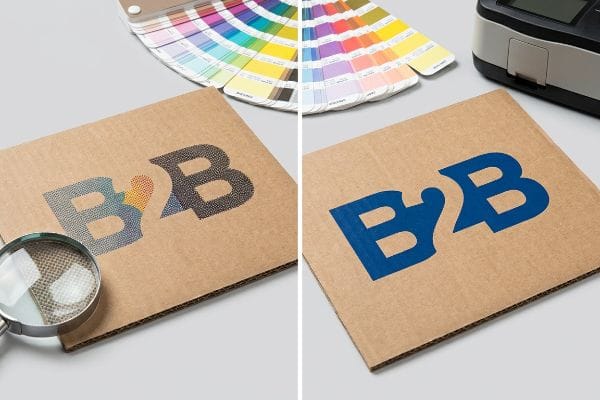
Corrugated cardboard displays two B2B logos, contrasting grainy CMYK halftone dots with dense Pantone spot color printing.
Print Quality Comparison

But knowing the theory isn't enough when the machines start running; translating digital four-color conversions onto raw corrugated board reveals critical mechanical flaws.

Why Standard 4 Color Process Fails on the Factory Floor

Marketing teams frequently convert solid corporate logos into standard CMYK formats during the design phase, assuming modern process printing will seamlessly match their digital screens. They assume that saving money on dedicated spot color plates18 is a smart procurement strategy for temporary retail campaigns.

This isn't just theory—I see this happen on the testing floor when a supposedly vibrant brand logo hits unsealed corrugated testliner. When standard four-color printing relies on tiny overlapping halftone dots, those microscopic ink droplets absorb unevenly into the rough, porous paper fibers. When I measure the visual output under our inspection lamps, the result is a grainy, washed-out optical failure I call CMYK Halftone Mud. To fix this, I mandate a strict Spot Color Flood Protocol for all primary brand logos. I pulled the spectrophotometer readings and proved that replacing optical CMYK blending with a single, precisely mixed Pantone spot color ink completely eliminates the visual grain. By enforcing this dedicated plate, I ensure a dense, perfectly smooth flood of pigment that drastically increases visual contrast, allowing the display to grab shopper attention from 20 feet (6.09 m) away and significantly protecting the client's marketing investment.

Common Rookie MistakeThe Pro FixRetail-Floor Benefit
Printing primary logos using overlapping CMYK dots19.Mandating a dedicated spot color flood.Eliminates washed-out, grainy branding on the shelf.
Assuming raw corrugated handles ink like glossy paper.Using high-density solid pigments for porous boards20.Maximizes high-contrast visibility from 20 feet away.
Sacrificing color accuracy to save on printing plates.Investing in exact Pantone formulation for core elements21.Protects brand equity and prevents retailer pushback.

I do not let procurement teams gamble their brand equity on optical dot blending. Mandating a true spot color flood is the only way to mathematically guarantee absolute pigment density on raw corrugated material.

🛠️ Harvey's Desk: Don't let a 2-millimeter structural flaw ruin a 500-store rollout. 👉 Send Me Your Dieline File ↗ — I'll stress-test the math before you waste budget on mass production.

Conclusion

You can choose a cheaper printer that relies on uncalibrated CMYK conversions, but when those halftone dots absorb unevenly into rough corrugated testliner, it creates a muddy visual failure that degrades your brand equity and triggers immediate retailer rejection. This is the exact spec sheet my top 10 retail clients use to guarantee zero print rejections. Stop guessing on pigment absorption and let me personally audit your artwork files through my Free Prepress Color Audit ↗ to catch fatal color conversion errors before mass production begins.


  1. "RGB vs CMYK Color Differences Explained | We Custom Boxes", https://www.wecustomboxes.com/blog/rgb-vs-cmyk-color/. [An authoritative guide on color management explains the fundamental discrepancy between additive RGB light and subtractive pigments, particularly how porous substrates like corrugated board absorb ink and alter color perception]. Evidence role: technical explanation; source type: industry printing standard. Supports: the claim that digital colors do not translate seamlessly to physical production. Scope note: accuracy varies by ink saturation and board grade. 

  2. "D50 Color checking for graphic arts | JUST-Normlicht", https://www.just-normlicht.com/us/d50-color-checking-graphic-arts.html. [An authoritative source on colorimetry would confirm that D50 is the international standard illuminant for graphic arts to ensure consistency across different viewing environments]. Evidence role: technical specification; source type: industry standard. Supports: the requirement for standardized lighting in professional color matching. Scope note: Specific to ISO 3664 standards. 

  3. "Optical density and absorbance measurements – BMG Labtech", https://www.bmglabtech.com/en/blog/optical-density-for-absorbance-assays/. [Scientific documentation on spectrophotometry explains that these devices measure the spectral distribution of light reflected from a surface across the visible spectrum]. Evidence role: technical mechanism; source type: scientific manual. Supports: the claim that spectrophotometers provide an objective measurement of color. Scope note: Applies to reflective color measurement. 

  4. "What Is a Colorimeter / Spectrophotometer in Printing and Packaging?", https://www.linshangtech.com/tech/colorimeter-spectrophotometer-in-printing-packaging-tech1524.html. [An authoritative source on color management would explain how spectrophotometers provide quantitative spectral data to ensure consistency and prevent batch-to-batch variance]. Evidence role: Technical validation; source type: Industry manual. Supports: The efficacy of spectrophotometers in print quality control. Scope note: Applies to professional color matching workflows. 

  5. "Standard lighting conditions for wide format printers and their many …", https://colorbase.com/blog-standard-lighting-conditions-for-wide-format-printers-and-their-many-markets/. [ISO and ANSI standards specify D50 (5000K) as the industry standard for viewing color proofs to eliminate metamerism and ensure consistent evaluation]. Evidence role: Standard specification; source type: International Standard. Supports: Use of D50 for standardized color review. Scope note: Specific to the graphic arts and printing industries. 

  6. "Pantone Color Systems – Introduction", https://www.pantone.com/color-systems/pantone-color-systems-explained?srsltid=AfmBOorFgD1bT5xHKcYRZ3m_b0QXGlaoyazJ-31AVKiEZFIViV4N08Cs. [Technical documentation from Pantone explains that formula codes provide the exact pigment ratios required for ink mixing, removing the variability found in digital color representations]. Evidence role: Technical specification; source type: Brand guidelines. Supports: Precision of PMS formulas over visual targets. Scope note: Limited to the Pantone Matching System. 

  7. "How to Avoid Packaging Scuffs from Antiblocking Agents – PPC Flex", https://ppcflex.com/blog/how-to-avoid-packaging-scuffs-from-antiblocking-agents/. [Industry documentation on print finishing explains how physical abrasion during logistics creates visible scuffs and burnishing on saturated, dark ink areas]. Evidence role: technical validation; source type: packaging engineering guide. Supports: the vulnerability of dark shades to supply chain damage. Scope note: limited to printed packaging materials. 

  8. "Scratch Resistant BOPP Film", https://www.greentechfilm.com/glossy-film/scratch-resistant-gloss-bopp-thermal-lamination-film-for-packaging-and-printing.html. [An authoritative industrial printing or packaging material guide would verify that Matte PP lamination creates a durable barrier that protects ink from abrasion and scuffing]. Evidence role: technical specification; source type: material datasheet. Supports: the efficacy of PP lamination in preventing visual degradation. Scope note: performance depends on film thickness. 

  9. "Anti-Scratch and Soft Touch Matte Lamination – PrintNinja", https://printninja.com/anti-scratch/. [Industry technical specifications for print finishing confirm that Matte PP lamination provides a durable protective layer that prevents surface scratches on high-density dark inks]. Evidence role: technical specification; source type: printing industry manual. Supports: the effectiveness of PP lamination over standard varnish. Scope note: effectiveness varies based on substrate and application method. 

  10. "Print Book, Brochure, Catalog: Coating Options", https://www.printindustry.com/newsletters/newsletter-18.aspx. [Materials science documentation on coating chemistries explains how polymer barriers shield pigment layers from abrasive friction to prevent the appearance of white scuffs]. Evidence role: mechanism of action; source type: packaging engineering journal. Supports: the method of eliminating scuff marks on premium displays. Scope note: specifically applicable to high-friction shipping environments. 

  11. "EcoShield® Barrier Coating for Paper and Corrugated", https://www.cortecvci.com/products/vpci-packaging-products/ecoshield-barrier-coating-for-paper-and-corrugated/. [Technical data on surface energy indicates that specific sealants reduce the electrostatic attraction and adhesion of micro-particulates from corrugated shipping materials]. Evidence role: technical performance; source type: industrial coatings guide. Supports: the claim that sealing surfaces keeps dark-colored merchandisers clean. Scope note: relates to surface tension and electrostatic properties. 

  12. "Efficient radiative cooling of low-cost BaSO4 paint-paper dual-layer …", https://pmc.ncbi.nlm.nih.gov/articles/PMC11501123/. [An authoritative source on color science or optics would explain how substrate porosity and surface texture affect light reflectance and absorption, leading to metamerism]. Evidence role: technical explanation; source type: colorimetry or physics textbook. Supports: reason for visual misalignment between different materials. Scope note: focus on substrate physics.] 

  13. "Max delta E to high | PrintPlanet.com", https://printplanet.com/threads/max-delta-e-to-high.17096/. [Technical documentation from GMG should verify the software's ability to calculate Delta-E values to determine color difference across varying materials]. Evidence role: technical verification; source type: manufacturer specifications. Supports: mathematical color matching accuracy. Scope note: applies to spectral analysis. 

  14. "The effect of colorants on the content of heavy metals in recycled …", https://bioresources.cnr.ncsu.edu/resources/the-effect-of-colorants-on-the-content-of-heavy-metals-in-recycled-corrugated-board-papers/. [Industry standards for corrugated packaging should describe the porosity and ink absorption characteristics of 32ECT testliner]. Evidence role: material science verification; source type: technical datasheet. Supports: substrate-specific behavior. Scope note: specific to 32ECT grade. 

  15. "GMG ColorProof User Manual", https://gmgcolor.com/support/help/colorproof/GMG-ColorProof_Manual_en.pdf. [Authoritative technical documentation from GMG would verify the system's ability to monitor and enforce specific Delta-E color difference thresholds]. Evidence role: Technical verification; source type: Technical specification. Supports: Use of GMG for color consistency. Scope note: Delta-E is the industry standard for quantifying color difference. 

  16. ""The Effect of Substrate Properties on Print Attributes for Gravure Pri …", https://scholarworks.wmich.edu/dissertations/823/?utm_source=scholarworks.wmich.edu%2Fdissertations%2F823&utm_medium=PDF&utm_campaign=PDFCoverPages. [Industry guides on color management explain how creating ICC or prepress profiles tailored to specific substrates compensates for ink absorption and light reflectance]. Evidence role: Procedural verification; source type: Professional industry manual. Supports: Prevention of mismatched colors on retail shelving. Scope note: Focuses on the interaction between ink and material. 

  17. "Spectrophotometer Use Cases for Quality Control – Nix Sensor Ltd", https://www.nixsensor.com/spectrophotometer-use-cases/?srsltid=AfmBOorxFbF3KBS6hQplF_jes9zaJ13fQHfiaQHrJ8Bl6V3GIt0g1er4. [Comparative technical analyses would demonstrate that industrial spectrophotometers provide higher precision and stability than consumer-grade scanners for brand guideline enforcement]. Evidence role: Technical comparison; source type: Scientific instrument white paper. Supports: Exact compliance with brand guidelines. Scope note: Distinguishes between hardware store tools and laboratory-grade equipment. 

  18. "Spot color vs. process color | Adobe", https://www.adobe.com/creativecloud/design/discover/spot-vs-process-color.html. [Industry printing guides and technical manuals explain that spot colors require separate plates for each specific ink, increasing setup costs compared to the standard four-plate CMYK process]. Evidence role: factual support; source type: technical printing manual. Supports: the financial rationale for utilizing CMYK over spot colors. Scope note: Cost differences fluctuate based on press type and total print volume. 

  19. "Spot Color vs Process Color: Key Differences and Best …", https://marijuanapackaging.com/blogs/comparison/understanding-spot-color-and-process-color-key-differences-and-best-practices?srsltid=AfmBOoqFiOu09N6WkrN1n8LDRT65kEkfASABH-gJfT4ZlSETZtT2c2Ij. [Technical printing guides explain how the halftone dot patterns of the CMYK process can result in a grainy appearance compared to the solid ink coverage of spot colors]. Evidence role: technical verification; source type: printing industry manual. Supports: The claim that CMYK is inferior for primary logo clarity. Scope note: Specifically regarding high-contrast brand assets.] 

  20. "Uncoated Paper vs. Matte, Dull and Glossy Paper", https://print-us.fujifilm.com/news-updates/different-types-printer-paper/. [Material science documentation on packaging describes how porous substrates like raw corrugated cardboard absorb ink, requiring high-density pigments to maintain opacity and contrast]. Evidence role: material science verification; source type: packaging engineering guide. Supports: The necessity of specialized pigments for corrugated materials. Scope note: Focuses on raw, uncoated corrugated boards.] 

  21. "Spot Color vs CMYK Color: Essential Differences Explained", https://unicopacking.com/en/new/spot-color-vs-process-color.html. [Color management standards demonstrate that Pantone Matching System (PMS) formulations ensure consistent color reproduction across different presses and substrates, unlike CMYK conversions]. Evidence role: standard verification; source type: color management standard. Supports: The importance of Pantone for maintaining brand equity. Scope note: Applies to commercial-scale offset and flexographic printing.] 

Design & production resource

Need to turn technical display requirements into production-ready structures?

For articles about dielines, artwork, prototypes, printing and structural engineering, browse production-ready display structures and related display categories that can be customized for your retail program.

Related Articles

View All Articles