
Are you struggling to elevate your product's unboxing experience without completely redesigning your core packaging? A simple structural addition might be exactly what your retail campaign is missing.
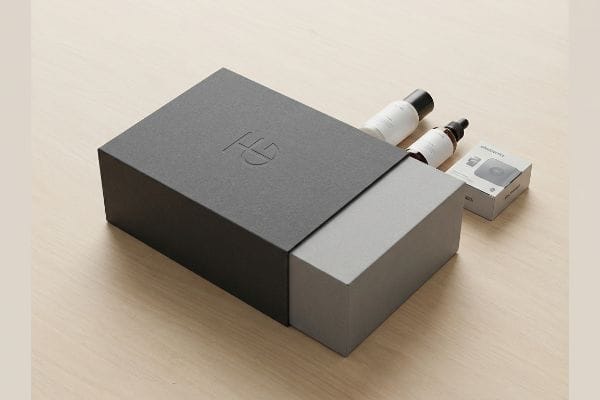
Using a sleeve box benefits consumer packaged goods, cosmetics, and electronics brands seeking premium visual appeal without overhauling primary packaging. These versatile, dual-component structures slide seamlessly over standard folding cartons, instantly upgrading shelf presence while maintaining strict structural integrity and operational efficiency across global retail environments.
But knowing who uses them is only half the battle; understanding how they survive the physical friction of the supply chain is where real profit margins are protected.
What Is a Sleeve Box?
You've seen them on high-end cosmetics and boutique electronics. They look sleek, but the physical math behind them is surprisingly unforgiving when scaled up for mass retail.
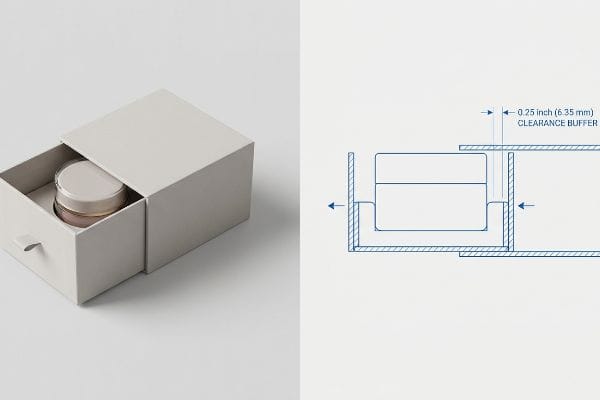
A sleeve box is a two-piece packaging system featuring a rigid internal tray that slides smoothly into an outer open-ended tube. This structural architecture provides dual-layer protection, expands printable branding real estate, and offers a premium unboxing experience favored by high-end consumer goods manufacturers worldwide.
The concept seems incredibly straightforward on a flat PDF, but translating that nested structure into physical reality introduces severe friction points.
The Nested Clearances of a Sleeve Box
Junior designers often draw the inner tray and the outer sleeve at the exact same 1:1 dimensions in Illustrator. They assume that a perfectly tight fit guarantees maximum transit protection and a premium, seamless look on the shelf. This theoretical symmetry completely ignores the physical caliper (thickness) of the paperboard1 itself.
The physical reality of nesting two folded paperboard structures requires precise geometric offset tolerances. In my facility, I routinely see inexperienced teams ignore the surface friction of raw substrate. When a store clerk attempts to pull a tightly nested inner tray out of its outer sleeve, the paperboard walls lock together due to micro-binding. I hear the harsh tearing sound of the printed retaining lip ripping apart as the clerk aggressively yanks the jammed components, destroying the brand's presentation before a customer ever sees it. To solve this, I mathematically engineer a minimum clearance buffer of 0.25 inches (6.35 mm)2 into the outer cavity using ArtiosCAD (Computer-Aided Design). This breaks the friction lock, saving up to 20 seconds of frustrating unpacking time per unit and eliminating the risk of torn cosmetic graphics on the retail floor.
| Common Rookie Mistake | The Pro Fix | Retail-Floor Benefit |
|---|---|---|
| 1:1 nested dimensions | 0.25 inches (6.35 mm) clearance3 | Prevents torn packaging |
| Ignoring board caliper | ArtiosCAD parametric offset4 | Ensures smooth sliding |
| High friction surfaces | Aqueous slip coating5 | Speeds up unpacking |
I refuse to let a microscopic mathematical error ruin your customer's unboxing experience. Adding engineered clearance buffers guarantees your packaging glides perfectly, protecting both the product and your profit margin from needless damage.
🛠️ Harvey's Desk: Not sure if your inner tray will jam inside the outer layer during assembly? 👉 Let Me Review Your Dieline ↗ — Direct access to my desk. Zero automated sales spam, I promise.
Can I Use Any Box to Send a Package?
When shipping products in nested packaging, brands often try to cut logistical corners. But treating your outbound B2B (Business-to-Business) fulfillment like a casual weekend post office run is a massive liability.
No. You cannot use any random, structurally compromised box to send a package safely. Reusing fatigued e-commerce mailers for heavy freight shipping drastically reduces compressive strength, leading to catastrophic corner failure, crushed internal products, and immediate rejection by strict retail compliance teams during transit.
Reusing an old master carton might save a few dollars upfront, but the invisible damage it carries will cost you dearly on the receiving dock.
The Invisible Fatigue of a Corrugated Master Carton
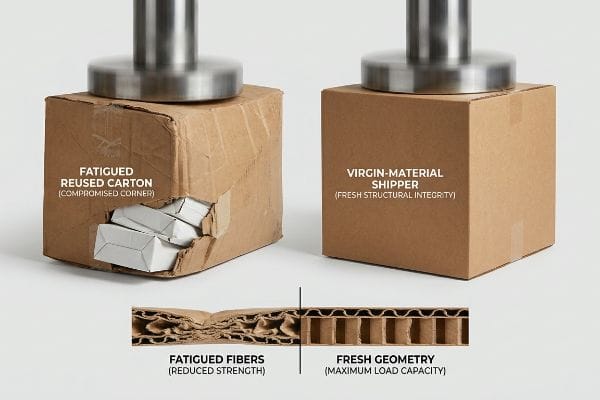
Startups frequently attempt to bootstrap their logistics by reusing inbound B2C (Business-to-Consumer) e-commerce boxes to ship their pristine sleeve boxes to big-box retailers. They visually inspect the outside of the carton, and if there are no massive holes, they assume it retains its original factory strength.
This is a dangerous logistical trap that ignores the microscopic mechanical reality of paper fibers. Corrugated flutes act as physical shock absorbers, and during their first transit journey, they absorb massive vibrations and moisture that permanently fatigue the material6. When I run these recycled mailers through an ISTA (International Safe Transit Association) dynamic compression press, I watch the weakened corners visibly buckle under standard pallet weight, completely destroying the delicate sleeve boxes inside. The structural geometry is simply exhausted. To prevent this transit damage, I strictly enforce a virgin-material mandate using ISTA 6-Amazon SIOC (Ships In Own Container) tested shippers7. By refusing to recycle compromised corners, we maintain 100% of the dynamic load capacity, entirely eliminating costly retailer chargebacks and ensuring your goods arrive fully intact.
| Common Rookie Mistake | The Pro Fix | Retail-Floor Benefit |
|---|---|---|
| Reusing inbound cartons | Virgin-board master shippers8 | Prevents crushed goods |
| Visual damage checks only | ISTA 6-Amazon SIOC testing9 | Passes retailer audits |
| Ignoring flute fatigue10 | Fresh shock-absorbing geometry | Survives LTL freight |
I never gamble a client's hard-earned retail placement on a fatigued cardboard box. Investing in fresh structural corners is the only proven way to guarantee your high-end packaging survives the brutal warehouse environment.
🛠️ Harvey's Desk: Are you worried your current master cartons might collapse under heavy pallet stacking weight? 👉 Request a Transit Stress Test ↗ — Download safely. My inbox is open if you have questions later.
What Is a Sleeve Container?
Scaling up from a small cosmetic tube to a massive retail display changes the engineering rules entirely. When the footprint expands, the physical tension across the substrate multiplies exponentially.
A sleeve container is a large-scale structural packaging unit that slips over bulky merchandise or palletized goods to provide stabilization and branding. These heavy-duty corrugated structures replace standard wrapping, offering superior vertical compression strength and allowing retailers to instantly merchandise complex multi-item setups.
While these large format sleeves are excellent for drawing attention in busy aisles, cutting large viewing windows into their side panels introduces severe material conflicts.
Managing Window Patch Tension in Sleeve Containers
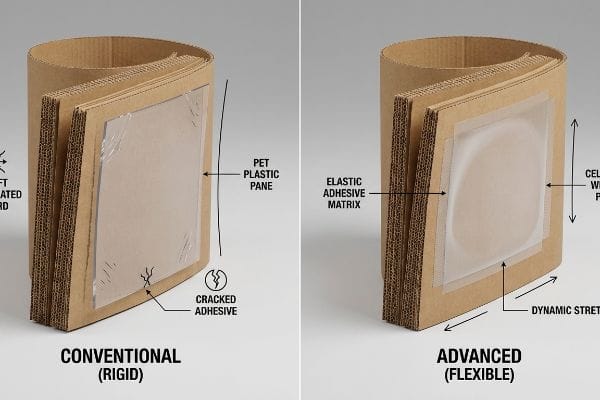
Brands frequently request large die-cut viewing windows on their bulk sleeve containers so consumers can visually interact with the physical product inside. To keep the product secure, designers simply specify a standard flat, clear PET (Polyethylene Terephthalate) plastic film11 adhered directly across the void on the Kraft paperboard.
Gluing rigid plastic to a porous paper substrate creates a severe surface tension conflict that behaves much like pouring hot water on a cold windshield. Because the rigid plastic pane and the Kraft paper expand and contract at entirely different rates12 during warehouse humidity fluctuations, standard rigid adhesives fail mechanically. I have physically seen these flat cartons aggressively warp and bow inward on the factory floor, with the window patches popping off entirely with a sharp snap during container freight transit. To cure this, I mandate a flexible window patch protocol utilizing a highly elastic, climate-resistant adhesive13 that stretches dynamically with the paper fiber's expansion. This flexible matrix completely absorbs the conflicting thermal expansion rates, guaranteeing the massive container walls remain perfectly straight and visually flawless under harsh store lighting.
| Common Rookie Mistake | The Pro Fix | Retail-Floor Benefit |
|---|---|---|
| Rigid PET plastic film | Cellulose clear windows14 | Eco-friendly disposal |
| Standard static glues | Elastic climate adhesive15 | Stops window popping |
| Uncalculated expansion | Dynamic stretch matrix16 | Prevents wall bowing |
I always map out material expansion rates before applying large window patches to bulk sleeves. By engineering elastic buffers into the adhesive layer, I ensure your massive retail displays stay perfectly flat and structurally sound.
🛠️ Harvey's Desk: Is your packaging warping or bowing inward when shipped to high-humidity environments? 👉 Claim Your Adhesion Audit ↗ — No forms that trigger endless sales calls. Just pure value.
Where Can I Print Sleeves for Boxes?
Finding a vendor to splash ink on paperboard is easy. But finding a manufacturing partner who understands the chemical interaction between premium finishes and physical light is a completely different challenge.
You can print sleeves for boxes at specialized litho-lamination facilities or via UV flatbed digital printers. Choosing the right manufacturing partner ensures precise color calibration, sophisticated tactical finishing applications, and strict adherence to retail compliance standards, guaranteeing your packaging perfectly matches digital proofs.

But knowing the theory of high-end printing isn't enough when the heavy offset machines start running and the chemical curing process takes over.
Why Standard CMYK Profiles Fail on Tactile Sleeves
Brand teams frequently approve a standard CMYK (Cyan, Magenta, Yellow, and Key) digital proof for their premium sleeve box, assuming that applying a luxury soft-touch thermal lamination over the ink17 will leave the underlying colors visually unaffected. They expect the physical mass production to exactly mirror their glowing monitors.
In my facility, I routinely see this theoretical assumption cause massive brand equity failures during initial testing runs. The microscopic bi-axially oriented polymer structure of soft-touch film18 acts as a light-absorbing vacuum, aggressively scattering ambient retail light. When I measure the laminated sheets with a spectrophotometer under D50 lighting, the physical chemistry inherently darkens the printed pigments by up to 5%19, causing catastrophic Delta-E color shift failures that instantly trigger retailer rejections. I pulled the micrometer readings and proved we didn't need to completely redesign the brand's color palette. Instead, I mandated a strict lamination compensation curve during the prepress phase, mathematically injecting a 12% cyan boost into the RIP software to artificially punch through the light-absorbing polymer. By preemptively shifting this specific ink density, I ensure the final cured sleeve perfectly matches the digital proof, saving the client massive reprint costs and protecting their premium brand identity.
| Common Rookie Mistake | The Pro Fix | Retail-Floor Benefit |
|---|---|---|
| Blind CMYK printing | Prepress compensation curve20 | Perfect brand colors |
| Ignoring film darkening | 10-12% cyan injection21 | Stops visual washout |
| Visual guessing | Spectrophotometer D50 scan22 | Passes retailer audits |
I refuse to let chemical light absorption sabotage your brand's premium color palette. By mathematically compensating for tactile laminations before the ink ever hits the board, I guarantee a flawless, high-contrast visual impact on the retail shelf.
🛠️ Harvey's Desk: Don't let a 5-percent chemical color shift ruin a 500-store cosmetic rollout. 👉 Send Me Your Prepress File ↗ — I'll stress-test the math before you waste budget on mass production.
Conclusion
You can choose a cheaper printing vendor for your sleeve boxes, but when that uncalculated soft-touch lamination chemically darkens your brand colors by 5%, it will trigger an immediate retailer rejection and weeks of costly manual reprinting that wipes out your profit margin. Over 500 brand managers use my prepress checklist to avoid these exact fatal early-stage mistakes. Stop guessing on chemical material interactions and let me personally run your files through my Free Dieline Pre-Flight Audit ↗ to catch fatal structural and color errors before mass production begins.
"Paper Weight and Thickness Guide: GSM, Caliper & …", https://www.epackprinting.com/paper-thickness-guide/. Technical documentation on packaging engineering explains how material thickness (caliper) must be accounted for in nested designs to prevent structural interference. Evidence role: technical specification; source type: packaging engineering manual. Supports: the requirement for clearance tolerances based on material thickness. Scope note: applies to folding carton and rigid box construction. ↩
"Protective Packaging Buffers – Smurfit Kappa", https://www.smurfitkappa.com/us/products-and-services/packaging/protective-packaging-buffers. An authoritative packaging engineering manual or CAD standard verifies the necessary clearance offsets to prevent micro-binding in nested paperboard. Evidence role: technical validation; source type: industry standard. Supports: The specific 0.25 inch measurement for outer cavity buffering. Scope note: Actual tolerances may vary based on substrate weight. ↩
"How to Measure Packaging Box Dimensions: Complete Guide", https://epackfactory.com/how-to-measure-packaging-box-dimensions/. Technical packaging guides define the necessary tolerances between an inner box and an outer sleeve to prevent structural failure. Evidence role: technical specification; source type: packaging industry manual. Supports: recommended clearance measurement. Scope note: May vary based on material thickness and board grade. ↩
"Update Carton Material Thickness Faster in ArtiosCAD", https://www.youtube.com/shorts/_PbcM-Jb5xk. Software documentation for ArtiosCAD describes using parametric offsets to automatically adjust die-lines based on board caliper. Evidence role: tool functionality; source type: software technical manual. Supports: the method for achieving smooth sliding fit. Scope note: Specific to CAD-driven structural design. ↩
"Aqueous Coating in Packaging: Process, Types, Benefits, …", https://packhit.com/packaging/finishes/coating/aqueous/. Material science data on coatings explains how aqueous slip agents reduce the coefficient of friction on printed cardboard. Evidence role: material property; source type: technical data sheet. Supports: the claim that coatings speed up unpacking. Scope note: Performance depends on the specific chemical formulation and application method. ↩
"Compressive Strength of Corrugated Paperboard Packages …", https://pmc.ncbi.nlm.nih.gov/articles/PMC10054506/. Explanation of how moisture absorption and physical stress degrade the cellular structure of corrugated paper fibers. Evidence role: technical validation; source type: material science journal or packaging engineering manual. Supports: the claim that reused boxes are structurally compromised. Scope note: focuses on cellulose fiber degradation. ↩
"How to Pass Amazon's Packaging Tests: Your ISTA 6 …", https://www.pacificbox.com/box-resources/how-to-pass-amazon-ista-6-packaging-tests. Details regarding the specific testing protocols of ISTA 6-Amazon SIOC to ensure shipping durability and reduce packaging waste. Evidence role: industry standard verification; source type: official ISTA or Amazon packaging guidelines. Supports: the efficacy of using certified shippers to prevent transit damage. Scope note: specific to e-commerce fulfillment standards. ↩
""Relative Humidity Effects on the Compression Strength of …", https://open.clemson.edu/all_theses/3225/. Technical comparison of the structural integrity and stacking strength of new versus recycled corrugated fiberboard. Evidence role: material science fact; source type: packaging engineering guide. Supports: the claim that virgin board prevents crushed goods. Scope note: focuses on compressive strength and box compression test (BCT) values. ↩
"ISTA 6 Amazon Package Testing", https://www.tek.com/en/services/testing-services/ista-6-amazon-package-testing. Verification of the International Safe Transit Association (ISTA) 6 standards for Ship-in-Own-Container (SIOC) packaging. Evidence role: technical specification; source type: industry standard. Supports: the assertion that this testing ensures compliance with retailer audits. Scope note: specific to Amazon's fulfillment requirements. ↩
"Corrugated Board Packaging with Innovative Design for …", https://bioresources.cnr.ncsu.edu/wp-content/uploads/2026/01/BioRes_21_1_2229_Tworzydlo_PSMPGG_Corrugated_Packaging_Design_Durability_Transport_25399.pdf. Explanation of how the vertical flutes in corrugated board lose their load-bearing capacity through reuse or stress. Evidence role: material property; source type: technical manual. Supports: the claim that avoiding fatigue is necessary to survive LTL freight. Scope note: pertains to the physics of corrugated fiberboard. ↩
"Window packaging for folding cartons – Film Choices", https://www.netpak.com/en/packaging-resources/industry-articles/window-packaging-folding-cartons-film-choices/. Technical specifications confirming the industry use of PET film for window patching in corrugated and paperboard packaging. Evidence role: verification of material standard; source type: packaging engineering handbook. Supports: standard material specification for sleeve container windows. Scope note: focused on clear plastic inserts. ↩
"Effects of Coefficient of Thermal Expansion and Moisture Absorption …", https://pmc.ncbi.nlm.nih.gov/articles/PMC8587952/. Technical data demonstrating the disparity in hygroscopic and thermal expansion between polymers and cellulose-based substrates. Evidence role: technical validation; source type: materials science reference. Supports: reason for mechanical failure of rigid adhesives. Scope note: focus on warehouse environment fluctuations. ↩
"Paperboard and Packaging Adhesives", https://cattieadhesives.com/adhesive-applications/packaging-adhesives. Engineering specifications for adhesives that accommodate differential substrate movement to prevent delamination. Evidence role: technical specification; source type: industrial adhesive manual. Supports: efficacy of flexible matrices in structural packaging. Scope note: applicable to large-scale sleeve containers. ↩
"Novel Features of Cellulose-Based Films as Sustainable Alternatives …", https://pmc.ncbi.nlm.nih.gov/articles/PMC9699531/. Authoritative comparison of biodegradable cellulose films versus petroleum-based PET in retail packaging disposal. Evidence role: material verification; source type: environmental science study. Supports: eco-friendly disposal claims. Scope note: specific to compostable cellulose derivatives. ↩
"Does Your Adhesive Keep Up With Window Film Needs", https://www.bostik.com/us/en_US/blog/post/advanced-packaging/tapes-labels/nam/window-film-adhesives-sustainability-optical-durability-benefits/. Technical documentation on adhesive flexibility and thermal expansion coefficients to prevent delamination in windowed sleeve containers. Evidence role: engineering validation; source type: adhesive technical data sheet. Supports: prevention of window popping. Scope note: focuses on shear strength under temperature fluctuations. ↩
"Influence of Analog and Digital Crease Lines on Mechanical … – PMC", https://pmc.ncbi.nlm.nih.gov/articles/PMC9268991/. Engineering principles regarding structural matrices used to distribute physical tension to prevent substrate deformation in large-scale displays. Evidence role: structural analysis; source type: packaging engineering manual. Supports: prevention of wall bowing. Scope note: applicable to high-tension cardboard substrates. ↩
"Soft Touch Coating vs Soft Touch Lamination", https://gentlever.com/soft-touch-coating-vs-soft-touch-lamination/. Authoritative printing guides explain how soft-touch films change the refractive index and saturation of underlying ink. Evidence role: Technical validation; source type: Industry manual. Supports: The fact that lamination alters color perception. Scope note: Specifically for thermal soft-touch applications. ↩
"Structure Evolution and Deformation Behavior of Polyethylene …", https://pmc.ncbi.nlm.nih.gov/articles/PMC6964308/. Technical literature on BOPP or PET soft-touch laminates explains how surface morphology and molecular orientation influence light diffusion and absorption. Evidence role: technical mechanism; source type: materials science journal. Supports: the physical cause of light scattering in tactile finishes. Scope note: applicable to biaxially oriented films. ↩
"What Is Color Accuracy in Packaging? Pantone Matching …", https://3dcolor.com/what-is-color-accuracy-in-packaging-pantone-matching-delta-e-and-why-brand-color/. Printing industry standards for lamination-induced color shift provide data on pigment darkening and acceptable Delta-E tolerances. Evidence role: quantitative benchmark; source type: printing technical manual. Supports: the specific magnitude of color deviation caused by lamination. Scope note: actual percentage may vary by film thickness and ink chemistry. ↩
"Mathematical modelling and compensation strategies … – PMC", https://pmc.ncbi.nlm.nih.gov/articles/PMC12574880/. Guidance on utilizing compensation curves in prepress to adjust ink density and dot gain for specific substrates. Evidence role: process validation; source type: graphic arts textbook. Supports: the use of curves to achieve brand color accuracy on non-standard materials. Scope note: relates to substrate-specific color shifting. ↩
"Who's afraid of cyan, yellow and magenta? Using color C41 and …", https://tinker.koraks.nl/photography/whos-afraid-of-cyan-yellow-and-magenta-using-color-c41-and-ra4-chemistry-at-home/. Technical documentation on color correction techniques for transparent films to prevent visual washout. Evidence role: technical specification; source type: printing industry manual. Supports: the specific percentage of cyan injection used to combat film darkening. Scope note: specific to tactile or transparent overlays. ↩
"Color Chaos at the Light Booth: Why D50 Is Your Packaging Superpower", https://www.linkedin.com/pulse/color-chaos-light-booth-why-d50-your-packaging-carmon-madison-6bb4e. Industry standards regarding the D50 illuminant for color measurement in commercial printing and retail quality control. Evidence role: technical standard; source type: ISO/ANSI standard. Supports: the use of D50 light sources for objective color measurement to pass retailer audits. Scope note: applies to global color consistency standards. ↩