
You've secured retail space, but generic boxes won't convert shoppers. Without a strategic physical presence, your product becomes invisible on crowded shelves. Let's fix that.
An example of a POP (Point of Purchase) display is a freestanding corrugated floor bin positioned at a grocery store end-cap. Other common examples include countertop register trays, quarter-pallet club store merchandisers, and hanging clip strips designed to trigger immediate impulse purchases in high-traffic retail aisles.
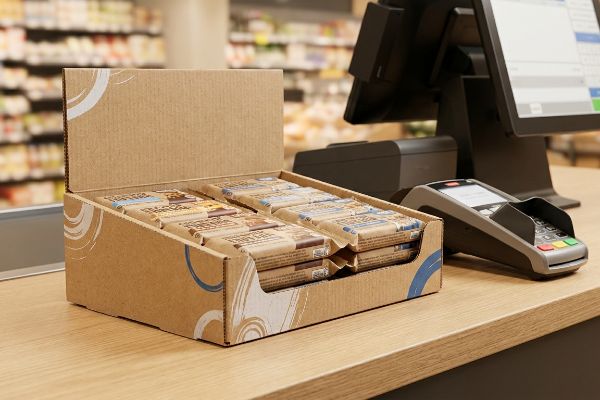
Understanding the physical format is only the first step; surviving the retail floor requires knowing which structural format fits your exact campaign goal.
What Are the Different Types of POP Displays?
Choosing the wrong structural footprint guarantees immediate retailer rejection. You must align your display format with strict spatial laws before you ever submit artwork.
The different types of POP displays include floor-standing units, pallet merchandisers, countertop trays, and interactive sidekicks. Each structural type serves a specific logistical zone, ranging from bulk aisle placements to compact register areas, driving targeted consumer engagement based on available retail floor space.
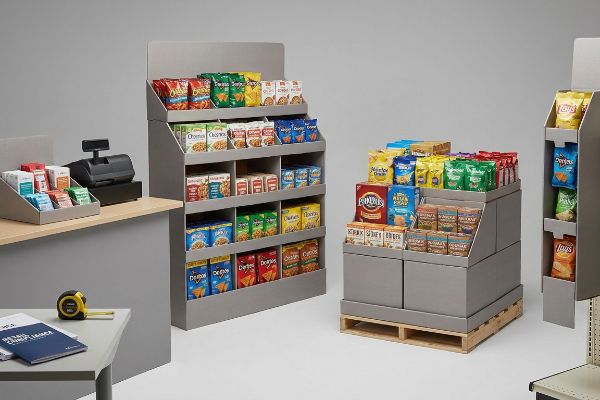
Separating these formats isn't just about aesthetics; it's about adhering to strict compliance rules dictated by big-box stores.
The ADA vs. GMA Physical Limits
A common assumption among new brands is that a successful floor display can simply be scaled down by 50% to create a matching countertop unit. They treat different physical formats as simple visual resizes. This shrink-to-fit approach completely ignores the strict legal and logistical rules dictating distinct retail zones1.
Even veteran designers often overlook this blind spot, trying to force a massive GMA (Grocery Manufacturers Association) 48×40 inch (1219×1016 mm) pallet design2 onto a checkout counter. I see this constantly when reviewing flat dielines. The brand scales the artwork down, but forgets that counter units are strictly anchored to the ADA (Americans with Disabilities Act) 15-48 inch (381-1219 mm)3 forward reach compliance window. I remember a specific rollout where a clerk spent twenty minutes aggressively folding and forcing a shrunk-down, overly rigid B-flute base into a tiny register space, tearing the raw brown paperboard with a loud rip. They eventually gave up and tossed the unit in the backroom. By completely separating the engineering pipelines for floor and counter units, we prevent these massive chargebacks and ensure seamless store manager approval.
| Common Rookie Mistake | The Pro Fix | Retail-Floor Benefit |
|---|---|---|
| Shrinking floor units to fit counters | Independent structural math per zone | Zero retailer ADA compliance rejections4 |
| Ignoring pallet footprint limits | Anchoring to 48×40 inch base limits5 | Fits warehouse racking perfectly |
| Overcomplicating counter bases | Using single-wall E-flute construction6 | Prevents paperboard tearing during setup |
I never allow a single master file to dictate multiple retail zones. Building distinct structural math for every specific format ensures your campaign actually hits the floor instead of the recycling bin.
🛠️ Harvey's Desk: Are your scaled-down counter displays violating ADA reach limits? 👉 Let Me Check Your Dieline ↗ — Direct access to my desk. Zero automated sales spam, I promise.
What Are the 5 Types of Displays with Examples?
Categorizing merchandisers helps clarify your marketing strategy. Let's break down the core structural categories and look at how physical physics impacts their real-world performance.
The 5 types of displays with examples are freestanding floor bins (like snack towers), countertop PDQ (Pretty Darn Quick) trays, pallet skirts (club store wraps), end-cap merchandisers (aisle ends), and kinetic spinner displays (rotating sunglass racks). Each category requires distinct structural engineering to survive daily shopper interaction.
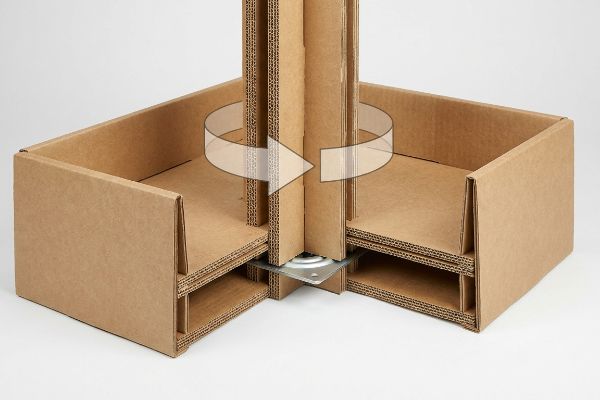
While static bins are straightforward, introducing kinetic movement like a rotating rack completely changes the manufacturing math.
The Rotational Torque Shear Failure
Brands frequently want to upgrade a standard floor display into a kinetic, rotating 360-degree merchandiser to maximize product visibility in a tight footprint7. They assume that taking a standard corrugated flat-pack base and simply bolting a metal ball-bearing hardware plate to it will result in a perfectly functioning spinner.
It is a common trap that catches even experienced procurement teams. When shoppers aggressively spin a heavily loaded display, the centrifugal torque transfers directly into the cardboard base structure8 as kinetic shear force. I have watched beautiful rotating displays freeze dead in their tracks because the rotational friction twisted the folded flaps, resulting in the distinct crunch of collapsing corner seams. Without an isolated torque hub, the outer cosmetic walls buckle under the lateral stress. I fix this by engineering an internal double-wall corrugated spine beneath a locked false bottom9 to anchor the hardware. This completely absorbs the centrifugal force, ensuring a frictionless spin and preventing a total collapse in the aisle.
| Common Rookie Mistake | The Pro Fix | Retail-Floor Benefit |
|---|---|---|
| Bolting bearings to standard flaps | Engineering an internal torque hub10 | Prevents corner seam buckling |
| Ignoring centrifugal shear force11 | Upgrading to double-wall spine | Keeps display spinning smoothly |
| Uneven weight distribution | Centering the vertical load axis12 | Eliminates base plate friction |
I always isolate kinetic stress from the outer cosmetic walls. Engineering a dedicated load-bearing spine guarantees your rotating displays survive aggressive shopper interactions without tearing apart.
🛠️ Harvey's Desk: Are your rotating merchandisers engineered to absorb centrifugal shear force? 👉 Audit Your Kinetic Structure ↗ — Download safely. My inbox is open if you have questions later.
Who Usually Provides POP Displays?
Navigating the supply chain is critical for a profitable rollout. You need to know exactly who is handling your materials, printing, and final assembly.
POP displays are usually provided by turnkey contract packaging manufacturers, specialized corrugated structural engineers, or print brokers. While brokers outsource various components, a centralized manufacturing partner physically produces the raw board, prints the graphics, and engineers the final interlocking geometry completely under one roof.
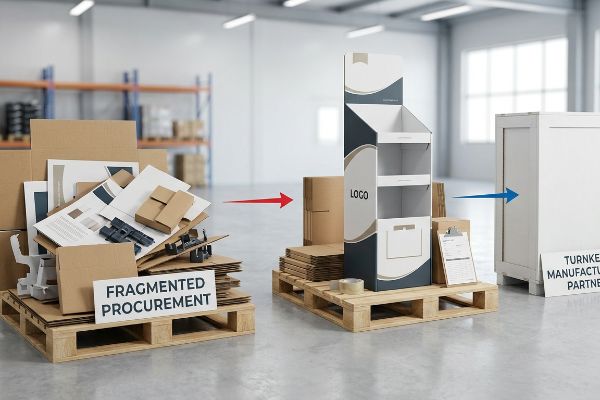
Selecting the right provider dictates whether your campaign launches on time or bleeds cash during the final assembly stage.
The Tolling vs. Turnkey Liability Trap
Brand owners frequently choose a tolling contract packaging model13, sourcing printed films, plastic clips, and corrugated boards from separate, cheaper vendors. They then ship these disparate parts to a co-packer, assuming assembly will be a seamless, standardized process.
Think of it like buying car parts from five different junkyards and expecting your local mechanic to build a flawless engine in one afternoon. When mismatched packaging components hit a high-speed assembly line, the mechanical tolerances always clash14. I recently audited a stalled project where the printed top sheets from one supplier were 0.12 inches (3 mm) too large for the structural bases from another, creating a sticky, overlapping edge that jammed the automated glue folder. The co-packer simply halted the line, triggering massive hourly machine-downtime penalties. By mandating a turnkey consolidation protocol15 where a single partner controls both the structural engineering and final physical assembly, I eliminate this cross-component friction. This shift ensures the line runs seamlessly and completely protects your expected return on investment.
| Common Rookie Mistake | The Pro Fix | Retail-Floor Benefit |
|---|---|---|
| Sourcing parts from varied vendors | Using a turnkey manufacturing partner16 | Eliminates assembly line jams |
| Ignoring cross-component tolerances | Centralized structural engineering17 | Prevents costly machine downtime |
| Paying hourly co-packing penalties | Securing a fixed per-unit assembly cost18 | Protects overall campaign ROI |
I refuse to let fragmented procurement destroy a brand's profit margin. Controlling the entire geometry under one roof is the only way to guarantee a frictionless, on-time retail launch.
🛠️ Harvey's Desk: Are mismatched component tolerances threatening to halt your co-packing assembly line? 👉 Consolidate Your Supply Chain ↗ — No forms that trigger endless sales calls. Just pure value.
What Is POP-in Display?
The terms can get confusing, but a POP-in usually refers to a nested retail tray that slides securely into a larger protective structure for shipping.
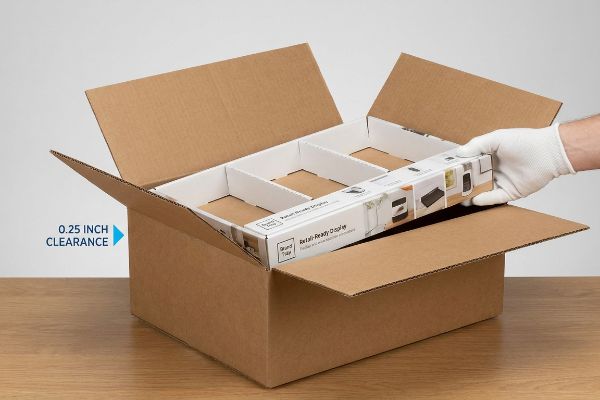
A POP-in display is a pre-assembled merchandising tray designed to nest tightly inside a master shipping carton. Store clerks simply open the outer shipper and instantly pop the inner retail-ready tray directly onto the store shelf, drastically reducing manual assembly time and retail labor.
But knowing the theory isn't enough when the machines start running. Getting a nested tray to slide smoothly requires exact mathematical engineering.
The Nested Friction Clearance Hazard
Procurement teams often design master shipping cartons to match the exact 1:1 exterior dimensions19 of their pre-filled retail POP-in trays. They logically assume that a perfectly tight, flush fit provides maximum transit protection20 and prevents the internal merchandise from shifting during rough ocean freight.
In my facility, I routinely see this theoretical assumption fail the moment we run a physical unpacking test. A tight 1:1 ratio completely ignores the severe surface friction of raw corrugated testliner21. When I measure the pull-force required to extract a tightly nested 24-inch (609.6 mm) tray out of a 24-inch shipper, the porous paperboard walls physically lock together. This massive resistance forces the retail clerk to aggressively yank on the display's front panels, inevitably tearing the printed retaining lip. To fix this, I enforce a strict geometric offset tolerance protocol, adding an exact minimum perimeter clearance buffer of 0.25 inches22 (6.35 mm) to the master carton's internal cavity. By enforcing this micro-tolerance, I break the friction lock, ensuring the unpacking time drops by 15 seconds per unit and saving clients from replacing hundreds of ripped displays before they ever reach the shelf.
| Common Rookie Mistake | The Pro Fix | Retail-Floor Benefit |
|---|---|---|
| Using 1:1 nested dimensions | Engineering a 0.25-inch (6.35 mm) offset23 | Eliminates paper friction lock |
| Ignoring testliner surface drag24 | Adding an internal clearance buffer | Stops retaining lip tearing |
| Forcing tight unboxing | Creating a smooth glide path | Speeds up shelf stocking time |
I never rely on perfectly flush dimensions for nested shippers. Building a precise mathematical clearance buffer guarantees your pre-filled trays reach the shelf completely intact and ready to sell.
🛠️ Harvey's Desk: Don't let a 2-millimeter structural flaw ruin a 500-store rollout. 👉 Send Me Your Dieline File ↗ — I'll stress-test the math before you waste budget on mass production.
Conclusion
You can rely on standard corrugated folds for your kinetic displays, but when centrifugal shear force twists that base and causes a massive structural collapse, you risk immediate retailer rejection and completely wiping out the project's profit margin. Over 500 brand managers use my prepress checklist to avoid these exact fatal early-stage mistakes. Stop guessing on complex load tolerances and let me personally run your structural files through my Free Dieline Audit ↗ to catch these hidden friction points before you ever authorize mass production.
"ADA Accessibility Standards", https://www.access-board.gov/ada/. External industry standards from organizations like the GMA and ADA provide specific dimensional and accessibility requirements for retail zones. Evidence role: regulatory verification; source type: industry standard. Supports: the claim that retail zones are governed by specific legal and logistical constraints. Scope note: Primarily applies to North American retail environments. ↩
"48×40" GMA Pallets | Largest Pallet Manufacturer & Supplier", https://www.palletone.com/products/gma-pallets/. Verification of standard Grocery Manufacturers Association (GMA) pallet dimensions. Evidence role: factual specification; source type: industry standard. Supports: the standard footprint for floor-standing pallet displays. Scope note: Applicable to North American retail standards. ↩
"Chapter 3: Operable Parts – Access-Board.gov", https://www.access-board.gov/ada/guides/chapter-3-operable-parts/. Verification of ADA accessibility standards regarding forward reach depth and height limits. Evidence role: legal compliance; source type: government regulation. Supports: the physical constraints for counter-top POP displays. Scope note: Specifically concerns accessibility for persons in wheelchairs. ↩
"ADA Standards for Accessible Design Title III Regulation 28 CFR …", https://www.ada.gov/law-and-regs/design-standards/1991-design-standards/. Legal requirements for aisle clearance and accessibility under the Americans with Disabilities Act (ADA) in commercial retail spaces. Evidence role: regulatory requirement; source type: government legislation. Supports: the necessity of aligning displays with spatial laws to avoid rejection. Scope note: US federal law. ↩
"Heat Treated Wood GMA Pallet – 48 x 40" H-1260 – ULINE", https://www.uline.com/Product/Detail/H-1260/Pallets/Heat-Treated-Wood-GMA-Pallet-48-x-40. Verification of the standard GMA (Grocery Manufacturers Association) pallet footprint dimensions used in North American retail logistics. Evidence role: factual specification; source type: industry standard. Supports: the requirement for anchoring displays to a 48×40 inch base. Scope note: North American market standard. ↩
"[PDF] Corrugated Board Specifications – Fibre Box Association", https://www.fibrebox.org/assets/2025/09/Walmart_Corrugated-Board_Specifications_Automation_Packaging_Standards.pdf. Technical specifications of E-flute corrugated cardboard, including its flute height and structural integrity for point-of-purchase displays. Evidence role: technical specification; source type: material science guide. Supports: the claim that E-flute prevents tearing during setup. Scope note: refers to corrugated cardboard grading. ↩
"Best Types of Displays for Big-Box Stores – PopDisplay", https://popdisplay.me/best-types-of-displays-for-big-box-stores/. Industry data on visual merchandising supports the claim that rotating displays increase product exposure and SKU density while minimizing the floor area required. Evidence role: validation; source type: retail design study. Supports: efficiency of kinetic merchandisers. Scope note: focus on retail floor space optimization. ↩
"Estimation of the Compressive Strength of Corrugated Board Boxes …", https://pmc.ncbi.nlm.nih.gov/articles/PMC8467740/. Technical validation of how rotational forces create shear stress in corrugated cardboard retail displays. Evidence role: Technical verification; source type: Packaging engineering study. Supports: Mechanics of rotational failure. Scope note: Focuses on high-load kinetic displays. ↩
"DISPLAY STRUCTURAL DESIGN FOR INTERACTIVE RETAIL …", https://www.bcipkg.com/display-structural-design-for-interactive-retail-displays/. Industry standard for reinforcing the vertical load-bearing capacity of point-of-purchase displays. Evidence role: Technical specification; source type: Manufacturing guideline. Supports: Method for preventing structural collapse. Scope note: Standard practice for heavy-duty cardboard units. ↩
"Different Types of Corrugated Retail POP Displays – PopDisplay", https://popdisplay.me/different-types-of-corrugated-retail-pop-displays/. Technical documentation on structural reinforcement in rotating displays explains how torque hubs redistribute stress to prevent seam failure. Evidence role: technical verification; source type: structural engineering manual. Supports: the efficacy of torque hubs in preventing buckling. Scope note: specific to high-torque rotational merchandisers. ↩
"Generation Mechanisms of Rotating Stall and Surge in Centrifugal …", https://pmc.ncbi.nlm.nih.gov/articles/PMC6044252/. Physics principles detailing how rotation creates centrifugal force that induces shear stress on structural spines. Evidence role: scientific principle verification; source type: physics textbook. Supports: the requirement for double-wall spines to counteract shear. Scope note: applicable to rotational displays with significant mass. ↩
"Moment-rotation model of self-centering(SC) column base with web …", https://www.sciencedirect.com/science/article/abs/pii/S0143974X24003511. Mechanical engineering standards on load distribution demonstrating that aligning the center of gravity with the axis of rotation minimizes frictional torque. Evidence role: mechanical verification; source type: engineering handbook. Supports: the relationship between load centering and friction reduction. Scope note: assumes a rotating base plate mechanism. ↩
"Toll vs Turnkey Manufacturing | Choosing the Right Model", https://uscpack.com/toll-vs-turnkey-manufacturing/. An industry-standard definition or trade publication explaining the tolling model where the client provides raw materials to the manufacturer. Evidence role: Definition; source type: Industry Guide/Whitepaper. Supports: The operational structure of the tolling model. Scope note: Applicable to contract packaging and assembly. ↩
"Efficiency and Automation: The Technological Basis of Modern …", https://www.lantech.com/efficiency-and-automation-the-technological-basis-of-modern-packaging-lines/. Technical explanation of how dimensional variance in components leads to failure in high-speed automated assembly. Evidence role: technical validation; source type: manufacturing engineering guide. Supports: the claim that mismatched parts cause assembly line jams. Scope note: focuses on precision in automated folding and gluing. ↩
"Simplify Your Business with Turnkey Manufacturing Solutions", https://uscpack.com/turnkey-manufacturing-solutions/. Analysis of how turnkey manufacturing models reduce component mismatch and assembly errors compared to fragmented sourcing. Evidence role: operational validation; source type: supply chain management textbook. Supports: the claim that consolidated partners eliminate cross-component friction. Scope note: specific to integrated structural and graphic production. ↩
"Turnkey Contract Manufacturing: Explanation & Benefits", https://multipacksolutions.com/blog/turnkey-contract-manufacturing-for-product-launches/. Analysis of supply chain efficiency demonstrating how turnkey solutions reduce logistical friction and assembly errors compared to fragmented sourcing. Evidence role: operational efficiency; source type: supply chain management guide. Supports: reduction of assembly line jams. Scope note: focused on retail display manufacturing. ↩
"The Analysis and Application of Installation Tolerances in … – MDPI", https://www.mdpi.com/2075-5309/13/7/1799. Technical documentation showing how integrated engineering minimizes tolerance stack-up and prevents production line downtime during assembly. Evidence role: technical validation; source type: manufacturing engineering standard. Supports: prevention of machine downtime. Scope note: applicable to modular retail displays. ↩
"Co-Packing Pricing 2026: Quotes, Hidden Fees, True Unit Cost", https://msl-indy.com/co-packing-pricing/. Financial comparison between fixed-cost assembly models and hourly billing to demonstrate cost predictability and ROI protection in large-scale rollouts. Evidence role: financial validation; source type: procurement analysis. Supports: protection of campaign ROI. Scope note: specifically for co-packing and assembly services. ↩
"The Ultimate Guide To Corrugated Boxes – Shorr Packaging", https://www.shorr.com/resources/blog/ultimate-guide-corrugated-boxes/. Industry packaging guidelines would verify the standard procurement practice of matching outer shipper dimensions to inner tray dimensions. Evidence role: industry standard; source type: packaging engineering manual. Supports: the commonality of 1:1 dimensioning in retail displays. Scope note: applies to pre-filled POP-in configurations. ↩
"Types of Fit in Engineering: Clearance, Transition, and Interference", https://www.fictiv.com/articles/engineering-fits-clearance-transition-interference. Logistics studies on load stability and vibration damping explain the theoretical benefit of eliminating void space to prevent merchandise shifting. Evidence role: technical validation; source type: logistics research. Supports: the engineering logic behind flush-fit packaging. Scope note: focuses on the prevention of internal shifting. ↩
"Evaluating the factors influencing the friction behavior of paperboard …", https://bioresources.cnr.ncsu.edu/resources/evaluating-the-factors-influencing-the-friction-behavior-of-paperboard-during-the-deep-drawing-process/. Technical data on the coefficient of friction for corrugated linerboard supports the claim that tight tolerances lead to material binding. Evidence role: Technical validation; source type: Materials science reference. Supports: The assertion that raw paperboard creates significant surface friction. Scope note: Friction coefficients vary by liner grade and moisture content. ↩
"Corrugated Trays for Food & Beverage Packaging", https://www.internationalpaper.com/packaging/corrugated-packaging/trays. Packaging engineering standards for corrugated tolerances provide guidelines on necessary clearances to prevent friction lock in nested assemblies. Evidence role: Industry standard validation; source type: Packaging engineering handbook. Supports: The use of a specific geometric offset to ensure easy extraction. Scope note: Recommended tolerances may fluctuate based on board caliper. ↩
"Why Work With a Professional Cardboard Display Manufacturer?", https://popdisplay.me/why-work-with-a-professional-cardboard-display-manufacturer/. Verification of industry-standard clearance measurements required to prevent friction lock in nested retail packaging. Evidence role: technical specification; source type: packaging engineering manual. Supports: the specific dimensional offset for nested displays. Scope note: actual requirements may fluctuate based on board caliper. ↩
"Hot Coefficient of Friction (HCOF) Test", https://rbi.gatech.edu/sites/default/files/2025-12/1hot_coeff_friction.pdf. Technical data regarding the coefficient of friction and surface drag of testliner paper used in corrugated board construction. Evidence role: material property; source type: material science data sheet. Supports: the claim that material surface properties cause mechanical resistance. Scope note: varies by liner grade and coating. ↩