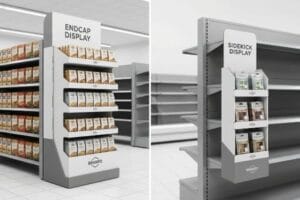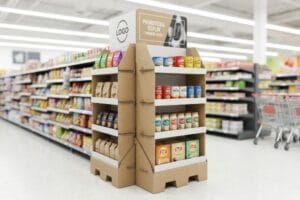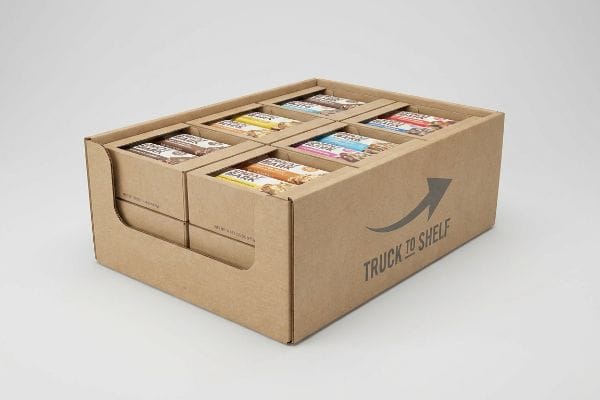
Launching a product at Walmart is an incredible milestone, but failing their strict display guidelines can stall your rollout. You need packaging that moves from truck to shelf instantly.
A Walmart PDQ display tray is a retail-ready corrugated merchandising unit designed for immediate shelf placement. Standing for "Pretty Darn Quick," these standardized trays allow store associates to transition pre-packed products directly onto Walmart shelves without unpacking individual items, drastically accelerating restocking operations and maximizing product visibility.
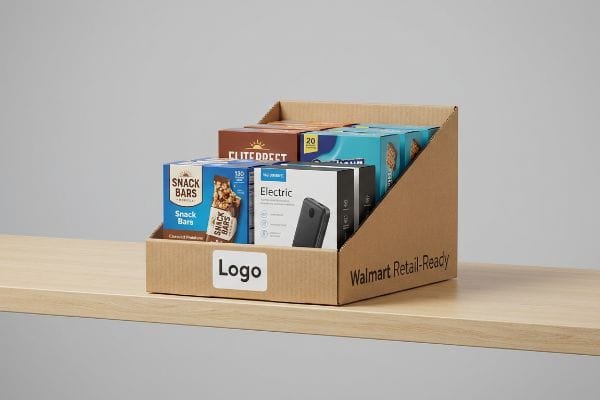
Understanding the basic definition is just the starting point; the real challenge lies in engineering these trays to survive the supply chain.
What Does PDQ Mean at Walmart?
When Walmart buyers request this format, they aren't just asking for a simple cardboard box. They are demanding extreme logistical efficiency on their store floor.
At Walmart, PDQ means "Pretty Darn Quick," representing a strict operational mandate for shelf-ready packaging. This classification requires that promotional trays and displays can be seamlessly assembled or placed on retail shelves within seconds, eliminating tedious manual labor and reducing overall store restocking times.
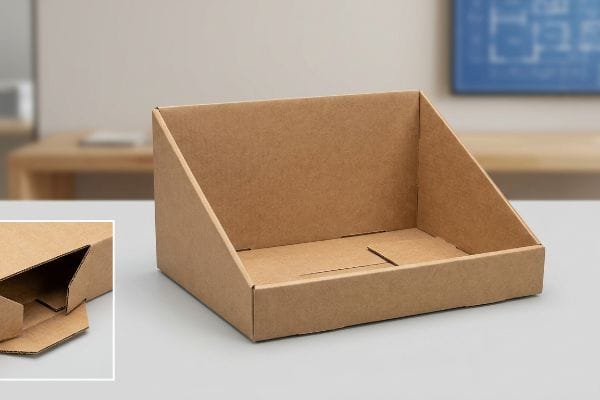
The acronym sounds simple, but the engineering required to achieve that speed is where most brands fail.
Achieving Zero-Frustration Assembly on the Retail Floor
Many marketing teams assume that as long as the graphic design looks appealing, the store associates will figure out the assembly. They approve flat-packed dielines that require intricate folding sequences and multiple interlocking tabs. This theoretical approach completely ignores the high-pressure environment of a big-box retail shift.
Even veteran designers often overlook this blind spot, designing complex tabs that look great in CAD (Computer-Aided Design) but fail in reality. I frequently see store clerks sweating to force a rigid B-flute tab into a tight slot for five minutes, eventually giving up and grabbing a roll of messy clear packing tape. The loud, sharp tearing sound of raw paperboard ripping because a slot was 2 mm (0.07 inches) too tight completely ruins the unboxing experience. To fix this, always specify pre-glued modular trays with auto-bottom mechanisms1 that snap open in a single motion.
| Common Rookie Mistake | The Pro Fix | Retail-Floor Benefit |
|---|---|---|
| Complex folding sequences | Pre-glued auto-bottoms | Saves 45s per tray2 |
| Tight manual friction tabs | Clear geometric tolerances | Prevents paperboard tearing |
| Relying on packing tape | Self-locking modular snaps | Maintains pristine branding |
I refuse to let poor dieline geometry cause a retailer chargeback. By engineering pre-glued auto-bottoms, I completely eliminate manual friction on the floor, protecting your brand image and ensuring your product gets shelved exactly as intended.
🛠️ Harvey's Desk: Not sure if your tray design requires too much manual folding? 👉 Get a Free Assembly Audit ↗ — Direct access to my desk. Zero automated sales spam, I promise.
What Is a PDQ Tray?
Stripping away the retail acronyms, the physical structure itself is an engineered bridge between shipping protection and active consumer merchandising.
A PDQ tray is a shallow, open-top corrugated container explicitly engineered to house, protect, and display multiple individual products simultaneously. These modular units feature cut-away front panels and optimized retaining lips, allowing consumers easy tactile access while keeping the merchandise securely organized on the retail shelf.
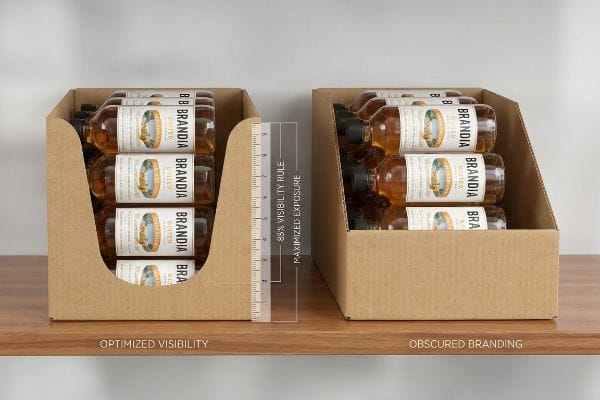
Creating a tray that holds products is easy, but engineering one that actually drives sales requires a deep understanding of visibility limits.
The 85% Visibility Rule for Shelf Trays
A frequent question buyers ask is how high the front wall of their tray should be to prevent products from falling out during transit. To solve this, they often approve a high, uniform retaining lip that wraps around the entire base3 of the merchandise. While this secures the items, it creates a massive physical barrier on the shelf.
When communicating with your factory, you must clearly separate shipping security from retail visibility. I often catch dielines where a generic 4-inch (101.6 mm) front lip completely covers the critical branding on a primary product bottle. The stiff resistance of folded virgin kraft board makes it impossible for a clerk to tear down manually without destroying the entire unit. I strictly enforce the "Product First" rule, die-cutting a sweeping swoop into the front lip to guarantee at least 85% of the primary packaging remains visible4.
| Common Rookie Mistake | The Pro Fix | Retail-Floor Benefit |
|---|---|---|
| High uniform front walls | Die-cut sweeping lip swoops | Maximizes product visibility |
| Obscuring primary branding | The 85% visibility rule5 | Drives faster impulse sales |
| Rigid non-tear fronts | Pre-perforated tear-aways6 | Allows safe shelf adaptation |
I always prioritize the psychological engagement of the shopper. By mathematically calculating the exact lip drop needed for your specific bottle, I ensure the tray securely holds the weight while keeping your core marketing message entirely unobstructed.
🛠️ Harvey's Desk: Are your current tray lips hiding your most important packaging details? 👉 Request a Visibility Check ↗ — Download safely. My inbox is open if you have questions later.
What Does PDQ Stand for in Displays?
Beyond individual shelf trays, this concept scales up to larger floor and pallet operations where the acronym dictates the entire logistical flow.
In displays, PDQ stands for "Product Display Quickly," referencing fully merchandised structural units that arrive at the store pre-filled with inventory. This methodology bypasses traditional backroom sorting, enabling large floor or pallet displays to be positioned directly in store aisles immediately after unloading from the freight truck.
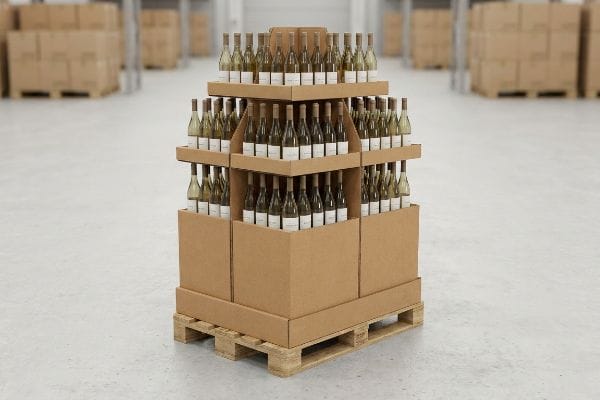
Moving from empty flat-packs to pre-filled merchandisers introduces a completely different layer of structural stress.
Optimizing the Supply Chain with Co-Packing
Brands looking to expand their footprint often assume they can just ship empty displays to the retailer and let the store staff handle the internal stocking. They fail to realize that major big-box retailers actively penalize or reject campaigns7 that require excessive manual labor from their own employees.
Think of it like serving a meal at a restaurant; you wouldn't hand a customer raw ingredients and a pan. The rule of thumb here is that the display must arrive 100% retail-ready. I regularly see brands try to pack heavy bottles into standard E-flute trays, only to find the displays crushed upon arrival. The heavy thud of a sagging, overloaded tray hitting the warehouse floor is a sound you never want to hear. To prevent this, I integrate dedicated co-packing protocols, utilizing double-wall corrugated bases that absorb the kinetic shock8 of pre-filled transit.
| Common Rookie Mistake | The Pro Fix | Retail-Floor Benefit |
|---|---|---|
| Shipping empty displays | Pre-filled co-packing systems | Eliminates store labor friction |
| Using thin single-wall bases | Double-wall corrugated spines9 | Prevents bottom-tier crushing |
| Ignoring transit shock | ISTA transit simulation testing10 | Ensures safe pallet arrival |
I build supply chain resilience directly into the structural dieline. By controlling the co-packing process and upgrading the load-bearing walls, I guarantee your pre-filled display survives the harsh journey from my factory straight to the center aisle.
🛠️ Harvey's Desk: Worried your current display base will buckle under the weight of pre-filled inventory? 👉 Claim Your Payload Assessment ↗ — No forms that trigger endless sales calls. Just pure value.
What Does PDQ Mean on a Food Box?
When this terminology crosses over into the grocery sector, the rules shift dramatically from basic logistics to stringent consumer safety compliance.
On a food box, PDQ indicates a shelf-ready secondary packaging unit that complies with strict grocery safety standards while maintaining rapid deployment capabilities. These specialized trays ensure direct food contact safety, often utilizing specialized barrier coatings, while allowing grocery clerks to restock high-turnover consumables with maximum efficiency.

But knowing the theory isn't enough when the machines start running and chemical compliance becomes a legal liability.
Why Standard Barrier Coatings Fail on the Factory Floor
Procurement teams frequently source standard moisture-resistant coatings for their grocery trays11 to protect against warehouse humidity and minor spills. They assume that any commercial varnish that visually repels water is perfectly adequate for a retail food environment.
In my facility, I routinely see brands submit specifications calling for legacy chemical barriers that contain PFAS (Per- and Polyfluoroalkyl Substances). When I pull the material safety data sheets, I have to reject the run immediately. The chemical smell of traditional solvent-based varnishes is a dead giveaway that the material will fail strict grocery audits. I completely stripped out these outdated chemicals, enforcing a strict mandate for PFAS-free, water-based aqueous coatings on all food-adjacent trays12. By making this 0.02 mm (0.0007 inches) chemical adjustment on the coating line13, I ensure the packaging repels moisture organically, entirely eliminating the risk of a multi-state retail rejection and saving clients from catastrophic recall liabilities.
| Common Rookie Mistake | The Pro Fix | Retail-Floor Benefit |
|---|---|---|
| Using legacy chemical varnishes | PFAS-free water-based coatings14 | Passes strict grocery audits |
| Ignoring moisture absorption | Organic liquid aqueous barriers15 | Prevents tray degradation |
| Assuming all coatings are safe | Material safety data verification16 | Protects consumer health liability |
I do not gamble with grocery compliance mandates. By auditing the microscopic chemical makeup of every varnish that touches your corrugated board, I physically bulletproof your packaging against both moisture fatigue and retailer regulatory audits.
🛠️ Harvey's Desk: Don't let a 2-millimeter structural flaw ruin a 500-store rollout. 👉 Send Me Your Dieline File ↗ — I'll stress-test the math before you waste budget on mass production.
Conclusion
You can choose a cheaper vendor, but when non-compliant chemical coatings trigger a massive retailer rejection, stalling your grocery rollout and completely wiping out the project's profit margin, the upfront savings become irrelevant. Over 500 brand managers use my prepress checklist to avoid these exact fatal early-stage mistakes. Stop risking your retail relationships on unverified materials and let me personally run your specs through my Free Dieline Audit ↗ to catch compliance failures before production begins.
"What Does PDQ Mean in Retail? – PopDisplay", https://popdisplay.me/what-does-pdq-mean-in-retail/. Technical specification confirming that auto-bottom mechanisms are the industry standard for rapid deployment in shelf-ready packaging. Evidence role: technical validation; source type: packaging industry standard. Supports: the claim that these mechanisms enable single-motion assembly. Scope note: applies to corrugated shipping-to-shelf displays. ↩
"Auto Bottom Folding Cartons | CCL Healthcare", https://cclhealthcare.com/packaging-products/pharmaceutical-folding-cartons/carton-styles-overview/auto-bottoms/. Industry benchmark data on the time efficiency gains of auto-bottom packaging over manual folding in retail environments. Evidence role: quantitative metric; source type: logistics study. Supports: efficiency of pre-glued bottoms. Scope note: typical average for single-tray assembly. ↩
"Understanding PDQ Packaging in Retail", https://www.linkedin.com/pulse/understanding-pdq-packaging-retail-moss-tvthc. Technical standards for corrugated display packaging explain the tradeoff between transit stability and consumer access. Evidence role: technical specification; source type: industry packaging guide. Supports: the function and impact of retaining lips on PDQ trays. Scope note: focused on retail display engineering. ↩
"14 Types Of Retail Displays | Chicago, IL", https://wertheimerbox.com/types-of-retail-displays/. Verification of industry standards regarding the percentage of product visibility required for effective retail merchandising in PDQ trays. Evidence role: technical specification; source type: retail packaging manual. Supports: the 85% visibility rule. Scope note: varies by retailer requirements. ↩
"Corrugated PDQ Displays Built for Fast Setup and Retail Impact", https://www.abbottaction.com/packaging/corrugated-pdq-displays/. An industry standard or guideline documenting the required percentage of visible product/branding to optimize conversion rates. Evidence role: technical benchmark; source type: retail merchandising manual. Supports: the efficacy of visibility thresholds in impulse sales. Scope note: may vary by retail category. ↩
"PDQ Packaging: Boost Brand Visibility and Retail Efficiency", https://innorhino.com/blog/about-business/pdq-packaging-brand-visibility?srsltid=AfmBOor49Yl0Yq5zbHfSbicXUIaiNeK4wR-avJzzF55-V2yyhiaiYD05. Technical specification explaining how perforated panels allow shipping containers to be converted into retail-ready displays. Evidence role: functional specification; source type: packaging engineering guide. Supports: safe shelf adaptation and ease of setup. Scope note: focused on corrugated design. ↩
"[PDF] Guidelines for Retail Grocery Stores – Ergonomics for the … – OSHA", https://www.osha.gov/sites/default/files/publications/OSHA3192.pdf. Industry reports or retailer vendor manuals confirming penalties for non-retail-ready displays. Evidence role: factual verification; source type: corporate policy; Supports: the claim that retailers penalize labor-intensive displays. Scope note: focuses on large-scale retail chains. ↩
"Estimation of the Compressive Strength of Corrugated Board Boxes …", https://pmc.ncbi.nlm.nih.gov/articles/PMC8467740/. Technical documentation on corrugated board grades (double-wall vs single-wall) verifies higher crush resistance and shock absorption for heavy pre-filled displays. Evidence role: technical specification; source type: packaging industry standard. Supports: use of double-wall bases for transit durability. Scope note: effectiveness depends on fluting type and material grade. ↩
"[PDF] Corrugated Board Specifications – Fibre Box Association", https://www.fibrebox.org/assets/2025/09/Walmart_Corrugated-Board_Specifications_Automation_Packaging_Standards.pdf. Technical engineering data on corrugated cardboard grades confirming that double-wall construction prevents structural failure under vertical compression. Evidence role: technical specification; source type: industry standard. Supports: prevention of bottom-tier crushing. Scope note: applies to heavy-duty retail displays. ↩
"Test Procedures – International Safe Transit Association", https://ista.org/test_procedures.php. Official guidelines from the International Safe Transit Association (ISTA) outlining vibration and shock testing protocols for shipping containers. Evidence role: industry standard; source type: certification body. Supports: ensuring safe pallet arrival. Scope note: focuses on transit simulation. ↩
"Barrier Coatings for Paper and Packaging Applications", https://www.mcpolymers.com/library/barrier-coatings-for-paper-and-packaging-applications. Verification of common material specifications and procurement standards for moisture-resistant coatings used in retail food packaging. Evidence role: factual verification; source type: industry technical specification. Supports: standard procurement practices for tray coatings. Scope note: focused on general grocery retail standards. ↩
"Development of a Risk Matrix for Assessing PFAS in Food …", https://pmc.ncbi.nlm.nih.gov/articles/PMC13074049/. An authoritative source on food packaging safety would verify the transition from PFAS-based barriers to aqueous coatings for regulatory compliance. Evidence role: technical validation; source type: industry standard/regulatory body. Supports: use of safer chemical alternatives. Scope note: focus on food-contact safety. ↩
"What Is Aqueous Coating In Packaging Printing? | Manufacturer", https://bpkc.com/blogs/blog/what-is-aqueous-coating-in-packaging-printing. Technical specifications for packaging coatings would confirm if 0.02 mm is a standard or effective thickness for moisture barriers in food-adjacent trays. Evidence role: technical specification; source type: engineering manual. Supports: precise coating measurement. Scope note: applies to aqueous barriers. ↩
"Authorized Uses of PFAS in Food Contact Applications – FDA", https://www.fda.gov/food/process-contaminants-food/authorized-uses-pfas-food-contact-applications. Verification that PFAS-free water-based coatings are the industry standard for passing modern grocery retail safety audits. Evidence role: technical validation; source type: regulatory guideline. Supports: safer alternatives to chemical varnishes. Scope note: focusing on food-contact packaging. ↩
"Paperboard with aqueous barrier coating material", https://www.groundedpackaging.co/materials/paperboard-with-aqueous-barrier-coating. Technical confirmation that organic liquid aqueous barriers effectively prevent moisture absorption and degradation in cardboard display trays. Evidence role: performance metric; source type: material science study. Supports: prevention of tray degradation. Scope note: applicable to fiber-based packaging. ↩
"Food Chemical Safety – FDA", https://www.fda.gov/food/food-ingredients-packaging/food-chemical-safety. Analysis of how Material Safety Data Sheet (MSDS) verification mitigates consumer health liability in food retail environments. Evidence role: legal/compliance standard; source type: safety regulation. Supports: protection against health liability. Scope note: focused on chemical migration in food containers. ↩