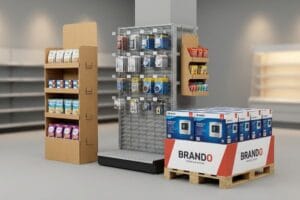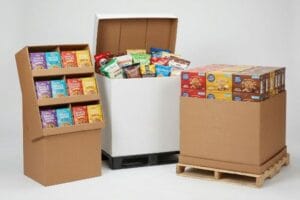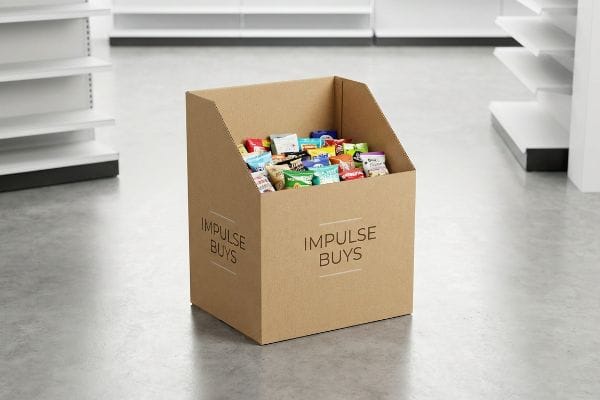
You want fast impulse sales, but your loose merchandise keeps getting buried on standard shelves. Without the right freestanding floor fixture, your product launch becomes practically invisible to passing shoppers.
Promoting products via dump bins requires capturing impulse buyers through strategic floor placement and high-visibility branding. These open-top, freestanding corrugated fixtures house loose merchandise securely, driving high-volume sales by placing accessible inventory directly in high-traffic retail intersections without requiring any careful or rigid shelf stacking.

Knowing how to design these bins on a screen is one thing, but keeping them structurally sound on the physical retail floor is a completely different game.
What Does Loose Bin Promote?
Throwing hundreds of unorganized items into a single cardboard container creates massive physical stress. You need to know what actually survives inside these chaotic bins.
Loose bin displays promote high-volume, lightweight impulse items like bagged candies, seasonal plush toys, and clearance cosmetics. These unorganized merchandise layouts encourage consumers to dig for deals, generating immediate retail sales lift by making the physical shopping experience feel like an exclusive, time-sensitive treasure hunt.
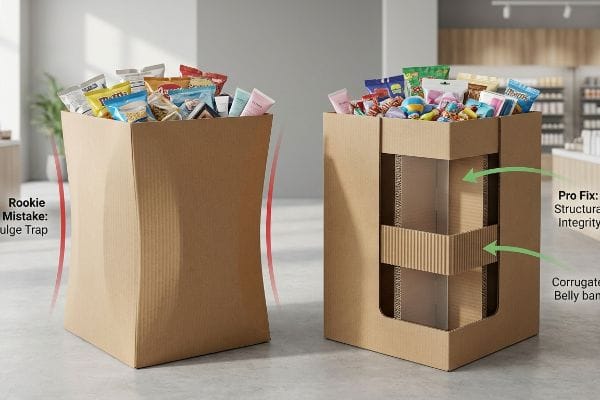
Dropping that merchandise into a basic box sounds easy until gravity and lateral pressure take over.
Preventing the Dump Bin Bulge Trap
Most amateur designers assume a dump bin is just a tall, four-sided corrugated box without a lid. They calculate the total cubic volume of their loose merchandise, size the outer walls to fit, and send the dieline to the prepress team. This oversimplified approach completely ignores the physical behavior of unorganized, loose items settling1 during transit or while sitting on the shop floor.
The rookie trap is assuming downward weight only affects the bottom panel. In reality, when a store clerk dumps 50 lbs (22.6 kg) of assorted lip balm or packaged snacks into a deep bin, that weight shifts outward against the side walls2. I see this fail constantly when a client uses a single-wall base; you can actually hear the paperboard straining and tearing as the sides bow out like a balloon. To fix this, I engineer a hidden corrugated H-Divider or a reinforced belly band3 directly into the lower core. This internal skeleton absorbs that outward lateral pressure, saving you from a collapsed display that ruins your brand image and ensuring the unit stays perfectly square under heavy impulse loads.
| Common Rookie Mistake | The Pro Fix | Retail-Floor Benefit |
|---|---|---|
| Using unsupported single-wall bins | Inserting a corrugated H-Divider4 | Prevents outward wall bulging |
| Ignoring lateral product shift | Adding a structural belly band5 | Keeps display perfectly square |
| Dropping loose items blindly | Calculating dynamic outward pressure6 | Stops paperboard from tearing |
I refuse to let a massive product launch fail because someone tried to save ten cents on an internal cardboard divider. Structural integrity always dictates whether your merchandiser survives the chaotic retail floor or gets thrown away.
🛠️ Harvey's Desk: Not sure if your deep bin design will bulge under your product's actual weight? 👉 Let Me Check Your Dieline ↗ — Direct access to my desk. Zero automated sales spam, I promise.
What Is the Best Way to Display Merchandise?
You have a fraction of a second to grab a rushing shopper's attention. If your structure does not command the aisle, your product simply will not sell.
The best way to display merchandise requires engineering a physical structure that satisfies the spatial engagement continuum. This strategic merchandising approach captures visual attention from thirty feet away, engages shopper interest at three feet, and drives tactile impulse conversions within the final three-inch interactive zone.
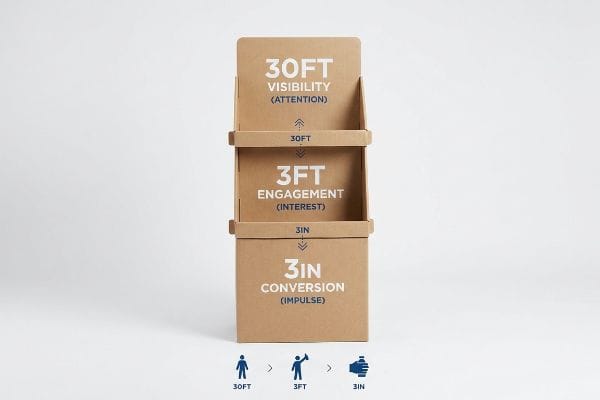
Grabbing attention from across the store is useless if the customer cannot physically access the product once they walk up to it.
Mastering Spatial Engagement and Accessibility
Junior marketing teams frequently design retail merchandisers strictly for up-close viewing on their backlit computer monitors. They focus obsessively on high-resolution graphics and dense typography, assuming shoppers will stop and read every single bullet point. They completely ignore the physical reality of how tired, rushing humans actually navigate big-box store aisles.
A common question I get is whether to prioritize bold logos or detailed product specs on a floor unit. The answer is spacing. The rookie mistake is plastering small text everywhere, causing massive cognitive overload. I see this firsthand when shoppers walk right past a cluttered unit without breaking their stride. To fix this, I ruthlessly apply a three-tiered spatial rule. I use aggressive die-cut headers to disrupt the aisle from thirty feet away, and I drop the front retaining lip to guarantee at least 85% product visibility7 for that final tactile reach. This physical zoning eliminates the frustrating visual noise, instantly reducing shopper hesitation and naturally driving up your impulse purchase conversion rate.
| Common Rookie Mistake | The Pro Fix | Retail-Floor Benefit |
|---|---|---|
| Designing for monitor screens | Engineering for 30-foot aisle visibility | Grabs rushing shopper attention |
| High retaining lips hiding items | Lowering lip for 85% visibility8 | Increases impulse grab rate |
| Cluttering display with text | Using high-contrast spot color floods | Prevents cognitive shopper overload9 |
I see too many brilliant products die on the shelf simply because their secondary packaging acts like a camouflage instead of a beacon. You have to physically disrupt the retail environment before you can ever make a sale.
🛠️ Harvey's Desk: Are your front retaining lips accidentally hiding your primary product labels from the customer's direct line of sight? 👉 Audit Your Visibility Zones ↗ — Download safely. My inbox is open if you have questions later.
What Is a Dump Bin Display?
Before you order thousands of units, you need to understand exactly what you are asking a factory to build. It is not just an empty cardboard vessel.
A dump bin display is a freestanding, open-top corrugated floor fixture engineered specifically to hold bulk quantities of loose, unpackaged, or irregularly shaped merchandise. These structural bins eliminate uniform shelf stacking, allowing retailers to quickly deploy massive product volumes into high-traffic promotional aisle spaces.

It sounds simple, but removing the lid of a standard box fundamentally destroys its natural load-bearing strength.
The Open-Top Compressive Vulnerability
Procurement teams frequently try to save money by taking a standard RSC (Regular Slotted Container), hacking off the top flaps, and calling it an instant retail bin. They assume the raw material thickness of the bottom and side walls is enough to keep the unit standing upright. This ignores the basic physics of how a six-sided box distributes vertical top-load pressure10 during shipping and storage.
Think of an open-top bin like a house missing its roof; without that top structural tie, the walls become incredibly weak. When you remove those continuous upper flaps, you instantly lose the 360-degree upper enclosure that stabilizes the corners. I once watched a beautiful open-top bin completely buckle under a minor 40 lbs (18.1 kg) top-load because the unsealed edges could not bear the dynamic compression. My rule of thumb is to mathematically compensate for this missing lid. If the internal product is not fully rigid, I immediately upgrade the substrate to a double-wall board profile11 and perfectly align the corrugated grain vertically12. This targeted material shift completely restores the lost structural strength, preventing costly crushed pallets in the warehouse while keeping your unit cost stable.
| Common Rookie Mistake | The Pro Fix | Retail-Floor Benefit |
|---|---|---|
| Treating bins like regular boxes | Upgrading to double-wall structures13 | Survives heavy pallet stacking |
| Ignoring vertical grain direction | Aligning flutes perfectly upright14 | Restores missing corner strength |
| Stacking open bins blindly | Utilizing dynamic load calculations15 | Eliminates warehouse crushing losses |
I always tell my buyers that removing raw material does not automatically equal savings. If you cut corners on a lidless structure without compensating the flute strength, your entire campaign will inevitably collapse before it even reaches the store.
🛠️ Harvey's Desk: Are you worried your current open-top design might buckle under the weight of warehouse double-stacking? 👉 Request a Structural Load Audit ↗ — No forms that trigger endless sales calls. Just pure value.
What Is the Purpose of a Promotional Display in Retail Merchandising?
Generating sales is the obvious goal, but the true purpose is surviving the brutal journey from the factory floor to the final retail aisle intact.
The purpose of promotional displays in retail merchandising involves physically interrupting established shopper patterns to secure impulse purchases. By deploying distinct structural designs and branded corrugated architectures, these targeted fixtures elevate secondary merchandise visibility, driving rapid inventory turnover while effectively utilizing otherwise dead retail floor space.
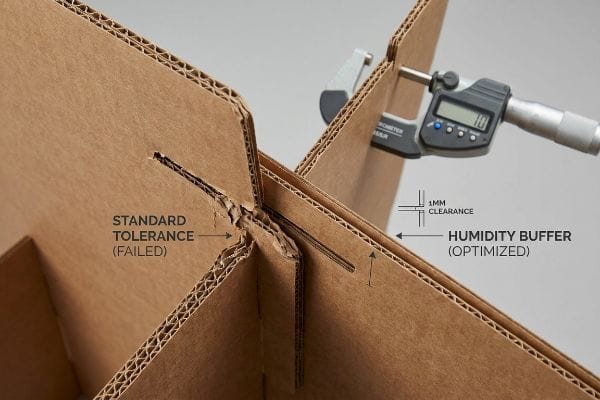
But knowing the theory of generating visual disruption isn't enough when the automated cutting machines start running and environmental variables enter the equation.
Why Standard CAD Tolerances Fail on the Factory Floor
Graphic designers and structural engineers sitting in climate-controlled offices frequently set their interlocking slot tolerances based entirely on the absolute dry caliper of the paperboard. They assume that if a B-flute board is exactly 3.17 mm (0.12 inches) thick16 on their CAD (Computer-Aided Design) software screen, a slot cut precisely to that dimension will yield a perfect, seamless assembly. This theoretical math completely ignores the massive environmental fluctuations these paper structures face during actual logistics.
Getting one display to stand up in a dry, perfectly air-conditioned testing lab is easy, but here is the harsh reality when you ship 500 of them across the ocean. In my facility, I routinely see beautifully engineered flat-packs turn into absolute nightmares because the porous 32 ECT (Edge Crush Test) testliner absorbs ambient moisture17 during ocean freight and physically swells. When I pull micrometer readings on boards sitting in humid climates, that 3.17 mm dry thickness has swollen, making the theoretical slot too tight. The co-packing team is then forced to violently crush the flutes and tear the top sheet just to jam the tabs together. To fix this, I automatically engineer a specific humidity buffer into my cutting files, injecting exactly 1 mm (0.04 inches) of extra clearance into every receiving slot. By enforcing this micro-tolerance, I guarantee a frictionless, zero-tear assembly on the final packing line, directly cutting manual co-packing labor times by 20%18 and saving you from a massive margin loss.
| Common Rookie Mistake | The Pro Fix | Retail-Floor Benefit |
|---|---|---|
| Using dry board caliper math | Engineering a 1mm humidity buffer19 | Ensures smooth interlocking assembly |
| Ignoring ocean freight moisture20 | Adding precise slot clearances | Prevents torn printed top sheets |
| Forcing tight tabs together | Using frictionless dimensional tolerances | Cuts co-packing labor costs21 |
I refuse to rely on theoretical dry-room math when physical reality dictates otherwise. True engineering is not just drawing lines on a screen; it is anticipating the chemical and environmental friction that destroys your profits on the assembly line.
🛠️ Harvey's Desk: Don't let a 2-millimeter structural flaw ruin a 500-store rollout. 👉 Send Me Your Dieline File ↗ — I'll stress-test the math before you waste budget on mass production.
Conclusion
You can choose a cheaper vendor, but when that 32 ECT testliner inevitably swells in a humid warehouse and tears, you face massive friction, slowing down your co-packing assembly line by an estimated 30% and draining your margins. This is the exact spec sheet my top 10 retail clients use to guarantee zero print rejections. Stop guessing on environmental tolerances and let me personally run your files through my Free Dieline Audit ↗ to catch fatal clearance errors before mass production begins.
"What Is a Dump Bin Display and When Should Retailers Use It?", https://www.wowpopdisplay.com/resources/what-is-a-dump-bin-display-and-when-should-retailers-use-it.html. Technical documentation on the physics of bulk material settling (granular flow) and how it impact structural integrity of corrugated shipping containers. Evidence role: technical validation; source type: materials science or packaging engineering manual. Supports: The claim that simple volume calculations ignore settlement dynamics. Scope note: Applies specifically to non-uniform, loose retail goods. ↩
"Estimation of the Compressive Strength of Corrugated Board Boxes …", https://pmc.ncbi.nlm.nih.gov/articles/PMC8467740/. Technical explanation of how internal mass in a container creates lateral force on vertical walls. Evidence role: physical validation; source type: structural engineering or packaging science manual. Supports: the claim that weight causes outward bowing in deep bins. Scope note: specific to flexible materials like paperboard. ↩
"Discover the Benefits of Corrugated Box Dividers for Your Business", https://www.estic-maillot.com/en/corrugated-box-dividers/. Verification of industry-standard structural reinforcements for high-volume retail displays. Evidence role: technical specification; source type: packaging design guide. Supports: the efficacy of internal skeletons in preventing lateral collapse. Scope note: refers to standard point-of-purchase (POP) engineering. ↩
"8" White Corrugated Open Top Bin Divider – The Cary Company", https://www.thecarycompany.com/white-corrugated-open-top-bin-box-divider-8?srsltid=AfmBOorQGvVxzs-QaPVVZoxJCqajU_PDHx25Cas5R-CfWM8Ly9u9IDWH. Technical documentation on how H-dividers distribute weight to prevent wall failure in corrugated packaging. Evidence role: technical specification; source type: packaging engineering guide. Supports: Use of dividers to prevent bulging. Scope note: Applies to corrugated cardboard materials. ↩
"DISPLAY STRUCTURAL DESIGN FOR INTERACTIVE RETAIL …", https://www.bcipkg.com/display-structural-design-for-interactive-retail-displays/. Industry standards for using belly bands to maintain the geometric integrity of retail dump bins. Evidence role: structural best practice; source type: retail merchandising manual. Supports: Maintaining square display shape. Scope note: Specific to lateral shift prevention. ↩
"A Simplified Dynamic Strength Analysis of Cardboard Packaging …", https://pmc.ncbi.nlm.nih.gov/articles/PMC10385285/. Engineering formulas for calculating the force exerted by loose items on container walls during filling. Evidence role: physical principle; source type: materials science textbook. Supports: Prevention of paperboard tearing. Scope note: Focuses on dynamic load vs static load. ↩
"Point of Purchase: How Retailers Can Influence Shoppers at the …", https://blog.intouch.com/posts/points-of-purchase-displays. An industry standard or ergonomic study confirming that 85% visibility benchmarks optimize tactile reach and conversion rates. Evidence role: quantitative benchmark; source type: retail design study. Supports: the specific visibility threshold for reducing shopper hesitation. Scope note: applies specifically to floor unit retaining lips. ↩
"POINT-OF-PURCHASE INSIGHTS: THE IMPACT OF RETAIL POP …", https://www.bcipkg.com/point-of-purchase-insights-the-impact-of-retail-pop-displays-on-consumer-behavior/. An authoritative industry standard or study on point-of-purchase (POP) design supporting the 85% visibility metric for product accessibility. Evidence role: technical specification; source type: retail design research. Supports: the correlation between lip height and visibility. Scope note: specific to shelf-edge design. ↩
"Is consumer neural response to visual merchandising types different …", https://pmc.ncbi.nlm.nih.gov/articles/PMC7757867/. Psychological research on consumer behavior explaining how high-contrast colors and reduced text minimize cognitive load to facilitate quicker decision-making. Evidence role: theoretical framework; source type: academic journal. Supports: the benefit of spot color floods over text. Scope note: focused on cognitive psychology in retail. ↩
"The Ultimate Guide To Corrugated Boxes – Shorr Packaging", https://www.shorr.com/resources/blog/ultimate-guide-corrugated-boxes/. Technical explanation of how closed flaps contribute to the vertical load-bearing capacity of a corrugated container compared to open-top structures. Evidence role: technical validation; source type: structural engineering or packaging science manual. Supports: the claim that removing flaps degrades structural stability. Scope note: focuses on compressive strength of RSCs. ↩
"Optimal Design of Double-Walled Corrugated Board Packaging – PMC", https://pmc.ncbi.nlm.nih.gov/articles/PMC8950760/. Technical documentation on corrugated material grades explaining how double-wall thickness increases vertical compression strength in open-top structures. Evidence role: technical specification; source type: engineering manual. Supports: the claim that upgrading substrate restores structural integrity. Scope note: focused on corrugated paperboard standards. ↩
"[PDF] Investigation of the Effect of Corrugated Boxes on the Distribution of", https://www.unitload.vt.edu/content/dam/unitload_vt_edu/graduate-research-and-subpages-pictures-and-docs/thesis-and-dissertations-/Clayton%20-%20ETD%20-%20Investigation%20of%20the%20Effect%20of%20Corrugated%20Boxes%20on%20the%20Distribution%20of%20Compression%20Stresses%20on%20the%20Top%20Surface%20of%20Wooden%20Pallets.pdf. Material science data confirming that vertical flute orientation maximizes load-bearing capacity and resists buckling in floor displays. Evidence role: technical principle; source type: manufacturing guide. Supports: the necessity of grain alignment for structural stability. Scope note: applies specifically to compressive loads. ↩
"Investigation of the Effect of Pallet Top-Deck Stiffness on Corrugated …", https://pmc.ncbi.nlm.nih.gov/articles/PMC8585293/. Authoritative engineering data on corrugated cardboard specifications showing how double-wall structures increase vertical load capacity for palletization. Evidence role: technical specification; source type: industry standard. Supports: The efficacy of double-walling for stack stability. Scope note: Applies specifically to corrugated fiberboard. ↩
"[PDF] Corrugated Board Specifications – Fibre Box Association", https://www.fibrebox.org/assets/2025/09/Walmart_Corrugated-Board_Specifications_Automation_Packaging_Standards.pdf. Materials science research demonstrating the relationship between flute orientation and the axial compressive strength (ECT) of cardboard. Evidence role: mechanical property validation; source type: academic textbook. Supports: The claim that vertical grain alignment restores corner strength. Scope note: Focuses on structural integrity of fluting. ↩
"How Much Load Can My Pallet Carry?", https://unitload.vt.edu/education/white-papers/5-wp-load-carrying-capacity-of-pallets.html. Logistics and warehouse management guidelines explaining how dynamic load calculations account for movement and vibration to prevent crushing. Evidence role: procedural validation; source type: logistics manual. Supports: The role of load calculations in eliminating warehouse losses. Scope note: Distinguishes between static and dynamic load. ↩
"Corrugated Board and Material Grades – Packaging Strategies", https://www.packagingstrategies.com/articles/96269-corrugated-board-and-material-grades. An industry standard technical manual or paperboard specification sheet confirms the nominal thickness of B-flute corrugated material. Evidence role: technical verification; source type: industry standard. Supports: the baseline measurement used for CAD tolerances. Scope note: thickness may vary by manufacturer. ↩
"[PDF] Effects of Moisture content on Box Compression Strength : FBA BCT …", https://renewablebioproducts.gatech.edu/sites/default/files/2025-12/4effects-of-moisture-content-on-box-compression-strength.pdf. Technical validation of how 32 ECT testliner reacts to humidity during maritime transport. Evidence role: technical mechanism; source type: materials science handbook. Supports: the claim that moisture causes physical swelling in specific flute grades. Scope note: focuses on corrugated fiberboard properties. ↩
"The 2026 Efficiency Pivot: Moving from Volume to Value – Korpack", https://korpack.com/the-2026-efficiency-pivot-moving-from-volume-to-value/?srsltid=AfmBOooPifw_uj9Bdlo749rIVDvTvWbUXp7hECdFqjCf62h65rVJPMPI. Industry benchmarks or case studies demonstrating the correlation between assembly tolerances and labor time reduction in retail kitting. Evidence role: performance metric; source type: logistics or manufacturing white paper. Supports: the efficiency gain claim. Scope note: relates to manual assembly of corrugated displays. ↩
""Relative Humidity Effects on the Compression Strength of …", https://open.clemson.edu/all_theses/3225/. Technical documentation on material expansion coefficients for paperboard and the industry standard for humidity buffers in retail displays. Evidence role: technical specification; source type: engineering handbook. Supports: the necessity of a 1mm buffer to counteract moisture swelling. Scope note: applies specifically to dry board/cardboard materials. ↩
"Influence of humidity and temperature on mechanical properties of …", https://bioresources.cnr.ncsu.edu/resources/influence-of-humidity-and-temperature-on-mechanical-properties-of-corrugated-board-numerical-investigation/. Study on the impact of high-humidity maritime transit on the structural integrity and dimensional stability of paper-based packaging. Evidence role: causal link; source type: logistics whitepaper. Supports: why moisture during ocean transit causes board swelling. Scope note: focused on long-haul sea freight. ↩
"The 2026 Efficiency Pivot: Moving from Volume to Value – Korpack", https://korpack.com/the-2026-efficiency-pivot-moving-from-volume-to-value/?srsltid=AfmBOooGhId7j_18MaiUos3YEZPC9s1NmlOMpoSfvFOxXDOIcBca4ZdG. Analysis comparing labor time for assembling tight-tolerance vs. frictionless-tolerance retail displays in co-packing facilities. Evidence role: economic impact; source type: industry case study. Supports: the link between dimensional tolerances and reduced assembly labor costs. Scope note: focused on high-volume retail deployments. ↩