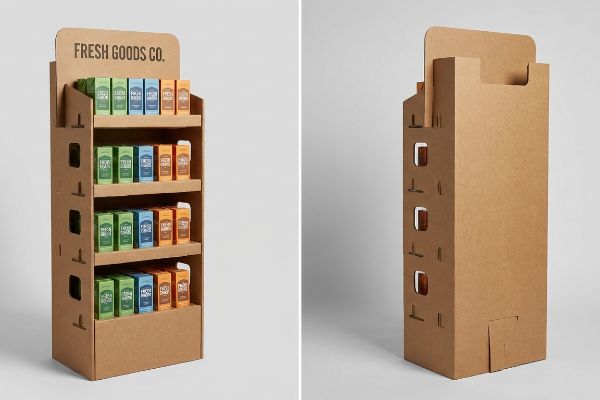
If you are launching a new consumer brand, poor visibility in a crowded retail aisle is your biggest liability. To survive, you must master the physical engineering of corrugated merchandising.
Cardboard paper display racks are temporary or semi-permanent retail merchandisers made from corrugated board. These freestanding or countertop fixtures use precision die-cutting and custom printing to secure strategic store placement, organize consumer products, and drive immediate impulse purchases.

Moving from structural theory to physical execution is where most campaigns either secure dominance or fail completely. Let us break down the exact mechanical thresholds required to build a merchandiser that survives the modern retail supply chain.
How to Make a Cardboard Display Stand Out of Cardboard?
Securing a premium aisle location means nothing if shoppers walk right past your merchandise without engaging the physical structure.
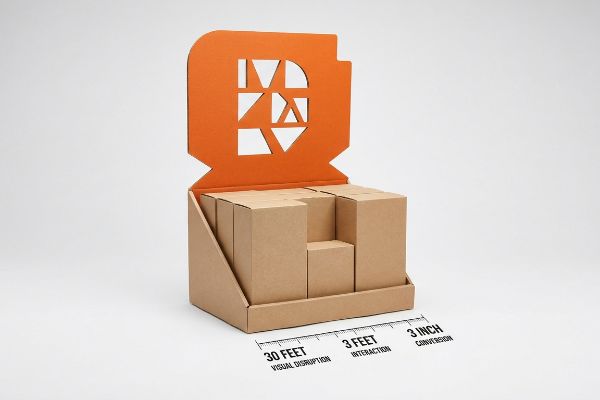
Making a cardboard display stand out requires precise spatial engagement using aggressive die-cut shapes and high-contrast spot colors. Engineers implement the 3-3-3 rule, guaranteeing visual disruption at thirty feet, ergonomic interaction at three feet, and unobstructed product visibility at a three-inch tactile conversion distance.
Understanding distance thresholds is the foundation of structural visual disruption, but executing that disruption on raw paper requires controlling the printing chemistry.
Activating the 3-3-3 Visual Disruption Framework
Marketing teams often design retail units strictly for up-close viewing on backlit computer monitors. They approve complex, text-heavy CMYK (Cyan, Magenta, Yellow, Key/Black) digital files and expect them to translate perfectly onto porous testliner1. This assumes that a shopper will stand directly in front of the fixture and read the brand messaging like a book, ignoring the harsh reality of how consumers actually navigate big-box aisles.
On the retail floor, shopper attention is fleeting and governed by visual hierarchy. Because raw corrugated fibers absorb liquid ink unevenly2, printing delicate CMYK halftones often results in a muddy aesthetic that fails to grab attention from a distance. To fix this, brands must shift their strategy to use a highly concentrated PMS (Pantone Matching System) spot color flood. This solid color contrast, paired with an aggressive die-cut header, disrupts the shopper's peripheral vision. By enforcing the 3-3-3 spatial rule3, you actively drive foot traffic to the unit and capture consumer interest before competing brands even register.
| Common Rookie Mistake | The Pro Fix | Retail-Floor Benefit |
|---|---|---|
| Printing CMYK halftones on raw board | Mandating PMS spot color floods4 | Eliminates muddy logo visibility |
| Designing strictly for up-close reading | Applying the 3-3-3 spatial rule5 | Captures peripheral foot traffic |
| Using perfectly square headers | Engineering aggressive die-cut shapes | Creates 30-foot visual disruption6 |
I always force brands to step back and evaluate their physical draw distance. If your artwork relies on reading fine text instead of high-contrast structural shapes, you are throwing away your retail placement.
🛠️ Harvey's Desk: Are your brand colors turning muddy and washed out under harsh fluorescent retail lights? 👉 Request a Free Color Proofing Audit ↗ — Direct access to my desk. Zero automated sales spam, I promise.
What Is a Cardboard Display Called?
Before you request a quote, you must use the correct industrial terminology to ensure your structure complies with retailer placement guidelines.
A cardboard display is called a POP or POS merchandiser. Depending on structural placement, terminology categorizes these units as floor displays, countertop trays, pallet shippers, or end-caps. Naming conventions dictate specific retailer logistics compliance, ADA accessibility guidelines, and structural load-bearing engineering requirements globally.

Categorizing your structure correctly is not just about vocabulary; it dictates the exact mathematical footprint allowed by store managers.
Distinguishing Between POP and POS Compliance Zones
Many procurement teams attempt to stretch their marketing budget by designing a single, highly scalable floor unit. They operate under the assumption that a large merchandiser can simply be scaled down by fifty percent in CAD (Computer-Aided Design) software to double as a register tray. This approach treats all store zones as identical, completely ignoring the strict legal and logistical rules that govern different retail environments7.
Categorizing your structure correctly dictates the exact mathematical footprint allowed by store managers. A warehouse club floor display operates strictly as a POP unit, anchoring to heavy-duty GMA (Grocery Manufacturers Association) pallet limits8 to survive forklift logistics. Conversely, POS countertop files are engineered exclusively for the tighter ergonomics of the checkout counter, requiring strict adherence to ADA (Americans with Disabilities Act) forward reach windows9. When brands separate these engineering pipelines, they align perfectly with retailer logistics compliance. This strategic spatial mapping ensures your inventory smoothly bypasses store-level rejections and successfully lands in its designated high-traffic zone.
| Common Rookie Mistake | The Pro Fix | Retail-Floor Benefit |
|---|---|---|
| Scaling down floor units for registers | Separating POP and POS pipelines | Prevents retailer chargebacks |
| Ignoring forward reach limits | Anchoring to ADA 15-48 inch windows10 | Ensures legal register compliance |
| Overhanging standard bases | Locking strictly to GMA pallet limits11 | Survives heavy forklift handling |
I refuse to let clients jeopardize their retail relationships over a poorly categorized footprint. Misunderstanding the difference between a pallet zone and a register zone is the fastest way to get your campaign blacklisted.
🛠️ Harvey's Desk: Not sure if your new scaled-down merchandiser violates strict ADA forward reach limits? 👉 Get a Floor-Plan Compliance Check ↗ — Download safely. My inbox is open if you have questions later.
How to Make a Display Board with Cardboard?
Drawing flat artwork is simple, but folding thick paperboard into a functional weight-bearing structure requires absolute mechanical precision.
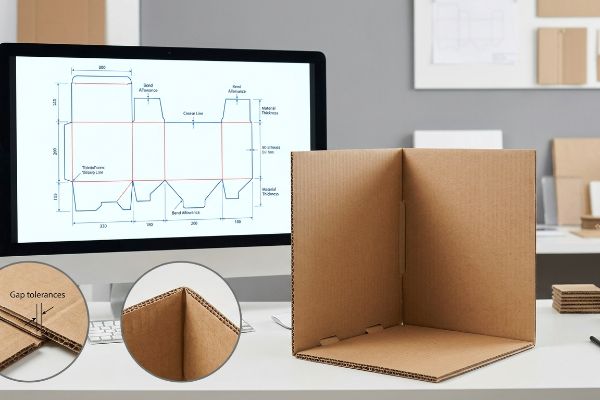
Making a display board with cardboard demands precise structural engineering software to calculate material caliper compensation. Designers must factor in the physical thickness of corrugated flutes during a 90-degree bend, adding mathematical tolerances into dieline slots to guarantee a frictionless, lock-tight mechanical assembly.
Accounting for material thickness mathematically is the only way to transition a two-dimensional design into a structurally sound three-dimensional fixture.
Engineering Bend Allowances for B-Flute Structures
Brand teams frequently build interlocking tabs and folding slots using basic vector software, drawing the receiving slot at the exact same width as the mating panel. They assume that corrugated paper folds exactly like a thin sheet of copy paper, maintaining a perfect right angle without consuming any extra space. This flat-file mentality completely ignores the physical dimensions required to build a functional weight-bearing structure12.
Transforming a two-dimensional design into a premium retail fixture requires accurate structural engineering software. When a thick corrugated panel folds, the paper fibers must travel around an outer radius13, which physically consumes material. To accommodate this, designers must introduce mathematically calculated bend allowances into the dieline slots14. Applying these necessary gap tolerances guarantees a frictionless mechanical assembly process for the co-packing team. By prioritizing this exact caliper compensation, brands effectively reduce manual labor time and ensure the final structure sits perfectly square on the retail shelf.
| Common Rookie Mistake | The Pro Fix | Retail-Floor Benefit |
|---|---|---|
| Drawing 1:1 slot widths in vector art | Applying CAD bend allowances15 | Guarantees frictionless assembly |
| Ignoring material thickness | Calculating physical flute caliper16 | Eliminates crushed board fibers |
| Forcing misaligned interlocking tabs | Adding automated gap tolerances17 | Reduces manual packing labor |
I never trust a flat drawing until the math accounts for the fold. Forcing a tight board into an uncompensated slot destroys structural integrity before the unit even holds a product.
🛠️ Harvey's Desk: Are your assembly teams struggling to force locking tabs together without crushing the flutes? 👉 Claim Your Dieline Tolerance Audit ↗ — No forms that trigger endless sales calls. Just pure value.
What Not to Store in a Cardboard Box?
Putting the wrong product weight into an unsupported structure is a logistical liability waiting to happen.
Deciding what not to store in a standard cardboard box depends on dynamic payload limits. Products exceeding 150 lbs, liquid chemicals lacking secondary containment, or sharp hardlines should never use basic single-wall testliner structures without targeted double-wall reinforcement and kinetic sheer-force engineering.

But knowing the payload theory is not enough when the automated sorting machines start running and freight handlers take over.
Why Heavy Payload Shippers Fail on the Factory Floor
Procurement teams frequently submit heavily loaded pre-filled merchandisers for standard vertical transit testing, relying strictly on basic free-fall drops to validate their integrity. They assume that if a single-wall box survives a simple waist-high drop onto a flat surface, it is cleared for the global supply chain. This completely ignores the violent, multi-axis physics that occur when heavy freight moves18 through US retail distribution centers.
Once a fully loaded unit crosses the critical 150 lbs (68 kg) threshold, standard testing is completely irrelevant and the protocol must shift to the ISTA (International Safe Transit Association) 2B heavy freight standard19. Using programmable kinetic drop tables, I subject these heavy shippers to severe rotational edge drops. When 187.5 lbs (85 kg) of payload rotates and slams directly onto a single, unsupported corner, the kinetic shear force is devastating. I have heard the loud, sickening pop of standard single-wall corners instantly blowing out under that localized pressure. To prevent this, I mandate injecting a targeted double-wall corrugated spine strictly into the vertical load-bearing corners20, completely neutralizing edge blowouts during less-than-truckload transit.
| Common Rookie Mistake | The Pro Fix | Retail-Floor Benefit |
|---|---|---|
| Relying on standard flat drop tests | Executing rotational edge testing21 | Identifies kinetic vulnerabilities |
| Ignoring the 150-lb payload limit22 | Mandating ISTA 2B heavy protocols23 | Prevents distribution failure |
| Using uniform single-wall structures | Injecting double-wall corner spines | Stops kinetic edge blowouts |
I will not allow an under-engineered box to carry a heavy payload into the supply chain. Ignoring kinetic sheer force on heavy freight is a guaranteed path to catastrophic inventory destruction.
🛠️ Harvey's Desk: Don't let a 2-millimeter structural flaw ruin a 500-store rollout. 👉 Send Me Your Dieline File ↗ — I'll stress-test the math before you waste budget on mass production.
Conclusion
You can choose a cheaper structural template for your heavy merchandisers, but when those unsupported corners suffer a kinetic edge blowout under a 150 lbs (68 kg) payload during transit, the resulting inventory damage will trigger an immediate retailer rejection and completely wipe out your campaign's profit margin. Over 500 brand managers use my prepress checklist to avoid these exact fatal early-stage mistakes. Stop guessing on heavy freight physics and let me personally run your files through my Free Dieline Audit ↗ to catch critical payload vulnerabilities before mass production begins.
"Mathematical modelling and compensation strategies for printing dot …", https://pmc.ncbi.nlm.nih.gov/articles/PMC12574880/. Technical explanation of how ink absorption and dot gain on porous testliner substrates affect the accuracy of CMYK color reproduction compared to backlit digital screens. Evidence role: technical validation; source type: print production guide. Supports: the discrepancy between digital design and physical cardboard output. Scope note: limited to corrugated packaging materials. ↩
"Understanding CMYK Color Mixing in Printing with eCare Packaging", https://www.linkedin.com/posts/ecare-packaging-65401b32_cmyk-printingknowledge-packagingdesign-activity-7412015327846256640-XLO1. Technical documentation on printing substrates explains how the porosity of raw corrugated fibers leads to ink bleed and poor halftone reproduction. Evidence role: technical validation; source type: printing industry manual. Supports: the claim that raw fibers cause a muddy aesthetic. Scope note: applies primarily to uncoated corrugated board. ↩
"Rule of 3 for Retail Store Displays", https://mcintyredisplays.com/blog/custom-store-displays/. A retail merchandising or visual design guide defines the 3-3-3 rule regarding shopper engagement distances (30ft, 3ft, and 3in). Evidence role: framework verification; source type: retail design standard. Supports: the use of spatial hierarchy to drive foot traffic. Scope note: specific distance metrics may vary slightly between design agencies. ↩
"Difference Between Spot Color and CMYK Color", https://www.deprintedbox.com/blog/spot-vs-process-color/. Technical printing guidelines explain how spot colors provide solid saturation on absorbent raw board compared to CMYK dot patterns. Evidence role: technical verification; source type: printing industry standard. Supports: the use of PMS to eliminate muddy logo visibility. Scope note: applies specifically to raw, uncoated cardboard. ↩
"Effective Visual Merchandising Strategies Involve Several Critical …", https://popdisplay.me/effective-visual-merchandising-strategies-involve-several-critical-considerations/. Retail design frameworks detail spatial rules for capturing consumer attention at specific distances. Evidence role: conceptual validation; source type: visual merchandising guide. Supports: the claim that spatial rules capture peripheral foot traffic. Scope note: specific to visual disruption strategies. ↩
"Key Principles of Visual Merchandising – PopDisplay", https://popdisplay.me/key-principles-of-visual-merchandising/. Research on consumer visual perception quantifies the distance at which irregular shapes trigger attention compared to standard rectangles. Evidence role: empirical verification; source type: retail design study. Supports: the claim that aggressive die-cuts increase the visibility range to 30 feet. Scope note: results may vary based on aisle width and lighting. ↩
"AG 1091A: Retail Merchandise Displays in the Frontage Zone", https://www.seattle.gov/transportation/permits-and-services/permits/applicant-guides/ag-1091a. Verification of industry-standard compliance guidelines and accessibility laws (e.g., ADA) that differentiate display requirements between floor zones and point-of-sale areas. Evidence role: validation of regulatory constraints; source type: industry standards/legal code. Supports: the claim that retail zones are not identical in their requirements. Scope note: Regulations may vary by jurisdiction. ↩
"GMA American Pallet. Dimensions, types and much more.", https://acrosslogistics.com/blog/en/american-pallet-gma. An industry logistics standard would verify the dimensional and load-bearing specifications for GMA pallets in warehouse environments. Evidence role: technical specification; source type: industry standard; Supports: adherence to pallet limits for forklift logistics; Scope note: primarily North American standards. ↩
"Sales and Service Counters – Access-Board.gov", https://www.access-board.gov/ada/guides/animations/sales-and-service-counters.html. Official ADA Standards for Accessible Design specify the reach range for accessibility at sales and service counters. Evidence role: legal compliance; source type: government regulation; Supports: engineering requirements for POS countertop accessibility; Scope note: applicable to US retail environments. ↩
"ADA Standards for Accessible Design Title III Regulation 28 CFR …", https://www.ada.gov/law-and-regs/design-standards/1991-design-standards/. Verification that the Americans with Disabilities Act (ADA) mandates specific reach ranges for accessible elements in retail spaces. Evidence role: technical validation; source type: regulatory guideline. Supports: legal register compliance. Scope note: specific to US federal accessibility laws. ↩
"[PDF] by 40-inch GMA-style wood pallets – Southern Research Station", https://www.srs.fs.usda.gov/pubs/VT_Publications/05t10.pdf. Documentation of the Grocery Manufacturers Association (GMA) standardized pallet dimensions used to ensure logistical compatibility and stability. Evidence role: technical specification; source type: industry standard. Supports: stability during heavy forklift handling. Scope note: primarily applicable to North American logistics. ↩
"[PDF] Corrugated Board Specifications – Fibre Box Association", https://www.fibrebox.org/assets/2025/09/Walmart_Corrugated-Board_Specifications_Automation_Packaging_Standards.pdf. Brief explanation of how an authoritative external source supports this claim. Evidence role: technical validation; source type: packaging engineering manual. Supports: the necessity of calculating material caliper and bend radii to ensure structural stability in corrugated assemblies. Scope note: applies specifically to industrial corrugated fluting. ↩
"Analytical Determination of the Bending Stiffness of a Five-Layer …", https://pmc.ncbi.nlm.nih.gov/articles/PMC8777652/. Technical explanation of material deformation and stretch during the folding of corrugated board. Evidence role: technical verification; source type: materials engineering manual. Supports: the physical consumption of material during bends. Scope note: applicable to B-flute and similar corrugated structures. ↩
"What is a Dieline in Packaging & Print? – PopDisplay", https://popdisplay.me/what-is-a-dieline-in-packaging-print/. Industry standards for calculating tolerances in structural packaging design to ensure mechanical fit. Evidence role: process verification; source type: packaging engineering guide. Supports: the use of bend allowances in dieline creation. Scope note: focuses on retail fixture assembly. ↩
"[PDF] The Bending Stiffnesses of Corrugated Board", https://www.fpl.fs.usda.gov/documnts/pdf1992/luo92a.pdf. Explanation of how CAD software calculates material displacement during folding to ensure accurate final dimensions. Evidence role: Technical validation; source type: Engineering manual. Supports: The necessity of bend allowances for frictionless assembly. Scope note: Specifically for B-flute corrugated board. ↩
"[PDF] Specifications for Corrugated Paperboard – National Archives", https://www.archives.gov/files/preservation/storage/pdf/corrugated-board.pdf. Definition of physical flute caliper and its role in determining the actual thickness of corrugated board. Evidence role: Specification verification; source type: Material science standard. Supports: The prevention of crushed fibers by accounting for actual material thickness. Scope note: Applies to industrial corrugated board specifications. ↩
"Tolerance for Manufacturers'Joint on RSC – AICC Now", https://now.aiccbox.org/tolerance-for-manufacturers-joint-on-rsc/. Guidance on standard tolerance gaps for interlocking corrugated parts to prevent binding and friction. Evidence role: Best practice validation; source type: Packaging design guide. Supports: The reduction of manual packing labor through precision gaps. Scope note: Focused on retail display board assembly. ↩
"Distribution Testing | Packaging Transit Testing – Smithers", https://www.smithers.com/industries/packaging/manufacturers-and-users/distribution-testing. Technical explanation of kinetic forces including vibration, torsion, and multi-directional shock encountered in automated distribution centers compared to simple vertical drop tests. Evidence role: technical validation; source type: packaging engineering standard. Supports: the inadequacy of single-axis testing for heavy loads. Scope note: applies to industrial logistics environments. ↩
"Test Procedures – International Safe Transit Association", https://ista.org/test_procedures.php. Confirmation of the specific weight limits and testing protocols mandated by the ISTA 2B standard for heavy payloads. Evidence role: Technical verification; source type: Industry Standard. Supports: Shift in testing protocol for units over 150 lbs. Scope note: Specific to ISTA testing frameworks. ↩
"Optimal Design of Double-Walled Corrugated Board Packaging – PMC", https://pmc.ncbi.nlm.nih.gov/articles/PMC8950760/. Technical analysis of how localized double-wall reinforcement enhances the vertical load-bearing capacity and impact resistance of corrugated boxes. Evidence role: Engineering principle; source type: Packaging science literature. Supports: Neutralization of edge blowouts. Scope note: Limited to corrugated board structures. ↩
"[PDF] 3A 2 – International Safe Transit Association", https://ista.org/docs/3Aoverview.pdf. Technical explanation of rotational edge testing used to simulate real-world impact and identify structural vulnerabilities. Evidence role: technical validation; source type: materials science or packaging journal. Supports: testing methodology effectiveness. Scope note: compared to standard flat drop tests. ↩
"Determining Corrugated Box Weight Limits – CS Packaging Blog", https://blog.cspackaging.com/blog/corrugated-weight-limits. Verification of the specific weight thresholds where standard corrugated structures typically fail without reinforcement. Evidence role: factual verification; source type: packaging engineering manual. Supports: payload capacity limits. Scope note: varies by board grade and flute type. ↩
"[PDF] 2B2 – International Safe Transit Association", https://ista.org/docs/2Boverview.pdf. Verification of the International Safe Transit Association (ISTA) 2B standard for package testing. Evidence role: industry standard reference; source type: certification body. Supports: the use of standardized protocols for heavy shippers. Scope note: focuses on parcel delivery simulations. ↩