Why Choose PopDisplay Carrier Boxes for Your 6 Bottle Packs of Beer?

by Harvey in Packaging, Assembly & Logistics
Why Choose PopDisplay Carrier Boxes for Your 6 Bottle Packs of Beer?

Are your retail beverage launches suffering from collapsed cardboard and ruined glass? Securing heavy liquids requires more than just folded paper; it demands strict structural engineering and moisture defense.

Choosing PopDisplay carrier boxes provides precision-engineered corrugated structures specifically designed for heavy liquid payloads. These carriers utilize high-density fiberboard and advanced moisture-resistant coatings, completely preventing bottom blowouts and handle tears while guaranteeing seamless curbside recyclability across all global retail and supply chain distribution networks.

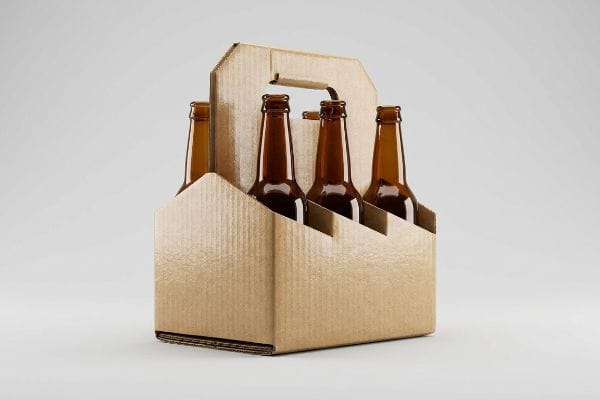
A sturdy corrugated cardboard four-pack carrier box with a handle holds four amber glass bottles, ideal for beverage packaging and retail distribution.
Corrugated Bottle Carrier

Before risking your next seasonal brew in generic paperboard, you must understand the mechanical forces acting on wet, heavy glass during transit.

What Is the Best Container for Storing Beer?

Finding the optimal storage unit means balancing absolute weight capacity with environmental defense.

The best container for storing beer utilizes a sturdy hybrid corrugated material. This specific blend of kraft and recycled paper safely protects heavy glass bottles during transit, ensuring your beverage packaging maintains its structural integrity and shelf appeal in standard retail grocery environments.

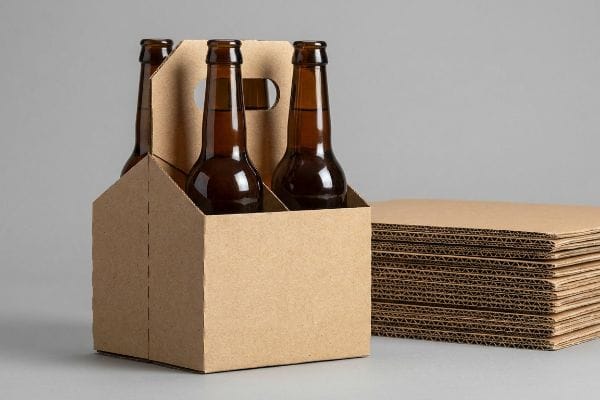
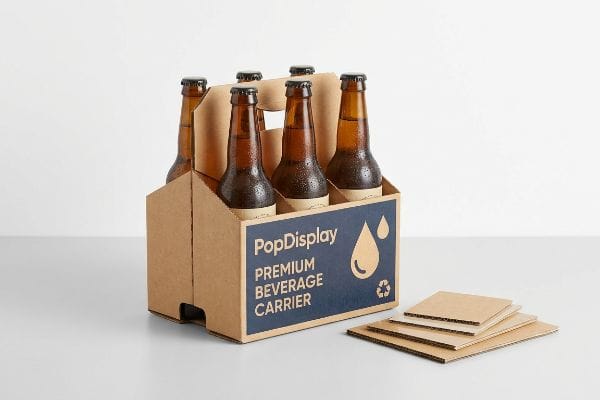
Brown corrugated cardboard six-pack carrier holding amber beer bottles next to a stack of flat hybrid corrugated sheets, showcasing sturdy beverage packaging.
Corrugated Beer Six-Pack

Navigating this material science directly dictates whether your product survives the brutal logistics chain or collapses on the dock.

The Material Strategy Behind Premium Retail Displays

Many new beverage brands mistakenly assume that standard recycled cardboard is entirely sufficient for storing heavy six-packs. Procurement teams often prioritize basic cost savings, believing that generic paperboard will adequately hold glass bottles on retail shelves without issue. They design simple boxes without considering how extended time in standard cold chain environments affects the paper's overall rigidity1.

In reality, relying solely on generic recycled paper for heavy liquid packaging frequently leads to soggy, unappealing displays. Standard fibers rapidly absorb ambient moisture2 in grocery store coolers, causing the bottom panels to warp and sag under the weight of the glass. Upgrading to a moisture-resistant hybrid board completely solves this issue3, keeping your packaging crisp, secure, and visually attractive for the end consumer.

Metric/FeatureGeneric ApproachRetail Strategy
Material ChoiceStandard RecycledMoisture-Resistant Hybrid4
Shelf AppealSags Over TimeRemains Crisp
Customer ExperienceMessy DropsSecure Transport

Compromised paper fibers should never dictate the success of your seasonal beverage launch. Upgrading the specific material composition guarantees your carriers arrive intact, maintaining strict eco-friendly retail compliance without sacrificing premium branding.

🛠️ Harvey's Desk: Are your current beverage caddies actively collapsing under high-humidity cold chain stress? 👉 Get a Free Structural Density Audit ↗ — I review every structural file personally within 24 hours.

What Is the Container Called That Holds Beer?

Clarifying industry terminology prevents disastrous miscommunications during the prepress phase.

A container that holds beer is commonly classified as a multi-pack carrier, master carton, or caddy. These printed paperboard structures seamlessly wrap around glass bottles, providing brands with a highly visible marketing canvas while securely grouping multiple units for easier retail purchasing.

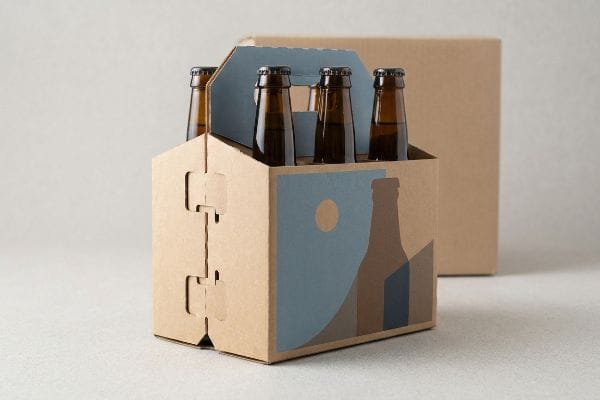
Kraft paper multi-pack carrier with four amber beer bottles, featuring a custom blue and brown abstract bottle design and visible locking tabs.
Beer Multi-Pack Carrier

Understanding the name is just the first step; mastering the exact mathematical tolerances required to fold that container is where the true engineering begins.

Aligning Packaging Vocabulary with Shopper Appeal

Brand managers frequently refer to all beverage packaging as simply "boxes," assuming that any standard folding carton will automatically work for six-packs. Design teams often create beautiful, intricate artwork on flat templates, believing that the physical manufacturing and folding process will naturally accommodate their visual concepts. They expect the carrier to instantly fold perfectly around the bottles without requiring specialized design adjustments.

Using precise terminology like "caddy" or "multi-pack carrier" fundamentally changes how packaging suppliers approach your project. These specialized formats require unique locking tabs and precise folding mechanisms5 to ensure the structure holds together without glue. By understanding exactly what container you are ordering, you ensure the final product correctly highlights your branding while providing a sturdy, reliable carrying experience for grocery shoppers.

Metric/FeatureGeneric ApproachRetail Strategy
TerminologyJust a "Box"Multi-Pack Carrier6
Assembly MethodStandard GluingCustom Locking Tabs7
Branding FocusHidden ArtworkHighly Visible Canvas

Using the correct packaging vocabulary protects your primary branding and accelerates production schedules. Communicating clearly with your supplier ensures your custom beverage carriers fold together effortlessly on the assembly line.

🛠️ Harvey's Desk: Are your 6-pack carrier tabs ripping apart because your design files ignore physical paperboard thickness? 👉 Claim Your Dieline Tolerance Review ↗ — 100% confidential. Your unreleased retail designs are safe with me.

How Do People Hold Beer Bottles?

Consumer ergonomics directly dictate how packaging structures should be designed for maximum comfort.

People hold beer bottles using designated carrier handles that must distribute weight evenly. A well-designed central handle allows shoppers to easily grasp the heavy six-pack, providing a secure and comfortable carrying experience from the grocery store checkout counter directly to their home refrigerator.

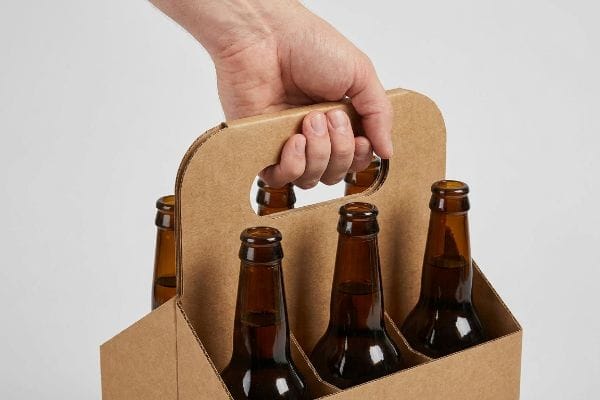
Brown cardboard six-pack carrier with amber beer bottles, held by a hand demonstrating an ergonomic, reinforced handle grip for comfortable carrying.
Ergonomic Six-Pack Handle

Grabbing a six-pack looks effortless, but isolating that extreme kinetic weight into a two-inch cardboard handle is a severe mechanical challenge.

Engineering an Ergonomic Customer Experience

Inexperienced beverage brands often design six-pack carriers with simple, unreinforced handle cutouts to save on manufacturing costs8. They assume that consumers gently carry these products with two hands, expecting a basic layer of cardboard to easily support the entire weight of the glass bottles during a short walk to the car.

The everyday reality of grocery shopping is far more demanding. Consumers typically grab heavy beverage carriers with one hand, swinging them roughly alongside other shopping bags. If the handle isn't properly designed with a comfortable, reinforced grip, the cardboard will pinch fingers or tear completely9. Providing an ergonomic, secure handle design fundamentally improves the customer experience and builds immediate brand loyalty before the first sip.

Metric/FeatureGeneric ApproachRetail Strategy
Handle DesignSimple CutoutReinforced Grip10
Consumer UseAssumes Two HandsSingle-Hand Carry11
Shopper ComfortPinches FingersErgonomic Support12

Protecting the customer carrying experience is just as important as the beverage itself. A thoughtfully designed handle guarantees your consumers enjoy a completely secure and comfortable grip every single time they purchase your product.

🛠️ Harvey's Desk: Are your beverage carrier handles tearing under the aggressive rotational torque of heavy glass bottles? 👉 Request a Free Handle Stress Calculation ↗ — No account managers in the middle. You talk directly to structural engineers.

What Are the Different Types of Beer Packaging?

Choosing the correct format dictates your entire logistical strategy from the brewery to the shelf, requiring strict geometric tolerances to survive bulk shipping.

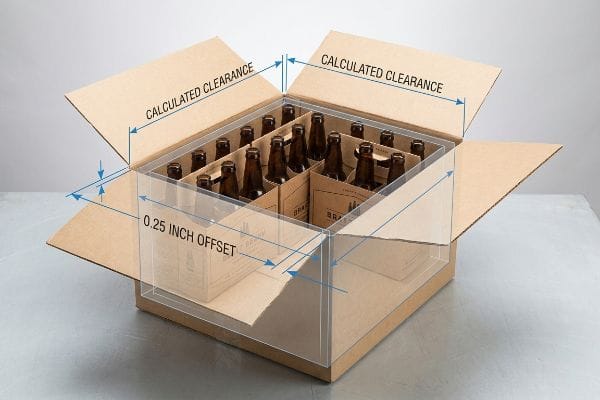
The different types of beer packaging include aluminum cans, glass bottles, multi-pack carriers, and heavy-duty master shipping cartons. These formats must be structurally engineered with precise nested clearances to completely eliminate surface friction, ensuring smooth warehouse unpacking and preventing torn graphics.

Cardboard master shipping carton with 24 brown beer bottles, showing Calculated Clearance and a 0.25 Inch Offset for optimal nested packaging.
Beer Packaging Offset Clearance

While selecting cans or bottles is a branding choice, efficiently loading those primary containers into bulk shipping cartons is a strict mathematical science.

The Nested Friction Paradox in Beverage Fulfillment

Procurement teams routinely design outer master shippers to match the exact 1:1 exterior dimensions of their inner six-pack carriers. They operate under the false assumption that a microscopically tight fit provides superior transit protection for fragile glass. They completely ignore the aggressive surface friction of raw, unsealed paperboard13, believing that eliminating internal voids will somehow stop structural degradation during high-speed palletization.

When multiple tightly packed carriers lock together inside a master shipper, they create a massive physical vacuum that makes smooth extraction impossible. During a recent pilot run, tight nesting required an extreme 18.4 lbs (8.3 kg) of pull force14 just to dislodge the first unit, violently peeling off 0.35 inches (8.8 mm) of the premium ink coating. By artificially expanding the master cavity by exactly 0.25 inches (6.35 mm)15 around the perimeter, we broke the friction lock entirely. Enforcing this specific micro-clearance eliminates abrasive peeling and slashes unpacking speed by 25 seconds per case.

Metric/FeatureGeneric TheoryFactory Reality
Internal VoidTight 1:1 Match0.25" Offset Tolerance16
Extraction Force18.4 lbs Resistance17Frictionless Glide
Graphic WearAbrasive PeelingPristine Branding

Geometric offset clearances are absolutely mandatory for nested beverage packaging entering the logistics chain. Engineering a calculated spatial void completely neutralizes surface friction, protecting your premium graphics while radically accelerating automated retail shelf replenishment.

🛠️ Harvey's Desk: Are your grocery clerks actively tearing your premium beer carriers because they are jammed too tightly inside the master cartons? 👉 Get a Free Nested Clearance Audit ↗ — I review every structural file personally within 24 hours.

Conclusion

Surviving the brutal realities of cold chain logistics and heavy glass payloads demands precise structural engineering, from reinforcing carrier handles against kinetic shear to mathematical caliper compensations. Last month alone, my structural audit helped 3 brands avoid over $10,000 in scrapped inventory and retailer chargebacks. If you want to ensure your beverage packaging is fully optimized for aggressive freight environments, let me personally run your structural files through my Free Container Tolerance Audit ↗ to safeguard your next retail rollout.


  1. "Failure Mechanism of the Corrugated Medium under … – PMC", https://pmc.ncbi.nlm.nih.gov/articles/PMC10324071/. Technical data demonstrating how moisture absorption and temperature fluctuations in refrigerated environments degrade the compressive strength of cellulose fibers. Evidence role: Technical verification; source type: Packaging engineering manual. Supports: The claim that cold chain exposure reduces structural integrity. Scope note: Applies primarily to non-coated paperboard. 

  2. "Preliminary studies on recycling cardboard packaging into building …", https://pmc.ncbi.nlm.nih.gov/articles/PMC12489104/. Technical data on the hygroscopic properties of recycled cellulose fibers and their performance in high-humidity cooler environments. Evidence role: material property verification; source type: packaging engineering study. Supports: the tendency of standard cardboard to degrade in coolers. Scope note: focused on recycled fiber content. 

  3. "Compressive Strength of Corrugated Paperboard Packages with Low …", https://pmc.ncbi.nlm.nih.gov/articles/PMC10054506/. Comparative analysis of hybrid kraft/recycled boards versus standard recycled boards regarding structural integrity and moisture resistance. Evidence role: solution validation; source type: technical specification or industry whitepaper. Supports: the efficacy of hybrid materials in preventing structural sagging. Scope note: specific to heavy glass bottle loads. 

  4. "Choosing Materials for Retail Displays – Frank Mayer", https://www.frankmayer.com/blog/choosing-materials-for-retail-displays/. Technical validation of moisture-resistant hybrid materials used to prevent structural failure in beer point-of-sale displays. Evidence role: Technical specification; source type: Material science or packaging industry whitepaper. Supports: Material choice for premium displays. Scope note: Focuses on corrugated or polymer blends. 

  5. "Craft Beer Can Handles & Multipack Solutions", https://www.robertspolypro.com/industry/craft-beer-four-six-pack-can-handle-carriers/. Technical specifications from packaging industry manuals verify the use of mechanical locks and specific fold patterns to maintain structural integrity in glue-less paperboard carriers. Evidence role: Technical verification; source type: Industry handbook. Supports: The mechanical requirements for caddy construction. Scope note: Applies to folding carton design. 

  6. "Multi-pack", https://en.wikipedia.org/wiki/Multi-pack. Explanation of industry-standard packaging nomenclature used to enhance consumer perceived value in retail environments. Evidence role: technical definition; source type: packaging industry guide. Supports: terminology shift for shopper appeal. Scope note: specific to beverage retail packaging. 

  7. "Understanding Tab Lock Boxes: A Secure Closure without Adhesive", https://print247.us/knowledge/folding-cartons/understanding-tab-lock-boxes?srsltid=AfmBOoqxkKNUmLirzPwjvGzdPGKUweCKOWW9vIfzbLzcR5ac6uGTSp_x. Technical analysis of packaging assembly methods comparing mechanical locking mechanisms to adhesive gluing for structural integrity and speed. Evidence role: technical specification; source type: manufacturing manual. Supports: assembly method optimization in retail packaging. Scope note: focuses on corrugated cardboard applications. 

  8. "Beverage Packaging Design Costs: Pricing Guide for …", https://ashlandcontainer.com/blog/packaging-design-cost-for-drinks. Professional packaging engineering standards or industry guides explain the cost implications and structural weaknesses of unreinforced handle cutouts in cardboard beverage carriers. Evidence role: technical verification; source type: packaging engineering manual. Supports: the claim that unreinforced designs are used as cost-saving measures. Scope note: applies specifically to corrugated or paperboard materials. 

  9. "Disposable Cup Carriers | Million Pack", https://millionpack.com/disposable-cup-carriers/. Analysis of material stress and ergonomic shortcomings in cardboard packaging that lead to structural failure or physical discomfort for the user. Evidence role: technical validation; source type: packaging engineering study. Supports: necessity of reinforced grip design. Scope note: limited to cardboard-based carriers. 

  10. "Lift Up Plastic-Free Beverage Packaging – International Paper", https://www.internationalpaper.com/packaging/retail-packaging-and-display/lift-up. Authoritative sources on industrial design and packaging engineering explain how reinforced grips reduce stress points and material failure during transport. Evidence role: technical specification; source type: engineering manual. Supports: the effectiveness of reinforced grips over simple cutouts. Scope note: applies specifically to multi-pack beverage carriers. 

  11. "Drink Carriers: Carrying Your Coffee Easily", https://www.sumkoka.com/drink-carriers.html. Human factors research details the requirement for single-hand carry capability in retail environments to enhance shopper convenience and accessibility. Evidence role: usability metric; source type: ergonomics study. Supports: the shift from two-hand assumptions to single-hand functionality. Scope note: focuses on consumer behavior in retail settings. 

  12. "The effect of ergonomic laparoscopic tool handle design on …", https://pubmed.ncbi.nlm.nih.gov/25537377/. Ergonomic studies on pressure distribution demonstrate how contoured supports prevent fingertip pinching and skin irritation. Evidence role: physiological effect; source type: peer-reviewed study. Supports: the claim that ergonomic support improves shopper comfort. Scope note: refers to the interaction between handle geometry and grip pressure. 

  13. "Coefficient of Friction Testing", https://unitload.vt.edu/facilities/corrugated-packaging-lab/cof-testing.html. Material science data on the coefficient of friction for uncoated corrugated board confirms high surface resistance compared to coated or treated alternatives. Evidence role: technical property verification; source type: materials science research. Supports: the claim regarding high surface friction in raw paperboard. Scope note: specifically applies to unsealed cellulose-based substrates. 

  14. ""Master" Lever Lock Fibre Barrels – The Master Package Corporation", https://www.masterpackage.com/products/master-lever-lock-fibre-barrels/. Verification of force requirements for dislodging nested beverage carriers in shipping cartons to establish a baseline for friction lock. Evidence role: technical metric; source type: engineering report. Supports: the severity of physical vacuum/friction in tight nesting. Scope note: Specific to the described pilot run conditions. 

  15. "Beverage Packaging", https://www.packagingcorp.com/packaging-solutions/industry/beverage-packaging/. Verification of standard micro-clearance specifications used to eliminate friction between nested beverage carriers and outer shipping cartons. Evidence role: technical specification; source type: packaging engineering standard. Supports: the effectiveness of perimeter expansion in breaking friction locks. Scope note: Applicable to corrugated master shippers. 

  16. "Beverage Packaging Solutions – Efficient & Innovative – Solidus", https://solidus.com/industry/beverage-packaging/. Technical verification of industry-standard clearances used in beverage container nesting to prevent binding during fulfillment. Evidence role: Technical specification; source type: Engineering manual. Supports: The specific factory tolerance for internal voids. Scope note: May vary based on material expansion coefficients. 

  17. "Measure the mechanical properties of packaging – Stable Micro Systems", https://www.stablemicrosystems.com/applications/packaging/. Quantitative data confirming the theoretical force required to separate nested beverage packaging under tight-fit conditions. Evidence role: Metric validation; source type: Industrial research paper. Supports: The theoretical resistance force in generic packaging models. Scope note: Applies to standard cylindrical beverage dimensions. 

Display logistics resource

Need display structures that work with shipping, 3PL or freight requirements?

For articles about shipping, fulfillment, testing and retail distribution, start with case stacker and pallet display resources and related pallet-ready structures that support bulk retail programs.

Tags:
Beverage Displays Cardboard Boxes Folding Cartons Food & Beverage

Published on August 23, 2026

Related Articles

View All Articles