Why the Top Dtc Brands Obsess over Packaging

Why the Top Dtc Brands Obsess over Packaging

Digital success rarely translates to physical retail survival. When entering a brick and mortar store, packaging becomes your sole defense against aggressive supply chain physics.

Top DTC (Direct-To-Consumer) brands obsess over packaging because it functions as their primary physical marketing asset and structural defense mechanism. In competitive retail environments, optimized packaging significantly reduces transit damages, lowers shipping volume, and drives impulse conversions at the shelf without relying on expensive human sales representatives.

Displaying custom printed cardboard boxes by Paliher, with one open box revealing a folded t-shirt and a brand tag inside.
Custom Branded Packaging Boxes

Moving from an Instagram feed to a chaotic Walmart aisle requires a massive strategic pivot. Let's break down exactly how these elite brands engineer their physical assets to dominate the retail floor.

What Are the Biggest Dtc Brands?

The biggest names you see dominating social media didn't survive Target or Costco by accident.

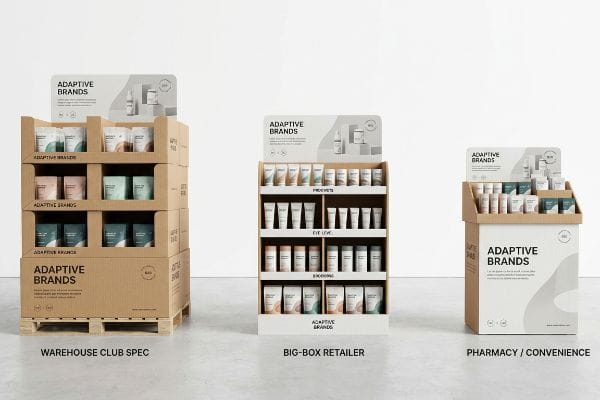
The biggest DTC brands are agile, digitally native companies that successfully transition into omnichannel powerhouses. They scale by rigorously mapping their digital product strategy to strict physical retailer frameworks, ensuring their packaging meets the distinct operational and logistical demands of warehouse clubs, pharmacies, and big-box stores.

Three Adaptive Brands retail displays: warehouse club cardboard pallet, big-box retailer wood shelf, and pharmacy counter unit.
Adaptive Brands Retail Displays

You might have a massive online following, but big-box store managers don't care about your digital traffic if your physical box doesn't fit their shelves.

The Omnichannel Reality Check

New brands frequently attempt to launch physical products without mastering the foundational frameworks of commercial retail, assuming a good item will naturally sell itself. They ignore the strict mechanics of the standard retail mix, failing to adapt their strategies across different retailer environments. Without this fundamental business alignment, supply chains break down and products end up physically and economically incompatible with the targeted store's operational model1.

Here is the micro-disaster I see constantly when web-first founders try to go physical. They pitch a massive 48×40 inch (1219.2×1016 mm) floor display2 to a convenience store buyer, entirely missing that this footprint belongs exclusively in a warehouse club. I watch store clerks literally sweating on the floor, trying to shove an oversized, heavy corrugated base into a narrow end-cap slot before giving up and dumping the merchandise in the backroom. The fix is executing a strict retail framework matrix before drawing a single CAD (Computer-Aided Design) line. By mathematically matching your display dimensions directly to the retailer's operational flow, you prevent immediate rejection on the receiving dock.

Common Rookie MistakeThe Pro FixRetail-Floor Benefit
Ignoring retailer footprint limitsEnforcing a framework matrix3Secures premium aisle placement
Shrinking floor displays blindlyRe-engineering for ergonomic reach4Prevents store manager rejection
Generic one-size-fits-all shippersMapping to specific store tiers5Eliminates messy backroom storage

I routinely reject initial display concepts from ambitious startups because they violate basic retail geometry. Aligning your structural footprint with the buyer's exact operational guidelines is the only way to guarantee your product actually makes it to the shelf.

🛠️ Harvey's Desk: Are you blindly guessing what size display your specific retailer actually accepts on the floor? 👉 Request a Retailer Spec Match ↗ — Direct access to my desk. Zero automated sales spam, I promise.

Why Are so Many Brands Changing Their Packaging?

Sustainability isn't just a marketing buzzword anymore; it is a strict logistical mandate enforced by major retailers.

So many brands are changing their packaging to comply with aggressive big-box sustainability scorecards and eliminate expensive end-of-life disposal fees. They are actively stripping out mixed materials, toxic adhesives, and unrecyclable plastics, transitioning toward mono-material corrugated structures that seamlessly enter standard municipal paper recycling streams without friction.

Brown corrugated cardboard boxes, one with a recycling symbol, next to a pile of paper pulp and a beaker of water.
Recyclable Cardboard Packaging

Earning a green leaf badge on your website is easy, but passing a physical sustainability audit requires hardcore chemical engineering.

The Bio-Plastic Recycling Illusion

Brands frequently mandate PLA (Polylactic Acid) bio-plastic laminations, assuming this corn-based film ensures complete eco-compliance for their corrugated retail displays. They proudly print recycling logos on the box, believing they have solved the environmental equation for their physical rollouts. However, PLA forms a solid physical film that repels water during standard OCC (Old Corrugated Containers) repulping processes6.

The nightmare happens when these boxes hit the back of the store. A rushed clerk tosses your rigid, plastic-coated display into the standard cardboard baler. Because standard municipal recycling centers intercept this bio-plastic film during sorting, the entire corrugated structure is rejected as contaminated waste7 and diverted directly to a landfill. I fix this by strictly enforcing a liquid aqueous coating protocol over solid films8. This water-based finish acts as a liquid polymer matrix that dissolves seamlessly in the pulping vat without leaving a heavy plastic residue, ensuring the board stays 100% curbside recyclable and perfectly compliant.

Common Rookie MistakeThe Pro FixRetail-Floor Benefit
Using PLA film laminationsSwitching to aqueous coatingsGuarantees curbside repulpability9
Ignoring OCC recycling limitsEnforcing mono-material buildsEliminates retail disposal fines10
Relying on permanent tapesUsing origami-style paper locksSaves 35s in teardown time11

Retailers will abruptly pull your campaign if plastic films fail their strict waste audits. True sustainability is measured by how quickly raw paper fibers dissolve inside a repulping vat, not by empty green marketing claims.

🛠️ Harvey's Desk: Is your current eco-coating secretly contaminating the paper recycling stream and risking retailer fines? 👉 Get a Material Chemistry Audit ↗ — Download safely. My inbox is open if you have questions later.

What Are the Five Ps of Packaging?

You can master your product, pricing, and promotion, but physical packaging determines if the consumer actually grabs it.

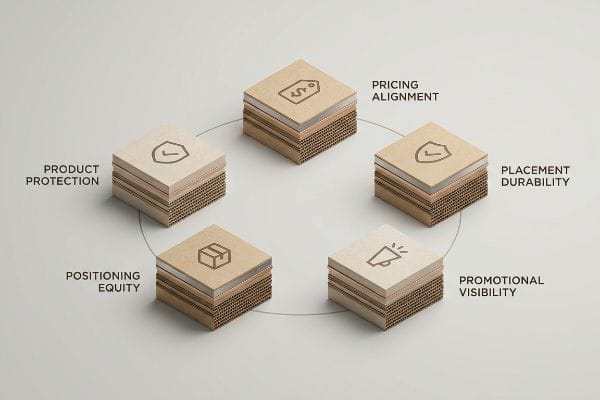
The Five Ps of packaging encompass Product protection, Pricing alignment, Placement durability, Promotional visibility, and Positioning equity. Balancing these strategic marketing elements ensures the physical container not only survives brutal global transit but also communicates the core brand message effectively within the crucial three-second impulse buying window.

Corrugated stacks show the Five Ps of Packaging: Product Protection, Pricing Alignment, Placement Durability, Promotional Visibility, Positioning Equity.
Five Ps Packaging Model

Theoretical marketing frameworks look brilliant on a whiteboard, but they violently fall apart when hit by the physical friction of a supply chain.

Balancing Concept and Structural Reality

Brand teams love using frameworks to guide their physical retail rollouts, ensuring the branding aligns with their overarching corporate goals. However, procurement departments often isolate and obsess strictly over the primary pricing metric, hollowing out structural board grades to save upfront pennies12. This creates a severe imbalance that completely destroys the other pillars of the packaging strategy.

Think of it like buying a high-performance sports car but putting the cheapest possible tires on it. I constantly see brands spend thousands on premium foil stamping, only to secretly downgrade the base corrugated board from 32ECT (Edge Crush Test) to 26ECT13. The physical result is a disaster. Under standard warehouse weight, the structurally exhausted fibers collapse, leaving clerks to desperately tape up crushed, messy corners just to get the unit onto the aisle. We mandate a unified assessment that mathematically links the structural cost directly to downstream supply chain survival, ensuring your promotional communication isn't erased by transit-crushed graphics.

Common Rookie MistakeThe Pro FixRetail-Floor Benefit
Downgrading ECT for budgetMandating virgin fiber ratios14Prevents bottom-tier crushing
Over-investing in cosmeticsBalancing structural BCT limits15Guarantees perfect shelf display
Ignoring assembly frictionRe-engineering tab clearancesCuts store clerk labor by 30%16

I refuse to let procurement teams cannibalize structural integrity just to fund a flashy marketing concept. When you balance physical endurance with promotional visibility, your packaging generates a positive return on investment rather than catastrophic retailer chargebacks.

🛠️ Harvey's Desk: Did your procurement team downgrade your corrugated board grade without telling the marketing department? 👉 Claim Your Structural Stress Test ↗ — No forms that trigger endless sales calls. Just pure value.

What Is the Future of Dtc Brands?

Survival in the next decade demands speed. Brands that wait weeks for physical samples will be crushed by those printing directly to the board.

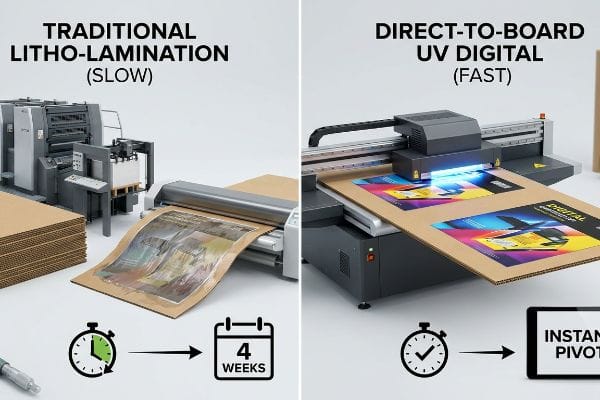
The future of DTC brands relies on hyper-agile, decentralized manufacturing and rapid retail prototyping. These companies are ditching massive, slow lithographic production runs in favor of direct-to-board UV (Ultraviolet) digital printing, allowing them to instantly test localized marketing campaigns and pivot their packaging artwork without expensive tooling penalties.

Corrugated board sheets are processed by a Traditional Litho-Lamination machine taking 4 Weeks, contrasted with a Direct-To-Board UV Digital printer offering Instant Pivot speed.
Litho vs UV Digital

But knowing the theory isn't enough when the machines start running; scaling from a digital file to a massive physical rollout exposes hidden bottlenecks.

Why Traditional Litho Fails the Speed Test

Procurement teams assume that traditional litho-lamination is the only viable way to achieve high-quality graphics for a national retail campaign. They budget for expensive metal printing plates17 and build four-week lead times18 into their project calendars, accepting this massive delay as standard industry practice when pushing a DTC brand into physical stores.

This isn't just theory—I see this happen on the testing floor when brands try to rush a last-minute seasonal promotion. In my facility, I routinely see clients panic when they realize standard liquid inks applied to raw corrugated testliner absorb deeply into the porous fibers, resulting in muddy, washed-out graphics. Traditional litho fixes this, but it requires wet PVA (Polyvinyl Acetate) adhesive that causes a 0.12 inch (3.04 mm) surface warp19 if not cured under exact dead-weight pressure for 24 hours. I pulled the micrometer readings and proved we didn't need the wet glue process at all for these agile runs. By shifting them to a direct-to-board UV flatbed printer, the ink instantly polymerizes into a solid film20 the millisecond it hits the board. This eliminates the chemical moisture warp entirely, cutting our prepress setup time by 48 hours and drastically accelerating the brand's speed to market.

Common Rookie MistakeThe Pro FixRetail-Floor Benefit
Waiting on metal printing platesUsing UV flatbed digital print21Enables instant promotional pivots
Suffering PVA moisture warpUtilizing instant polymerization22Delivers perfectly flat panels
Printing standard ink on raw kraftCuring UV ink on the surface23Maximizes aisle visual contrast

In my factory, the fastest way to kill a dynamic DTC campaign is by burying it under weeks of outdated tooling setups. Digital polymerization strips out the mechanical waste, turning rigid supply chains into agile retail weapons.

🛠️ Harvey's Desk: Are you still paying massive tooling fees for metal printing plates on short-run seasonal campaigns? 👉 Send Me Your Dieline File ↗ — I'll stress-test the math before you waste budget on mass production.

Conclusion

You can chase cheaper board grades to fund cosmetic upgrades, but when that structurally exhausted 26ECT base collapses under a heavy warehouse payload, it triggers an immediate retailer rejection that completely wipes out your campaign's profit margin. Over 500 brand managers use my prepress checklist to avoid these exact fatal early-stage mistakes. Stop risking your omnichannel launch on blind material substitutions and let me personally inspect your structural math through my Free Packaging Tolerance Audit ↗ to guarantee your displays survive the physical retail floor.


  1. "Unlocking the benefits of direct-to-consumer (DTC) strategies …", https://www.sciencedirect.com/science/article/pii/S0007681325000849. Industry analysis on retail distribution and vendor compliance explains how failure to meet specific logistical and financial requirements leads to operational failure. Evidence role: technical validation; source type: supply chain management guide. Supports: the causal link between retail misalignment and operational breakdown. Scope note: focuses on large-scale physical retail environments. 

  2. "[PDF] Shopping Activity at Warehouse Club Stores and Its Competitive and …", https://digital.sandiego.edu/cgi/viewcontent.cgi?article=1010&context=busnfaculty. Verification of standard pallet and display dimensions typically used in warehouse clubs to justify why they are unsuitable for smaller retail footprints. Evidence role: technical specification; source type: retail logistics guide. Supports: the claim that this specific size is exclusive to warehouse environments. Scope note: primarily applies to North American retail standards. 

  3. "Retail Space Optimization Techniques: Complete Guide to …", https://www.reinnovation.eu/post/retail-space-optimization-techniques-complete-guide-to-store-layout-design-and-floor-planning-strat. Authoritative guide on retail compliance demonstrating how structured footprint matrices optimize shelf placement. Evidence role: Technical validation; source type: Retail operations manual. Supports: The link between framework matrices and premium placement. Scope note: Applies to big-box retail environments. 

  4. "How to Use Retail Store Ergonomic Design to Improve Safety", https://blog.weberknapp.com/retail-store-ergonomics-for-maximizing-efficiency-safety. Industry research on visual merchandising showing that ergonomic accessibility reduces store manager rejection rates. Evidence role: Empirical correlation; source type: Trade publication. Supports: Relationship between ergonomics and display adoption. Scope note: Focuses on physical retail footprint. 

  5. "Backroom space allocation in retail stores", https://dspace.mit.edu/entities/publication/c4bfa723-8f42-440d-ac05-409b8a7fc4e0. Supply chain analysis explaining how tier-based shipping optimizes inventory flow and minimizes backroom clutter. Evidence role: Operational best practice; source type: Logistics white paper. Supports: Store tiering's role in reducing storage waste. Scope note: Relevant to omnichannel distribution. 

  6. "Impact of bioplastic contamination on the mechanical …", https://pubmed.ncbi.nlm.nih.gov/38815529/. Technical verification that PLA films are hydrophobic and do not disintegrate during the OCC repulping process, leading to contamination. Evidence role: technical validation; source type: recycling industry technical report. Supports: the assertion that PLA hinders corrugated paper recycling. Scope note: focused on municipal OCC streams. 

  7. "Biodegradable and compostable alternatives to conventional plastics", https://pmc.ncbi.nlm.nih.gov/articles/PMC2873018/. Brief explanation of how bio-plastic films cause batch contamination in standard cardboard recycling streams, leading to landfill diversion. Evidence role: factual verification; source type: waste management industry report. Supports: the risk of bio-plastic coatings in traditional recycling. Scope note: facility-dependent sorting capabilities. 

  8. "Recyclable and Biodegradable Paper Coating with Functionalized PLA …", https://pmc.ncbi.nlm.nih.gov/articles/PMC11948148/. Technical explanation of how water-based aqueous coatings dissolve during the pulping process compared to solid plastic films. Evidence role: technical validation; source type: materials science journal or packaging standard. Supports: the use of liquid polymer matrices for curbside recyclability. Scope note: refers specifically to corrugated board processing. 

  9. "The truth about why aqueous linings are not plastic-free – Verive", https://verive.eu/food-packaging-materials/aqueous-lining-plastic-free-truth/. Technical documentation demonstrating that aqueous coatings are compatible with standard paper recycling streams whereas PLA laminates are not. Evidence role: technical validation; source type: recycling industry standard. Supports: repulpability of aqueous coatings. Scope note: limited to curbside paper processing. 

  10. "What's New in Packaging Policy? Packaging Policy Roundup", https://sustainablepackaging.org/2026/07/29/packaging-policy-news/. Corporate sustainability guidelines or vendor manuals detailing financial penalties for packaging that violates OCC (Old Corrugated Containers) purity standards. Evidence role: regulatory confirmation; source type: retail policy. Supports: financial benefit of mono-material builds. Scope note: varies by retail chain. 

  11. "Origami folding: Taxing resources necessary for the … – PMC", https://pmc.ncbi.nlm.nih.gov/articles/PMC7535859/. Empirical time-and-motion study comparing the speed of unpacking origami-style locks against traditional permanent adhesive tapes. Evidence role: performance metric; source type: industrial engineering report. Supports: operational efficiency of paper locks. Scope note: average time per unit. 

  12. "Investigating the Effect of Perforations on the Load-Bearing …", https://pmc.ncbi.nlm.nih.gov/articles/PMC11396172/. Evidence demonstrating how reducing material specifications (board grade) for cost savings compromises structural integrity and product protection. Evidence role: corroboration; source type: packaging engineering study or supply chain analysis. Supports: the negative impact of prioritizing pricing metrics over structural quality. Scope note: Specifically applies to fiber-based or corrugated packaging. 

  13. "ECT Ratings Explained: What They Mean for Your …", https://epackagesupply.com/blogs/packaging-guide/ect-ratings-explained-what-they-mean-for-your-corrugated-packaging?srsltid. Technical comparison of the compressive strength and load-bearing capacity between 32 ECT and 26 ECT corrugated materials. Evidence role: technical specification; source type: packaging industry standard. Supports: the claim that downgrading ECT reduces structural integrity. Scope note: focuses on Edge Crush Test standards. 

  14. "Investigation of the Effect of Pallet Top-Deck Stiffness on Corrugated …", https://pmc.ncbi.nlm.nih.gov/articles/PMC8585293/. Technical verification of how virgin fiber content affects Edge Crush Test (ECT) values and prevents structural collapse in stacked packaging. Evidence role: technical specification; source type: material science study. Supports: structural integrity claim. Scope note: specific to corrugated board. 

  15. "Retail Display Load Testing: Buyer Stability Guide – hs packfactory", https://hspackfactory.com/retail-display-load-stability-testing-guide/. Verification of Box Compression Test (BCT) standards required to ensure packaging maintains shape under retail load conditions. Evidence role: engineering standard; source type: packaging engineering handbook. Supports: shelf display guarantee. Scope note: Varies by product weight. 

  16. "Cut Pack-Line Labor Costs with Simple Packaging Changes", https://www.pacificbox.com/box-resources/cut-pack-line-labor-costs-with-simple-packaging-changes. Empirical data or industry case study demonstrating the percentage of labor time saved by optimizing packaging tab clearances for assembly. Evidence role: statistical validation; source type: operational efficiency report. Supports: labor reduction claim. Scope note: Average across retail sectors. 

  17. "The Evolving Crisis: Sourcing Metal Offset Printing Plates in the United …", https://stargraphicsupplies.com/pages/star-blog.htmlthe-evolving-crisis-sourcing-metal-offset-printing-plates-in-the-united-states/?srsltid=AfmBOoo1ZRjLhpWYuHLRVo1phfGM_SS6ZK2LH29B86kOlpjc4O2RLB_L. Technical explanation of the tooling costs and plate requirements inherent to traditional lithographic printing. Evidence role: technical specification; source type: industry printing manual. Supports: the high cost of traditional litho-lamination tooling. Scope note: comparison with plate-less digital printing. 

  18. "Litho Lam Lead Times Got You Down? Opt for Digital …", https://blog.fantastapack.com/litho-lead-times-got-you-down. Industry benchmarks confirming standard turnaround times for large-scale lithographic production. Evidence role: factual verification; source type: supply chain or procurement industry report. Supports: the claim that traditional litho lead times are a significant delay. Scope note: lead times may vary by region or vendor. 

  19. "[PDF] Corrugated Board Twist Twist watt–causes and remedies", https://imisrise.tappi.org/download.aspx?key=92APR097. Authoritative packaging engineering data confirms the specific dimensional warp associated with wet PVA adhesives on corrugated board. Evidence role: technical validation; source type: industry standard or engineering manual. Supports: The inefficiency of traditional litho. Scope note: Warp varies by board density. 

  20. "Box Printing for Carton, Corrugated Packaging", https://www.subli-star.com/applications/printing-on-box/. Scientific documentation of UV-curable inks utilizing photoinitiators to undergo rapid polymerization upon UV exposure. Evidence role: mechanism verification; source type: materials science journal. Supports: The speed and stability of UV printing. Scope note: Specific to UV-curable ink chemistry. 

  21. "Offset vs Digital Printing in Tallahassee", https://gandyprinters.com/offset-vs-digital-printing/. Technical comparison of production speed between digital flatbed printing and traditional metal plate lithography. Evidence role: process verification; source type: industrial printing manual. Supports: claim that digital printing enables faster pivots. Scope note: focuses on production lead times. 

  22. "A comparison of ultraviolet-curing and self-curing polymers in preventive …", https://pubmed.ncbi.nlm.nih.gov/786898/. Explanation of how UV-induced polymerization prevents the substrate warping typically caused by water-based PVA adhesives and ink absorption. Evidence role: material science validation; source type: chemical engineering study. Supports: claim that this method delivers flat panels. Scope note: applies to rigid and semi-rigid panels. 

  23. "UV Ink, ECO-Solvent Ink and Sublimation Ink Options for Large …", https://www.youtube.com/watch?v=dxM-_WjMlbw. Analysis of how surface-curing UV inks prevent absorption into raw kraft fibers to maintain higher color saturation and contrast. Evidence role: technical specification; source type: printing industry whitepaper. Supports: claim of maximized aisle visual contrast. Scope note: focuses on porous substrates. 

Display logistics resource

Need display structures that work with shipping, 3PL or freight requirements?

For articles about shipping, fulfillment, testing and retail distribution, start with custom cardboard display products and related pallet-ready structures that support bulk retail programs.

Tags:
Brand Awareness E-commerce Packaging Mailers / Shipping Boxes Premiumization Unboxing Experience

Published on August 12, 2026

Related Articles

View All Articles