What Is a Custom Box?

What Is a Custom Box?

Brands lose thousands on damaged goods simply because they grab generic packaging off a shelf. You need structural engineering, not just a cardboard container to ship air.

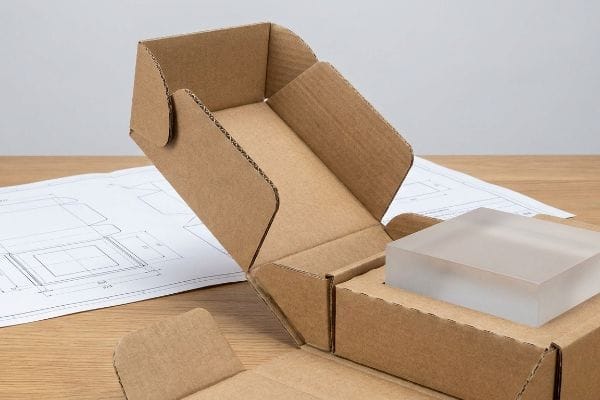
A custom box is a structurally engineered packaging solution designed to perfectly fit a specific product's dimensions, weight, and retail environment. It utilizes tailored corrugated fluting, precise dieline tolerances, and exact material grades to guarantee physical protection and brand visibility throughout the supply chain.

An overhead view displays a brown corrugated cardboard box being assembled next to its blue dieline pattern and a sample of exposed fluting, illustrating custom packaging design.
Custom Box Dieline Fluting

Let's break down exactly what separates a generic carton from a precision-engineered retail package.

What Does "Custom Box" Mean?

Slapping a logo on a stock shipper doesn't make it custom. Real customization happens in the micro-math before the ink ever hits the paperboard.

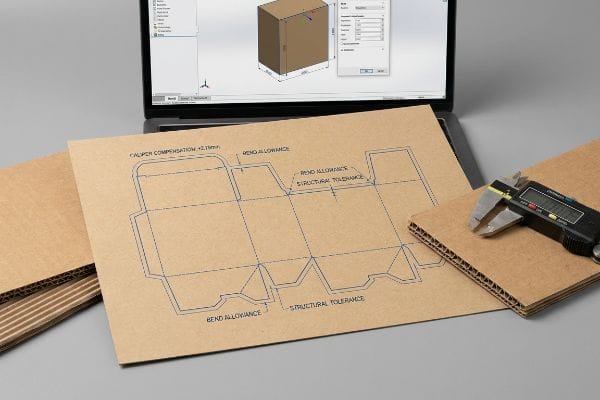
Meaning a custom box requires parametric design adjustments for structural tolerances, bend allowances, and physical board thickness. It ensures interlocking tabs and folds account for the exact caliper of the corrugated material, preventing friction, tearing, or assembly failure during high-speed fulfillment.

Brown corrugated board with a dieline blueprint showing Caliper Compensation +2.79mm, Bend Allowance, and Structural Tolerance, next to a laptop displaying 3D CAD software and a digital caliper.
Custom Box Dieline Design

The difference between a box that works and one that rips often comes down to millimeters.

The Hidden Math Behind a True Custom Box

Even veteran designers often draw flat interlocking tabs in CAD (Computer-Aided Design) software, assuming a receiving slot should perfectly match the width of the inserting tab. They treat paper like it exists in a two-dimensional vacuum, forgetting that physical substrates take up actual space. When that file hits the factory, we are cutting real corrugated board with distinct fluting that actively resists tight angles.

A true custom design must include strict caliper compensation. I see this blind spot constantly: a procurement team sends a flat file for a 0.11-inch (2.79 mm) thick B-flute carton1 without adding bend allowances2. When the co-packer tries to fold that thick panel 90 degrees, the paper fibers consume material, and the slot is suddenly far too tight. I've watched clerks sweat on the assembly line, feeling the stiff resistance of the virgin kraft board as they force it, only to hear the top sheet aggressively tear with a loud rip. The fix is strictly mathematical. I use parametric algorithms to artificially widen the receiving slots by exactly the board's thickness, ensuring a frictionless assembly that drops co-packing time by an estimated 25%.

Common Rookie MistakeThe Pro FixRetail-Floor Benefit
1:1 tab-to-slot ratiosAdd board caliper clearance3Zero tearing during assembly
Ignoring fold radiusesParametric bend allowances4Box sits perfectly square
Using flat 2D software3D structural engineeringSaves 30s per unit setup5

I refuse to let uncompensated dielines hit my cutting tables. By calculating the exact fold consumption upfront, I eliminate the mechanical friction that causes massive delays and manual rework on the packing line.

🛠️ Harvey's Desk: Are your interlocking tabs tearing when you fold them? 👉 Send Me Your Flat Dieline ↗ — Direct access to my desk. Zero automated sales spam, I promise.

How Much Does a Custom Box Cost?

Everyone wants a premium unboxing experience, but mismanaging your manufacturing budget can instantly destroy your physical product.

It depends. A custom box costs anywhere from a few cents to several dollars based on volume, board grade, and printing techniques. However, secretly downgrading the structural edge crush test rating to afford expensive cosmetic foil laminations inevitably causes catastrophic compression failure under heavy pallet top-loads.

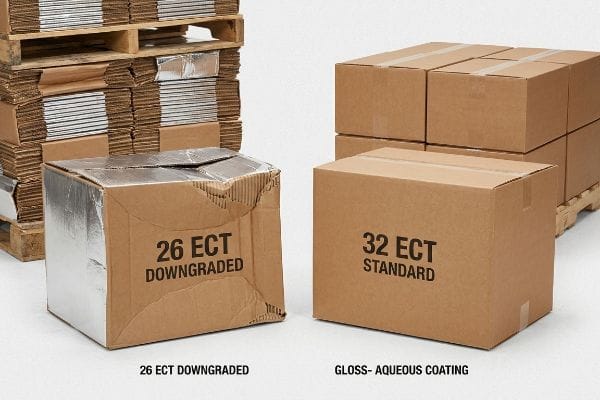
A crushed 26 Ect Downgraded box with silver lamination contrasts with a sturdy 32 Ect Standard box, representing Gloss Aqueous Coating.
ECT Downgrade vs Standard

Paying for luxury aesthetics means nothing if the package arrives flattened.

The Cosmetic Downgrade Trap in Custom Box Pricing

Procurement teams frequently treat expensive cosmetic finishes, like full-coverage foil laminations or soft-touch films, as non-negotiable marketing mandates. To keep the per-unit cost under budget, they often secretly downgrade the raw structural board from a sturdy 32 ECT6 (Edge Crush Test) rating down to a flimsy 26 ECT. They assume the beautiful exterior will distract from the weakened core fluting.

This budget imbalance creates a nightmare when those boxes hit the supply chain. I remember a client who slashed their board grade to pay for heavy silver foil. When their 45 lbs (20.4 kg) master cartons were double-stacked in a humid warehouse, the weakened internal flutes couldn't handle the dynamic load. You could literally hear the structural pop as the bottom tier buckled, collapsing the entire pallet and triggering an immediate retailer rejection. To fix this, I strictly forbid compromising the base substrate. We restored the virgin 32 ECT board7 and swapped the expensive foil for a high-solid gloss aqueous coating8, guaranteeing zero transit damage while maintaining the premium shine and keeping the total cost locked.

Common Rookie MistakeThe Pro FixRetail-Floor Benefit
Downgrading ECT for budgetMaintain 32 ECT minimum9Survives double-stacking
Heavy foil laminationGloss aqueous coating10100% curbside recyclable
Ignoring dynamic load limitsISTA transit simulation11Zero retailer chargebacks

I never let marketers cannibalize the engineering budget. Your supply chain doesn't care how shiny your packaging is; if it cannot bear weight, your entire investment is completely wiped out.

🛠️ Harvey's Desk: Are you sacrificing your corrugated board strength to pay for premium printing? 👉 Get A Structural Cost Audit ↗ — Download safely. My inbox is open if you have questions later.

What Is Custom Box Packaging?

It is not just the single container holding the product; it is the entire synchronized ecosystem of inner trays, inserts, and outer shippers.

Custom box packaging is a comprehensive structural system integrating primary product enclosures with secondary retail displays and tertiary master cartons. It requires engineered geometric offsets and clearance buffers between nested components to prevent surface friction locks, ensuring seamless unpacking and pristine brand presentation upon arrival.

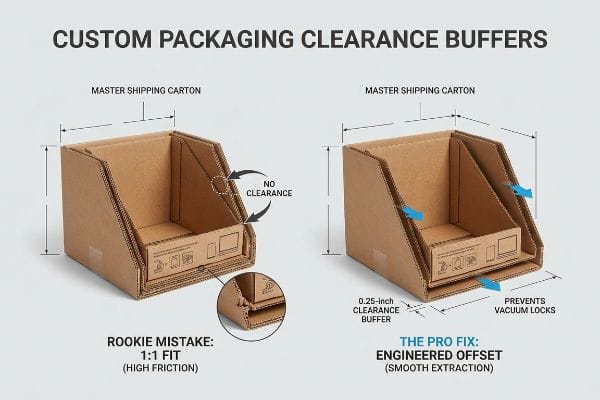
Corrugated master shipping cartons illustrate custom packaging clearance buffers: a 1:1 fit rookie mistake with no clearance versus a pro fix 0.25-inch engineered offset.
Packaging Clearance Buffers

If the internal and external boxes fight each other, the retailer pays the price.

Overcoming Master Carton Friction in Custom Box Packaging

Brands frequently design their outer master shipping cartons to match the exact 1:1 exterior dimensions of their pre-filled retail trays, assuming a tight fit provides maximum transit protection. They view the packaging like a Russian nesting doll, completely ignoring the severe surface friction created by raw, unsealed corrugated testliner12 rubbing against itself during extraction.

This 1:1 ratio creates a massive vacuum lock when a busy store clerk tries to unpack the merchandise. I've watched retail employees yank aggressively on a tightly nested 24-inch (609.6 mm) tray stuck inside a shipper. Because the porous paperboard walls physically lock together13, the clerk inevitably rips the printed front retaining lip right off the display, ruining the unit before it even hits the aisle. I fix this by enforcing a strict geometric offset tolerance, mathematically adding a 0.25-inch (6.35 mm) perimeter clearance buffer14 into the master cavity. This breaks the friction lock and ensures a smooth, zero-tear unpacking experience for the retailer.

Common Rookie MistakeThe Pro FixRetail-Floor Benefit
1:1 nested box dimensions0.25-inch clearance buffer15Effortless retail unpacking
Ignoring paper frictionGeometric offset mapping16Prevents torn front lips
Too tight shipper fitAir-gap tolerance17Faster store restocking

I engineer packaging ecosystems, not just isolated containers. If your retail tray cannot be extracted from its shipper without physical violence, your custom structural design has fundamentally failed.

🛠️ Harvey's Desk: Are your store clerks tearing your retail-ready trays just trying to unpack them? 👉 Claim Your Friction-Lock Review ↗ — No forms that trigger endless sales calls. Just pure value.

How Can I Make a Custom Box?

Moving from a digital concept to a physical, high-volume manufacturing run requires strict adherence to prepress machinery protocols.

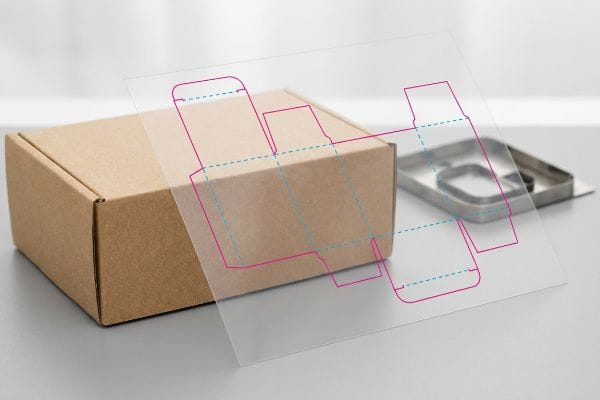
Making a custom box requires transitioning structural vector artwork into machine-readable formats for CNC cutting tables and steel rule dies. This involves assigning absolute spot colors to cut and crease lines, preventing automated RIP software from merging critical structural paths into the cosmetic printed artwork layer.

Transparent dieline with magenta cut lines and cyan crease lines overlaid on a brown corrugated cardboard box, illustrating prepress spot colors.
Dieline Spot Colors

But knowing the theory isn't enough when the machines start running and digital files crash the factory floor.

Why Standard CMYK Files Fail on the Factory Floor

Graphic designers often submit dielines for custom packaging using standard CMYK (Cyan, Magenta, Yellow, Key) lines18 to indicate where the substrate should be cut or folded. They assume that because the black outline looks perfectly clear on their high-resolution monitor, the factory's cutting machinery will automatically recognize the borders and process the board accordingly.

In my facility, I routinely see this exact file format cause catastrophic manufacturing bottlenecks before a single blade drops. Automated CNC (Computer Numerical Control) cutting tables and laser die-board burners do not read visual black ink; they require specific spot color commands. When a file arrives with basic CMYK strokes, the prepress system simply merges those lines into the artwork layer19. The result is a press that prints a beautiful box with visible black outlines, but the cutting blades remain completely frozen, yielding zero physical cuts and a massive stack of wasted board. I fix this by intercepting the files and strictly assigning 100% Magenta spot colors for cuts and 100% Cyan for creases. This micro-adjustment guarantees the physical steel rule die engages perfectly, saving my clients thousands of dollars in wasted materials.

Common Rookie MistakeThe Pro FixRetail-Floor Benefit
Using CMYK black dielinesAssign absolute spot colors20Perfect machine cutting
Merging art and cut layersIsolate structural vector paths21Zero printed cut lines
Assuming machines read visualsMachine-readable tooling data22Prevents production stops

I never trust a flat visual proof to drive a massive steel machine. By strictly policing prepress spot color assignments, I ensure the structural integrity of your box translates perfectly from the screen to the retail aisle.

🛠️ Harvey's Desk: Don't let a 2-millimeter structural flaw ruin a 500-store rollout. 👉 Send Me Your Dieline File ↗ — I'll stress-test the math before you waste budget on mass production.

Conclusion

You can choose a vendor based entirely on cheap cosmetic finishes, but when that downgraded 26ECT board collapses under a heavy pallet load, you will face an immediate retailer rejection and completely wipe out your project's profit margin. Over 500 brand managers use my prepress checklist to avoid these exact fatal early-stage mistakes. Stop guessing on structural tolerances and let me personally run your files through my Free Dieline Audit ↗ to catch fatal compression and friction errors before mass production.


  1. "Corrugated Board and Material Grades | 2021-06-30", https://www.packagingstrategies.com/articles/96269-corrugated-board-and-material-grades. Industry standards for corrugated materials define the nominal caliper of B-flute board to verify specific thickness. Evidence role: technical specification; source type: industry standard. Supports: precise material thickness. Scope note: measurements may vary slightly by manufacturer tolerances. 

  2. "Cardboard Constructions: Calculating Bend Allowance 1", https://www.youtube.com/watch?v=j1n5ojAbAic. Packaging engineering guides detail the calculation of bend allowances to account for material thickness and prevent structural failure. Evidence role: technical methodology; source type: engineering manual. Supports: necessity of mathematical compensation in design. Scope note: applies to folding rigid or semi-rigid substrates. 

  3. "Investigating the Effect of Perforations on the Load-Bearing Capacity of …", https://pmc.ncbi.nlm.nih.gov/articles/PMC11396172/. Technical documentation explaining how accounting for material thickness (caliper) prevents structural stress and tearing during assembly. Evidence role: technical validation; source type: packaging industry standard; Supports: the requirement for material clearance in custom die-lines. Scope note: specific to corrugated and heavy paperboard. 

  4. "How to Calculate Bend Allowance and Bend Deduction with SendCutSend", https://www.youtube.com/watch?v=0mGG4ZtC2a4. Engineering principles demonstrating how bend allowances account for material deformation to ensure the final folded product remains square. Evidence role: technical validation; source type: mechanical engineering handbook; Supports: the use of parametric math for geometric precision. Scope note: applies to folding carton design. 

  5. "Structural Packaging Design: Key Elements and Process", https://www.arkay.com/resources/structural-packaging-design. Industry benchmarks or case studies comparing the efficiency of 3D structural prototyping against traditional 2D drafting for setup time. Evidence role: quantitative verification; source type: industry case study; Supports: the claim of time savings via 3D engineering. Scope note: time savings may vary based on box complexity. 

  6. "[PDF] Mullen Test vs. Edge Crush Test Boxes – Crown Packaging Corp.", https://crownpack.com/wp-content/uploads/2023/11/Crown-Packaging-Mullen-vs-ECT-Whitepaper.pdf. Technical data comparing the load-bearing capacity of 32 ECT versus 26 ECT board to validate the claim of structural weakening. Evidence role: technical specification; source type: industry standard (ASTM/TAPPI). Supports: claim that 32 ECT is structurally superior to 26 ECT. Scope note: applies to single-wall corrugated fiberboard. 

  7. "ECT Ratings Explained: What They Mean for Your …", https://epackagesupply.com/blogs/packaging-guide/ect-ratings-explained-what-they-mean-for-your-corrugated-packaging?srsltid=AfmBOooXZwLCAFm6ZCq3ugiaRJiCKbdYAYEfE1NkXCa0zfxrfmp8Y3PA. Verification of the Edge Crush Test (ECT) rating for corrugated board and its suitability for heavy master carton stacking. Evidence role: technical specification; source type: packaging industry standard. Supports: structural integrity requirements for heavy loads. Scope note: applies to corrugated fiberboard. 

  8. "A Complete Guide to Packaging Finishes and Coatings", https://www.winpackprinting.com/blog/a-complete-guide-to-packaging-finishes-and-coatings.html. Comparison of aqueous coatings and foil laminations regarding visual quality and production cost. Evidence role: technical comparison; source type: printing industry guide. Supports: cost-effective premium finish alternatives. Scope note: focused on cosmetic application. 

  9. "Flute Grades, ECT Ratings & Wall Thickness Explained 2025", https://anchorbox.com/corrugated-box-strength/. Technical verification of Edge Crush Test (ECT) ratings and their correlation to vertical compression strength for retail stacking. Evidence role: Technical specification; source type: Packaging industry standard. Supports: Minimum ECT for retail durability. Scope note: Effective strength depends on box dimensions. 

  10. "Custom Food Packaging: The Complete Guide for Food Brands …", https://crateform.com/blog/food-packaging-guide. Comparison of aqueous-based coatings versus plastic-based foil laminations regarding their compatibility with standard paper recycling streams. Evidence role: Material science fact; source type: Sustainability guideline. Supports: Curbside recyclability claims. Scope note: Recyclability varies by local municipality. 

  11. "Retail Packaging Testing for Big-Box Compliance", https://www.intertek.com/performance-testing/packaging/retail-compliance/. Validation of International Safe Transit Association (ISTA) testing protocols in reducing transit damage and associated retail penalties. Evidence role: Industry standard; source type: Certification body. Supports: Mitigation of retailer chargebacks. Scope note: Simulation reduces risk but cannot eliminate all shipping damage. 

  12. "Coefficient of Friction Testing", https://unitload.vt.edu/facilities/corrugated-packaging-lab/cof-testing.html. Verification of the physical friction properties of unsealed corrugated paper liners and their impact on nested packaging extraction. Evidence role: technical validation; source type: materials science or packaging engineering manual. Supports: the claim that raw testliners create significant friction during unpacking. Scope note: Comparison between coated and uncoated liners. 

  13. "Compressive Strength of Corrugated Paperboard Packages with Low …", https://pmc.ncbi.nlm.nih.gov/articles/PMC10054506/. Brief explanation of how surface friction and air pressure differentials create vacuum locks in nested paperboard components. Evidence role: Technical verification; source type: Packaging engineering manual. Supports: The physical cause of unpacking friction. Scope note: Specific to high-tolerance nested structural designs. 

  14. "Custom Packaging Tolerances Guide for Boxes & Inserts", https://hspackfactory.com/custom-packaging-tolerances-guide/. Brief explanation of industry-standard geometric tolerances used to prevent binding in tertiary packaging. Evidence role: Technical specification; source type: Structural design guide. Supports: The specific measurement for offset tolerance. Scope note: Optimal clearance may vary based on material caliper. 

  15. "How to Measure Packaging Box Dimensions: Complete Guide", https://epackfactory.com/how-to-measure-packaging-box-dimensions/. Industry standards for the minimum spatial gap required between nested boxes to prevent friction during unpacking. Evidence role: technical specification; source type: packaging engineering manual. Supports: the 0.25-inch buffer recommendation. Scope note: applicable to standard corrugated materials. 

  16. "Corrugated board packaging with innovative design for enhanced …", https://bioresources.cnr.ncsu.edu/resources/corrugated-board-packaging-with-innovative-design-for-enhanced-durability-during-transport/. Explanation of the mathematical mapping used to adjust box dimensions to account for material friction and structural tolerances. Evidence role: methodology verification; source type: structural design guide. Supports: the use of offset mapping to prevent torn lips. Scope note: relates to high-precision custom inserts. 

  17. "Tolerance for Manufacturers'Joint on RSC – AICC Now", https://now.aiccbox.org/tolerance-for-manufacturers-joint-on-rsc/. Technical requirements for air-gap tolerances in master cartons to facilitate efficient retail restocking. Evidence role: operational metric; source type: logistics and supply chain whitepaper. Supports: the claim that air-gap tolerance increases restocking speed. Scope note: varies based on shipment volume. 

  18. "When to Use Spot Color in Your Packaging Design – PopDisplay", https://popdisplay.me/when-to-use-spot-color-in-your-packaging-design/. Professional printing and packaging standards explaining the requirement for spot colors over CMYK for structural dielines. Evidence role: technical verification; source type: industry manual. Supports: the distinction between cosmetic print and structural cutting paths. Scope note: standard prepress protocols. 

  19. "What is Packaging PrePress? A Complete Overview", https://www.esko.com/en/blog/the-complete-overview-of-packaging-prepress. Explanation of how RIP software processes CMYK as printable ink versus spot colors as machine instructions. Evidence role: Process explanation; source type: Print production guide. Supports: Failure of CMYK lines to trigger cutting tools. Scope note: Applies to automated prepress workflows. 

  20. "Spot color vs. process color | Adobe", https://www.adobe.com/creativecloud/design/discover/spot-vs-process-color.html. Professional print guidelines specify using spot colors for dielines to differentiate cut paths from CMYK artwork. Evidence role: Technical standard; source type: Printing industry manual. Supports: Requirement for spot colors in cutting files. Scope note: Applies to vector-based dielines. 

  21. "Structural Packaging Design Services", https://www.internationalpaper.com/services/structural-design. Separation of structural layers ensures cutting machinery ignores artwork and printing presses ignore die lines. Evidence role: Process verification; source type: Technical printing guide. Supports: Elimination of printed cut lines. Scope note: Specific to layer management in vector software. 

  22. "CNC Mill Tool Wear – Kaggle", https://www.kaggle.com/datasets/shasun/tool-wear-detection-in-cnc-mill. Automated cutting equipment requires specific vector data attributes rather than visual representations to execute cuts. Evidence role: Technical specification; source type: Manufacturing documentation. Supports: Prevention of production stops. Scope note: Pertains to CNC and automated die-cutting equipment. 

Design & production resource

Need to turn technical display requirements into production-ready structures?

For articles about dielines, artwork, prototypes, printing and structural engineering, browse custom display design support and related display categories that can be customized for your retail program.

Tags:
Cardboard Boxes Folding Cartons Packaging Materials Rigid Boxes

Published on August 13, 2026

Related Articles

View All Articles