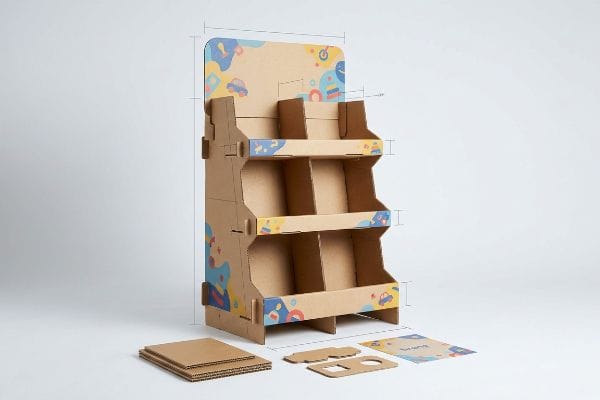
Can the toy display racks be customized?

by Harvey in Design & Customization
Can the toy display racks be customized?

Tired of generic shelving that buries your products? You are not alone. Let me show you exactly how custom engineering turns dead retail space into high-velocity profit zones.

Yes. Customizing a toy display rack involves engineering precise structural dimensions, applying branded graphics, and optimizing material strength to secure specific retailer placements. This tailored manufacturing process ensures maximum product visibility, strict compliance with logistics standards, and highly efficient assembly on the competitive retail floor.

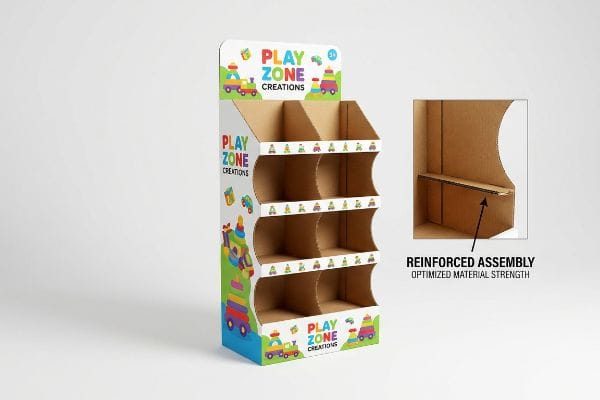
Corrugated cardboard 'Play Zone Creations' toy display rack, empty, featuring colorful train graphics and reinforced assembly.
Cardboard Toy Display

But knowing the theory isn't enough when the machines start running; let's break down how this actually works on the physical manufacturing floor.

How to organize a lot of toys in a small space?

Retail floor space is the most expensive real estate on earth, and fighting for a massive end-cap isn't always the smartest play for a growing brand.

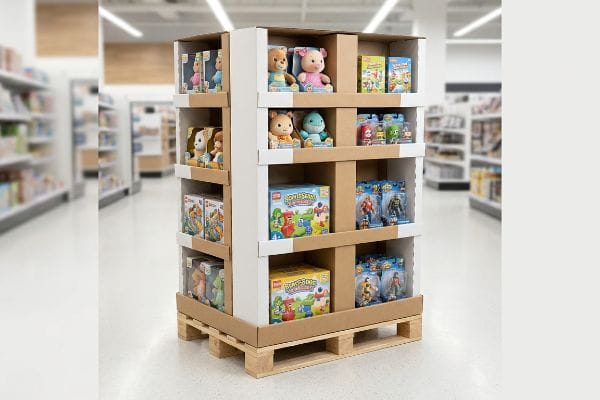
Organizing a lot of toys in a limited retail footprint requires implementing fractional pallet displays and internal modular dividers. This high-density merchandising strategy allows multiple product lines to share a single base, drastically maximizing vertical shelf capacity while strictly maintaining required store aisle clearances.

Corrugated cardboard fractional pallet display with modular dividers, merchandising Lego Bonus Box sets, plush toys, and action figures.
Toy Fractional Pallet Display

Getting high volume into a tight footprint sounds great until you actually try to set it up in an active store aisle.

The Fractional Geometry Rule for High-Density Merchandising

Even experienced procurement teams often pitch full-size 48×40 inch (1219×1016 mm) floor displays1 to big-box retailers, assuming a major campaign requires a massive wood base. They design wide, sprawling shelves hoping to dominate the aisle, completely ignoring the reality that valuable store real estate is strictly rationed by store managers.

Here is what happens when you try to force a bloated footprint into a crowded toy aisle. I regularly see brands get their giant displays instantly rejected by floor managers because they physically block the main walkways. To fix this, I engineer bulk merchandisers precisely to standard fractional dimensions—like quarter pallets measuring exactly 24×20 inches (609×508 mm)2. The moment that stiff corrugated board slides perfectly into place on the fractional skid, you hear the satisfying friction of a snug, engineered fit. By mathematically dividing the geometry, I ensure multiple distinct product lines perfectly share one base, saving you massive logistical fees while keeping your merchandise highly visible in tight store intersections.

Common Rookie MistakeThe Pro FixRetail-Floor Benefit
Pitching oversized full-pallet displaysEngineering 24×20 fractional footprintsSecures premium aisle intersections
Wasting vertical merchandising spaceAdding internal modular SKU dividersDoubles product holding capacity
Ignoring store aisle clearance rulesAdapting to strict retailer spatial limitsPrevents instant manager rejection

I always push clients toward high-density fractional bases when launching new toy lines. It instantly reduces your shipping volume and practically guarantees the retailer will approve your placement.

🛠️ Harvey's Desk: Are your current floor displays getting rejected for being too wide? 👉 Request A Fractional Footprint Audit ↗ — Direct access to my desk. Zero automated sales spam, I promise.

How to display toys in Montessori?

Creating a compliant, child-friendly retail environment requires more than just natural wood tones and minimalist graphics; it demands precise physical accessibility metrics.

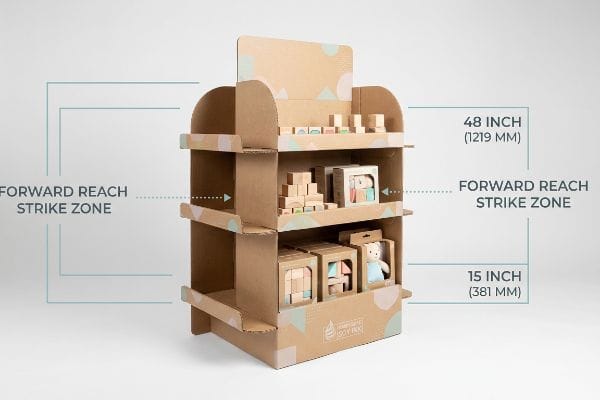
Displaying toys in a Montessori retail setting involves strictly adhering to standard forward reach limits. Maintaining product presentation within a 15 to 48-inch vertical window guarantees that young children can visually engage and physically interact with the items safely, promoting independent exploration without requiring adult assistance.

Corrugated cardboard display for Montessori toys, highlighting Ada Forward Reach Strike Zone 15 to 48 inches, with baby-safe soy ink.
ADA Reach Zone Display

Designing for children seems simple, but transferring that concept into a sturdy, compliant cardboard structure introduces immediate friction.

Designing for the ADA Forward Reach Strike Zone

Brands trying to capture the educational toy market often design beautifully tall floor displays to match a premium aesthetic. They mistakenly scale down standard adult-focused point-of-purchase structures, thinking a simple pastel graphic change is enough to attract a younger demographic.

The problem hits when the unit actually lands on the floor. I have watched store clerks frantically try to reorganize these setups because a young child physically cannot reach the premium toys placed on the top tier. In my facility, I enforce a strict ADA (Americans with Disabilities Act) reach range protocol, mathematically locking the primary merchandising shelves between 15 and 48 inches (381 and 1219 mm)3 off the floor. When I run my hand along that perfectly angled bottom shelf, feeling the smooth, baby-safe soy ink finish, I know the structural math is flawless. By locking in this specific vertical window, we eliminate awkward stretching and ensure the kids can actually grab your product, directly lifting conversion rates on the floor.

Common Rookie MistakeThe Pro FixRetail-Floor Benefit
Placing items above 48 inchesEnforcing ADA forward reach limits4Allows independent child access
Using sharp 90-degree cornersApplying wave-cut safety edgesPrevents paper cuts and liability
Printing with standard chemical inksSpecifying baby-safe soy-based inks5Eliminates toxic exposure risks

I refuse to let brands build towering displays for toddler products. Keeping your merchandise strictly within that safe strike zone is the fastest way to drive organic engagement.

🛠️ Harvey's Desk: Not sure if your top shelf is entirely out of a child's reach? 👉 Get Your Shelf Height Verified ↗ — Download safely. My inbox is open if you have questions later.

How do you store a lot of toys for kids?

High-volume dump bins are incredibly popular for moving small, loose toys, but throwing massive amounts of weight into a cardboard box rarely ends well without proper engineering.

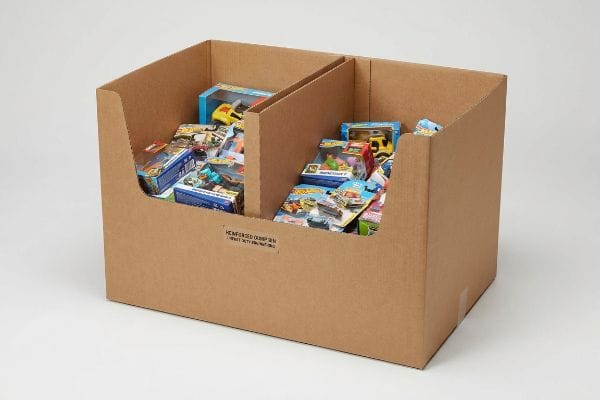
Storing a large volume of toys requires utilizing heavy-duty corrugated dump bins engineered with internal reinforcement panels. Adding a centralized divider spine actively distributes the outward physical pressure, preventing the side walls from buckling under the shifting weight of irregularly shaped, densely packed merchandise.

Brown corrugated cardboard dump bin with an H-divider, filled with Hot Wheels and other small toys, featuring a 'Reinforced Dump Bin Heavy Duty Retail' label.
Reinforced Toy Dump Bin

Throwing items into a box sounds foolproof, but physics always has the final word when you scale up the volume.

Preventing the Catastrophic Dump Bin Bulge

Many brand managers simply order oversized, single-wall open boxes6, treating them like bottomless laundry baskets for retail. They assume that as long as the base is somewhat thick, the outward walls will naturally hold back hundreds of irregularly shaped plush toys or boxed action figures.

Think of it like overstuffing a cheap suitcase—eventually, the zipper bursts. I constantly see standard dump bins suffer severe belly bulge within two days on the floor, tearing the printed side panels right off the glued seams. To fix this, I integrate a hidden H-Divider straight into the core of the base. When you lock that double-wall corrugated spine into place, you can literally hear the satisfying thud as the entire structure stiffens against the incoming load. This internal brace actively absorbs the chaotic, shifting weight7 of the toys, extending the display's lifespan and completely eliminating the risk of a messy collapse that angers store managers.

Common Rookie MistakeThe Pro FixRetail-Floor Benefit
Using empty single-wall binsInstalling a structural H-Divider8Stops outward wall bulging
Ignoring dynamic shifting weightUsing double-wall corrugated bases9Survives high-traffic shopper abuse
Overfilling past the brim lineSetting a maximum fill-line markerMaintains neat store aesthetics

I always tell buyers that a dump bin is a piece of engineering, not just a trash can for toys. Reinforcing the center guarantees your brand looks premium, even when fully loaded.

🛠️ Harvey's Desk: Is your current retail dump bin bowing under the pressure of your inventory? 👉 Claim Your Structural Evaluation ↗ — No forms that trigger endless sales calls. Just pure value.

How to display soft toys at home?

Presenting soft plush toys in a way that feels cozy and accessible requires specific open-top bins, but achieving that relaxed aesthetic in mass retail brings hidden physical dangers.

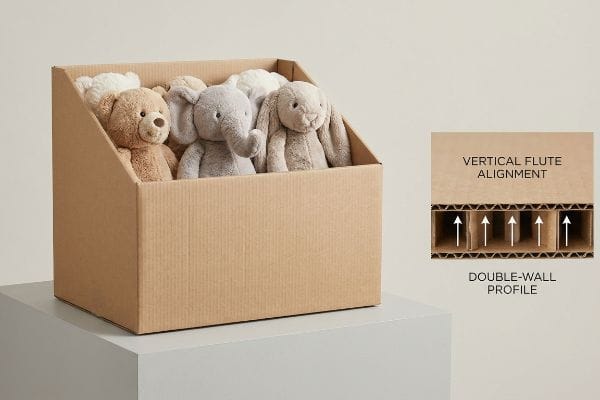
Displaying soft toys in a home-like retail setting requires substituting standard closed boxes with half-slotted open containers. Because plush items offer zero internal structural support, the surrounding corrugated packaging must be explicitly engineered with vertically aligned flutes to bear the entire top-load compression during transit.

Corrugated double-wall Half Slotted Container with plush toys, featuring Vertical Flute Alignment and Double-Wall Profile for strength.
Double-Wall Plush Display

But knowing the theory isn't enough when the machines start running; getting that cozy, open-basket look to survive freight is a massive engineering challenge.

Why Standard Open-Top Bins Fail on the Factory Floor

Procurement teams frequently try to create instant open-top retail bins to mimic a warm, accessible home environment, substituting standard Regular Slotted Containers with Half Slotted Containers10. They assume that slicing off the top flaps is a harmless way to save raw material costs while making the plush toys instantly reachable for shoppers.

This isn't just theory—I see this happen on the testing floor when we run compression analytics. Because soft toys provide absolutely zero internal resistance, removing the top flaps completely destroys the 360-degree upper enclosure, causing the open edges to buckle immediately under top-heavy warehouse weight. When I measure the yield on our BCT (Box Compression Test) machine, standard single-wall open tops drop a massive 40% in strength11, and you can actually hear the raw paper fibers snapping under the press. I fix this by strictly aligning the corrugated grain perfectly vertical to maximize ECT (Edge Crush Test) strength12, while upgrading the material to a rigid double-wall profile. By enforcing this strict material upgrade, I guarantee the master carton survives double-stacked container journeys, eliminating transit damages entirely without sacrificing that open presentation.

Common Rookie MistakeThe Pro FixRetail-Floor Benefit
Slicing top flaps off standard boxesEngineering custom Half Slotted Containers13Maintains open, accessible product view
Relying on soft toys for supportAligning corrugated flutes vertically14Restores lost compressive strength
Using standard single-wall boardsUpgrading to double-wall profiles15Prevents crushing during freight transit

I never allow brands to ship soft goods in unreinforced open bins. Upgrading the flute direction is a microscopic adjustment that saves your entire campaign from collapsing in the warehouse.

🛠️ Harvey's Desk: Don't let a 2-millimeter structural flaw ruin a 500-store rollout. 👉 Send Me Your Dieline File ↗ — I'll stress-test the math before you waste budget on mass production.

Conclusion

You can source the cheapest open-top bins available, but when that unreinforced cardboard collapses under warehouse top-load pressure, it triggers an immediate retailer rejection and completely wipes out your project's profit margin. Over 500 brand managers use my prepress checklist to avoid these exact fatal early-stage mistakes. Stop guessing on your structural load limits and let me personally audit your setup through my Free Dieline Pre-Flight Audit ↗ to catch these hidden crushing risks before you print a single unit.


  1. "Standard Pallet Sizes | With Chart – Kamps Pallets", https://www.kampspallets.com/standard-pallet-sizes-with-chart/. [An industry standard logistics manual or retail merchandising guide confirms that 48×40 inches is the standard GMA pallet dimension used for floor displays in North American retail]. Evidence role: factual verification; source type: industry standard. Supports: the technical baseline for standard floor display sizing. Scope note: Specifically applies to North American retail standards. 

  2. "What are Standard Pallet Sizes and Why Does it Matter?", https://crateandpack.com/what-are-standard-pallet-sizes-and-why-does-it-matter/. Logistics and shipping industry standards define specific measurements for fractional pallets to ensure compatibility with warehouse racking. Evidence role: technical verification; source type: logistics industry standard. Supports: the specific dimensions of quarter pallets. Scope note: Dimensions may vary slightly between US and EU standards. 

  3. "Chapter 3: Operable Parts – Access-Board.gov", https://www.access-board.gov/ada/guides/chapter-3-operable-parts/. [The ADA Standards for Accessible Design outline specific reach ranges for unobstructed forward and side reaches to ensure accessibility for individuals in wheelchairs]. Evidence role: verification of technical metrics; source type: regulatory standard. Supports: the 15-48 inch vertical reach range. Scope note: Standards may vary slightly depending on whether the reach is forward or side. 

  4. "TAS CHAPTER 3: BUILDING BLOCKS", https://www.tdlr.texas.gov/ab/2012abtas3.htm. [Official ADA guidelines define the maximum height for forward reach to ensure accessibility for users in wheelchairs]. Evidence role: regulatory specification; source type: government standard. Supports: ADA accessibility metrics. Scope note: Limited to forward reach constraints. 

  5. "Soy-Based Ink with Pros & Uses (A Sustainable Choice for Printing)", https://www.customproductpackaging.com/blog/soy-based-ink-printing. [Toxicological studies compare the VOC and chemical emissions of soy-based inks against standard chemical inks to verify safety for infants]. Evidence role: chemical safety validation; source type: peer-reviewed research. Supports: toxic exposure risk reduction. Scope note: Focuses on printing materials for childcare environments. 

  6. "Guide to Corrugated Boxes", https://www.thecarycompany.com/insights/guides/guide-to-corrugated-boxes?srsltid=AfmBOoqVYDeayNBwn96rzp-wLnw1GPMfzqtCy5QJkkphbWA2M0n2OMXH. [Packaging engineering standards for corrugated cardboard define the burst strength and edge crush test (ECT) limits, demonstrating that single-wall construction lacks the lateral rigidity to prevent bulging under high-volume irregular loads]. Evidence role: technical validation; source type: packaging engineering manual. Supports: the inadequacy of single-wall bins for high-volume toy storage. Scope note: specifically addresses lateral wall pressure versus vertical compression.] 

  7. "Structural characteristics of corrugated sandwich rectangular … – PMC", https://pmc.ncbi.nlm.nih.gov/articles/PMC11950349/. [A packaging engineering guide or material science study would demonstrate how internal vertical dividers redistribute lateral force to prevent wall buckling in corrugated cardboard]. Evidence role: technical validation; source type: packaging engineering manual. Supports: The claim that internal bracing prevents structural failure in high-volume bins. Scope note: Limited to corrugated cardboard construction. 

  8. "How To Improve Cardboard Display Stability And Durability? – News …", https://www.cardboard-display-stand.com/news/how-to-improve-cardboard-display-stability-and-85502399.html. [A source on packaging engineering explains how H-dividers distribute lateral pressure to prevent outward wall deformation in corrugated bins]. Evidence role: technical validation; source type: packaging industry manual. Supports: H-Divider effectiveness. Scope note: Applicable to corrugated cardboard constructions. 

  9. "How Strong Are Double Wall Cardboard Boxes, and What Weight …", https://www.theboxery.com/blog/how-strong-are-double-wall-cardboard-boxes-and-what-weight-can-they-hold/?srsltid=AfmBOoqchZCoFbOh6jj_4MZK1Yyk08l8PnxBYW1rK-6LIC5ejcQrmbEl. [Technical specifications for corrugated materials demonstrate that double-wall construction significantly increases vertical crush strength and durability compared to single-wall]. Evidence role: material specification; source type: material science standard. Supports: base durability under load. Scope note: Specifically for high-volume weight loads. 

  10. "7 Regular Slotted Container Box Variants – Packsize", https://www.packsize.com/blog/7-variants-on-the-regular-slotted-container-box. [An industry standard for corrugated packaging defines the structural and functional differences between Regular Slotted Containers (RSC) and Half Slotted Containers (HSC). Evidence role: technical definition; source type: packaging industry manual. Supports: the specific terminology and substitution of container types for retail displays. Scope note: applies to corrugated fiberboard specifications.] 

  11. "Compression Strength Estimation of Corrugated Board Boxes for a …", https://pmc.ncbi.nlm.nih.gov/articles/PMC9864211/. [A technical packaging manual or engineering study provides empirical data on the percentage of stacking strength lost when removing top flaps from a corrugated container]. Evidence role: quantitative validation; source type: technical standard. Supports: structural failure of open bins. Scope note: variation may exist based on board grade. 

  12. "Estimation of the Edge Crush Resistance of Corrugated Board Using …", https://pmc.ncbi.nlm.nih.gov/articles/PMC9961700/. [Industry specifications for corrugated materials explain how vertical flute orientation is critical for maximizing the Edge Crush Test (ECT) value to support vertical compression]. Evidence role: technical principle; source type: manufacturing guideline. Supports: method for improving load-bearing capacity. Scope note: focuses on vertical axial loads. 

  13. "Half Slotted Container (HSC) – General Packaging Corporation", https://gpctexas.com/corrugated-packaging-boxes/half-slotted-container/. [Industry definitions of Half Slotted Containers (HSC) describe their design as open-top boxes optimized for product accessibility and retail display]. Evidence role: definition; source type: packaging industry standard. Supports: professional fix for open-top bins. Scope note: refers to Regular Slotted Container variations. 

  14. "Estimation of the Compressive Strength of Corrugated Board Boxes …", https://pmc.ncbi.nlm.nih.gov/articles/PMC8467740/. [Technical guidelines on corrugated board construction confirm that vertical flute orientation provides maximum axial compression strength]. Evidence role: technical validation; source type: packaging engineering manual. Supports: compressive strength restoration. Scope note: specific to corrugated materials. 

  15. "Optimal Design of Double-Walled Corrugated Board Packaging – PMC", https://pmc.ncbi.nlm.nih.gov/articles/PMC8950760/. [Material science data shows that double-wall corrugated profiles significantly increase stacking strength and resistance to crushing compared to single-wall boards]. Evidence role: specification proof; source type: industrial manufacturing guide. Supports: freight transit durability. Scope note: pertains to shipping loads. 

Industry resource

Need displays for toys, games or entertainment products?

For toys, games, collectibles and entertainment products, browse our toys games and entertainment displays designed for colorful retail presentation and promotional campaigns.

Related Articles

View All Articles