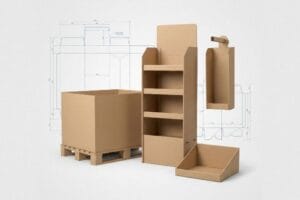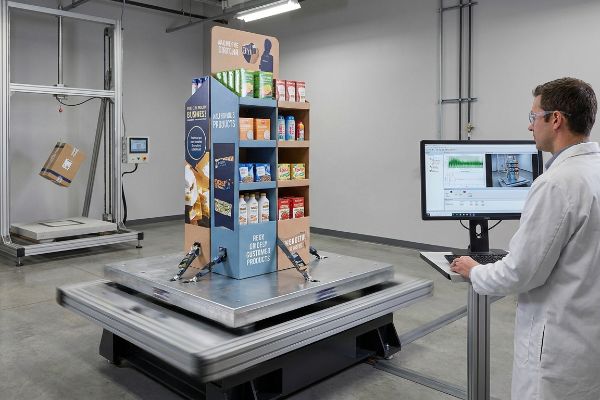
Shipping a fully loaded floor display across the country is a brutal physical gauntlet. Without rigorous transit validation, your retail campaign is just one pothole away from total collapse.
Testing an ISTA (International Safe Transit Association) standard validates the physical survival of your floor displays during global transit. The protocols simulate severe supply chain hazards, utilizing mechanical vibrations, atmospheric conditioning, and drop sequences to guarantee packaging integrity before merchandise ever reaches the retail destination.
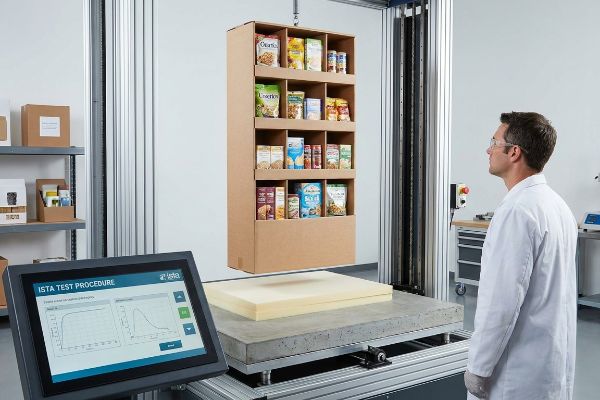
Bypassing these simulations isn't a cost-saving measure; it is a direct gamble with your total cost of ownership and retailer relationships.
What are the different types of ISTA tests?
Understanding the exact simulation protocol dictates whether your master carton survives the specific supply chain it travels through.
The different types of ISTA test protocols include the 1-Series for basic non-simulation integrity, the 3-Series for advanced general simulation, and the 6-Series for member-specific requirements like SIOC (Ships In Own Container). Selecting the correct tier depends entirely on your specific logistical routing and retailer mandates.
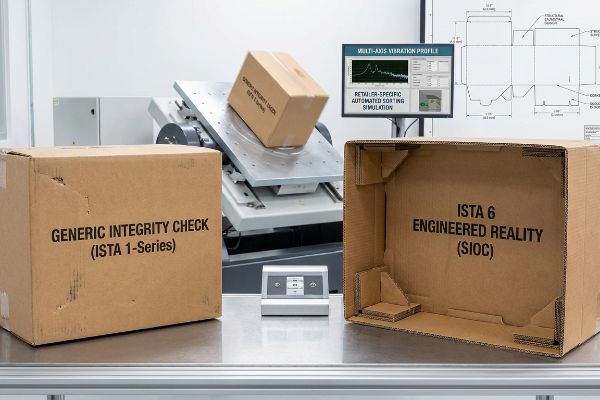
You cannot blindly apply a basic integrity check to a highly complex e-commerce or club store routing and expect survival.
The "SIOC vs. Standard Freight" Routing Reality
When I audit client dielines, I constantly see procurement teams requesting basic 1A testing1 for highly complex, multi-touch supply chains. They assume any certification stamp protects their pre-filled display trays. This theoretical assumption completely ignores the violent realities of modern omni-channel distribution.
This isn't just theory—I see this happen on the testing floor when a standard 1A-approved shipper2 gets routed through an automated fulfillment center. During my testing lab's vibration sequences, the standard corrugated flutes fatigue rapidly under multi-directional stress. To fix this, I completely redesign the CAD (Computer-Aided Design) structure to pass ISTA 6-Amazon standards3, utilizing a CNC (Computer Numerical Control) table to cut precise 0.75 inches (19.0 mm) internal structural corner buffers. By strictly enforcing this localized reinforcement, I ensure the packaging survives the exact mechanical sorting process without adding parasitic weight, reducing freight damage chargebacks by an estimated 40% and keeping the campaign profitable.
| Metric/Feature | Generic Integrity Check | ISTA 6 Engineered Reality |
|---|---|---|
| Vibration Profile | Fixed displacement | Random multi-axis |
| Testing Scope | Basic handling | Retailer-specific automated sorting |
| Financial Impact | High chargeback risk | Freight penalty elimination |
I refuse to let brands guess their routing survival. If you don't engineer specifically for the exact sorting machinery your product will face, your master carton is a financial liability.
🛠️ Harvey's Desk: Are your master cartons actively failing retailer-specific sorting requirements before they even reach the dock? 👉 Get a Free Transit Compliance Audit ↗ — I review every structural file personally within 24 hours.
What is the difference between ISTA and ASTM testing?
Engineers rely on distinct validation frameworks to separate raw material strength from total system performance.
The primary difference between ISTA and ASTM (American Society for Testing and Materials) testing is scope. ASTM focuses on standardized material property evaluations, such as corrugated board crush strength. Conversely, ISTA protocols evaluate the total performance of the fully packed system during simulated transit conditions and mechanical handling.
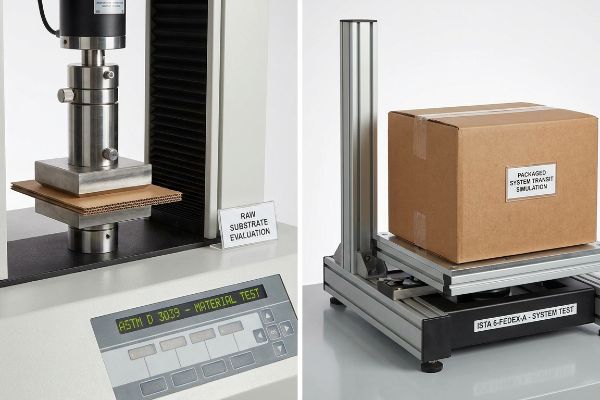
Knowing the theoretical limit of a paper fiber means nothing if the assembled box geometry fails under kinetic stress.
The "Component vs. System" Engineering Mechanics
To properly engineer a heavy retail merchandiser, we must utilize both frameworks in a specific sequence. The ASTM provides the foundational metrics for the raw substrates we select. For example, we use ASTM protocols to verify the exact TAPPI T811 ECT (Edge Crush Test) rating of a virgin kraft linerboard4 before it is ever cut or folded.
Once the raw material limits are mathematically verified, we shift to the system-level validation. This is where the fully loaded, 185 lbs (83.9 kg) master carton undergoes kinetic evaluation5. We use these simulated transit environments to observe how the individual ASTM-verified materials interact as a unified geometry under dynamic load. If the raw board is strong but the interlocking tabs shear under rotational torque, the system fails. By combining material science with transit simulation, we systematically guarantee both the structural integrity of the substrate and the logistical survival of the finished campaign.
| Framework | Testing Focus | Engineering Output |
|---|---|---|
| ASTM Standard | Raw material properties | Substrate ECT/Mullen rating6 |
| ISTA Standard | Full packaged system7 | Supply chain survival verification8 |
| Application | Board specification | Logistics and freight approval |
I never let material specifications mask a poorly designed structure. You need robust substrate metrics to build the foundation, but only full-system simulation proves it can survive the physical world.
🛠️ Harvey's Desk: Is your current display relying entirely on raw material stats while ignoring how the assembled unit behaves under physical freight stress? 👉 Request a Structural Systems Review ↗ — 100% confidential. Your unreleased retail designs are safe with me.
What is the purpose of ISTA testing?
Proving a design on a computer screen is useless if it shatters inside an ocean container.
The purpose of ISTA testing is to proactively expose and eliminate packaging vulnerabilities before physical distribution begins. By mathematically simulating kinetic shocks, vibrations, and compression forces, engineers can validate that the structure will fully protect the merchandise and survive the exact logistical environment it will encounter.
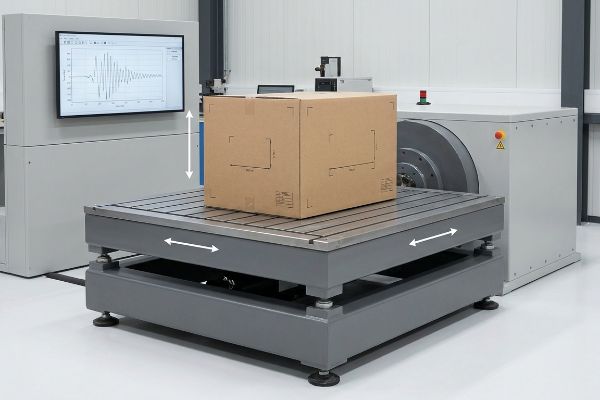
We don't simulate these environments to generate paperwork; we do it to mathematically prevent catastrophic cargo failure.
The "Dynamic Compression" Validation Protocol
The primary objective of subjecting a packed display to simulated transit environments is to identify hidden geometric weaknesses under dynamic top-load stress9. A perfectly stationary warehouse pallet behaves entirely differently10 than a pallet experiencing multi-axis kinetic vibration inside a moving semi-truck.
During prolonged transit, continuous low-frequency vibrations force the corrugated flutes to absorb micro-impacts, which physically exhausts the paper fibers. The simulation exposes exactly when and where this fatigue compromises the BCT (Box Compression Test) strength of the master shipper. If the structural alignment is slightly off-axis, the simulation will reveal a rapid bowing effect in the lower tiers. By deliberately inducing these exact environmental stresses in a controlled laboratory, structural engineers can mathematically recalibrate the internal flute directions or add load-bearing inserts before the mass production run, guaranteeing safe arrival.
| Testing Objective | Unvalidated Risk | Engineered Validation |
|---|---|---|
| Vibration Exposure | Invisible flute fatigue | Verified kinetic endurance |
| Dynamic Load | Lower-tier BCT collapse | Sustained vertical alignment |
| Logistical Goal | Costly retailer chargebacks | Frictionless warehouse receiving |
I utilize these protocols strictly to eliminate variables. When you validate the physical geometry against the actual forces of the shipping channel, you remove hope from the logistics equation.
🛠️ Harvey's Desk: Are your multi-tiered pallet shipments vulnerable to hidden compression fatigue during long-haul transit? 👉 Claim a Freight Density & Stress Audit ↗ — No account managers in the middle. You talk directly to structural engineers.
What is the ISTA 3A test?
Small parcel delivery networks subject individual displays to a highly chaotic, multi-touch environment.
The ISTA 3A test is an advanced general simulation designed specifically for packaged products shipped via small parcel delivery systems. It mathematically replicates the aggressive shocks, random multi-axis vibrations, and multi-directional drops inherent to carrier networks, ensuring individual parcels weighing under 150 lbs (68.0 kg) survive courier handling.

Surviving a dedicated LTL (Less-Than-Truckload) freight run is entirely different than surviving the relentless sorting chutes of a parcel carrier.
The "Small Parcel" Shock Absorption Mechanics
When engineering displays that will be drop-shipped directly to individual retail franchisees or field agents, the testing methodology must reflect the chaotic handling of small parcel networks. This specific simulation focuses heavily on sudden impact velocity rather than just static pallet compression11.
The protocol requires a rigorously sequenced series of free-fall drops impacting multiple specific faces, edges, and corners12 of the master carton. Because courier networks rely on high-speed conveyor chutes and manual tossing, the internal kinetic energy transfer during a corner impact is severe. Engineers utilize this exact drop sequence to measure how effectively the internal void-fill or crumpled air-cell buffers decelerate the merchandise. By calibrating the internal deceleration zones against these specific simulated impacts, we ensure the fragile retail display inside the shipper remains perfectly square and undamaged, regardless of how violently the courier handles the outer box.
| Test Parameter | Supply Chain Threat | Mechanical Validation |
|---|---|---|
| Free-Fall Drops | Sudden kinetic shock | Calibrated deceleration zones13 |
| Corner Impacts | Internal structural shear14 | Rigid geometric squaring |
| Target Delivery | High damage ratios15 | Guaranteed parcel survival |
I strictly align the packaging architecture to the courier's reality. A master carton that survives standard palletization will still shatter in a parcel network without specific shock deceleration engineering.
🛠️ Harvey's Desk: Are your individually shipped counter displays arriving at retail franchises with crushed corners and torn headers? 👉 Get a Shock Mitigation Blueprint ↗ — I review every structural file personally within 24 hours.
Conclusion
By mastering the kinetic mechanics of ISTA simulations, we completely eliminate the risk of dynamic BCT collapse and hidden flute fatigue destroying your campaign during transit. Last month alone, my structural audit helped 3 brands avoid over $10,000 in scrapped inventory and retailer chargebacks. If you are launching a complex omni-channel campaign, let me personally run your structural files through my Free Transit Stress & Dieline Audit ↗ to guarantee your retail footprint survives the supply chain intact.
"[PDF] 1A2 – International Safe Transit Association", https://ista.org/docs/1Aoverview.pdf. [Official ISTA documentation outlines the specific stress tests and constraints of the 1A protocol, confirming its status as a basic integrity test rather than a full simulation]. Evidence role: technical definition; source type: industry standard. Supports: the characterization of 1A testing. Scope note: limited to 1-Series standards. ↩
"Test Procedures – International Safe Transit Association", https://ista.org/test_procedures.php. [The official ISTA 1-Series documentation defines the basic integrity and non-simulation testing requirements used to approve standard shippers]. Evidence role: technical verification; source type: industry standard documentation. Supports: the definition of baseline ISTA 1A testing. Scope note: Applies to general integrity rather than environmental simulation. ↩
"[PDF] 6-amazon.com-sioc – International Safe Transit Association", https://ista.org/docs/6AmazoncomSIOCOverview.pdf. [Authoritative ISTA and Amazon packaging guidelines detail the specific simulation protocols required for Ships In Own Container (SIOC) compliance within automated fulfillment networks]. Evidence role: technical specification; source type: industry standard. Supports: the existence of member-specific testing requirements for Amazon logistics. Scope note: Specific to the 6-Amazon protocol. ↩
"Edgewise compressive strength of corrugated fiberboard (short …", https://imisrise.tappi.org/TAPPI/Products/01/T/0104T811.aspx. [An authoritative technical standard from TAPPI or ASTM would define the specific testing procedure and requirements for measuring the Edge Crush Test (ECT) of linerboard]. Evidence role: technical specification; source type: industry standard. Supports: verification of raw material strength. Scope note: focuses on corrugated board properties. ↩
"ISTA Packaging Testing – Intertek", https://www.intertek.com/performance-testing/packaging/ista/. [Industry standards for transit testing specify the weight thresholds and kinetic evaluation protocols used to validate system-level performance]. Evidence role: technical specification; source type: industry standard. Supports: specific mass-based kinetic testing requirements. Scope note: weight parameters vary based on ISTA test series. ↩
"Bursting Weight of Corrugated Box: Complete Guide to Ratings …", https://redstagfulfillment.com/bursting-weight-of-corrugated-box/. Authoritative ASTM standards define the specific test methods for Edge Crush Test (ECT) and Mullen burst strength to quantify raw material properties. Evidence role: technical specification; source type: industry standard. Supports: ASTM's focus on raw material strength. Scope note: Specifically relates to corrugated board substrates. ↩
"[PDF] Guidelines for Selecting and Using ISTA® Test Procedures and …", https://ista.org/docs/ISTA_2017_Guidelines.pdf. ISTA protocols require testing the entire packaging assembly, including the product and internal cushioning, to validate system integrity. Evidence role: methodology verification; source type: industry standard. Supports: The distinction between system-level and component-level testing. Scope note: Focuses on the integrated unit rather than raw materials. ↩
"[PDF] 3K2 – International Safe Transit Association", https://ista.org/docs/3Koverview.pdf. ISTA standards employ simulated transport environments (vibration, shock, compression) to verify that a package survives the distribution cycle. Evidence role: outcome validation; source type: industry standard. Supports: ISTA's role in logistics and freight approval. Scope note: Limited to distribution environment simulation. ↩
"[PDF] 2B2 – International Safe Transit Association", https://ista.org/docs/2Boverview.pdf. [Authoritative packaging standards like ISTA describe how dynamic compression tests reveal structural failures that static tests miss]. Evidence role: technical validation; source type: industry standard. Supports: identification of geometric weaknesses. Scope note: specifically for packed displays. ↩
"3 Most Important Pallet Tests | Nelson Company Blog", https://www.nelsoncompany.com/blog-post-3-most-important-pallet-tests.cfm. [Research in logistics engineering demonstrates that multi-axis vibration significantly reduces the effective load-bearing capacity of pallets compared to static storage]. Evidence role: empirical proof; source type: academic research. Supports: the premise that transit environments differ from storage. Scope note: focuses on vibration-induced fatigue. ↩
"[PDF] 3A 2 – International Safe Transit Association", https://ista.org/docs/3Aoverview.pdf. [Technical specifications from the ISTA 3A standard will confirm the focus on dynamic impact velocity to simulate parcel handling]. Evidence role: technical specification; source type: industry standard. Supports: the specific mechanics of the ISTA 3A simulation. Scope note: limited to the ISTA 3A test protocol. ↩
"What orientation should my packaged-product be placed in when …", https://support.ista.org/portal/en/kb/articles/what-orientation-should-my-packaged-product-be-placed-in-when-identifying-its-faces-edges-and-corners-for-ista-3a. [The ISTA 3A standard defines the mandatory sequence and orientation of free-fall drops to simulate the stresses of small parcel delivery]. Evidence role: verification; source type: technical standard. Supports: specific drop sequence requirements. Scope note: limited to parcels under 150 lbs. ↩
"ISTA 3A Packaging Test Procedure: A Complete Step-by-Step Guide", https://www.itm-lab.com/article/ista-3a-packaging-test-procedure-a-complete-step-by-step-guide.html. An authoritative packaging standard describes how deceleration zones are engineered to mitigate G-force peaks during free-fall drops. Evidence role: technical specification; source type: industry standard. Supports: shock absorption mechanics. Scope note: Limited to ISTA 3A compliant materials. ↩
"Multi-Load Topology Optimization Design for the Structural Safety …", https://pmc.ncbi.nlm.nih.gov/articles/PMC11356512/. Materials science literature explains how non-axial loads during corner impacts induce shear stress in internal components. Evidence role: technical explanation; source type: academic paper. Supports: mechanical validation of corner impacts. Scope note: specifically regarding rigid internal frames. ↩
"Trends in parcel delivery driver injury: Evidence from NEISS-Work", https://pmc.ncbi.nlm.nih.gov/articles/PMC11850030/. Logistic industry data provides empirical evidence of damage rates in small parcel networks that drive the need for rigorous shock testing. Evidence role: statistical evidence; source type: industry report. Supports: supply chain threat analysis. Scope note: Data varies by carrier and product fragility. ↩