
Mastering retail compliance is critical. A single missed regulation triggers pallet rejections and destroys ROI. Let us explore what your packaging must do to survive.
Packaging must fulfill strict functional and regulatory mandates. It protects goods during transit, communicates brand messaging, ensures consumer safety, optimizes logistical spatial volume, and meets legal environmental compliance. A successful structure bridges structural engineering with regional merchandising laws to prevent catastrophic retail chargebacks.

Theory looks great in a PDF file, but let's step onto the factory floor and see how these mandates actually dictate physical engineering realities.
What Are the 5 Requirements of Packaging?
Understanding the core rules of retail merchandising separates successful brand rollouts from costly warehouse disasters.
The five requirements of packaging dictate that it must protect the product, optimize logistics, communicate brand value, ensure consumer safety, and comply with environmental laws. These interconnected pillars guarantee that a corrugated structure physically survives transit while seamlessly integrating into specific retail environments.
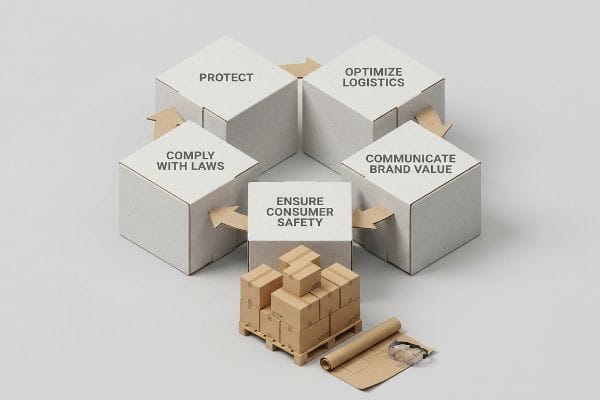
Most designers memorize these pillars quickly, but they fail to balance them mechanically when the production budget gets tight.
The Danger of the 4 C's Imbalance in Packaging Requirements
Even veteran procurement teams often rely on the 4 C's framework—Cost, Concept, Convenience, Communication1—alongside strict compliance mandates. They assume that as long as the initial unit cost is low, the other pillars will naturally fall into place during mass production. This leads them to isolate and obsess strictly over the primary financial metric, hollowing out structural board grades to save a few pennies upfront.
I see this happen constantly when brands try to scale down to a cheaper paperboard without adjusting the structural math. The physical concept buckles under heavy pallet weight, and assembly convenience is completely ruined by distorted locking tabs. I once watched a 3PL (Third-Party Logistics) worker sweating on the warehouse floor, trying to force a lightweight, warped display tray together. The tearing sound of raw paperboard echoed as the structural tab blew out because the downgraded material could not handle the friction. By mandating a unified assessment that mathematically links the structural cost directly to downstream supply chain convenience, I enforce a frictionless assembly that drops co-packing time by 45 seconds per unit2, completely avoiding massive retailer chargebacks.
| Common Rookie Mistake | The Pro Fix | Retail-Floor Benefit |
|---|---|---|
| Downgrading board grade for cost | Unified 4 C's ROI assessment | Stops structural buckling3 |
| Ignoring assembly friction | Precision locking tabs | Saves 45s per unit4 |
| Sacrificing compliance for design | Integrated material tracking | Prevents retailer rejection5 |
I refuse to let procurement teams blindly strip out structural integrity just to hit a spreadsheet target. Balancing the fundamental requirements upfront is the only way I guarantee your campaign survives both transit and the harsh retail environment.
🛠️ Harvey's Desk: Are your cost-cutting measures secretly destroying your assembly convenience? 👉 Get a Free Dieline Audit ↗ — Direct access to my desk. Zero automated sales spam, I promise.
What Are the Main Industry Standards for Packaging?
Deciphering the alphabet soup of testing protocols can paralyze a new brand, but choosing the wrong validation standard is far worse.
The main industry standards for packaging include TAPPI (Technical Association of the Pulp and Paper Industry), ASTM (American Society for Testing and Materials), and ISTA (International Safe Transit Association). These frameworks evaluate raw material strength, kinetic transit survivability, and environmental compliance across global retail supply chains.
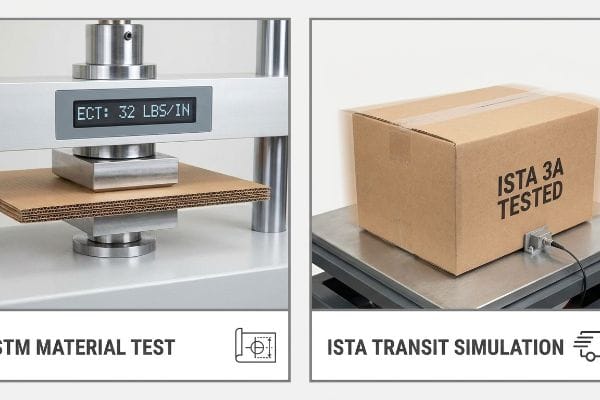
Knowing the acronyms is one thing, but applying the correct validation protocol to a fully loaded display is where most supply chains fail.
The ASTM vs. ISTA Testing Fallacy in Packaging Standards
Procurement teams frequently rely on ASTM material certifications, such as the TAPPI T811 ECT (Edge Crush Test)6, to guarantee their corrugated displays will survive transit. They look at a high structural rating on a flat sheet of board and falsely assume this theoretical density automatically translates to a structurally sound retail merchandiser. They completely ignore that ASTM protocols strictly evaluate flat, unassembled raw boards7 in static lab environments.
Relying solely on flat raw material specifications creates a false sense of security that inevitably results in catastrophic box failures during live freight movement. A client once brought me a display that passed static flat-board tests but completely pancaked during LTL (Less-Than-Truckload) shipping. When I recreated their design on my kinetic vibration table, I watched the heavy merchandise shift; you could literally feel the low, grinding vibration tear the weakened corners apart because the assembled 3D geometry could not displace kinetic shock. By mandating a dual-standard protocol that pairs raw ASTM baselines with full ISTA 3A dynamic transit simulations8, I guarantee the structural geometry successfully bridges the gap between theoretical material strength and real-world supply chain survival.
| Common Rookie Mistake | The Pro Fix | Retail-Floor Benefit |
|---|---|---|
| Trusting flat board ECT only | ISTA 3A kinetic testing9 | Eliminates transit damages |
| Ignoring assembled geometry | 3D dynamic load simulations10 | Ensures safe double-stacking |
| Skipping kinetic shock tests | Dual-standard validation11 | Prevents retailer chargebacks |
I never trust a flat sheet of cardboard to tell me how a fully loaded display will behave on a fast-moving truck. You have to subject the finished geometry to brutal kinetic reality before you commit to mass manufacturing.
🛠️ Harvey's Desk: Are you banking your entire Q4 rollout on a flat-board compression test that ignores transit vibration? 👉 Request a Transit Strategy Guide ↗ — Download safely. My inbox is open if you have questions later.
How Do You Ensure Compliance with Industry Regulations?
Big-box sustainability mandates are not mere suggestions; they are rigid legal gateways strictly enforcing entry to the retail floor.
To ensure compliance with industry regulations, manufacturers must strictly implement closed-loop traceability protocols, mandate certified raw material sourcing, and utilize continuous diagnostic testing. This proactive documentation guarantees environmental claims are legally verifiable, preventing devastating retail audits and safeguarding global supply chain integrity.

Claiming your display is eco-friendly on a marketing pitch is easy, but surviving a rigid retail compliance audit requires a flawless paper trail.
Beating the Traceability Trap for Packaging Regulations
Brand managers frequently assume that simply requesting FSC (Forest Stewardship Council) certified cardboard12 from a supplier automatically guarantees compliance with big-box sustainability mandates. They treat sustainability like a basic checklist item, trusting that a verbal confirmation or a generic logo on a PDF is enough to satisfy corporate ESG (Environmental, Social, and Governance) targets. They ignore the mechanical reality of factory operations, where certified boards can easily be mixed with untraceable, low-grade paperboard13 on a busy production floor.
Without a verified Chain of Custody tracking system14, brands cannot legally prove their material's origin, which triggers immediate failures during strict environmental audits. I had a frantic client call me after their displays were held at the loading dock because their previous vendor couldn't produce the mill logs. I walked through that disorganized facility and saw fresh kraft sheets sitting right next to unverified stock—the distinct dusty smell of mixed pulp was a dead giveaway that cross-contamination had occurred. I immediately enforced absolute raw material segregation and centralized sourcing logs, maintaining an unbroken paper trail from the initial mill to the final die-cut display, effectively neutralizing the compliance risk and guaranteeing seamless retailer receiving.
| Common Rookie Mistake | The Pro Fix | Retail-Floor Benefit |
|---|---|---|
| Assuming verbal FSC compliance | Unbroken Chain of Custody15 | Passes rigid retail audits |
| Mixing certified and raw board | Factory floor material segregation16 | Prevents dock-level rejections |
| Lacking verifiable mill logs | Centralized sourcing documentation17 | Protects brand ESG integrity |
I don't deal in verbal sustainability promises or unverified greenwashing. If you cannot trace the paper fiber back to the specific mill that produced it, your entire retail campaign is a massive liability waiting to happen.
🛠️ Harvey's Desk: Are you entirely sure your current supplier isn't mixing untraceable testliner into your certified displays? 👉 Claim Your Factory Sourcing Audit ↗ — No forms that trigger endless sales calls. Just pure value.
What Are the Legal Requirements for Packaging?
Missing a legal labeling requirement doesn't just result in a polite warning; it stops your product dead at the distribution center.
The legal requirements for packaging dictate mandatory federal labeling data, exact hazardous material warnings, and specific spatial compliance. These binding laws ensure absolute consumer safety, prevent false advertising, and guarantee product origin transparency, making strict prepress verification mandatory before mass production begins.

But knowing the theory isn't enough when the machines start running; federal compliance requires physical precision on the structural dieline.
Why Standard Legal Labeling Fails on the Factory Floor
Premium wine and beverage brands frequently design retail-ready packaging and corrugated displays that fail to duplicate critical federal labeling data, assuming secondary marketing boxes are exempt from primary bottle laws. They trust their graphic designers to handle the text layout, mistakenly believing that a beautiful brand aesthetic can override the strict TTB (Alcohol and Tobacco Tax and Trade Bureau) mandates. They ignore the 75-85-95 rule18, which dictates that if a vintage or varietal is advertised on the outer box, it must legally guarantee those exact grape thresholds.
In my facility, I routinely see beautifully printed master cartons rejected instantly because the structural folds physically obscure the mandatory compliance text. When I measure the folded retaining lips on these generic dielines, they often overlap the 75% varietal claim19 by exactly 0.5 inches (12.7 mm). The smooth, waxy feel of the printed flap might look premium, but when it hides federal data, the entire shipment faces a compliance hold that completely halts the supply chain. I pulled the micrometer readings and proved we didn't need to shrink the artwork; I just engineered a custom die-cut swoop directly into the retaining lip to guarantee 100% unobstructed visibility of the varietal claim. By enforcing this precise prepress geometry, I ensure frictionless legal receiving and save clients an estimated 30% in potential rework and logistics delay penalties.
| Common Rookie Mistake | The Pro Fix | Retail-Floor Benefit |
|---|---|---|
| Ignoring secondary packaging laws | TTB data mirror protocol20 | Avoids federal compliance holds |
| Obscuring text with folded flaps | Die-cut retaining lip swoop21 | 100% visibility of legal claims |
| Treating compliance as just text | Prepress geometry mapping22 | Guarantees seamless 3PL receiving |
I engineer displays to sell product, but my primary job is keeping you out of legal purgatory. If your die-cut flap covers even a fraction of a federal mandate, your entire production run is immediately rendered useless.
🛠️ Harvey's Desk: Do you know if your current dieline's fold radius physically obscures your mandatory compliance data? 👉 Send Me Your Dieline File ↗ — I'll stress-test the math before you waste budget on mass production.
Conclusion
You can choose a vendor who ignores the physical reality of transit compliance, but when your untested structure collapses on a kinetic vibration table and destroys your inventory, you will face an immediate retailer rejection and weeks of costly manual rework. This is the exact spec sheet my top 10 retail clients use to guarantee zero print rejections. Stop guessing on regulatory tolerances and let me personally run your files through my Free Compliance and Dieline Audit ↗ to catch fatal legal and structural errors before production begins.
"How the 4 C's of Packaging Drive Business Growth", https://www.linkedin.com/posts/gauravchheda-thebaxsaaco_what-are-the-4-cs-of-packaging-the-baxsaa-activity-7307752054314229762-sr8h. Verification of the 4 C's as a recognized industry standard for evaluating packaging and retail procurement. Evidence role: Definition/Framework validation; source type: Professional procurement manual or retail merchandising guide. Supports: The specific components of the procurement model mentioned. Scope note: Framework terms may vary slightly across different industry sectors. ↩
"How Structural Packaging Design Reduces Waste and Costs", https://www.bcipkg.com/how-structural-packaging-design-reduces-waste-and-costs/. Brief explanation of how industry benchmarks or logistical case studies correlate packaging structural improvements with specific reductions in assembly time. Evidence role: quantitative verification; source type: logistics industry report or operational case study. Supports: The efficiency gain claim regarding co-packing speed. Scope note: actual time savings vary based on SKU complexity. ↩
"The Role of Buckling in the Estimation of Compressive … – PMC", https://pmc.ncbi.nlm.nih.gov/articles/PMC7602429/. Engineering guidelines on corrugated board grades and their relationship to structural failure and buckling under compression loads. Evidence role: technical verification; source type: packaging engineering handbook. Supports: the link between board grade and structural integrity. Scope note: depends on load weight and stacking height. ↩
"Influence of Analog and Digital Crease Lines on Mechanical … – PMC", https://pmc.ncbi.nlm.nih.gov/articles/PMC9268991/. Authoritative manufacturing or logistics study demonstrating the time saved per unit when implementing precision locking mechanisms. Evidence role: quantitative validation; source type: industry whitepaper or operational study. Supports: efficiency gains of precision locking tabs. Scope note: may vary by packaging complexity. ↩
"FSMA Final Rule on Requirements for Additional Traceability Records – FDA", https://www.fda.gov/food/food-safety-modernization-act-fsma/fsma-final-rule-requirements-additional-traceability-records-certain-foods. Retailer compliance manuals outlining the necessity of material tracking and documentation to avoid shipment rejection during intake. Evidence role: regulatory validation; source type: retail vendor manual. Supports: role of integrated tracking in retail acceptance. Scope note: varies by specific retailer guidelines. ↩
"Full-Field Measurements in the Edge Crush Test of a … – PMC", https://pmc.ncbi.nlm.nih.gov/articles/PMC8199211/. Verification of the TAPPI T811 standard's methodology for determining the Edge Crush Test (ECT) value of corrugated board. Evidence role: technical specification; source type: industry standard. Supports: the specific test used for material strength. Scope note: applies specifically to corrugated materials. ↩
"Paper Standards and Packaging Standards", https://store.astm.org/products-services/standards-and-publications/standards/paper-standards-and-packaging-standards.html. Confirmation that ASTM material testing protocols focus on raw substrate properties rather than assembled product transit performance. Evidence role: methodology verification; source type: technical manual. Supports: the distinction between material and system testing. Scope note: focuses on ASTM raw material certifications. ↩
"Test Procedures – International Safe Transit Association", https://ista.org/test_procedures.php. Verification that combining ASTM raw material specifications with ISTA 3A dynamic testing is the industry-standard protocol for validating structural integrity in shipping. Evidence role: validation; source type: technical standard. Supports: a dual-standard testing methodology. Scope note: focused on the transition from material strength to system survivability. ↩
"Getting Started with Design & Testing – International Safe Transit Association", https://www.ista.org/getting_started_with_design.php. Verification that ISTA 3A protocols simulate real-world transport conditions to validate packaging durability beyond static Edge Crush Test (ECT) measurements. Evidence role: validation; source type: industry standard; Supports: use of kinetic testing for transit damage prevention. Scope note: Applies specifically to parcel delivery systems. ↩
"Quantitative Analysis of the Compressive Stress Distributions …", https://www.unitload.vt.edu/content/dam/unitload_vt_edu/graduate-research-and-subpages-pictures-and-docs/thesis-and-dissertations-/Yoo%20-%20ETD%20-%20Quantitative%20Analysis%20of%20the%20Compressive%20Stress%20Distributions%20Across%20Pallet%20Decks%20Supporting%20Packaging%20in%20Simulated%20Warehouse%20Storage.pdf. Documentation of how Finite Element Analysis (FEA) or dynamic simulations account for assembled geometry to predict stacking stability and collapse thresholds. Evidence role: technical verification; source type: engineering whitepaper; Supports: efficacy of simulations for double-stacking safety. Scope note: Results vary by material and software used. ↩
"Retail Packaging Testing for Big-Box Compliance", https://www.intertek.com/performance-testing/packaging/retail-compliance/. Industry guidelines showing how combining ASTM and ISTA standards minimizes failure rates and avoids retail penalty fees for damaged goods. Evidence role: corroboration; source type: logistics manual; Supports: prevention of retailer chargebacks. Scope note: Dependent on specific retailer requirements. ↩
"Paper & Packaging", https://fsc.org/en/businesses/paper-packaging. An authoritative source defines the FSC certification standards and their role in meeting corporate ESG and retail sustainability requirements. Evidence role: technical standard; source type: industry certification body. Supports: the use of FSC certification as a benchmark for compliance. Scope note: specifically focuses on forest-based packaging. ↩
"Group Chain of Custody (CoC) FSC Certification Manual", https://cfwc.mgcafe.uky.edu/sites/cfwc.ca.uky.edu/files/cfwc_coc_group_certification_manual_revised_2_16_2018_0.pdf. External evidence from supply chain audits explains the risks of material contamination and the failures of 'Chain of Custody'protocols on production floors. Evidence role: operational risk analysis; source type: supply chain audit report. Supports: the claim that simple certification requests are insufficient without traceability. Scope note: applies to high-volume manufacturing environments. ↩
"Chain of Custody Certification", https://fsc.org/en/chain-of-custody. Explanation of how Chain of Custody (CoC) standards, such as FSC or PEFC, provide the legally recognized framework for verifying the origin of raw materials. Evidence role: technical verification; source type: regulatory standard. Supports: the claim that CoC is essential for passing environmental audits. Scope note: Primarily applies to certified sustainable forestry and recycled content claims. ↩
"Inside the FSC Chain of Custody | Traceable Packaging", https://ecopulppack.com/inside-the-fsc-chain-of-custody-how-responsible-packaging-is-traced-and-verified/. Explanation of how the Forest Stewardship Council (FSC) Chain of Custody standard ensures material traceability from forest to retail floor. Evidence role: technical standard; source type: industry certification body. Supports: necessity of CoC for passing retail audits. Scope note: Specific to FSC and similar traceability standards. ↩
"Certified vs. Non-Certified Packaging: When and Why to Use Them", https://en.overpack.it/news/certified-vs-non-certified-packaging-when-to-use.html. Detailing the technical requirement to physically separate certified and non-certified materials to maintain certification integrity. Evidence role: operational requirement; source type: quality management standard. Supports: prevention of material mixing and dock-level rejections. Scope note: Applicable to sustainable packaging certifications. ↩
"Why Traceability Is Becoming the Backbone of EU …", https://www.3rsustainability.com/traceability-eu-packaging-regulation/. Verification of how sourcing logs from mills provide the audit trail required for Environmental, Social, and Governance (ESG) reporting. Evidence role: compliance requirement; source type: regulatory/ESG framework. Supports: protection of brand ESG integrity. Scope note: Focuses on traceability logs. ↩
"Wine Labeling: Appellation of Origin", https://www.ttb.gov/regulated-commodities/beverage-alcohol/wine/labeling-wine/wine-labeling-appellation-of-origin. Verification of the TTB's specific percentage requirements for varietal and vintage labeling on wine packaging. Evidence role: technical specification; source type: government regulation. Supports: the legal necessity of grape thresholds on outer packaging. Scope note: Applies specifically to US wine labeling laws. ↩
"Grape Variety Designations on American Wine Labels | TTB", https://www.ttb.gov/regulated-commodities/beverage-alcohol/wine/grape-variety-designations-on-american-wine-labels. Verification of the legal percentage threshold required for a product to make a specific varietal claim on packaging labels. Evidence role: technical verification; source type: regulatory agency. Supports: the necessity of unobstructed visibility for mandatory compliance data. Scope note: specific to alcoholic beverage or agricultural labeling laws. ↩
"Labeling Resources | TTB – Alcohol and Tobacco Tax and Trade Bureau", https://www.ttb.gov/regulated-commodities/labeling/labeling-resources. Verification of the TTB's specific requirements for mirroring mandatory data on secondary packaging to prevent shipment holds. Evidence role: technical verification; source type: government regulation. Supports: The use of a specific data protocol for federal compliance. Scope note: Limited to alcohol and tobacco regulated products. ↩
"Custom Die Cut Labels That Elevate Shelf Appeal and Brand Identity", https://inovarpackaging.com/custom-die-cut-labels-that-elevate-shelf-appeal-and-brand-identity/. Technical confirmation of the 'retaining lip'design feature used in die-cutting to ensure flaps do not obscure legal text. Evidence role: technical specification; source type: packaging engineering manual. Supports: The claim that specific die-cut geometry ensures 100% label visibility. Scope note: Applicable to folding carton packaging. ↩
"What is Packaging PrePress? A Complete Overview", https://www.esko.com/en/blog/the-complete-overview-of-packaging-prepress. Explanation of how geometry mapping in the prepress phase aligns label placement with physical packaging dimensions to ensure automated 3PL scanning. Evidence role: technical specification; source type: industry whitepaper. Supports: The link between prepress mapping and seamless 3PL receiving. Scope note: Focused on automated logistics environments. ↩