
Brands often waste thousands launching products, assuming basic shipping boxes survive harsh shelves. The truth? Untested retail packaging quietly destroys your profit margins before customers even see it.
Ideal products for SRP (Shelf-Ready Packaging) and RRP (Retail-Ready Packaging) include fast-moving consumer goods, cosmetics, and pre-packaged foods. These high-turnover items require durable corrugated materials, optimized visibility, and fast restocking designs to maximize shelf impact and minimize retail labor costs.

Knowing which products fit these formats is just the start; the real challenge is engineering them to survive the factory and the freight line.
What Is an Srp in Packaging?
Many procurement teams assume they can just chop the top off a standard box and call it shelf-ready.
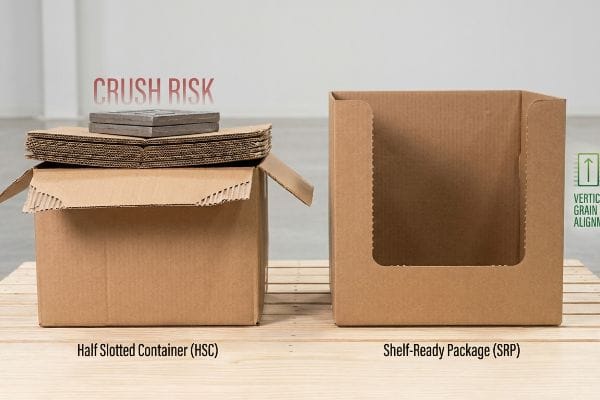
An SRP (Shelf-Ready Packaging) is a specialized transit container designed to move directly from the pallet to the retail shelf without unpacking. It features pre-perforated tearaways or open-top structures, drastically reducing store labor while maintaining dynamic load strength during shipping.
But understanding the basic definition doesn't protect you from the hidden structural risks of open-top designs.
Why Basic SRP Fails on the Retail Shelf
Even experienced procurement teams frequently substitute standard fully enclosed boxes with HSC (Half Slotted Containers)1 to save raw material costs and create instant open-top retail bins. They assume the lower material weight automatically translates to higher supply chain efficiency.
The problem is that removing those top flaps completely eliminates the 360-degree upper enclosure, destroying the container's ability to distribute top-load pressure2 across the vertical walls. I see this rookie mistake constantly: a clerk excitedly stacks these open-top bins on a pallet, only to hear the dull, sickening crunch of the unsupported open edges collapsing under the weight. To fix this, I mathematically align the corrugated grain perfectly vertical to maximize ECT3 (Edge Crush Test) strength, restoring the lost upper stability and ensuring frictionless, zero-crush stacking.
| Common Rookie Mistake | The Pro Fix | Retail-Floor Benefit |
|---|---|---|
| Using unreinforced open-top HSC boxes | Aligning grain vertically for maximum ECT4 | Prevents base-tier crushing under pallets |
| Ignoring missing top-flap stability | Upgrading to double-wall structural profiles5 | Eliminates costly retailer chargebacks |
| Relying on horizontal flute strength | Mandating dynamic load distribution tests6 | Speeds up safe, damage-free restocking |
I never let an open-top container ship without recalculating the lost compressive strength. Adjusting the grain direction takes zero extra material but permanently eliminates the risk of your products arriving crushed at the big-box receiving dock.
🛠️ Harvey's Desk: Not sure if your open-top displays can survive a double-stacked pallet load? 👉 Request a Free Dieline Audit ↗ — Direct access to my desk. Zero automated sales spam, I promise.
What Is the Most Cost-Effective Packaging?
Chasing the lowest unit cost often triggers massive hidden fees during fulfillment.
The most cost-effective packaging is a structurally optimized, micro-fluted corrugated board that balances material efficiency with dynamic compression strength. It eliminates unnecessary permanent hardware, reduces volumetric freight weight, and prevents transit damage, ensuring true return on investment over raw upfront savings.

Upfront savings look great on a spreadsheet, but they frequently lead to catastrophic failures on the warehouse floor.
The Danger of the Cosmetic Downgrade
Brand teams often treat expensive cosmetic finishes, like full-coverage foil laminations, as non-negotiable marketing mandates. To offset these high production costs, they secretly downgrade the base corrugated board's ECT rating from a standard 32 ECT to 26 ECT7 to save a few pennies per unit.
It is a common trap that catches even experienced procurement teams, assuming a rigid shiny film makes up for the lost core density. I've watched this unfold on the testing floor: the beautiful foil-wrapped display looks premium until you add the merchandise, and then you hear the sharp, tearing sound of the weakened inner flutes buckling under a standard pallet load. I solve this by strictly forbidding structural board downgrades, replacing expensive heavy foils with high-solid gloss aqueous coatings that maintain the virgin 32 ECT standard8 while delivering premium reflection.
| Common Rookie Mistake | The Pro Fix | Retail-Floor Benefit |
|---|---|---|
| Downgrading ECT to fund foil finishes | Mandating virgin 32 ECT structural baselines9 | Prevents display collapse under product weight |
| Assuming heavy film adds compression | Utilizing high-solid gloss aqueous coatings10 | Keeps structural integrity 100% intact |
| Sacrificing internal flute density11 | Engineering a balanced board thickness | Ensures safe, damage-free aisle placement |
I strictly block any material downgrade that trades physical strength for shiny cosmetics. By swapping expensive foils for advanced liquid coatings, I ensure you get the premium look without sacrificing the required freight survival metrics.
🛠️ Harvey's Desk: Are you secretly paying for a weakened board grade just to afford a premium print finish? 👉 Check Your Material Specs ↗ — Download safely. My inbox is open if you have questions later.
What Is an Rrp Packaging?
You finally got your product into the store, but generic trays might be hiding your best selling points.
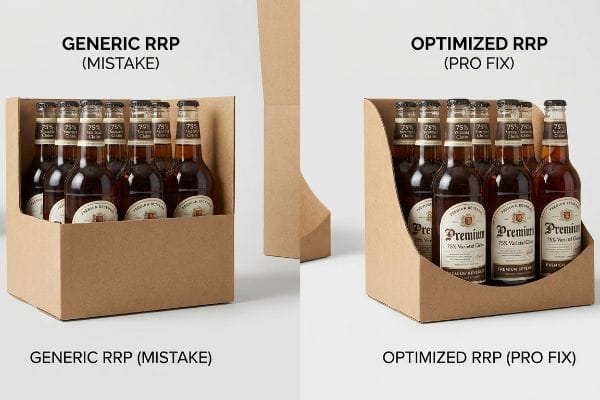
An RRP (Retail-Ready Packaging) is a secondary shipping container engineered to transition instantly onto retail shelves for consumer purchasing. It features clean tear-lines, distinct branding, and optimized retaining lips that present the primary product flawlessly without requiring store clerks to unpack individual units.
Getting the tear-away lines right is vital, but the front retaining lip holds a much more dangerous trap.
How Generic RRP Hides Your Brand Equity
Premium beverage and food brands invest heavily in their primary bottle labels to meet strict marketing and regulatory claims12. However, when transitioning these bottles into secondary retail trays, generic packaging designers frequently engineer front retaining lips that are simply straight lines13 cut at an arbitrary height.
Think of it like buying an expensive billboard and then parking a truck right in front of it. I see this structural oversight completely hide the product's primary legal equity, like a 75% varietal claim on a wine bottle14, crippling impulse conversions in the aisle. To fix this, I import the physical bottle's exact label dieline directly into my CAD (Computer-Aided Design) software, mathematically cutting a custom swoop into the retaining lip that guarantees 100% unobstructed visibility without losing structural friction.
| Common Rookie Mistake | The Pro Fix | Retail-Floor Benefit |
|---|---|---|
| Designing straight, high retaining lips | Engineering custom die-cut visibility swoops | Maximizes primary product brand exposure |
| Guessing the product label height | Importing exact bottle dielines into CAD15 | Ensures regulatory compliance text is seen |
| Hiding core marketing messages | Enforcing the 85% visibility clearance rule16 | Drives higher impulse purchase conversions |
I refuse to let a generic cardboard lip block your most expensive marketing asset. By mapping the exact label geometry before we cut a single board, I guarantee your core messaging hits the consumer exactly as intended.
🛠️ Harvey's Desk: Is your current retail tray accidentally blocking your most critical product label? 👉 Get a Visibility Audit ↗ — No forms that trigger endless sales calls. Just pure value.
What Is the Cheapest Type of Packaging?
Bootstrap brands often try to cheat the system by reusing inbound materials, completely ignoring the microscopic physics of paper fatigue.
The cheapest type of packaging is typically single-wall kraft corrugated board, often utilized as a standard brown shipping box. While highly economical for basic transit, it lacks the specialized micro-fluting, moisture barriers, and structural engineering required for heavy-duty retail displays or long-term pallet stacking.

But knowing the theory isn't enough when the machines start running and pallets start moving.
Why the Recycled Mailer Trap Fails on the Factory Floor
Startups frequently attempt to bootstrap their logistics by reusing inbound B2C ecommerce boxes, like standard mailers, for outbound B2B retail fulfillment. They assume that as long as the box looks visually intact, it retains its original factory strength17 and can safely carry their heavy retail displays.
This isn't just theory—I see this happen on the testing floor when clients send me their "saved" boxes for payload evaluation. During their initial parcel journey, the corrugated flutes absorb micro-impacts and moisture, permanently fatiguing the paper fibers18. When I measure the compressive strength on a Mullen Tester, I routinely see a massive drop in dynamic load capacity, meaning a box originally rated for 65 lbs (29 kg) suddenly fails at 35 lbs (15 kg), completely losing the stiff resistance of virgin kraft board. By strictly enforcing a virgin-material mandate and running fresh ISTA (International Safe Transit Association) 6-Amazon SIOC tests19, I ensure the corrugated corners maintain 100% of their strength, entirely eliminating transit damages and keeping your product out of the retailer's rejection pile.
| Common Rookie Mistake | The Pro Fix | Retail-Floor Benefit |
|---|---|---|
| Reusing inbound ecommerce boxes | Enforcing a virgin-material outbound mandate | Prevents base-tier collapse under pallets20 |
| Ignoring invisible paper fiber fatigue | Running strict ISTA dynamic transit tests21 | Eliminates massive retailer chargebacks |
| Trusting visual box integrity | Measuring exact flute compression strength22 | Guarantees safe, damage-free delivery |
I never gamble a massive retail rollout on exhausted, second-hand paper fibers. Spending slightly more on fresh, tested corrugated board acts as cheap insurance against the devastating logistical friction of damaged goods.
🛠️ Harvey's Desk: Do you know the exact dynamic load capacity of the cheapest box your supplier just quoted? 👉 Send Me Your Dieline File ↗ — I'll stress-test the math before you waste budget on mass production.
Conclusion
You can choose the cheapest recycled material vendor, but when those exhausted paper fibers collapse under a heavy pallet load, slowing down the warehouse receiving line by an estimated 30%, your entire project profit margin is wiped out by retailer chargebacks. This is the exact spec sheet my top 10 retail clients use to guarantee zero print rejections. Stop guessing on structural limits and let me personally run your files through my Free Dieline Audit ↗ to catch fatal compression errors before you spend a dime on mass production.
"RSC vs Die Cut: Which Box Style is Right for You? – PakFactory", https://pakfactory.com/blog/what-is-rsc-box-vs-die-cut-boxes/?srsltid=AfmBOooR1BBSdrluYahWF2iKlipvCmwYvidUgG3yfFIw0m_ngkLkVblv. Technical comparison of raw material requirements and cost savings when using Half Slotted Containers (HSC) instead of standard Regular Slotted Containers (RSC). Evidence role: factual support; source type: packaging industry specification. Supports: the claim that HSCs are used to reduce material costs. Scope note: specific to corrugated fiberboard packaging. ↩
"Estimation of the Compressive Strength of Corrugated Board Boxes …", https://pmc.ncbi.nlm.nih.gov/articles/PMC8467740/. Technical explanation of how top flaps provide structural reinforcement and distribute vertical loads in corrugated packaging. Evidence role: technical validation; source type: packaging engineering handbook. Supports: the claim that removing flaps reduces load-bearing capacity. Scope note: applicable to standard corrugated shipping containers. ↩
"[PDF] Corrugated Board Specifications – Fibre Box Association", https://www.fibrebox.org/assets/2025/09/Walmart_Corrugated-Board_Specifications_Automation_Packaging_Standards.pdf. Technical data confirming that vertical alignment of corrugated fluting maximizes the Edge Crush Test (ECT) value and vertical compression strength. Evidence role: technical specification; source type: industry standard (TAPPI). Supports: the strategy for maximizing load strength in open-top designs. Scope note: assumes standard corrugated board construction. ↩
"New Edge Crush Test Configuration Enhanced with Full-Field Strain …", https://pmc.ncbi.nlm.nih.gov/articles/PMC8510352/. Technical explanation of how vertical flute orientation optimizes Edge Crush Test (ECT) values to increase compression strength. Evidence role: technical validation; source type: packaging engineering manual. Supports: the efficacy of vertical grain for strength. Scope note: Specific to corrugated fiberboard. ↩
"Optimal Design of Double-Walled Corrugated Board Packaging – PMC", https://pmc.ncbi.nlm.nih.gov/articles/PMC8950760/. Comparative data showing that double-wall corrugated profiles provide significantly higher stacking strength and stability than single-wall. Evidence role: technical specification; source type: industrial design guide. Supports: structural stability improvements. Scope note: Relative to single-wall alternatives. ↩
"Retail Packaging Testing for Big-Box Compliance – Intertek", https://www.intertek.com/performance-testing/packaging/retail-compliance/. Documentation of standardized testing protocols (such as ASTM or ISO) for evaluating packaging integrity under dynamic loads during transit. Evidence role: procedural verification; source type: industry standard. Supports: the necessity of load testing for restocking safety. Scope note: Focuses on kinetic stress rather than static weight. ↩
"Understanding Shipping Box Strength – EcoEnclose", https://www.ecoenclose.com/blog/understanding-shipping-box-strength/?srsltid=AfmBOor_aS8qoSFj2L7kyh9smKOZ_7gKJEFM0IroYJNfiCovr4HZToCs. Technical specifications from packaging manufacturers would verify the structural performance difference and cost reduction associated with switching from 32 ECT to 26 ECT board. Evidence role: technical specification; source type: industry manual. Supports: the cost-saving rationale for reducing ECT ratings. Scope note: Applies to corrugated fiberboard standards. ↩
""Relative Humidity Effects on the Compression Strength of …", https://open.clemson.edu/all_theses/3225/. Technical validation of the Edge Crush Test (ECT) rating and the comparative effect of aqueous coatings versus foil laminates on board compression strength. Evidence role: technical specification; source type: packaging industry standard. Supports: the claim that specific coatings preserve structural integrity. Scope note: Focuses on corrugated board performance metrics. ↩
"ECT Ratings Explained: What They Mean for Your Corrugated …", https://epackagesupply.com/blogs/packaging-guide/ect-ratings-explained-what-they-mean-for-your-corrugated-packaging?srsltid=AfmBOoqwVs1B_1OcWM6isO-dKcK-G91FPQ2LQh9TI-8veWHSpMnf4n_I. Technical verification of 32 ECT (Edge Crush Test) as a standard baseline for retail packaging to prevent compression failure. Evidence role: Technical specification; source type: Packaging industry standard. Supports: Prevention of display collapse under product weight. Scope note: Specific to corrugated fiberboard. ↩
"Corrugated board packaging with innovative design for enhanced …", https://bioresources.cnr.ncsu.edu/resources/corrugated-board-packaging-with-innovative-design-for-enhanced-durability-during-transport/. Technical analysis of aqueous coatings compared to film laminates regarding their effect on board compression strength and structural integrity. Evidence role: Material property verification; source type: Technical data sheet. Supports: Maintaining structural integrity without adding compression risks. Scope note: Focuses on high-solid aqueous applications. ↩
"Testing methods and effects of interflute buckling – BioResources", https://bioresources.cnr.ncsu.edu/resources/overview-of-recent-studies-at-ipst-on-corrugated-board-edge-compression-strength-testing-methods-and-effects-of-interflute-buckling/. Engineering explanation of how flute density and board thickness correlate to the vertical load-bearing capacity of packaging. Evidence role: Engineering principle; source type: Corrugated packaging manual. Supports: The necessity of balanced board thickness for safe placement. Scope note: Applicable to various flute profiles (e.g., B, C, E). ↩
"Guidance for Industry: Food Labeling Guide – FDA", https://www.fda.gov/regulatory-information/search-fda-guidance-documents/guidance-industry-food-labeling-guide. Official regulatory documents detailing mandatory labeling requirements for food and beverage products to ensure consumer safety and legal compliance. Evidence role: regulatory verification; source type: government regulation. Supports: the necessity of high investment in primary labels. Scope note: focuses on mandatory legal disclosures. ↩
"The Complete Guide to Retail Ready Packaging – Bay Cities", https://www.bay-cities.com/resources/blogs/the-complete-guide-to-retail-ready-packaging/. Industry design benchmarks contrasting generic straight-cut retaining lips with brand-optimized contours in retail-ready packaging. Evidence role: technical verification; source type: packaging industry analysis. Supports: the assertion that generic designs lack optimization for brand visibility. Scope note: applies to secondary retail trays. ↩
"Wine Labeling | TTB: Alcohol and Tobacco Tax and Trade Bureau", https://www.ttb.gov/regulated-commodities/beverage-alcohol/wine/labeling. Brief explanation of how government regulations (such as the TTB in the US) mandate a minimum percentage of a grape variety for a varietal designation to be legal on a label. Evidence role: factual validation; source type: government regulation. Supports: the existence of legally mandated brand equity. Scope note: refers specifically to US wine labeling standards. ↩
"The Crucial Role of Dielines in Packaging Design & Production", https://www.manageartworks.com/blog-post/the-crucial-role-of-dielines-in-packaging-design-and-production. Packaging engineering guides demonstrate how precision CAD integration of product dielines ensures that legally mandated regulatory text remains unobstructed. Evidence role: technical process; source type: engineering manual. Supports: the link between CAD accuracy and regulatory compliance. Scope note: applicable to secondary packaging design. ↩
"Packaging's Role in Impulse Purchases – LinkedIn", https://www.linkedin.com/top-content/marketing/product-packaging-impact-on-marketing/packaging-s-role-in-impulse-purchases/. Industry standards for retail packaging design define specific visibility thresholds that correlate with increased consumer impulse purchase rates. Evidence role: technical specification; source type: industry benchmark. Supports: the impact of the 85% visibility rule on conversions. Scope note: specific to retail-ready packaging. ↩
"[PDF] Effects of Moisture content on Box Compression Strength : FBA BCT …", https://renewablebioproducts.gatech.edu/sites/default/files/2025-12/4effects-of-moisture-content-on-box-compression-strength.pdf. Technical explanation of how repeated handling and mechanical stress reduce the Edge Crush Test (ECT) values and structural integrity of corrugated fiberboard. Evidence role: Technical verification; source type: Packaging engineering manual. Supports: The claim that visual intactness does not equal structural strength. Scope note: Specific to corrugated board fatigue. ↩
"[PDF] Investigating the mechanical properties of paperboard packaging …", https://repository.rit.edu/cgi/viewcontent.cgi?article=1066&context=japr. Brief explanation of how material science literature describes the irreversible loss of structural integrity in cellulose fibers due to moisture and mechanical stress. Evidence role: factual support; source type: technical manual or material science journal. Supports: the claim that reuse degrades packaging strength. Scope note: applies to kraft paper substrates. ↩
"[PDF] ISTA 6‑Amazon.com SIOC Overview", https://ista.org/docs/6AmazoncomSIOCOverview.pdf. Brief explanation of how the ISTA 6-Amazon SIOC protocol validates that packaging meets specific durability standards for direct-to-consumer shipments. Evidence role: technical specification; source type: industry standard. Supports: the use of specific testing to eliminate transit damage. Scope note: specific to Amazon's Ship-in-Own-Container guidelines. ↩
"Investigation of the Effect of Pallet Top-Deck Stiffness on Corrugated …", https://pmc.ncbi.nlm.nih.gov/articles/PMC8585293/. Brief explanation of how structural degradation in reused corrugated cardboard reduces vertical load capacity leading to pallet failure. Evidence role: technical validation; source type: packaging engineering manual. Supports: risk of using non-virgin materials for outbound shipping. Scope note: specifically applies to palletized warehouse environments. ↩
"ISTA Packaging Testing – Intertek", https://www.intertek.com/performance-testing/packaging/ista/. Brief explanation of International Safe Transit Association (ISTA) protocols for simulating shipping stresses to identify packaging weaknesses. Evidence role: standardization proof; source type: industry certification standard. Supports: the efficacy of dynamic testing over visual inspection. Scope note: applies to global shipping logistics. ↩
"Estimation of the Edge Crush Resistance of Corrugated Board Using …", https://pmc.ncbi.nlm.nih.gov/articles/PMC9961700/. Brief explanation of how measuring Edge Crush Test (ECT) values quantifies the load-bearing capacity of corrugated fluting. Evidence role: technical specification; source type: materials science reference. Supports: the necessity of quantitative measurement for delivery safety. Scope note: refers to the vertical compression strength of the medium. ↩