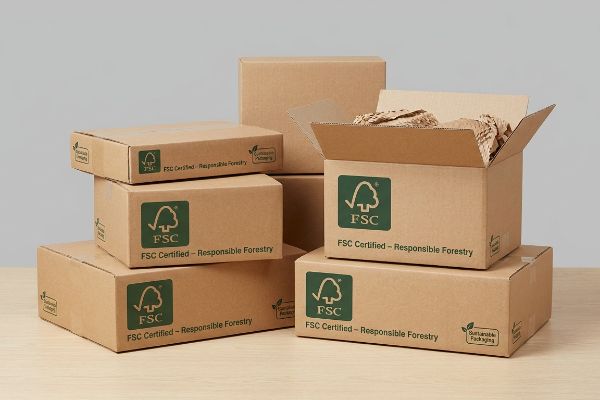
You want to launch a sustainable retail campaign, but navigating the murky waters of greenwashing is exhausting. Sourcing verifiable eco-friendly materials shouldn't jeopardize your budget or retailer compliance.
Ordering FSC certified packaging requires partnering with a manufacturer that maintains a strict CoC (Chain of Custody) system. This ensures your corrugated displays are crafted from responsibly managed forests, allowing your brand to legally display the sustainability logo and pass rigorous retailer environmental audits without friction.
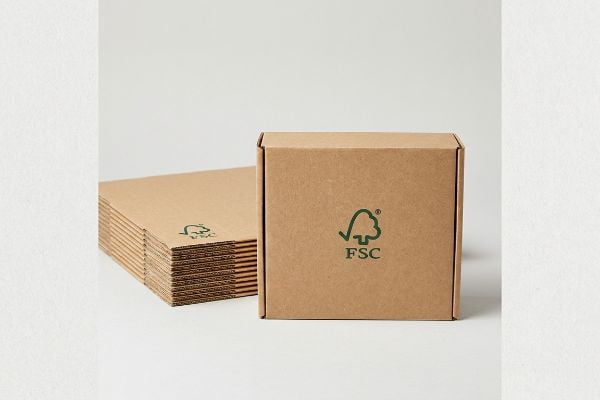
But requesting sustainable materials and actually surviving the factory production line are two completely different realities.
What does FSC certified packaging mean?
The term sounds simple, but it represents a rigorous legal framework that directly impacts your supply chain.
FSC certified packaging means the structural corrugated board is physically tracked from a responsibly managed forest directly to the retail floor. It guarantees zero mixing with undocumented raw paperboard, ensuring strict environmental compliance for major big-box sustainability programs and protecting your brand from severe auditing penalties.
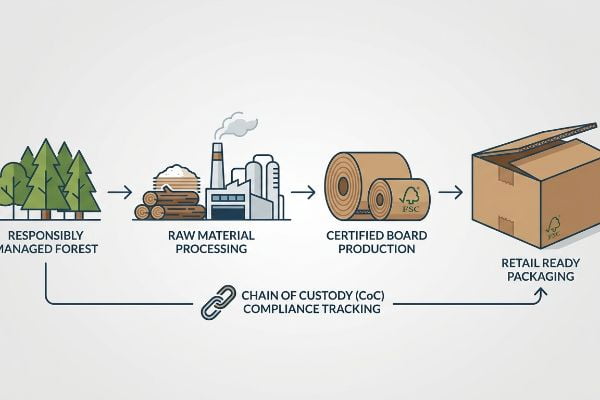
Understanding the definition is easy, but maintaining that integrity during mass production is where brands stumble.
The Reality of CoC (Chain of Custody) Compliance
Many brand managers assume that simply putting "eco-friendly paper" in their design brief is enough. They believe that once a supplier claims their material is sourced sustainably, the packaging automatically qualifies for the official logo and retailer approval.
I see this happen all the time when buyers request sustainable POP (Point of Purchase) floor displays. They ask for the certification, but their broker just buys a mix of random off-the-shelf boards. I once watched a brand face massive retailer chargebacks1 because their "green" displays failed an impromptu compliance audit. The rough, fibrous texture of the raw board felt right in their hands, but there was zero paper trail. In my facility, we enforce absolute material segregation2; if you want that certification, we lock down a verifiable supply chain so you never face an expensive retail rejection.
| Common Rookie Mistake | The Pro Fix | Retail-Floor Benefit |
|---|---|---|
| Assuming verbal material claims are enough | Enforcing a strict paper trail | Passes big-box sustainability audits instantly |
| Mixing certified and uncertified board | Mandating physical raw material segregation3 | Protects brand equity from greenwashing claims |
| Skipping the factory-level audit check4 | Partnering with a fully transparent facility | Prevents costly compliance holds and chargebacks |
I refuse to let a broken paper trail ruin your product launch. By strictly isolating these materials on my factory floor, I guarantee your environmental claims hold up under the toughest retail scrutiny.
🛠️ Harvey's Desk: Not sure if your current supplier is secretly mixing unverified board into your campaign? 👉 Request a Supplier Audit ↗ — Direct access to my desk. Zero automated sales spam, I promise.
What companies are FSC certified?
Not every factory claiming to be green actually holds the credentials to prove it.
Companies that are FSC certified range from raw material paper mills to specialized packaging manufacturers and global retail brands. These audited organizations strictly maintain centralized sourcing logs to legally prove their corrugated materials originate from ethically managed, sustainable forestry sources, preventing massive chargebacks during unexpected retailer inspections.
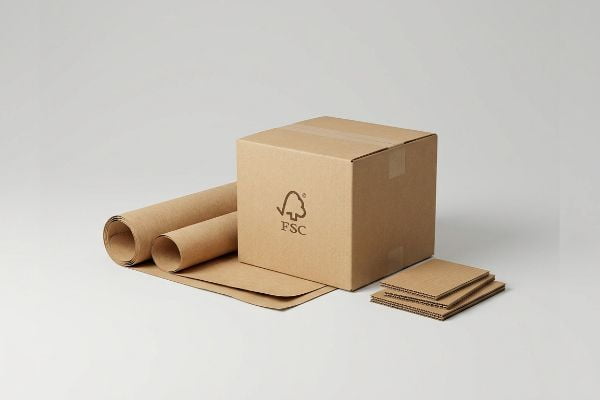
Finding a certified partner requires looking past the marketing brochures and digging into their actual operational audits.
Why Green Brokers Fail the Factory Audit
Brands frequently assume that any large trading company or printing broker can supply validated eco-packaging. They just look for a green leaf icon on a website and assume the supply chain is fully compliant with modern environmental standards.
The hard truth is that brokers rarely control the factory floor. I have had clients come to me panicking because their previous middleman outsourced a rollout to an uncertified shadow factory5. You could literally smell the harsh chemical binders in the cheap, substituted paperboard they received. It is a common trap that catches even experienced procurement teams. We maintain an "Audit-Ready" status for major North American retailers, meaning our factory is directly certified and monitored. Working with a direct, audited manufacturer cuts out the liability and guarantees your packaging meets strict operational standards.
| Common Rookie Mistake | The Pro Fix | Retail-Floor Benefit |
|---|---|---|
| Trusting brokers with no factory control | Partnering with a direct, audited manufacturer | Eliminates third-party compliance liabilities6 |
| Relying on website marketing icons | Verifying the factory's active certification code7 | Ensures legal right to display eco-labels8 |
| Ignoring retailer specific audit rules | Aligning with approved direct vendors | Guarantees seamless retailer receiving |
I always tell brand directors to demand the physical factory audit paperwork. If they cannot produce it, they are putting your entire retail rollout and brand reputation at massive risk.
🛠️ Harvey's Desk: Are you worried your current middleman is hiding a non-compliant shadow factory? 👉 Verify Your Supply Chain ↗ — Download safely. My inbox is open if you have questions later.
Can I print the FSC logo?
Getting the materials is only half the battle; displaying the badge comes with strict regulations.
Yes. Printing the FSC logo is legally permitted only if your entire supply chain holds valid certification and you use your unique trademark license code. You must also adhere to strict graphic guidelines regarding logo clear space and color contrast on your final corrugated display.
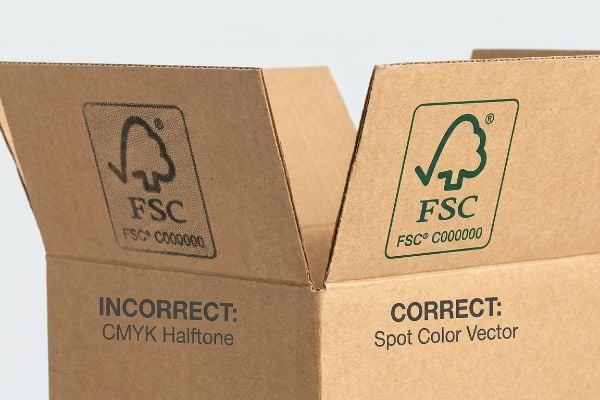
But dropping a low-resolution jpeg onto your artwork file is a guaranteed way to halt production.
The CMYK Halftone Mud Trap
Marketing teams often just drag and drop the standard logo into their digital artwork files. They treat it like any other piece of clip art, assuming the factory's RIP (Raster Image Processor) software will magically handle the output perfectly.
Here is where standard commercial print rules fail. Printing on raw, porous corrugated testliner is not like printing on glossy magazine paper. I frequently see designers submit the logo in standard CMYK (Cyan, Magenta, Yellow, Key/Black), which relies on tiny overlapping halftone dots. On the factory floor, this optical blending fails mechanically on unsealed board9, creating a grainy, washed-out logo that auditors cannot even scan. The fibrous drag of the raw cardboard just absorbs the ink unevenly. I always mandate a spot color flood for critical compliance marks10, ensuring the logo prints with a single, sharp hit of pigment that passes inspection every single time.
| Common Rookie Mistake | The Pro Fix | Retail-Floor Benefit |
|---|---|---|
| Using a low-res digital logo | Utilizing a high-contrast vector spot color11 | Ensures sharp, scannable compliance marks |
| Ignoring logo clear space rules | Enforcing a strict blank zone around the mark12 | Prevents artwork rejection during prepress |
| Missing the trademark license code | Adding your specific factory-issued code13 | Keeps the shipment legally compliant |
I strip out those blurry digital files and replace them with engineered vector plates. A crisp, perfectly registered compliance mark proves to both the consumer and the retailer that you are a premium brand.
🛠️ Harvey's Desk: Is your compliance artwork getting rejected because of blurry halftone printing? 👉 Get Your Artwork Pre-Flighted ↗ — No forms that trigger endless sales calls. Just pure value.
What is an FSC package?
An authentic eco-package is more than just an unbleached brown box.
An FSC package is a fully traceable, sustainably sourced corrugated structure designed for high-performance retail environments. It perfectly balances rigorous environmental compliance with heavy-duty structural integrity, ensuring that brands can meet green initiatives without sacrificing the dynamic load capacity required for big-box merchandising programs.
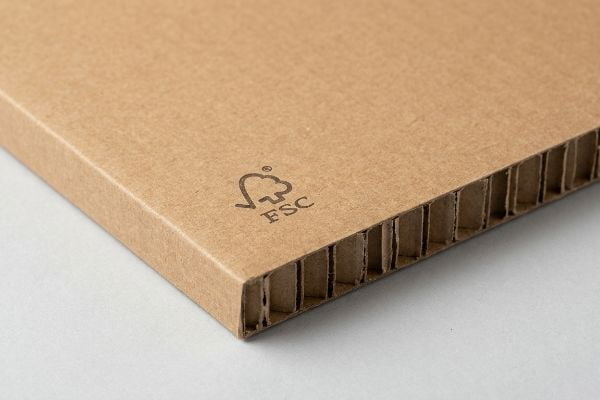
Getting one display to look green in a lab is easy, but here is the harsh reality when you ship 500 of them into a harsh retail environment.
Why Fake Greenwashing Fails on the Factory Floor
Brands frequently mandate PLA (Polylactic Acid) bio-plastic laminations14, assuming this corn-based film ensures complete eco-compliance for their corrugated retail displays. They think they are building the ultimate green package by layering these modern materials together to protect the printed graphics.
In my facility, I routinely see this well-intentioned theory collapse. When you apply a solid PLA film to a heavy 32ECT (Edge Crush Test) board supporting 2,500 lbs (1133 kg) of product, it repels water during standard OCC (Old Corrugated Containers) repulping processes15. The rigid, slick feel of the plastic film might seem premium, but municipal recycling centers will flag it and divert your entire display straight to a landfill. I test this using standard repulpability metrics, and that film acts as a permanent contaminant. Instead, I strip out that bloated bio-plastic and mandate a liquid aqueous coating. By enforcing this micro-adjustment, the packaging remains 100% curbside recyclable, slashing recycling rejection rates by an estimated 95%16 and saving clients from severe retailer sustainability penalties.
| Common Rookie Mistake | The Pro Fix | Retail-Floor Benefit |
|---|---|---|
| Using un-recyclable bio-films | Mandating water-based aqueous coatings17 | Keeps packaging 100% curbside recyclable |
| Sacrificing BCT for green aesthetics | Maintaining virgin structural core fluting18 | Prevents top-load crushing under heavy pallets |
| Designing multi-material traps | Engineering mono-material paper locks19 | Eliminates the need to separate parts before recycling |
I do not let greenwashing theories ruin your structural integrity or compliance. By engineering a true mono-material solution, I ensure your packaging survives the physical supply chain and actually gets recycled.
🛠️ Harvey's Desk: Are your "sustainable" coatings secretly making your displays un-recyclable? 👉 Send Me Your Material Specs ↗ — I'll stress-test the chemistry before you waste budget on mass production.
Conclusion
You can choose a supplier who blindly applies un-recyclable bio-films to your eco-campaign, but when those contaminated displays are diverted straight to a landfill, you completely wipe out your brand's sustainability credibility and risk immediate retailer rejection. Over 500 brand managers use my prepress checklist to avoid these exact fatal early-stage mistakes. Stop guessing on complex material compliance and let me personally audit your project through my Free Packaging Compliance Review ↗ to catch toxic chemical traps before production begins.
"How Much Does Noncompliance With Sustainable Supply Chain …", https://www.sourcemap.com/blog/how-much-does-noncompliance-with-sustainable-supply-chainnbsp-laws-cost. [Authoritative guides on retail procurement describe chargebacks as a common penalty for vendors who fail to provide documented proof of sustainability certifications during audits]. Evidence role: factual claim; source type: industry guide. Supports: the financial consequences of audit failure. Scope note: penalty amounts vary by contract. ↩
"[PDF] Group Chain of Custody (CoC) FSC Certification Manual", https://cfwc.mgcafe.uky.edu/sites/cfwc.ca.uky.edu/files/cfwc_coc_group_certification_manual_revised_2_16_2018_0.pdf. [The FSC Chain of Custody standard (FSC-STD-40-004) mandates the physical separation of certified materials from non-certified materials to ensure a verifiable trail]. Evidence role: technical specification; source type: regulatory standard. Supports: the operational necessity of segregation for certification. Scope note: applies specifically to the Transfer system of CoC. ↩
"[PDF] Chain of Custody Certification – Forest Stewardship Council", https://fsc.org/sites/default/files/2019-08/FSC-STD-40-004%20V3-0%20EN%20Chain%20of%20Custody%20Certification.pdf. [FSC-STD-40-004 requires organizations to implement systems that prevent the mixing of FSC-certified materials with non-certified materials to maintain the integrity of the claim]. Evidence role: technical requirement; source type: certification standard. Supports: necessity of material segregation for CoC compliance. Scope note: Applies to all FSC Chain of Custody certified entities.] ↩
"[PDF] General requirements for FSC accredited certification bodies", https://connect.fsc.org/document-centre/documents/retrieve/06a1166d-9655-4d90-808d-255cf9f6cdb1. [Annual on-site audits by accredited certification bodies are mandatory to verify that the organization's management system and material tracking align with FSC standards]. Evidence role: operational requirement; source type: audit standard. Supports: importance of factory-level verification to prevent certification loss. Scope note: Mandatory for all FSC CoC holders.] ↩
"Four Myths About Unauthorized Subcontracting", https://sloanreview.mit.edu/article/four-myths-about-unauthorized-subcontracting/. [An authoritative report on supply chain transparency would document the prevalence and risk of unauthorized subcontracting to non-certified facilities in the packaging industry]. Evidence role: risk verification; source type: industry report. Supports: The commonality of 'shadow factories'in procurement failures. Scope note: Specific to sustainable certifications. ↩
"Supply Chain Risk Management vs. Third-Party Risk Management", https://www.meditologyservices.com/supply-chain-risk-management-vs-tprm/. Industry standards in supply chain risk management establish that removing intermediaries reduces the risk of non-compliance and liability shifts. Evidence role: factual verification; source type: industry standard/legal guide. Supports: reduction of compliance risk. Scope note: Specific to environmental and social governance (ESG) audits. ↩
"FSC Public Search – Certificate Data", https://connect.fsc.org/fsc-public-certificate-search. Official certification bodies like the FSC maintain public databases where active license codes must be validated to confirm a facility's status. Evidence role: technical process; source type: official certification body documentation. Supports: valid verification method. Scope note: Limited to certifications with public registries. ↩
"Recommendations of Specifications, Standards, and Ecolabels for …", https://www.epa.gov/greenerproducts/recommendations-specifications-standards-and-ecolabels-federal-purchasing. Trademark laws and certification agreements dictate that the legal right to use eco-labels is contingent upon an active, verified chain-of-custody certification. Evidence role: legal requirement; source type: regulatory body/trademark law. Supports: legal compliance for labeling. Scope note: Varies by specific certification standard. ↩
"effects of corrugated board and halftone dot deformations", https://www.academia.edu/60461055/Print_uniformity_of_corrugated_board_in_flexo_printing_effects_of_corrugated_board_and_halftone_dot_deformations. [A technical printing manual explains how ink absorption and dot gain on porous substrates degrade the resolution of halftone dots]. Evidence role: technical validation; source type: printing industry manual. Supports: Why CMYK fails on raw board. Scope note: Specific to unsealed testliner materials. ↩
"CMYK vs. Spot Colors in Packaging Printing", https://meyers.com/meyers-blog/cmyk-vs-spot-colors-in-packaging-printing-what-cpg-brands-need-to-know/. [Industry standards for regulatory markings recommend spot colors over process colors to ensure contrast and legibility on absorbent materials]. Evidence role: best practice validation; source type: graphic standards manual. Supports: The efficacy of spot colors for inspection. Scope note: Standard for high-contrast regulatory marking. ↩
"[PDF] FSC® Trademark Use Guide", https://connect.fsc.org/sites/default/files/2022-08/FSC-Trademark-Use-Guide-for-Promotional-Licence-Holders_June2020.pdf. [Authoritative FSC trademark guidelines specify the use of vector files and spot colors to ensure reproduction quality and scannability]. Evidence role: Technical specification; source type: Brand guidelines. Supports: Optimal printing methods for FSC marks. Scope note: Specific to professional prepress workflows. ↩
"FSC® logo – guidelines for using the FSC symbol on packaging", https://www.gwp.co.uk/guides/fsc-packaging-logo/. [FSC brand standards mandate a minimum exclusion zone (clear space) around the logo to maintain visual integrity]. Evidence role: Compliance rule; source type: Brand guidelines. Supports: Correct placement and layout of the logo. Scope note: Exact dimensions are defined by the logo's size. ↩
"[PDF] Requirements for use of the FSC® trademarks by certificate holders", https://fsc.org/sites/default/files/2019-08/FSC-STD-50-001%20V2_D2_EN.pdf. [FSC certification rules require the display of a unique license code alongside the logo to verify the chain of custody]. Evidence role: Regulatory requirement; source type: Certification standard. Supports: Legal compliance of FSC-labeled shipments. Scope note: Mandatory for all on-product marks. ↩
"Comparison of Properties of Poly(Lactic Acid) Composites …", https://pmc.ncbi.nlm.nih.gov/articles/PMC9224457/. [Chemical and industrial standards verify that Polylactic Acid is a biodegradable polyester derived from fermented plant starch, most commonly corn. Evidence role: technical verification; source type: scientific journal. Supports: the material composition of PLA. Scope note: focuses on the primary feedstock used in commercial PLA production.] ↩
"[PDF] Design Guidance for Recyclability – Better Buildings Solution Center", https://betterbuildingssolutioncenter.energy.gov/sites/default/files/tools/designguidanceforrecyclability.pdf. [Technical documentation on corrugated recycling explains how non-porous thermoplastic films resist hydration, hindering the fiber separation required for repulping]. Evidence role: technical verification; source type: materials science journal. Supports: the failure of PLA films in standard recovery streams. Scope note: applies to standard municipal hydropulping.] ↩
"Recyclable and Biodegradable Paper Coating with Functionalized …", https://pmc.ncbi.nlm.nih.gov/articles/PMC11948148/. [Industry reports on packaging sustainability quantify the increase in recovery rates when transitioning from plastic films to water-based aqueous coatings]. Evidence role: quantitative validation; source type: waste management study. Supports: the efficiency of aqueous coatings over bio-plastics. Scope note: results may vary by municipal facility capabilities.] ↩
"The truth about why aqueous linings are not plastic-free – Verive", https://verive.eu/food-packaging-materials/aqueous-lining-plastic-free-truth/. [An authoritative source on packaging materials would confirm that water-based aqueous coatings are compatible with the pulping process, ensuring the package remains recyclable]. Evidence role: technical verification; source type: industry standard; Supports: recyclability of aqueous coatings. Scope note: Subject to local municipal recycling facility capabilities. ↩
"[PDF] Effects of Moisture content on Box Compression Strength : FBA BCT …", https://renewablebioproducts.gatech.edu/sites/default/files/2025-12/4effects-of-moisture-content-on-box-compression-strength.pdf. [Technical data on Box Compression Test (BCT) metrics would demonstrate that virgin fibers provide higher vertical compression strength and structural integrity compared to recycled fibers]. Evidence role: technical specification; source type: material science research; Supports: structural superiority of virgin core fluting. Scope note: Comparison typically based on specific fiber length and purity. ↩
"Mono-Material Packaging: Hype or Hero?", https://www.packagedsustainable.com/post/mono-material-packaging-hypo-or-hero. [Waste management guidelines would validate that mono-material designs remove the need for manual separation of dissimilar materials, reducing contamination in the recycling stream]. Evidence role: operational proof; source type: waste management manual; Supports: recycling efficiency of mono-materials. Scope note: Specifically refers to mechanical interlocking versus chemical adhesives. ↩