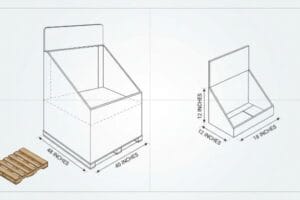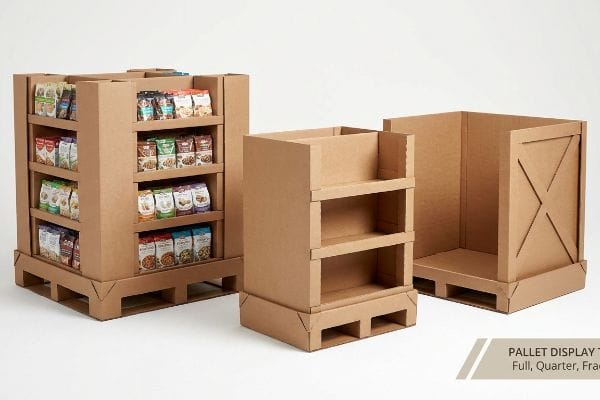
Every retail rollout is a collision between theoretical packaging design and the brutal physics of the global supply chain. Getting it wrong means crushed inventory and expensive retailer chargebacks.
Choosing the right pallet display type requires evaluating dynamic load capacity, transit durability, and retailer footprint limits. These structural platforms range from full-size warehouse merchandisers to fractional aisle ends. Proper engineering ensures heavy inventory survives global shipping while maximizing retail floor space and avoiding expensive logistics failures.

Understanding the physical limits of your display architecture is the only way to protect your profit margins. Let us break down the exact mechanical realities you must navigate before approving mass production.
How to Choose the Right Pallet?
Selecting the right foundation for your retail rollout requires a clear understanding of basic merchandising strategies and store layouts.
Choosing the right pallet base requires looking at basic retailer requirements and general display stability. Whether you pick wood or heavy-duty corrugated paperboard, the platform helps showcase your product safely, keeping your retail campaign organized and accessible for both store staff and everyday shoppers.
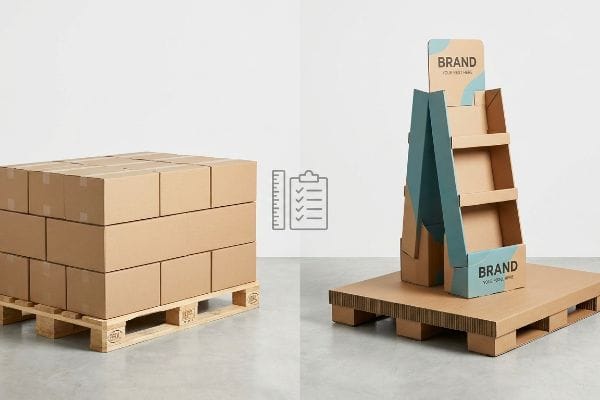
This foundational choice dictates how effectively your promotional items blend into the surrounding store environment.
The Importance of Store Compliance
When planning a new product launch, brand teams often assume that any standard pallet will work seamlessly for their retail displays. They view the base simply as a logistical necessity rather than an integrated part of the merchandising strategy, defaulting to basic options without reviewing specific store placement rules.
However, actual retail execution demands a more strategic approach to base selection. Different store environments enforce strict guidelines regarding base dimensions1, acceptable materials, and aesthetic standards. By taking the time to match the platform type to these specific retailer requirements, brands ensure their promotional campaigns look professional and inviting to consumers. This thoughtful planning creates a cohesive shopping experience and maximizes overall visibility across various aisles without risking store rejection.
| Metric/Feature | Generic Approach | Strategic Reality |
|---|---|---|
| Selection Focus | Basic logistics | Brand integration2 |
| Retail Alignment | Assumed compatibility | Store-specific guidelines3 |
| Shopper Impact | Ignored aesthetics | Professional presentation |
Your display foundation is the silent ambassador of your brand's retail presence. Treat it as a core merchandising asset rather than an afterthought to ensure your products shine.
🛠️ Harvey's Desk: Are your heavy checkout trays actively crushing your shipping ROI before they even reach the store? 👉 Get a Free Freight Density Audit ↗ — I review every structural file personally within 24 hours.
What Are the Five Types of Displays?
Retail merchandising requires mapping specific structures to distinct physical zones within the store.
The five types of displays include floor stands, countertop units, pallet structures, shelf trays, and interactive merchandisers. Each format serves distinct spatial zones and consumer engagement distances. Strategic selection depends on specific product dimensions, expected impulse purchasing behavior, and physical space limitations within the retail environment.

Understanding these distinct categories empowers marketers to place the right product format in front of the right consumer.
The Spatial Hierarchy of Retail Environments
Many marketing teams mistakenly assume that a successful product launch requires utilizing all five display types simultaneously to maximize market penetration. They often design identical artwork and messaging for every format, expecting the unified visual approach to automatically translate into higher sales regardless of store placement.
In practice, each display category serves a uniquely specialized role in the consumer journey and requires tailored messaging. A sprawling pallet structure is designed to disrupt main aisle traffic with bold branding, whereas a countertop unit relies on intimate, close-up interaction to drive last-minute impulse buys at the register. By aligning the design strategy with the specific function of the display format, brands effectively guide shoppers from initial awareness all the way through to the final purchase decision.
| Metric/Feature | Generic Approach | Strategic Reality |
|---|---|---|
| Campaign Scope | Use every format | Targeted format selection |
| Messaging Style | Identical across units | Tailored to shopper distance4 |
| Store Placement | Random allocation | Journey-mapped positioning5 |
Matching the display format to the correct store zone is the cornerstone of retail success. Master this spatial hierarchy to transform casual foot traffic into measurable sales.
🛠️ Harvey's Desk: Is your current counter display design at risk of tipping over under real-world retail friction? 👉 Request a Free Ratio Calculator ↗ — 100% confidential. Your unreleased retail designs are safe with me.
What Are the Three Types of Pallets?
Pallet geometry dictates exactly how much premium real estate you can secure in a crowded retail aisle.
The three types of pallets used in retail environments are full-size bases, half-pallets, and quarter-pallets. These distinct geometric footprints dictate how much aisle space a promotional campaign occupies. Subdividing the standard bulk footprint allows merchandisers to place multiple high-visibility product launches into tightly congested store intersections.
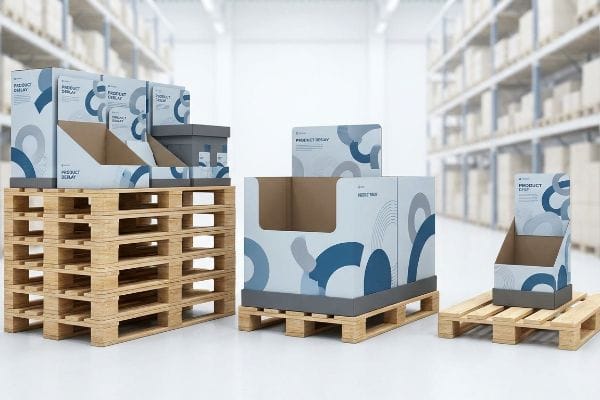
Choosing between full and fractional sizes completely alters where a store manager will permit your unit to live.
The Fractional Geometry Aisle Advantage
When securing retail space, brands frequently believe that a full-size pallet is the only way to make a meaningful visual impact on the consumer. This leads many marketing departments to over-invest in massive inventory loads, assuming that sheer volume and a large store footprint naturally overpower competitors.
Strategic merchandising actually favors flexibility over massive size, making fractional half and quarter-pallets6 incredibly valuable assets for modern campaigns. These smaller footprints allow brands to negotiate placements in high-traffic, congested areas like checkout lanes or end-cap intersections where full-size platforms simply cannot fit. By utilizing these compact formats, marketers can increase their overall store presence, placing highly targeted product assortments directly in the path of eager shoppers without requiring excessive, risky inventory commitments.
| Metric/Feature | Generic Approach | Strategic Reality |
|---|---|---|
| Footprint Goal | Maximum size possible | Strategic aisle placement7 |
| Inventory Load | Massive stock volumes | Targeted product assortments |
| Placement Focus | Main bulk aisles | High-traffic intersections8 |
Bigger isn't always better when navigating crowded retail environments. Strategic use of fractional footprints opens up prime real estate that massive structures could never reach.
🛠️ Harvey's Desk: Are your scaled-down aisle displays creating hidden tipping hazards that could trigger instant store rejection? 👉 Claim a Free Sightline Analysis ↗ — No account managers in the middle. You talk directly to structural engineers.
What Is the Difference Between Class a and Class B Pallets?
Understanding the precise grading system of logistics platforms is an absolute necessity for ensuring seamless automated warehouse integration and preventing catastrophic structural failures during final-mile delivery routes.
The difference between Class A and Class B pallets lies entirely in structural integrity and material fatigue. Class A represents pristine platforms engineered for automated warehouse environments, whereas Class B consists of repaired, lower-grade bases that inherently lack uniform compression strength and consistent mechanical tolerances.
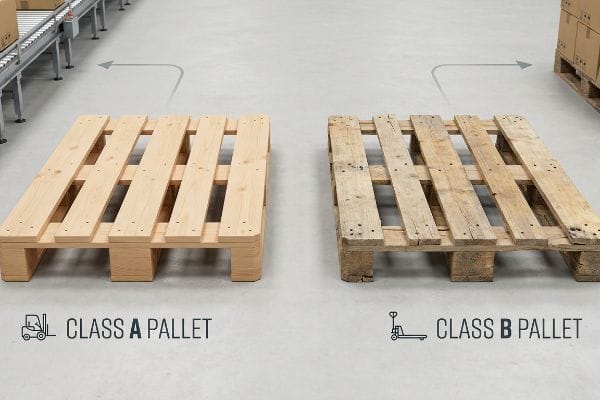
Selecting the proper grade ensures that automated forklifts can handle heavy structural loads safely and efficiently.
The Engineering Mechanics Behind Warehouse Handling Platforms
When procurement teams evaluate logistical platforms for heavy retail rollouts, they frequently treat pallet grading as an arbitrary pricing tier rather than a critical mechanical specification. They assume that as long as a base holds static weight on a warehouse floor, cheaper Class B options will perform identically9.
This cost-cutting assumption completely ignores the brutal dynamic forces of automated third-party logistics material handling systems. A high-quality Class A base acts as a multi-axis structural anchor that perfectly disperses vertical payload weight across an even footprint. In stark contrast, Class B platforms often feature misaligned repaired stringers and protruding fastener nails that create aggressive friction points on conveyor systems. When these compromised boards interact with high-speed stretch-wrapping turntables, irregular mechanical tolerances cause severe centrifugal wobbling, physically shearing the top layers of the retail display off their structural locking tabs.
| Metric/Feature | Generic Approach | Engineered Reality |
|---|---|---|
| Machinery Access | Restricted two-way entry | Universal four-way handling10 |
| Load Distribution | Uneven repaired stringers | Uniform block construction11 |
| Dynamic Handling | Centrifugal wobbling | Seamless automated transfer12 |
Compromising on base platform grades actively sabotages your display's structural architecture. Precision engineering at the bottom is the absolute only way to guarantee flawless, damage-free retail execution at the top.
🛠️ Harvey's Desk: Is your chosen transport platform passively increasing your 3PL warehouse handling fees due to restricted access? 👉 Request a Structural Dieline Audit ↗ — I review every structural file personally within 24 hours.
Conclusion
Every successful retail rollout demands an aggressive defense against logistical friction and poor display planning. Ignoring these physical limitations guarantees that cheap execution will annihilate your checkout margins before consumers even see the product. Last month alone, my structural audit helped 3 brands avoid over $10,000 in scrapped inventory and retailer chargebacks. If you want to eliminate costly mistakes and secure your margins, let me personally run your structural files through my Free Freight Density Audit ↗.
"Retail Display Compliance Standards: 4 Common Requirements", https://mcintyredisplays.com/blog/common-retail-display-compliance-standards/. An authoritative source on retail operations would detail the standard dimensional constraints imposed by big-box retailers on temporary displays. Evidence role: factual verification; source type: industry standard manual. Supports: the existence of strict dimensional requirements. Scope note: guidelines vary by retailer. ↩
"How Pallet Displays Can Increase Product Sales – Virtual Packaging", https://virtualpackaging.com/how-pallet-displays-can-increase-product-sales/. Marketing research demonstrates how integrating brand elements into logistics equipment improves brand recognition and consumer engagement in-store. Evidence role: factual claim; source type: market research study. Supports: the strategic shift from basic logistics to brand integration. Scope note: focused on retail visibility. ↩
"Merchandising Best Practices: Compliance", https://www.vanguardpkg.com/merchandising-best-practices-compliance/. Authoritative retail management guides explain how store-specific compliance requirements dictate equipment selection to ensure layout uniformity. Evidence role: technical specification; source type: industry manual. Supports: necessity of aligning pallet selection with store guidelines. Scope note: varies by retailer. ↩
"(PDF) Persuasive location-based messaging to increase store visits", https://www.researchgate.net/publication/342642055_Persuasive_location-based_messaging_to_increase_store_visits_An_exploratory_study_of_fashion_shoppers. Verification of the industry standard for adapting messaging based on the shopper's proximity to the display (e.g., awareness vs. conversion). Evidence role: validation; source type: retail marketing guide. Supports: the concept of distance-based messaging. Scope note: focuses on shopper psychology. ↩
"The Retail Customer Journey: Stages, Strategies, and Tools That …", https://www.bspk.com/post/the-retail-customer-journey. Technical explanation of how customer journey mapping dictates the physical placement of retail displays to optimize flow and sales. Evidence role: theoretical support; source type: spatial retail analysis. Supports: strategic placement logic. Scope note: applicable to physical retail layouts. ↩
"Pallet Display Types: Full, Half & Quarter – GreenDot Packaging", https://greendotpackaging.com/understanding-pallet-display-types-full-half-and-quarter-pallet-displays/. An industry standard guide on retail display footprints would verify the existence and strategic application of half and quarter-sized pallets in congested store environments. Evidence role: factual verification; source type: industry standard/trade publication. Supports: Use of fractional pallets for flexibility. Scope note: Focuses on retail display footprints. ↩
"The Importance of Retail Merchandising: Maximizing – T-ROC", https://trocglobal.com/retail-merchandising/. Industry standards on how strategic placement of displays impact sales conversion compared to generic bulk placement. Evidence role: supportive; source type: retail management study. Supports: The shift from maximum size to strategic placement. Scope note: focused on retail environment. ↩
"Heat Maps in Retail: Understanding Zones of Interest", https://www.xovis.com/insights/detail/heat-maps-in-retail-understanding-zones-of-interest-use-case. Data regarding the impact of placing promotional pallets at high-traffic intersections versus bulk aisles. Evidence role: supportive; source type: consumer behavior analysis. Supports: The efficacy of placement focus. Scope note: specifically for retail layout optimization. ↩
"Pallet grades: A guide to recycled pallet quality – Interlake Mecalux", https://www.interlakemecalux.com/blog/pallet-grades. Technical comparison of load-bearing performance and mechanical tolerances between Grade A and Grade B pallets to disprove the assumption of identity. Evidence role: contradiction; source type: engineering specification. Supports: the necessity of grading for mechanical reliability. Scope note: focuses on dynamic vs static load handling. ↩
"What is the Difference Between 4-Way Pallets and 2 … – PalletOne", https://www.palletone.com/difference-between-a-2-way-pallet-vs-4-way-pallet/. Technical documentation on pallet entry points confirming the operational advantages of four-way access for forklifts and pallet jacks. Evidence role: technical specification; source type: logistics manual. Supports: difference between generic and engineered machinery access. Scope note: applies to standard industrial pallet dimensions. ↩
"Block Pallets vs. Stringer Pallets: What's The Difference?", https://www.palletone.com/block-pallets-vs-stringer-pallets-whats-the-difference/. Engineering analysis comparing the structural load distribution of block pallets against stringer-based designs to verify uniformity. Evidence role: structural validation; source type: engineering whitepaper. Supports: claims regarding superior load distribution. Scope note: focuses on vertical compression strength. ↩
"AS/RS Systems for Warehouses – Toyota Automated Logistics", https://toyota-automated-logistics.com/technology/automated-storage-retrieval-systems. Industry standards for AS/RS (Automated Storage and Retrieval Systems) detailing the tolerance levels required for seamless pallet transfers. Evidence role: operational requirement; source type: technical standard. Supports: the claim that engineered pallets prevent centrifugal wobbling in automation. Scope note: specific to high-density automated warehousing. ↩