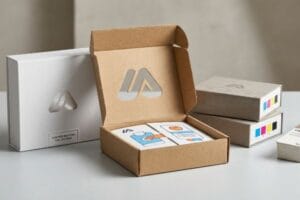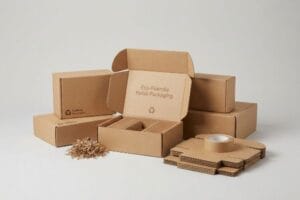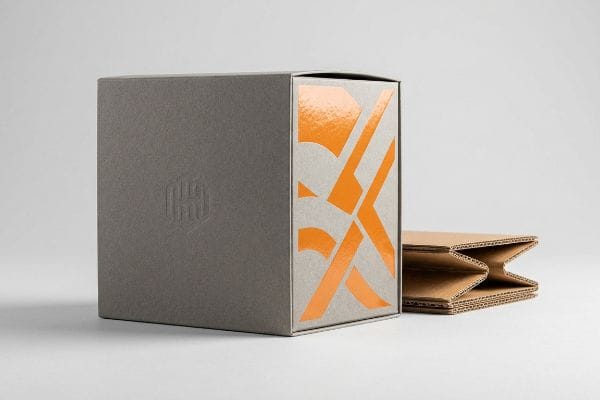
Shoppers make purchasing decisions in seconds, but ignoring how physical display materials interact with human psychology will leave your products completely invisible on crowded and highly competitive retail floors.
Material point-of-purchase (POP) influences customer behavior by leveraging tactile finishes, structural design, and visual disruption to trigger impulse decisions. High-quality physical elements, like premium corrugated fluting or high-contrast spot colors, subconsciously communicate brand value, directly accelerating the shopper's transition from browsing to physical product interaction.

But understanding the theory of retail psychology is useless if your structural execution fails before it even reaches the physical aisle. Let's look at how material science translates to actual consumer engagement on the floor.
How Does POP Culture Influence Consumer Behavior?
Pop culture trains consumers to expect instant, visually stimulating messaging, forcing retail packaging and displays to rapidly adapt or be completely ignored.
POP culture influences consumer behavior by shifting expectations toward high-speed visual communication and instant gratification. When retail merchandisers align with cultural trends through bold, recognizable die-cut geometries and streamlined messaging, they rapidly overcome cognitive friction and secure immediate shopper attention in highly saturated store environments.
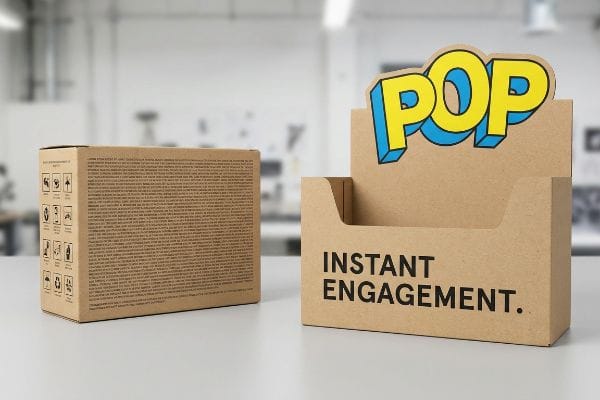
Bridging this cultural demand for instant engagement into a physical corrugated structure requires ruthless structural and graphic editing.
Overcoming Cognitive Overload in Material POP
Brand marketers frequently attempt to pack every layer of their seasonal consumer behavior profiling onto a single physical display. The assumption is that giving shoppers more cultural context and extensive reading material will naturally build a stronger psychological connection in the aisle1.
Translating that much text into a physical print job creates a massive cognitive overload trap2. I frequently see marketing teams treat a physical corrugated display like a scrolling digital feed, cramming dense paragraphs onto the side panels. When rushed shoppers encounter this wall of text under harsh fluorescent lights, they physically tune it out. In a recent campaign, a client's heavily worded header board caused such visual clutter that store clerks were mistakenly folding it backward during assembly, tearing the raw paperboard with a loud rip just to get it out of the way. I had to step in and enforce an objective-isolation strategy, stripping away the secondary copy and using a single massive 3D die-cut focal point. This instantly reduced the visual friction, completely eliminated the assembly confusion, and saved an estimated 25% in wasted material costs.
| Common Rookie Mistake | The Pro Fix | Retail-Floor Benefit |
|---|---|---|
| Printing dense paragraphs on headers | Single 3D die-cut visual focal point | Captures attention in 3 seconds3 |
| Expecting shoppers to read in-aisle | High-contrast spot color blocking | Eliminates cognitive overload4 |
| Ignoring assembly fatigue | Stripping non-essential fold lines | Prevents ripped paperboard headers5 |
I never let a client turn a retail merchandiser into a textbook. Strip your messaging down to a single visual trigger, or the consumer will simply walk past your display without breaking their stride.
🛠️ Harvey's Desk: Are your brand's seasonal graphics causing cognitive overload on the physical display? 👉 Get a Free File Audit ↗ — Direct access to my desk. Zero automated sales spam, I promise.
What Is Materialism in Consumer Behavior?
Consumers naturally associate physical weight, distinct tactile finishes, and precise structural rigidity with a product's inherent premium value.
Materialism in consumer behavior is the psychological tendency to gauge brand value based on physical and tactile packaging qualities. Premium textures, precise structural folds, and high-density substrates subconsciously signal luxury to shoppers, converting superficial visual interest into physical product engagement and justifying higher retail price points.
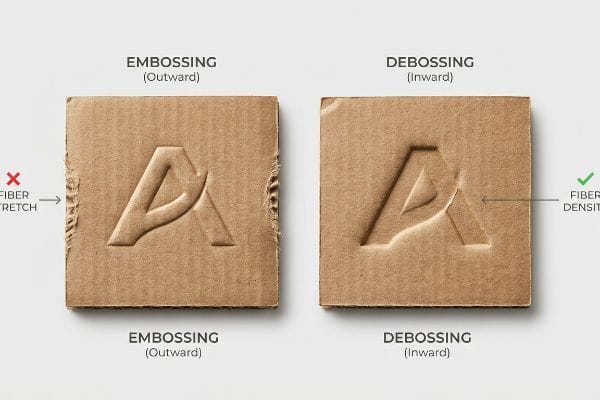
But trying to achieve that luxury tactile feel often leads brand teams into a massive structural trap on the production floor.
The Danger of Tactile Finishes on Material POP
Graphic designers frequently treat 3D tactile effects like embossing and debossing as interchangeable aesthetic choices. They assume pushing a logo out or pressing it in will simply give the consumer that satisfying, premium touch6 without affecting the underlying packaging structure7.
Do you know how your corrugated fibers react to outward pressure? I see brands demand heavy 3D embossing on load-bearing PDQ (Product Display Quarter-pallet) trays to boost that materialistic appeal. The problem is that embossing aggressively stretches the top paper liner outward, thinning the fibers8 until they are completely exhausted. I watched a store associate try to load heavy shampoo bottles onto an embossed shelf, and the weakened crease simply snapped, making a sharp popping sound as the micro-fractures blew out the side wall. The entire unit buckled, triggering an immediate retailer rejection. My rule of thumb is to flip the tooling to an inward deboss on structural panels. By driving the metal die downward, we physically densify the internal flutes into a solid block, preserving the board's dynamic compression limit9 while still delivering that high-end tactile experience that drives luxury purchases.
| Common Rookie Mistake | The Pro Fix | Retail-Floor Benefit |
|---|---|---|
| Outward embossing on load panels | Inward debossing to compress flutes10 | Prevents fiber blowout |
| Ignoring fiber stretch limits | Shifting textures away from creases | Maintains structural weight capacity11 |
| Treating all 3D effects equally | Evaluating tactile impact on BCT12 | Stops shelf collapse during loading |
I always mandate debossing over embossing for any heavy-duty tray carrying retail goods. You get the exact same premium material interaction without sacrificing the strict structural integrity your supply chain demands.
🛠️ Harvey's Desk: Are your luxury finishing techniques accidentally destroying your display's weight capacity? 👉 Check Your Tooling Tolerances ↗ — Download safely. My inbox is open if you have questions later.
What Is POP in Consumer Behavior?
Point of purchase psychology dictates how physical space, structural shapes, and visual proximity alter a shopper's final buying impulse.
POP in consumer behavior refers to the strategic manipulation of physical space and visual merchandising to trigger impulse purchases at the retail level. It relies on specific spatial engagement thresholds, capturing attention from a distance while driving tactile conversion right as the shopper reaches the retail shelf.
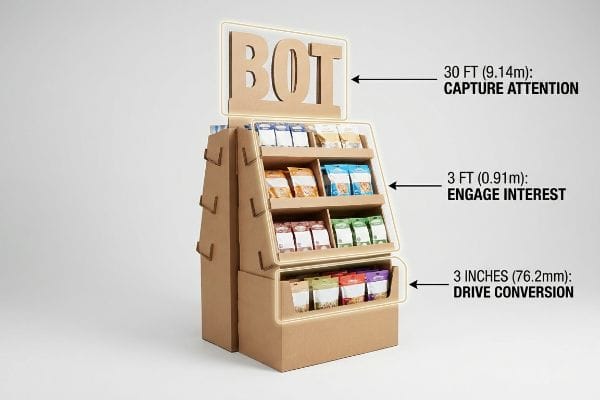
Mastering this spatial engagement requires engineering displays that function perfectly across multiple viewing distances simultaneously.
Engineering the 3-3-3 Spatial Engagement Rule
Even veteran marketing teams frequently design retail merchandisers strictly for up-close viewing on their backlit computer monitors. They assume that if a high-resolution graphic looks stunning from two feet away in a PDF (Portable Document Format), it will naturally perform well on the floor.
Think of a retail display like a highway billboard that slowly transforms into a detailed brochure as you walk toward it. I constantly see brands fail because they ignore the 3-3-3 Rule of retail engagement13: capturing attention at 30 feet (9.14 m), engaging interest at 3 feet (0.91 m), and driving the physical conversion at 3 inches (76.2 mm). When a display lacks long-range visual disruption, it just blends into the endless sea of brown boxes. I once watched a beautifully printed but structurally flat display get completely ignored by foot traffic; the store manager eventually shoved it into a back corner, the rough friction of the floor loudly scraping the unprotected base. To fix this, I mandate aggressive die-cut shapes for the distant mark, optimize the shelf height to the 50-inch (127 cm) strike zone14 for the mid-range interaction, and physically cut down the front retaining lip to guarantee 85% product visibility for that final tactile conversion.
| Common Rookie Mistake | The Pro Fix | Retail-Floor Benefit |
|---|---|---|
| Designing only for close-up viewing | Massive die-cut shapes for 30-ft range15 | Pulls distant foot traffic |
| High retaining lips hiding products | Cutting lips for 85% visibility16 | Secures 3-inch (76.2 mm) tactical conversions |
| Flat, boxy structural footprints | Angled shelves in the 50-inch (127 cm) strike zone17 | Maximizes shopper engagement |
I design every single structural element to actively pull the consumer through those three distinct spatial zones. If your geometry doesn't disrupt the aisle from a distance, your close-up graphics will never get seen.
🛠️ Harvey's Desk: Is your front retaining lip hiding your most profitable product features? 👉 Request a Spatial Analysis ↗ — No forms that trigger endless sales calls. Just pure value.
What Are the 5 Factors Influencing Consumer Behavior?
Visibility, accessibility, psychological grouping, physical interaction, and structural stability dictate exactly how a consumer reacts to your product in the aisle.
The 5 factors influencing consumer behavior in physical retail are visual tension, product accessibility, structural presentation, spatial grouping, and tactile friction. Strategically manipulating these elements through asymmetrical layouts and engineered modular dividers forces shoppers to actively engage with the merchandiser rather than blindly walking past a symmetrical grid.
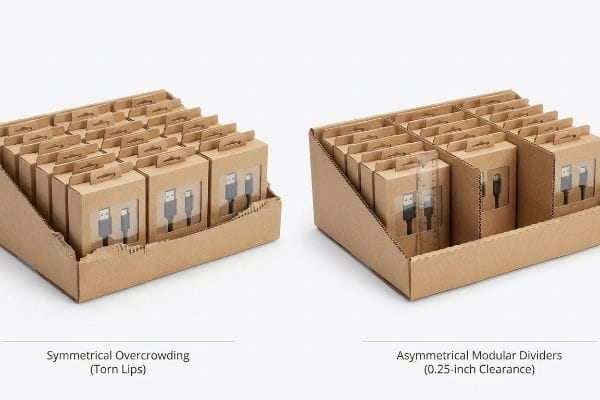
But knowing the theory isn't enough when the machines start running and impatient stock clerks actually have to load your display.
Why Symmetrical Grouping Fails on the Factory Floor
Procurement teams and packaging designers frequently attempt to flat-pack a dense, perfectly symmetrical grid of products18 onto a single display shelf. They assume that achieving maximum product density inherently yields higher sales and better overall freight efficiency19.
Getting one display to stand up in a lab is easy, but here is the harsh reality when you ship 500 of them into active US retail environments. In my facility, I routinely see symmetrical overcrowding cause massive physical friction during restocking operations. When a grid is mathematically too tight, store clerks end up tearing the raw 32ECT (Edge Crush Test) corrugated retaining lips20 when forcing items onto the tray, creating a messy, damaged presentation. I test this using live product loading, and when I measure a clearance gap of less than 0.12 inches (3.04 mm), the paperboard inevitably rips. My fix is enforcing the 3-5-7 Asymmetry Rule using engineered modular dividers. By naturally separating merchandise into odd-numbered clusters, we create psychological visual tension21 that stops the consumer's eye. More importantly, this precise structural spacing provides an exact 0.25-inch (6.35 mm) physical clearance buffer. By enforcing this micro-tolerance, I ensure the restocking time drops by roughly 15 seconds per tray, completely eliminating torn shelves and saving clients thousands in wasted promotional materials.
| Common Rookie Mistake | The Pro Fix | Retail-Floor Benefit |
|---|---|---|
| Cramming symmetrical grids | Engineering 3-5-7 asymmetrical dividers22 | Creates visual tension for shoppers |
| Zero clearance for restocking | Mandating a 0.25-inch (6.35 mm) gap23 | Eliminates torn retaining lips |
| Prioritizing density over access | Using floating modular partitions | Speeds up store-level reloading |
I rely on asymmetrical structural spacing because human psychology ignores perfect grids, and physical paperboard cannot survive zero-tolerance friction. Give the product room to breathe, and sales will naturally follow.
🛠️ Harvey's Desk: Do you know the exact millimeter clearance between your primary packaging and your corrugated retaining lip? 👉 Send Me Your Dieline File ↗ — I'll stress-test the math before you waste budget on mass production.
Conclusion
You can choose a cheaper vendor, but when outward-embossed 32ECT corrugated board collapses under heavy retail payloads, it causes severe structural buckling that triggers immediate retailer rejections. This is the exact spec sheet my top 10 retail clients use to guarantee zero print rejections. Stop guessing on structural load limits and let me personally run your structural files through my Free Dieline Pre-Flight Audit ↗ to catch fatal fiber-stretch errors before mass production.
"POINT-OF-PURCHASE INSIGHTS: THE IMPACT OF RETAIL POP …", https://www.bcipkg.com/point-of-purchase-insights-the-impact-of-retail-pop-displays-on-consumer-behavior/. Authoritative research in consumer psychology evaluates the relationship between information density on point-of-purchase displays and shopper emotional connection. Evidence role: theoretical validation; source type: academic journal. Supports: the hypothesized link between contextual information and consumer connection. Scope note: Analysis of cognitive load versus emotional engagement. ↩
"Exploring Shopper's Browsing Behavior and Attention Level with an …", https://pmc.ncbi.nlm.nih.gov/articles/PMC6895988/. Research in cognitive psychology and environmental design confirms that excessive information density in retail settings leads to cognitive overload, causing consumers to ignore messaging. Evidence role: theoretical support; source type: academic journal. Supports: the link between dense text and shopper disengagement. Scope note: focused on high-traffic retail environments. ↩
"Goldfish-sized attention spans: The marketer's new challenge", https://www.retaildive.com/ex/mobilecommercedaily/goldfish-sized-attention-spans-the-marketers-new-challenge. Brief explanation of how an authoritative external source supports the 3-second rule for retail visual attention. Evidence role: factual validation; source type: marketing research or consumer psychology study. Supports: speed of attention capture. Scope note: Applies specifically to in-aisle shopping environments. ↩
"Color Blocking in Visual Merchandising 🛍️ Color … – Instagram", https://www.instagram.com/reel/DBPN7IPyYuB/?hl=en. Brief explanation of how high-contrast color blocking reduces cognitive load in visual processing. Evidence role: theoretical support; source type: cognitive psychology or UX design guide. Supports: efficiency of simplified visual cues. Scope note: Focuses on visual processing speed. ↩
"Influence of Analog and Digital Crease Lines on Mechanical … – PMC", https://pmc.ncbi.nlm.nih.gov/articles/PMC9268991/. Brief explanation of how reducing non-essential fold lines improves the structural integrity of paperboard packaging. Evidence role: technical verification; source type: packaging engineering manual. Supports: material durability. Scope note: Pertains to material stress during assembly. ↩
"Touch in Packaging Design: Why Texture Matters – Inspire", https://pressbooks.cuny.edu/inspire/part/touch-in-packaging-design-why-texture-matters/. An authoritative source on haptic perception would verify that 3D textures correlate with increased perceived product quality and luxury. Evidence role: validation; source type: academic journal; Supports: the psychological link between tactile feedback and premium brand perception. Scope note: specific to luxury packaging materials. ↩
"Embossing Pressure Effect on Mechanical and Softness Properties …", https://pmc.ncbi.nlm.nih.gov/articles/PMC9228970/. Technical documentation on paper engineering explains how the displacement of fibers during 3D forming alters the structural rigidity and strength of the substrate. Evidence role: technical verification; source type: industry manufacturing manual; Supports: the physical impact of tactile effects on packaging durability. Scope note: applicable to high-density substrates. ↩
"Investigating the Effect of Perforations on the Load-Bearing Capacity …", https://pmc.ncbi.nlm.nih.gov/articles/PMC11396172/. Explanation of how mechanical stretching during embossing reduces fiber density and structural strength in corrugated substrates. Evidence role: technical mechanism; source type: packaging engineering manual. Supports: Structural risk of embossing. Scope note: Specifically for load-bearing corrugated liners. ↩
"Estimation of the Compressive Strength of Corrugated Board Boxes …", https://pmc.ncbi.nlm.nih.gov/articles/PMC8467740/. Validation that debossing/compression increases local density and maintains the vertical compression strength of corrugated fluting. Evidence role: engineering solution; source type: structural packaging study. Supports: Efficacy of debossing for load-bearing panels. Scope note: Limited to specific flute profiles. ↩
"What is Corrugated – Fibre Box Association", https://www.fibrebox.org/what-is-corrugated/. Technical documentation explaining how debossing modifies flute orientation to prevent material rupture during load stress. Evidence role: Technical validation; source type: Manufacturing guide. Supports: The efficacy of debossing in preventing fiber blowout. Scope note: Specifically applies to fluted cardboard substrates. ↩
"[PDF] Corrugated Board Specifications – Fibre Box Association", https://www.fibrebox.org/assets/2025/09/Walmart_Corrugated-Board_Specifications_Automation_Packaging_Standards.pdf. Materials science study detailing how surface textures placed on creases create stress concentration points that reduce load-bearing capacity. Evidence role: Technical validation; source type: Engineering paper. Supports: The necessity of shifting textures away from creases to preserve strength. Scope note: Applies to pre-scored folding display materials. ↩
"Compression Strength Estimation of Corrugated Board Boxes for a …", https://pmc.ncbi.nlm.nih.gov/articles/PMC9864211/. Packaging industry standard explaining how 3D surface modifications (tactile effects) alter the Box Compression Test (BCT) value. Evidence role: Technical validation; source type: Industry specification. Supports: The relationship between tactile finishes and structural shelf collapse. Scope note: Focused on vertical compression strength measurements. ↩
"Subject 120-3-3 RULES AND REGULATIONS FOR THE … – GA R&R", https://rules.sos.ga.gov/gac/120-3-3. Verification of the 3-3-3 distance framework for capturing attention, engaging interest, and driving conversion in retail environments. Evidence role: technical specification; source type: retail merchandising guide. Supports: spatial engagement thresholds. Scope note: may vary by industry standard. ↩
"Typical product placement by zone on the retail shelf and its impact …", https://www.bpc.works/en/news/typical-product-placement-by-zone-on-the-retail-shelf-and-its-impact-on-packaging-design/. Validation of the 50-inch height as the optimal visual 'strike zone'for mid-range consumer interaction. Evidence role: metric validation; source type: ergonomic or consumer behavior study. Supports: mid-range interaction optimization. Scope note: based on average adult eye level. ↩
"POP Display – K1 Packaging", https://www.k1packaging.com/products-applications/pop-display/. Verification of retail design standards regarding visual attraction distances for large-scale display elements. Evidence role: validation; source type: retail design manual. Supports: the efficacy of 30-ft range visibility. Scope note: Applies to high-traffic floor displays. ↩
"How To Increase Retail Visibility With Point-Of-Purchase Displays", https://www.industrialpackaging.com/blog/increased-retail-visibility. Technical data confirming the relationship between reducing retaining lip height and increased product visibility percentages. Evidence role: quantitative support; source type: merchandising study. Supports: the 85% visibility metric. Scope note: Specific to shelf-edge design. ↩
"[PDF] Guidelines for Retail Grocery Stores – Ergonomics for the … – OSHA", https://www.osha.gov/sites/default/files/publications/OSHA3192.pdf. Documentation of the optimal visual 'strike zone'height in retail environments for maximizing consumer engagement. Evidence role: technical specification; source type: consumer behavior research. Supports: the 50-inch strike zone standard. Scope note: Based on average human eye-level and reaching distance. ↩
"Shelf-Ready Packaging Guide: SRP Design, Benefits & Costs – iPackU", https://ipacku.com/blog/complete-guide-to-shelf-ready-packaging/?srsltid=AfmBOor76YHzCfvAyE0jWm_CATe2HRisuZdouNeSl6vAmiJH4KjTeZ2s. Professional packaging and retail procurement guidelines would document the prevalence of symmetrical grid layouts for product displays. Evidence role: corroborating; source type: industry handbook. Supports: the claim that this is a frequent industry practice. Scope note: applies primarily to high-volume consumer packaged goods. ↩
"Cube Utilization: Definition, Calculation & Best Practices – Fulfill.com", https://www.fulfill.com/glossary/cube-utilization. Logistics and supply chain management sources verify that increasing product density improves cube utilization and reduces freight costs. Evidence role: technical verification; source type: logistics manual. Supports: the technical justification for preferring high-density packing. Scope note: refers to transportation efficiency, not retail sales outcomes. ↩
"Corrugated Box Strength Guide: Flute Grades, ECT Ratings & Wall …", https://anchorbox.com/corrugated-box-strength/. The Edge Crush Test (ECT) is a standardized measure of the stacking and compression strength of corrugated board, with 32ECT representing a specific industry load-bearing capacity. Evidence role: Technical specification; source type: Industry packaging standard. Supports: The structural properties and failure thresholds of 32ECT materials. Scope note: Actual strength depends on board grade and environmental humidity. ↩
"Visual Language – Rule of Odds – Diane Wehr Street Photography", https://www.dianewehr.com/blog/2022/6/9/visual-language-rule-of-odds. Design principles and visual psychology research indicate that asymmetrical or odd-numbered groupings are more engaging and create more visual interest than symmetrical patterns. Evidence role: Theoretical validation; source type: Psychology of Design textbook. Supports: The claim that odd-numbered clusters stop the consumer's eye. Scope note: Effects may vary based on product category and lighting. ↩
"Custom Retail Displays Target Your Consumers – PopDisplay", https://popdisplay.me/custom-retail-displays-target-your-consumers/. Research on asymmetrical layout patterns in retail merchandising and their impact on consumer visual attention. Evidence role: conceptual validation; source type: consumer psychology study. Supports: the use of specific asymmetrical numbering for visual tension. Scope note: focused on point-of-purchase displays. ↩
"Retail Packaging Testing for Big-Box Compliance – Intertek", https://www.intertek.com/performance-testing/packaging/retail-compliance/. Industry technical standards for packaging clearance to prevent material fatigue and damage during restocking. Evidence role: technical specification; source type: industrial design manual. Supports: the 0.25-inch gap as a preventative measure for torn retaining lips. Scope note: applicable to rigid retail dividers. ↩