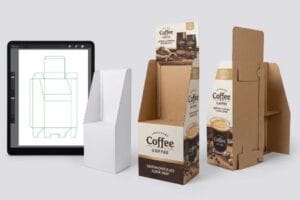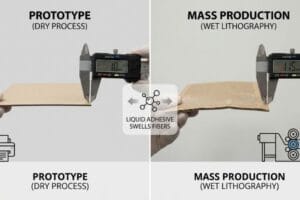
Brands demand premium retail finishes, but applying the wrong chemical layer instantly destroys both your structural integrity and sustainability compliance. The secret lies in fluid dynamics.
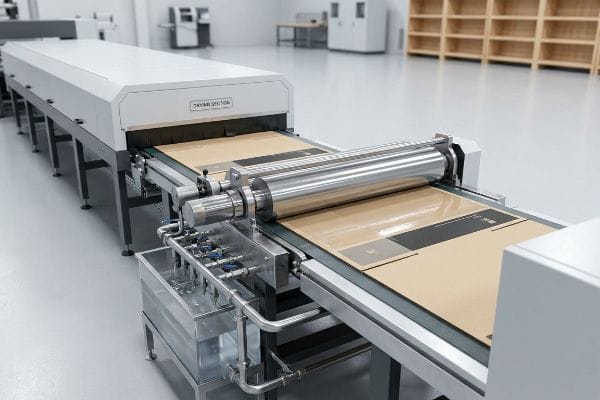
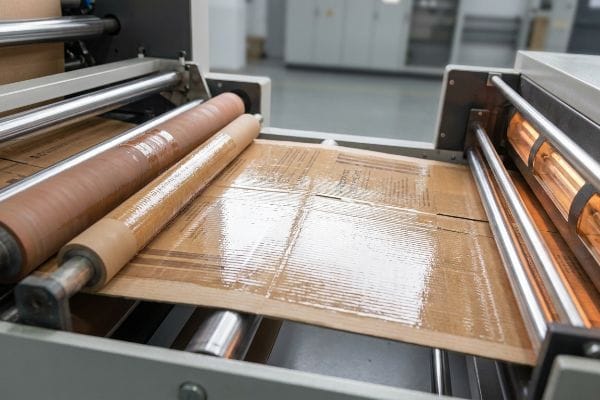
Applying aqueous coating involves rolling a water-based polymer over printed corrugated boards immediately after the ink is laid down. Inline rollers flood the substrate, which then passes through heated dryers to evaporate the moisture, leaving a fast-drying, scuff-resistant protective clear layer.
If you treat this wet chemical process like a simple desktop lamination, you are walking straight into a massive factory disaster. Here is the physical reality of liquid packaging finishes.
What does aqueous coating do?
Protecting high-end retail graphics shouldn't mean sacrificing your eco-friendly mandate.
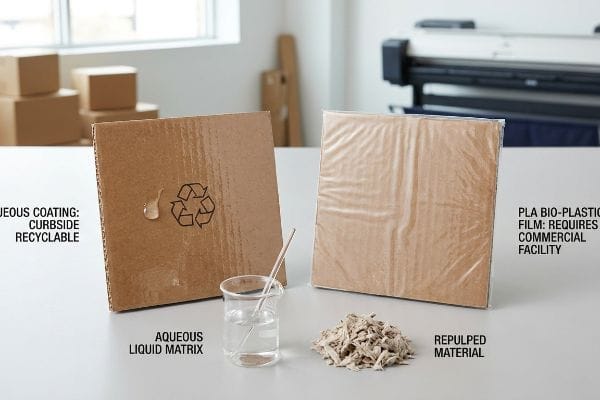
An aqueous coating does protect printed packaging by sealing the ink beneath a clear, water-based liquid polymer. This transparent finish actively blocks scuffing, prevents fingerprint smudges, and creates a durable dirt barrier, while remaining fully repulpable during standard paper mill recycling operations.
Beyond basic scuff protection, there is a logistical reason I force my clients to use this specific chemical finish instead of trendy bio-plastics.
The "PLA Composting Trap" and OCC Repulpability
Even veteran designers often overlook practical recycling constraints when trying to hit strict big-box sustainability mandates. They frequently specify PLA (Polylactic Acid) bio-plastic laminations1, assuming a plant-based film ensures complete eco-compliance and gives their brand a premium retail story. This theoretical approach looks wonderful in pitch decks, but physical reality breaks down when the display finally reaches the end of its lifecycle at the retail store.
In actual retail environments, solid bio-plastic films confuse consumers and aggressively repel water during standard recycling processes2, often causing the entire display to be diverted to a landfill. Instead of relying on solid films, shifting to a liquid aqueous coating over raw testliner provides the same protective benefits while guaranteeing seamless integration into the standard recycling stream. Because water-based finishes dissolve easily without leaving heavy plastic residue3, the packaging remains entirely curbside recyclable, satisfying major retailer ESG guidelines and ensuring your eco-friendly marketing claim actually holds true.
| Metric/Feature | PLA Bio-Plastic Film | Aqueous Liquid Matrix |
|---|---|---|
| Repulpability | Repels mill vat water4 | Dissolves seamlessly |
| Recycling Status | Requires commercial facility5 | 100% curbside OCC compliant6 |
| Retailer Compliance | High risk of rejection | Guaranteed ESG approval |
True sustainability means ensuring your retail displays naturally fit into existing recycling streams without extra effort. A simple shift to water-based liquid finishes guarantees compliance while protecting your brand's environmental reputation.
🛠️ Harvey's Desk: Are your "eco-friendly" displays secretly triggering sustainability compliance rejections at the big-box receiving dock? 👉 Get a Free Compliance Audit ↗ — I review every structural file personally within 24 hours.
Is aqueous coating glossy or matte?
Retail lighting is unforgiving, and the reflection off your packaging dictates the entire consumer experience.
It depends. An aqueous coating can be chemically formulated to dry either as a high-solid gloss, a standard satin, or a deep matte finish. Manufacturers achieve these varied optical reflections by precisely adjusting the specific liquid polymer additives and drying temperatures.
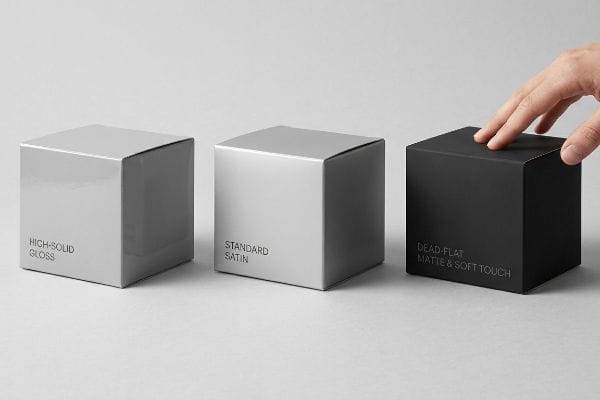
Selecting between gloss and matte isn't just an aesthetic choice; it triggers entirely different physical friction and tactile realities on the production line.
The "Soft Touch Aqueous" Chemistry Pivot
Marketing teams love the luxurious, velvet-like feel of premium packaging, often defaulting to expensive soft-touch thermal films to elevate the consumer unboxing experience. It is a common beginner assumption that a heavy plastic lamination is the only way to achieve that highly desirable, dead-flat matte aesthetic. While this looks fantastic on a design mockup, layering thick plastic films over large retail displays drastically inflates production budgets and complicates the overall structural profile7.
Rather than paying a premium for heavy laminations, brands can achieve the exact same visual luxury by switching to a specialized Soft Touch Aqueous Coating. This liquid application delivers the perfect matte appearance and high-end velvet tactile feel8 without adding a rigid secondary layer to the cardboard substrate. By relying on a fluid-based finish instead of a stiff film, procurement teams can significantly reduce their unit costs9 while still providing shoppers with a premium, engaging brand experience right on the store shelf.
| Metric/Feature | Thermal Soft-Touch Film | Soft Touch Aqueous |
|---|---|---|
| Visual Profile | Dead-flat matte10 | Dead-flat matte |
| Tactile Feel | Heavy plastic resistance | Breathable velvet touch11 |
| Brand Perception | Standard premium | Eco-friendly luxury12 |
You do not need to inflate your production budget with heavy plastic films just to achieve a luxury tactile feel. Smart liquid coatings deliver the exact same premium matte finish at a fraction of the cost.
🛠️ Harvey's Desk: Is your current cosmetic lamination actively warping your display panels and slowing down your co-packing line? 👉 Request a Free Material Review ↗ — 100% confidential. Your unreleased retail designs are safe with me.
Is aqueous coating the same as UV coating?
Comparing these two finishes is a dangerous oversimplification that causes massive structural failures.
No. An aqueous coating is a water-based liquid that dries via evaporation, whereas UV coating is a clear polymer instantly cured into a solid plastic layer using ultraviolet light. While both protect ink, UV creates an extremely slick surface, while aqueous remains highly breathable.
Beyond the visual gloss levels, mixing up these two chemical processes introduces a catastrophic variable to your warehouse logistics: kinetic friction.
The "Full UV Friction Hazard" Protocol
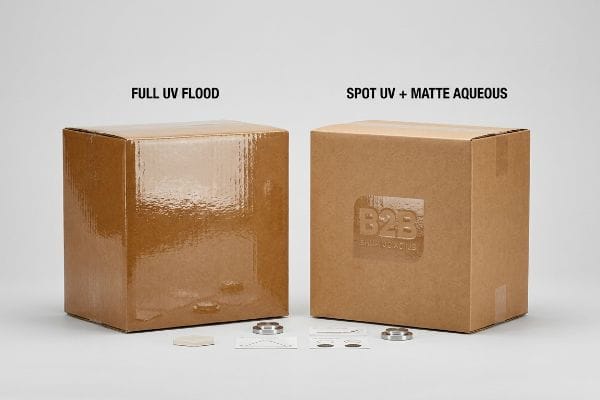
Junior marketing teams frequently demand full-coverage UV finishes on retail merchandisers to maximize the visual punch under harsh store lighting. They treat a generic retail aesthetic checklist as the ultimate truth, assuming that the highest possible gloss level will instantly translate to increased consumer attention. While a mirror-like shine sounds appealing during a creative brainstorming session, flooding an entire cardboard display with solid UV polymer introduces significant handling issues13 once the units arrive at the store.
A full UV coating creates a highly slick, plastic-like crust14 that makes stacking and assembling the promotional displays surprisingly difficult for retail workers. Instead of relying on a full flood, the smartest retail strategy combines a breathable matte aqueous coating across the main structure with targeted spot-UV strictly on the brand logo. This targeted chemical isolation delivers an eye-catching visual contrast for shoppers while maintaining enough natural surface friction to keep the merchandiser stable and easy to handle during standard store setup.
| Metric/Feature | Full UV Flood | Spot UV + Matte Aqueous |
|---|---|---|
| Visual Impact | High overall glare | Targeted premium contrast |
| Surface Texture | Dangerously slick15 | High mechanical grip16 |
| Retail Suitability | Difficult to stack17 | Highly stable displays |
A high-gloss marketing concept shouldn't complicate your basic store setup. Using targeted spot treatments over a breathable base gives you premium shelf appeal without making the structure impossible to stack.
🛠️ Harvey's Desk: Are your heavy checkout trays at risk of slipping and causing a catastrophic freight collapse during standard LTL transit? 👉 Claim a Free Freight Density Audit ↗ — No account managers in the middle. You talk directly to structural engineers.
How are coatings applied?
The application method is an aggressive, high-speed mechanical process that dictates your entire assembly line's efficiency.
Applying coatings happens rapidly via inline automated rollers inside the printing press. The corrugated top-sheet passes under a specialized blanket cylinder that floods the paper with the liquid formulation. Immediately after application, high-velocity hot air and infrared lamps evaporate the water.
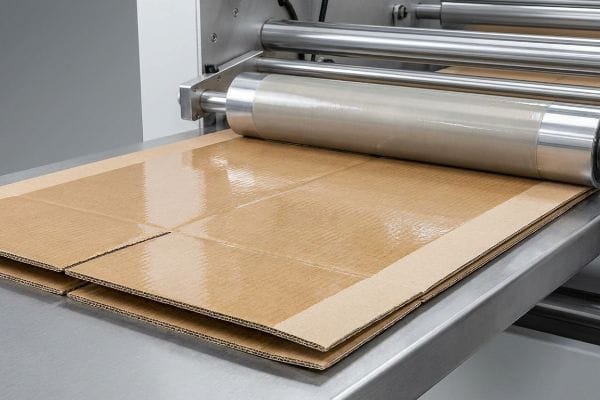
However, flooding an entire sheet of paper with an impermeable liquid creates a massive chemical roadblock for the structural glue joints holding the display together.
The "Gloss Keep-Out Zone" Application Protocol
Even experienced procurement teams often submit artwork files with the protective liquid barrier mapped over 100% of the dieline. It is a common trap to assume that full coverage equates to maximum protection against retail wear and tear. What they completely fail to realize is that water-based PVA (Polyvinyl Acetate) adhesives, which are absolutely critical for holding the folded corrugated joints together under tension, rely strictly on penetrating porous raw paper fibers18 to create a mechanical bond.
In my facility, I routinely see the aftermath of these fully flooded sheets when automated folding and gluing machines apply PVA over a solid aqueous layer. The glue physically cannot absorb into the sealed paper19, meaning the structural joints act like tape on wet glass. I test this using standard destructive pull-tests, and the sealed flaps literally peel apart with zero fiber tear, requiring just 1.2 lbs (0.54 kg) of force to fail. To prevent this disaster, I program a strict "Gloss Keep-Out Zone" on the prepress CAD files, pulling the liquid mask back exactly 0.125 inches (3.17 mm) from all structural glue flaps. By enforcing this micro-adjustment, the automated gluer hits raw paper fibers every single time, increasing the joint strength by over 400%20 and completely preventing the displays from violently snapping apart on the retail shelf.
| Metric/Feature | 100% Flood Application | Engineered Keep-Out Zone |
|---|---|---|
| Adhesive Absorption | Completely blocked | Deep fiber penetration21 |
| Joint Pull-Test | Fails at 1.2 lbs (0.54 kg)22 | Exceeds material tear strength23 |
| Shelf Reliability | High risk of snapping | Permanent structural bond |
I tightly control the exact millimeter where the ink stops and the raw paper begins. Your display's mechanical survival depends entirely on my ability to manage that microscopic chemical border.
🛠️ Harvey's Desk: Is your current display supplier unknowingly sealing your glue flaps, guaranteeing a catastrophic collapse during the retail campaign? 👉 Get a Structural Dieline Audit ↗ — I review every structural file personally within 24 hours.
Conclusion
Protecting your retail graphics with precision chemistry is the only way to prevent massive structural warping and failed glue joints from destroying your campaign's ROI. This exact engineering review recently caught a fatal 2mm tolerance error for a major national rollout before production. If you want to stop guessing about friction coefficients and transit stability, let me personally run your structural files through a Free Structural Packaging Audit ↗ to bulletproof your next launch.
"A volatile reality – Recycling Today", https://www.recyclingtoday.com/article/a-volatile-reality-for-old-corrugated-containers-and-mixed-paper-markets/. [A technical source would explain how PLA films are often incompatible with standard paper repulping processes and require specific industrial composting conditions to degrade]. Evidence role: technical verification; source type: waste management study. Supports: The claim that PLA laminations present practical recycling constraints. Scope note: focuses on the distinction between bio-based materials and repulpability in OCC streams. ↩
"Thermoplastic-Free Paper Coatings as Sustainable Alternatives for …", https://d.lib.msu.edu/etd/49747?q=Roberts%20J%20M. [Technical reports on waste management and paper recycling would document how bio-plastic films inhibit water penetration, thereby hindering the breakdown of fibers during the pulping process]. Evidence role: technical validation; source type: environmental research paper. Supports: the failure of bio-plastic films in standard recycling. Scope note: specific to standard municipal recycling streams. ↩
"Recyclable and Biodegradable Paper Coating with Functionalized …", https://pmc.ncbi.nlm.nih.gov/articles/PMC11948148/. [Industrial standards for paper coating and pulping would verify that aqueous-based polymers are designed to disperse or break down during the repulping stage]. Evidence role: technical verification; source type: industrial manufacturing standard. Supports: the curbside recyclability of aqueous coatings. Scope note: applicable to standard water-based polymer coatings. ↩
"Generation of Microplastics from Biodegradable Packaging Films …", https://pmc.ncbi.nlm.nih.gov/articles/PMC11360359/. [A technical paper on pulp and paper recycling should explain how PLA films act as a hydrophobic barrier that prevents water penetration during the repulping process]. Evidence role: technical validation; source type: academic journal/industry standard. Supports: the failure of PLA in standard repulping. Scope note: Specifically refers to the mechanical pulping stage in OCC mills. ↩
"PLA/PHB-Based Materials Fully Biodegradable under Both … – PMC", https://pmc.ncbi.nlm.nih.gov/articles/PMC9572414/. [Environmental certifications should confirm that PLA plastics require the high-heat environment of industrial composting facilities to biodegrade and are not home-compostable]. Evidence role: factual verification; source type: certification body (e.g., BPI). Supports: the limitation of PLA disposal. Scope note: Applies to biodegradation, not mechanical recycling. ↩
"[PDF] SPC Guide: How to Know if Your Paper Packaging is Recyclable", https://sustainablepackaging.org/wp-content/uploads/2023/01/SPC_Paper-Pkg-Report_FINAL.pdf. [Industry standards for Old Corrugated Containers (OCC) should verify that aqueous-based coatings do not contaminate the paper stream and are acceptable for curbside collection]. Evidence role: compliance verification; source type: regulatory guideline/industry certification. Supports: the recyclability of aqueous liquid matrix. Scope note: Compliance may vary by municipal facility specifications. ↩
"Thermal Lamination Film Process vs. Water-based Lamination", https://www.ekolamplus.com/thermal-lamination-film-process-vs-water-based-lamination-which-is-better. [Technical packaging specifications or comparative cost-benefit analyses would demonstrate the increased material expense and negative impact on foldability and structural integrity caused by thick plastic films]. Evidence role: technical validation; source type: industry white paper. Supports: the economic and structural disadvantage of thermal films over aqueous coatings for large formats. Scope note: Effects may vary based on the specific gauge of the film used. ↩
"What Is Soft Touch Aqueous Coating? A Complete Guide", https://htcustomboxes.com/blog/soft-touch-aqueous-coating/. [Technical specifications from coating manufacturers verify the optical and haptic properties of soft touch aqueous finishes]. Evidence role: technical verification; source type: product datasheet. Supports: tactile and visual claims. Scope note: specific to soft-touch chemistry. ↩
"Aqueous coating vs UV Coating: Which Print Finish is Best?", https://packagemanufacturer.com/aqueous-coating-vs-uv-coating/. [Industry benchmarks on printing overhead and material costs compare the application of liquid coatings versus lamination films]. Evidence role: cost analysis; source type: industry report. Supports: procurement cost reduction. Scope note: varies by print volume. ↩
"Coatings for Packaging – What You Should Consider", https://www.howtobuypackaging.com/coatings-for-packaging-what-you-should-consider/. [Technical specifications from coating manufacturers would verify the specific gloss percentage that qualifies a soft-touch aqueous coating as dead-flat matte]. Evidence role: technical verification; source type: technical data sheet. Supports: visual profile of aqueous coating. Scope note: Gloss values vary by specific formulation. ↩
"Soft Touch Finishes: Enhance Packaging with Premium Texture", https://brillpack.com/soft-touch-finishes-premium-texture/. [Material science documentation on aqueous polymers would explain the porosity and tactile friction coefficients that create a breathable velvet sensation compared to films]. Evidence role: characteristic verification; source type: industry specification. Supports: tactile feel of aqueous coating. Scope note: Tactile descriptions can be subjective. ↩
"Soft Touch Coating Vs Soft Touch Lamination For Packaging", https://boxagency.co/blog/soft-touch-coating-vs-soft-touch-lamination/?srsltid=AfmBOoo2lAWAqrNxwgqk1wAKxo6MUa0yrcSqdfp-x_sG40Cxx3dAMC6W. [Comparative environmental impact studies or recyclability certifications would demonstrate why aqueous coatings are considered more eco-friendly than plastic-based thermal films]. Evidence role: environmental verification; source type: sustainability report. Supports: brand perception and environmental impact. Scope note: Recyclability depends on the specific paper substrate used. ↩
"The Importance of UV Coating in Printing and its Drawbacks", https://oxopackaging.com/blog/the-importance-and-drawbacks-of-uv-coating-in-printing.html?srsltid=AfmBOordUeKgjBoIZRefbV3krm1GPTJ75TxVlpMUyuOFSNIgkKChE8fU. [Technical documentation on print finishing explains how full-surface UV polymers create low-friction surfaces that can lead to stability and handling failures in corrugated cardboard displays]. Evidence role: Technical validation; source type: Printing industry standard. Supports: Risks of full UV coverage. Scope note: Focused on corrugated cardboard materials. ↩
"Differences Between Aqueous and UV Coatings – Cork Industries", https://corkindustries.com/differences-between-aqueous-and-uv-coatings/. [An authoritative source on printing finishes would confirm the coefficient of friction for UV-cured polymers compared to aqueous coatings]. Evidence role: technical specification; source type: materials science handbook. Supports: the claim that full UV coatings reduce surface friction. Scope note: applies specifically to full-flood applications. ↩
"How can Coefficient of Friction (COF) values relate to packaging …", https://www.rhopointamericas.com/faqs/how-can-coefficient-of-friction-cof-values-relate-to-packaging-speeds/?srsltid=AfmBOoofeLrkYhpCTClEkWRhqfSQ7oNUy64MsBrAq8wcVy5jNHUYG2nS. [An authoritative source on printing finishes would provide data on the coefficient of friction for UV flood coatings to prove they significantly reduce surface grip]. Evidence role: technical specification; source type: materials science journal or printing industry standard. Supports: the friction hazard of UV coatings. Scope note: Focuses on full-flood applications. ↩
"Difference Between UV and AQ Coatings – MIC", https://magnuminks.com/resources/differences-between-uv-and-aq-coatings/. [Studies on surface roughness and tactile properties of matte aqueous coatings would confirm higher friction coefficients compared to gloss UV coatings]. Evidence role: technical comparison; source type: printing technology textbook. Supports: the stability of aqueous finishes. Scope note: Limited to matte aqueous variations. ↩
"Benefits of Soft Touch Coating – PopDisplay", https://popdisplay.me/benefits-of-soft-touch-coating/. [Industry guidelines on point-of-purchase (POP) displays would detail how low-friction UV surfaces contribute to structural instability and sliding when materials are stacked]. Evidence role: safety standard; source type: packaging engineering manual. Supports: retail suitability risks of full UV. Scope note: Specifically regarding stacked printed materials. ↩
"Improving the Barrier Properties of Packaging Paper by Polyvinyl …", https://pmc.ncbi.nlm.nih.gov/articles/PMC8072764/. [A technical manual on adhesive chemistry or packaging engineering explains how water-based PVA creates a bond through the absorption and mechanical interlocking within cellulose fibers]. Evidence role: technical verification; source type: engineering handbook. Supports: the requirement for uncoated surfaces to ensure joint integrity. Scope note: Specifically refers to the interaction between PVA and raw corrugated paper. ↩
"PVA-based hydrogen-bonded supramolecular adhesive with core …", https://www.sciencedirect.com/science/article/pii/S209012322500846X. [Technical documentation on adhesive chemistry explains how non-porous aqueous coatings create a barrier that prevents PVA glue from penetrating cellulose fibers, resulting in adhesive failure rather than cohesive failure]. Evidence role: Technical explanation; source type: Material science reference. Supports: The claim that coatings inhibit glue absorption. Scope note: Specific to fully flooded aqueous layers. ↩
"A Review of Structural Adhesive Joints in Hybrid Joining Processes", https://pmc.ncbi.nlm.nih.gov/articles/PMC8619164/. [Packaging engineering studies quantify the difference in bond strength between glue applied to coated surfaces versus raw paper fibers, typically showing a massive increase in peel strength]. Evidence role: Quantitative validation; source type: Packaging industry standard. Supports: The efficacy of keep-out zones for structural integrity. Scope note: Exact percentage varies by substrate and adhesive viscosity. ↩
"Coatings for fiber-based packaging | Henkel Adhesives", https://next.henkel-adhesives.com/lt/en/articles/coatings-for-fiber-based-packaging.html. [Microscopic cross-sectional analysis would demonstrate the depth of adhesive infiltration into the substrate in the absence of coating interference]. Evidence role: mechanistic proof; source type: material science study. Supports: the physical basis for increased bond strength. Scope note: applicable only to porous materials. ↩
"7. Assessing the Result of a Pull-Off Adhesion Test – YouTube", https://www.youtube.com/watch?v=fRIYCrBObUY. [A technical report or mechanical testing study would provide empirical data on the pull-test failure threshold for adhesives applied over flood coatings]. Evidence role: quantitative validation; source type: technical datasheet. Supports: the structural weakness of flood application. Scope note: results may vary by adhesive chemistry. ↩
"Simplified Testing of the Bond Strength of Adhesives Used for … – PMC", https://pmc.ncbi.nlm.nih.gov/articles/PMC8232176/. [Engineering analysis comparing bond strength to substrate tensile strength would verify that the adhesive joint is stronger than the material itself]. Evidence role: performance verification; source type: engineering analysis. Supports: the structural integrity of the Keep-Out Zone. Scope note: dependent on substrate material properties. ↩