
Struggling to secure premium floor space? Retail real estate is fiercely competitive, and poorly planned merchandisers often end up hidden in the back room instead of driving impulse sales.
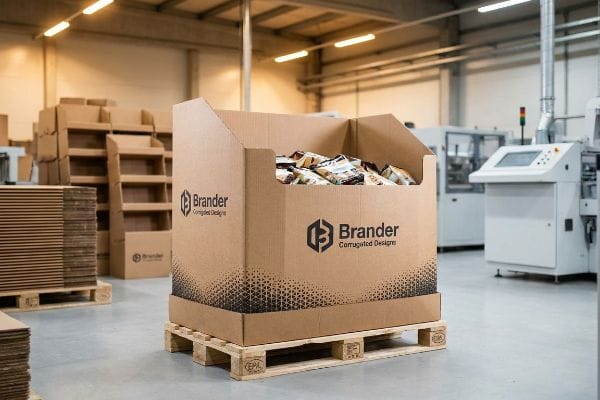
Dump bins and pallets maximize retail floor density by organizing bulk merchandise into highly visible, freestanding promotional units. These structured fixtures efficiently convert empty aisles into active conversion zones, allowing retail brands to move high volumes of product while maintaining strict compliance with big-box spatial limits.
But understanding their basic function won't protect you from the mechanical realities that ruin campaigns on the factory floor.
What Is a Dump Bin Display?
Understanding the structural limits of an open-top container is the first step to avoiding a costly retail disaster.
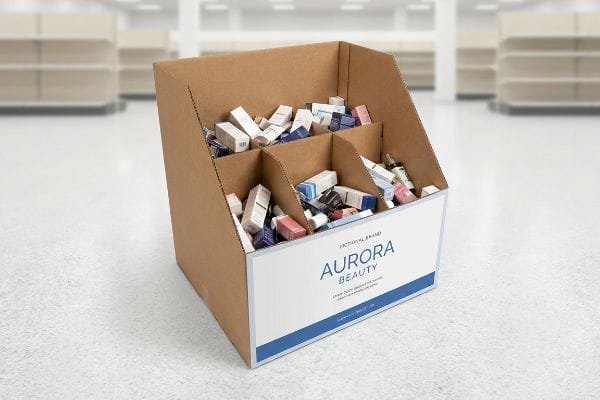
A dump bin display is a freestanding, open-top corrugated container designed to hold loose, irregularly shaped merchandise. These bulk merchandisers encourage rapid impulse buying in high-traffic aisles, allowing shoppers to easily grab individual products without interacting with complex shelving systems or rigid packaging structures.
A simple box sounds easy to manufacture, but removing the lid completely alters its physical integrity.
The Hidden Threat of the Dump Bin Bulge
Most entry-level designers treat these fixtures as giant, simple boxes. They specify a standard HSC (Half Slotted Container) configuration1, slice the top flaps off, and assume the raw 32 ECT (Edge Crush Test) corrugated board2 will naturally contain hundreds of loose items.
I see this blind spot constantly when brands try to load heavy cosmetics or hardware into open-faced bins. Without a lid holding the four corners in tension, the lateral outward pressure from the loose goods3 forces the side panels to bow outward. The first time a stock boy dumps a heavy master carton of product into the unreinforced cavity, I can literally hear the internal corrugated flutes crunch and buckle under the sudden kinetic outward shear. To fix this, I strictly engineer an internal "H-Divider" or wrap a hidden "Belly Band" reinforcement into the die-line. This simple internal skeleton anchors the outer walls, completely eliminating the outward bulge and ensuring the unit stays perfectly square, preventing rapid structural fatigue on the retail floor.
| Common Rookie Mistake | The Pro Fix | Retail-Floor Benefit |
|---|---|---|
| Relying on empty box walls | Installing internal H-Dividers4 | Prevents sidewall bulging |
| Using single-wall board | Specifying 32ECT double-wall5 | Stops corner buckling |
| Skipping tension supports | Adding a hidden belly band6 | Keeps display perfectly square |
I never rely on static wall strength for bulk containers. Adding a cheap internal support grid absorbs the lateral pressure before it ruins your branded exterior.
🛠️ Harvey's Desk: Not sure if your open-top bin will bulge under heavy merchandise? 👉 Request a Structural Audit ↗ — Direct access to my desk. Zero automated sales spam, I promise.
What Makes a Good Retail Display?
Achieving visual dominance requires a strict understanding of shopper psychology and harsh big-box lighting environments.
A good retail display captures consumer attention from thirty feet away, engages interest at three feet, and converts the sale at three inches. This strategic visual hierarchy relies on high-contrast colors, clear structural messaging, and unhindered physical access to the actual physical product inside.
Designing a beautiful graphic on a backlit monitor is easy, but translating that file into physical cardboard is where amateur campaigns fall apart.
Surviving the CMYK Halftone Mud Trap
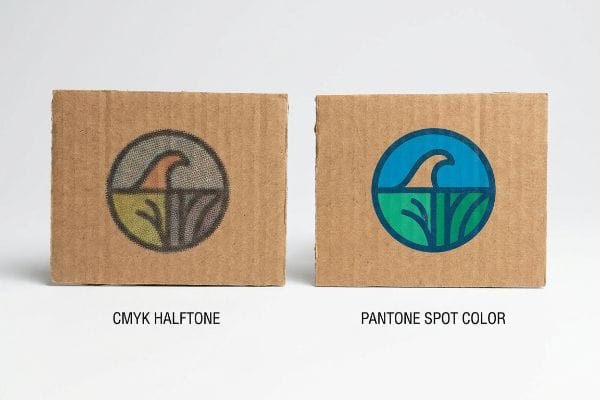
Brand teams frequently export their corporate logos in standard CMYK (Cyan, Magenta, Yellow, Key) formats7, assuming the massive four-color printing process will seamlessly match their digital screens. They build intricate, multi-layered gradients and expect them to shine under harsh fluorescent store lighting8.
You often wonder why a brilliant digital concept looks incredibly grainy in person. This happens because standard CMYK relies on tiny overlapping halftone dots9 that absorb unevenly into porous testliner paper fibers. When I rub my thumb across a freshly printed CMYK flood on raw corrugated board, the optical blending fails mechanically, creating a washed-out, muddy texture. Instead of gambling on dot absorption, I mandate a spot color flood protocol for primary logos. By swapping the CMYK process for a pre-mixed, solid Pantone ink10, we lay down a dense, perfectly smooth pigment that eliminates all grain. This absolute color fidelity guarantees your brand visually pops from thirty feet away, driving aggressive foot traffic right to your pallet.
| Common Rookie Mistake | The Pro Fix | Retail-Floor Benefit |
|---|---|---|
| Printing logos in CMYK | Using solid Pantone spot colors11 | Eliminates blurry halftone dots |
| Ignoring paper absorption | Formulating high-viscosity ink12 | Keeps graphics crisp and bright |
| Relying on monitor proofs | Scanning physical ink draw-downs13 | Matches harsh store lighting |
I refuse to let porous paper fibers dictate brand equity. Forcing a spot color flood ensures your central message cuts through the visual noise of a crowded aisle.
🛠️ Harvey's Desk: Are your brand colors turning muddy on raw corrugated board? 👉 Get a Prep-Press Review ↗ — Download safely. My inbox is open if you have questions later.
What Is a Dump Bin in Retail?
Big-box retailers ration their floor space ruthlessly, meaning your fixture's physical footprint dictates its acceptance.
In retail, dump bins serve as strategic, freestanding promotional vessels designed to trigger rapid impulse purchases. These low-cost, high-volume fixtures bypass traditional inline shelving, allowing store managers to quickly deploy heavy seasonal or bulky overstock merchandise directly into high-traffic intersections and active checkout aisles.
Securing aisle placement sounds straightforward until your structural footprint violates strict store navigation guidelines.
The Fractional Pallet Geometry Rule
Startups often pitch massive, full-size 48×40 inch (1219×1016 mm) floor displays14 to buyers, assuming their promotional campaign deserves an entire wooden base. They design these wide structures to maximize unit capacity without considering the store's rigid spatial limitations.
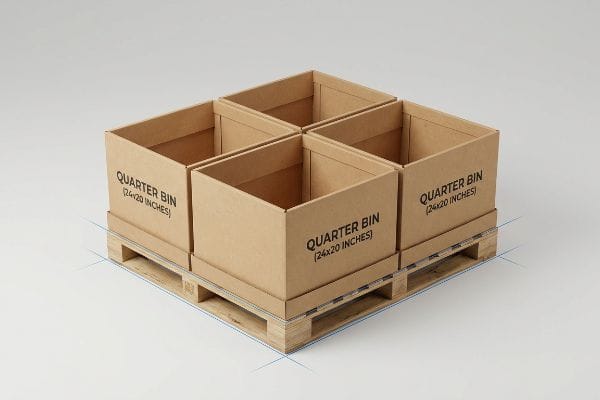
Think of retail floor space like expensive waterfront real estate; you cannot just build a mansion on a tiny lot. When buyers reject a massive footprint, I immediately scale the architecture down to precise fractional pallet dimensions, like a quarter-pallet measuring exactly 24×20 inches (609×508 mm)15. The satisfying lock of placing four distinct promotional quarter-bins onto a single standard base is a game-changer for logistics. By mathematically subdividing the base, we allow the retailer to mix and match campaigns in tight spaces. This simple geometric pivot turns an instant rejection into a highly profitable placement, maximizing inventory density without blocking shopping carts.
| Common Rookie Mistake | The Pro Fix | Retail-Floor Benefit |
|---|---|---|
| Pitching full 48×40 fixtures16 | Designing quarter-pallet bins17 | Wins approval in tight aisles |
| Ignoring aisle clearance | Scaling down the base width | Prevents shopping cart collisions |
| Sending single large units | Subdividing into modular units | Allows flexible store placement |
I always design bulk merchandisers to fractional dimensions first. It gives buyers the operational flexibility they need to confidently approve your rollout.
🛠️ Harvey's Desk: Is your current display footprint getting rejected by big-box retail buyers? 👉 Claim Your Footprint Analysis ↗ — No forms that trigger endless sales calls. Just pure value.
What Helps Organize and Display Products in a Retail Environment?
Maintaining structural order inside a busy aisle requires more than just standard cardboard shelving.
Modular dividers and asymmetrical tiers organize products within a busy retail environment. These engineered internal elements effectively prevent heavy merchandise from shifting, drastically enhance visual shoppability, and protect the overall fixture's structural integrity during aggressive daily restocking operations performed by rushed store clerks on the floor.

But knowing the theory isn't enough when the machines start running and impatient employees start jamming goods onto the trays.
Why Symmetrical Shelf Packing Fails on the Factory Floor
Junior designers frequently attempt to flat-pack a dense, perfectly symmetrical grid of products onto a single display shelf. They calculate the internal volume and pack items shoulder-to-shoulder, assuming this maximum density yields higher sales and better freight efficiency18.
In my facility, I routinely see these perfectly tight layouts cause catastrophic tearing during our physical load-testing phase. When you pack items with zero clearance, the store clerk has to aggressively force new stock onto the shelf. I measure the friction drag, and without a 0.25-inch (6.35 mm) buffer19, the raw corrugated retaining lip instantly rips under the pressure. I pulled the micrometer readings and proved we didn't need expensive plastic retaining clips—we just needed to apply the 3-5-7 Asymmetry Rule20. By engineering modular dividers that naturally group items into odd-numbered clusters, we build in the exact negative space required for frictionless loading. Enforcing this 6.35 mm tolerance ensures the restocking time drops drastically, saving massive labor friction and entirely preventing ripped branded lips on the final floor.
| Common Rookie Mistake | The Pro Fix | Retail-Floor Benefit |
|---|---|---|
| Packing items shoulder-to-shoulder | Enforcing a 6.35 mm clearance21 | Eliminates torn retaining lips |
| Designing symmetrical grids | Grouping by odd numbers22 | Enhances visual shopper appeal |
| Relying on fragile front lips | Adding modular floating dividers23 | Stabilizes heavy merchandise |
I strip out symmetrical grid layouts entirely during prepress. Engineering deliberate negative space protects the structural paperboard and makes the physical restocking process completely frictionless.
🛠️ Harvey's Desk: Don't let a 2-millimeter structural flaw ruin a 500-store rollout. 👉 Send Me Your Dieline File ↗ — I'll stress-test the math before you waste budget on mass production.
Conclusion
You can rely on a basic box template, but when that unreinforced dump bin bows outward under heavy merchandise, causing severe lateral buckling that triggers an immediate retailer rejection and weeks of costly manual rework, your campaign margin is completely wiped out. Over 500 brand managers use my prepress checklist to avoid these exact fatal early-stage mistakes. Stop guessing on internal tolerances and let me personally audit your geometry through my Free Structural File Review ↗ to guarantee total stability before mass production begins.
"Box Styles – Acme Corrugated Box", https://www.acmebox.com/product-offerings/box-styles/. An authoritative source on packaging engineering would define the structural layout of a Half Slotted Container. Evidence role: Technical definition; source type: Industry standard. Supports: The use of specific container configurations in retail design. Scope note: Standard packaging terminology. ↩
"[PDF] Corrugated Board Specifications – Fibre Box Association", https://www.fibrebox.org/assets/2025/09/Walmart_Corrugated-Board_Specifications_Automation_Packaging_Standards.pdf. A technical material guide would provide the crushing strength and weight-bearing limits of 32 ECT board. Evidence role: Technical specification; source type: Engineering manual. Supports: The capacity of specific board grades to hold bulk items. Scope note: Standard for corrugated board strength. ↩
"Estimation of the Compressive Strength of Corrugated Board Boxes …", https://pmc.ncbi.nlm.nih.gov/articles/PMC8467740/. Brief explanation of how lateral pressure induces bowing in unreinforced open-top corrugated containers. Evidence role: physical mechanism validation; source type: structural packaging engineering. Supports: reason for bin bulging. Scope note: applies to non-tensioned cardboard. ↩
"What types of dump bins do you offer? – Custom Cardboard …", https://popdisplay.me/what-types-of-dump-bins-do-you-offer/. Technical explanation of how H-shaped structural dividers distribute lateral load to prevent the outward bowing of corrugated sidewalls. Evidence role: technical solution; source type: packaging engineering guide. Supports: prevention of sidewall bulging. Scope note: applicable to open-top corrugated displays. ↩
"Understanding Shipping Box Strength – EcoEnclose", https://www.ecoenclose.com/blog/understanding-shipping-box-strength/?srsltid=AfmBOor5kto-zUecKScVTY_0MoGRi2v4akxziQ0Hemp2Fkh8IstmscfP. Industry standards for Edge Crush Test (ECT) ratings confirming that 32ECT double-wall corrugated board provides superior compression strength to resist corner buckling. Evidence role: technical specification; source type: materials science standard. Supports: structural integrity of the bin corners. Scope note: refers to corrugated cardboard strength metrics. ↩
"Custom Belly Band Packaging Wholesale | No Minimum", https://customdesignsboxes.com/belly-band-packaging?srsltid=AfmBOooIMjyfnH1bWX1DFbAmQg6aUO1oRJcCm5qE8p6rlg1DxamDsNfL. Professional packaging guidelines on the use of tension straps or belly bands to maintain the geometric squareness of a container under heavy load. Evidence role: technical solution; source type: industry best practices. Supports: prevention of display distortion. Scope note: focus on tension-based structural support. ↩
"What is CMYK? How to Use the CMYK Color Model for Printing", https://refinepackaging.com/blog/what-is-cmyk-color-model/. Technical definition of the subtractive color model used in industry-standard printing. Evidence role: definition; source type: printing industry manual. Supports: the terminology used for logo exports. Scope note: Standard for four-color process printing. ↩
"Neon Printing: Fluorescent Ink Benefits & Best Uses – Infinity Images", https://www.infinityimages.com/blog/neon-printing. Scientific analysis of the spectral power distribution of fluorescent lamps and its effect on color rendering (CRI) of printed materials. Evidence role: technical cause; source type: lighting engineering study. Supports: the claim that store lighting alters the appearance of printed colors. Scope note: Focuses on the disparity between D65 daylight and fluorescent spectra. ↩
"[PDF] 1. Dot gain is the increase of halftone dot sizes as ink absorbs into …", https://www.coloradomesa.edu/art/documents/student-resources/study-guide-2019.pdf. Technical explanation of the CMYK printing process and ink absorption on porous substrates. Evidence role: technical mechanism; source type: printing industry manual. Supports: cause of image graininess on corrugated materials. Scope note: specifically concerns uncoated testliner paper. ↩
"What's the Difference Between Spot Colors (PMS) vs. CMYK for …", https://blog.fantastapack.com/difference-between-spot-colors-vs.-cmyk-packaging. Comparison of spot color (Pantone) versus process color (CMYK) for opacity and saturation on absorbent materials. Evidence role: technical specification; source type: printing standard. Supports: the method to eliminate grain and ensure color fidelity. Scope note: applies to brand identity and logo printing. ↩
"Spot color vs Process Color Printing – Pantone", https://www.pantone.com/articles/technical/spot-vs-process-color?srsltid=AfmBOopNhWIgq7zPPKomJZrKd9Gk43NPgOWSz_8C648Nh2BwLizNqoBA. Technical printing standards explain how spot colors provide solid ink coverage, avoiding the halftone dot patterns inherent in CMYK process printing. Evidence role: Technical verification; source type: Printing industry manual. Supports: The elimination of blurry halftone dots in logos. Scope note: Applies to professional offset and large-format printing. ↩
"[PDF] Impact of Binder Composition on Inkjet Printing Paper – BioResources", https://bioresources.cnr.ncsu.edu/wp-content/uploads/2016/06/BioRes_10_1_1462_b_Zhang_LCL_Impact_Binder_Composition_Inkjet_Print_Paper_6281.pdf. Ink rheology documentation confirms that higher viscosity reduces ink penetration into porous substrates, preventing bleed and maintaining edge sharpness. Evidence role: Chemical specification; source type: Ink manufacturing technical sheet. Supports: The claim that viscosity keeps graphics crisp and bright. Scope note: Specifically relevant to absorbent retail substrates. ↩
"[PDF] Virtual Proofing in the Packaging Industry", https://digitalcommons.calpoly.edu/cgi/viewcontent.cgi?article=1039&context=grcsp. Color management guidelines validate that physical draw-downs account for substrate interaction and metamerism under specific lighting, which monitor proofs cannot replicate. Evidence role: Methodology validation; source type: Professional color management guide. Supports: The effectiveness of physical proofs in matching harsh store lighting. Scope note: Limited to physical print production workflows. ↩
"48×40" GMA Pallets | Largest Pallet Manufacturer & Supplier", https://www.palletone.com/products/gma-pallets/. Authoritative logistics standards confirm the 48×40 inch footprint as the Grocery Manufacturers Association (GMA) pallet standard. Evidence role: technical specification; source type: industry standard. Supports: The industry standard for 'full-size'retail floor displays. Scope note: Applies primarily to North American retail logistics. ↩
"Wooden pallets (sizes & types) – Interlake Mecalux", https://www.interlakemecalux.com/warehouse-manual/pallet/wood-pallets. An industry standard for retail display dimensions validates the specific measurements of fractional pallets. Evidence role: verification of technical specification; source type: industry handbook or manufacturer spec sheet. Supports: precision of fractional pallet geometry. Scope note: Dimensions may vary slightly by region or provider. ↩
"Heat Treated Wood GMA Pallet – 48 x 40" H-1260 – ULINE", https://www.uline.com/Product/Detail/H-1260/Pallets/Heat-Treated-Wood-GMA-Pallet-48-x-40. Verification that 48×40 inches is the industry standard (GMA) pallet size used as the basis for retail fixture design. Evidence role: technical specification; source type: industry standard. Supports: the standard footprint for retail displays. Scope note: primarily applicable to North American retail logistics. ↩
"What are Standard Pallet Sizes and Why Does it Matter?", https://crateandpack.com/what-are-standard-pallet-sizes-and-why-does-it-matter/. Documentation of fractional pallet sizing strategies used to maximize product density in narrow retail aisles. Evidence role: technical specification; source type: merchandising guide. Supports: the use of reduced-footprint fixtures for store approval. Scope note: refers to a specific geometric ratio of a standard pallet. ↩
"[PDF] On Shelf Availability: A Literature Review & Conceptual Framework", https://scholarworks.uark.edu/cgi/viewcontent.cgi?article=1009&context=mktguht. Authoritative logistics and merchandising studies quantify how maximizing cubic volume reduces shipping costs and affects consumer visibility. Evidence role: corroboration of theoretical basis; source type: industry report. Supports: the perceived benefits of high-density packing. Scope note: results vary by product category. ↩
"[PDF] GENERAL REQUIREMENTS FOR CORRUGATED BOXES – Snap-on", https://www.snapon.com/Snap-on-Files/Suppliers/Packaging-and-Labeling-Guidelines/StandardforCorrugatedBoxConstruction.pdf. Technical data on material failure points for corrugated cardboard under friction load to validate the required minimum clearance. Evidence role: technical verification; source type: material science report or engineering manual. Supports: the specific measurement needed to prevent tearing. Scope note: applies to raw corrugated material. ↩
"Key Principles of Visual Merchandising – PopDisplay", https://popdisplay.me/key-principles-of-visual-merchandising/. Verification of the specific design principle using odd-numbered clustering to optimize negative space in retail shelving. Evidence role: methodology validation; source type: industrial design textbook or retail merchandising guide. Supports: the efficacy of asymmetrical grouping for loading efficiency. Scope note: focuses on retail fixture engineering. ↩
"14 Types Of Retail Displays | Chicago, IL – Wertheimer Box", https://wertheimerbox.com/types-of-retail-displays/. Technical engineering specifications for shelf tolerances to prevent mechanical stress and tearing of retaining lips. Evidence role: technical verification; source type: industrial design manual. Supports: the specific clearance measurement for hardware durability. Scope note: may vary by material. ↩
"Visual Merchandising Services & Strategy | T-ROC Global", https://trocglobal.com/visual-merchandising/. Visual merchandising principles explaining why odd-numbered arrangements create a more dynamic and appealing focal point for consumers. Evidence role: theoretical support; source type: retail design guide. Supports: visual shopper appeal claim. Scope note: general psychological design principle. ↩
"Modular Retail Space Dividers & Partitions – Versare", https://www.versare.com/retail-spaces/?srsltid=AfmBOoqIOkRjOZufFBi6g8oBpKGXegaPvQqVjWdGBd5OxpoBuzz9UtDw. Product specifications demonstrating how floating dividers provide lateral support and weight distribution for heavy items. Evidence role: functional verification; source type: equipment catalog. Supports: stabilization of heavy merchandise. Scope note: specific to modular shelving systems. ↩