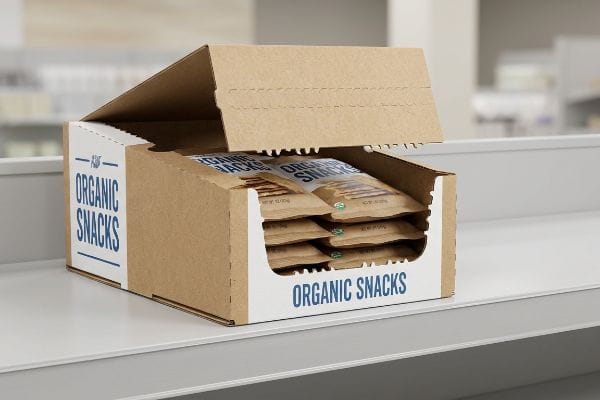
Walking into a big-box store, you see perfectly stacked merchandise seamlessly transitioning from pallets to shelves. Behind that flawless execution is a strict logistical science.
Working with RRP (Retail Ready Packaging) requires engineering corrugated shippers that transition directly to store shelves without unpacking. It works by combining optimized structural physics, clear perforation lines, and precise brand graphics to accelerate restocking speed and maximize visible merchandising space in high-traffic retail environments.

Before you ship thousands of units to major retailers, you need to understand the rigorous framework that governs these physical structures.
What Is an Rrp Rule?
Every major retailer guards their aisle space with strict physical mandates.
An RRP rule dictates the exact physical dimensions, weight limits, and structural requirements that packaging must meet to enter a retailer's supply chain. These strict mandates ensure that display trays and master cartons integrate flawlessly into automated warehouses and specific store shelving configurations without causing logistical disruptions.
Hitting these guidelines on a digital design file is one thing, but translating them to thick paperboard is where most campaigns fail.
Mastering the ADA vs. GMA Spatial Constraint
New brands often attempt to design a single, universal display file, hoping a large floor unit can just be mathematically shrunk by 50% to sit on a checkout counter. They assume a smaller footprint automatically complies with general store rules.
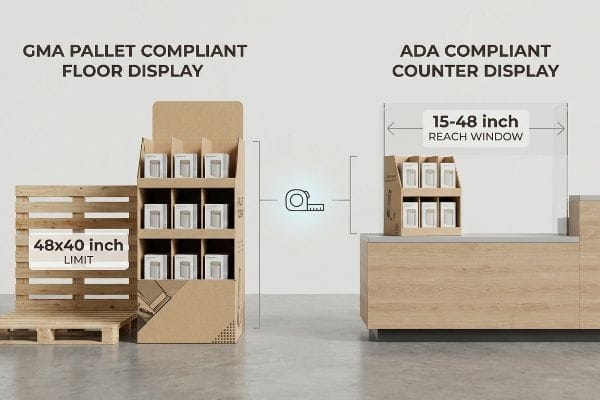
I see this happen constantly when designers ignore the strict legal and logistical rules dictating major retail zones. A store clerk will try to forcefully shove an oversized POP (Point of Purchase) floor base into a tight POS (Point of Sale) checkout zone, scraping the rough corrugated board against metal shelving until it noticeably tears. I permanently separate the engineering pipelines: floor files anchor strictly to the 48×40 inch (121.9×101.6 cm) GMA (Grocery Manufacturers Association) pallet limit1, while counter files strictly obey the ADA (Americans with Disabilities Act) 15-48 inch (38.1-121.9 cm) forward reach compliance window2.
| Common Rookie Mistake | The Pro Fix | Retail-Floor Benefit |
|---|---|---|
| Scaling down floor units to fit counters | Engineering separate ADA-compliant counter files3 | Prevents massive retailer chargebacks4 |
| Ignoring pallet overhang limits | Anchoring strictly to 48×40 inch GMA pallets5 | Stops warehouse transit crushing |
| Guessing store dimensions | Using a strict internal retailer spec database | Guarantees instant store manager approval |
I never let clients guess spatial constraints. By permanently separating these engineering pipelines, I eliminate the friction that causes store managers to reject non-compliant units directly at the loading dock.
🛠️ Harvey's Desk: Not sure if your floor display violates strict ADA reach zones? 👉 Request a Spatial Audit ↗ — Direct access to my desk. Zero automated sales spam, I promise.
What Can I Do with a Rrp Certification?
A piece of paper proving your packaging is certified completely changes how buyers treat your brand.
With an RRP certification, you can legally guarantee that your retail-ready packaging meets strict environmental, structural, and logistical standards. It allows your brand to bypass extensive retailer friction, secure premium floor space, and confidently survive brutal supply chain transit without risking costly rejections at the receiving dock.
But securing that certification requires surviving physical stress tests that destroy standard packaging.
Beating the ASTM vs. ISTA Testing Fallacy
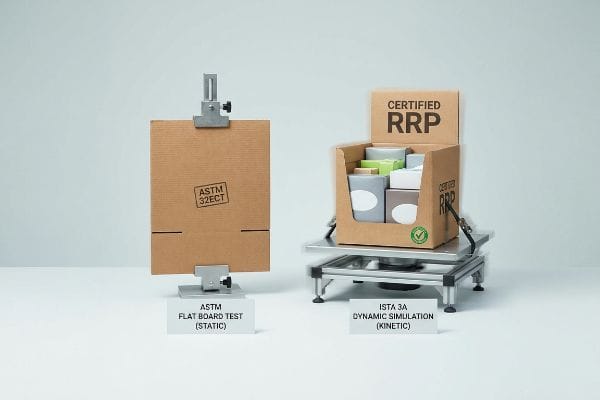
Procurement teams frequently rely on basic ASTM (American Society for Testing and Materials) material certifications, assuming that starting with a high-test 32ECT (Edge Crush Test)6 raw board guarantees a structurally sound display. They trust flat, static lab data to protect their physical investments.
You cannot predict kinetic survival with a static flat-board test7. I have watched beautiful, high-ECT boxes shear apart during the loud, violent shaking of an ISTA (International Safe Transit Association) 3A transit simulation8 because the fully assembled 3D geometry was fundamentally flawed. To fix this, I mandate full ISTA dynamic transit simulations on the loaded master carton to prove the unified geometry can survive multi-axis vibrations before mass production ever begins.
| Common Rookie Mistake | The Pro Fix | Retail-Floor Benefit |
|---|---|---|
| Relying strictly on flat ASTM board tests | Mandating full dynamic ISTA 3A simulations9 | Prevents 3D geometric shear failure |
| Testing empty display structures | Testing with actual merchandise payload weight10 | Accurately predicts kinetic freight survival |
| Assuming certification is optional | Using dual-standard validation protocols11 | Accelerates big-box retailer approval |
I separate material strength from system endurance entirely. Relying solely on raw paper data is a massive blind spot that leads directly to catastrophic box failures during live freight movement.
🛠️ Harvey's Desk: Does your current packaging actually pass dynamic multi-axis transit simulations? 👉 Get a Testing Breakdown ↗ — Download safely. My inbox is open if you have questions later.
How to Apply for Rrp?
Securing a spot on a retailer's shelf starts long before you submit your physical product.
Applying for RRP approval requires submitting highly accurate structural dielines, detailed compliance documentation, and physical white samples to the retailer's procurement team. This application process proves that your custom corrugated displays and retail-ready trays physically conform to the specific operational limits of automated distribution centers.
The fastest way to get your application rejected is submitting artwork that physically cannot be printed or folded.
The 0.5-Inch Litho-Lamination Bleed Mandate
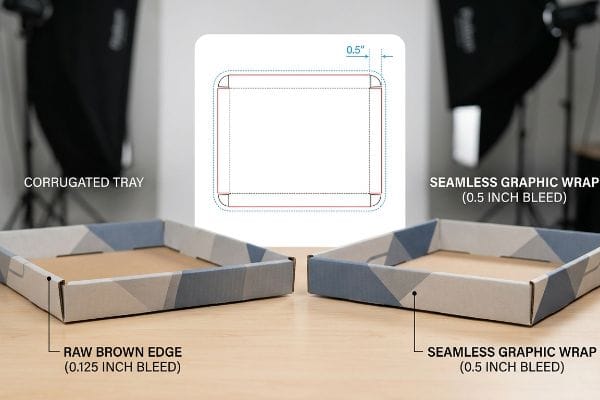
Graphic designers usually apply standard commercial print bleeds of 0.125 inches (3.17 mm)12 to their RRP files. They treat thick corrugated structures exactly like thin business cards, assuming standard margins will easily cover the fold lines.
Think of wrapping a thick mattress with a fitted sheet that is slightly too small; it will inevitably expose the raw corners. When I see standard 3 mm bleeds on a thick B-flute board, I know the automated litho-lamination process will shift, leaving a glaring, ugly strip of raw brown cardboard flashing on the final folded edge. I strictly enforce a minimum 0.5-inch (12.7 mm) bleed margin13 past the physical cut line, creating a massive safety net that completely wraps around every exposed edge during die-cutting.
| Common Rookie Mistake | The Pro Fix | Retail-Floor Benefit |
|---|---|---|
| Using 0.125 inch commercial print bleeds | Enforcing a strict 0.5 inch bleed margin14 | Hides ugly raw brown cardboard edges |
| Ignoring thick flute caliper shift15 | Re-engineering flat dielines for mechanical tolerance | Guarantees pristine, seamless brand graphics |
| Submitting flat web-tool raster art | Issuing locked vector PDFs from CAD software16 | Prevents expensive prepress file rejections |
I reject files at the prepress stage that fail this threshold. Forcing designers to extend their artwork backgrounds guarantees the printed graphic perfectly survives the mechanical tolerance of automated mounting.
🛠️ Harvey's Desk: Are your graphic designers using the wrong bleed margins for thick corrugated board? 👉 Claim Your Prepress Guide ↗ — No forms that trigger endless sales calls. Just pure value.
What Happens If a Contractor Performs Renovations on a Pre-1978 Home Without Rrp Certification?
Skipping mandatory compliance protocols seems like a quick way to save money, until the penalties hit.
Performing renovations without RRP certification on a pre-1978 home exposes contractors to massive federal EPA (Environmental Protection Agency) fines, devastating legal liabilities, and mandatory project shutdowns. Bypassing these strict lead-safe work practices endangers public health, instantly voiding business insurance policies and destroying a company's reputation.
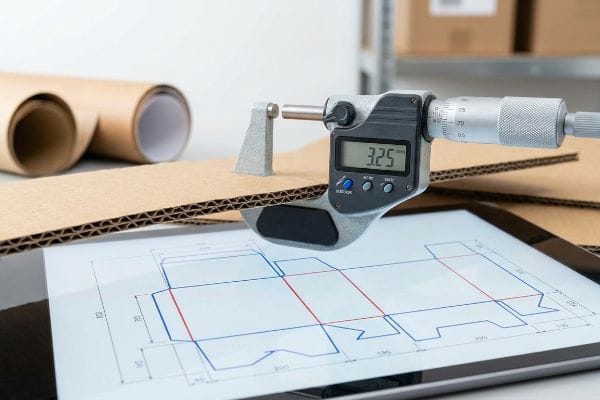
In the construction world, skipping compliance brings federal fines. In the manufacturing world, launching a retail campaign without precise structural engineering causes an equally devastating physical collapse.
Why Standard Board Tolerances Fail on the Factory Floor
Procurement teams frequently approve interlocking packaging based on the absolute dry caliper of the board17 in a climate-controlled office. They assume that if a tab fits perfectly into a 3.17 mm slot18 on the computer, it will assemble flawlessly on the packing line.
In my facility, I routinely see this theoretical math fail the moment corrugated flat-packs hit high-humidity environments. When porous 32ECT testliner absorbs ambient moisture19 during ocean transit, the paper physically swells, turning a perfect CAD (Computer-Aided Design) slot into a tight, impossible squeeze. When I measure the crushed flutes from forced assembly, the physical resistance is massive; clerks end up tearing the top sheet just to lock the trays. I automatically engineer a strict 0.04-inch (1.01 mm) humidity buffer20 directly into the receiving slots of our interlocking mechanisms to account for this swelling. By enforcing this micro-tolerance, I ensure the co-packing assembly time drops by up to 30 seconds per unit, saving clients thousands in labor fees while preventing structural tearing.
| Common Rookie Mistake | The Pro Fix | Retail-Floor Benefit |
|---|---|---|
| Designing slots for dry board calipers | Engineering a 1 mm humidity buffer21 | Speeds up in-store shelf assembly |
| Ignoring ambient moisture swelling | Calculating physical paper fiber expansion22 | Eliminates torn top sheets during setup |
| Forcing tight tabs with manual labor | Using precision CAD interlocking clearances | Saves costly co-packing machine downtime |
I rely on micrometer readings, not office theories. Accounting for environmental paper expansion guarantees the co-packer experiences a frictionless, zero-tear assembly regardless of the ambient warehouse humidity.
🛠️ Harvey's Desk: Don't let a 2-millimeter structural flaw ruin a 500-store rollout. 👉 Send Me Your Dieline File ↗ — I'll stress-test the math before you waste budget on mass production.
Conclusion
You can choose a cheaper vendor who ignores ambient moisture swelling, but when that 32ECT board violently tears during high-humidity assembly, causing massive physical friction, slowing down the line by an estimated 30%, and completely wiping out the project's profit margin. Over 500 brand managers use my prepress checklist to avoid these exact fatal early-stage mistakes. Stop guessing on mechanical paperboard tolerances and let me personally review your flat structural files through my Free Dieline Audit ↗ to catch these hidden physical friction points before mass production begins.
"Standard Pallet Sizes | With Chart", https://www.kampspallets.com/standard-pallet-sizes-with-chart/. Verification of the standard Grocery Manufacturers Association pallet dimensions to ensure logistical compliance. Evidence role: technical specification; source type: industry standard. Supports: physical dimensions of pallet limits. Scope note: Standard North American pallet size. ↩
"ADA Standards for Accessible Design Title III Regulation 28 CFR Part 36 …", https://www.ada.gov/law-and-regs/design-standards/1991-design-standards/. Confirmation of ADA accessibility guidelines regarding forward reach distances for retail displays. Evidence role: legal requirement; source type: government regulation. Supports: ADA compliance for counter-top placements. Scope note: Specific to reach range requirements. ↩
"Chapter 9: Built-In Elements – Access-Board.gov", https://www.access-board.gov/ada/chapter/ch09/. Verification of specific accessibility standards for retail fixtures as mandated by the Americans with Disabilities Act. Evidence role: regulatory compliance; source type: government regulation. Supports: The necessity of engineering separate files to meet legal accessibility mandates. Scope note: Focuses on US federal law. ↩
"The Cost of Retail Execution Non-Compliance: Brands Lose …", https://onedoor.com/resource/retail-execution-non-compliance-costs-brands/. Evidence of financial penalties (chargebacks) issued by major retailers for failure to adhere to vendor compliance manuals and spatial mandates. Evidence role: business impact; source type: retail trade agreement. Supports: The claim that compliance prevents financial loss. Scope note: Specific amounts vary by retailer contract. ↩
"48×40" GMA Pallets | Largest Pallet Manufacturer & Supplier", https://www.palletone.com/products/gma-pallets/. Confirmation of the Grocery Manufacturers Association (GMA) industry standard dimensions for shipping pallets in North America. Evidence role: technical specification; source type: industry standard. Supports: The requirement for anchoring fixtures to a specific pallet size to prevent transit damage. Scope note: Applies primarily to North American logistics. ↩
"ECT Ratings Explained: What They Mean for Your …", https://epackagesupply.com/blogs/packaging-guide/ect-ratings-explained-what-they-mean-for-your-corrugated-packaging?srsltid=AfmBOoq1-X29QF9ljyNXA7iojzbId6cSUuDLyERjJaWbcHlqm_XIxDl6. Authoritative technical standard explaining the Edge Crush Test (ECT) and its application in measuring the compressive strength of corrugated board. Evidence role: technical specification; source type: industry standard. Supports: the use of 32ECT as a benchmark for board strength. Scope note: Focuses on vertical load-bearing capacity. ↩
"A Simplified Dynamic Strength Analysis of Cardboard … – PMC", https://pmc.ncbi.nlm.nih.gov/articles/PMC10385285/. Authoritative packaging engineering guidelines explain why material-level static tests cannot account for the dynamic forces encountered during transit. Evidence role: Technical validation; source type: Engineering manual. Supports: The claim that static tests are insufficient for kinetic prediction. Scope note: Specifically regarding corrugated board. ↩
"ISTA Packaging Testing – Intertek", https://www.intertek.com/performance-testing/packaging/ista/. Official ISTA documentation defines the 3A standard as a simulation of the parcel delivery environment, including multi-axis vibration and shock. Evidence role: Definitional proof; source type: Industry standard. Supports: The use of ISTA 3A for validating shipping survival. Scope note: Applies primarily to small parcel shipments. ↩
"Test Procedures – International Safe Transit Association", https://ista.org/test_procedures.php. Brief explanation of how ISTA 3A parcel delivery simulation standards account for 3D structural stresses unlike static ASTM board tests. Evidence role: technical validation; source type: industry standard; Supports: prevention of geometric shear failure. Scope note: applies to retail-ready packaging. ↩
"Impact assessment of the transported load mass on the lateral …", https://pmc.ncbi.nlm.nih.gov/articles/PMC12914039/. Brief explanation of how integrating actual payload mass is required to accurately calculate kinetic energy and impact forces during transit. Evidence role: technical verification; source type: logistics engineering manual; Supports: prediction of freight survival. Scope note: focused on dynamic transport conditions. ↩
"ISTA Testing for Medical Device Packaging | LSO", https://lso-inc.com/medical-package-testing/standards/ista/. Brief explanation of how compliance with multiple certification standards (e.g., ASTM and ISTA) reduces retailer risk and streamlines onboarding. Evidence role: process validation; source type: retail compliance guidelines; Supports: acceleration of retailer approval. Scope note: specific to large-scale retail distribution. ↩
"There Will Be Bleed (and other design terms you should know)", https://dar.uga.edu/2019/there-will-be-bleed-and-other-design-terms-you-should-know/. Verification of the universal industry standard for bleed margins in commercial offset and digital printing. Evidence role: factual verification; source type: printing industry manual. Supports: the typical baseline designers use before applying RRP-specific requirements. Scope note: Applies to general print media. ↩
"[PDF] Corrugated Containers", http://courses.washington.edu/art166sp/documents/Spring2012/readings/week_7/CorrugatedCardboard.pdf. Verify if a 0.5-inch bleed is a recognized industry standard for litho-lamination on B-flute corrugated board to prevent flashing due to machine shift. Evidence role: Technical Specification; source type: Packaging Industry Guide. Supports: The technical necessity of expanded bleed margins. Scope note: Application may vary based on machine tolerance. ↩
"Litho-Laminated Packaging – Accurate Box Company, Inc", https://accuratebox.com/our-packaging/litho-laminated-packaging/. Industry standards for litho-lamination on corrugated substrates require larger bleed margins than standard print to compensate for die-cutting shifts. Evidence role: technical specification; source type: packaging industry manual. Supports: the necessity of a 0.5 inch bleed for corrugated materials. Scope note: specific to litho-lamination processes. ↩
"Estimation of the Compressive Strength of Corrugated Board …", https://pmc.ncbi.nlm.nih.gov/articles/PMC8467740/. Technical documentation on corrugated board explains how the thickness (caliper) of the fluting affects the internal and external dimensions of a folded box. Evidence role: engineering principle; source type: structural packaging guide. Supports: the need for re-engineering dielines for mechanical tolerance. Scope note: applies to B, C, and E flute materials. ↩
"Artwork and Prepress Requirements", https://bluelinelabels.com/custom-label-and-packaging-help/artwork-and-prepress-requirements/. Professional prepress workflows for industrial packaging mandate vector-based files to ensure precise die-line cutting and scalability. Evidence role: industry standard; source type: prepress technical guide. Supports: the requirement for CAD-generated vector PDFs to prevent file rejection. Scope note: standard for high-volume retail packaging. ↩
"Spec Sheets That Work: The Minimum Fields a Packaging Paper …", https://www.paperindex.com/academy/spec-sheets-that-work-the-minimum-fields-a-packaging-paper-converter-needs-to-avoid-guesswork/. Technical literature on paperboard properties explains why dry caliper measurements fail to account for hygroscopic expansion and moisture absorption in production environments. Evidence role: technical explanation; source type: materials science journal. Supports: The claim that relying on dry caliper leads to assembly failure. Scope note: Applies to cellulose-based packaging materials. ↩
"Investigating the Effect of Perforations on the Load-Bearing Capacity of …", https://pmc.ncbi.nlm.nih.gov/articles/PMC11396172/. Engineering specifications for packaging design would verify if 3.17 mm represents a standard industry dimension for specific board grades. Evidence role: technical specification; source type: engineering handbook. Supports: The technical validity of the specific measurement provided. Scope note: May be an illustrative example of a tight-tolerance fit. ↩
"Effects of Moisture content on Box Compression Strength", https://renewablebioproducts.gatech.edu/sites/default/files/2025-12/4effects-of-moisture-content-on-box-compression-strength.pdf. Verification of the hygroscopic properties of 32ECT corrugated liners and how moisture absorption leads to physical expansion. Evidence role: technical verification; source type: material science or packaging engineering manual. Supports: the claim that specific liner grades swell in humid environments. Scope note: focused on 32ECT grade materials. ↩
""Relative Humidity Effects on the Compression Strength of …", https://open.clemson.edu/all_theses/3225/. Validation of industry-standard tolerances for accounting for humidity-induced expansion in interlocking corrugated mechanisms. Evidence role: technical standard; source type: packaging design guide. Supports: the technical justification for the specific 0.04-inch buffer measurement. Scope note: applicability depends on material density and humidity levels. ↩
"Engineering Boxes for Relative Humidity in the Distribution …", https://www.packagingstrategies.com/articles/91064-engineering-boxes-for-relative-humidity-in-the-distribution-environment. Verification of whether a 1 mm buffer is a recognized industry standard for mitigating moisture-induced fit issues in paperboard. Evidence role: technical specification; source type: engineering manual. Supports: specific tolerance values for humidity buffers. Scope note: applies to retail display board materials. ↩
"Full-field hygro-expansion characterization of single softwood …", https://pmc.ncbi.nlm.nih.gov/articles/PMC8997710/. Scientific data confirming that paper fibers expand physically when absorbing ambient moisture. Evidence role: scientific principle; source type: material science journal. Supports: the technical necessity of calculating fiber expansion. Scope note: focused on cellulose-based materials. ↩