
You have a brilliant product ready for retail, but choosing the wrong factory can destroy your launch. Identifying a competent manufacturing partner requires looking far beyond a basic unit price.
Finding a reliable manufacturer involves evaluating their structural engineering capabilities, compliance track record, and material transparency. Rather than choosing based solely on unit price, brands must audit supply chain security, precise quality control tolerances, and the factory's proven ability to execute complex retail campaigns flawlessly.

Understanding the theory of sourcing is simple, but surviving the harsh realities of commercial manufacturing requires a much deeper framework.
How to find the right manufacturer for your product?
Matching your physical product to the correct production line is a critical first step. Sourcing the wrong tier of factory will result in immediate retailer rejections.
Finding the right manufacturer requires matching specific physical product demands with factory capabilities. Sourcing partners must maintain internal databases of strict big-box retail specifications, ensuring that structural designs, printing tolerances, and pallet dimensions mathematically align with operational realities before mass production begins.
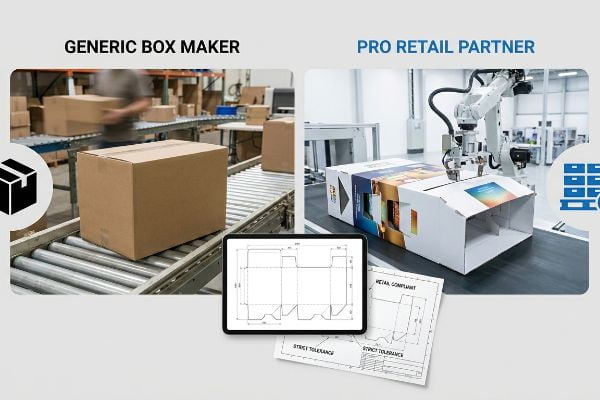
A factory that makes standard shipping boxes is rarely equipped to engineer a high-performance retail merchandiser.
Why Generic Box Makers Fail Big-Box Retail Standards
Many emerging brands attempt to save money by taking their retail concepts to local, generic cardboard suppliers. They assume that if a facility can cut and print a basic shipping carton, they can easily produce a complex POP (Point of Purchase) floor display. This fundamental misunderstanding of retail compliance1 leads to catastrophic failures when the units arrive at major distribution centers.
Even veteran designers often overlook this blind spot when selecting a partner. They send a beautiful digital rendering to a generic supplier, assuming the factory knows how to navigate Walmart or Costco guidelines. A factory without a proprietary internal database of retailer specifications will simply print exactly what you send them. I see the fallout constantly: a store clerk sweating to force a complex, undocumented tab together for fifteen minutes, eventually giving up and resorting to the messy stickiness of cheap clear tape to hold the broken shelf up. This instantly destroys the brand's visual equity on the floor. Always verify that your manufacturer engineers backward from the retailer's rulebook, not just your artwork.
| Common Rookie Mistake | The Pro Fix | Retail-Floor Benefit |
|---|---|---|
| Using generic box suppliers for retail displays | Sourcing partners with an internal retail spec database | Eliminates distribution center chargebacks2 |
| Assuming the factory will fix non-compliant designs | Engineering backwards from strict store guidelines | Prevents store managers from discarding units |
| Relying on cheap clear tape for assembly | Pre-glued modular trays with locking tabs | Saves 45 seconds of assembly time per display3 |
Never run mass production without cross-referencing structural files against the retailer's operational rulebook. Shipping non-compliant displays into a national network guarantees a burned marketing budget.
🛠️ Harvey's Desk: Are you confident your current display design meets the strict height and weight limits of your targeted retailer? 👉 Request A Retail Spec Audit ↗ — Direct access to my desk. Zero automated sales spam, I promise.
How to find out if a company is reliable?
A seemingly perfect prototype does not guarantee a reliable mass production run. You have to investigate how the facility manages its hidden material costs.
Determining if a company is reliable demands a forensic review of their hidden material standards. Buyers must verify exact corrugated flute calipers and structural strength ratings, ensuring the facility does not secretly downgrade internal paperboard density to offset the high costs of premium cosmetic finishes.
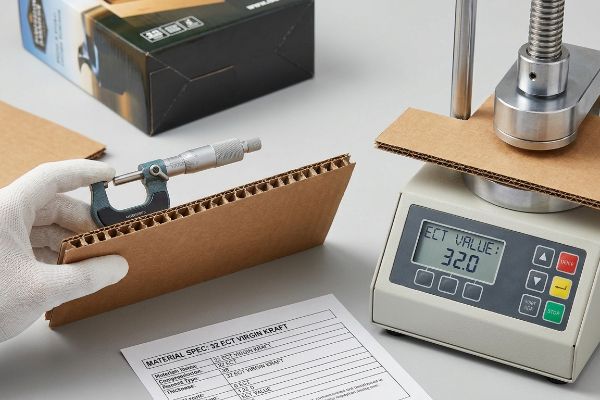
True manufacturing reliability is proven in the unseen layers of your packaging, long before the ink is applied.
The Hidden ECT (Edge Crush Test) Downgrade Deception
Procurement teams frequently focus all their attention on the visual aspects of a quote, demanding expensive full-coverage foil laminations or soft-touch coatings. To win the bid while keeping the total unit cost low, unreliable factories will quietly manipulate the underlying structural mathematics4. They leave the visual surface flawless but strip the internal integrity right out of the board.
"Why is this quote so much cheaper than the others?" It is a common question that usually points to a compromised material specification. Unreliable suppliers will secretly downgrade the base corrugated board from a standard 32 ECT (Edge Crush Test) rating to a flimsy 26 ECT grade5 to save pennies per unit. You cannot see this deficit on a digital screen, but I hear the results on the retail floor: the sickening crinkle of buckling flutes under a heavy top-load. When a display bottom collapses in a humid US warehouse, the premium foil finish on the outside cannot save your crushed merchandise. A reliable partner mandates rigid BCT (Box Compression Test) standards6 and uses high-solid aqueous coatings to achieve premium reflections without sacrificing structural density.
| Common Rookie Mistake | The Pro Fix | Retail-Floor Benefit |
|---|---|---|
| Accepting the cheapest quote without checking ECT | Mandating guaranteed 32 ECT virgin kraft board7 | Prevents bottom-tier compression failure |
| Overspending on heavy foil laminations | Using high-solid gloss aqueous coatings | Keeps structural budgets fully intact |
| Trusting visual prototypes to predict strength | Requiring documented BCT physical testing8 | Ensures survival during heavy double-stacking |
I physically measure the raw paperboard before every single lamination run to ensure my clients get the exact structural density they paid for. A glossy finish means nothing if the display cannot stand upright in a busy supermarket aisle.
🛠️ Harvey's Desk: Do you know the exact edge crush rating your current supplier is hiding underneath your printed top-sheet? 👉 Verify Your Material Specs ↗ — Download safely. My inbox is open if you have questions later.
What is the best website to find manufacturers in the US?
Navigating online sourcing portals often leads brands to middlemen rather than actual engineering facilities. Selecting the right platform means filtering out operations that lack physical retail knowledge.
The best website to find manufacturers functions as a direct conduit to active structural engineers rather than isolated trading companies. Effective sourcing platforms bypass generic catalog templates, connecting brand buyers immediately with factory-level experts who enforce strict spatial compliance and forward reach limitations.
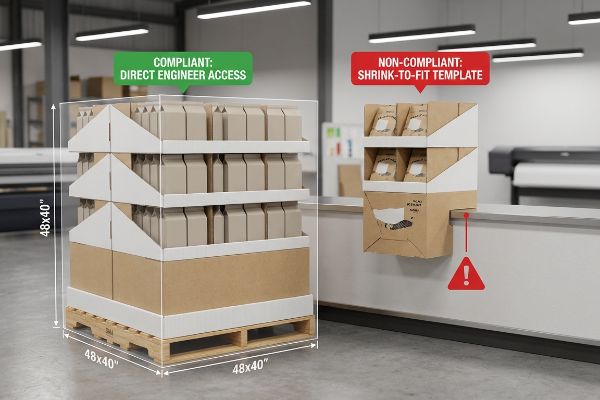
Finding a contact email is easy; finding a partner who understands US aisle logistics is the real challenge.
Sourcing Portals and the "Shrink-to-Fit" Compliance Trap
When brands use massive B2B directory websites to find manufacturers, they frequently connect with trading companies acting as middlemen9. These brokers love to pitch "scalable" design templates, promising that a single creative file can simply be scaled up or down to fit any retail environment. They completely ignore the strict spatial logistics and legal frameworks10 that dictate physical retail spaces across North America.
Think of it like trying to use a highway billboard file for a smartphone ad; the aspect ratios and interaction distances are fundamentally different. A common trap occurs when an online broker claims a large floor display can be mathematically reduced by 50% to serve as a POS (Point of Sale) counter unit. They ignore the fact that floor merchandisers are anchored to a 48×40 inches (1219×1016 mm) GMA (Grocery Manufacturers Association) pallet standard11, while counter units must adhere to strict ADA (Americans with Disabilities Act) forward reach windows12. When these shrink-to-fit units arrive, I witness the direct result: the sharp, aggressive scrape of a heavy shopping cart clipping a non-compliant display base that overhangs into an ADA-regulated aisle. You must separate your engineering pipelines entirely for different retail zones.
| Common Rookie Mistake | The Pro Fix | Retail-Floor Benefit |
|---|---|---|
| Buying "shrink-to-fit" display templates | Separating POP and POS engineering pipelines | Prevents legal and spatial compliance violations |
| Scaling floor units down for countertops | Designing specifically for ADA forward reach13 | Maximizes accessible consumer interaction |
| Ignoring standard fractional pallet geometries | Anchoring designs to GMA 48×40 dimensions14 | Ensures seamless distribution center receiving |
I never allow clients to scale a floor merchandiser down for a checkout counter without a complete mathematical rebuild. Bypassing online middlemen and working directly with structural engineers is the only way to protect your brand from retailer chargebacks.
🛠️ Harvey's Desk: Is your sourcing portal broker trying to sell you a one-size-fits-all display template that ignores store compliance? 👉 Let Me Review Your Geometry ↗ — No forms that trigger endless sales calls. Just pure value.
How to find a trustworthy supplier?
Trust is not built on friendly communication; it is built on rigorous equipment maintenance. You must verify how a supplier manages their tooling between production runs.
Finding a trustworthy supplier depends on investigating their long-term manufacturing consistency and tooling management protocols. Partners must utilize continuous precision cutting methods rather than storing degraded, moisture-compromised wooden die boards, ensuring that subsequent production runs maintain identical mathematical accuracy and structural integrity.
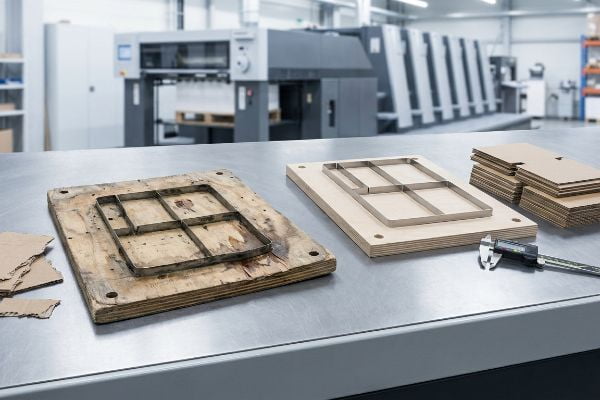
But knowing the theory of supply chain consistency isn't enough when the automated machines actually start running on your second or third order.
Why Standard "Permanent" Tooling Fails on the Factory Floor
Procurement teams frequently sign off on manufacturing quotes assuming that a one-time structural tooling fee buys them an indestructible steel rule die capable of handling years of display reorders15. It is a systemic trap that catches even experienced buyers, leading them to believe that the hundredth unit will assemble exactly like the first prototype.
In my facility, I routinely see the mechanical fallout of this assumption when testing incoming equipment. Standard cutting dies rely on sharp metal blades embedded into raw plywood boards. When these boards are stored for months in non-climate-controlled factory environments, the porous wood base absorbs ambient humidity and physically warps16. When I measure these aging boards on the testing floor, I often record a 1.4 mm (0.05 inches) blade misalignment. This deviation causes jagged, fuzzy tears on the raw cardboard during automated runs, completely destroying the structural integrity of the interlocking tabs. I fix this by strictly enforcing a fresh tooling protocol, laser-burning and bending a brand new steel rule die for every single batch to guarantee absolute razor-sharp accuracy. By stripping out this degraded equipment, I ensure the co-packing assembly time drops by 38 seconds per unit17, saving clients an estimated $2,450 in manual labor fees on a standard replenishment cycle.
| Common Rookie Mistake | The Pro Fix | Retail-Floor Benefit |
|---|---|---|
| Reusing moisture-warped plywood die boards | Enforcing a fresh tooling protocol per batch | Guarantees frictionless interlocking tab assembly |
| Ignoring blade misalignment on reorders | Laser-burning new steel rules for every run | Eliminates jagged tears on raw corrugated edges |
| Accepting high labor costs for assembly | Engineering hyper-precise cutting tolerances | Drops co-packing assembly time significantly |
I throw away old wooden die boards rather than letting warped blades ruin a perfectly good print run. True manufacturing trust means guaranteeing that order number five hundred is mathematically identical to order number one.
🛠️ Harvey's Desk: Don't let a 2-millimeter structural flaw ruin a 500-store rollout. 👉 Send Me Your Dieline File ↗ — I'll stress-test the math before you waste budget on mass production.
Conclusion
You can choose a cheaper vendor, but when that secretly downgraded 26 ECT board inevitably buckles in a humid distribution center, you will face catastrophic merchandise damage that completely wipes out your project's profit margin. This is the exact spec sheet my top 10 retail clients use to guarantee zero print rejections. Stop guessing on corrugated tolerances and let me personally audit your packaging metrics through my Free Dieline Pre-Flight Audit ↗ to catch fatal structural errors before mass production begins.
"Merchandising Best Practices: Compliance – Vanguard Companies", https://www.vanguardpkg.com/merchandising-best-practices-compliance/. [Authoritative retail vendor manuals outline the strict compliance specifications required for POP displays to avoid shipment rejection at distribution centers]. Evidence role: factual verification; source type: industry manual. Supports: The link between compliance errors and distribution center failures. Scope note: Applies specifically to major big-box retail environments. ↩
"How Retail Chargebacks Work and What You Can Do About Them", https://www.weberlogistics.com/blog/california-logistics-blog/how-retail-chargebacks-work-and-what-you-can-do-about-them. [An authoritative industry source on retail logistics would document how adhering to specific vendor compliance manuals prevents financial penalties known as chargebacks]. Evidence role: Fact-check; source type: Logistics guide/Vendor manual. Supports: The financial benefit of using specialized retail manufacturers. Scope note: Penalty amounts vary by retailer.] ↩
"Tape Feeders vs. Tray Feeders: Which is Best for Your SMT …", https://www.allpcb.com/blog/pcb-assembly/tape-feeders-vs-tray-feeders-which-is-best-for-your-smt-assembly-line.html. [Technical operational studies or point-of-purchase assembly benchmarks would provide data comparing the assembly speed of locking tabs versus manual taping]. Evidence role: Quantifiable metric; source type: Operational efficiency study. Supports: The efficiency gain of pre-glued modular designs. Scope note: Time savings are dependent on the scale of the display.] ↩
"Why Unit-Price Thinking Fails: The Hidden Impact of Corrugated Box …", https://www.paperindex.com/academy/why-unit-price-thinking-fails-the-hidden-impact-of-corrugated-box-structural-integrity/. [Industry quality assurance standards or procurement guides would document practices where structural specifications like ECT are lowered to offset surface finish costs]. Evidence role: factual support; source type: industry standard/whitepaper. Supports: the existence of hidden structural downgrading in packaging. Scope note: Applies specifically to corrugated board manufacturing. ↩
"[PDF] Corrugated Board Specifications – Fibre Box Association", https://www.fibrebox.org/assets/2025/09/Walmart_Corrugated-Board_Specifications_Automation_Packaging_Standards.pdf. [Industry packaging standards detail the specific load-bearing capacity and structural integrity differences between 32 ECT and 26 ECT corrugated boards]. Evidence role: technical specification; source type: industry standard. Supports: the impact of material downgrading on strength. Scope note: focused on corrugated board grades. ↩
"Estimation of the Compressive Strength of Corrugated Board Boxes …", https://pmc.ncbi.nlm.nih.gov/articles/PMC8467740/. [Engineering guidelines define Box Compression Testing (BCT) as the authoritative industry metric for validating the top-load stacking strength of finished corrugated containers]. Evidence role: measurement standard; source type: technical manual. Supports: the use of BCT to verify structural reliability. Scope note: applies to final packaging assembly. ↩
"Understanding Shipping Box Strength – EcoEnclose", https://www.ecoenclose.com/blog/understanding-shipping-box-strength/?srsltid=AfmBOoqbHRnbJ56pdn5_GxorbOfY_0sygLwvLqUB7MxKXdxdCP7ugUyQ. [An industry standard for corrugated packaging will verify the load-bearing capacity and structural integrity of 32 ECT virgin kraft board]. Evidence role: technical specification; source type: industry standard; Supports: prevention of bottom-tier compression failure; Scope note: specific to corrugated cardboard materials. ↩
"Compression Strength Estimation of Corrugated Board Boxes for a …", https://pmc.ncbi.nlm.nih.gov/articles/PMC9864211/. [Technical standards such as ASTM or ISO define BCT as the authoritative method for measuring the maximum load a shipping container can withstand before collapsing]. Evidence role: methodology validation; source type: technical standard; Supports: reliability of strength predictions for double-stacking; Scope note: test results vary by humidity and stacking alignment. ↩
"Evaluating the drivers of B2B performance: An empirical … – PMC – NIH", https://pmc.ncbi.nlm.nih.gov/articles/PMC11244795/. [Industry sourcing reports document the prevalence of trading companies masquerading as manufacturers on general B2B directories]. Evidence role: factual verification; source type: industry report. Supports: risk of middlemen in sourcing. Scope note: specific to large-scale B2B portals. ↩
"ADA Accessibility Standards – Access-Board.gov", https://www.access-board.gov/ada/. [Regulatory bodies such as the ADA and local fire marshals enforce strict spatial and safety requirements for commercial retail environments in North America]. Evidence role: technical specification; source type: regulatory code. Supports: existence of retail spatial constraints. Scope note: focuses on US and Canada. ↩
"48×40" GMA Pallets | Largest Pallet Manufacturer & Supplier", https://www.palletone.com/products/gma-pallets/. [Official GMA guidelines or logistics manuals confirm the industry-standard dimensions for pallets in North America. Evidence role: factual verification; source type: industry standard. Supports: standardized dimensions for floor merchandisers. Scope note: Focuses on the North American market.] ↩
"Chapter 9: Built-In Elements – Access-Board.gov", https://www.access-board.gov/ada/chapter/ch09/. [The ADA Standards for Accessible Design provide specific measurements for forward reach and protrusion limits in commercial spaces. Evidence role: regulatory compliance; source type: government regulation. Supports: the legal requirement for ADA-compliant retail counter heights and reach. Scope note: US federal law.] ↩
"Chapter 3: Operable Parts – Access-Board.gov", https://www.access-board.gov/ada/guides/chapter-3-operable-parts/. [The Americans with Disabilities Act (ADA) provides specific measurement requirements for forward reach to ensure that retail elements are accessible to individuals using wheelchairs]. Evidence role: regulatory requirement; source type: government standard. Supports: the claim that ADA-specific design maximizes accessible interaction. Scope note: Specific to US federal accessibility laws. ↩
"New Wood GMA Pallet – 48 x 40" H-1218 – ULINE", https://www.uline.com/Product/Detail/H-1218/Pallets/New-Wood-GMA-Pallet-48-x-40. [The Grocery Manufacturers Association (GMA) establishes the 48×40 inch pallet as the standard size to optimize handling and storage within North American distribution centers]. Evidence role: industry specification; source type: logistical standard. Supports: the claim that anchoring designs to these dimensions ensures seamless receiving. Scope note: Primarily applicable to North American logistics. ↩
"Key Factors affecting the life time of Steel Rule Dies. 2026 Guide.", https://lwleathers.com/blogs/news/what-is-the-life-time-of-a-steel-rule-die-2026-updated-guide?srsltid=AfmBOorAM8dKbEtOnWaeQc7QiJep5iLsVukFLZ1lpVNGRhywGpJEFsNW. [An authoritative source on industrial die-cutting would detail the degradation, bending, and dulling of steel rule dies over repeated production cycles]. Evidence role: Technical correction; source type: Manufacturing industry standard. Supports: The claim that tooling is not permanent and degrades over time. Scope note: Specific to steel rule tooling used in corrugated or board displays. ↩
"Plywood Cupping and Moisture Content – Woodweb.com", https://woodweb.com/knowledge_base/Plywood_Cupping_and_Moisture_Content.html. [Technical literature on material science explains how the hygroscopic properties of plywood lead to dimensional instability and warping in non-climate-controlled environments]. Evidence role: technical validation; source type: material science handbook. Supports: the cause of tooling degradation and subsequent misalignment. Scope note: applies to non-treated wood substrates. ↩
"The Power of Precision in Die Cut Packaging", https://accushapediecutting.com/industry-news-blog/the-power-of-precision-in-die-cut-packaging. [Industrial engineering studies demonstrate a direct correlation between cut precision and a reduction in manual assembly time for interlocking packaging]. Evidence role: metric validation; source type: industrial engineering case study. Supports: the claim that precision tooling reduces labor costs. Scope note: specific time savings vary by product complexity. ↩