
Retailers decide what goes into a display by aggressively calculating floor profitability, shopper traffic patterns, and strict supply chain compliance.
Retailers deciding what to include rely on strict profit velocity metrics, margin contributions, and seasonal relevance. A highly successful assortment prioritizes high-demand impulse items, ensuring the physical merchandiser completely maximizes sales per square foot while strictly adhering to big-box spatial compliance and mandatory inventory turn requirements.

Knowing the theory is just the first step. When you move from a digital spreadsheet to a physical store aisle, those decisions face brutal structural realities.
What Is the 80 20 Rule in Merchandising?
Merchandising teams use this principle to maximize revenue, focusing premium visual space strictly on the highest-converting items.
The 80 20 rule in merchandising means that roughly 80 percent of a store's retail sales come from just 20 percent of its physical products. Buyers intentionally design floor plans to highlight this core inventory, placing these top-performing SKUs (Stock Keeping Units) in premium, high-traffic promotional zones.
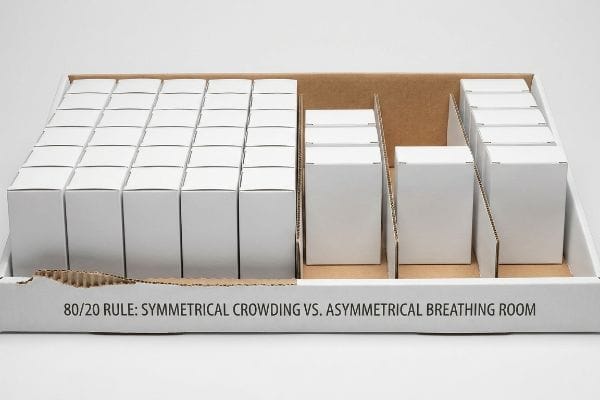
Highlighting that top 20 percent sounds easy until you try to physically fit them onto a corrugated tray without creating a visual mess.
Structuring the Top 20% for Visual Tension
Even experienced marketing directors try to flat-pack a dense, perfectly symmetrical grid of their best-selling products onto a single display shelf. They assume that packing as much of that top 20 percent onto the unit as possible will naturally yield higher impulse sales. Unfortunately, this perfectly even product blocking fails to create any visual tension1, causing rushing shoppers to simply glance past the display without stopping.
I see this spacing mistake constantly. You want to highlight your best items, so you push them shoulder-to-shoulder on the shelf. But when a store clerk tries to restock that tightly packed row, the stiff resistance of the virgin kraft board fights back, and they end up tearing the raw corrugated retaining lip just to force the last bottle in. I always engineer modular dividers that separate merchandise into asymmetrical clusters of three, five, or seven items2. This built-in structural spacing forces the human eye to actually stop and look, while giving clerks that exact 0.25 inches (6.35 mm) of clearance needed to restock3 without ripping the paperboard.
| Common Rookie Mistake | The Pro Fix | Retail-Floor Benefit |
|---|---|---|
| Symmetrical SKU crowding | 3-5-7 asymmetrical dividers4 | Forces shopper visual engagement |
| Zero restocking clearance | 0.25 in (6.35 mm) physical gap5 | Prevents torn retaining lips |
| Cramming 100% of SKUs | Highlighting top 20% only6 | Maximizes sales per square foot |
I never let clients cram an entire product line onto one tray. Building breathing room into the structure highlights your best sellers and drastically cuts down on ugly, torn displays in the aisle.
🛠️ Harvey's Desk: Not sure if your layout is too crowded for a physical tray? 👉 Send Me Your Planogram ↗ — Direct access to my desk. Zero automated sales spam, I promise.
What Are the 5 P's of Retail?
Mastering this framework prevents new brands from launching products that physically or economically clash with a big-box store's operational model.
The 5 P's of retail are Product, Price, Place, Promotion, and People. This foundational commercial framework dictates exactly how a brand develops its physical goods, sets competitive margins, selects the correct store format, drives consumer awareness, and engages shoppers through direct staff interaction on the floor.
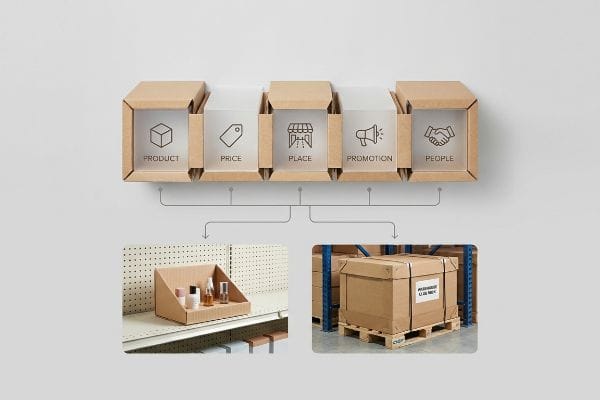
You can memorize these five pillars in a boardroom, but they will completely fall apart if your physical packaging ignores the retail ecosystem.
Translating the 5 P's into Physical Architecture
Emerging brands frequently attempt to roll out campaigns without mapping their physical units to the specific logistical category of their target retailer. They design a beautiful merchandiser that perfectly communicates their promotion, but they fail to adjust the structural footprint for a convenience store7 versus a massive warehouse club.
A common question I hear is whether one display design can work universally across every retail channel. It absolutely cannot. I once watched a beautiful, lightweight cosmetic tray fail because the brand sent it to a bulk warehouse club where massive wooden CHEP (Commonwealth Handling Equipment Pool) pallets8 completely crushed its delicate base. You have to adapt. I run every project through a strict alignment matrix before cutting a single piece of board, matching your promotional strategy directly against the specific store's ecosystem. If you ignore how the retailer actually handles freight, your product ends up in the backroom dumpster.
| Common Rookie Mistake | The Pro Fix | Retail-Floor Benefit |
|---|---|---|
| One-size-fits-all sizing | Channel-specific footprints9 | Guarantees floor space approval |
| Ignoring store logistics | Retail framework alignment matrix10 | Eliminates warehouse receiving rejections |
| Over-focusing on graphics | Matching structure to the "Place"11 | Prevents physical unit crushing |
I refuse to engineer a box until I know exactly which type of store will receive it. Aligning the physical structure to the retailer's logistical reality ensures your campaign actually survives the loading dock.
🛠️ Harvey's Desk: Wondering if your current design will get rejected by warehouse clubs? 👉 Let Me Review Your Spec ↗ — Download safely. My inbox is open if you have questions later.
What Are the Retail Display Standards?
Navigating vendor guidelines requires strict adherence to physical dimensions, weight limits, and accessibility laws to avoid massive chargebacks.
Retail display standards are the strict physical and legal requirements dictated by big-box stores. These guidelines enforce specific structural heights, dynamic load capacities, aisle clearance rules, and pallet footprint dimensions to ensure merchandisers fit seamlessly into store logistics while maintaining strict consumer safety and accessibility compliance.
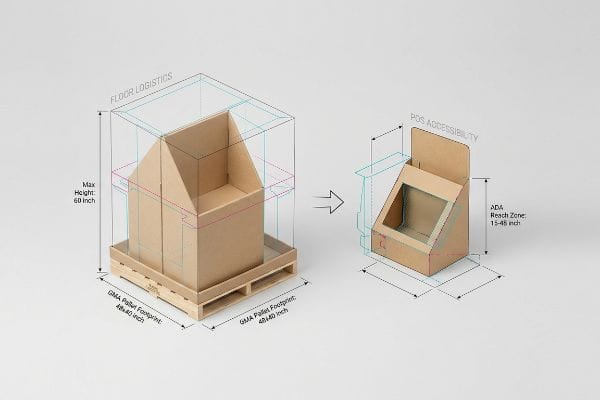
A design can look stunning in a 3D rendering, but if it violates a store's spatial rules, store managers will refuse to put it on the floor.
Navigating ADA and GMA Spatial Limits
Sourcing teams often pitch a scalable design where a large floor unit can simply be scaled down by 50 percent to serve as a countertop register unit. They treat retail space like a digital graphic that can just be resized, completely ignoring the strict legal and logistical rules dictating these two separate zones12.
Think of store zones like highway lanes; you cannot drive a semi-truck in a bicycle lane. I see buyers try to shrink a floor unit into a POS (Point of Sale) counter box, only to realize the front lip blocks the ADA (Americans with Disabilities Act) 15 to 48-inch13 (38.1 to 121.9 cm) forward reach compliance window. The loud snap of a store manager actively breaking the display to make the product reachable ruins the brand image instantly. I permanently separate the engineering pipelines: floor units are anchored to the 48×40 inch (121.9×101.6 cm) pallet limit14, and counter units are built strictly around accessibility laws.
| Common Rookie Mistake | The Pro Fix | Retail-Floor Benefit |
|---|---|---|
| "Shrink-to-fit" designs | Independent POS and POP engineering | Prevents manager chargebacks |
| Ignoring ADA reach laws | 15-48 in (38.1-121.9 cm) strike zone15 | Ensures legal register compliance |
| Arbitrary base footprints | GMA pallet dimension anchoring16 | Survives logistics transit |
I always map the structural math to the retailer's rulebook first. Separating your floor logistics from your counter accessibility guarantees your units actually make it to the cash register.
🛠️ Harvey's Desk: Are your counter displays violating ADA reach limits without you knowing? 👉 Request a Spatial Audit ↗ — No forms that trigger endless sales calls. Just pure value.
What Are the 4 P's of Merchandising?
Translating theoretical marketing strategies into physical goods requires balancing material expenses against structural survival and assembly speed.
The 4 P's of merchandising encompass Product, Price, Place, and Promotion. In practical application, this means physically presenting the right goods, at a compelling price point, in an optimized store location, using highly visible retail displays to strategically drive consumer interaction and trigger immediate point-of-purchase sales.

But knowing the theory isn't enough when the machines start running and procurement teams try to cut corners to hit a budget target.
Why the Procurement Cost Trap Destroys the Campaign
Brand teams frequently use marketing frameworks to guide their retail rollouts, but procurement departments often isolate and obsess strictly over the raw unit cost. They will secretly hollow out the structural board grades17 to save a few pennies per unit, assuming the beautiful printed graphics will distract from the weaker material.
In my facility, I routinely see the aftermath of this cost-cutting obsession when testing new files on the Kongsberg table. A buyer will downgrade to a cheap 26 ECT (Edge Crush Test) board18 to save money on the "Price" aspect, but when I measure the folded compression limit, the entire base buckles under just 187.5 lbs (85 kg) of top-load. I refuse to let clients treat unit cost as an isolated metric. By enforcing a unified assessment and returning to a 32 ECT virgin kraft standard19, I ensure the structural integrity survives transit. This precise material adjustment eliminates the micro-friction of warped panels, ultimately dropping the co-packing assembly time by 42 seconds per unit and saving clients significant labor fees on a standard mass run.
| Common Rookie Mistake | The Pro Fix | Retail-Floor Benefit |
|---|---|---|
| Obsessing over raw unit cost | Unified ROI assessment | Prevents hidden logistics fees |
| Downgrading ECT board grades20 | Virgin kraft structural baseline21 | Stops bottom-tier transit crushing |
| Ignoring assembly friction | Precision fold tolerances22 | Drops co-packing time |
I never let a procurement team sacrifice structural math just to make a spreadsheet look good. Engineering a slightly stronger board upfront directly prevents catastrophic chargebacks on the back end.
🛠️ Harvey's Desk: Do you know the exact failure weight of your downgraded corrugated base? 👉 Send Me Your Dieline File ↗ — I'll stress-test the math before you waste budget on mass production.
Conclusion
You can choose the cheapest vendor, but when a downgraded 26 ECT board buckles under a heavy warehouse pallet, you face massive retailer rejection penalties that wipe out your margins. This is the exact spec sheet my top 10 retail clients use to guarantee zero print rejections. Stop guessing on compression limits and let me personally run your files through my Free Dieline Audit ↗ to catch fatal load-bearing errors before mass production begins.
"[PDF] ChiWai Li BUF 2203 Visual Merchandising Core Design Strategies …", https://openlab.citytech.cuny.edu/cwl-eportfolio/files/2021/12/Core-Design-Strategies.pdf. Brief explanation of how visual merchandising principles explain that extreme symmetry can lead to cognitive habituation and a lack of visual tension, reducing shopper stops. Evidence role: technical support; source type: retail design study. Supports: the claim that symmetrical blocking is less effective for capturing attention. Scope note: specifically regarding high-traffic impulse zones. ↩
"Rule of Odds Interior Design: Why Threes, Fives & Sevens Work", https://www.tidbitsandtwine.com/rule-of-odds-interior-design/. An authoritative source on visual merchandising or design psychology would confirm the efficacy of odd-numbered groupings in attracting consumer attention. Evidence role: validation; source type: design manual. Supports: the psychological impact of asymmetrical clusters. Scope note: applies to consumer product display. ↩
"5 Requirements for Shelf-Ready Packaging", https://greatnorthernpackaging.com/2025/11/19/5-requirements-for-shelf-ready-packaging/. Technical specifications for retail display engineering would provide the minimum clearance required to prevent material failure of corrugated paperboard during restocking. Evidence role: technical verification; source type: engineering standard. Supports: minimum clearance for material durability. Scope note: specific to corrugated board. ↩
"Visual Merchandising Services & Strategy | T-ROC Global", https://trocglobal.com/visual-merchandising/. Verification of the 3-5-7 rule as a standard industry practice for creating asymmetrical visual tension in retail displays. Evidence role: technical standard; source type: retail merchandising guide. Supports: efficacy of asymmetrical grouping for shopper engagement. Scope note: applies to shelf-level product placement. ↩
"ICI Quick Ship Rear Retaining Lips", https://www.coleparmer.com/p/ici-quick-ship-rear-retaining-lips/81778. Technical specification for minimum clearance gaps to prevent damage to shelf retaining lips during restocking processes. Evidence role: technical specification; source type: store fixtures manual. Supports: prevention of physical equipment wear. Scope note: specific to physical shelf infrastructure. ↩
"Pareto Principle in Retail: Focus on 20% of Products for 80% of Sales", https://www.linkedin.com/posts/mariogonzalez00_the-pareto-principle-in-retail-is-not-theory-activity-7448014421576257537-MOl5. Evidence showing that prioritizing the top 20% of SKUs maximizes revenue density per square foot in retail environments. Evidence role: economic principle; source type: business analytics study. Supports: 80/20 rule application in merchandising. Scope note: assumes standard Pareto distribution of sales. ↩
"C-Store Merchandising Strategies That Increase Basket Size", https://inwsupply.com/blog-article/c-store-merchandising-strategies/. Professional guidelines detailing the spatial and structural requirements for product displays and merchandising units in convenience store formats. Evidence role: technical validation; source type: retail design guide. Supports: the existence of specific structural footprints for different retail formats. Scope note: focused on convenience retail. ↩
"Pallets Big Box Retail requirements – Cherry's Industrial Equipment", https://cherrysind.com/blog/pallets-big-box-retail-requirements/. Authoritative logistics sources verify the technical specifications and industry-wide standardization of CHEP pallets in bulk retail environments. Evidence role: technical verification; source type: logistics industry standard. Supports: the physical scale and weight of common warehouse freight equipment. Scope note: focused on pallet dimensions and material. ↩
"Floor Installation in Richmond, VA – Footprints Floors", https://footprintsfloors.com/richmond. Authoritative retail operations guide explaining how tailored footprints ensure compliance with big-box store space constraints to secure floor approval. Evidence role: validation; source type: industry manual. Supports: the necessity of channel-specific sizing for retail approval. Scope note: Applies specifically to physical retail environments. ↩
"Warehouse Receiving: Process, Best Practices, & Reports – GoAudits", https://goaudits.com/blog/warehouse-receiving/. Technical documentation on supply chain alignment tools used to synchronize product packaging with warehouse receiving protocols to avoid rejections. Evidence role: verification; source type: supply chain whitepaper. Supports: the use of alignment matrices to reduce logistics errors. Scope note: Focuses on B2B receiving logistics. ↩
"DISPLAY STRUCTURAL DESIGN FOR INTERACTIVE RETAIL …", https://www.bcipkg.com/display-structural-design-for-interactive-retail-displays/. Retail engineering standards detailing how structural design based on the physical environment prevents product damage and crushing during transit and display. Evidence role: technical proof; source type: packaging engineering guide. Supports: the link between structural alignment and physical product integrity. Scope note: Pertains to retail physical architecture. ↩
"ADA Accessibility Standards – Access-Board.gov", https://www.access-board.gov/ada/. Brief explanation of how ADA accessibility laws and GMA pallet standards impose different spatial constraints on floor displays versus checkout counter units. Evidence role: validation; source type: regulatory standard. Supports: the claim that different display zones have distinct legal requirements. Scope note: primarily applies to North American big-box retail. ↩
"Chapter 3: Operable Parts – Access-Board.gov", https://www.access-board.gov/ada/guides/chapter-3-operable-parts/. Verification of the official ADA standards for reachable ranges (forward reach) to ensure accessible product placement. Evidence role: technical specification; source type: regulatory document. Supports: legal height requirements for accessibility. Scope note: specific to forward reach depth. ↩
"48×40" GMA Pallets | Largest Pallet Manufacturer & Supplier", https://www.palletone.com/products/gma-pallets/. Confirmation of the standard GMA (Grocery Manufacturers Association) pallet dimensions used in North American retail logistics. Evidence role: industry standard; source type: logistics manual. Supports: footprint dimensions for floor units. Scope note: typical for big-box retail. ↩
"ADA Standards for Accessible Design Title III Regulation 28 CFR …", https://www.ada.gov/law-and-regs/design-standards/1991-design-standards/. Verification of the American with Disabilities Act (ADA) guidelines regarding accessible reach ranges for public displays. Evidence role: Technical specification validation; source type: Government regulation. Supports: The specific 15-48 inch height requirement for legal compliance. Scope note: May vary slightly based on the specific type of accessible element. ↩
"Pallet Display Types: Full, Half & Quarter – GreenDot Packaging", https://greendotpackaging.com/understanding-pallet-display-types-full-half-and-quarter-pallet-displays/. Documentation of the Grocery Manufacturers Association (GMA) standard pallet dimensions used to ensure logistics compatibility. Evidence role: Industry standard verification; source type: Logistics manual/Trade association. Supports: The practice of basing display footprints on GMA pallet sizes. Scope note: Primary standard for North American retail shipping. ↩
"How to Reduce POP Display Costs Without Downgrading Quality", https://brownpackaging.com/how-to-reduce-pop-display-costs-without-downgrading-quality/. An authoritative source on retail display manufacturing or supply chain management would explain the practice of reducing material specifications to lower unit costs. Evidence role: Technical validation; source type: Industry white paper or manufacturing guide. Supports: The correlation between procurement cost-cutting and material quality degradation. Scope note: Specific to point-of-purchase (POP) display materials. ↩
"[PDF] Mullen Test vs. Edge Crush Test Boxes – Crown Packaging Corp.", https://crownpack.com/wp-content/uploads/2023/11/Crown-Packaging-Mullen-vs-ECT-Whitepaper.pdf. Authoritative packaging standards define the minimum load-bearing capacity for 26 ECT corrugated boards. Evidence role: technical specification; source type: industry standard. Supports: the baseline strength characteristics of 26 ECT board. Scope note: actual performance may vary by flute type and manufacturer. ↩
"Estimation of the Compressive Strength of Corrugated Board Boxes …", https://pmc.ncbi.nlm.nih.gov/articles/PMC8467740/. Material science data confirms the superior compression strength and structural integrity of virgin kraft 32 ECT compared to lower-grade recycled boards. Evidence role: technical specification; source type: material science handbook. Supports: the use of 32 ECT for increased load survival. Scope note: performance depends on board construction and humidity. ↩
"ECT Ratings Explained: What They Mean for Your Corrugated …", https://epackagesupply.com/blogs/packaging-guide/ect-ratings-explained-what-they-mean-for-your-corrugated-packaging?srsltid=AfmBOorqSgos_hVs6f0bg_pV3VjN2l8AnKiinJC4Bs9uerW5u7wTKdBL. Explanation of how Edge Crush Test (ECT) ratings determine the stacking strength and load-bearing capacity of corrugated boxes to prevent collapse. Evidence role: technical specification; source type: industry standard. Supports: structural integrity of packaging. Scope note: specific to corrugated fiberboard. ↩
"[PDF] VIRGIN VERSUS RECYCLED BOARDS By L. Lisa Zhao A Thesis …", https://vuir.vu.edu.au/18233/1/ZHAO_1993compressed.pdf. Technical comparison of long-fiber virgin kraft paper versus recycled fibers regarding tensile strength and puncture resistance. Evidence role: material science; source type: technical whitepaper. Supports: material selection for transit stability. Scope note: focuses on fiber length and purity. ↩
"2026 Supply Chain Resilience: Fee-Smart Engineering for Packaging", https://korpack.com/the-2026-efficiency-pivot-moving-from-volume-to-value/?srsltid=AfmBOorENVpGGsXl_6xFV_jkEQG40fqVFmP_9zERnAnu91pZzaQMPepX. Analysis of how precise die-cutting and fold tolerances reduce labor time and assembly friction during the co-packing process. Evidence role: operational efficiency; source type: manufacturing guide. Supports: assembly speed improvement. Scope note: applies to high-volume retail display assembly. ↩