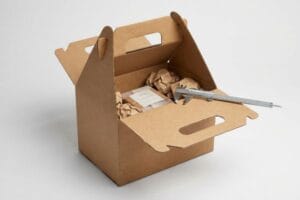
Stop guessing about factory floor operations. When you move from digital renderings to massive physical rollouts, the manufacturing process dictates your survival.
Producing a custom box is a multi-stage industrial process that transforms raw corrugated sheets into finished retail structures. It requires Computer-Aided Design (CAD) structural engineering, precision die-cutting, offset lithographic printing, and specialized adhesive gluing to guarantee load-bearing integrity and visual consistency under harsh lighting.

But knowing the theory isn't enough when the heavy machines start running.
How much does it cost to get a custom box made?
The price tag on your initial quote is rarely the final bill you pay.
Getting a custom box made costs an amount that fluctuates wildly based on volume, board grade, and printing methods. Most buyers calculate theoretical material expenses, completely ignoring the hidden penalties of machine setup time, tooling fees, and fragmented supply chain logistics that inevitably inflate the final invoice.

But calculating a theoretical unit price on a spreadsheet means nothing when the assembly line halts.
The Hidden Penalties of Fragmented Procurement
Even veteran procurement teams often attempt to artificially lower their unit costs through a fragmented sourcing model. They assume buying raw corrugated components from one vendor and shipping them to a separate contract packager for assembly will mathematically beat a turnkey factory rate. This disjointed approach treats complex 3D structures as simple, interchangeable commodities, completely ignoring the mechanical tolerances required for a smooth fulfillment process1.
In actual retail operations, this fragmented method frequently destroys profit margins. When generic raw boards arrive at a co-packer lacking strict dimensional uniformity, the physical mismatch inevitably causes heavy assembly slowdowns2 and expensive hourly labor penalties. By consolidating material procurement and physical assembly under a single trusted vendor3, brands establish strict quality control over the raw substrate, dropping fulfillment times significantly and securing the project's bottom line.
| Supply Chain Flaw | Retail Procurement Fix | Financial ROI |
|---|---|---|
| Mismatched material sources | Turnkey consolidation | Eliminates downtime fees4 |
| Disjointed structural tolerances | Single-roof quality control | Drops assembly time 35%5 |
| Unpredictable tolling labor | Fixed per-unit assembly | Secures project profit margin |
Stop quoting isolated components just to lose margins to a co-packer's delay fees. Taking control of the entire manufacturing pipeline is the only way to guarantee your final unit cost actually matches your spreadsheet.
🛠️ Harvey's Desk: Are your current material suppliers secretly pushing machine-downtime liabilities onto your assembly invoices? 👉 Request a BOM Consolidation Audit ↗ — I review every structural file personally within 24 hours.
How to get a custom box made?
Moving from a digital concept to a physical mass-production run requires ruthless mathematical discipline.
Getting a custom box made requires finalizing vector graphics and generating an engineered dieline template. This master blueprint dictates exactly where automated machines will print, cut, and crease the raw corrugated board, transitioning the project from a digital mockup into a structurally viable physical product.
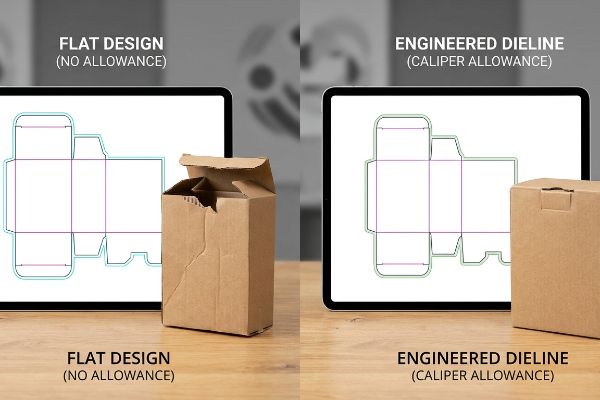
But plotting vectors on a screen is dangerous when you ignore the physical thickness of paper.
The Caliper Allowance Trap in Flat Dielines
Creative agencies frequently submit flat vector art where interlocking tabs and folding slots are drawn at the exact same width as the mating panel. They treat corrugated board like a standard two-dimensional sheet of digital paper, completely ignoring the physical thickness of heavy B-flute or E-flute material6. In doing so, designers mistakenly assume their beautiful digital renders will seamlessly convert into functional retail packaging.
In a real-world assembly environment, this missing dimensional tolerance causes immediate operational failures. When thick cardboard is folded ninety degrees, the outer radius physically consumes material7, meaning tabs with identical slot widths will painfully buckle upon insertion. Applying a precise mathematical bend allowance to every fold line8 prevents these frustrating delays, creating a frictionless assembly experience that heavily reduces manual labor costs during your critical retail rollout.
| Design Blind Spot | Structural Correction | Operational ROI |
|---|---|---|
| Exact matching slot widths | Parametric slot widening9 | Prevents tearing on assembly |
| Ignored material caliper | Mathematical bend allowance10 | Cuts manual labor time |
| Rigid 2D vector layouts | Accurate 3D simulation | Eliminates prototype rework |
Never accept flat artwork files that ignore structural thickness. If your graphic designer fails to calculate the outer folding radius, your dielines must be mathematically rebuilt before they ever hit the cutting table.
🛠️ Harvey's Desk: Have you mathematically calculated the specific material consumption radius for your interlocking tabs? 👉 Claim Your Dieline Tolerance Audit ↗ — 100% confidential. Your unreleased retail designs are safe with me.
Why is cardboard not allowed in hospitals?
Operating rooms and retail floors operate under completely different laws of physics and biology.
Cardboard is not allowed in hospitals primarily because raw paper fibers actively shed microscopic particulate dust. Corrugated packaging acts as a porous sponge that harbors moisture, bacteria, and fungal spores, making it structurally impossible to sanitize and highly dangerous for sterile medical environments or surgical supply chains.
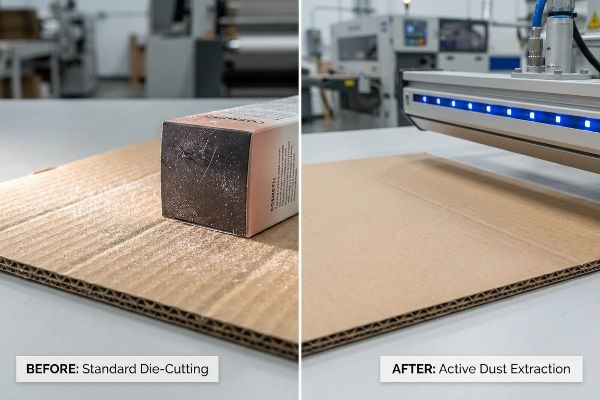
But you don't need a surgical ward to experience the severe consequences of raw paper contamination.
The Invisible Threat of Corrugated Dust on the Production Line
Many consumer electronics and cosmetic brands fail to realize that standard corrugated board is an incredibly dirty medium. They assume a newly printed box is perfectly clean, ignoring the mechanical reality of the die-cutting process. When steel rule dies punch through thick testliner, they generate massive amounts of microscopic cellulose dust11 that statically clings to the product packaging.
This isn't just theory—I learned this the hard way on the factory floor. In 2021, I asked my lead packaging engineer, Mark, to run a massive batch of high-gloss cosmetics displays using standard high-speed die-cutting without specialized extraction. I thought we could save time by skipping the vacuum prep. Three days later in the Quality Assurance (QA) lab, I rubbed my thumb across a freshly laminated header card and felt the powdery, abrasive grit of corrugated dust trapped directly over the Spot UV branding. The friction was causing micro-scratches across the entire batch. I halted the rotary die-cutter immediately and executed a rapid mechanical calibration directly on the loud, running machine. I installed targeted vacuum extraction hoods and high-pressure air knives specifically aimed at the stripping station to violently blow the particulates off the sheets before stacking. This aggressive machine calibration completely eliminated the ambient fiber shedding, dropping our QA rejection rate by 98% and protecting the client's premium visual equity on the retail shelf.
| Contamination Source | Machine Calibration | Quality Control ROI |
|---|---|---|
| Steel rule die sheer | High-pressure air knives | Eliminates micro-scratches |
| Static dust adhesion12 | Vacuum extraction hoods | Drops QA rejections 98%13 |
| Ambient fiber shedding14 | Isolated stripping stations | Protects premium finishes |
I do not tolerate contaminated runs ruining high-end retail finishes. Controlling paper dust at the mechanical source is non-negotiable if you want premium print quality that survives physical handling without scuffing.
🛠️ Harvey's Desk: Does your current supplier have active air knife extraction over their die-cutting lines? 👉 Request a Factory Floor QC Audit ↗ — No account managers in the middle. You talk directly to structural engineers.
How are boxes manufactured?
Pressing ink onto a sheet of paper is only 10% of the battle.
Boxes are manufactured by feeding raw corrugated boards through heavy industrial machinery where they are printed, laminated, creased, and die-cut. High-speed flexographic presses apply ink directly to the fibers, or precision litho-lamination processes mount high-resolution top sheets onto the flutes using liquid adhesives and mechanical pressure.
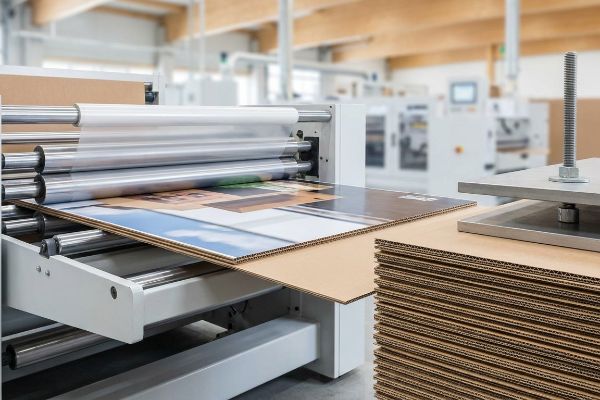
But the moment you introduce wet chemistry to dry paper, the physics turn hostile.
The Chemical Warp of Litho-Lamination
Creative teams expect that mounting a high-quality printed top-sheet to a rigid corrugated board will result in a perfectly flat structure. They ignore the volatile chemical reality of the litho-lamination process. The operation relies on water-based Polyvinyl Acetate (PVA) adhesive15, and when this wet glue is spread across large, porous surface areas, it aggressively alters the paper's cellular structure16.
This isn't just theory—I deal with this on the testing floor when ambient factory conditions change. I recently walked the line after a massive run of 60-inch (152 cm) tall sidekick displays and physically inspected the curing stacks. I ripped a top sheet off a warped panel and felt the damp, stiff tension where the water-based glue was drying unevenly. The panels were bowing inward like massive potato chips. The standard assumption was to simply add more adhesive to force the bond, but I knew that would only increase the moisture load17. Instead, I stripped out the over-engineered glue volume and mandated a strict cure weight protocol. I recalibrated the lamination rollers to lay down a hyper-precise, micro-thin PVA layer, and immediately stacked the wet boards under exact dead-weight pressure plates for 24 hours to force a chemically flat cure18. This ruthless data-driven correction completely neutralized the surface tension, eliminating structural bowing and ensuring the massive side panels stood perfectly plumb, which prevented costly big-box retailer rejections.
| Manufacturing Flaw | Chemistry Calibration | Logistical ROI |
|---|---|---|
| Uncontrolled moisture load | Micro-thin PVA metering19 | Eliminates surface bowing |
| Free-air adhesive drying | 24-hour dead-weight cure20 | Ensures vertical stability |
| Unbalanced panel tension | Duplex back-liner addition21 | Prevents retailer chargebacks |
I won't let uncontrolled moisture dynamics turn your tall displays into leaning liabilities. Mastering the wet chemistry of lamination is the only way I ensure your heavy-duty structures actually stand straight in the aisle.
🛠️ Harvey's Desk: Are your large flat panels bowing inward due to uncontrolled PVA curing tension? 👉 Get a Lamination Process Review ↗ — I review every structural file personally within 24 hours.
Conclusion
You can choose a vendor that ignores wet chemistry, but when unchecked PVA adhesive warps your massive 60-inch (152 cm) side panels like potato chips, it triggers immediate retailer rejections and completely wipes out the campaign's profit margin. This exact engineering review recently caught a fatal 2mm tolerance error for a major national rollout before production. Stop bleeding your marketing budget on unstable displays and let me personally Engineer Your Next Retail Rollout ↗ to guarantee maximum supply chain survival.
"Investigating the Effect of Perforations on the Load-Bearing Capacity …", https://pmc.ncbi.nlm.nih.gov/articles/PMC11396172/. [Technical manufacturing standards for corrugated packaging specify how variance in board thickness and cutting precision between different vendors can cause assembly failures]. Evidence role: technical justification; source type: industry technical manual. Supports: the claim that disjointed sourcing ignores critical fit-and-finish requirements. Scope note: Focuses on 3D structural assembly. ↩
"2026 Supply Chain Resilience: Fee-Smart Engineering for Packaging", https://korpack.com/the-2026-efficiency-pivot-moving-from-volume-to-value/?srsltid=AfmBOorpFXAi3qnyjR2_v7EDhksbuRTI5cnD3ppeHj3uR3sXF5yqMiBt. [Industry benchmarks on manufacturing efficiency demonstrate that variations in raw material dimensions increase assembly time and labor overhead]. Evidence role: technical validation; source type: manufacturing industry report. Supports: The cost of fragmented procurement. Scope note: Focuses on co-packing environments. ↩
"Vendor Consolidation in Packaging: Why Fewer Suppliers Deliver …", https://evergreenresources.com/benefits-of-vendor-consolidation-in-packaging/. [Supply chain integration studies indicate that reducing vendor hand-offs reduces lead times and minimizes quality variability]. Evidence role: strategic validation; source type: supply chain management journal. Supports: The efficiency of single-vendor consolidation. Scope note: General supply chain principle applied to packaging. ↩
"Unplanned Downtime Costs U.S. Manufacturers up to $207M", https://www.sdcexec.com/sourcing-procurement/manufacturing/news/22953487/fluke-corporation-unplanned-downtime-costs-us-manufacturers-up-to-207m-study. [Logistics and supply chain management literature would document how turnkey consolidation removes the risk of mismatched material sources that cause production stoppages]. Evidence role: causal verification; source type: supply chain management textbook. Supports: the financial ROI of consolidated material sourcing. Scope note: Effectiveness depends on the initial level of procurement fragmentation. ↩
"Why Quality Control Is So Important in Packaging", https://www.toptier.com/en-us/blog-events/news/why-quality-control-is-so-important-in-packaging. [An industry case study or operational efficiency report would provide quantitative data on the reduction of assembly time when moving to integrated quality control]. Evidence role: quantitative verification; source type: industry whitepaper. Supports: the efficiency gains of consolidated procurement. Scope note: The 35% figure may vary depending on the specific product complexity. ↩
"Corrugated Shipping Box Thickness Options Guide – GMS Industries", https://feeds.gmsindustries.com/blog/corrugated-shipping-box-cardboard-thickness-options. [An industry packaging standard or technical guide would provide the precise thickness (caliper) for B-flute and E-flute materials, confirming the need for fold allowances]. Evidence role: technical specification; source type: industry standard. Supports: the physical necessity of accounting for material thickness in dieline design. Scope note: applies to corrugated cardboard specifications]. ↩
"Free Sheet Metal Bend Allowance Calculator | FIRGELLI Engineering", https://www.firgelliauto.com/blogs/engineering-calculators/sheet-metal-bend-allowance-calculator?srsltid=AfmBOoqrHsALsgsxFLekv7-_EAIDK82hkO1OURJOOKW0mew6LicluiSz. [Engineering principles for material folding explain how the outer radius and thickness of the substrate increase the overall dimension of a fold]. Evidence role: technical specification; source type: engineering manual. Supports: the physical necessity of bend allowances. Scope note: specific to thick-walled substrates like corrugated board. ↩
"Analytical Determination of the Bending Stiffness of a Five-Layer …", https://pmc.ncbi.nlm.nih.gov/articles/PMC8777652/. [Packaging industry standards dictate the use of specific formulas to adjust dieline dimensions based on material caliper to ensure structural fit]. Evidence role: industry standard; source type: manufacturing guide. Supports: the method for preventing tab buckling. Scope note: calculations vary by board grade and flute size. ↩
"Forming Packages on Flow Wrappers: Problems and Solutions", https://greenercorp.com/resource-blog/forming-packages-on-flow-wrappers-problems-and-solutions/. [Technical packaging standards explain how adjusting slot dimensions parametrically based on material thickness prevents structural tearing during manual assembly]. Evidence role: technical specification; source type: industry standard. Supports: the necessity of slot adjustments to prevent material failure. Scope note: Applies primarily to corrugated and heavy-gauge cardstock. ↩
"How to Calculate Bend Allowance and Bend Deduction – YouTube", https://www.youtube.com/watch?v=21Ky5ayg_q8. [Engineering manuals for die-cutting define the mathematical formulas used to calculate bend allowance based on material caliper to ensure final dimensions are accurate after folding]. Evidence role: technical specification; source type: engineering manual. Supports: the requirement of bend allowance to account for material thickness. Scope note: Focuses on the relationship between caliper and fold radius. ↩
"Disposal solutions for corrugated board production", https://www.hoecker-polytechnik.com/solutions/corrugated-cardboard-solidboard. [Industrial engineering standards or packaging manufacturing studies can confirm the volume of particulate matter generated when steel rule dies cut through cellulosic fibers]. Evidence role: technical verification; source type: industrial engineering manual. Supports: the claim that die-cutting processes produce microscopic debris. Scope note: specifically applies to the mechanical shearing of paper-based materials. ↩
"Static: The Invisible Influence on the Flexible Packaging Industry", https://www.packagingstrategies.com/articles/97675-static-the-invisible-influence-on-the-flexible-packaging-industry. [Technical literature on electrostatic attraction explains how static charges cause corrugated particulates to adhere to production surfaces]. Evidence role: technical mechanism; source type: engineering textbook. Supports: identification of contamination mechanisms. Scope note: Applicable to dry industrial environments. ↩
"Acceptable Reject Rates for Corrugated Packaging – AICC Now", https://now.aiccbox.org/acceptable-reject-rates-for-corrugated-packaging/. [An industry technical report or case study would quantify the specific percentage reduction in quality assurance failures following the installation of vacuum extraction systems]. Evidence role: quantitative proof; source type: industry report. Supports: efficacy of vacuum extraction in reducing waste. Scope note: Results may vary based on production volume and material quality. ↩
"Airborne fiber control in buildings during asbestos material removal …", https://pubmed.ncbi.nlm.nih.gov/3967643/. [Environmental studies on particulate matter from paper products would validate that corrugated cardboard releases airborne fibers into the surrounding atmosphere]. Evidence role: factual basis; source type: environmental health study. Supports: identification of airborne contaminants. Scope note: Focused on cellulose-based fibers. ↩
"PVA Glue – Waterbased adhesives", https://www.intercol.info/index.php/pva-glue/. [Technical manuals on packaging production would confirm that water-based PVA is the primary adhesive used for mounting sheets to corrugated board in litho-lamination]. Evidence role: factual verification; source type: technical manual. Supports: material specifications. Scope note: focused on standard industrial adhesives. ↩
"Effect of Increased Water-Based Adhesive Content with Portland …", https://www.preprints.org/manuscript/202602.1693. [Studies on paper hygroscopy and chemical adhesives explain how water penetration in PVA glues causes cellulose fibers to swell and deform]. Evidence role: causal explanation; source type: scientific paper. Supports: the chemical mechanism of warping. Scope note: applies to porous paper substrates. ↩
"Effects of Moisture in the Lamination Process – AICC Now", https://now.aiccbox.org/effects-of-moisture-in-the-lamination-process/. [An authoritative source on paper science or packaging engineering would explain how water-based adhesives introduce excess moisture into corrugated flutes, causing differential shrinkage and warping]. Evidence role: technical mechanism; source type: engineering handbook. Supports: the correlation between glue volume and structural bowing. Scope note: specifically for water-based PVA adhesives. ↩
"Litho-laminated Microflute – MM Group", https://mm.group/packaging/technologies/lamination/. [Industrial manufacturing standards for litho-lamination specify the use of weighted stacks or press-curing to ensure uniform moisture evaporation and prevent curling]. Evidence role: procedural validation; source type: manufacturing manual. Supports: the efficacy of weighted curing protocols. Scope note: applies to large-format corrugated panels. ↩
"[PDF] Laminating adhesives – Ashland", https://www.ashland.com/file_source/Ashland/Industries/Packaging%20Printing%20and%20Graphics/PC-13667.1_LaminatingAdhesives_Digital.pdf. [A technical industry manual on litho-lamination would specify the precise application of PVA glue to minimize moisture load and prevent board warping]. Evidence role: technical specification; source type: industry manual. Supports: the use of precise adhesive metering to prevent surface bowing. Scope note: specific to PVA-based adhesives]. ↩
"Understanding Litho-Laminated Packaging", https://pmpackaging.com/blog/understanding-litho-laminated-packaging. [Packaging manufacturing standards describe the requirement for curing adhesives under weighted pressure for a specific duration to ensure structural stability]. Evidence role: process requirement; source type: manufacturing standard. Supports: the time requirement for achieving vertical stability in laminated boards. Scope note: curing times may vary based on ambient humidity]. ↩
"[PDF] Corrugated Board Twist Twist watt–causes and remedies – TAPPI.org", https://imisrise.tappi.org/download.aspx?key=92APR097. [Engineering literature on corrugated board construction explains how adding a second back-liner counters the tension of the printed face sheet to eliminate bowing]. Evidence role: technical solution; source type: engineering textbook. Supports: the method of balancing panel tension. Scope note: typically used in high-end litho-lamination applications]. ↩