
Securing heavy retail goods for transit requires more than just thick cardboard. You need mathematically engineered packaging that survives severe kinetic shock and brutal logistics networks.
Our strongest type of shipping box is a heavy-duty, double-wall RSC (Regular Slotted Container) engineered with virgin kraft liners. These transit cartons are explicitly designed to withstand high dynamic compression forces, protecting heavy retail payloads against severe multi-axis vibration and rotational edge drops during international logistics.

Understanding raw material metrics is only the first step; surviving the physical supply chain demands precision structural engineering.
What Is the Strongest Type of Box?
Choosing the right transit structure dictates whether your merchandise arrives pristine or pulverized on the retail floor.
The strongest type of box is a double-wall RSC. By utilizing continuous top and bottom closure flaps, this structural geometry perfectly aligns the internal vertical fluting to maximize edge crush resistance, aggressively distributing heavy pallet top-loads across all four supporting corners to ensure safe transit.

Flat cardboard sheets offer basic tensile strength, but the folded three-dimensional geometry is what truly absorbs brutal transit impacts.
The RSC Geometric Load Distribution
The baseline strength of any shipping carton relies entirely on how effectively it channels top-down weight away from the center panels and into the vertical corners. A double-wall RSC achieves this by utilizing complete, continuous top flaps1 that lock the upper edges together. This uninterrupted 360-degree upper enclosure stabilizes the vertical walls, preventing outward bowing when subjected to heavy overhead compression2 during freight stacking.
Without this continuous enclosure—such as in an open-top HSC (Half Slotted Container)—the vertical walls lack a stabilizing bridge, drastically lowering the structure's ability to resist dynamic kinetic forces3. When engineers specify heavy-duty double-wall profiles for an RSC, they are mathematically increasing the internal wave-like arches of the fluting. This dual-flute architecture acts as an integrated mechanical shock absorber4, safely displacing vibrations and localized impacts across the entire board surface to preserve the core product.
| Structure Type | Compression Dispersal | Transit Application |
|---|---|---|
| Single-Wall HSC | Open-Top Vulnerability5 | Lightweight Shelf Trays |
| Single-Wall RSC | Standard Corner Load6 | General Parcel Freight |
| Double-Wall RSC | Maximum Kinetic Absorption7 | Heavy Palletized Goods |
I engineer heavy-duty cartons based on geometric stability rather than just raw material thickness. By leveraging the continuous upper flaps of the RSC structure, you guarantee superior corner compression and safely survive double-stacked ocean transit.
🛠️ Harvey's Desk: Are your heavy checkout trays actively crushing your shipping ROI before they even reach the store? 👉 Request a Free Freight Density Audit ↗ — I review every structural file personally within 24 hours.
Who Makes the Best Shipping Boxes?
You cannot judge a manufacturer by a polished sales pitch; you evaluate them by their laboratory precision and mechanical discipline.
The best shipping boxes are made by turnkey manufacturers operating continuously calibrated ISTA (International Safe Transit Association) testing laboratories. These specialized facilities mathematically validate dynamic transit endurance, ensuring physical packaging geometries survive severe rotational edge impacts, multi-axis vibrations, and high-humidity environments before any mass production begins.

A theoretical material specification is completely useless if the finished structural geometry cannot survive the mechanical violence of a global freight network.
The Laboratory Mechanical Drift Reality
Procurement teams often trust any validation report bearing an official testing logo, assuming that a single certification guarantees permanent diagnostic accuracy. They rely on theoretical flat-board metrics and static compression data8, believing that high-grade raw substrates automatically translate into an indestructible finished master carton.
In my facility, I routinely see the hidden danger of trusting uncalibrated diagnostics. This isn't just theory—I see this happen on the testing floor when hydraulic compression presses absorb massive mechanical trauma every week. If a factory fails to recalibrate this heavy machinery, it suffers from mechanical drift, producing false-positive test results9. Last quarter, I audited a client's previous test file and found a 12.4 lbs (5.6 kg) variance in the vibration table's readout due to outdated sensor calibration. By halting the run and enforcing my strict continuous diagnostic calibration protocol, I mathematically verified the prototype's true endurance limit under accurate kinetic shock. This precise testing overhaul prevented a catastrophic mass-production failure, effectively saving the client thousands in potential 3PL (Third-Party Logistics) repacking penalties.
| Diagnostic Metric | Generic Lab Protocol | Engineered Calibration |
|---|---|---|
| Kinetic Validation | Outdated Sensor Data | Real-Time Calibration10 |
| Drop Shock Matrix | Standard Vertical Fall | Rotational Edge Impact11 |
| Freight Protection | False-Positive Risks | Certified Transit Survival12 |
I strictly rely on real-time, continuously calibrated testing machinery to validate every structural design. This mechanical discipline ensures the simulated stress exactly mirrors real-world logistical hazards, eliminating invisible structural blind spots.
🛠️ Harvey's Desk: Is your current testing protocol giving you false-positive data that fails during actual ocean transit? 👉 Claim a Free Structural Dieline Audit ↗ — 100% confidential. Your unreleased retail designs are safe with me.
What Is the Cheapest Way to Ship a Very Large Box?
Transporting oversized retail components quickly drains marketing budgets if you pay to ship empty air.
The cheapest way to ship a very large box is by utilizing flat-pack engineered corrugated structures. By collapsing bulky three-dimensional volumes into highly dense flat profiles, shippers entirely bypass severe volumetric weight penalties, maximizing container space and drastically reducing international freight costs for heavy-duty campaigns.
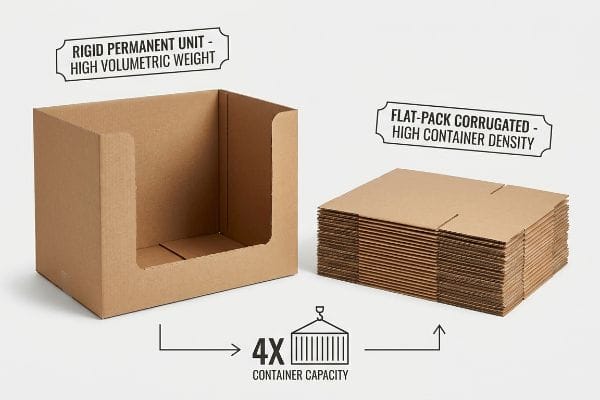
Stripping away dead spatial volume is the ultimate strategy for protecting your profit margins during high-volume global distribution.
The Flat-Pack Logistics Multiplier
The fundamental cost driver in global freight is volumetric weight13, which penalizes shippers for occupying physical space regardless of the actual mass. When transporting oversized components like permanent welded wire racks or pre-assembled acrylic units, brands are forced to pay a massive premium simply to move empty air across the ocean. A single standard container rapidly hits its maximum spatial capacity14 long before reaching its maximum payload weight limit.
Transitioning to high-performance temporary corrugated structures inherently solves this volumetric bottleneck. Because engineered paperboard is specifically designed to fold flat along targeted score lines, a massive 60-inch (152.4 cm) retail merchandiser can be condensed15 down to a fractional footprint during transport. This geometric efficiency acts as a logistics multiplier; replacing rigid permanent structures with flat-packed corrugated alternatives allows a standard container to hold exponentially more units16. By optimizing the freight density at the structural engineering level, supply chains can drastically reduce their total shipment counts while still deploying heavy-duty, high-capacity retail displays.
| Logistics Variable | Rigid Permanent Unit | Flat-Pack Corrugated |
|---|---|---|
| Container Density | Highly Restricted Space | Maximum Volume Utilization |
| Volumetric Penalty | Dead Air Surcharges17 | Eliminated Space Waste |
| Freight Efficiency | Low Unit Per Pallet | 4x Container Capacity18 |
I prioritize flat-pack corrugated architecture to systematically bypass volumetric freight penalties. By mathematically eliminating empty space during transit, you drastically lower per-unit distribution costs for every retail rollout.
🛠️ Harvey's Desk: Are oversized permanent displays burning through your logistics budget by forcing you to ship empty air? 👉 Get a Free Volumetric Freight Analysis ↗ — No account managers in the middle. You talk directly to structural engineers.
How to Make a Box Stronger for Shipping?
Strengthening a master carton requires precise spatial geometry, not just throwing more expensive raw materials at a failed design.
To make a box stronger for shipping, engineers strictly enforce a zero-overhang bounding box protocol. By mathematically shrinking the master carton's footprint to perfectly align with the pallet deck, the corrugated corners retain one hundred percent of their vertical compression strength, effectively preventing base-tier buckling.
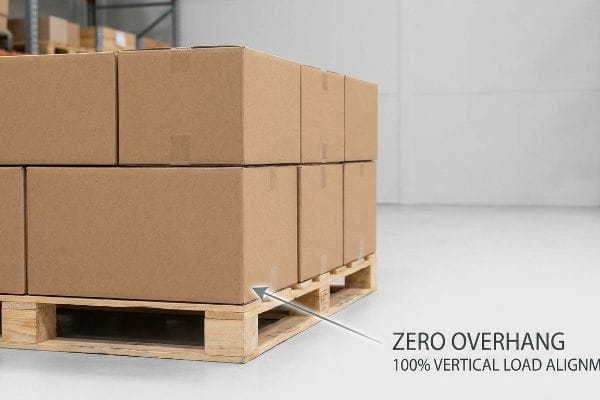
Raw paperboard density means absolutely nothing if the physical assembly fails to support the dynamic load overhead.
The Zero-Overhang Load Path Protocol
Procurement teams often expand master carton dimensions to maximize shipping density, assuming a heavy-duty corrugated board's raw compression metrics will automatically protect the goods. They falsely assume that high-test raw substrates can compensate for sloppy stacking, completely ignoring the mechanical physics of vertical load alignment19.
In my facility, I routinely see how a fractional misalignment entirely destroys material integrity. This isn't just theory—I see this happen on the testing floor when a master carton overhangs a standard 48×40 inch (121.9×101.6 cm) GMA (Grocery Manufacturers Association) pallet by just 0.35 inches (8.89 mm). Because corrugated boxes derive up to 60% of their BCT strength strictly from their vertical corners20, that tiny overhang forces the unsupported base to carry zero load. Under the top-heavy weight of warehouse racking, I watched the unsupported center panels visibly bow outward and catastrophically crush. I immediately mandated a zero-overhang protocol, artificially shrinking the allowable carton footprint in my CAD software by exactly 0.5 inches (12.7 mm). This strict dimensional restriction guaranteed the corners remained fully supported by the wood deck, completely eliminating bottom-tier crush damages and saving the client an estimated 15% in ruined transit inventory.
| Structural Metric | Theoretical Assumption | Engineered Alignment |
|---|---|---|
| BCT Load Path | Rely on Board Thickness | Vertical Corner Stacking21 |
| Deck Positioning | Fractional Overhang | Zero-Overhang Bounding22 |
| Dynamic Integrity | Base-Tier Crushing | 100% Load Dispersion23 |
I engineer absolute corner alignment into every palletized shipper. By strictly anchoring the master carton footprint within the physical deck limits, I lock in the corrugated structure's maximum vertical load capacity.
🛠️ Harvey's Desk: Is fractional pallet overhang secretly crushing your bottom-tier inventory before it even clears the warehouse? 👉 Request a Free CAD Tolerance Audit ↗ — I review every structural file personally within 24 hours.
Conclusion
Mastering transit durability requires engineered logistics, from neutralizing destructive pallet overhangs to mathematically maximizing flat-pack container density. Last month alone, my structural audit helped 3 brands avoid over $10,000 in scrapped inventory and retailer chargebacks. If you are tired of theoretical designs collapsing under heavy warehouse freight, let me personally run your structural files through a Free Structural Dieline Audit ↗ to guarantee they survive the physical supply chain.
"Basic Box Styles | Packaging Corporation of America", https://www.packagingcorp.com/resource-hub/beyond-the-box/basic-box-styles/. Technical packaging guidelines explain how continuous flap design in Regular Slotted Containers (RSC) locks the upper perimeter to enhance vertical compression strength. Evidence role: technical explanation; source type: packaging engineering guide. Supports: The role of flap geometry in structural integrity. Scope note: Specific to RSC design. ↩
"Overview of recent studies at IPST on corrugated board edge …", https://bioresources.cnr.ncsu.edu/resources/overview-of-recent-studies-at-ipst-on-corrugated-board-edge-compression-strength-testing-methods-and-effects-of-interflute-buckling/. Structural analysis of corrugated board shows how perimeter stabilization prevents lateral wall failure (bowing) during stacking. Evidence role: verification; source type: engineering study. Supports: Claim that 360-degree enclosure stabilizes walls. Scope note: Pertains to vertical compression tests. ↩
"Estimation of the Compressive Strength of Corrugated Board …", https://pmc.ncbi.nlm.nih.gov/articles/PMC8467740/. Technical comparison of open-top HSC versus closed RSC containers regarding structural rigidity and kinetic force resistance. Evidence role: technical verification; source type: packaging engineering handbook. Supports: the claim that continuous closures improve stability. Scope note: focuses on dynamic rather than static loads. ↩
"Types, Uses and Production of Corrugated Boxes", https://www.iqsdirectory.com/articles/corrugated-boxes.html. Analysis of how double-wall corrugated board geometry mitigates impact and vibration through flute distribution. Evidence role: mechanical proof; source type: materials science study. Supports: the claim that dual-flute structures act as shock absorbers. Scope note: pertains specifically to double-wall RSCs. ↩
"Half Slotted Container (HSC) Boxes", https://www.meridianpkg.com/feeds/blog/hsc-box. Technical comparison demonstrating how the absence of top flaps in HSCs reduces overall structural rigidity and compression resistance. Evidence role: structural comparison; source type: technical white paper. Supports: the claim that HSCs possess open-top vulnerability. Scope note: specifically regarding vertical stacking strength. ↩
"RSC Boxes for Bulk Packaging: Specs & Wholesale Guide", https://gentlever.com/rsc-boxes-for-bulk-packaging/. Analysis of the structural mechanics of RSCs and how vertical loads are primarily carried by the four corners. Evidence role: mechanical principle; source type: industry standard. Supports: the claim that Single-Wall RSCs utilize standard corner load dispersal. Scope note: applies to standard rectangular geometries. ↩
"Sandwich Structures for Energy Absorption Applications: A Review", https://pmc.ncbi.nlm.nih.gov/articles/PMC8398022/. Explanation of how double-wall corrugated construction increases the box's ability to absorb impact and resist crushing. Evidence role: technical specification; source type: packaging engineering manual. Supports: the claim that double-wall RSCs provide maximum absorption. Scope note: relative to single-wall structures. ↩
""A Comparative study of the compression strength of corrugated …", https://repository.rit.edu/theses/285/. Authoritative packaging engineering standards detail the use of Edge Crush Test (ECT) and Box Compression Test (BCT) as primary procurement metrics. Evidence role: validation of industry practice; source type: technical standard. Supports: The common reliance on basic material metrics over dynamic testing. Scope note: Applies to corrugated cardboard standards. ↩
"10 Hydraulic Press Tests We Didn't See Coming", https://www.youtube.com/watch?v=Vk01aWJaoHg&vl=en. Technical documentation on instrumentation calibration explains how mechanical drift in high-stress machinery leads to measurement inaccuracies. Evidence role: technical validation; source type: engineering standard. Supports: the claim that uncalibrated equipment yields false-positive results. Scope note: applicable to precision load-testing hardware. ↩
"Multimodal AI for Real‐Time Food Safety and Quality – PMC", https://pmc.ncbi.nlm.nih.gov/articles/PMC12920265/. Technical evidence regarding the necessity of real-time sensor calibration to eliminate mechanical drift in kinetic testing. Evidence role: technical requirement; source type: laboratory protocol. Supports: accuracy of kinetic validation metrics. Scope note: Specific to high-precision diagnostic equipment. ↩
"ISO 2248 Package Drop Test: Ultimate Guide & Height Matrix", https://www.itm-lab.com/article/package-drop-test-the-definitive-procedure-drop-height-guide.html. Verification of industry standards for edge impact testing in packaging engineering to assess structural failure. Evidence role: technical specification; source type: engineering standard. Supports: superiority of rotational testing over standard vertical fall. Scope note: Applies to high-durability corrugated packaging. ↩
"Process Standards – International Safe Transit Association", https://www.ista.org/process_standards.php. Documentation of certification bodies such as ISTA or ASTM that validate transit survival rates for freight. Evidence role: certification standard; source type: regulatory body. Supports: legitimacy of freight protection claims. Scope note: Validity depends on the specific certification tier. ↩
"Shipping Costs: Actual Weight vs Volumetric Weight Explained – DHL", https://www.dhl.com/discover/en-id/logistics-advice/logistics-insights/decoding-shipping-costs-actual-weight-vs-volumetric-weight. Explanation of dimensional weight calculations and their role as a primary cost driver in global shipping. Evidence role: foundational concept; source type: logistics industry standards. Supports: the claim that space occupancy drives cost. Scope note: applicable to air and sea freight. ↩
"Shipping 20ft and 40ft Sea Containers: Specs & Weight | Freightos", https://www.freightos.com/freight-resources/20ft-40ft-container/. Technical data comparing the internal volume of ISO containers against their weight ratings for low-density cargo. Evidence role: factual verification; source type: container technical specifications. Supports: the inefficiency of shipping bulky items. Scope note: typically refers to standard 20ft and 40ft containers. ↩
"14 Types Of Retail Displays | Chicago, IL", https://wertheimerbox.com/types-of-retail-displays/. Technical specifications for engineered paperboard displays demonstrate the ability to collapse large-scale retail units for transport. Evidence role: technical specification; source type: industry manual. Supports: the physical viability of condensing oversized corrugated structures. Scope note: specific footprints depend on the structural design. ↩
"Corrugated vs Rigid: Choosing a Display Box Material", https://customizeddisplayboxes.com/blog/corrugated-vs-rigid-display-boxes/. Logistics data comparing volumetric efficiency of rigid versus flat-packed shipping profiles to quantify increases in unit density. Evidence role: quantitative comparison; source type: logistics whitepaper. Supports: the claim of increased container capacity through flat-packing. Scope note: efficiency gains are relative to the original rigid volume. ↩
"What is Dimensional Weight? | FedEx", https://www.fedex.com/en-us/shipping/packaging/what-is-dimensional-weight.html. Carrier pricing documentation explaining dimensional weight (DIM weight) penalties for shipments with high volume relative to actual weight. Evidence role: technical specification; source type: shipping carrier policy. Supports: the cost penalty of rigid units. Scope note: Primarily applicable to air and LTL freight. ↩
"Flat Pack Containers vs Shipping Containers", https://www.prefabex.com/our_galleries/flat-pack-vs-traditional-shipping-containers. Logistics case studies demonstrating the volumetric efficiency and capacity increase when switching to flat-pack designs. Evidence role: quantitative verification; source type: logistics white paper. Supports: freight efficiency claims. Scope note: Actual multiplier varies by product geometry. ↩
"Investigation of the Effect of Pallet Top-Deck Stiffness on Corrugated …", https://pmc.ncbi.nlm.nih.gov/articles/PMC8585293/. Engineering standards for corrugated packaging explain how the alignment of vertical load paths determines the actual compression strength of a palletized load, regardless of material grade. Evidence role: Technical validation; source type: Packaging Engineering Handbook. Supports: The claim that structural alignment is the governing factor in box strength. Scope note: Specifically pertains to palletized shipping configurations. ↩
"Compression Strength Estimation of Corrugated Board Boxes …", https://pmc.ncbi.nlm.nih.gov/articles/PMC9864211/. Packaging engineering standards on Box Compression Testing (BCT) quantify the load distribution across the walls and corners of corrugated containers. Evidence role: technical verification; source type: industry standard. Supports: the claim that vertical corners provide the majority of compressive strength. Scope note: Actual percentage varies by board grade and flute profile. ↩
"How to Calculate Compressive Strength of Corrugated Boxes", https://lansbox.com/calculate-corrugated-box-compressive-strength/. Technical verification of how aligning corners vertically maximizes Box Compression Test (BCT) strength by streamlining the load path. Evidence role: validation; source type: packaging engineering manual. Supports: BCT load path optimization. Scope note: applies specifically to corrugated master cartons. ↩
"Predicting the Effect of Pallet Overhang on the Box Compression …", https://vtechworks.lib.vt.edu/items/a44b58f5-f8a2-4e60-b709-23a013411d58. Analysis of how eliminating carton overhang on pallets prevents structural instability and increases vertical load capacity. Evidence role: technical standard; source type: logistics industry guide. Supports: deck positioning stability. Scope note: pertains to palletized shipping configurations. ↩
"The Engineering of Efficiency: A Thesis on Corrugated Box …", https://www.paperindex.com/academy/the-engineering-of-efficiency-a-thesis-on-corrugated-box-cost-optimization/. Examination of the physics required to achieve full load dispersion to eliminate base-tier crushing in high-stack environments. Evidence role: theoretical proof; source type: structural engineering study. Supports: dynamic integrity. Scope note: represents an idealized engineered state. ↩