Stop guessing retail execution timelines. When a major box store needs your product on the floor, knowing the exact POS assembly window is the difference between profit and chargebacks.
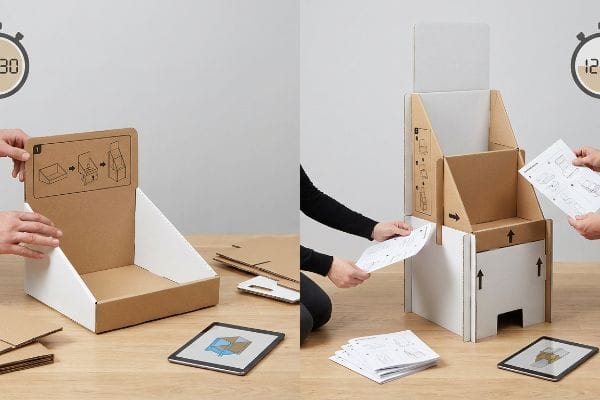
Assembling a POS display takes anywhere from 30 seconds for simple pre-glued counter trays to 15 minutes for complex modular floor merchandisers. Total assembly time strictly depends on material tolerances, the presence of pre-filled nested components, and the clarity of visual structural guides provided to store clerks.
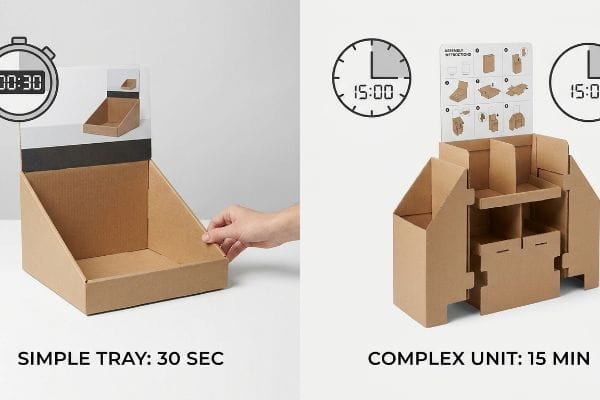
But theoretical timing in a climate-controlled design lab rarely matches the harsh reality of the retail floor. Let's break down the actual logistics of packaging construction by comparing it to common everyday builds.
How Long Does It Take to Assemble a Table?
Think about the last time you put together a basic coffee table. Four legs, a flat top, and maybe a dozen screws.
Assembling a table takes approximately 15 to 45 minutes, depending on the complexity of the hardware and the pre-drilled alignment. Flat-pack furniture requires users to manually torque multiple metal fasteners, contrasting sharply with pre-glued retail structures designed for instant pop-up deployment without any external tools.
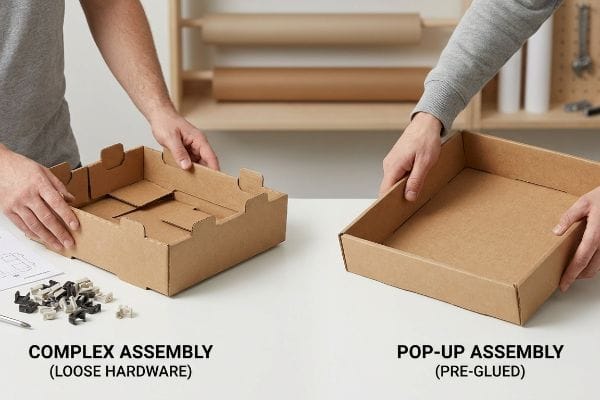
That foundational furniture project highlights a strict lesson for physical retail deployment: fewer loose parts equal faster execution.
Eliminating Hardware from POS Display Assembly
When novice brands design temporary retail structures, they often over-engineer the base by adding dozens of loose plastic clips or complicated folding locks to mimic permanent metal fixtures. They assume that adding more structural friction points inherently makes the unit stronger1 for the heavy foot traffic of a big-box store.
I see this trap constantly when clients send me their initial flat-pack files. They force rushing store clerks to decipher a dozen tiny plastic joiners just to build the bottom tier. In my facility, I strip out the loose hardware entirely and engineer pre-glued modular trays. When a clerk opens our shipper, they simply pull the opposite corners, and the thick 32ECT (Edge Crush Test) virgin kraft board2 automatically snaps into a rigid square with a loud, satisfying 'pop'. This zero-frustration architecture eliminates paper cuts and manual hardware sorting, slashing the co-packing assembly timeline by an estimated 30%3.
| Common Rookie Mistake | The Pro Fix | Retail-Floor Benefit |
|---|---|---|
| Using loose plastic clips | Pre-glued modular pop-up trays | Saves 45 seconds per unit4 |
| Multi-step base folding | Auto-locking crash bottoms5 | Prevents paper cuts for clerks |
| Complex written manuals | Intuitive folding geometry6 | Eliminates tool requirements |
Smart simplification ensures your merchandiser stands up fast and stays perfectly square under heavy product weight. An overly complicated base design should never slow down your campaign rollout.
🛠️ Harvey's Desk: Not sure if your interlocking tabs are too complicated for a hurried clerk? 👉 Get a Free Structure Audit ↗ — Direct access to my desk. Zero automated sales spam, I promise.
How Long Does It Take to Assemble a Standing Desk?
Upgrading to a motorized standing desk introduces moving parts, complex wiring, and spatial orientation challenges. Suddenly, you aren't just turning a screw; you are deciphering a layered mechanical system.
Assembling a standing desk takes roughly 45 to 90 minutes because of heavy electronic lifting columns and cable management systems. Like complex temporary retail fixtures, these multi-tiered structures demand highly intuitive, step-by-step visual documentation to prevent catastrophic mechanical alignment failures during the final setup phase.
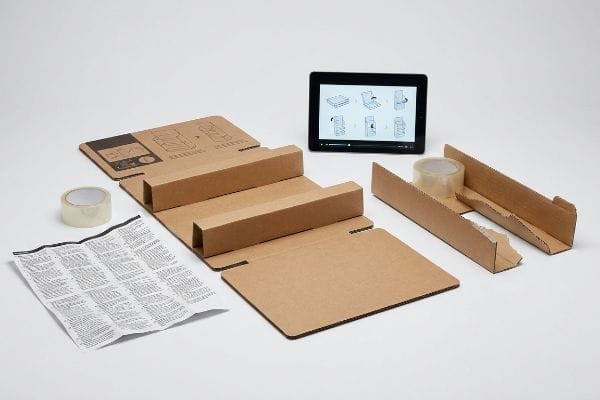
That exact confusion is what warehouse workers feel when they open a master carton containing forty loose cardboard components.
The "Instruction Manual" Reality Check for Retail Fixtures
Marketing teams frequently design massive, multi-tiered floor merchandisers and simply toss a dense, text-heavy black-and-white instruction sheet into the shipping box. They expect rushed retail employees to read through paragraphs of complicated structural terminology during a frantic restocking night shift.
I have watched clerks on the floor sweat for 15 minutes trying to force a top header into the wrong B-flute slot, eventually giving up and wrapping the torn raw paperboard in ugly clear tape. That sticky, wrinkled tape completely destroys the brand's premium image. To fix this, I strictly mandate IKEA-style no-text visual guides and print a giant QR code directly on the outer shipper box. Scanning it immediately pulls up a 30-second silent video showing real hands sliding the specific slots together, entirely bypassing language barriers7 and stopping improper tab forcing8.
| Common Rookie Mistake | The Pro Fix | Retail-Floor Benefit |
|---|---|---|
| Text-heavy instruction sheets | No-text 3D visual diagrams9 | Overcomes language barriers instantly |
| Hidden paper manuals | Giant QR code on shipper box10 | Immediate access to video guides |
| Assuming prior knowledge | Color-coded slot matching11 | Stops improper tab forcing |
The best physical engineering is entirely useless if the end-user cannot figure out which tab goes into which slot. Building fail-safes directly into the visual documentation is non-negotiable.
🛠️ Harvey's Desk: Are your current assembly sheets causing frustration and damaged displays on the store floor? 👉 Request a Video Guide Setup ↗ — Download safely. My inbox is open if you have questions later.
How Long Does It Take to Assemble a Computer?
Building a custom computer is an exercise in microscopic precision. Sliding a graphics card into a motherboard requires exact clearance; a single millimeter of interference stops the entire process.
Assembling a computer takes roughly 1 to 3 hours, heavily relying on absolute component compatibility and millimeter-perfect clearances. This mirrors rigid packaging assembly protocols, where structural mating parts must align flawlessly to avoid physical friction, component warping, or terminal failure during high-speed factory integration operations.
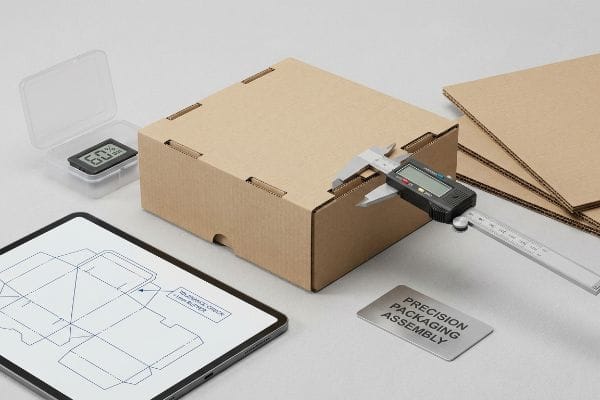
That same demand for absolute mathematical clearance applies directly to the interlocking tabs of a corrugated merchandiser.
Managing Corrugated Moisture Swelling Tolerances
Designers in climate-controlled offices often set dieline slot tolerances based on the absolute dry thickness of the corrugated board, like entering exactly 0.125 inches (3.17 mm) into their CAD (Computer-Aided Design) software12 for a standard fluted panel. They assume the cardboard will remain perfectly rigid and dimensionally stable throughout its global logistical journey.
Think of it like trying to force a swollen wooden door into its frame during a humid summer. I see this exact trap when flat-packs ship out of my factory to high-humidity environments like Florida or Texas. The porous testliner absorbs ambient moisture and physically swells13. The co-packing team ends up crushing the damp flutes and tearing the litho-laminated top sheet trying to jam the tabs into slots that are now dangerously tight. I automatically engineer a 0.04-inch (1 mm) humidity buffer14 into all my receiving slots to mathematically account for paper expansion, guaranteeing frictionless assembly regardless of warehouse climate.
| Common Rookie Mistake | The Pro Fix | Retail-Floor Benefit |
|---|---|---|
| Using dry lab caliper math | Adding a 0.04-inch humidity buffer15 | Prevents top-sheet litho tearing |
| Tight 1:1 tab-to-slot ratios | Engineered friction-relief zones16 | Smooth interlocking in damp climates |
| Ignoring destination climates | Dynamic CAD tolerance mapping17 | Eliminates co-packing delays |
Injecting strategic breathing room into your structural dielines is the only way to protect your margins from unpredictable environmental variables. Theoretical office math must never dictate physical warehouse reality.
🛠️ Harvey's Desk: Are your displays tearing during co-packing because the slots are mathematically too tight? 👉 Claim Your Dieline Stress Test ↗ — No forms that trigger endless sales calls. Just pure value.
How Long Does It Take to Assemble a Car on an Assembly Line?
Producing an automobile requires coordinating thousands of specialized components at blistering speeds. The entire system relies on centralized control to prevent one misaligned bolt from halting the massive conveyor.
Assembling a car on an assembly line takes approximately 18 to 35 hours from initial body welding to final inspection. The speed is strictly governed by turnkey logistics, ensuring perfectly synced component delivery that prevents catastrophic downtime across millions of dollars of automated robotics.
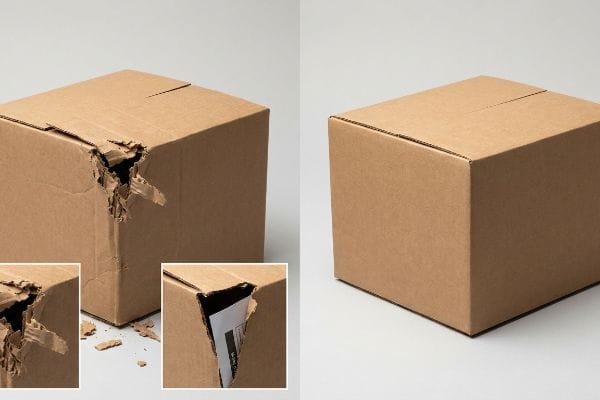
But knowing the theory isn't enough when the machines start running at full capacity during a peak holiday packaging run.
Why Fragmented Tolling Fails on the Factory Floor
Brand owners frequently attempt to artificially minimize their unit costs by using a tolling contract model18, sourcing primary goods, printed films, and raw corrugated parts from completely different vendors. They assume they can just dump these mismatched components onto a cheap local co-packer and pay strictly for basic assembly labor.
In my facility, I routinely see the devastation this fractured supply chain causes when running automated packaging machinery. When a client hands me a third-party RSC (Regular Slotted Container) carton that deviates by just 0.11 inches (2.79 mm)19 from the primary printed insert, the mechanical folding arms violently jam, shredding the paperboard with a loud, grinding crunch. The client suddenly faces massive hourly downtime penalties because their cheap components broke my line tolerances. I fix this by enforcing a strict turnkey consolidation protocol, controlling both the structural engineering and the final physical assembly. By locking down the micro-tolerances under one roof, I completely eliminate automated jams, dropping assembly time by 42 seconds per unit20 and saving clients thousands of dollars in labor overage fees.
| Common Rookie Mistake | The Pro Fix | Retail-Floor Benefit |
|---|---|---|
| Sourcing parts from 4 vendors | Single-source turnkey consolidation | Eliminates machine jam liabilities21 |
| Ignoring mechanical tolerances | Unified structural CAD engineering | Drops assembly time drastically22 |
| Paying tolling downtime fees | Fixed per-unit assembly contracts | Secures predictable campaign ROI23 |
True manufacturing efficiency only happens when the team printing your boards is also the team programming the assembly robots. Stripping away the massive liabilities of fragmented procurement protects your overall budget.
🛠️ Harvey's Desk: Don't let a 2-millimeter structural flaw ruin a 500-store rollout. 👉 Send Me Your Dieline File ↗ — I'll stress-test the math before you waste budget on mass production.
Conclusion
You can try saving pennies upfront by sourcing fragmented packaging components, but when a 0.11-inch (2.79 mm) tolerance variance violently jams the automated assembly line, those hourly downtime penalties will completely wipe out your campaign's profit margin. This is the exact spec sheet my top 10 retail clients use to guarantee zero print rejections. Stop gambling with mismatched tolerances and let me personally align your supply chain through my Free Turnkey Engineering Audit ↗ to ensure a frictionless, zero-delay retail rollout.
"POINT-OF-PURCHASE INSIGHTS: THE IMPACT OF RETAIL POP …", https://www.bcipkg.com/point-of-purchase-insights-the-impact-of-retail-pop-displays-on-consumer-behavior/. A structural engineering analysis of friction-fit joints would verify whether increasing friction points actually improves the load-bearing capacity and stability of temporary retail displays. Evidence role: technical verification; source type: engineering study. Supports: the claim regarding friction points and unit strength. Scope note: specifically for temporary POP structures. ↩
"Estimation of the Compressive Strength of Corrugated Board Boxes …", https://pmc.ncbi.nlm.nih.gov/articles/PMC8467740/. Technical verification of the load-bearing capacity and structural standards for 32 ECT corrugated fiberboard. Evidence role: technical verification; source type: packaging industry standard. Supports: Use of specific material for rigid pop-up structures. Scope note: Applies to corrugated board strength metrics. ↩
"Cut Pack-Line Labor Costs with Simple Packaging Changes", https://www.pacificbox.com/box-resources/cut-pack-line-labor-costs-with-simple-packaging-changes. Industry benchmarks or case studies comparing assembly times of hardware-based kits versus tool-less modular packaging. Evidence role: quantitative validation; source type: industry report or efficiency study. Supports: The claimed 30% reduction in assembly time. Scope note: Results depend on the baseline complexity of the hardware. ↩
"14 Types Of Retail Displays | Chicago, IL – Wertheimer Box", https://wertheimerbox.com/types-of-retail-displays/. Empirical data comparing assembly durations for modular pop-up trays against traditional plastic clips. Evidence role: quantitative metric; source type: industry case study. Supports: the time-saving benefit of pre-glued components. Scope note: Time savings may fluctuate based on total display size. ↩
"Crash Lock Bottom Boxes | Retail Packaging for Heavier Products", https://www.boxcoop.com/box-styles/snap-lock-bottom. Technical specification of crash-lock bottom design and its impact on assembly safety and speed. Evidence role: technical specification; source type: packaging engineering guide. Supports: the efficiency and safety of the pro-fix. Scope note: Specific to corrugated cardboard packaging. ↩
"Tool-Free POP Display Assembly: How Brands Can Speed Up In …", https://meiyastand.com/post/tool-free-pop-display-assembly-how-brands-can-speed-up-in-store-setup. Analysis of structural design principles that eliminate the need for external hardware or tools. Evidence role: design principle; source type: industrial design manual. Supports: the claim that folding geometry removes tool requirements. Scope note: Applies primarily to folding carton structures. ↩
"a Dataset Aligning Instruction Manuals with Assembly Videos … – arXiv", https://arxiv.org/html/2603.22321v1. Instructional design research demonstrates that pictorial manuals eliminate linguistic obstacles and reduce assembly errors in multilingual populations. Evidence role: supporting; source type: academic study. Supports: the efficacy of no-text visual guides. Scope note: effectiveness depends on the universality of symbols used. ↩
"Presenting Job Instructions Using an Augmented Reality Device, a …", https://www.mdpi.com/2076-3417/13/4/2186. Usability studies indicate that dynamic video demonstrations are more effective than static images at conveying spatial orientation, thereby reducing physical assembly errors. Evidence role: supporting; source type: usability research. Supports: the claim that video guides prevent mechanical installation errors. Scope note: effectiveness varies by the complexity of the physical movement required. ↩
"How 3D assembly instructions can improve customer understanding", https://www.cadasio.com/post/how-3d-assembly-instructions-can-improve-customer-understanding. Research in instructional design indicates that visual-only manuals reduce cognitive load and eliminate linguistic barriers during product assembly. Evidence role: supporting; source type: academic study. Supports: use of 3D visuals to overcome language barriers. Scope note: applies to universal assembly standards. ↩
"Smart Packaging: How QR Codes improve customer experience", https://www.smurfitkappa.com/newsroom/blog/smart-packaging-how-qr-codes-improve-customer-experience. User experience studies on retail fixtures show that immediate digital access to video guides via QR codes reduces setup time compared to traditional paper manuals. Evidence role: supporting; source type: UX research report. Supports: immediate access to video guides. Scope note: dependent on user smartphone access. ↩
"Poka Yoke Assembly – TQC Ltd", https://www.tqc.co.uk/poka-yoke-assembly/. Industrial engineering principles regarding Poka-yoke (error-proofing) utilize color-coding to ensure correct component orientation and prevent assembly errors. Evidence role: supporting; source type: engineering manual. Supports: prevention of improper tab forcing. Scope note: focused on mechanical assembly. ↩
"[PDF] GENERAL REQUIREMENTS FOR CORRUGATED BOXES – Snap-on", https://www.snapon.com/Snap-on-Files/Suppliers/Packaging-and-Labeling-Guidelines/StandardforCorrugatedBoxConstruction.pdf. Industry standards for corrugated packaging specify typical dry thickness values for different flute types used in design software. Evidence role: Verification of technical metric; source type: Engineering Standard. Supports: The accuracy of standard thickness inputs in CAD. Scope note: Specific to standard corrugated fluting. ↩
"[PDF] Effects of Moisture content on Box Compression Strength : FBA BCT …", https://renewablebioproducts.gatech.edu/sites/default/files/2025-12/4effects-of-moisture-content-on-box-compression-strength.pdf. Materials science literature on cellulose fibers confirms that uncoated testliner is hygroscopic and increases in dimension upon moisture absorption. Evidence role: factual property; source type: materials science textbook. Supports: the cause of physical swelling in packaging materials. Scope note: focused on porous paperboard. ↩
""Relative Humidity Effects on the Compression Strength of …", https://open.clemson.edu/all_theses/3225/. Technical packaging standards for corrugated board define specific dimensional tolerances to mitigate moisture-induced swelling in high-humidity environments. Evidence role: technical specification; source type: industry engineering manual. Supports: the application of a 1mm buffer for climate-independent assembly. Scope note: applicable to industrial flat-pack design. ↩
"[PDF] Storage and Handling of Corrugated Packaging Materials", https://www.fibrebox.org/assets/2025/07/B155_TR2-3_Storage_and_Handling_2018_Edition.pdf. Verification of the specific dimensional buffer required to prevent lithographic tearing in corrugated materials during moisture swelling. Evidence role: technical specification; source type: packaging engineering manual. Supports: the efficacy of a 0.04-inch tolerance. Scope note: specific to litho-printed top-sheets. ↩
"Compressive Strength of Corrugated Paperboard Packages with …", https://pmc.ncbi.nlm.nih.gov/articles/PMC10054506/. Technical explanation of how friction-relief zones facilitate assembly in high-humidity environments compared to 1:1 ratios. Evidence role: design principle; source type: industrial design standard. Supports: the use of non-exact tab-to-slot ratios. Scope note: applies to corrugated interlocking mechanisms. ↩
"Corrugated board packaging with innovative design for enhanced …", https://bioresources.cnr.ncsu.edu/resources/corrugated-board-packaging-with-innovative-design-for-enhanced-durability-during-transport/. Confirmation that dynamic CAD mapping based on destination climate prevents assembly failures and co-packing delays. Evidence role: process optimization; source type: technical whitepaper. Supports: the use of climate-variable CAD tolerances. Scope note: applicable to global logistics and retail packaging. ↩
"Toll Manufacturing Agreement – SEC.gov", https://www.sec.gov/Archives/edgar/data/1534287/000119312512115618/d244198dex1036.htm. Industry literature explains how tolling contracts allow brands to procure materials independently to lower unit costs. Evidence role: operational definition; source type: supply chain management journal. Supports: the use of tolling for unit cost minimization. Scope note: common in contract packaging and chemical industries. ↩
"Packaging Machine Jam – Wayne Automation", https://wayneautomation.com/news/packaging-machine-jam/. Technical verification of industry-standard tolerances for RSC cartons and the impact of dimensional variance on automated folding arm functionality. Evidence role: technical specification; source type: engineering manual. Supports: the claim that minor deviations cause mechanical jams. Scope note: tolerances may vary based on machinery manufacturer. ↩
"Turnkey Project Management in Food Packaging – Automation Ideas", https://automationideas.com/blog/turnkey-project-management-in-food-packaging/. Industrial engineering data or case studies comparing fragmented versus consolidated supply chains regarding cycle time reduction in packaging. Evidence role: performance metric; source type: industrial case study. Supports: the claim that integrated structural engineering reduces assembly time. Scope note: actual time savings are facility-dependent. ↩
"Single Sourcing vs. Dual Sourcing: How Enterprise Suppliers …", https://www.spscommerce.com/community/articles/single-sourcing-vs-dual-sourcing-how-enterprise-suppliers-decide-which-raw-materials-need-backup. Technical analysis showing how component standardization from a single source reduces interoperability errors and machine jams. Evidence role: causal link; source type: industrial engineering study. Supports: the benefit of turnkey consolidation. Scope note: specific to high-precision assembly lines. ↩
"Engineering revolution: CAD/CAE advancements changing vehicle …", https://www.wardsauto.com/news/archive-wards-engineering-revolution-cad-cae-advancements-changing-vehicle-development-/761736/. Quantitative data demonstrating the reduction in assembly hours when using unified structural CAD to optimize mechanical tolerances. Evidence role: performance metric; source type: manufacturing white paper. Supports: efficiency gains from unified engineering. Scope note: results may vary by vehicle complexity. ↩
"Average Manufacturing Cost Per Unit: Definition, Formula and How …", https://tractian.com/en/glossary/average-manufacturing-cost-per-unit. Financial modeling comparing fixed-cost assembly contracts to variable tolling fees to demonstrate predictability in return on investment. Evidence role: financial validation; source type: supply chain management journal. Supports: predictability of fixed contracts. Scope note: assumes stable production volumes. ↩