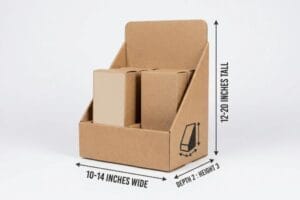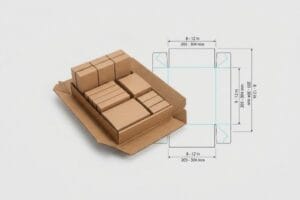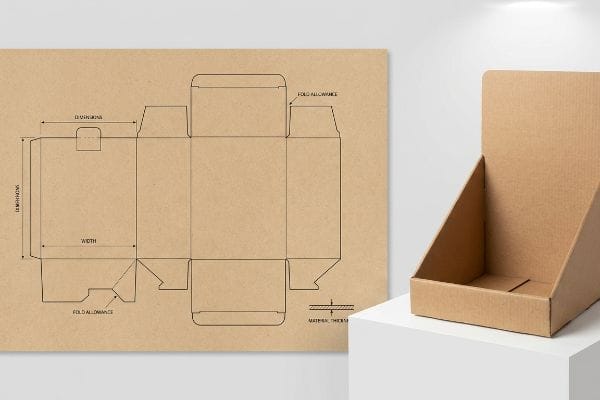
Struggling to find the right display box dimensions? Wasting hours searching for dielines that actually fold correctly? Stop guessing and start building with proven structural foundations.
Yes. Pre-designed display box templates can be sourced through packaging manufacturers, structural engineering databases, and online B2B (Business-to-Business) portals. However, these standardized 2D outlines require critical physical adjustments to account for material thickness, fold allowances, and specific retail load capacities before beginning mass production.
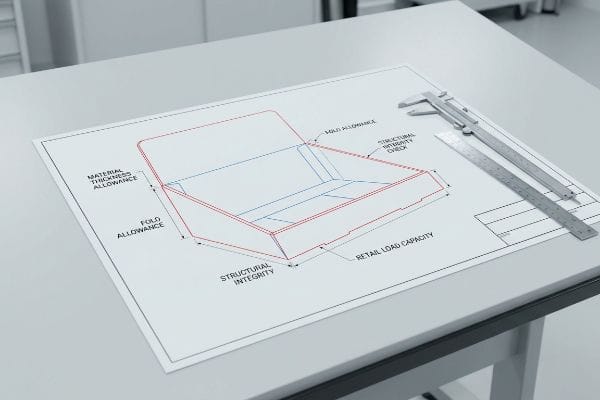
Let's break down exactly where to source these files and why relying strictly on theoretical downloads can turn your retail rollout into a costly headache.
Where Can I Find Design Templates?
Searching for reliable starting points is the first step most marketing teams take when planning a new merchandising campaign.
Standard design templates are found through structural packaging manufacturers and specialized CAD (Computer-Aided Design) portals. These baseline electronic files establish accurate outer dimensions and basic interlocking geometries, serving strictly as a foundational structural blueprint for your graphic artwork integration before physical factory routing begins.
Having the file is great, but treating it like a simple graphic canvas is where most teams crash.
The Hidden Trap of Web-Based Design Tools
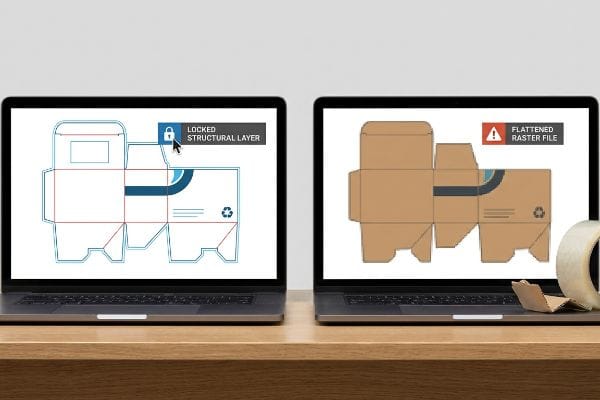
Many brands try to save money by having junior designers draw complex interlocking tabs directly in basic web tools1. They assume that if it looks right on the screen, it will naturally fold correctly on the factory floor.
Even veteran designers often overlook this blind spot when they drag a PDF template into software that strictly outputs raster art. I see this constantly when a client sends a flattened file where the structural math has been overwritten by uncalibrated pixel manipulation2. The store clerk ends up sweating on the aisle, trying to force a rigid tab into a slot that does not exist anymore, eventually reaching for the messy stickiness of clear packing tape to hold the unit together. To fix this, always lock your pre-engineered PDF to the bottom layer and apply only surface graphics, ensuring the complex geometry remains completely untouched.
| Common Rookie Mistake | The Pro Fix | Retail-Floor Benefit |
|---|---|---|
| Flattening CAD lines in web tools | Locking PDF structural layers | Saves 25s assembly time3 |
| Deleting bend allowances | Preserving original slot widths | Prevents torn paperboard4 |
| Rasterizing cut paths | Keeping vector geometry intact | Eliminates messy clear tape5 |
I strictly require my clients to use locked structural PDFs before they apply a single drop of color. It completely eliminates cognitive overload for the co-packers and ensures the physical display can actually hold heavy dynamic loads.
🛠️ Harvey's Desk: Not sure if your web-based artwork accidentally flattened the critical folding tabs? 👉 Send Me Your Flat File ↗ — Direct access to my desk. Zero automated sales spam, I promise.
Where Can I Find Custom Display Boxes?
When standard dimensions fail to protect your fragile primary goods or fit retailer shelves, transitioning to tailored structural engineering becomes mandatory.
Custom display boxes are sourced through dedicated corrugated packaging manufacturers equipped with parametric engineering software. Unlike generic stock suppliers, these facilities design unique structural blueprints mathematically calibrated to your specific product dimensions, dynamic payload weights, and highly specific targeted retail aisle spatial constraints.
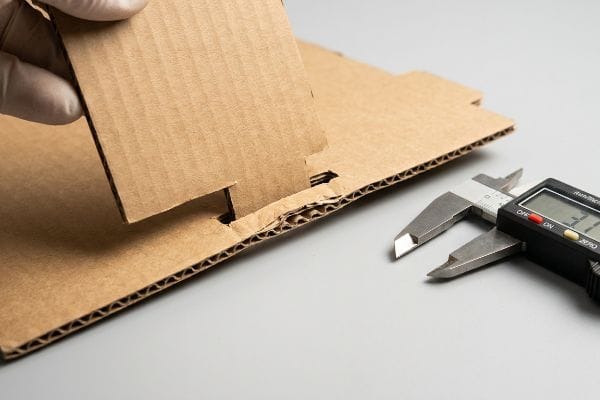
A custom box sounds simple, until you realize paperboard consumes physical space when it bends.
Why Theoretical Dimensions Fail in Reality
A frequent question buyers ask is why their custom box prototype feels too tight when they used the exact dimensions of their product6. They assume a one-inch (25.4 mm) bottle fits perfectly into a one-inch (25.4 mm) cardboard slot.
The reality of caliper compensation completely shatters this assumption. I recently watched a co-packer aggressively yank on a printed header panel because the client designed the interlocking slots at the exact same width as the mating panel, ignoring the 0.11 inches (3 mm) thickness of the B-flute board7. The stiff resistance of the thick virgin kraft board caused the entire side panel to aggressively bow outward and tear during assembly. You must mathematically widen the receiving slot on the dieline to compensate for the fold's outer radius8, or the physical display will severely warp and trigger massive retail friction.
| Common Rookie Mistake | The Pro Fix | Retail-Floor Benefit |
|---|---|---|
| 1:1 slot-to-tab matching | Adding outer radius clearance9 | Frictionless tab insertion |
| Ignoring flute thickness | Applying caliper compensation10 | Prevents bowed side panels |
| Tight product nesting | Engineering internal voids11 | Stops primary box crushing |
I automatically rebuild these flat dielines using parametric algorithms to add specific bend allowances. Doing so guarantees the pre-filled displays assemble with zero friction and sit perfectly square under heavy store lights.
🛠️ Harvey's Desk: Are your custom tabs fighting the natural thickness of your corrugated board? 👉 Request a Structural Audit ↗ — Download safely. My inbox is open if you have questions later.
Where Can I Find Free Printable Templates?
Budget-conscious teams often scour the internet for open-source structural blueprints to jumpstart their packaging designs.
Free printable templates are widely available on graphic design forums, packaging blogs, and open-source vector libraries. These generic downloads provide a basic visual outline of a box structure, but they universally lack the precise machine-readable color profiling required for automated industrial CNC (Computer Numerical Control) equipment.
Downloading a free outline is harmless, but sending it directly to a factory will instantly stall your project.
The Spot Color Translation Trap
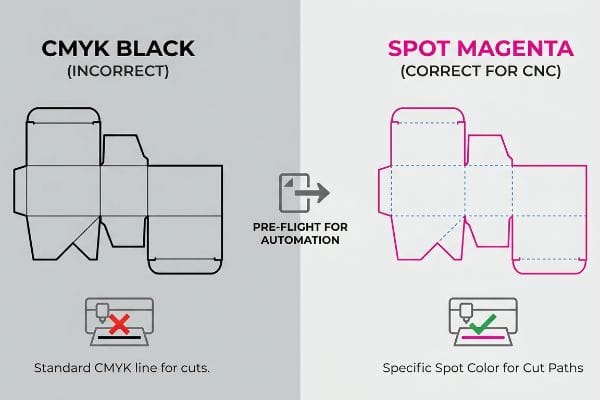
It is a common trap that catches even experienced procurement teams: they download a free PDF template and submit it using standard CMYK black lines to indicate where the display should be cut or folded. They assume modern machinery automatically knows the difference between a printed graphic and a physical cut12.
Think of automated cutting tables like a blindfolded worker who only speaks one highly specific language. The machine software does not process visual black lines; it strictly reads specific spot color names assigned to vector strokes13. When I receive a free template mapped in standard CMYK black, and hear the loud vacuum suction of the Kongsberg table engage, the machine software simply merges the cut lines into the artwork layer, resulting in a printed box with zero physical cuts. A solid rule of thumb is to always assign structural paths to absolute spot colors14—like 100% Magenta for Cut—so the blades engage the board correctly.
| Common Rookie Mistake | The Pro Fix | Retail-Floor Benefit |
|---|---|---|
| Using CMYK black for cuts | Assigning 100% Magenta spot color15 | Clean precise die-cutting |
| Merging structural layers | Separating cut and crease paths16 | Eliminates visible print lines |
| Trusting free internet files | Pre-flighting vector strokes17 | Prevents mass production halts |
I strictly intercept and separate these structural layers before they ever reach the cutting floor. By mapping exact mechanical colors to the cutting tools, I ensure the steel rule die strikes perfectly without ruining your visual branding.
🛠️ Harvey's Desk: Did your downloaded file use generic CMYK black for its critical cut lines? 👉 Get Your File Pre-Flighted ↗ — No forms that trigger endless sales calls. Just pure value.
Where Can I Find the Template?
Ultimately, securing the right structural blueprint means moving away from internet forums and directly engaging a manufacturing partner.
The ultimate factory template is found directly within a packaging manufacturer's internal structural engineering database. These proprietary files are pre-calibrated to match specific testliner board grades, localized moisture tolerances, and precise physical machinery capabilities, ensuring a frictionless transition from digital rendering to tangible retail units.

Getting a flawless file from your factory is great, but knowing the theory isn't enough when the physical materials start reacting to the real world.
Why Standard Templates Fail on the Factory Floor
Many brands source a pristine, mathematically perfect CAD file from a high-end agency and assume it is ready for global mass production. They trust the flat theoretical dimensions, completely ignoring the microscopic environmental variables that alter paperboard during ocean transit18.
In my facility, I routinely see brilliant agency designs buckle under the reality of ambient humidity. This is not just theory—I test this using climate conditioning chambers when we simulate ocean transit to the US east coast. The porous 32ECT testliner absorbs ambient moisture and physically swells19 by nearly 0.04 inches (1.01 mm). A slot that perfectly fit the tab in the software suddenly becomes a friction nightmare, forcing assembly teams to crush the dense flutes just to connect the panels. I pulled the micrometer readings and proved we did not need to switch to expensive plastic clips; I just injected a dedicated humidity buffer into the original dieline math. By mathematically widening the slots before cutting, I ensure the co-packing assembly time drops by roughly 35 seconds per unit, protecting the project's profit margin from costly manual rework fees.
| Common Rookie Mistake | The Pro Fix | Retail-Floor Benefit |
|---|---|---|
| Relying on dry board caliper | Adding a 0.04-inch humidity buffer20 | Frictionless warehouse assembly |
| Ignoring ocean transit moisture | Engineering moisture swelling tolerance21 | Stops structural flute crushing |
| Using zero-clearance slots | Mathematically widening receivers22 | Eliminates torn top sheets |
I never trust a theoretical template without stress-testing its environmental limits. By engineering these micro-clearances on the front end, I guarantee your cardboard structure survives unpredictable warehouse climates.
🛠️ Harvey's Desk: Do you know the exact moisture swelling tolerance of your current corrugated supplier's board? 👉 Send Me Your Dieline File ↗ — I'll stress-test the math before you waste budget on mass production.
Conclusion
Relying on generic internet downloads is risky; when that uncalibrated 32ECT board swells in a humid warehouse and crushes during assembly, the resulting friction will slow down your co-packing line by an estimated 30%. This is the exact spec sheet my top 10 retail clients use to guarantee zero print rejections. Stop guessing on structural tolerances and let me personally run your files through my Free Dieline Audit ↗ to lock in critical moisture buffers before mass production begins.
"Software That Simplifies Structural and Graphic Packaging …", https://www.packagingdesignsoftware.com/post/software-that-simplifies-structural-and-graphic-packaging-steps. Technical standards for packaging engineering explain why CAD is required for calculating material thickness and fold tolerances for interlocking tabs. Evidence role: technical validation; source type: packaging engineering guide. Supports: the risk of structural failure when using basic graphic tools. Scope note: focused on industrial routing and die-cutting. ↩
"Recognizing Vector Graphics without Rasterization – arXiv", https://arxiv.org/html/2111.03281v3. Technical explanation of how converting vector-based structural coordinates to raster pixels causes dimensional drift and loss of geometric precision. Evidence role: technical validation; source type: graphic design manual. Supports: the claim that rasterization compromises physical assembly. Scope note: limited to non-vector editing software. ↩
"How to Export AutoCAD to PDF with layers [HIGH QUALITY]", https://www.youtube.com/watch?v=a3B8NPBFoUk. A technical benchmark or industry case study demonstrating the efficiency gain when using locked structural layers for assembly. Evidence role: quantitative verification; source type: technical manual or operational study. Supports: assembly time reduction claim. Scope note: specific to retail merchandising displays. ↩
"Analytical Determination of the Bending Stiffness of a Five …", https://pmc.ncbi.nlm.nih.gov/articles/PMC8777652/. Packaging engineering standards explaining how preserving original bend allowances prevents material failure and tearing. Evidence role: technical validation; source type: packaging engineering guide. Supports: material integrity claim. Scope note: applies to corrugated or heavy paperboard materials. ↩
"Laser Cutter – Vector vs Raster Laser Cutting – NC State College of Design", https://design.ncsu.edu/operations/510/laser-cutter-vector-vs-raster-laser-cutting/. Technical explanation of how maintaining vector geometry ensures precision fits that remove the need for corrective adhesives. Evidence role: technical validation; source type: CNC or die-cutting specification. Supports: precision and finishing claim. Scope note: focuses on the output quality of digital cutting tools. ↩
"Why packaging designs fail in production | Ecobliss Pharma", https://www.ecobliss-pharma.com/blog/why-packaging-designs-fail-in-production. Packaging engineering standards specify the need for clearance tolerances to prevent tight fits caused by material thickness and manufacturing variance. Evidence role: technical validation; source type: engineering manual. Supports: the claim that exact dimensions result in improper fit. Scope note: Specific to corrugated packaging. ↩
"Corrugated Board and Material Grades | 2021-06-30", https://www.packagingstrategies.com/articles/96269-corrugated-board-and-material-grades. Industry technical specifications for corrugated fluting grades verify the standard nominal thickness of B-flute material. Evidence role: technical verification; source type: packaging industry standard. Supports: material dimension accuracy. Scope note: Actual thickness may vary slightly by manufacturer. ↩
"Are Dielines Specific to Certain Box Shapes? – PopDisplay", https://popdisplay.me/are-dielines-specific-to-certain-box-shapes/. Structural engineering guidelines for corrugated packaging explain the requirement for slot allowances to account for material caliper and bend radius during assembly. Evidence role: technical best practice; source type: packaging design manual. Supports: structural integrity and assembly logic. Scope note: Specific offsets depend on the board's specific caliper. ↩
"Paper Packaging Structural Design Guide", https://greendotpackaging.com/paper-packaging-structural-design-guide/. Verification of engineering standards for slot-and-tab clearance to ensure ease of assembly. Evidence role: technical validation; source type: packaging engineering handbook. Supports: necessity of clearance for frictionless insertion. Scope note: applies to folded cardboard structures. ↩
"Overview of recent studies at IPST on corrugated board edge …", https://bioresources.cnr.ncsu.edu/resources/overview-of-recent-studies-at-ipst-on-corrugated-board-edge-compression-strength-testing-methods-and-effects-of-interflute-buckling/. Technical explanation of how accounting for material thickness (caliper) prevents structural deformation in box side panels. Evidence role: technical validation; source type: manufacturing manual. Supports: prevention of bowing caused by material thickness. Scope note: specific to corrugated fluting. ↩
"Protective Packaging vs. Void Fill: Which Shipping Material …", https://www.onlinelabels.com/articles/protective-packaging-vs-void-fill?srsltid=AfmBOoq4VnRqlBFRX94b9RIJdyHrJ5quJ1JbXFJa7R3ZMlkL023k1zBA. Evidence that strategically designed voids prevent pressure transfer to the primary container. Evidence role: functional validation; source type: logistics/packaging standards. Supports: prevention of primary box crushing. Scope note: focuses on internal structural engineering. ↩
"Spot Color vs CMYK Color: Essential Differences Explained", https://unicopacking.com/en/new/spot-color-vs-process-color.html. Explanation of why industrial cutting equipment requires specific spot color designations to differentiate cut paths from CMYK print graphics. Evidence role: technical specification; source type: printing industry standard. Supports: the claim that machinery cannot distinguish cuts based on standard CMYK black. Scope note: applies to automated CNC and die-cutting machinery. ↩
"Mastering CNC Plasma Cutting: Technology, Operation, and …", https://www.youtube.com/watch?v=wtriVCfRIK0. An authoritative technical manual or industry guide for industrial cutting tables would confirm that machine software interprets specific spot color names as command instructions rather than visual CMYK data. Evidence role: technical verification; source type: equipment manual. Supports: the necessity of spot color naming for CNC output. Scope note: applicable to most professional vector-based cutting systems. ↩
"Packaging Dieline Design: What to Give Your …", https://www.digitalpolo.com/packaging-dieline-design/. Professional graphic design standards for packaging would verify that specific spot colors are used to differentiate cut, crease, and bleed lines for automated production. Evidence role: industry standard; source type: packaging design guide. Supports: the practice of using distinct spot colors for structural paths. Scope note: specific color choices may vary by print house. ↩
"Graphic Guidelines", https://www.delinebox.com/graphic-guidelines/. Brief explanation of how an authoritative external source supports the use of specific spot colors to distinguish non-printing die-lines from CMYK artwork. Evidence role: technical standard; source type: print production manual. Supports: use of spot colors for precise die-cutting. Scope note: color choices may vary by print house. ↩
"Structural Packaging Design: Key Elements and Process", https://www.arkay.com/resources/structural-packaging-design. Brief explanation of how separating cutting and creasing lines into distinct layers or paths is required for die-making tool production. Evidence role: process verification; source type: packaging industry guide. Supports: elimination of print lines on finished products. Scope note: specifically applies to vector-based die-line creation. ↩
"What is Packaging PrePress? A Complete Overview", https://www.esko.com/en/blog/the-complete-overview-of-packaging-prepress. Brief explanation of how pre-flight checks on stroke weight and path closure prevent errors in CNC routing or die-cutting. Evidence role: quality control; source type: pre-press technical standard. Supports: prevention of mass production halts. Scope note: standard procedure for vector file preparation. ↩
"Environmental impact of shipping", https://en.wikipedia.org/wiki/Environmental_impact_of_shipping. Technical explanation of how humidity and temperature fluctuations during ocean freight cause hygroscopic expansion or contraction in cellulose-based materials. Evidence role: Technical validation; source type: Material science or logistics whitepaper. Supports: The claim that theoretical CAD dimensions fail due to material instability. Scope note: Focuses on paperboard and corrugated materials. ↩
"Compressive Strength of Corrugated Paperboard Packages …", https://pmc.ncbi.nlm.nih.gov/articles/PMC10054506/. Detailed technical analysis of how cellulose-based testliners react to humidity, causing measurable physical expansion. Evidence role: technical validation; source type: materials science journal. Supports: the impact of ambient humidity on cardboard dimensions. Scope note: Expansion rates depend on the specific board grade and moisture content. ↩
""Relative Humidity Effects on the Compression Strength of …", https://open.clemson.edu/all_theses/3225/. Verification of the specific 0.04-inch industry standard for humidity buffers in cardboard display engineering. Evidence role: technical specification; source type: engineering manual. Supports: the precision of the buffer measurement. Scope note: applicable to standard corrugated cardboard substrates. ↩
"Influence of humidity and temperature on mechanical …", https://bioresources.cnr.ncsu.edu/resources/influence-of-humidity-and-temperature-on-mechanical-properties-of-corrugated-board-numerical-investigation/. Scientific confirmation that accounting for moisture swelling prevents the structural collapse of internal fluting during transit. Evidence role: causal link; source type: materials science journal. Supports: the relationship between swelling tolerance and flute integrity. Scope note: specifically relevant to ocean freight environments. ↩
"Can Divider Inserts Be Added Inside Display Packaging? – PopDisplay", https://popdisplay.me/can-divider-inserts-be-added-inside-display-packaging/. Technical evidence showing that increasing receiver width relative to the tab prevents top sheet tearing during assembly. Evidence role: technical best practice; source type: manufacturing guide. Supports: the effectiveness of widening receivers over zero-clearance slots. Scope note: applies to slot-and-tab assembly methods. ↩