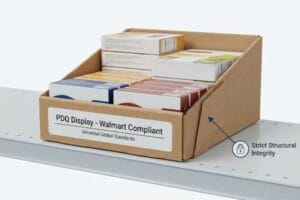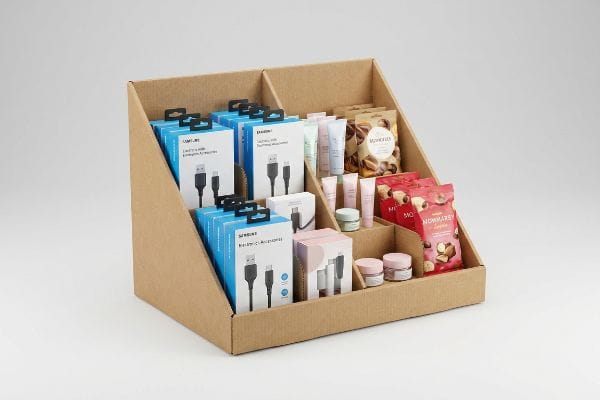
Maximizing retail real estate means utilizing every inch of vertical end-cap space. Sidekick merchandisers transform dead air into impulse revenue if engineered to survive severe high-traffic friction.
Choosing the best products for sidekick displays involves selecting high-margin, lightweight impulse items. Smaller electronics, cosmetics, and seasonal candies perform exceptionally well because their compact footprint fits perfectly within standard hanging profiles, driving immediate purchases without overloading the structural integrity of the corrugated wing.
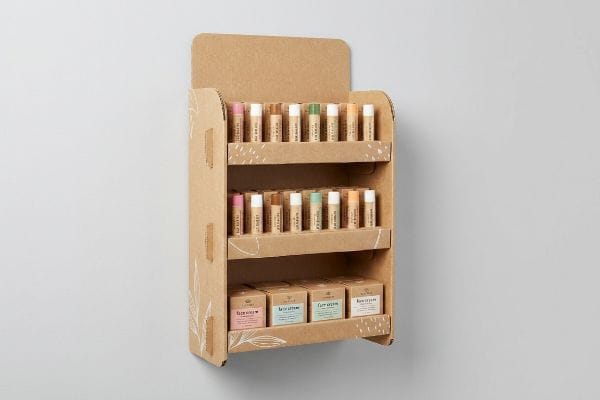
Securing that hanging end-cap placement is only the first hurdle. Making sure your hanging inventory actually survives the retail gauntlet requires brutal material logic.
How Do I Attract Customers with My Display?
Earning shopper attention in crowded big-box aisles demands more than just colorful artwork. It requires a thoughtful approach to retail strategy and visual placement.
Attracting customers to your display requires executing the 3-3-3 spatial engagement rule. Shoppers must be visually disrupted from thirty feet away, fully engaged at three feet, and physically converting at three inches. Implementing bold colors and clear messaging guarantees maximum visual pull within crowded aisles.
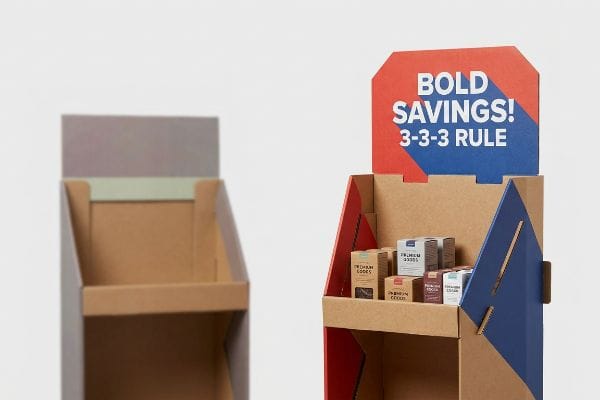
Pretty graphics mean absolutely nothing if the physical structure fails to capture the shopper's eye line from across the store.
The 30-Foot Visual Disruption Mathematics
When reviewing retail floor plans, I constantly see brands relying on standard rectangular headers that blend into the visual noise of the store. Designers often assume that a bright logo is enough to capture consumer interest from across the aisle. This flat approach completely ignores how hurried shoppers navigate large spaces, causing them to walk right past your promotion without breaking their stride or noticing your key seasonal messaging.
To successfully capture impulse buyers, your retail strategy must incorporate physical disruption that breaks the linear aisle pattern. Instead of flat boxes, introducing angled headers and vibrant, contrasting side panels ensures the structure stands out against generic store shelves. By utilizing strategic geometric shapes and clear, high-contrast typography, brands can effectively disrupt the shopper's line of sight1, pulling more foot traffic toward the promotion and boosting average conversion rates significantly2.
| Metric/Feature | Generic Approach | Strategic Retail Reality |
|---|---|---|
| Aisle Contrast | Flat rectangle profile | Engaging geometric shapes |
| Visual Reach | Fades into background | Stands out across the store |
| Shopper Engagement | Blends into shelves | Drives immediate impulse interest |
Invisible structures are essentially expensive recycling shipped directly to the retailer. Breaking the visual plane with strategic shapes is the only way to effectively capture consumer attention.
🛠️ Harvey's Desk: Are your square hanging trays blending into the background and killing your impulse sales? 👉 Get a Free Sightline Analysis ↗ — I review every structural file personally within 24 hours.
What Are the Trends in Retail Displays?
The industry is rapidly shifting toward sustainable retail designs, but this eco-friendly push means brands must rethink how they present merchandise in modern store environments.
Current trends in retail displays highlight a massive shift toward sustainable, mono-material corrugated structures. However, replacing permanent plastic fixtures with entirely recycled paperboard requires smart structural planning. Brands now prioritize eco-friendly aesthetics and clear messaging to resonate with environmentally conscious consumers without sacrificing overall visual appeal.
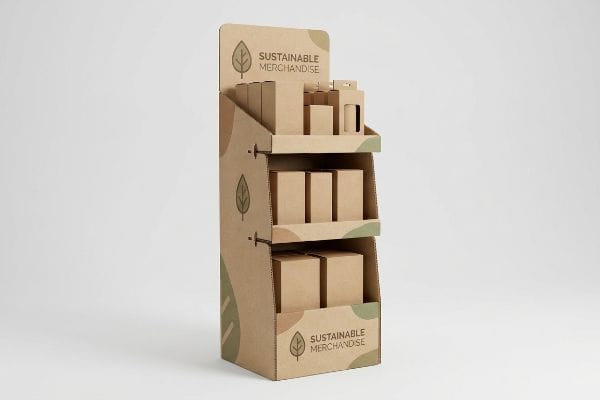
Removing plastic from your supply chain sounds great on an environmental report, but it fundamentally changes how your merchandisers react to the atmosphere.
The Moisture Swelling Calibration Trap
Many emerging brands assume that simply printing an eco-friendly logo on a standard cardboard box is enough to align with modern sustainability trends. Marketing teams often submit simple designs that look great on a computer screen but fail to communicate their environmental commitment on the crowded retail floor. They mistakenly believe that consumers will automatically recognize their green initiatives without any thoughtful integration of sustainable aesthetics into the actual display structure.
A successful sustainable retail strategy requires integrating earthy textures, raw kraft materials, and minimalist graphic layouts that instantly communicate eco-conscious values to the shopper. By deliberately utilizing unbleached paperboard and water-based inks3, brands visually reinforce their environmental message while maintaining a premium look. This strategic shift not only appeals to modern consumer values but also creates a distinct, natural contrast against the high-gloss plastic packaging typically found in traditional big-box aisles.
| Metric/Feature | Generic Approach | Strategic Retail Reality |
|---|---|---|
| Sustainability | Hidden eco-logos | Visible raw kraft materials4 |
| Graphic Style | High-gloss plastic look | Earthy, minimalist aesthetics |
| Consumer Appeal | Ignored green values | Connects with eco-conscious shoppers5 |
Slapping a green logo on a shiny box won't fool modern shoppers. Embracing natural textures is the most effective way to communicate your brand's true environmental commitment.
🛠️ Harvey's Desk: Is undetected moisture swelling causing your eco-friendly merchandisers to tear during assembly? 👉 Request a Free Material Audit ↗ — 100% confidential. Your unreleased retail designs are safe with me.
How to Merchandise a Multi-Shelf Display?
Stacking multiple products vertically requires balancing high-density layouts with human psychology. Perfect symmetry often ruins the shopping experience and frustrates customers trying to browse.
Merchandising a multi-shelf display requires utilizing the asymmetrical 3-5-7 product grouping rule. Instead of packing items into a dense grid, spacing merchandise into odd-numbered clusters creates visual tension. This thoughtful retail layout prevents cognitive overload and encourages shoppers to interact comfortably with the featured products.
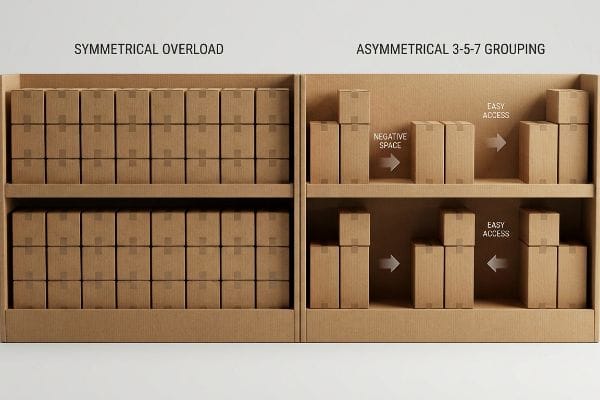
Forcing too much product onto a single cardboard shelf doesn't just confuse the shopper; it actively destroys the physical tray.
The Symmetrical Overload & Restocking Friction
Retail designers often overlook the shopper's experience by prioritizing maximum shelf capacity over clear visual organization. I frequently see layouts that pack heavy jars or boxes shoulder-to-shoulder in a mathematically perfect grid. This symmetrical layout looks incredibly efficient on a digital rendering, but it completely ignores how real humans shop. When consumers see a perfectly packed, impenetrable wall of product, they are often hesitant to remove an item for fear of ruining the pristine display6.
Effective merchandising requires engineering strategic negative space to make the shopping experience feel effortless and inviting. By grouping items in odd numbers7 and leaving slight gaps between clusters, you create a layout that naturally draws the eye and encourages physical interaction. This deliberate spacing not only makes it easier for customers to pick up and inspect the product, but it also allows store employees to easily restock the shelves, maintaining a neat appearance throughout the promotion.
| Metric/Feature | Generic Approach | Strategic Retail Reality |
|---|---|---|
| Product Layout | Symmetrical grid packing | 3-5-7 asymmetrical grouping8 |
| Shopper Interaction | Hesitant to touch | Encourages easy product removal |
| Visual Appeal | Cluttered and overwhelming | Clean, inviting, and organized |
Cramming your shelves to absolute capacity creates an intimidating barrier for buyers. Strategic negative space is essential for transforming a static stockroom shelf into an engaging retail experience.
🛠️ Harvey's Desk: Are dense product layouts causing your retaining lips to tear and triggering chargebacks? 👉 Claim a Free Divider Geometry Audit ↗ — No account managers in the middle. You talk directly to structural engineers.
What Makes a Good Product Display?
Achieving excellence in retail merchandising requires balancing premium cosmetic finishes with unyielding structural physics. You cannot sacrifice strength for shine.
A good product display perfectly balances heavy-duty material compression strength with high-contrast graphic visibility. The most successful structures utilize highly engineered corrugated fluting to absorb logistical shock while employing strategic aqueous coatings to deliver premium visual aesthetics without compromising the board's dynamic load capacity.

A beautiful, glossy end-cap is completely worthless if the internal cardboard architecture crushes under its own weight during freight.
The Cosmetic ECT Downgrade Trap
In my facility, I routinely see brands attempting to offset the massive costs of luxury foil stamping by secretly stripping away structural integrity. They prioritize superficial marketing mandates while ignoring the kinetic demands of global logistics. This creates a visually stunning unit that lacks the internal flute density required to survive standard palletization. The trap always starts with an RFQ that blindly downgrades the board grade from a 32ECT to a flimsy 26ECT9 just to save an estimated $0.06 per unit to pay for a heavy cosmetic film.
When I put these downgraded structures through my hydraulic BCT (Box Compression Test) press, the failure is absolute. Under just 187.5 lbs (85.04 kg) of simulated top-load pressure, the weakened B-flute completely buckles, causing the side panels to bow violently outward and shatter the expensive foil lamination. I fix this by ruthlessly stripping out the over-engineered cosmetic waste. I pulled the micrometer readings and proved we didn't need expensive heavy plastic films—we just needed a targeted high-solid gloss aqueous coating applied over a restored virgin 32ECT base. Once the procurement team allowed me to adjust the Excel BOM (Bill of Materials), the material itself did the heavy lifting. By restoring the proper structural fluting and utilizing strategic liquid coatings, I guarantee the unit survives 300 lbs (136.07 kg) of freight compression, saving clients from a catastrophic 40% loss in crushed transit inventory.
| Metric/Feature | Generic Approach | Engineered Reality |
|---|---|---|
| Budget Focus | Expensive foil lamination | Structural ECT restoration |
| Material Density | Downgraded to 26ECT10 | Virgin 32ECT baseline |
| Compression Test | Buckles at 187.5 lbs | Survives 300 lbs top-load11 |
I refuse to let cosmetic vanity destroy your freight survivability. A structurally sound base finished with smart, lightweight chemistry will always outperform a weak box wrapped in expensive foil.
🛠️ Harvey's Desk: Is your procurement team secretly downgrading your ECT just to afford cosmetic printing finishes? 👉 Get a Free Structural BOM Audit ↗ — I review every structural file personally within 24 hours.
Conclusion
Surviving the brutal realities of retail logistics requires mathematically eliminating the friction traps, from moisture-swollen interlocking tabs to catastrophic top-load compression failures. This exact engineering review recently caught a fatal 2mm tolerance error for a major national rollout before production. Before you risk funding a shipment of crushed cardboard, let me personally run your structural files through a Free Corrugated Compression Audit ↗ to guarantee your campaign survives the supply chain and dominates the aisle.
"Visual Engagement Tactics That Drive Sales In Big-Box Retail", https://thelookcompany.com/blog/visual-engagement-tactics-that-drive-sales-for-big-box-retail/. Research in environmental psychology and retail design confirms how non-linear geometric shapes break visual scanning patterns to increase stop rates. Evidence role: technical validation; source type: academic study or industry whitepaper. Supports: the efficacy of geometric disruption in attracting foot traffic. Scope note: focus on big-box retail environments. ↩
"POINT-OF-PURCHASE INSIGHTS: THE IMPACT OF RETAIL POP …", https://www.bcipkg.com/point-of-purchase-insights-the-impact-of-retail-pop-displays-on-consumer-behavior/. Comparative data on standard vs. disrupted display designs demonstrating the percentage increase in sales conversion. Evidence role: empirical proof; source type: market research report. Supports: the claim that visual disruption leads to higher conversion. Scope note: specifically for impulse purchase categories. ↩
"An overview of paper and paper based food packaging … – PMC", https://pmc.ncbi.nlm.nih.gov/articles/PMC6801293/. Verification of the reduced carbon footprint and toxicity levels of unbleached paper and water-based inks compared to traditional materials. Evidence role: technical validation; source type: environmental impact study. Supports: the claim that these materials reinforce an environmental message. Scope note: focuses on material sustainability certifications. ↩
"Top Packaging Trends for 2026", https://creativeretailpackaging.com/packaging-insights/packaging-trends/. Industry reports on sustainable visual merchandising demonstrate how raw kraft materials signal eco-friendliness to consumers. Evidence role: factual validation; source type: industry whitepaper. Supports: shift toward visible sustainable materials. Scope note: specifically regarding retail display aesthetics. ↩
""The Effect of Sustainable 3D Store Design on Consumer Online …", https://scholarworks.uark.edu/ampduht/46/. Market research data correlates sustainable retail design elements with increased engagement from environmentally conscious consumer segments. Evidence role: supporting evidence; source type: consumer psychology study. Supports: link between green design and consumer appeal. Scope note: focuses on demographic response. ↩
"Consumer Psychology | McIntyre Retail Displays", https://mcintyredisplays.com/blog/category/consumer-psychology/. Analysis of consumer behavior and the psychological deterrent of high-symmetry displays in retail environments. Evidence role: supporting psychological claim; source type: consumer behavior study. Supports: the concept that perfect grids inhibit product interaction. Scope note: focuses on the 'museum effect'in retail. ↩
"Psychological pricing | Odd-even pricing and charm pricing", https://www.intuit.com/enterprise/blog/pricing/psychological-pricing/. Academic or industry research on the 'Rule of Three'or odd-number grouping and its effect on visual attraction and consumer behavior. Evidence role: theoretical foundation; source type: consumer psychology study. Supports: the effectiveness of odd-numbered clusters in drawing the eye. Scope note: Applicable to visual merchandising aesthetics. ↩
"The Rule of Three in Visual Merchandising: A Simple yet Effective …", https://www.linkedin.com/posts/visual-merchandiser_visualmerchandising-retaildesign-vmdisplaytips-activity-7387144667760439296-9fEU. Verification of the specific numeric patterns used in visual merchandising to create asymmetric appeal and consumer engagement. Evidence role: technical specification; source type: industry standard/retail psychology. Supports: the effectiveness of odd-number groupings over symmetrical grids. Scope note: specific to visual merchandising norms. ↩
"Understanding Shipping Box Strength – EcoEnclose", https://www.ecoenclose.com/blog/understanding-shipping-box-strength/?srsltid=AfmBOoqd740N_tyDUgSmdJ-0ZyzP1L3c0c5fSyWA6nZ9pi5ZeKJHRMQq. Technical comparison of Edge Crush Test (ECT) ratings to verify the structural strength loss when transitioning from 32 to 26 ECT in industrial shipping. Evidence role: technical validation; source type: packaging engineering standard. Supports: the claim that downgrading ECT reduces structural integrity. Scope note: specific to corrugated board standards. ↩
"ECT Ratings Explained: What They Mean for Your Corrugated …", https://epackagesupply.com/blogs/packaging-guide/ect-ratings-explained-what-they-mean-for-your-corrugated-packaging?srsltid=AfmBOop6rXdv287Gdrtm98yqf5-_GCIriubkFJ0OqOwQJM3zazLgSOvs. Technical documentation establishing Edge Crush Test (ECT) ratings as the industry standard for measuring corrugated board stacking strength. Evidence role: technical specification; source type: industry standard. Supports: the classification of 26ECT as a lower-grade structural baseline. Scope note: specific to corrugated packaging. ↩
"Understanding Shipping Box Strength – EcoEnclose", https://www.ecoenclose.com/blog/understanding-shipping-box-strength/?srsltid=AfmBOoqmYYRdFWII7qa6nT00JbLNrV1F-wXKZTsyidm_XT48L_bEIwQB. Engineering data demonstrating the correlation between 32ECT material density and maximum vertical load capacity. Evidence role: performance verification; source type: technical data sheet. Supports: the claim that engineered structural reality yields higher load resistance. Scope note: load capacity varies by display dimensions. ↩