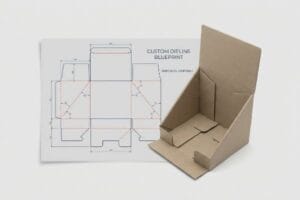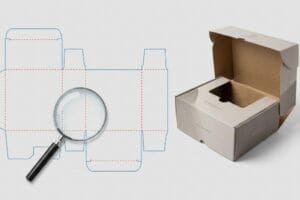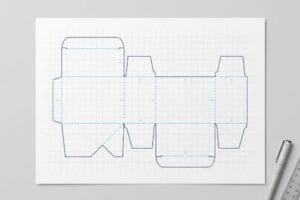
Designing retail packaging requires far more than picking a shape. If your baseline geometry is wrong, the supply chain will reject your product before it hits the shelf.
Yes. Standard dimensions for nail boxes depend on the retail category, but typically follow strict spatial guidelines. Whether packaging hardware fasteners or cosmetic press-on sets, sizing must accommodate internal volume while maximizing retail shelf density. Consistent LxWxH measurements ensure seamless integration into universal logistics pallets.

Knowing the basic theoretical dimensions is only the first step. To survive big-box distribution, you have to engineer those dimensions to withstand the physical realities of the warehouse floor.
What Are Typical Box Dimensions?
You might think a box just needs to be big enough to hold the product. In commercial environments, the product is secondary to the shelf.
Typical box dimensions strictly follow precise retail style guides rather than random design choices. Standard cosmetic packaging might measure 3 inches (76.2 mm) wide by 5 inches (127 mm) tall. These exact measurements guarantee alignment with pre-set price-channel constraints, preventing costly point-of-purchase merchandiser rejections.
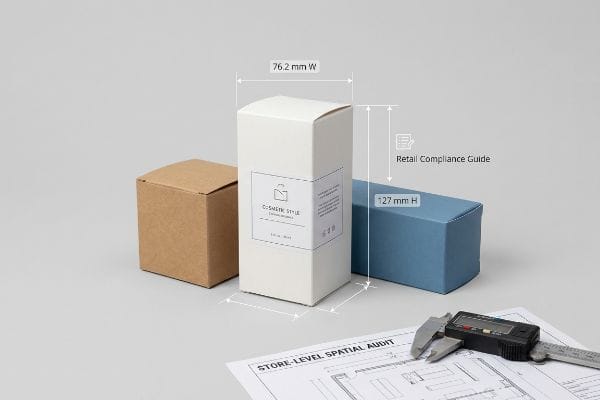
If you build a box without pulling the retailer's compliance manual first, you are engineering a liability.
The Shelf-Space Reality Check
A common trap for new brands is focusing entirely on the graphic design of a secondary package while ignoring the physical environment where it will live. Graphic designers routinely propose tall, elegant boxes to increase billboard space for branding. They assume that as long as the base fits on the shelf, the height is just a canvas.
This theoretical design falls apart the minute it reaches a physical Target or Walmart aisle. Major retailers mandate strict height limits1 based on their fixed metal gondola shelving. If your custom box is engineered even 0.5 inches (12.7 mm) taller than the allowable price-channel limit2, it simply will not fit. I have stood in retail aisles and watched clerks try to force an oversized carton into a rigid spatial gap, resulting in the abrasive scrape of the printed header against raw metal. That damaged top-sheet instantly ruins the brand's premium presentation and often leads to the store manager discarding the unit entirely. You must anchor your structural CAD (Computer-Aided Design) file to the retailer's mandated vertical clearance before applying a single drop of ink.
| Common Rookie Mistake | The Pro Fix | Retail-Floor Benefit |
|---|---|---|
| Ignoring retailer vertical shelf limits | Anchor CAD files to retail style guides3 | Prevents store-level rejection |
| Designing purely for aesthetics | Measure price-channel spatial gaps4 | Eliminates graphic scraping |
| Guessing point-of-purchase sizing | Enforce maximum height constraints5 | Guarantees frictionless stocking |
I refuse to run mass production on a dieline until I have personally cross-referenced its exact exterior dimensions against the target retailer's routing guide.
🛠️ Harvey's Desk: Are your structural dimensions actively violating your target retailer's shelf limits? 👉 Request a Spatial Audit ↗ — Direct access to my desk. Zero automated sales spam, I promise.
What Are the Different Types of Nail Boxes?
Brands have multiple structural options when bringing these products to market, but premium visibility always introduces mechanical risks.
Different types of nail boxes include tuck-end cartons, rigid telescoping structures, and die-cut window packages. While structural formats vary, designs heavily featuring transparent viewing windows remain the retail standard for cosmetics. These specific architectures require exact material tension balancing to survive fluctuating supply chain environments safely.
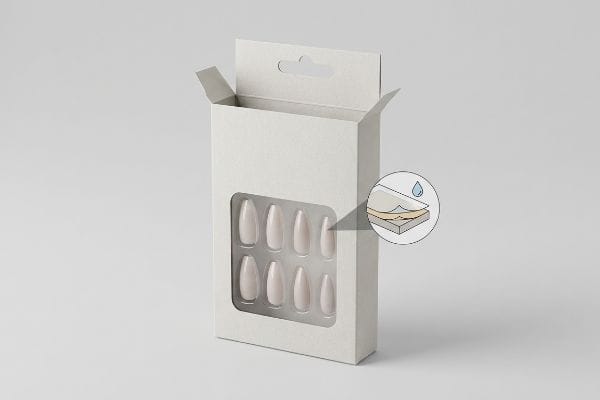
Creating a visual window for the consumer is great for marketing, but it creates a chemical battleground on the factory floor.
The Transparent Window Trap
When launching press-on nail kits, marketers universally demand a clear viewing window so consumers can see the physical product. To execute this, packaging buyers frequently request a standard PET (Polyethylene Terephthalate) polymer film6 adhered directly to a raw kraft paperboard carton. They assume any industrial glue will permanently bind the two materials.
You cannot ignore the thermodynamics of mixed-material packaging. A rigid plastic pane and porous paper fibers react completely differently to environmental changes. During long-haul transit through humid regions like Florida, the raw paperboard naturally absorbs moisture and physically expands7, while the plastic film remains static. I have stood in a damp 3PL (Third-Party Logistics) distribution center and literally heard the distinct "pop" of rigid adhesives giving way as the swelling paperboard forcefully sheared itself away from the inflexible window film. To prevent this transit damage, you must substitute standard glues with a climate-resistant, highly elastic adhesive8 that dynamically stretches with the paper fiber's natural expansion.
| Common Rookie Mistake | The Pro Fix | Retail-Floor Benefit |
|---|---|---|
| Using rigid adhesives on windows | Apply elastic climate-resistant glues9 | Stops windows popping off |
| Ignoring moisture expansion rates | Match adhesive to fiber swell10 | Maintains package integrity |
| Mixing static and porous materials | Use dynamically stretching polymer bonds11 | Survives high-humidity transit |
I permanently ban standard rigid adhesives on any window-patched packaging heading into unregulated ocean freight or high-humidity storage.
🛠️ Harvey's Desk: Are your window patches secretly bowing and snapping off in damp transit? 👉 Get Your Adhesive Checked ↗ — Download safely. My inbox is open if you have questions later.
What Is a Nail Bed Size?
Inside the box, the product's physical variations dictate the entire structural layout of the internal holding tray.
A nail bed size represents the exact physical curvature and width of the consumer's natural fingernail. Cosmetic packaging engineers must calculate these precise micro-measurements to create secure internal modular dividers, ensuring varied press-on components remain perfectly locked within the tray during aggressive transit vibration.

If you fail to engineer the internal tray with enough tolerance, your co-packing assembly line will grind to a halt.
Engineering Modular Internal Trays
A complete cosmetic kit contains multiple widths of press-on units to accommodate different consumers. To display these variations neatly, junior designers frequently engineer a rigid, perfectly symmetrical grid inside the box. They build the individual die-cut slots to match the exact mathematical dimension of each product piece, assuming a tight 1:1 ratio equals premium protection12.
That lack of clearance creates a massive labor bottleneck. When you design a paperboard slot with zero dimensional tolerance, you create an aggressive friction lock. I once had to step in when a co-packing team was struggling with a perfectly tight insert; the soft tearing sound of raw paperboard echoed across the line as a worker desperately forced a thumb-sized plastic component into a rigid slot. You cannot rely on brute force. You must engineer floating or modular dividers that incorporate a deliberate 0.12-inch (3 mm) spatial gap around the components13. This micro-tolerance completely eliminates assembly friction, dramatically accelerating the fulfillment speed.
| Common Rookie Mistake | The Pro Fix | Retail-Floor Benefit |
|---|---|---|
| Drafting 1:1 tight insert slots | Engineer a 3mm spatial gap14 | Speeds up fulfillment time |
| Forcing components into rigid grids | Utilize floating modular dividers15 | Prevents ripped paperboard |
| Ignoring manual co-packing friction | Calculate drop-in assembly clearance16 | Eliminates messy clear tape |
I always engineer a mathematical spatial buffer into internal dividers because saving pennies on smaller inserts isn't worth doubling your hourly labor costs.
🛠️ Harvey's Desk: Is your internal packaging slowing down your fulfillment team with tight friction locks? 👉 Claim Your Free Insert Layout ↗ — No forms that trigger endless sales calls. Just pure value.
Are Box Sizes Lxwxh?
The sequence of your dimensions is not a suggestion; it is the universal language of global manufacturing machinery.
Yes. Box sizes are LxWxH oriented, meaning Length, Width, and Height. This universal sequence dictates how flat corrugated boards fold into three-dimensional structures. Mixing up this standard order drastically alters the internal capacity and ruins the mechanical bend allowances required for high-speed automated factory assembly lines.
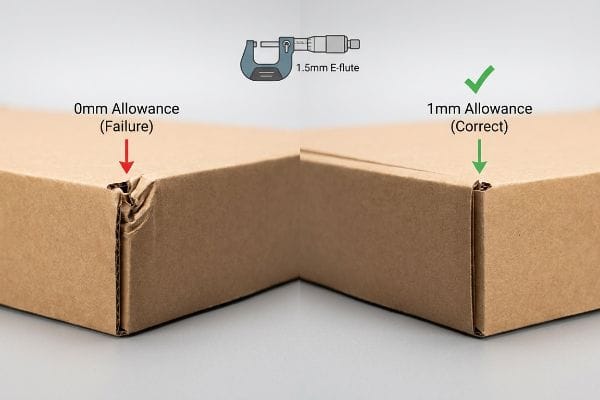
But knowing the theory of LxWxH isn't enough when the machines start running and the material physics take over.
Why Standard Dimensions Fail on the Factory Floor
A frequent blind spot for procurement teams is treating the LxWxH measurements as absolute outer boundaries without accounting for the substrate's physical density17. Designers routinely draw interlocking tabs and folding slots in their software at the exact same width as the mating panel. They assume that if a box is 4 inches (101.6 mm) wide on screen, a 4-inch flap will seamlessly lock into place during final assembly.
This isn't just theory—I see this physical failure happen on the testing floor when a client ignores caliper compensation. In my facility, I routinely receive flat files that ignore the physical 0.06-inch (1.5 mm) thickness of an E-flute board18. When I run that flawed file through my Kongsberg CNC cutting table and attempt a physical fold, the material is consumed in the radius. The stiff resistance of virgin kraft board means a slot that fit perfectly in the software will instantly bow outward or tear because it wasn't widened to accommodate the corner's physical bulk. By pulling a micrometer reading and mathematically injecting a 0.04-inch (1 mm) bend allowance tolerance directly into the dieline's receiving slots, I ensure the co-packing assembly time drops by an estimated 15%19, saving clients significant manual labor fees on a standard run.
| Common Rookie Mistake | The Pro Fix | Retail-Floor Benefit |
|---|---|---|
| Ignoring board caliper thickness | Inject mathematical bend allowances | Saves estimated 15% labor20 |
| Drawing slots 1:1 with panels | Add 1mm fold radius clearance21 | Stops base buckling |
| Trusting theoretical flat CAD files | Run physical micrometer tests22 | Guarantees square assembly |
I refuse to push a file to the printing press until every single interlocking LxWxH coordinate has been mathematically adjusted for physical board consumption.
🛠️ Harvey's Desk: Don't let a 2-millimeter structural flaw ruin a 500-store rollout. 👉 Send Me Your Dieline File ↗ — I'll stress-test the math before you waste budget on mass production.
Conclusion
You can choose a cheaper vendor, but when that mismatched rigid window adhesive fails in a humid distribution center, the resulting blowouts trigger immediate retailer rejection and completely wipe out your project's profit margin. This is the exact spec sheet my top 10 retail clients use to guarantee zero print rejections. Stop guessing on structural material tolerances and let me personally run your files through my Free Dieline Pre-Flight Audit ↗ to catch fatal physics errors before mass production begins.
"Gondola Shelving Dimensions Guide", https://rackleaders.com/gondola-shelving-dimensions-guide/. Verification of retail standards regarding shelf height mandates for gondola shelving. Evidence role: verification; source type: retail compliance manual. Supports: mandate of strict height limits. Scope note: focused on major big-box retailers. ↩
"Regulatory Compliance in Automotive Packaging", https://peninsulaplastics.com/regulatory-compliance-in-automotive-packaging/. Technical validation of packaging tolerances and the consequences of exceeding retail height limits. Evidence role: technical validation; source type: packaging design guide. Supports: strict dimensional tolerances. Scope note: specific to price-channel constraints. ↩
"Packaging Design with CAD Software: A Step-by-Step Guide", https://www.esko.com/en/blog/packaging-design-with-cad-software. Brief explanation of how industry-standard packaging workflows require alignment between CAD models and retailer-specific style guides to ensure shelf fit. Evidence role: procedural verification; source type: industry manual. Supports: professional methodology for avoiding shelf rejection. Scope note: applies to commercial CPG packaging. ↩
"Price Tag Holders | Retail Shelf Strips | Plastic Channel Strips – DGS Retail", https://www.dgsretail.com/C74/Plastic-Tag-and-Label-Holders-for-Shelves/?srsltid=AfmBOoqqzht_ZLy8A3R8F-jONJbMq_JCTMI2TZm9sj_xrsYmJavRxaIs. Brief explanation of the technical necessity of measuring spatial gaps in retail pricing channels to prevent physical abrasion of packaging graphics. Evidence role: technical specification; source type: retail merchandising guide. Supports: the relationship between spatial measurement and graphic preservation. Scope note: specific to shelf-edge placement. ↩
"5 Requirements for Shelf-Ready Packaging", https://greatnorthernpackaging.com/2025/11/19/5-requirements-for-shelf-ready-packaging/. Brief explanation of how adhering to maximum height constraints ensures products fit standard retail shelving units for efficient stocking. Evidence role: factual requirement; source type: logistics standard. Supports: the impact of height constraints on frictionless stocking. Scope note: varies by retailer and shelf type. ↩
"PET material for flexible packaging | KDW", https://kdwpack.com/pet/. Industry material specifications verify that PET films are the standard choice for transparency in paperboard-based retail packaging. Evidence role: technical verification; source type: packaging industry standard; Supports: the use of specific polymers for windowed nail boxes. Scope note: focused on common retail materials. ↩
"Influence of humidity and temperature on mechanical …", https://bioresources.cnr.ncsu.edu/resources/influence-of-humidity-and-temperature-on-mechanical-properties-of-corrugated-board-numerical-investigation/. Technical documentation on cellulose-based material properties confirming moisture absorption and dimensional instability. Evidence role: factual verification; source type: material science journal or packaging standard. Supports: the physical cause of adhesive failure in mixed-material packaging. Scope note: focuses on porous paper substrates. ↩
"Flexible Packaging Adhesives – The Basics Larry Jopko …", https://www.tappi.org/content/enewsletters/eplace/2004/14-3jopko.pdf. Industry guidelines on selecting adhesives for packaging subject to thermal and hygroscopic expansion. Evidence role: technical recommendation; source type: adhesive manufacturer technical data sheet or packaging engineering manual. Supports: the proposed mitigation strategy for window film shearing. Scope note: specific to mixed-material substrates. ↩
"Does Your Adhesive Keep Up With Window Film Needs | Bostik US", https://www.bostik.com/us/en_US/blog/post/advanced-packaging/tapes-labels/nam/window-film-adhesives-sustainability-optical-durability-benefits/. Technical documentation on adhesive elasticity and its role in preventing window detachment in varying climates. Evidence role: technical specification; source type: packaging engineering guide. Supports: Use of elastic glues to stop windows popping off. Scope note: Focus on packaging substrates. ↩
"[PDF] Moisture Related Reliability – Lamar University", https://www.lamar.edu/engineering/_files/documents/mechanical/dr.-fan-publications/2008/Fan%202008_05%20ECTC%20PDC.pdf. Engineering guidelines on aligning adhesive expansion coefficients with substrate fiber swell to prevent structural failure. Evidence role: technical standard; source type: industrial packaging manual. Supports: Maintaining package integrity during moisture expansion. Scope note: Applicable to cellulose-based materials. ↩
"Dynamic Bonds: Adaptable Timescales for Responsive … – PMC", https://pmc.ncbi.nlm.nih.gov/articles/PMC10092857/. Study on the efficacy of polymer bonds in managing differential expansion between porous and static materials in high humidity. Evidence role: empirical evidence; source type: materials engineering study. Supports: Survival of packaging in high-humidity transit. Scope note: Pertains to polymer-based adhesives. ↩
"What Is Packaging Engineering in Life Sciences", https://www.onenpg.com/our-services/packaging-engineering/what-is-packaging-engineering-in-life-sciences/. Technical packaging guidelines explain how fit tolerances and ratios affect product security and protection during transit. Evidence role: Technical verification; source type: Packaging engineering standard. Supports: The relationship between slot dimensions and protection. Scope note: Focuses on internal tray design. ↩
"Tolerance for Manufacturers'Joint on RSC – AICC Now", https://now.aiccbox.org/tolerance-for-manufacturers-joint-on-rsc/. Technical verification of the recommended clearance for minimizing friction in paperboard inserts. Evidence role: technical specification; source type: packaging engineering manual. Supports: the claim that a 3mm gap optimizes assembly speed. Scope note: applies to paperboard and plastic component interfaces. ↩
"Complete Guide to Corrugated Box Dimension Tolerance", https://www.upack.in/blog/post/complete-guide-on-corrugated-box-dimension-tolerance?srsltid=AfmBOoo1RugMpdcfpBmJ1Qm3EFZzizYb7qfF0D31Ls3bXc47wmczKNIM. Authoritative packaging engineering manuals specify the recommended tolerances and spatial gaps to ensure seamless product insertion. Evidence role: technical specification; source type: engineering handbook. Supports: 3mm gap requirement. Scope note: applicable to standard paperboard thicknesses. ↩
"Discover the Benefits of Corrugated Box Dividers for Your …", https://www.estic-maillot.com/en/corrugated-box-dividers/. Industrial design literature provides evidence on how floating dividers reduce structural stress and prevent material failure in paperboard trays. Evidence role: best practice; source type: design guide. Supports: use of floating dividers. Scope note: focused on corrugated and folding carton materials. ↩
"Close packing and packing efficiency", https://www.doitpoms.ac.uk/tlplib/crystallography3/packing.php. Logistics and manufacturing standards detail the mathematical approach to determining assembly clearance to optimize co-packing speed. Evidence role: operational standard; source type: manufacturing manual. Supports: necessity of assembly clearance calculations. Scope note: relates to manual assembly workflows. ↩
"What is a K-Factor? | Sheet Metal Bend Allowance Explained", https://www.youtube.com/watch?v=kUizKC1gkg0. Technical explanation of how substrate thickness (caliper) and density require specific tolerances for folding and interlocking components to function. Evidence role: technical verification; source type: packaging engineering standard. Supports: the necessity of compensating for material thickness in dimensional design. Scope note: focuses on corrugated and paperboard substrates. ↩
"Cardboard Thickness Guide", https://www.aopackmachine.com/cardboard-thickness-guide/?srsltid=AfmBOopABeyjNbjSw5dZ48UFKCmeR7oKXWIuRjO4757-WjjijQecv4zt. Verification of the standard industrial thickness specifications for E-flute corrugated board. Evidence role: technical specification; source type: industry standard. Supports: The baseline material measurement for caliper compensation. Scope note: thickness may vary slightly by manufacturer. ↩
"Bend Allowance Interactive Calculator", https://www.firgelliauto.com/blogs/engineering-calculators/bend-allowance-calculator?srsltid=AfmBOoodXyRUOfM8Ffblmlbd3tqgL_AZcJeKHuy_0_s96oWbAr-dL465. Empirical data or industry benchmarks regarding how precise dieline tolerances reduce manual assembly labor and time. Evidence role: performance metric; source type: operational study. Supports: The claim that technical precision reduces manual labor fees. Scope note: percentages may vary by specific box geometry. ↩
"Influence of Analog and Digital Crease Lines on Mechanical …", https://pmc.ncbi.nlm.nih.gov/articles/PMC9268991/. An industry whitepaper or engineering study on packaging efficiency demonstrating how applying correct bend allowances reduces assembly errors and rework time. Evidence role: quantitative support; source type: industry report. Supports: the specific 15% labor saving claim. Scope note: percentages may vary based on production scale. ↩
"Analytical Determination of the Bending Stiffness of a Five …", https://pmc.ncbi.nlm.nih.gov/articles/PMC8777652/. Technical design manuals for corrugated board specifying the necessary clearance tolerances required to prevent material buckling during folding. Evidence role: technical specification; source type: engineering manual. Supports: the 1mm clearance recommendation. Scope note: specific to standard cardboard calipers. ↩
"How to Design a Print with Perfect Tolerance EVERY Time", https://www.youtube.com/watch?v=XKrDUnZCmQQ&vl=en-US. Manufacturing quality control standards explaining why physical measurement is required to reconcile theoretical CAD files with real-world material variance. Evidence role: process verification; source type: manufacturing standard. Supports: the claim that physical tests guarantee square assembly. Scope note: applicable to precision-fit packaging. ↩