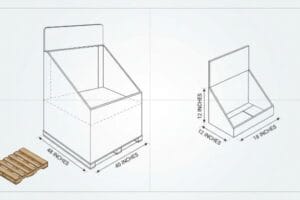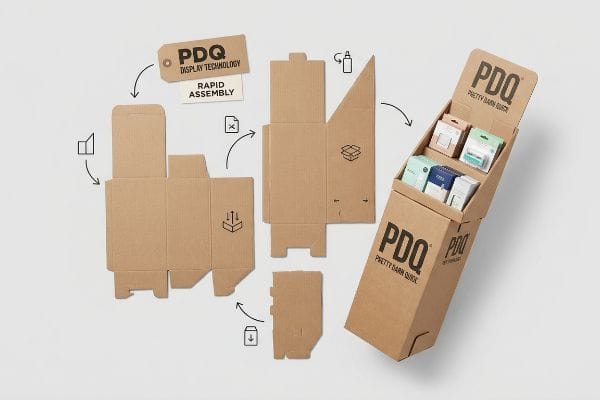
Retail moves fast, and getting your product noticed requires more than just good artwork. To win the shelf, your merchandising strategy must adapt to strict big-box structural realities.
Future prospects and significance of PDQ (Pretty Darn Quick) display technology rely heavily on material optimization and rapid deployment. These merchandisers drive impulse purchases by combining structural efficiency with zero-frustration assembly, allowing emerging brands to secure high-traffic aisle placements and maximize retail velocity.

While flashy graphics look great on a monitor, the physical execution on the factory floor determines if your campaign survives transit or ends up in the recycling bin.
What Is the Future of Display Technology?
Advancements in manufacturing are entirely reshaping how quickly we can push retail campaigns from the drawing board to the big-box floor.
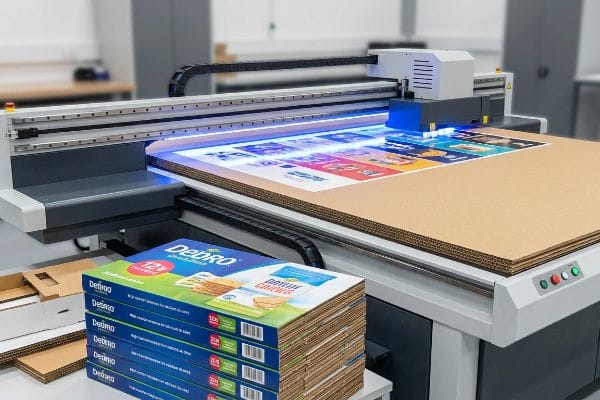
The future of display technology hinges on UV (Ultraviolet) flatbed digital printing and instant polymerization. This plate-free innovation eliminates moisture warp and drastically reduces setup times, allowing brands to launch hyper-targeted, short-run retail campaigns with ultra-crisp graphics on heavy-duty corrugated substrates.
But accessing this rapid-deployment technology requires abandoning outdated procurement habits that slow down your supply chain.
Why Legacy Printing Bottlenecks Your Retail Speed
Even veteran marketing directors often assume that traditional litho-lamination is the only way to achieve high-end graphics on a floor merchandiser. They design intricate campaigns and accept four-week lead times1, believing that expensive printing plates and wet adhesive mounting processes2 are unavoidable necessities for premium quality.
I see this trap constantly when brands try to execute agile, seasonal rollouts. They rely on wet PVA (Polyvinyl Acetate) glue for lamination3, which inherently causes a massive tension imbalance as the porous cardboard absorbs the moisture. You can literally smell the sharp, acidic scent of the drying adhesive in the curing room as the boards warp inwards like potato chips. Instead of fighting moisture, I bypass it entirely using flatbed digital presses that flash-cure liquid ink into a solid polymer film4 the millisecond it hits the board. This instant curing strips days out of the production schedule, eliminating physical plates and drastically cutting setup costs, keeping your promotional calendar perfectly on track.
| Common Rookie Mistake | The Pro Fix | Retail-Floor Benefit |
|---|---|---|
| Relying on wet PVA glue | Direct-to-board digital curing | Eliminates moisture warping5 |
| Paying for metal plates | Plate-free digital setups | Enables rapid short-run tests |
| Ignoring substrate absorption | Polymerizing ink instantly6 | Keeps brand colors vibrant |
I refuse to let outdated, wet-glue processes dictate your market entry speed. Leveraging instant digital curing means I can launch your seasonal campaigns weeks faster while keeping your initial prototyping costs completely grounded.
🛠️ Harvey's Desk: Not sure if your seasonal artwork is optimized for plate-free digital output? 👉 Let Me Review Your Files ↗ — Direct access to my desk. Zero automated sales spam, I promise.
What Is PDQ Display?
Getting a product onto the counter is only half the battle; ensuring the store staff actually unpacks it intact is the real challenge.
A PDQ display is a compact, pre-loaded retail tray engineered for rapid shelf stocking. These merchandisers eliminate manual setup for store clerks, utilizing protective master shipping cartons and friction-free clearance tolerances to guarantee products transition seamlessly from the supply chain directly to the cash register.

However, standardizing a tray for mass retail isn't just about printing a logo; it's an exercise in precise volumetric math.
The Hidden Dangers of Nested Packaging Friction
Brands frequently design their master shipping boxes to exactly match the 1:1 exterior dimensions7 of their pre-filled retail trays. They operate under the logical but dangerous assumption that a perfectly tight, zero-wiggle fit will provide maximum transit protection8 during turbulent ocean freight journeys.
The physical reality of raw testliner is much more abrasive9. I regularly watch clerks struggle with perfectly nested boxes because the high friction of the raw paperboard acts like a mechanical lock. You can hear the awful tearing sound of the printed retaining lip as a frustrated employee aggressively yanks a snug 24-inch (609.6 mm) tray out of a 24-inch (609.6 mm) shipper. To fix this, I mathematically enforce a 0.25-inch (6.35 mm) offset tolerance10 in the CAD (Computer-Aided Design) software for all nested packaging. Breaking this friction lock guarantees a smooth unpacking experience, preventing costly in-store damage before the unit ever reaches the consumer.
| Common Rookie Mistake | The Pro Fix | Retail-Floor Benefit |
|---|---|---|
| Using 1:1 tight dimensions | Adding a clearance buffer11 | Prevents tray extraction tearing |
| Ignoring paperboard friction | Engineering offset tolerances12 | Speeds up shelf stocking |
| Overcomplicating shipper math | Standardized nested perimeters13 | Stops in-store unit damage |
I strictly engineer for the exhausted retail clerk working the night shift. A perfectly printed tray means nothing if the unboxing friction rips the front header off before the store opens.
🛠️ Harvey's Desk: Are your nested master cartons secretly creating a mechanical friction lock? 👉 Check Your Clearance Tolerances ↗ — Download safely. My inbox is open if you have questions later.
What Are the Latest Trends in Display Technology?
Sustainability is no longer a fringe marketing term; it is a rigid supply chain mandate enforced by nearly every major big-box retailer.
The latest trends in display technology strictly prioritize end-of-life recyclability over superficial eco-marketing. Supply chains are actively shifting away from solid bio-plastics and mixed materials, mandating highly repulpable aqueous coatings that maintain structural integrity without disrupting municipal recycling facilities or triggering massive environmental compliance fines.
Navigating these eco-mandates can be a minefield, especially when procurement teams invest in materials that look green but fail under mechanical scrutiny.
The PLA Composting Trap in Modern Retail
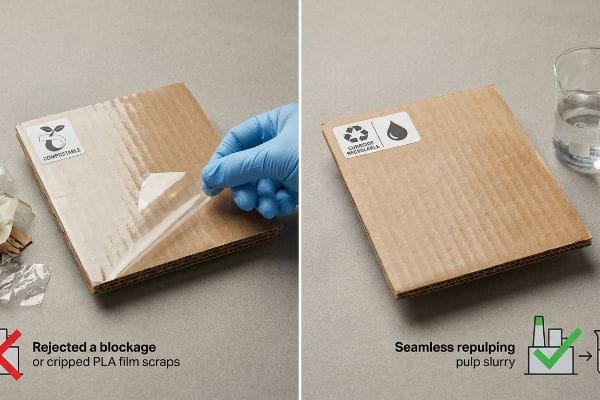
Many procurement teams mandate PLA (Polylactic Acid) bio-plastic laminations14, assuming this corn-based film guarantees complete environmental compliance. They believe that slapping a compostable sticker on their merchandiser automatically satisfies strict big-box sustainability scorecards and appeals to eco-conscious consumers.
Think of it like trying to dissolve a heavy plastic bag in a paper mill; it simply gums up the machinery. I have seen entire pallets of expensive displays get diverted directly to landfills because municipal sorters intercept the physical PLA film, which requires highly specialized, high-heat commercial composting facilities to actually break down15. You can feel the stiff, unyielding surface tension of the bio-plastic when you rub the board, which immediately flags it as a contaminant to recyclers. Instead, I enforce a liquid aqueous coating protocol that acts as a protective barrier but dissolves seamlessly during standard repulping16, keeping the unit completely curbside recyclable while maintaining the required visual gloss.
| Common Rookie Mistake | The Pro Fix | Retail-Floor Benefit |
|---|---|---|
| Specifying solid PLA films | Liquid aqueous coatings17 | Ensures true curbside recyclability |
| Ignoring recycling facility limits | Using mono-material structures18 | Passes strict retailer audits |
| Mixing non-repulpable plastics | Frictionless paper mill integration19 | Avoids heavy compliance fines |
I refuse to let your brand get hit with greenwashing penalties. Switching from heavy films to smart liquid coatings protects your brand equity and keeps your supply chain legally compliant.
🛠️ Harvey's Desk: Does your current eco-friendly packaging contain hidden bio-plastics that fail municipal recycling? 👉 Audit Your Material Specs ↗ — No forms that trigger endless sales calls. Just pure value.
What Is the Importance of Display?
A beautifully engineered structure means nothing if it cannot survive the violent physics of global logistics and warehouse stacking.
The importance of display lies in its dynamic structural resilience during multi-axis freight transit. A precisely engineered merchandiser successfully displaces kinetic shock and vertical pallet top-loads, ensuring that high-value consumer goods arrive on the retail floor completely intact without requiring expensive secondary repacking operations.
But knowing the theory isn't enough when the machines start running and procurement teams try to squeeze an extra inch out of the shipping footprint.
Why Standard Footprints Fail on the Factory Floor
Procurement teams often expand master carton dimensions to maximize shipping density, assuming a heavy-duty corrugated board's raw compression metrics will naturally protect the goods. They treat the shipping box as a flexible boundary, failing to realize that maximizing the internal volume can fatally compromise the external structural geometry20.
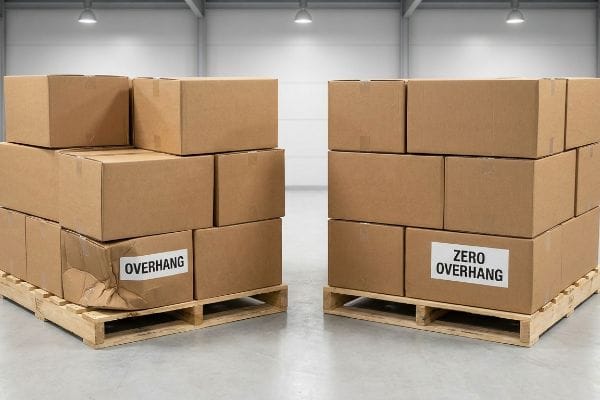
In my facility, I routinely see the disastrous results of this volumetric greed during ISTA (International Safe Transit Association) testing. A standard corrugated box derives up to 60% of its BCT (Box Compression Test) strength21 strictly from the vertical alignment of its four corners. When a client pushes a design that overhangs a standard 48×40 inch (1219×1016 mm) GMA (Grocery Manufacturers Association) pallet22 by just 0.5 inches (12.7 mm), the unsupported corners bow outward, and you can hear the sickening crunch of the flutes buckling under the hydraulic press. I fix this by strictly shrinking the maximum allowable footprint in my software, forcing a zero-overhang bounding box. By enforcing this strict geometric tolerance, I ensure the corners remain fully supported, practically eliminating transit damage and saving clients massive unsalvageable inventory write-offs.
| Common Rookie Mistake | The Pro Fix | Retail-Floor Benefit |
|---|---|---|
| Overhanging the wood pallet | Zero-overhang bounding boxes | Maintains 60% corner strength23 |
| Relying on flat material ECT24 | Testing assembled 3D geometry | Survives double-stacked freight |
| Maximizing box volume blindly | Mathematical structural shrink | Stops massive retail chargebacks |
I do not compromise on base geometry to save a fraction of freight space. An unsupported corner is a guaranteed failure, and I engineer specifically to ensure your payload survives the warehouse.
🛠️ Harvey's Desk: Are your master cartons secretly overhanging the pallet and losing their compressive strength? 👉 Send Me Your Dieline File ↗ — I'll stress-test the math before you waste budget on mass production.
Conclusion
You can choose a cheaper vendor, but when that overloaded master carton overhangs the pallet and collapses under dynamic warehouse weight, the resulting structural crushing will trigger an immediate retailer rejection and weeks of costly manual rework. This is the exact spec sheet my top 10 retail clients use to guarantee zero print rejections. Stop guessing on critical shipping tolerances and let me personally run your files through my Free Dieline Audit ↗ to catch fatal dimensional errors before you begin mass production.
"Litho Lam Lead Times Got You Down? Opt for Digital Printing Instead!", https://blog.fantastapack.com/litho-lead-times-got-you-down. Verification of industry standard production timelines for litho-lamination compared to digital alternatives. Evidence role: quantitative verification; source type: industry manufacturing guide. Supports: the claim that legacy printing slows down speed-to-market. Scope note: Timelines may vary by vendor scale. ↩
"Understanding Litho Laminated Packaging", https://pmpackaging.com/posts/2025/03/understanding-litho-laminated-packaging. Technical confirmation of the components involved in the litho-lamination process, specifically the requirement for offset plates and adhesives. Evidence role: technical validation; source type: printing technical manual. Supports: the description of legacy bottlenecks. Scope note: Applies to traditional offset lithography. ↩
"Effects of Moisture in the Lamination Process – AICC Now", https://now.aiccbox.org/effects-of-moisture-in-the-lamination-process/. Technical explanation of how moisture-based PVA adhesives cause substrate deformation and tension imbalance in porous corrugated cardboard. Evidence role: technical verification; source type: materials science journal or printing industry manual. Supports: the claim that wet adhesives cause warping. Scope note: specific to porous substrates. ↩
"UV Flatbed Printer Working Principle: From Print Head to UV Curing", https://seniorprinter.com/uv-flatbed-printer-working-principle-from-print-head-to-curing/. Detailed explanation of the photochemical process where UV light triggers instant polymerization of liquid ink into a solid film on rigid substrates. Evidence role: process validation; source type: technical whitepaper or ink chemistry specification. Supports: the mechanism of instant curing. Scope note: applies to UV-curable inks. ↩
"Perfect Glue for Papercrafting | GLUE GUIDE – YouTube", https://www.youtube.com/watch?v=8_MB0G3a_js. Technical documentation on print substrates would explain how eliminating water-based adhesives prevents substrate expansion and warping. Evidence role: technical verification; source type: industrial printing guide. Supports: the efficiency of digital curing over wet glues. Scope note: Focuses on substrate stability. ↩
"UV LED Ink Curing: A Complete Solution Guide – Fannon Products", https://fannoninfrared.com/feeds/blog/uv-led-ink-curing-solution. Materials science literature would detail how UV curing causes immediate polymerization, preventing ink absorption into the substrate. Evidence role: chemical process verification; source type: technical white paper. Supports: the link between instant polymerization and color vibrancy. Scope note: Applicable to UV-curable digital ink systems. ↩
"Shelf-Ready Packaging Guide: SRP Design, Benefits & Costs – iPackU", https://ipacku.com/blog/complete-guide-to-shelf-ready-packaging/?srsltid=AfmBOoqRv12w3VQ4KAYVve3ykN0ohUx5tIA_iCvnwwWIWfr_q_TEgsjG. An authoritative packaging engineering guide would detail industry practices regarding the dimensional tolerances between PDQ trays and master cartons. Evidence role: factual verification; source type: industry standard. Supports: the common practice of tight-fit design. Scope note: specifically for pre-filled retail trays. ↩
"Importance of Proper Packaging in an Ocean Freight Shipment", https://codotlogistics.com/blog/importance-of-proper-packaging-in-an-ocean-freight-shipment/. Logistics and packaging science research explains why zero-clearance fits often increase damage during ocean freight due to vibration and pressure. Evidence role: technical validation; source type: engineering manual. Supports: the danger of neglecting clearance tolerances. Scope note: focuses on turbulent transit environments. ↩
"Evaluating the factors influencing the friction behavior of paperboard …", https://bioresources.cnr.ncsu.edu/resources/evaluating-the-factors-influencing-the-friction-behavior-of-paperboard-during-the-deep-drawing-process/. Technical data on the surface friction and abrasiveness of raw testliner compared to coated packaging materials. Evidence role: technical specification; source type: materials science handbook. Supports: claim that raw paperboard increases friction in nested containers. Scope note: surface friction varies by liner grade and finish. ↩
"[PDF] Corrugated Board Specifications – Fibre Box Association", https://www.fibrebox.org/assets/2025/09/Walmart_Corrugated-Board_Specifications_Automation_Packaging_Standards.pdf. Packaging engineering standards for clearance gaps in nested retail displays to prevent friction locks. Evidence role: industry best practice; source type: packaging design manual. Supports: the efficacy of a 0.25-inch offset for seamless unpacking. Scope note: optimal tolerances may fluctuate based on material caliper and box dimensions. ↩
"Best Practices For Buffering And Packaging Line Design", https://www.prosource.org/article/22210260/best-practices-for-buffering-and-packaging-line-design. Brief explanation of how industry standards for packaging tolerances prevent structural failure during unpacking. Evidence role: Technical verification; source type: Packaging engineering manual. Supports: The necessity of clearance buffers to prevent tearing. Scope note: Applies specifically to cardboard/paperboard PDQ displays. ↩
"How PDQ Displays Work in Retail – PopDisplay", https://popdisplay.me/how-pdq-displays-work-in-retail/. Brief explanation of how accounting for material friction through offset tolerances reduces extraction time for retail staff. Evidence role: Process optimization proof; source type: Logistics or supply chain study. Supports: The link between tolerances and stocking speed. Scope note: Focuses on paperboard material properties. ↩
"Mitigating packaging damage in the supply chain", https://www.packagingdigest.com/trends-issues/mitigating-packaging-damage-in-the-supply-chain. Brief explanation of how standardized dimensions in nested packaging reduce mechanical stress and product damage during transit and unpacking. Evidence role: Technical specification; source type: Industrial design guideline. Supports: The role of standardized perimeters in preventing damage. Scope note: Relates to shipper-to-display fit. ↩
"PLA Lamination Film: The Eco-Friendly Alternative for Sustainable …", https://naturepoly.com/pla-lamination-film-sustainable-packaging/. Verification of the use of Polylactic Acid (PLA) as a bio-plastic lamination in retail displays and its role in meeting sustainability mandates. Evidence role: factual verification; source type: material science or industry procurement standards. Supports: the technical identification of materials used in eco-friendly display trends. Scope note: focuses on retail merchandising materials. ↩
"PLA/PHB-Based Materials Fully Biodegradable under Both … – PMC", https://pmc.ncbi.nlm.nih.gov/articles/PMC9572414/. Authoritative source explains that polylactic acid (PLA) requires specific industrial composting conditions, including high heat and humidity, to degrade and will not break down in home compost or landfills. Evidence role: technical specification; source type: environmental science journal or waste management guide. Supports: requirement for specialized facilities for PLA degradation. Scope note: applies to standard PLA bio-plastics. ↩
"Recyclable and Biodegradable Paper Coating with … – PMC", https://pmc.ncbi.nlm.nih.gov/articles/PMC11948148/. Technical documentation on sustainable packaging confirms that aqueous coatings are designed to be repulpable and compatible with standard municipal recycling streams. Evidence role: technical specification; source type: packaging industry standard or recycling technical manual. Supports: the recyclability of aqueous-coated displays. Scope note: refers to water-based polymer coatings. ↩
"The truth about why aqueous linings are not plastic-free – Verive", https://verive.eu/food-packaging-materials/aqueous-lining-plastic-free-truth/. Technical verification that aqueous coatings are compatible with standard paper recycling streams unlike PLA films. Evidence role: technical verification; source type: industry standard. Supports: claim that aqueous coatings ensure curbside recyclability. Scope note: depends on the specific chemical composition of the coating. ↩
"Boost sustainability with mono-material packaging | Business – Shell", https://www.shell.us/business/sectors/shell-polymers/resources-and-insights/boost-sustainability-with-mono-material-packaging.html. Documentation showing that mono-materials are a primary requirement for passing sustainability audits in big-box retail supply chains. Evidence role: compliance verification; source type: retailer guidelines. Supports: claim that mono-materials pass strict audits. Scope note: focuses on retail packaging standards. ↩
"A systematic review of plastic recycling: technology, environmental …", https://pmc.ncbi.nlm.nih.gov/articles/PMC12301532/. Evidence regarding the technical difficulty of processing non-repulpable plastics in paper mills and the resulting financial penalties. Evidence role: industrial validation; source type: technical report. Supports: claim that repulpability avoids compliance fines. Scope note: specific to fiber-based display materials. ↩
"Estimation of the Compressive Strength of Corrugated Board Boxes …", https://pmc.ncbi.nlm.nih.gov/articles/PMC8467740/. Technical evidence explaining how increasing box dimensions relative to material strength affects structural stability and load-bearing capacity. Evidence role: technical validation; source type: packaging engineering standards. Supports: the claim that volume maximization reduces structural integrity. Scope note: applies specifically to corrugated fiberboard shipping containers. ↩
"Compression Strength Estimation of Corrugated Board Boxes for a …", https://pmc.ncbi.nlm.nih.gov/articles/PMC9864211/. Technical verification of the proportion of load-bearing capacity attributed to corner integrity in corrugated packaging. Evidence role: quantitative validation; source type: packaging engineering textbook. Supports: the claim that vertical corner alignment is the primary driver of compression strength. Scope note: results may vary based on material grade. ↩
"48×40" GMA Pallets | Largest Pallet Manufacturer & Supplier", https://www.palletone.com/products/gma-pallets/. Verification of the standardized footprint for GMA pallets used in North American logistics. Evidence role: factual baseline; source type: industry specification. Supports: the dimensional basis for identifying pallet overhang. Scope note: North American regional standard. ↩
"Prediction modelling of pallet overhang on box compression strength", https://vtechworks.lib.vt.edu/items/d6fb70fe-bf11-40d2-a44c-3ba7918d06e3. Technical data validating the loss of structural integrity in corrugated shipping containers when they overhang a pallet versus zero-overhang. Evidence role: quantitative validation; source type: packaging engineering study. Supports: the claim that zero-overhang preserves significant corner strength. Scope note: applicable to standard corrugated materials. ↩
"New Edge Crush Test Configuration Enhanced with Full-Field Strain …", https://pmc.ncbi.nlm.nih.gov/articles/PMC8510352/. Explanation of the Edge Crush Test (ECT) and why flat-sheet measurements are insufficient for predicting the load-bearing capacity of assembled 3D geometries. Evidence role: technical clarification; source type: industry standard (e.g., ASTM). Supports: the need for 3D geometry testing. Scope note: focuses on corrugated cardboard standards. ↩