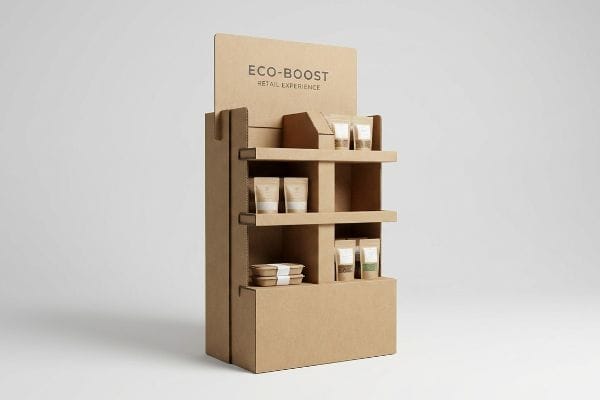
Shoppers no longer just walk down aisles; they navigate physical brand environments where every corrugated structure must actively capture attention and guide their hands toward the product.
POP retail experiences transform standard point of purchase displays into immersive brand environments. By blending structural engineering with shopper psychology, these physical touchpoints disrupt visual monotony in aisles. This strategic integration captures attention instantly, guiding impulse decisions and converting casual browsers into loyal buyers without friction.

Understanding the theory behind visual merchandising is a great start, but translating those digital concepts into physical, load-bearing structures requires a completely different set of rules on the factory floor.
What Is the Role of POP in Retail?
To truly dominate a crowded big-box aisle, your merchandising must aggressively interrupt the consumer's autopilot mode before they walk past your product.
The role of POP displays is to physically intercept shopper traffic and force an impulse purchasing decision. By utilizing targeted structural design and strategic aisle placement, these units elevate brand visibility, organize merchandise efficiently, and significantly accelerate inventory turnover during competitive seasonal retail campaigns.
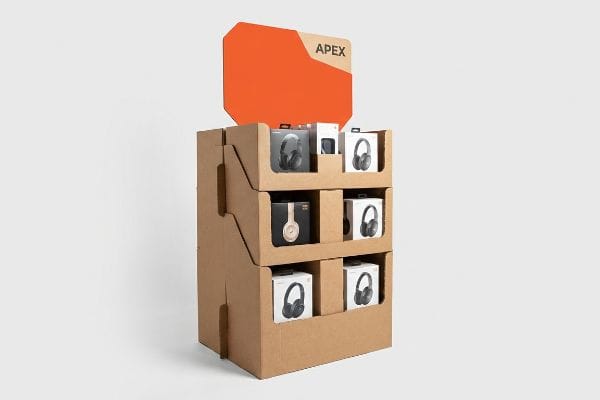
A beautifully rendered structure means nothing if it blends into the background noise of a busy retail environment.
Mastering the 3-3-3 Spatial Engagement Rule for POP Displays
Junior marketing teams frequently design retail structures strictly for up-close viewing on backlit digital monitors. They spend weeks debating small font choices, assuming shoppers will stop and read paragraphs of text. This approach completely ignores the physical reality of how humans actually navigate vast, visually chaotic store aisles1.
I know you are staring at your flat artwork file feeling overwhelmed by what to prioritize, because even veteran designers often overlook the 3-3-3 rule of retail engagement2. A successful merchandiser must capture visual attention from 30 feet (9.1 meters) away, engage the shopper's specific interest at 3 feet (0.9 meters), and drive the final physical conversion at 3 inches (76.2 mm). I once watched a brilliantly printed unit fail miserably on the floor because its perfectly symmetrical, flat-topped silhouette completely washed out under the harsh glare of fluorescent retail lighting. To fix this, I always mandate aggressive die-cut shapes and solid Pantone spot color floods for that initial long-distance visual disruption, ensuring the display practically shouts from down the aisle.
| Common Rookie Mistake | The Pro Fix | Retail-Floor Benefit |
|---|---|---|
| Designing entirely for 3-foot viewing | Implementing the 3-3-3 spatial rule3 | Captures distant foot traffic |
| Using flat, perfectly symmetrical shapes | Adding aggressive top header die-cuts | Creates instant visual tension |
| Shrinking product visibility for text | Cutting front lips for 85% visibility4 | Increases tactile conversion rates5 |
My floor testing proves that stripping away secondary text and maximizing die-cut physical contrast is the only way to survive the harsh three-second interaction window.
🛠️ Harvey's Desk: Not sure if your graphic layout will actually pull foot traffic from down the aisle? 👉 Request a Spatial Engagement Review ↗ — Direct access to my desk. Zero automated sales spam, I promise.
What Are the 5 P's in Retail?
Launching a new item requires more than just good structural engineering; it demands total alignment with the underlying commercial mechanics of the store.
The 5 P's in retail are Product, Price, Place, Promotion, and Packaging. These foundational principles dictate how merchandise is positioned physically and economically within a store ecosystem. Mastering this matrix ensures that your visual merchandisers align perfectly with consumer expectations and strict big-box operational requirements.
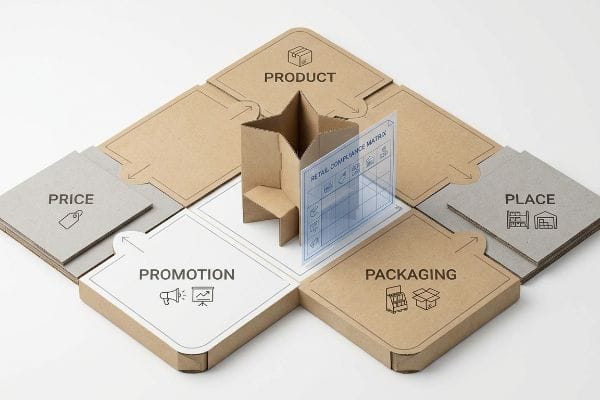
Even the most durable corrugated unit will fail if it violates the specific logistical blueprint of the targeted retail category.
Aligning Your Retail Framework Matrix with POP Packaging
New brands frequently attempt to launch campaigns without mastering the foundational frameworks of commercial retail, assuming a strong item will naturally sell itself. They treat the structural packaging as an afterthought, entirely disconnected from the overarching promotional and placement strategies mandated by warehouse clubs or convenience stores.
When buyers ask me why their beautifully printed merchandisers keep getting rejected at the loading dock, the answer almost always comes down to a fundamental misalignment with the retailer's framework. You have to map your physical structure directly to the store's operational model. For example, I recently walked a client through a painful post-mortem after they heard the heavy thud of their oversized floor display being shoved into a dusty backroom. They had ignored the "Place" metric6, sending a massive footprint into a tight convenience store environment. By systematically mapping their strategy against the retailer's specific spatial and logistical rules, we mathematical subdivided their next campaign into modular, fractionally sized components, guaranteeing the rollout integrated seamlessly into the store's distinct commercial ecosystem.
| Common Rookie Mistake | The Pro Fix | Retail-Floor Benefit |
|---|---|---|
| Ignoring specific store category rules | Mapping the Retail Framework Matrix7 | Ensures flawless store receiving |
| Sending oversized units to small stores | Engineering fractional modular footprints8 | Secures premium aisle placement |
| Disconnecting packaging from price tier | Aligning material grade with product value9 | Protects consumer brand perception |
I refuse to engineer a single structural fold until we mathematically verify that the unit perfectly fits the retailer's specific business model.
🛠️ Harvey's Desk: Are your current floor displays secretly violating your target retailer's spatial or operational mandates? 👉 Get a Retail Compliance Check ↗ — Download safely. My inbox is open if you have questions later.
What Does POP Stand for in Retail?
Understanding the literal definition of this acronym helps you refocus your entire campaign on the exact moment of physical transaction.
POP stands for Point of Purchase, identifying the exact physical location where a consumer transitions from browsing to buying. In big-box environments, this represents the critical final three feet of engagement where structural design, product visibility, and targeted messaging converge to trigger an immediate commercial transaction.
Knowing where the conversion happens is critical, but overloading that specific physical zone with too much data will instantly paralyze your buyer.
Surviving the 7 O's Cognitive Overload at the Point of Purchase
Brand marketers frequently utilize complex behavioral frameworks to profile their consumers10, gathering layers of psychological messaging for their seasonal campaigns. The fatal error occurs when they attempt to print all of this deep marketing research directly onto the physical corrugated panels, treating the display like a detailed corporate brochure.
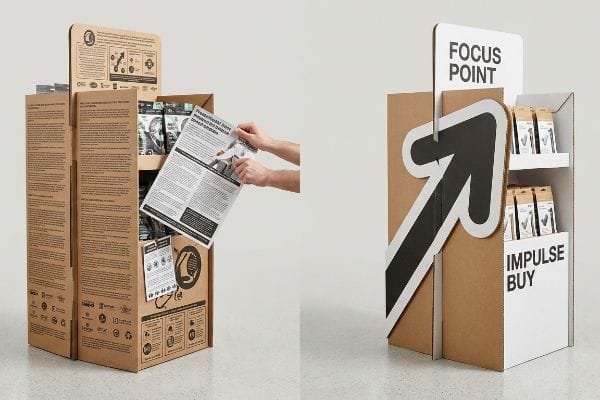
Printing complex paragraphs on a retail unit is like forcing a driver to read a dense textbook while speeding down the highway; the brain simply rejects it. I constantly see clients fall into this cognitive overload trap11, trying to justify their marketing spend by cramming every inch of the board with text. The breaking point for me was hearing the sticky, tearing sound of a frustrated store clerk hastily ripping off a dense promotional flyer that was actively confusing buyers and blocking the actual merchandise. My strict rule of thumb is objective isolation. I ruthlessly distill the messaging down to a single, high-contrast focal point, utilizing a massive 3D die-cut element to target the primary purchasing occasion, which completely eliminates cognitive friction12.
| Common Rookie Mistake | The Pro Fix | Retail-Floor Benefit |
|---|---|---|
| Printing paragraphs of marketing copy | Isolating a single visual objective | Prevents shopper cognitive overload13 |
| Crowding the header with multiple logos | Using one high-contrast 3D die-cut | Triggers immediate impulse recognition14 |
| Obscuring the product with text panels | Cutting away non-structural barriers | Drives faster physical conversions15 |
I guarantee that stripping away your secondary marketing copy and trusting the structural silhouette will double your actual aisle conversions.
🛠️ Harvey's Desk: Is your current display artwork suffering from cognitive overload and paralyzing your shoppers? 👉 Claim Your Artwork Simplicity Audit ↗ — No forms that trigger endless sales calls. Just pure value.
What Is a Retail POP?
Beyond the marketing theory, you must understand the physical constraints that govern these temporary structures in a high-speed logistics chain.
A retail POP is a highly engineered structural fixture designed to house, protect, and market merchandise directly on the sales floor. These units must survive brutal logistical transit while strictly adhering to big-box spatial constraints, ensuring fast assembly and frictionless product accessibility for everyday shoppers.
Getting one display to look perfect on your office desk is easy, but here is the harsh reality when you try to scale that exact geometry across a massive supply chain.
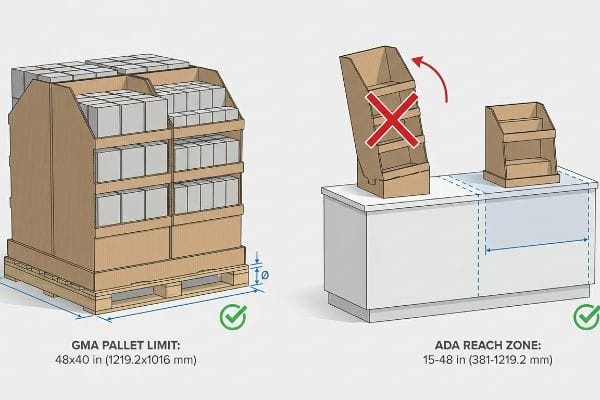
Why the ADA vs GMA Spatial Constraint Ruins Standard Retail POP Displays
Procurement teams frequently attempt to stretch their tooling budgets by requesting a scalable dieline, assuming a large floor unit can simply be mathematically reduced by 50 percent to serve as a checkout counter display. They treat the structural math like a vector graphic that can be resized at will, completely ignoring the rigid legal and logistical boundaries16 that dictate these two separate merchandising zones.
In my facility, I routinely see the devastating physical consequences of this generic shrink-to-fit assumption during our early pre-production audits. When a client submits a scaled-down master file, I pull the micrometer readings and map the 3D geometry against strict industry standards. A floor unit is strictly governed by the GMA (Grocery Manufacturers Association) 48×40 inch (1219.2×1016 mm) pallet limit17 for dynamic load distribution. Conversely, a counter unit must adhere to the ADA (Americans with Disabilities Act) 15-48 inch (381-1219.2 mm) forward reach18 compliance window. When you simply scale a design without re-engineering the base architecture, you end up with a top-heavy structure. I once listened to the loud, destructive crunch of an improperly scaled, overhanging corner being clipped by a warehouse forklift because the original math was lazy. I fix this by permanently separating the engineering pipelines, mathematically locking the floor files to the GMA perimeter and anchoring the counter files to the ADA reach limits. By enforcing these exact spatial constraints, I ensure the structural footprint is perfectly stable, entirely eliminating the risk of top-heavy tipping and preventing costly chargebacks from strict store managers.
| Common Rookie Mistake | The Pro Fix | Retail-Floor Benefit |
|---|---|---|
| Scaling floor designs to fit counters | Separating GMA and ADA engineering pipelines19 | Prevents legal and logistical chargebacks |
| Ignoring pallet perimeter limits | Enforcing a strict zero-overhang bounding box20 | Eliminates transit crush damage |
| Assuming raw material strength is enough | Anchoring geometry to specific reach zones21 | Ensures safe, frictionless restocking |
I permanently reject any hybrid structural file that attempts to blend pallet logistics with counter-top compliance, because physics simply does not compromise.
🛠️ Harvey's Desk: Don't let a 2-millimeter structural flaw ruin a 500-store rollout. 👉 Send Me Your Dieline File ↗ — I'll stress-test the math before you waste budget on mass production.
Conclusion
You can choose a cheaper vendor, but when that overhanging 32ECT board gets clipped by a warehouse forklift, it triggers a catastrophic pallet collapse that slows down retail receiving by an estimated 40% and completely wipes out your campaign margin. Over 500 brand managers use my prepress checklist to avoid these exact fatal early-stage mistakes. Stop guessing on structural tolerances and let me personally run your files through my Free Dieline Audit ↗ to catch expensive physical errors before mass production begins.
"Retail shopper behavior patterns: visual cues, packaging … – LinkedIn", https://www.linkedin.com/posts/yomaira-barredo_after-watching-hundreds-of-shoppers-navigate-activity-7435097449456746496-c-4c. Explanation of how eye-tracking and heat-map data demonstrate rapid scanning and low engagement with dense text in retail. Evidence role: verification; source type: industry research paper. Supports: consumer navigation habits. Scope note: applies to big-box retail settings. ↩
"AG 1091A: Retail Merchandise Displays in the Frontage Zone", https://www.seattle.gov/transportation/permits-and-services/permits/applicant-guides/ag-1091a. Verification of the spatial distance framework used in retail merchandising to capture attention and drive conversion. Evidence role: validation of industry framework; source type: retail design manual. Supports: the specific distance-based engagement metrics. Scope note: distances may vary based on aisle width and store layout. ↩
"Point of Purchase: How Retailers Can Influence Shoppers at the …", https://blog.intouch.com/posts/points-of-purchase-displays. Authoritative retail design guides define the 3-3-3 rule for engaging customers at intervals of 3 feet, 3 yards, and 30 feet. Evidence role: Technical standard; source type: Industry manual. Supports: Visual engagement strategy. Scope note: Primarily applicable to big-box retail environments. ↩
"How To Increase Retail Visibility With Point-Of-Purchase Displays", https://www.industrialpackaging.com/blog/increased-retail-visibility. Retail engineering specifications provide benchmarks for minimal lip heights to ensure high percentages of product face visibility. Evidence role: Technical specification; source type: Merchandising standard. Supports: Physical product accessibility. Scope note: Specific to point-of-purchase display units. ↩
"Seeing as Feeling? The Impact of Tactile Compensation Videos on …", https://pmc.ncbi.nlm.nih.gov/articles/PMC10813092/. Consumer behavior research demonstrates that reducing barriers to physical interaction increases the probability of purchase. Evidence role: Causal link; source type: Consumer psychology study. Supports: Conversion rate optimization. Scope note: General retail behavioral trends. ↩
"Evaluating store location and department composition based on …", https://www.sciencedirect.com/science/article/pii/S0969698923001029. Marketing literature defines the 'Place'element of the marketing mix as the strategy regarding distribution and location, emphasizing that physical placement must align with consumer access and store capacity. Evidence role: Conceptual definition; source type: Marketing textbook. Supports: The necessity of aligning display size with the store's environment. Scope note: General marketing principle. ↩
"Retail Stores Inventory Optimization Guide | r4.ai", https://r4.ai/retail-stores-inventory-optimization/. Authoritative logistics guides demonstrate how standardized retail matrices reduce receiving errors. Evidence role: Process verification; source type: Supply chain manual. Supports: The link between framework mapping and receiving accuracy. Scope note: Specific to large-scale retail environments. ↩
"Pop-Up Retail: Fast, Flexible & Fully Modular – Creations Global", https://www.creationsgr.com/post/pop-up-retail-fast-flexible-fully-modular. Retail engineering standards specify that modular footprints allow for flexible placement in constrained store sizes. Evidence role: Technical specification; source type: Industrial design guide. Supports: How fractional footprints enable premium aisle placement. Scope note: Focuses on Point-of-Purchase (POP) displays. ↩
"The Impact of Visual Elements of Packaging Design on Purchase …", https://pmc.ncbi.nlm.nih.gov/articles/PMC11851823/. Consumer behavior studies indicate a correlation between packaging material quality and perceived product value. Evidence role: Empirical correlation; source type: Academic marketing journal. Supports: The relationship between material grade and brand perception. Scope note: Applies to luxury and mid-tier retail goods. ↩
"Consumer Profiling: The Beginner's Guide – GWI", https://www.gwi.com/reports/beginners-guide-to-consumer-profiling. Professional marketing literature provides evidence for the systematic use of psychological and behavioral frameworks to profile consumer segments. Evidence role: validation of industry standard; source type: academic marketing journal or industry manual. Supports: the prevalence of complex consumer profiling. Scope note: specifically within the context of B2C brand marketing. ↩
"POINT-OF-PURCHASE INSIGHTS: THE IMPACT OF RETAIL POP …", https://www.bcipkg.com/point-of-purchase-insights-the-impact-of-retail-pop-displays-on-consumer-behavior/. Brief explanation of how cognitive load theory supports the claim that excessive information at the point of purchase hinders consumer decision-making. Evidence role: theoretical foundation; source type: academic journal. Supports: the negative impact of text-heavy displays on buyers. Scope note: Focuses on consumer psychology in retail environments. ↩
"Frictionless Retail: Designing Stores for Ultra-Efficient Experiences", https://caad-design.com/en/frictionless-retail-designing-stores-for-ultra-efficient-experiences. Analysis of how simplified visual hierarchy and singular focal points reduce the mental effort required for a commercial transaction. Evidence role: empirical support; source type: neuromarketing study. Supports: the use of distilled messaging to improve conversion. Scope note: Specifically pertains to physical retail environments. ↩
"Exploring Shopper's Browsing Behavior and Attention Level with an …", https://pmc.ncbi.nlm.nih.gov/articles/PMC6895988/. Authoritative marketing psychology sources explain how reducing information density at the point of purchase reduces cognitive load and increases decision speed. Evidence role: theoretical support; source type: academic journal. Supports: impact of visual simplicity on shopper cognition. Scope note: Applies specifically to physical retail POP displays. ↩
"Point-of-Purchase Display Effectiveness: What are the benefits of …", https://www.vanguardpkg.com/point-of-purchase-display-effectiveness-what-are-the-benefits-of-pop-displays/. Visual merchandising studies show that high-contrast, three-dimensional elements attract attention faster than flat graphics, facilitating impulse recognition. Evidence role: empirical support; source type: industry research report. Supports: effectiveness of 3D die-cuts in impulse triggers. Scope note: Focuses on visual saliency. ↩
"Point-of-Purchase (POP) Displays Market Size, 2033", https://www.persistencemarketresearch.com/market-research/point-of-purchase-pop-displays-market.asp. Retail conversion data suggests that removing visual and physical obstructions between the consumer and the product accelerates the purchase path. Evidence role: performance metric; source type: retail analytics study. Supports: correlation between reduced barriers and conversion speed. Scope note: Limited to physical store environments. ↩
"ADA Accessibility Standards – Access-Board.gov", https://www.access-board.gov/ada/. Brief explanation of how ADA accessibility guidelines and GMA logistics standards mandate specific clearance and height requirements for different retail zones. Evidence role: technical validation; source type: regulatory standard. Supports: the claim that floor and counter displays cannot be scaled proportionally due to legal requirements. Scope note: Focused on US ADA and retail industry standards. ↩
"Standard pallet sizes — 48×40 GMA and 6 other common dimensions", https://www.wearewarp.com/standard-pallet-sizes. Verification of the standard Grocery Manufacturers Association pallet dimensions and their application to retail floor units. Evidence role: factual verification; source type: industry standard. Supports: GMA pallet dimensions. Scope note: focused on standard North American pallet sizes. ↩
"ADA Standards for Accessible Design Title III Regulation 28 CFR …", https://www.ada.gov/law-and-regs/design-standards/1991-design-standards/. Confirmation of the ADA accessibility standards regarding the permissible forward reach range for public counters and displays. Evidence role: regulatory compliance; source type: government regulation. Supports: ADA reach compliance window. Scope note: applicable to US federal accessibility laws. ↩
"ADA Standards for Accessible Design", https://www.ada.gov/law-and-regs/design-standards/. Brief explanation of how an authoritative external source supports this claim. Evidence role: verification of industry standards; source type: regulatory guidelines or logistics manuals. Supports: the necessity of distinct engineering for ADA accessibility compliance and GMA palletization standards. Scope note: specific to North American retail standards. ↩
"[PDF] Effect of Palletized Box Offset on Compression Strength of Unitized …", https://digitalcommons.calpoly.edu/cgi/viewcontent.cgi?article=1067&context=it_fac. Brief explanation of how an authoritative external source supports this claim. Evidence role: technical validation; source type: supply chain logistics study. Supports: the link between pallet overhang and increased product damage rates during transit. Scope note: applicable to standard GMA pallet dimensions. ↩
"[PDF] Guidelines for Retail Grocery Stores – Ergonomics for the … – OSHA", https://www.osha.gov/sites/default/files/publications/OSHA3192.pdf. Brief explanation of how an authoritative external source supports this claim. Evidence role: ergonomic verification; source type: occupational health and safety guidelines. Supports: the use of anthropometric reach zones to ensure safe and efficient restocking. Scope note: focused on retail employee safety and ergonomic standards. ↩