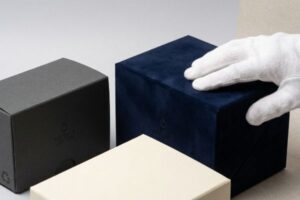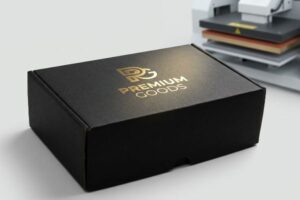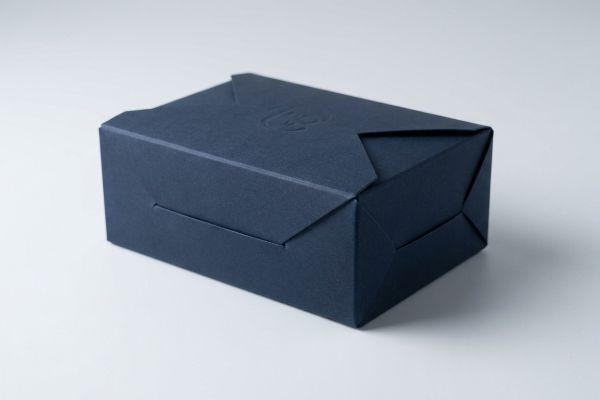
Standard finishes often fall short for high-end retail packaging. Specifying specialized tactile films is the proven method to physically elevate your brand's premium unboxing experience.
A soft touch lamination is a specialized thermal film applied to packaging substrates, creating a premium, velvety tactile texture. It physically alters the surface friction and optical glare of corrugated displays, providing a luxurious matte finish while reinforcing the printed paperboard against moisture and retail shelf wear.
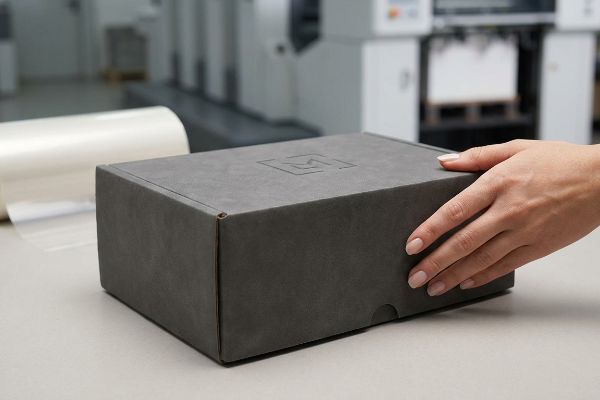
But before you specify this velvet-like finish for your next major retail rollout, we need to strip away the marketing fluff and look at the physical chemistry happening on the factory floor.
What is the difference between matte lamination and soft touch lamination?
Distinguishing between these two finishes is a matter of microscopic surface tension.
The difference between matte lamination and soft touch lamination lies in their microscopic surface topography. Matte lamination uses a standard flat polypropylene film to reduce glare, whereas soft touch lamination incorporates a bi-axially oriented polymer layer that creates a distinct, high-friction velvety texture for premium tactical engagement.
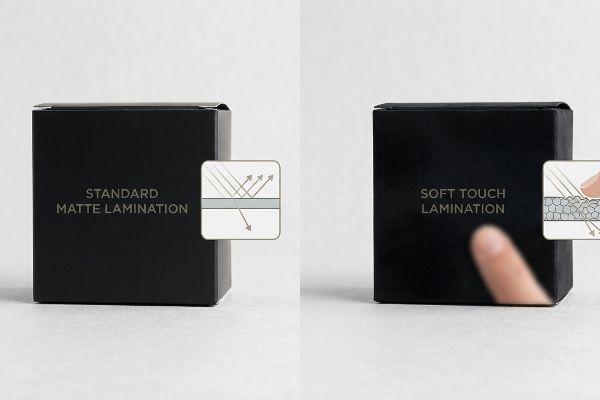
To understand why buyers pay a premium for that velvet feel, I need to break down the mechanical friction of the films.
The Microscopic Topography of Tactile Films
Standard matte films are engineered purely for optical light diffusion, flattening the visual glare under harsh retail lighting while remaining smooth to the touch. Conversely, the tactile version physically modifies the outer polymer web with a microscopic cellular structure1. This specialized bi-axially oriented polypropylene film absorbs light while simultaneously increasing the kinetic friction against human fingertips2. From an engineering standpoint, you are physically altering the user's sensory engagement, not just protecting the underlying ink.
I always explain to product managers that specifying these films requires balancing structural rigidity with sensory impact. When a standard matte finish is applied to a high-end folding carton or corrugated display, it provides an excellent, durable baseline that resists minor scuffs during transit. However, when you upgrade to a specialized velvety film, you are fundamentally changing how the light physically enters the ink profile. This cellular film layer acts like a microscopic sponge for ambient light, which naturally darkens the underlying CMYK (Cyan, Magenta, Yellow, Key) pigments3 by roughly five percent. I factor this optical density shift into the prepress curves before the press even rolls.
| Finish Type | Surface Friction | Optical Impact |
|---|---|---|
| Standard Matte | Low Smooth | Glare reduction4 |
| Velvet Film | High Tactile5 | Deep color darkening6 |
| Bare Board | Variable Porous | Zero protection |
I never let brands finalize their artwork without proofing through the actual thermal film. The physical chemistry of that velvety layer demands precise prepress compensation.
🛠️ Harvey's Desk: Are your dark brand colors turning to mud underneath premium tactile films? 👉 Get a Free Color Calibration Audit ↗ — I review every structural file personally within 24 hours.
What does soft touch lamination look like?
Visually, this specific finish acts like a light-absorbing vacuum.
Soft touch lamination looks like an ultra-flat, dead-matte surface with absolutely zero light reflection. Because the velvety polymer structure scatters harsh retail lighting rather than reflecting it, the underlying printed graphics appear significantly deeper, richer, and more muted compared to standard glossy or standard matte packaging finishes.
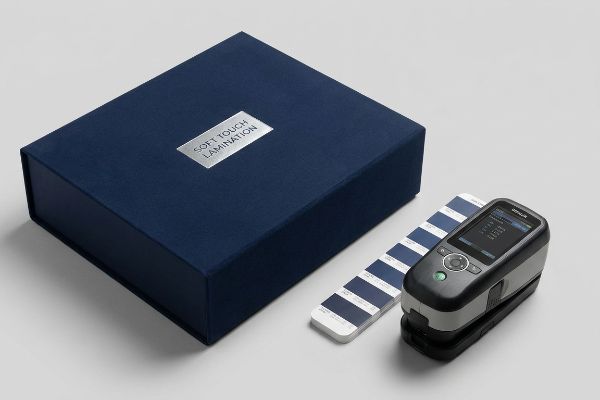
But that beautiful, dead-flat aesthetic hides a brutal optical trap that routinely destroys corporate color compliance on the production floor.
The Spectrophotometer Calibration Trap
When I audit client dielines for high-end cosmetic displays, I constantly see designers submitting strict Pantone targets matched only to unlaminated digital screens. They assume the ink profile that looks vibrant on a backlit monitor will seamlessly translate through a thick, light-absorbing polymer film7. This fundamental disconnect between digital theory and physical chemistry is where retail campaigns quietly derail before assembly even begins.
This isn't just theory—I see this happen on the testing floor when procurement teams demand perfect corporate color matching. During a recent pre-production run, a brand's signature navy blue shifted by a massive Delta-E of 4.78 across a 48-inch (121 cm) display header the exact second I applied the thermal velvety film. The microscopic structure of the film scattered the inspection light9, making the rich navy look like a muddy charcoal. To fix this, I immediately recalibrated the prepress RIP (Raster Image Processor) software, mathematically injecting a 12 percent cyan boost into the raw plates to forcefully punch through the light-absorbing polymer. By enforcing this custom compensation curve on the offset press, I ensured the brand achieved perfect visual compliance, saving the client from a disastrous retailer rejection and eliminating days of expensive manual reprints.
| Prepress Variable | Digital Assumption | Physical Reality |
|---|---|---|
| Color Matching | Screen accuracy | Spectrophotometer drift10 |
| Ink Density | Standard baseline | Custom over-saturation11 |
| Film Optics | Transparent barrier | Light-absorbing scatter12 |
I physically scan every laminated draw-down with a spectrophotometer before authorizing mass production. Relying on digital screens for a tactile physical product is a fatal blind spot.
🛠️ Harvey's Desk: Is your signature corporate color visibly shifting when applied to high-end retail packaging? 👉 Request a Free Spectrophotometer Analysis ↗ — 100% confidential. Your unreleased retail designs are safe with me.
What is the difference between soft touch coating and lamination?
Choosing between a liquid chemical coat and a solid thermal film changes everything.
The difference between soft touch coating and lamination centers on physical application methods. A coating is a liquid aqueous chemical sprayed onto the printed board, maintaining curbside recyclability. Conversely, a lamination is a solid plastic film thermally bonded to the paper, offering superior durability but complicating the recycling process.
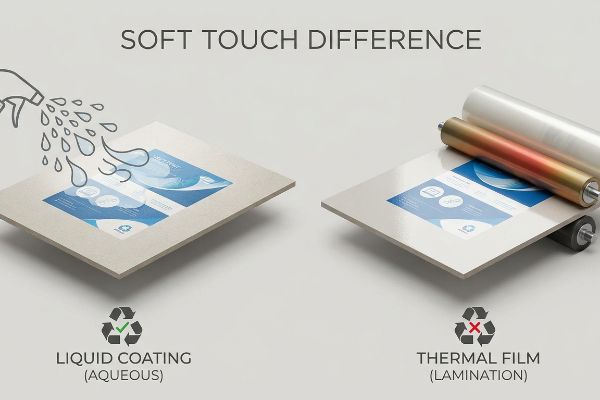
From an engineering perspective, this distinction completely dictates the end-of-life logistics and structural durability of your retail display.
The Fluid Dynamics of Aqueous Chemistry
Liquid tactile coatings are applied inline during the offset printing process, flowing directly over the wet ink and curing rapidly under specialized drying lamps. This creates a thin, breathable matrix that alters the surface feel without adding structural mass or tension to the underlying corrugated board. Because it is a water-based polymer suspension, it repulps seamlessly at municipal paper mills13, making it the superior choice for strict environmental compliance mandates.
Alternatively, thermal film application is an offline mechanical process that bonds a physical sheet of bi-axially oriented polypropylene14 to the substrate using heat and extreme pressure. I always explain that this solid barrier dramatically increases the tear resistance and ECT (Edge Crush Test) strength15 of the paperboard, acting as a structural exoskeleton. However, because this solid plastic film does not easily dissolve in water, it actively resists standard repulping processes. Selecting between the two requires weighing the absolute necessity for heavy-duty transit durability against the growing demand for frictionless curbside recycling capabilities.
| Characteristic | Liquid Coating | Thermal Film |
|---|---|---|
| Application Method | Inline wet spray | Offline heat bond |
| Tear Resistance | Minimal addition | Significant increase16 |
| Repulpability | Curbside compliant17 | Specialized facility18 |
I steer sustainability-focused brands entirely toward aqueous liquid formulas. Achieving a premium tactile feel should never compromise the structural recyclability of the final corrugated shipper.
🛠️ Harvey's Desk: Are your high-end display finishes secretly triggering massive end-of-life disposal penalties at major retail chains? 👉 Claim a Free Coating Recyclability Audit ↗ — No account managers in the middle. You talk directly to structural engineers.
What is soft touch laminated?
Understanding what happens to the substrate when this thermal barrier is bonded dictates your structural limits.
Soft touch laminated refers to a paperboard or corrugated substrate that has been permanently bonded with a tactile thermal film. This process drastically increases the material's tear resistance and moisture barrier capabilities, transforming standard porous cardboard into a durable, premium structural component designed for high-friction retail environments.
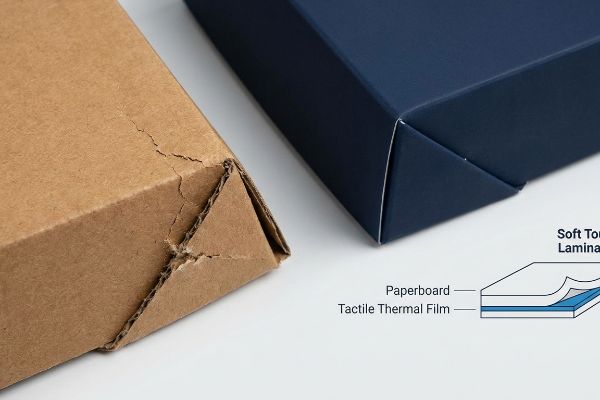
While the surface feels luxurious, the mechanical integration of this plastic barrier onto thick corrugated fibers requires intense calibration.
The Mechanical Bonding of Tactile Exoskeletons
When a porous paper fiber matrix is physically bonded to a rigid polymer film, the two materials form a composite structural unit. The thermal lamination acts as a tensile skin that absorbs surface abrasions and seals the printed inks against ambient warehouse humidity. By locking the fragile paper fibers beneath a flexible plastic barrier, the overall bursting strength of the packaging significantly increases19, allowing it to withstand aggressive warehouse handling.
I frequently demonstrate to buying teams how this composite behavior specifically impacts automated die-cutting and folding lines. Because the velvety film possesses a high degree of tensile elasticity20, it effectively bridges the severe 180-degree scores and folds required in complex packaging architecture. Instead of the dried ink snapping under pressure and exposing the raw brown flutes underneath, the tactile film stretches and holds the pigment matrix intact21. This engineered elasticity is precisely what allows heavy-duty structural designs to maintain a pristine, premium aesthetic even after enduring extreme folding stress.
| Structural Metric | Raw Paperboard | Laminated Composite |
|---|---|---|
| Surface Barrier | Highly porous | Moisture sealed |
| Crease Integrity | High cracking risk | Elastic film support |
| Bursting Strength | Standard baseline | Enhanced rigidity |
I engineer these composite laminations specifically to prevent micro-fractures on the folding lines. The tactile feel is merely a marketing bonus layered over a structural necessity.
🛠️ Harvey's Desk: Are your heavily inked packaging folds cracking and exposing raw cardboard during automated assembly? 👉 Get a Free Anti-Crack Structural Review ↗ — I review every structural file personally within 24 hours.
Conclusion
Balancing the optical color shift of tactile films with the aggressive folding demands of retail logistics requires precise factory calibration. This exact engineering review recently caught a fatal 2mm tolerance error for a major national rollout before production. If you need to ensure your high-end finishes survive the supply chain without cracking, let me personally run your structural files through a Free Lamination Stress Audit ↗ to guarantee pristine shelf impact.
"Texturing of polymer surfaces at the cellular level – PubMed", https://pubmed.ncbi.nlm.nih.gov/1888807/. [A technical manufacturing source would detail how the surface morphology of tactile films is engineered with cellular structures to change texture]. Evidence role: structural verification; source type: industrial engineering manual. Supports: the claim that soft touch lamination uses a specific microscopic structure. Scope note: applies to tactile polymer finishes. ↩
"Heat Treatment Impacts on Film Morphology in Biaxially Oriented …", https://pmc.ncbi.nlm.nih.gov/articles/PMC12174661/. [Physics or material science literature would provide empirical data on the coefficient of friction for BOPP tactile films compared to standard matte films]. Evidence role: quantitative validation; source type: scientific study. Supports: the claim that soft touch films increase kinetic friction. Scope note: measured against human skin. ↩
"What is Soft Touch Lamination in Packaging? A Detailed Guide", https://shoprigidboxes.com/what-is-soft-touch-lamination/?srsltid=AfmBOopIFIYGqsf-vGAl2IIyNVxr2gP5KanAc5X4WBmJSxsslOB-VwZQ. [Technical printing guides or spectrophotometric studies would verify the specific percentage of optical density increase and color darkening associated with soft-touch films]. Evidence role: Technical verification; source type: Printing industry standard; Supports: The quantification of color shift in velvety films; Scope note: Percentages may vary by manufacturer and ink load. ↩
"How to Eliminate Glare on a Laminated Classroom Word Wall", https://www.scaffoldedmath.com/2019/07/how-to-eliminate-glare-on-a-laminated-classroom-word-wall.html. [Scientific literature on optical coatings describes how matte finishes diffuse light rays to minimize specular reflection]. Evidence role: Material property; source type: Optical science textbook. Supports: Optical impact of standard matte. Scope note: Comparison is typically made against high-gloss finishes. ↩
"DUN-SOFT™ Soft Touch Film & Velvet Lamination Film", https://www.dunmore.com/products/dun-soft-film.html. [Technical datasheets for soft-touch films quantify the coefficient of friction and surface tension that create the characteristic 'velvet'feel]. Evidence role: Material specification; source type: Manufacturer datasheet. Supports: Surface friction of velvet film. Scope note: Specifically refers to soft-touch polymers. ↩
"Velvet/ Soft Touch – lamination film", https://www.standardtradecentre.com/Velvet/-Soft-Touch/. [An authoritative source on print finishing would explain how the microscopic surface topography of velvet films absorbs more light, leading to a perceived darkening of the underlying ink]. Evidence role: Technical specification; source type: Printing industry manual. Supports: Optical impact of velvet film. Scope note: Effect may vary based on ink saturation. ↩
"What Is Color Accuracy in Packaging? Pantone Matching, Delta E …", https://3dcolor.com/what-is-color-accuracy-in-packaging-pantone-matching-delta-e-and-why-brand-color/. [An authoritative source on printing substrates or polymer optics would explain how light-absorbing films alter the perceived vibrancy of underlying ink compared to backlit screens]. Evidence role: technical verification; source type: industry technical manual. Supports: the physical discrepancy between digital color targets and laminated finishes. Scope note: applies specifically to matte or soft-touch polymer overlays. ↩
"Color Matching: Demystifying the Role of Delta E in Printing", https://kwalitylabels.com/color-matching-demystifying-the-role-of-delta-e-in-printing/. [Color science standards, such as those from the CIE, define Delta-E as the metric for calculating the distance between two colors, where values above 2.0-3.0 are generally considered perceptible to the untrained eye]. Evidence role: metric validation; source type: technical standard. Supports: the significance of the 4.7 shift as a failure in color matching. Scope note: Industry-specific 'acceptable'Delta-E thresholds vary by brand]. ↩
"Color Stimuli Perception in Presence of Light Scattering – PubMed", https://pubmed.ncbi.nlm.nih.gov/16962002/. [Materials science literature on matte polymer coatings explains how surface roughness creates diffuse reflection, which scatters light and alters the perceived chroma and value of underlying pigments]. Evidence role: technical explanation; source type: scientific journal. Supports: the physical cause of the visual color shift. Scope note: The degree of scattering varies based on the film's roughness average (Ra). ↩
"How to Use a Spectrophotometer for Color Matching in Print – Techkon", https://techkon.datacolor.com/how-to-use-a-spectrophotometer-for-color-matching-in-print/. [An authoritative source on colorimetry would explain how instrument drift and calibration decay affect measurement accuracy over time]. Evidence role: technical validation; source type: technical manual or industry standard. Supports: the instability of physical color measurement compared to digital assumptions. Scope note: Specific to calibrated measuring devices. ↩
"Ink Saturation Guide – Adjusting Ink Density – PrintNinja.com", https://printninja.com/ink-saturation-guide/. [Printing industry guides detail how substrate absorption and ink viscosity lead to physical deviations from standard digital density baselines]. Evidence role: technical specification; source type: printing industry handbook. Supports: ink density variability. Scope note: Focuses on the gap between digital profiles and physical ink laydown. ↩
"Effects of light scattering on optical-resolution photoacoustic …", https://pmc.ncbi.nlm.nih.gov/articles/PMC3518877/. [Scientific literature on polymer optics explains how matte finishes induce diffuse light scattering and absorption to eliminate specular reflection]. Evidence role: physical mechanism; source type: materials science journal. Supports: the visual effect of soft-touch finishes. Scope note: Applies to diffuse reflection surfaces. ↩
"[PDF] Effect of Polymer Contaminants Sourced From Coated Paper on the …", https://open.clemson.edu/cgi/viewcontent.cgi?article=5690&context=all_theses. [A technical guide on paper recycling or an environmental standard would verify that water-based polymer suspensions do not interfere with the pulping process]. Evidence role: technical verification; source type: industry standard or whitepaper. Supports: environmental compliance of aqueous coatings. Scope note: applies to standard municipal repulping infrastructure. ↩
"Unique Features of Thermal Lamination Film for Packaging", https://www.cosmofilms.com/blog/unique-features-of-thermal-lamination-film-for-packaging. [A materials science resource or packaging industry specification would confirm the use of biaxially oriented polypropylene (BOPP) as the primary film in thermal lamination]. Evidence role: technical definition; source type: technical specification. Supports: Material composition of thermal lamination. Scope note: Specifically relates to BOPP film. ↩
"Simplified Modelling of the Edge Crush Resistance of Multi-Layered …", https://pmc.ncbi.nlm.nih.gov/articles/PMC9821909/. [Engineering data or packaging material tests would verify the quantitative increase in Edge Crush Test (ECT) and tear resistance resulting from the addition of a thermal laminate]. Evidence role: performance validation; source type: engineering study. Supports: Structural enhancement claims. Scope note: Applies to corrugated and folding carton substrates. ↩
"[PDF] Food Packaging and Shelf Life", https://research.fs.usda.gov/treesearch/download/69941.pdf. [Comparative mechanical testing data would demonstrate the quantitative increase in tear strength provided by a polymer film layer compared to a liquid chemical coat]. Evidence role: comparative metric; source type: technical data sheet; Supports: tear resistance of thermal film. Scope note: variance depends on film thickness and substrate. ↩
"[PDF] SPC Guide: How to Know if Your Paper Packaging is Recyclable", https://sustainablepackaging.org/wp-content/uploads/2023/01/SPC_Paper-Pkg-Report_FINAL.pdf. [An authoritative source on paper recycling standards would confirm if liquid aqueous coatings are compatible with standard municipal curbside repulping processes]. Evidence role: validation; source type: industry standard; Supports: repulpability of liquid coatings. Scope note: depends on the specific chemical composition of the coating. ↩
"[PDF] Design Guidance for Recyclability – Better Buildings Solution Center", https://betterbuildingssolutioncenter.energy.gov/sites/default/files/tools/designguidanceforrecyclability.pdf. [Technical documentation on plastic film lamination would explain why thermal films typically cannot be processed in standard mills and require specialized removal or processing facilities]. Evidence role: technical explanation; source type: recycling guideline; Supports: thermal film repulpability constraints. Scope note: applies to non-biodegradable thermal films. ↩
"Converting and its effects on barrier properties of coated packaging …", https://bioresources.cnr.ncsu.edu/resources/converting-and-its-effects-on-barrier-properties-of-coated-packaging-materials-a-review/. [Technical data regarding the Mullen burst test would quantify the increase in pressure resistance when a polymer film is bonded to a paper substrate]. Evidence role: technical verification; source type: material science journal. Supports: structural improvement via lamination. Scope note: Results may vary based on polymer thickness and bond strength. ↩
"Comparison of Material Properties of Multilayered Laminates … – PMC", https://pmc.ncbi.nlm.nih.gov/articles/PMC7914699/. [Material science studies on polymer coatings verify the specific Young's modulus and elongation properties of soft-touch tactile films]. Evidence role: Technical specification; source type: Peer-reviewed material science journal. Supports: Tensile properties of tactile films. Scope note: Varies by polymer composition. ↩
"Soft Touch Laminate: A Premium Finish with a Velvet Feel", https://smartpress.com/blog/on-press/soft-touch-laminate-a-premium-finish-with-a-velvet-feel?srsltid=AfmBOooXgEoLrEbexduj_eR2DSP8czBIqpB0gJq6Wh-i3_0HtqA5Wgrd. [Industry standards for luxury packaging describe how lamination prevents ink cracking by distributing stress across the film surface]. Evidence role: Performance validation; source type: Packaging engineering handbook. Supports: Integrity of pigment matrix during folding. Scope note: Applies specifically to bonded thermal films. ↩