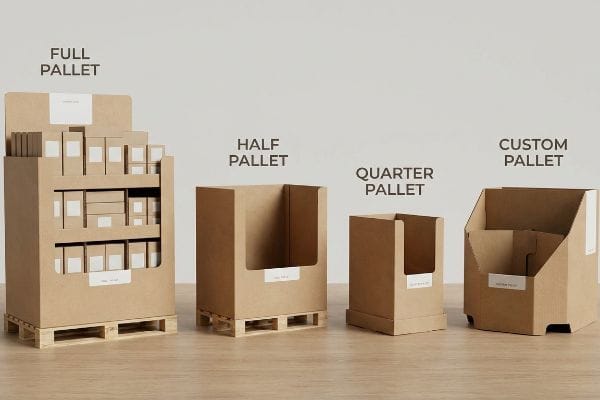
Struggling to get your merchandise onto big-box retail floors? Choosing the right pallet format solves spatial friction instantly and gets your brand approved despite strict aisle guidelines.
The main types of pallet displays are full, half, quarter, and custom retail formats. A full GMA (Grocery Manufacturers Association) pallet dominates major aisles, while half and quarter structures maximize tight promotional zones. Custom footprints adapt to unique retailer specifications, ensuring optimal merchandising density across varied store layouts.
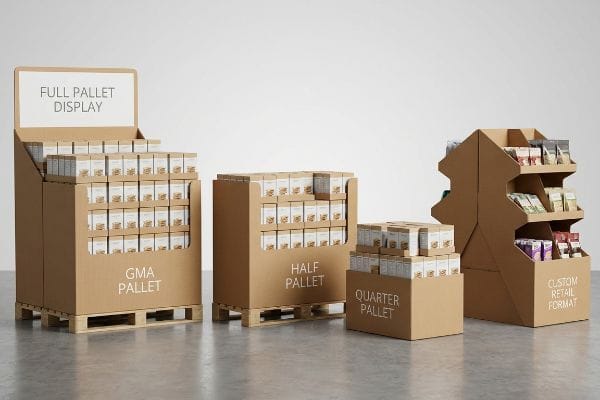
Let's break down exactly how these structural formats function on the floor and why your choice directly impacts your supply chain profitability.
What Are the Three Types of Pallets?
Big-box retailers ration their floor space ruthlessly. If you don't understand the primary dimensional options, your pitch gets rejected before production even begins.
The three types of pallets utilized in retail environments are full, half, and quarter footprints. These specific structural subdivisions allow brand managers to effectively scale promotional campaigns, fitting heavy merchandise into distinct aisle intersections without violating strict spatial clearances mandated by massive big-box store operators.

Knowing the physical dimensions is just the baseline. The real challenge happens when we adapt your creative vision to these rigid bases.
Why Standardizing Your Pallet Display Footprint Matters
Many marketing teams assume a campaign must monopolize an entire wood base to be effective. They design massive, monolithic structures intended to dominate an aisle, completely ignoring the reality that store buyers prefer to mix and match campaigns to maximize profit per square foot1.
Even experienced procurement teams often pitch a massive 48×40 inch (1219×1016 mm) floor display, only to face immediate rejection. I routinely see beautiful artwork get scrapped because the brand didn't design for a shared space. When a client hands me a monolithic design, I immediately chop it into fractional dimensions—half pallets at 48×20 inches (1219×508 mm) or quarter pallets at 24×20 inches (609×508 mm). Subdividing the footprint guarantees your promotional campaign can seamlessly share a single wood base with another brand. This strategic flexibility instantly doubles your chances of retailer approval, helps category buyers maximize their aisle real estate, and ultimately ensures your seasonal rollout secures prime placement.
| Common Rookie Mistake | The Pro Fix | Retail-Floor Benefit |
|---|---|---|
| Pitching only full sizes | Engineering fractional subdivisions | Increases buyer approval rate |
| Ignoring shared floor space | Designing for shared base plates | Maximizes dense aisle density |
| Oversized monolithic displays | 48×20 inch half-pallet scaling2 | Prevents costly floor rejection |
Fractional geometry guarantees flexibility, keeping your rollout agile and highly profitable across multiple distinct store layouts without betting your entire budget on a single massive footprint.
🛠️ Harvey's Desk: Are your current floor merchandisers too large for shared aisle placements? 👉 Let Me Review Your Dieline ↗ — Direct access to my desk. Zero automated sales spam, I promise.
What Are the Different Types of Retail Displays?
Wandering through a retail environment reveals a massive variety of merchandisers, each engineered to trigger distinct purchasing behaviors based on their physical placement.
The different types of retail displays include freestanding floor units, countertop merchandisers, end-caps, shelf-ready trays, and custom pallet structures. Each specific category serves a unique logistical function, dynamically engaging passing shoppers at varying visual heights while effectively managing inventory density across different commercial retail store zones.

While permanent metal racks look impressive in a catalog, selecting the right material format fundamentally alters your logistical overhead.
Temporary Corrugated vs. Permanent Retail Displays
Procurement departments frequently default to permanent welded metal FSDU (Free Standing Display Unit) structures for short-term campaigns, assuming heavy-duty steel automatically guarantees a higher return on investment. They treat temporary paperboard options as cheap afterthoughts, expecting them to buckle under the weight of consumer packaged goods.
You might assume steel is safer, but the freight penalty will destroy your profit margins. I've watched brands pay massive shipping premiums simply to move "dead air" across the global supply chain, loading only 250 pre-welded wire racks into a 40HQ3 (High Cube) container. Instead, I transition these campaigns to high-performance temporary corrugated structures engineered with a sturdy double-wall base. Pivoting to flat-pack engineered cardboard allows me to fit up to 1,500 units into that exact same container4. This completely eliminates the permanent hardware shipping penalty, keeping your co-packing operations frictionless while ensuring retail associates can quickly assemble the units directly on the sales floor.
| Common Rookie Mistake | The Pro Fix | Retail-Floor Benefit |
|---|---|---|
| Shipping empty metal racks | Using flat-pack corrugated units | Slashes overseas container costs |
| Over-engineering for short runs | Heavy-duty double-wall paperboard | Maintains high dynamic load |
| Ignoring freight volume limits | High-density flat-pack nesting | Accelerates warehouse unloading |
You don't need heavy steel to sell lightweight goods during a seasonal push. Transitioning to smart corrugated flat-packs drastically cuts your raw material spend and frees up capital for better high-fidelity graphic communication.
🛠️ Harvey's Desk: Are you paying to ship empty air with bulky metal fixtures? 👉 Get a Flat-Pack Conversion Audit ↗ — Download safely. My inbox is open if you have questions later.
What Are the Five Types of Displays?
Categorizing your point-of-purchase tools correctly prevents downstream compliance failures. Retailers maintain strict spatial laws governing how these fixtures interact with human traffic.
The five main types of retail displays generally recognized include floor stands, countertop units, pallet builds, shelf clip strips, and end-cap merchandisers. Understanding these specific classifications ensures brands deploy the appropriate structural geometry to maximize consumer visibility while adhering to strict spatial and safety compliance regulations.
Knowing the five categories is easy, but attempting to lazily morph one format into another introduces severe physical compliance hazards.
The Danger of Scaling Floor Stands into Countertop Displays
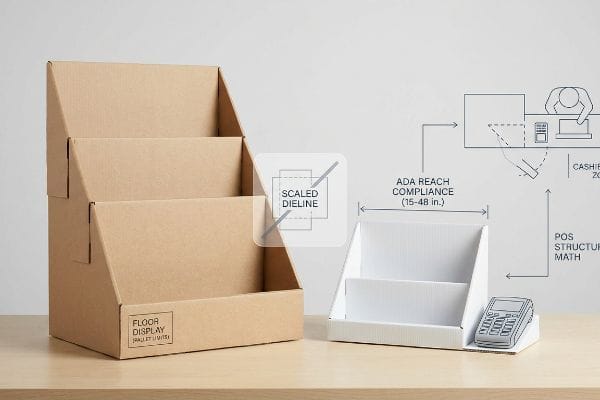
Brands love to talk about scalable design. A common practice is designing a beautiful POP (Point of Purchase) floor display and simply asking the graphic designer to shrink the dieline by fifty percent to create a POS5 (Point of Sale) counter unit.
Treating physical structures like scalable digital images is a massive blind spot. Floor units are anchored to standard pallet limits for warehouse logistics, while counter units must adhere to strict ADA (Americans with Disabilities Act) 15-48 inch (381-1219 mm) forward reach zones6. A scaled-down floor display often ends up with a deep base that completely blocks the credit card terminal, frustrating both cashiers and shoppers at checkout. I completely separate the engineering pipelines for these two zones. By rebuilding the structural math from scratch for the POS environment using thin micro-flute board, we guarantee your unit easily clears the cashier's operating area and provides a premium presentation at the point of sale.
| Common Rookie Mistake | The Pro Fix | Retail-Floor Benefit |
|---|---|---|
| Shrinking floor dielines | Dedicated POS structural math | Prevents cashier zone blocking |
| Ignoring forward reach rules | ADA compliance engineering7 | Secures register placements |
| Using bulky B-flute for counters8 | Switching to thin E-flute board9 | Ensures clean interlocking folds |
Structural physics do not scale symmetrically. Treating the checkout counter and the main aisle as completely separate engineering environments protects your brand from sudden retailer rejections and angry store managers.
🛠️ Harvey's Desk: Are your checkout counter trays secretly violating ADA forward reach laws? 👉 Request a Spatial Compliance Check ↗ — No forms that trigger endless sales calls. Just pure value.
What Is the Difference Between a Half Pallet and a Quarter Pallet?
Subdividing your merchandising footprint unlocks high-traffic retail real estate, but changing the base geometry alters the physics of your fully loaded structure entirely.
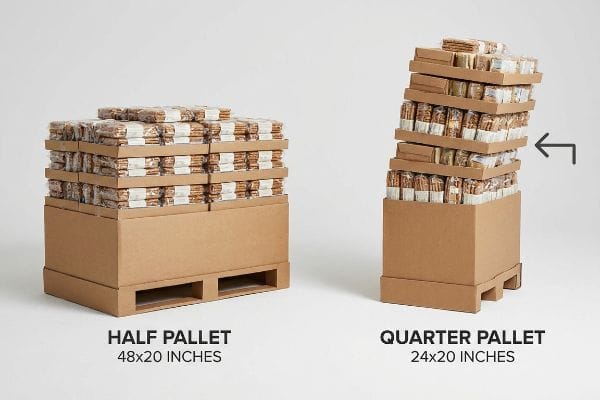
The difference between a half pallet and a quarter pallet lies entirely in their base footprint dimensions. A half pallet measures forty-eight by twenty inches, whereas a quarter pallet is scaled down strictly to twenty-four by twenty inches to accommodate extremely tight retail aisle intersections.
But knowing the theory isn't enough when the machines start running, and gravity takes over in the aisle.
Why Standard Quarter Pallets Fail on the Factory Floor
Procurement teams frequently scale down standard full-size merchandisers into these smaller quarter footprints to secure premium end-cap placements. They assume that if they simply cut the width in half but maintain the original 50-inch (1270 mm) overall height10, the unit will perform identically to its larger counterpart.
Getting one display to stand up in a lab is easy, but here is the brutal factory reality when you ship 500 of them into a high-traffic environment. When you reduce the base to 24×20 inches (609×508 mm) but keep the height towering above four feet, you severely shift the center of gravity. It acts exactly like a pencil balancing on its eraser, generating extreme lateral torque at the base wall. In my facility, I routinely see these top-heavy designs violently tip over during a standard 10-degree incline tilt test11, and the concentrated pressure completely crushes the BC-flute corrugation12 at the corners. The fix requires manipulating the internal payload distribution to counteract these localized stress fractures. I engineer hidden false bottoms specifically designed to house dense sandbag weights, completely anchoring the center of mass. By enforcing this strict geometric ballast, I eliminate the tipping hazard entirely, ensuring your display survives minor shopping cart collisions without collapsing and triggering costly liability claims.
| Common Rookie Mistake | The Pro Fix | Retail-Floor Benefit |
|---|---|---|
| Maintaining tall standard heights | Lowering center of gravity13 | Stops aisle tipping hazards |
| Ignoring base-to-height ratio14 | Engineering hidden false bottoms | Survives shopping cart bumps |
| Loading top shelves heavily | Anchoring heavy SKUs lower | Stabilizes entire structure |
You cannot cheat basic physics just to maximize vertical branding space. Engineering a heavy, anchored base is non-negotiable if you want your narrow merchandiser to survive a crowded weekend shopping rush.
🛠️ Harvey's Desk: Don't let a 2-millimeter structural flaw ruin a 500-store rollout. 👉 Send Me Your Dieline File ↗ — I'll stress-test the math before you waste budget on mass production.
Conclusion
You can try to scale your standard floor displays down without recalculating the center of gravity, but when a top-heavy quarter pallet tips over in the aisle, it triggers an immediate retailer rejection and forces weeks of costly manual rework. Over 500 brand managers use my prepress checklist to avoid these exact fatal early-stage mistakes. Stop guessing on physical tolerances and let me personally run your files through my Free Structural Stability Audit ↗ to catch dynamic load errors before mass production begins.
"10 Steps for Custom Pallet Display Success", https://www.tphinc.com/custom-point-of-purchase-pop-pos-retail-store-displays-packaging-blog/10-steps-for-pallet-display-success/. Industry analysis of retail category management and space optimization confirms that buyers prioritize high-margin product density over single-brand dominance. Evidence role: validation of business logic; source type: retail management study. Supports: The claim that retailers favor modular display layouts for profit optimization. Scope note: Applies specifically to big-box retail environments. ↩
"Half pallet: Definition, measurements, and main uses", https://www.interlakemecalux.com/blog/half-pallet. Verification of standard industry dimensions for half-pallets used in retail environments to ensure floor space compatibility. Evidence role: technical specification; source type: logistics standard. Supports: standard half-pallet sizing. Scope note: focus on North American retail standards. ↩
"40HQ container inner size and cbm – Tube boxes", https://www.tube-boxes.com/40hq-container-inner-size-and-cbm. Industry logistics data on shipping volumes for non-collapsible metal fixtures compared to container dimensions. Evidence role: quantitative benchmark; source type: logistics industry report. Supports: shipping inefficiency of permanent racks. Scope note: based on standard rack sizing. ↩
"40ft High Cube Containers: Best Business Use Cases", https://boshboxes.store/40ft-high-cube-containers-business-use-cases/. Comparative analysis of shipping density for flat-packed corrugated displays versus welded steel. Evidence role: quantitative benchmark; source type: supply chain case study. Supports: cost efficiency of temporary displays. Scope note: assumes standard flat-pack dimensions. ↩
"Countertop Displays & Accelerating Product Sales | TPH Global", https://www.tphinc.com/custom-point-of-purchase-pop-pos-retail-store-displays-packaging-blog/accelerating-product-sales-with-countertop-displays/. Technical verification of whether linear scaling of structural dielines from floor to counter displays is a standard industry practice or a common design error affecting structural integrity. Evidence role: technical validation; source type: packaging engineering guide. Supports: The claim that shrinking dielines by 50% is a common but potentially flawed practice. Scope note: Focuses on structural geometry in POP design. ↩
"Chapter 3: Operable Parts – Access-Board.gov", https://www.access-board.gov/ada/guides/chapter-3-operable-parts/. Verification of the specific ADA measurement requirements for forward reach zones to ensure accessibility compliance. Evidence role: technical specification; source type: government regulation. Supports: legal reach requirements for fixtures. Scope note: applies to accessible design standards. ↩
"ADA Update: A Primer for Small Business", https://www.ada.gov/resources/title-iii-primer/. Verification that specific engineering standards exist to meet Americans with Disabilities Act (ADA) accessibility requirements for retail fixtures. Evidence role: legal standard; source type: government regulation. Supports: The necessity of ADA compliance for register placements. Scope note: Focuses on US accessibility laws. ↩
"E Flute vs B Flute: Which One Is Right for Your Custom Boxes?", https://custompackaginghouse.com/e-flute-vs-b-flute-which-one-is-right-for-your-custom-boxes/?srsltid=AfmBOoqPrDLwxZWBfuH7NdseYdgQ4ZHyOQAG8e9QLYssaTRA39T0wJse. Technical comparison of corrugated flute thicknesses and their suitability for small-scale interlocking folds in POS displays. Evidence role: technical specification; source type: manufacturing guide. Supports: The claim that B-flute is too bulky for counter displays. Scope note: Applies to corrugated packaging materials. ↩
"Investigating the Mechanical Properties of Paperboard …", https://repository.rit.edu/cgi/viewcontent.cgi?article=1066&context=japr. Evidence demonstrating that E-flute's thinner profile allows for cleaner interlocking folds in compact structural designs. Evidence role: technical specification; source type: materials science. Supports: The benefit of switching to E-flute for counter displays. Scope note: Limited to corrugated board standards. ↩
"14 Types Of Retail Displays | Chicago, IL – Wertheimer Box", https://wertheimerbox.com/types-of-retail-displays/. An industry standard specification guide would verify if 50 inches is a benchmark height for standard full-size retail merchandisers. Evidence role: factual verification; source type: technical specification sheet. Supports: the baseline height of traditional retail displays. Scope note: specific to cardboard or temporary retail displays. ↩
"AG 1091A: Retail Merchandise Displays in the Frontage Zone", https://www.seattle.gov/transportation/permits-and-services/permits/applicant-guides/ag-1091a. Industry standard safety guidelines or ASTM standards for retail POP displays regarding tilt-test stability requirements. Evidence role: procedural validation; source type: industry regulatory standard. Supports: the validity of the 10-degree benchmark as a standard test. Scope note: may vary by specific retail chain requirements. ↩
"Estimation of the Compressive Strength of Corrugated Board Boxes …", https://pmc.ncbi.nlm.nih.gov/articles/PMC8467740/. Technical specifications on the bursting strength and edge crush test (ECT) values for BC-flute double-wall corrugated board to verify failure points under concentrated pressure. Evidence role: technical validation; source type: material science data sheet. Supports: structural failure of specific corrugation. Scope note: assumes standard industry grade BC-flute. ↩
"Center of Gravity | Physics Van – University of Illinois", https://van.physics.illinois.edu/ask/listing/74. Technical explanation of how lowering the center of mass reduces the tipping moment in freestanding retail structures. Evidence role: theoretical principle; source type: physics textbook or engineering guide. Supports: The claim that lowering the center of gravity prevents tipping. Scope note: General physical laws applied to retail furniture. ↩
"What Is the Average Retail Shelf Height? – PopDisplay", https://popdisplay.me/what-is-the-average-retail-shelf-height/. Industry standard guidelines for the maximum permissible height relative to the base width to ensure structural stability. Evidence role: safety standard; source type: OSHA or retail safety manual. Supports: The importance of maintaining specific ratios to prevent accidents. Scope note: Specific to non-fixed retail fixtures. ↩