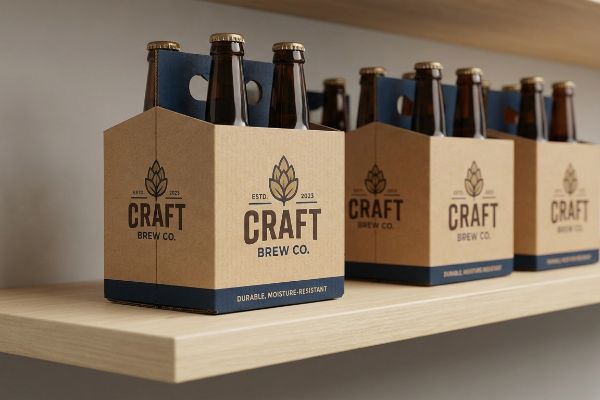
Lancer une boisson artisanale dans les grandes surfaces implique de se battre pour se faire remarquer. Si la mise en valeur physique des produits est défaillante, même la meilleure bière finira par prendre la poussière au fond des rayons.
Un emballage commercial conçu pour mettre en valeur votre bière en rayon allie une ingénierie CAO de précision à une force visuelle percutante. Grâce à des présentoirs en carton ondulé résistants à l'humidité et capables de supporter des charges importantes de liquide, les marques bénéficient d'un emplacement privilégié et stimulent les achats impulsifs dans les zones commerciales à fort trafic.
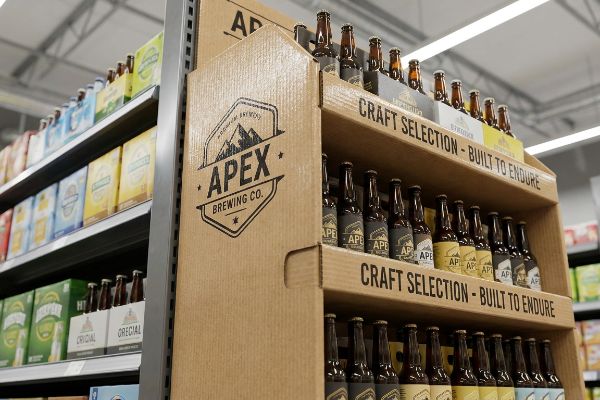
Comprendre la théorie du merchandising des boissons n'est que la première étape ; survivre aux dangers physiques du magasin exige une approche technique beaucoup plus approfondie.
Qu'est-ce que la bière de la règle 47 ?
Nombreux sont les fondateurs d'entreprises de boissons qui s'interrogent sur cette réglementation mystérieuse, mais dans le monde du commerce physique, elle renvoie directement à une norme d'ingénierie essentielle pour les liquides lourds.
Le concept d'emballage de bière conforme à la règle 47 est étroitement lié au protocole de coefficient de sécurité de 3,5 en vente au détail. Les boissons liquides générant un poids dynamique important, les ingénieurs en structure doivent surdimensionner le fond ondulé à trois fois et demie la charge statique afin de prévenir la fatigue due à l'humidité et d'éviter tout litige.
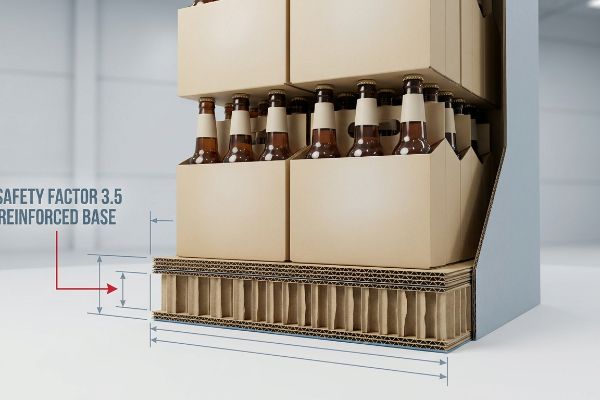
Il est évident que votre présentoir doit supporter du verre lourd et du liquide, mais la façon dont vous calculez cette charge déterminera si votre campagne survivra à l'été.
Pourquoi le coefficient de sécurité de 3,5 détermine-t-il la présentation des bières ?
Il est incroyablement courant qu'une nouvelle marque de boissons pèse ses packs de six, calcule une charge utile totale d'affichage de 150 lbs (68 kg) et commande un présentoir standard en carton simple paroi1.Ils supposent que si les calculs fonctionnent dans un bureau climatisé, ils se traduiront parfaitement dans un grand magasin club.
Je constate constamment cette erreur de débutant lors des audits de lancements de produits de grande consommation ratés. J'ai vu une fois une marque lancer une importante promotion de bières artisanales dans un magasin de Floride, en plein climat humide, en utilisant un présentoir standard ECT 32 (test de résistance à la compression des bords)². Le papier poreux ayant absorbé l'humidité ambiante, la base a perdu sa résistance à la compression³.J'entendais littéralement le bruit désagréable du carton humide qui s'est déformé sous le poids statique des bouteilles, sur les 50 mm inférieurs. L'ensemble s'est incliné vers l'avant, obligeant le gérant du magasin à l'envelopper de ruban adhésif transparent peu esthétique pour éviter tout déversement dangereux.
En appliquant un coefficient de sécurité strict de 3,5,j'oblige les marques à surdimensionner leurs structures de base pour supporter une pression de 238 kg (525 lb) pour une charge de 68 kg (150 lb). L'ajout d'un revêtement aqueux résistant aux liquides sur le bord inférieurgarantit une rigidité parfaite du présentoir, éliminant ainsi tout risque de remboursement par les détaillants et préservant l'image haut de gamme de votre marque.
| Erreurs courantes des débutants | La solution pro | Avantage du magasin |
|---|---|---|
| Conception strictement basée sur le poids statique | Application du coefficient de sécurité 3,56 | Empêche un effondrement catastrophique de la base |
| Utilisation de supports en papier brut non couché | Ajout d' un revêtement de fond résistant à l'eau7 | Résiste au lavage des sols et à l'humidité |
| S'appuyant sur un testeur de doublure à simple paroi | Passage à des épines ondulées à double paroi8 | Préserve la valeur et la sécurité de la marque |
Je refuse que mes clients expédient un présentoir à boissons sans ce filet de sécurité intégré, car économiser quelques centimes sur le papier brut ne vaut jamais le risque d'une défaillance structurelle dans un magasin bondé.
🛠️ Le bureau d'Harvey : Craignez-vous que le support de votre présentoir actuel ne cède sous le poids de vos produits ? 👉 Demandez une évaluation structurelle gratuite ↗ — Accès direct à mon bureau. Zéro spam commercial automatisé, promis.
Que signifie la règle des 3-3-3-0 pour la bière ?
Il est inutile de faire figurer votre produit en magasin si les clients passent devant sans même y jeter un second regard.
La règle 3 30 300 pour le merchandising de la bière, étroitement liée au cadre spatial 3-3-3, est une directive stratégique stipulant que l'emballage doit capter l'attention visuelle à trente pieds, engager les acheteurs à trois pieds et provoquer la conversion d'impulsion tactile à exactement trois pouces.
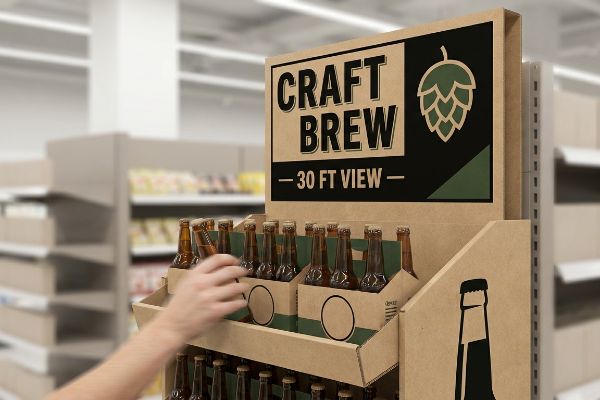
Ce cadre de travail vous oblige à cesser de concevoir des graphismes plats pour un écran d'ordinateur et à commencer à concevoir des graphismes adaptés au mouvement humain.
Survivre au piège de l'engagement spatial 3-3-3
Les jeunes équipes marketing adorent surcharger chaque centimètre carré d'un présentoir de textes minuscules, de notes de dégustation et d'un historique de marque complexe. Elles évaluent le visuel assises à 45 cm d'un écran haute résolution, oubliant complètement qu'un client pressé, poussant son chariot, le regarde depuis l'autre bout d'un immense entrepôt visuellement chaotique.
Le problème le plus fréquent que je constate se situe au niveau de la zone de conversion cruciale de 7,6 cm (3 pouces) . Un client a récemment conçu un magnifique présentoir de tête de gondole , mais le rebord avant est beaucoup trop haut, empêchant les bouteilles de tomber. J'ai vu un client essayer de sortir un pack de 12 bouteilles du présentoir, pour finalement se heurter à la friction frustrante de ses articulations contre le carton rigide. Il a fini par abandonner, et on a entendu le craquement sec du carton lorsqu'il a remis le produit en place.
Pour remporter la mise lors de cette dernière interaction physique, il est essentiel d'optimiser mathématiquement le rebord de retenue afin de garantir une visibilité du produit de 85 % et une prise en main sans frottement. En abaissant la paroi avant et en inclinant l'étagère inférieure vers le haut de 15 degrés , vous présentez le produit directement dans les mains du consommateur, facilitant ainsi l'achat impulsif.
| Erreurs courantes des débutants | La solution pro | Avantage du magasin |
|---|---|---|
| lèvres de retenue avant hautes | Conception pour une visibilité produit de 85 %12 | Supprime les frictions physiques liées à l'achat |
| Étagères plates près du sol | Inclinaison des étagères inférieures vers le haut de 15 degrés13 | Améliore la visibilité dans la zone de frappe |
| Graphiques minuscules et riches en texte | Utilisation de points focaux découpés à l'emporte-pièce massifs | Attire l'attention à une distance de 9 mètres14 |
Si votre présentoir ne capte pas le regard du client depuis l'allée principale et ne lui présente pas le produit de manière fluide et à portée de main, vous financez simplement un monument en carton coûteux à la gloire de votre marque.
🛠️ Le bureau de Harvey : Vous vous demandez si la hauteur du rebord avant de votre étiquette masque correctement le visuel principal pour le consommateur ? 👉 Faites vérifier votre tracé ↗ — Téléchargement sécurisé. Ma boîte de réception est ouverte si vous avez des questions.
Quels sont les différents types d'emballages pour la bière ?
Choisir le bon contenant pour la vente est tout aussi important que la recette de la bière elle-même.
Les différents types d'emballages pour la bière comprennent les bouteilles en verre ou les canettes en aluminium, ainsi que des formats secondaires comme les présentoirs de sol, les présentoirs de comptoir et les conteneurs à demi-fentes (HSC). Ces structures de vente au détail en carton ondulé doivent utiliser un alignement vertical des fibres pour résister aux fortes charges dynamiques exercées sur le dessus dans les magasins-entrepôts très fréquentés.
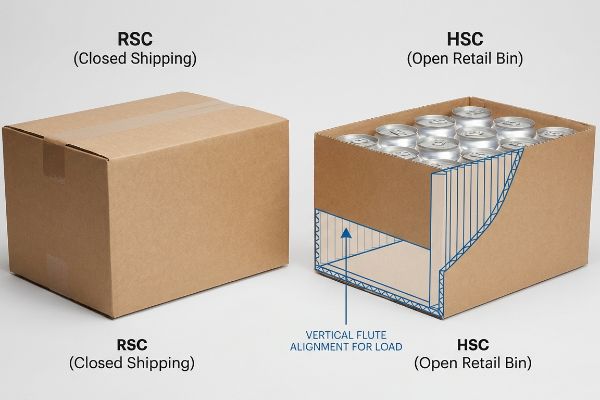
Choisir entre un carton d'expédition fermé et un bac de vente ouvert est une décision logistique qui a un impact considérable sur l'intégrité structurelle.
Vulnérabilité compressive RSC vs. HSC
Lors du lancement d'une campagne de vente au détail en gros, les marques essaient fréquemment d'économiser de l'argent en convertissant les RSC (Regular Slotted Containers) standard en HSC (Half Slotted Containers)15.En retirant simplement les rabats supérieurs, elles créent un bac ouvert instantané qui permet aux acheteurs d'accéder immédiatement aux canettes, en supposant que la boîte résistera toujours exactement de la même manière pendant le transport.
Il s'agit d'un défaut structurel majeur. En supprimant ces rabats supérieurs continus, on détruit complètement l' enceinte supérieure à 360 degrés qui stabilise les coins de la boîte.Je me souviens d'avoir inspecté une livraison où le client avait utilisé des HSC standard à dessus ouvert sans améliorer la qualité de leur carton. Pendant le transport, les vibrations non atténuées ont provoqué le cintrage des bords non soutenus. Lorsque l'équipe de l'entrepôt a empilé les palettes, j'ai entendu le bruit sourd et craquant de la palette inférieure qui s'est complètement effondrée sous une charge de 181 kg (400 lbs), endommageant des dizaines de boîtes.
Lorsqu'on retire le couvercle supérieur pour accéder au point de vente, il faut compenser la perte de stabilité. J'exige systématiquement que le grain du carton ondulé soit parfaitement aligné verticalement(17) afin d'optimiser la résistance à l'écrasement des bords. Si le produit interne ne peut pas servir de pilier rigide, je préconise immédiatement l'utilisation d'un profilé structurel à double paroi(18), neutralisant ainsi complètement la vulnérabilité à la compression des présentoirs ouverts.
| Erreurs courantes des débutants | La solution pro | Avantage du magasin |
|---|---|---|
| Utilisation de HSC avec une carte standard | Passage aux profilés à double paroi | Résiste aux charges de palettes empilées doublement19 |
| En ignorant l'orientation de la flûte | Forcer l'alignement vertical du grain | Restaure la compression manquante des coins20 |
| En supposant que les boîtes supportent le poids | Concevoir la boîte pour qu'elle supporte la charge | Empêche l'écrasement des produits et les fuites |
On ne peut pas supprimer la moitié de la géométrie structurelle d'une boîte pour créer un bac de vente au détail sans remanier délibérément les fibres de papier restantes pour supporter la charge manquante.
🛠️ Harvey's Desk : Vos présentoirs ouverts échouent-ils actuellement aux tests de compression avant expédition ? 👉 Demandez votre audit structurel gratuit ↗ — Pas de formulaires interminables qui vous inondent d'appels commerciaux. Uniquement de la valeur ajoutée.
Que doit faire un détaillant s'il trouve sur ses rayons de la bière périmée ?
La gestion des dates de péremption des produits en magasin est un combat logistique constant que les marques doivent activement soutenir.
Si un détaillant découvre de la bière périmée en rayon, il doit immédiatement la retirer afin de prévenir tout risque sanitaire pour le consommateur. La mise en place d'une gestion rigoureuse du cycle de vie des produits, avec des codes « Date limite de consommation » pré-imprimés et à fort contraste sur les emballages secondaires en carton ondulé, élimine complètement ce risque coûteux lié à la gestion des stocks.
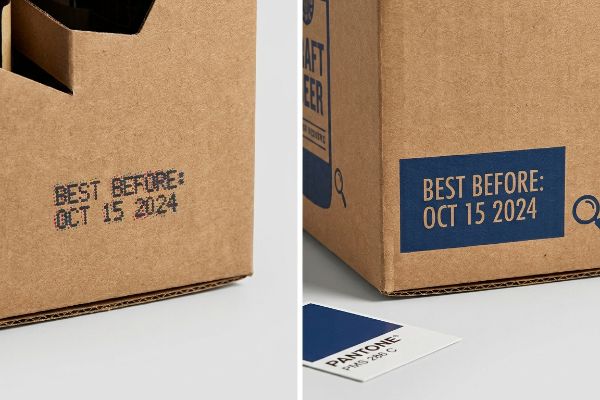
Mais décider d'imprimer une date de péremption sur votre présentoir en carton ne suffit pas lorsque les réalités de la prépresse en usine déforment votre visuel.
Pourquoi les codes de date standard échouent-ils en production ?
La plupart des responsables marketing partent du principe qu'en saisissant une date de péremption précise dans leur fichier Illustrator, celle-ci apparaîtra parfaitement lisible sur le présentoir. Ils s'appuient sur le traitement quadrichromique CMJN standard pour imprimer les minuscules données de suivisur les panneaux latéraux, faisant confiance à l'usine pour reproduire exactement la netteté affichée sur leurs écrans d'ordinateur portable.
Ce n'est pas qu'une simple théorie : je constate ce problème récurrent en prépresse. Lorsqu'on imprime de petits caractères en utilisant des points de trame CMJN superposés sur du papier testliner ondulé brut et poreux, les fibres absorbent abondamment l'encre encore humide. Lors de ma dernière préproduction pour le lancement d'une IPA saisonnière, j'ai effectué des mesures au micromètre et constaté un écart de gain de point impressionnant de 2,4 mm.Le mélange optique a dysfonctionné, transformant un minuscule « 8 » en un « 0 » illisible. L'impossibilité de lire la date a empêché le distributeur d'assurer une gestion efficace du cycle de vie du produit, ce qui a entraîné le stockage de bières périmées et un véritable casse-tête logistique pour la marque.
Pour remédier à ce problème, j'applique rigoureusement un protocole d'impression en tons directs pour tous les textes essentiels relatifs à la date limite de consommation et à la conformité. Au lieu de laisser la machine mélanger quatre couleurs liquides, je supprime les données CMJN et impose une seule encre Pantone (PMS) haute densité pour le bloc de date. Grâce à cette unique couche d'encre, je garantis une netteté parfaite du texte, ce qui permet aux vendeurs de repérer facilement les unités périmées et évite au client des frais de retour importants liés aux produits périmés .
| Erreurs courantes des débutants | La solution pro | Avantage du magasin |
|---|---|---|
| Impression de dates minuscules en CMJN | Utiliser une couleur Pantone unie | Garantit une lisibilité parfaite du code de date |
| Codes cachés sur le panneau arrière | Impression à contraste élevé des « dates d'élimination » | Accélère les inventaires en magasin |
| En négligeant le gain de point ondulé | Compensation dans les logiciels RIP de prépresse | Empêche le texte brouillé et illisible |
Je ne permets jamais à une marque de risquer sa réputation ou ses relations avec un grand distributeur simplement parce qu'un opérateur de prépresse n'a pas respecté les lois physiques de l'encre qui bave sur le papier brut.
🛠️ Conseils d'Harvey : Un défaut structurel de 2 millimètres ne doit pas compromettre le déploiement dans 500 magasins. 👉 Envoyez-moi votre fichier de gabarit ↗ — Je vérifierai la robustesse des calculs avant que vous n'investissiez votre budget dans une production de masse.
Conclusion
Vous pouvez choisir le fournisseur de carton le moins cher, mais si ce bac à simple paroi et à ouverture supérieure se déforme sous le poids d'une double palette, l'effondrement structurel qui en résultera entraînera un refus immédiat du détaillant et anéantira la marge bénéficiaire de votre campagne. Voici la fiche technique exacte utilisée par mes 10 principaux clients du secteur de la distribution pour garantir zéro rejet d'impression. Ne vous laissez plus guider par les tolérances de charge verticale : laissez-moi analyser vos fichiers grâce à mon Audit de découpe gratuit ↗ afin de détecter les erreurs d'écrasement des bords critiques avant le lancement de la production en série.
« Principes de conception des présentoirs PLV en carton ondulé pour la résistance aux charges », https://brownpackaging.com/load-bearing-design-principles-for-corrugated-pop-displays/. Les normes d'ingénierie de l'emballage et les valeurs d'essai de résistance à l'écrasement des bords (ECT) définissent la résistance maximale à la compression et les limites de charge verticale pour le carton ondulé simple cannelure. Éléments de preuve : spécification technique ; type de source : manuel d'ingénierie. Démonstration : les matériaux à simple cannelure sont structurellement insuffisants pour supporter des charges liquides importantes. Remarque : la capacité varie en fonction de la taille des cannelures et de la qualité du carton .
« [PDF] Spécifications du carton ondulé – Fibre Box Association », https://www.fibrebox.org/assets/2025/09/Walmart_Corrugated-Board_Specifications_Automation_Packaging_Standards.pdf. [Les normes industrielles relatives aux emballages en carton ondulé définissent la résistance à la traction de 32 ECT comme une mesure spécifique de la capacité de charge du bord du carton]. Rôle de la preuve : spécification technique ; type de source : norme de l’industrie de l’emballage. Supporte : la capacité structurelle de base du matériau choisi. Remarque : cette résistance s’applique généralement à des conditions sèches .
« [PDF] Effets de la teneur en humidité sur la résistance à la compression des boîtes : FBA BCT… », https://rbi.gatech.edu/sites/default/files/2025-12/4effects-of-moisture-content-on-box-compression-strength.pdf . [Les recherches en science des matériaux indiquent que l’absorption d’humidité par les fibres de cellulose affaiblit les liaisons hydrogène, ce qui entraîne une baisse significative de la capacité de charge verticale]. Type de preuve : principe mécanique ; source : revue scientifique spécialisée en science des matériaux. Appuie : le lien de causalité entre l’humidité et l’effondrement structurel. Remarque : s’applique au carton poreux non traité.
« CONCEPTION STRUCTURELLE DES PRÉSENTATEURS POUR LE COMMERCE DE DÉTAIL INTERACTIF… », https://www.bcipkg.com/display-structural-design-for-interactive-retail-displays/ . [Un guide d'ingénierie faisant autorité pour les présentoirs de vente au détail confirmerait l'application d'un coefficient de sécurité de 3,5 pour les charges liquides importantes afin d'éviter tout effondrement ] . Rôle de la preuve : Spécification technique ; type de source : Norme d'ingénierie. Justifie : L'exigence de surdimensionnement des bases ondulées. Note de portée : Concerne spécifiquement les charges statiques et dynamiques dans les environnements de vente au détail.
« Revêtements aqueux pour emballages : procédés, types, avantages et utilisations », https://packhit.com/packaging/finishes/coating/aqueous/ . [Les fiches techniques des matériaux d’emballage confirment que les revêtements aqueux empêchent l’absorption d’humidité et préservent l’intégrité structurelle]. Rôle de la preuve : Spécification du matériau ; type de source : Fiche technique. Justification : Prévention des défaillances structurelles dues à la fatigue hygrométrique. Remarque : L’efficacité dépend de la composition chimique spécifique du revêtement.
« Comment l’emballage de la bière protège votre produit – PopDisplay », https://popdisplay.me/how-beer-packaging-helps-your-product/. [Une norme d’ingénierie ou d’emballage faisant autorité définit le coefficient multiplicateur spécifique utilisé pour garantir l’intégrité structurelle sous des charges liquides importantes]. Rôle de la preuve : Spécification technique ; type de source : Norme d’ingénierie. Appui : Exigences de sécurité relatives à la résistance aux charges. Note relative à la portée : Spécifique à la commercialisation de boissons à haute densité .
« ClimaShield® Emballage recyclable et résistant à l'eau », https://www.internationalpaper.com/packaging/corrugated-packaging/climashield . [Des données scientifiques démontrent comment les revêtements hydrophobes empêchent la dégradation du carton causée par le nettoyage des sols en magasin et l'humidité]. Preuve : Performance du matériau ; type de source : Fiche technique. Atouts : Durabilité et protection contre l'humidité. Remarque: Appliqué au point de contact de base.
« Boîtes à simple ou double cannelure : laquelle choisir ? », https://diapkg.com/blog/single-wall-vs-double-wall-corrugated-boxes/ . [La documentation technique sur les qualités de carton ondulé spécifie l’augmentation de la résistance à la compression verticale grâce à la construction à double cannelure]. Preuve : Spécification du matériau ; type de source : Manuel de l’industrie de l’emballage. Arguments : Stabilité structurelle. Note de portée : Comparaison des couches de cannelures du carton.
« Qu'est-ce que la règle 3:30-300 pour la bière et pourquoi est-elle importante ? – Hiuier », https://www.hiuierpack.com/what-is-the-3-30-300-rule-for-beer-and-why-does-it-matter.html. [Une source faisant autorité en matière de merchandising ou de psychologie du consommateur validerait la zone de 7,6 cm (3 pouces) comme point final d'interaction tactile dans le cadre spatial 3-3-3]. Rôle de la preuve : définition technique ; type de source : guide du secteur de la distribution. Appuie : la mesure de distance spécifique pour l'interaction avec le produit. Note sur la portée : applicable aux emballages de produits de grande consommation et de boissons .
« Clips et fixations pour étagères – Merchandising – Produits d’affichage », http://displayproductsonline.com/retail-merchandising/shelf-clips-retainers.html . [Un manuel de conception ou un guide de merchandising préciserait le pourcentage de visibilité requis pour une mise en valeur efficace du produit]. Type de preuve : spécification technique ; source : manuel professionnel. Éléments pris en charge : indicateurs de visibilité des fixations. Remarque : s’applique à la géométrie des bords d’étagères.
« Stratégie de rayon : 7 façons pour les marques de produits de grande consommation d’optimiser l’espace (2026) », https://tastewise.io/blog/retail-shelf-strategy . [Des études ergonomiques sur le commerce de détail ou des normes de présentation permettraient de déterminer l’angle optimal pour une prise en main facile du produit]. Type de preuve : spécification technique ; type de source : norme de merchandising. Critères d’évaluation : accessibilité physique du produit. Précision : concerne la géométrie du rayon inférieur.
« Guide stratégique des rayons pour la vente et la visibilité en 2026 – FieldPie », https://www.fieldpie.com/blog/retail-shelf-strategy-guide/. [Les normes du secteur en matière de merchandising visuel spécifient un pourcentage de visibilité cible afin de garantir que les produits soient facilement repérables par les consommateurs]. Rôle de la preuve : référentiel technique ; type de source : guide du secteur de la distribution. Éléments pris en charge : indicateurs de visibilité optimale des produits. Note relative à la portée : Spécifique à l’aménagement des rayons .
« OPTIMISER L’ESPACE DE VOS RAYONS – QPSI », https://qpsiusa.com/2019/12/26/maximizing-your-retail-shelf-space/ . [Les recommandations en matière de merchandising visuel indiquent des angles d’inclinaison spécifiques pour améliorer la visibilité des produits situés dans la partie inférieure des rayons]. Type de preuve : spécification technique ; source : manuel de conception. Application : optimisation de la visibilité des produits sur les étagères inférieures. Remarque : limité aux étagères de niveau inférieur.
« Directives relatives à la visibilité et à la distance de lecture des panneaux – Sign Knights », https://www.signknights.com/sign-visibility-and-viewing-distance-guidelines/ . [Une étude marketing sur le suivi oculaire des consommateurs et la signalétique identifie la distance à laquelle les graphismes de grande taille attirent efficacement l’attention]. Rôle de la preuve : indicateur de performance ; type de source : étude marketing. Appuie : distance d’efficacité du point focal. Note de portée : S’applique aux graphismes découpés.
« Estimation de la résistance à la compression des boîtes en carton ondulé… », https://pmc.ncbi.nlm.nih.gov/articles/PMC8467740/. [Les spécifications techniques relatives aux emballages en carton ondulé détaillent la conception des boîtes à fentes standard et le procédé de fabrication des boîtes à demi-fentes par suppression des rabats supérieurs]. Rôle de la preuve : définition technique ; type de source : manuel d’ingénierie. Éléments pris en compte : le processus de conversion et la terminologie des boîtes à fentes standard et des boîtes à demi-fentes. Note relative à la portée : s’applique aux spécifications standard du carton ondulé .
« Boîtes RSC vs HSC : Comparaison et contraste – Brown Packaging », https://brownpackaging.com/rsc-vs-hsc-boxes-compared-and-contrast/ . [Les normes techniques d’emballage expliquent comment les rabats continus d’un conteneur à fentes standard (RSC) assurent un renforcement latéral essentiel des montants d’angle verticaux]. Rôle de la preuve : vérification technique ; type de source : manuel d’ingénierie de l’emballage. Appuie : la vulnérabilité structurelle des conteneurs à demi-fentes. Note de portée : fait référence à la perte de résistance à la compression en l’absence de rabats supérieurs.
« Estimation de la résistance à l’écrasement des bords du carton ondulé à l’aide de… », https://pmc.ncbi.nlm.nih.gov/articles/PMC9961700/. [Les guides techniques sur l’ingénierie des emballages en carton ondulé confirment que l’orientation verticale des cannelures est essentielle pour optimiser les valeurs du test d’écrasement des bords (ECT)]. Rôle de la preuve : vérification technique ; type de source : manuel d’ingénierie. Sujets abordés : la relation entre l’alignement du grain et la résistance à la compression. Remarque sur la portée : limité aux scénarios de charge verticale .
« Estimation de la résistance à la compression des boîtes en carton ondulé pour… », https://pmc.ncbi.nlm.nih.gov/articles/PMC9864211/. [Les spécifications d'emballage démontrent que le carton ondulé double cannelure augmente considérablement la capacité de charge verticale pour compenser l'absence de couvercle]. Rôle de la preuve : validation structurelle ; type de source : spécification technique. Appuie : l'utilisation de profilés double cannelure pour une meilleure stabilité structurelle. Note de portée : porte sur la comparaison entre la résistance du carton simple et du carton double cannelure .
« Conception optimale des emballages en carton ondulé double cannelure – PMC », https://pmc.ncbi.nlm.nih.gov/articles/PMC8950760/. [Un manuel technique ou une étude d'ingénierie d'emballage démontre que le carton ondulé double cannelure augmente la résistance à la compression verticale requise pour les charges empilées]. Rôle de la preuve : validation technique ; type de source : spécification technique. Arguments : avantage des profils double cannelure pour les emballages à haute résistance. Note de portée : spécifique aux qualités de carton ondulé .
« Comprendre la résistance des cartons d'expédition – EcoEnclose », https://www.ecoenclose.com/blog/understanding-shipping-box-strength/?srsltid=AfmBOoqEOL8FaWuJ-DfNPXfqWPlgrPSghXIyMEtk8sThkxT9nT1b8ZVZ . [Les normes industrielles relatives aux emballages en carton ondulé expliquent comment l'alignement vertical des cannelures optimise la capacité de charge des coins du carton]. Type de preuve : explication technique ; source : guide de l'industrie de l'emballage. Sujet : effet de l'alignement vertical du grain sur la compression. Remarque : s'applique aux cannelures standard.
« Le modèle de couleurs CMJN : principes et applications dans l’impression d’emballages », https://www.packaging.vip/empirical-knowledge/the-cmyk-color-model-principles-applications-in-packaging-printing/?srsltid=AfmBOorrPP1yksslWX7vhzcqiAaGRpQjOI98HWODa5ue_omvBSEpY6Qh. [Les guides techniques d’impression expliquent comment l’impression en quadrichromie CMJN sur des matériaux ondulés poreux entraîne souvent des bavures d’encre et un gain de point, réduisant ainsi la lisibilité des petits caractères de suivi]. Rôle de la preuve : limitation technique ; type de source : manuel de l’industrie de l’imprimerie. Contexte : défaillance des codes de date standard en usine. Note de portée : spécifique aux présentoirs de vente au détail en carton ondulé .
« [PDF] 1. Le gain de point correspond à l’augmentation de la taille des points de trame lorsque l’encre est absorbée par… », https://www.coloradomesa.edu/art/documents/student-resources/study-guide-2019.pdf. [La documentation technique sur l’impression d’emballages en carton ondulé quantifie l’ampleur du gain de point dû à la capillarité et à l’absorption d’encre dans les fibres poreuses]. Type de preuve : Métrique technique ; type de source : Manuel de l’industrie de l’imprimerie. Justification : Défaut mécanique affectant la lisibilité des petits codes de date. Remarque : Les valeurs de mesure spécifiques dépendent de la viscosité de l’encre et de la qualité du support .
« Utilisation du CMJN vs Pantone (PMS) », https://sites.saic.edu/servicebureau/home/help_center/using-cmyk-vs-pantone-pms/. [Les normes techniques d'impression expliquent comment les couleurs d'accompagnement offrent une opacité et une définition des contours supérieures à celles obtenues par le mélange de trames de l'impression CMJN]. Rôle de la preuve : vérification technique ; type de source : manuel de l'industrie de l'imprimerie. Appuie : l'affirmation selon laquelle l'encre d'accompagnement garantit un texte net et lisible. Note relative au champ d'application : applicable à l'impression flexographique et offset .
« Le coût caché des refacturations des produits de grande consommation : ce que les fabricants négligent », https://www.inmar.com/blog/insights/martech/hidden-cost-cpg-chargebacks-what-manufacturers-overlook. [La documentation sur la gestion de la chaîne d'approvisionnement détaille les pénalités financières et les coûts de logistique inverse que les marques encourent lorsque les détaillants retournent des stocks périmés]. Rôle de la preuve : validation économique ; type de source : rapport du secteur de la logistique. Appuie : l'affirmation selon laquelle les produits périmés entraînent des pertes financières pour le client. Note sur la portée : dépend des accords spécifiques entre fournisseurs et détaillants .