
You spend months perfecting your product, only to see it buried on a cluttered retail shelf. Choosing the wrong merchandising format can kill your campaign before it starts.
Types of PDQ displays include versatile countertop trays, robust floor standees, space-saving sidekicks, heavy-duty pallet configurations, and specialized end-cap units. Selecting the correct structural format ensures retail compliance, maximizes aisle visibility, and directly dictates your total supply chain efficiency from the factory to the checkout counter.

But knowing the theoretical categories isn't enough when the automated packaging machines start running.
What Are the 5 Types of Displays with Examples?
Knowing your structural options is the first step to dominating the retail aisle.
The 5 types of displays are floor stands, countertop units, pallet builds, sidekicks, and shelf trays. Floor stands dominate aisles, countertop units drive impulse checkout sales, pallets handle bulk club-store volume, sidekicks cross-merchandise on end-caps, and shelf trays organize high-velocity goods efficiently within standard retail racking.

Transitioning a campaign across these five formats sounds easy on a screen, but physics quickly intervenes.
Why Direct Scaling Ruins Countertop Displays
A standard industry practice is to design a successful, heavy-duty floor merchandiser and then simply scale the CAD (Computer-Aided Design) file down by 50%1 to create a matching countertop unit. Brands assume this universal design approach saves engineering time and maintains perfect visual consistency across all five formats.
I see this lazy scaling trap constantly, and it always creates a retail-floor headache. When you mathematically shrink a thick B-flute floor display down to a register unit, the interlocking tabs are reduced to micro-proportions. The dense corrugated flutes simply cannot bend cleanly around those tight radiuses. During assembly, the stiff raw paperboard physically resists, emitting a loud tearing sound as the outer top-sheet snaps entirely. I know exactly how this ends: your frustrated co-packers resort to wrapping messy clear packing tape around the broken corners just to hold the structure together, ruining your premium brand image and slowing down the assembly line by an estimated 30%2.
| Common Rookie Mistake | The Pro Fix | Retail-Floor Benefit |
|---|---|---|
| Scaling thick B-flute files 50% down. | Switch to micro-flute (E-flute) substrates3. | Prevents torn corners and messy tape. |
| Using floor-sized tab lock clearances. | Re-engineer friction locks for micro-tabs. | Speeds up co-packing assembly drastically. |
| Ignoring fold radius physics. | Apply specific bend allowances4. | Ensures crisp, square register units. |
I refuse to let broken tabs destroy your checkout presence. By explicitly separating the engineering pipelines and stepping down to a thin E-flute material for smaller formats, I guarantee frictionless assembly and perfectly pristine branding on the register.
🛠️ Harvey's Desk: Are your smaller display files just mathematically shrunken versions of your floor units? 👉 Send Me Your Dieline File ↗ — Direct access to my desk. Zero automated sales spam, I promise.
What Are the Four Basic Types of Display?
Categorizing retail structures by their specific physical location prevents compliance disasters.
The four basic types of displays typically categorized by footprint are free-standing units, end-cap configurations, inline shelf organizers, and point-of-sale checkout structures. Each distinct physical footprint dictates strict logistical rules, specific material grades, and precise spatial limitations to ensure seamless integration into the targeted store's operational environment.

Categorizing them on a spreadsheet is simple, but violating the spatial zones they belong to triggers massive logistical penalties.
The ADA vs. GMA Spatial Conflict
Procurement teams often ask if they can build a hybrid unit that serves as both a primary aisle POP (Point of Purchase) bin and a secondary checkout counter POS (Point of Sale) merchandiser to save on tooling costs. They try to blur the lines between the four basic footprints5, assuming a scalable box can just be placed wherever the store manager finds empty space.
The reality is that US retail is strictly divided by legal and logistical boundaries, and ignoring them guarantees rejection. Floor displays must rigidly anchor to standard 48×40 inch (121.9×101.6 cm) GMA (Grocery Manufacturers Association) pallets6 for heavy warehouse transit, while register units are heavily restricted by ADA (Americans with Disabilities Act) forward reach limits, requiring a strict 15 to 48-inch (38.1 to 121.9 cm) access window7. If you try to force a bulky floor footprint onto a checkout counter, the spatial geometry fails instantly. I've watched store clerks try to dangerously balance an oversized tray over a register scanner, ultimately tossing the entire unit into the compactor. You can't cheat the zone limits; forcing a hybrid fit triggers an immediate retailer rejection and forces costly emergency reprints.
| Common Rookie Mistake | The Pro Fix | Retail-Floor Benefit |
|---|---|---|
| Blurring floor and counter specs. | Permanent separation of POP and POS files. | Guarantees compliance and retailer acceptance. |
| Ignoring reach limit compliance. | Anchor counter units to ADA reach windows8. | Avoids legal and accessibility liabilities. |
| Guessing warehouse pallet fits. | Lock floor units to standard GMA dimensions9. | Ensures safe, stable heavy freight transit. |
Enforcing strict spatial compliance guarantees retailer acceptance. By anchoring your designs to their exact legal and physical boundaries, you eliminate store-level placement friction and keep your brand completely off the rejection pile.
🛠️ Harvey's Desk: Are your checkout structures secretly violating basic accessibility reach limits? 👉 Download ADA Retail Guidelines ↗ — Download safely. My inbox is open if you have questions later.
What Is a PDQ Display?
Speed is the absolute currency of modern retail merchandising operations.
A PDQ display is a "Pretty Darn Quick" retail merchandising tray engineered for rapid in-store deployment. Shipped pre-assembled and fully loaded with products, these corrugated structures allow rushing store employees to seamlessly transition goods straight from a master shipping carton directly onto the retail shelf within seconds.

They are designed to be fast, but a tiny math error in the design phase can bring unpacking to a grinding halt.
The Unpacking Friction Lock Trap
A common assumption is that the outer master shipping carton should match the exact 1:1 exterior dimensions of the pre-filled PDQ tray inside. Designers think of it like a perfectly tailored suit, assuming that a skin-tight nested fit will provide maximum transit protection10 and prevent the inner tray from shifting during transport.
This 1:1 nesting ratio sounds brilliant until it hits a busy retail aisle. When a pre-filled 24-inch (609.6 mm) corrugated tray sits skin-tight inside a master shipper, it creates a massive vacuum of surface friction between the raw testliner walls11. I've felt this exact resistance on the floor; the dense paperboards physically lock together. Rushing clerks don't have the time to carefully shimmy the box out. Instead, they aggressively yank on the PDQ's front panel, resulting in the sickening sound of the printed retaining lip tearing cleanly in half before the unit ever touches the shelf. This structural oversight completely ruins your shelf communication, wiping out the campaign's visual equity just to save a fraction of an inch in cardboard.
| Common Rookie Mistake | The Pro Fix | Retail-Floor Benefit |
|---|---|---|
| Designing 1:1 skin-tight shippers. | Apply a minimum 0.25-inch offset tolerance12. | Breaks the friction lock for easy removal. |
| Ignoring paperboard surface friction13. | Engineer geometric clearance buffers. | Allows one-handed, smooth tray extraction. |
| Forcing clerks to pry trays out. | Create dedicated air-gap slip zones. | Eliminates torn front lips and wasted units. |
I never let tight math ruin a fast rollout. By mathematically engineering an absolute minimum perimeter clearance buffer into the master carton's internal cavity, I guarantee a smooth, zero-tear unpacking experience that saves critical labor seconds.
🛠️ Harvey's Desk: Are your fully loaded trays going to get stuck inside their tight master shippers? 👉 Request a Nested Tolerance Check ↗ — No forms that trigger endless sales calls. Just pure value.
What Are the Three Types of Display?
Selecting your fixture material dictates your entire logistical budget.
The three types of displays are temporary corrugated structures, semi-permanent multi-material fixtures, and permanent heavy-duty metal racks. Temporary options last under twelve weeks, semi-permanent units withstand up to six months of use, and permanent displays are welded steel investments designed for multi-year lifespans on the retail floor.
Getting a fixture to stand up in a lab is easy, but here is the harsh reality when you ship 500 of them across the ocean.
The Permanent Hardware Freight Penalty
Many procurement teams mistakenly believe that upgrading a three-month promotional campaign to a permanent welded metal FSDU (Free Standing Display Unit) guarantees a higher return on investment. They assume that heavy-duty steel construction automatically equals superior structural integrity14 and a more premium aesthetic, justifying the higher raw material cost.
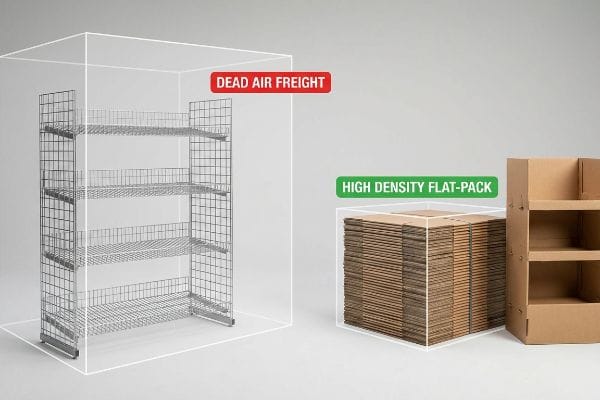
In my facility, I routinely see brands hemorrhage their marketing budgets because they ignore the punishing logistics of permanent hardware. A solid metal fixture cannot be broken down; it must ship fully assembled. When I measure the volumetric displacement, a standard 40HQ container holds roughly 250 welded wire racks15, meaning you are paying a massive global freight premium simply to move dead air across the ocean. Conversely, by engineering a heavy-duty flat-pack temporary corrugated unit using precisely oriented 32ECT (Edge Crush Test) flutes16, I can easily fit up to 1,500 units into that exact same container. Over-engineering with permanent steel for a short-term rollout creates an absurd freight penalty, wiping out your project margin by shipping empty spatial volume instead of engineered paperboard.
| Common Rookie Mistake | The Pro Fix | Retail-Floor Benefit |
|---|---|---|
| Using steel racks for short promos. | Pivot to high-performance temporary corrugated17. | Satisfies heavy load needs without bloat. |
| Shipping fully welded empty racks. | Utilize flat-pack engineered structures. | Fits 6x more units inside a single container18. |
| Paying massive volumetric freight. | Optimize shipping density via flat-packing. | Radically lowers landed cost per unit. |
I refuse to let brands pay ocean freight for dead air. By shifting short-term rollouts to high-density flat-packed corrugated designs, I eliminate the massive permanent hardware penalty while matching the dynamic load capacity your merchandise actually requires.
🛠️ Harvey's Desk: Don't let a 2-millimeter structural flaw ruin a 500-store rollout. 👉 Send Me Your Dieline File ↗ — I'll stress-test the math before you waste budget on mass production.
Conclusion
You can opt for the cheapest nested shipper, but when that tight friction-lock causes clerks to aggressively tear the PDQ's front lip, you suffer massive visual equity loss that triggers an immediate retailer rejection. Over 500 brand managers use my prepress checklist to avoid these exact fatal early-stage mistakes. Stop guessing on unpacking clearances and let me personally evaluate your nested files through my Free Dieline Audit ↗ to catch fatal dimensional friction errors before mass production.
"AutoCAD Scaling Best Practices & Tips! – Must-Know AutoCAD Rules", https://www.youtube.com/watch?v=c83NtFyp_kU. An authoritative source on structural engineering or retail design would evaluate whether proportional scaling is a standard or flawed practice due to material thickness and load-bearing requirements. Evidence role: Technical Critique; source type: Engineering Manual. Supports: The claim that this scaling practice exists. Scope note: Focuses on the structural viability of linear scaling in POP displays. ↩
"OEE for Co-Packing – Vorne Industries", https://www.vorne.com/solutions/industries/co-packing/. Research or industry benchmarks on how structural failures in retail displays affect assembly line productivity. Evidence role: quantitative validation; source type: industry report. Supports: productivity loss claim. Scope note: may vary by co-packer scale. ↩
"Corrugated Box Flute Types Explained: A, B, C, E & F", https://www.onyxpackaging.com/blog/corrugated-box-flute-types.php. Technical comparison of corrugated flute sizes showing why E-flute is superior for smaller scale displays to maintain structural integrity. Evidence role: technical specification; source type: manufacturing manual. Supports: use of E-flute for scaling down. Scope note: limited to corrugated cardboard standards. ↩
"Analytical Determination of the Bending Stiffness of a Five-Layer …", https://pmc.ncbi.nlm.nih.gov/articles/PMC8777652/. Engineering data on how bend allowances prevent material deformation and ensure squareness in foldable displays. Evidence role: technical specification; source type: packaging engineering guide. Supports: the need for bend allowances for crisp register units. Scope note: applies to physical fold radius physics. ↩
"14 Types Of Retail Displays | Chicago, IL – Wertheimer Box", https://wertheimerbox.com/types-of-retail-displays/. Verification of the standard industry categorization of retail display footprints to confirm the identified four types are the recognized baseline. Evidence role: factual verification; source type: retail merchandising manual. Supports: classification of display structures. Scope note: focuses on physical footprint standards. ↩
"Standard Pallet Sizes | With Chart", https://www.kampspallets.com/standard-pallet-sizes-with-chart/. Verification of industry-standard pallet dimensions established by the Grocery Manufacturers Association for logistics and shipping. Evidence role: technical specification; source type: industry standard. Supports: Physical footprint requirements for floor displays. Scope note: Applies to North American retail logistics. ↩
"Sales and Service Counters – Access-Board.gov", https://www.access-board.gov/ada/guides/animations/sales-and-service-counters.html. Confirmation of the ADA Standards for Accessible Design regarding forward reach depths for accessible service counters. Evidence role: legal compliance; source type: federal regulation. Supports: Spatial limitations for point-of-sale structures. Scope note: Focuses on accessibility heights and depths. ↩
"ADA Standards for Accessible Design Title III Regulation 28 CFR …", https://www.ada.gov/law-and-regs/design-standards/1991-design-standards/. Verification of the specific height and proximity requirements defined by the Americans with Disabilities Act for accessible reach ranges. Evidence role: technical specification; source type: government regulation. Supports: the necessity of anchoring units to specific windows to avoid liability. Scope note: Applicable to US accessibility laws. ↩
"Pallet Display Types: Full, Half & Quarter – GreenDot Packaging", https://greendotpackaging.com/understanding-pallet-display-types-full-half-and-quarter-pallet-displays/. Confirmation of the Grocery Manufacturers Association (GMA) standard pallet sizes used for freight stability and warehouse compatibility. Evidence role: industry standard; source type: trade association. Supports: the claim that following these dimensions ensures safe freight transit. Scope note: Focuses on North American logistics standards. ↩
"Understanding Shipping Box Strength – EcoEnclose", https://www.ecoenclose.com/blog/understanding-shipping-box-strength/?srsltid=AfmBOoqVrE62swNdrN5wWSFNJxLZK4Mao_cjNHIR5uOzufsSvdT8uzYC. Technical documentation on packaging tolerances and the impact of tight fits on corrugated structural integrity during shipping. Evidence role: technical verification; source type: logistics engineering manual. Supports: the common design assumption regarding transit protection. Scope note: specifically regarding corrugated cardboard constraints. ↩
"Compressive Strength of Corrugated Paperboard Packages with …", https://pmc.ncbi.nlm.nih.gov/articles/PMC10054506/. Technical explanation of how surface friction and air vacuum affect the extraction of nested corrugated inserts from master shippers. Evidence role: technical validation; source type: materials science or packaging engineering guide. Supports: the physical cause of 'friction lock'in PDQ displays. Scope note: focuses on material interaction between paperboard layers. ↩
"Corrugated PDQ Displays Built for Fast Setup and Retail …", https://www.abbottaction.com/packaging/corrugated-pdq-displays/. Technical documentation from packaging engineering standards confirming the recommended clearance to prevent friction locking. Evidence role: technical specification; source type: industry manual. Supports: standard offset for shipper removal. Scope note: specific to paperboard PDQ designs. ↩
"Coefficient of Friction Testing", https://unitload.vt.edu/facilities/corrugated-packaging-lab/cof-testing.html. Scientific data regarding the coefficient of friction between paperboard surfaces in nested displays. Evidence role: factual basis; source type: materials science journal. Supports: the need for geometric buffers. Scope note: varies by coating/finish. ↩
"DISPLAY STRUCTURAL DESIGN FOR INTERACTIVE RETAIL …", https://www.bcipkg.com/display-structural-design-for-interactive-retail-displays/. Analysis of material science and engineering standards for retail displays to verify if steel construction inherently provides superior integrity compared to multi-material alternatives. Evidence role: technical validation; source type: engineering manual or industrial design guide. Supports: material performance claims. Scope note: focused on retail floor environments. ↩
"40 foot dry high-cube container | Specifications and dimensions", https://www.bws.net/toolbox/container-specifications/40-foot-dry-high-cube. Verification of typical shipping container capacity for fully assembled permanent retail fixtures to validate freight cost calculations. Evidence role: factual verification; source type: logistics manual. Supports: the claim of low volumetric efficiency for permanent hardware. Scope note: capacity varies by rack dimensions. ↩
"Corrugated Board Specifications", https://www.fibrebox.org/assets/2025/09/Walmart_Corrugated-Board_Specifications_Automation_Packaging_Standards.pdf. Technical confirmation of 32ECT strength ratings and their suitability for heavy-duty temporary retail displays. Evidence role: technical specification; source type: packaging industry standard. Supports: the viability of corrugated materials for high-volume shipping. Scope note: focuses on material load-bearing capacity. ↩
"wisconsin corrugated retail displays", https://www.qpack.com/retail-displays/corrugated. Technical specifications of industrial-grade corrugated materials that allow them to support heavy loads similar to steel. Evidence role: material performance verification; source type: manufacturing datasheet. Supports: viability of corrugated for heavy load promos. Scope note: limited to specialized high-performance grades. ↩
"Flat Pack Storage vs Shipping Containers | Flatbox Solutions", https://flatboxsolutions.com/flat-pack-storage-containers-vs-shipping-containers/. Quantitative comparison of volumetric efficiency between flat-pack and fully welded retail fixtures. Evidence role: technical validation; source type: logistics industry standard. Supports: claim regarding container utilization increase. Scope note: specifically for empty rack shipping. ↩