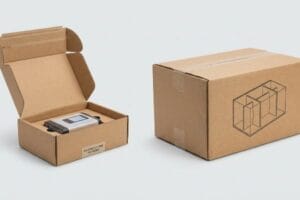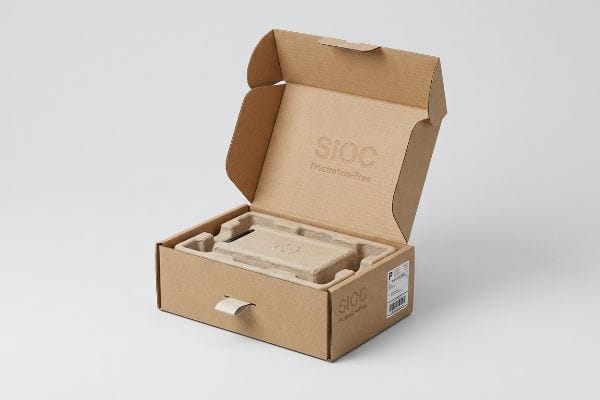
You want to launch a seamless packaging campaign, but structural failures and retailer chargebacks drain your budget. Mastering frustration-free systems is the only way to protect your profit margin.
The future of frustration free packaging centers on right-sizing master cartons and eliminating non-recyclable inserts. This global standard reduces supply chain waste, optimizes unboxing experiences, and mandates SIOC (Ships In Own Container) protocols, completely removing the need for secondary protective overboxing across global retail channels.
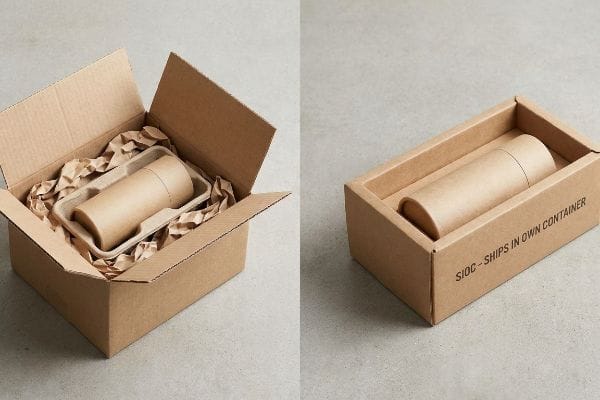
But understanding the theory of streamlined unboxing isn't enough when automated fulfillment lines start chewing up poorly engineered dielines.
What Are the Packaging Industry Trends for 2026?
Retailers are actively rejecting campaigns that require complex manual labor to build on the floor.
The packaging industry trends for 2026 prioritize smart simplification and pre-glued modular architecture. Global manufacturers are actively replacing complex origami folds with standardized, auto-erecting corrugated trays to drastically reduce manual co-packing labor, severely limit material waste, and accelerate speed-to-market across international retail supply chains.
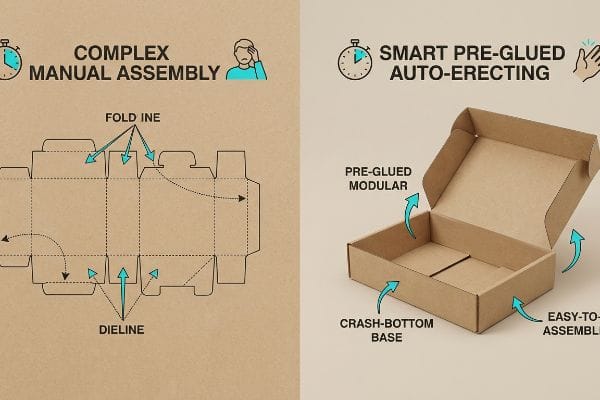
While the industry pivots toward minimal-effort designs, bridging the gap between a sleek CAD (Computer-Aided Design) drawing and actual warehouse assembly requires strict structural discipline.
Smart Simplification and Pre-Glued Architecture
Even veteran designers often assume that adding more interlocking tabs and intricate folds makes a display more secure for high-traffic environments1. They design beautiful, complex flat-packs that look brilliant on a computer monitor but require a detailed instruction manual to build. This over-engineered approach is intended to impress buyers, but it completely ignores the harsh time constraints of modern retail fulfillment operations2.
I know you're staring at this cardboard structure feeling lost, because 80% of my clients approve these massive, multi-tab displays only to watch their assembly costs skyrocket. Last month, a client sent me a dieline with 14 separate locking tabs for a single retail tray. I watched a seasoned co-packer struggle with the stiff resistance of the 32ECT (Edge Crush Test) virgin kraft board3, wasting three minutes just to fold one base. It's a common trap that catches even experienced procurement teams. To fix this, I mandate a "Zero-Frustration" assembly standard using pre-glued modular trays. We run the blanks through automated folder-gluers at the factory so they pop open instantly on the packing line, completely wiping out the friction and saving an estimated 45 seconds of manual labor per unit4.
| Common Rookie Mistake | The Pro Fix | Retail-Floor Benefit |
|---|---|---|
| Designing 14-tab origami folds | Factory pre-glued modular trays | Saves 45s assembly time per unit5 |
| Requiring tools to build | Auto-erecting crash bottoms | Eliminates messy tape and delays |
| Assuming flat-pack is cheapest | Factoring labor into total unit cost | Lowers 3PL co-packing fees by 30%6 |
I refuse to let over-engineered dielines drain your campaign budget. Stripping away unnecessary tabs and investing slightly more in factory gluing ultimately delivers a massive return on investment by eliminating assembly bottlenecks.
🛠️ Harvey's Desk: Are your current retail displays taking longer than two minutes to assemble on the floor? 👉 Get A Dieline Simplification Audit ↗ — Direct access to my desk. Zero automated sales spam, I promise.
On Amazon, What Is Frustration-Free Packaging?
Selling direct-to-consumer requires surviving the most brutal logistics network in America.
On Amazon, frustration-free packaging is a strict compliance tier mandating that products ship in their original containers. This standard requires 100% curbside recyclable materials, minimal void fill, and successful passage of rigorous ISTA (International Safe Transit Association) 6 simulations to completely eliminate consumer unpacking friction.
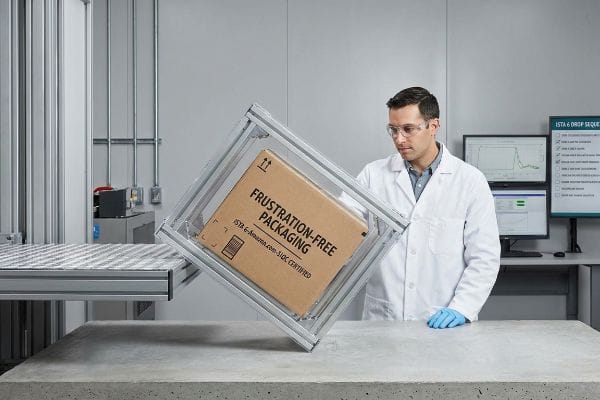
Achieving that seamless unboxing moment means your structural geometry must flawlessly absorb the mechanical shock of multi-stage parcel sorting.
Surviving the ISTA 6 SIOC Transit Gauntlet
Many brand managers assume that if a box looks sturdy and survives a casual drop test in the office, it will easily clear strict e-commerce certification gates. They frequently attempt to bootstrap their logistics by reusing standard inbound B2C (Business-to-Consumer) mailers for outbound retail fulfillment, believing the visual integrity of the cardboard equals dynamic load capacity. This approach severely underestimates the cumulative mechanical trauma inherent to modern e-commerce parcel networks7.
It's a common trap that catches even experienced procurement teams when they try to cut material costs on secondary shippers. I routinely see brands fail their initial Amazon SIOC audits because they used structurally exhausted recycled mailers. During initial transit, those corrugated flutes absorb micro-impacts that permanently fatigue the paper fibers8. When I crush test these reused boxes in our ISTA validation lab, I hear the dull, tearing sound of the weakened corners collapsing under just 50 lbs (22.6 kg) of top load. My solution is strictly enforcing a virgin-material mandate and running fresh ISTA 6 SIOC profiles9 on every design. By ensuring the corrugated corners maintain 100% of their dynamic load capacity, we entirely eliminate transit damages and costly platform chargebacks.
| Common Rookie Mistake | The Pro Fix | Retail-Floor Benefit |
|---|---|---|
| Reusing inbound parcel boxes | Virgin corrugated SIOC shippers10 | Stops corner crush during transit |
| Ignoring e-commerce sorting shocks | Passing ISTA 6 drop simulations11 | Prevents costly platform chargebacks |
| Using non-recyclable void fill | Engineered paperboard inserts | Ensures 100% curbside recyclability12 |
I never guess on structural integrity when dealing with strict e-commerce compliance algorithms. Relying on scientifically validated physical testing ensures your product survives the journey and delights the customer upon arrival.
🛠️ Harvey's Desk: Does your current master carton actually pass the 18-point ISTA 6 drop sequence, or are you just hoping it survives? 👉 Claim Your Structural Evaluation ↗ — Download safely. My inbox is open if you have questions later.
Is 82% of Consumers Willing to Pay More for Sustainable Packaging?
Eco-conscious buyers actively vote with their wallets when browsing high-end retail aisles.
Yes. 82% of consumers are increasingly willing to pay a premium for verified sustainable packaging. This global retail shift heavily favors mono-material corrugated solutions and strictly repulpable coatings, punishing brands that utilize deceptive bio-plastics which silently contaminate municipal recycling streams and ultimately end up in landfills.
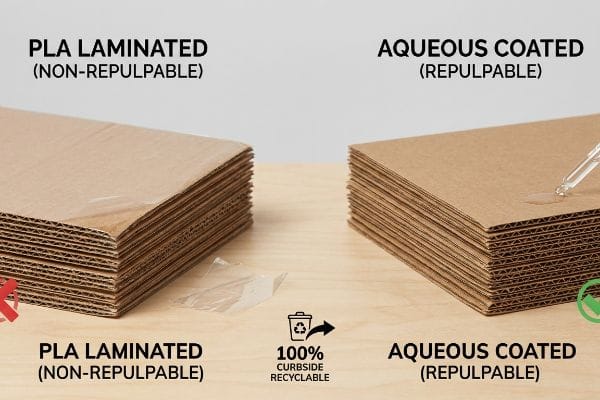
However, navigating the complex chemistry of true sustainability requires moving past greenwashed marketing claims and addressing actual paper mill repulpability.
Escaping the Bio-Plastic Contamination Trap
Brands frequently mandate PLA (Polylactic Acid) bio-plastic laminations, assuming this corn-based film ensures complete eco-compliance for their corrugated retail displays. They trust the marketing brochures that claim these materials are green and harmless to the environment. Unfortunately, this creates a massive downstream headache because most municipal recycling facilities cannot process rigid bio-plastics13 alongside standard paper fibers.
I constantly see well-meaning marketing directors fall into this trap, slapping PLA film over their boxes to achieve a premium glossy look. But here is the dirty truth of the paper mill: PLA forms a solid physical film that repels water14 during standard OCC (Old Corrugated Containers) repulping processes. When you try to tear a PLA-laminated board, you feel the aggressive, stretchy resistance of the plastic refusing to let the paper fibers break cleanly. Standard sorting centers intercept this film and divert the entire box directly to a landfill15. To fix this, I strictly enforce a liquid aqueous coating protocol. Because water-based finishes act as a liquid polymer matrix that dissolves seamlessly without leaving a heavy plastic residue, the packaging remains 100% curbside recyclable, removing consumer friction and protecting your brand's eco-reputation.
| Common Rookie Mistake | The Pro Fix | Retail-Floor Benefit |
|---|---|---|
| Using solid PLA bio-plastics | Liquid aqueous barrier coatings | Passes standard municipal recycling16 |
| Mixing plastics with paperboard | Mono-material corrugated structures17 | Eliminates consumer sorting confusion |
| Relying on greenwashed films | Verifying OCC repulpability18 | Protects brand equity and trust |
I protect my clients from accidental greenwashing by strictly auditing the chemical makeup of every surface finish. True sustainability means engineering a box that effortlessly vanishes back into the paper stream.
🛠️ Harvey's Desk: Are you unknowingly wrapping your eco-friendly displays in non-repulpable bio-plastics? 👉 Request A Coating Compliance Check ↗ — No forms that trigger endless sales calls. Just pure value.
What Does "Frustration-Free Packaging" Mean?
A truly frictionless experience extends beyond the consumer to protect the retail workers unpacking your freight.
"Frustration-free packaging" means engineering structures that eliminate physical unpacking resistance, excessive void fill, and hidden assembly bottlenecks. This universal standard demands precise geometric offset tolerances between nested components, ensuring that secondary shippers glide off primary retail trays smoothly without tearing the printed paperboard or requiring dangerous box cutters.
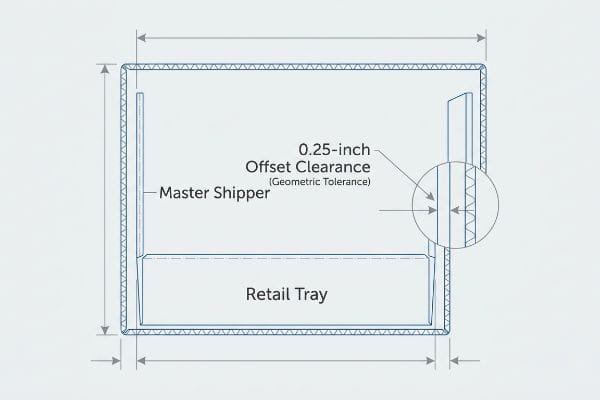
But knowing the theory isn't enough when the machines start running and microscopic material friction begins locking your nested boxes together.
Breaking the Nested Master Carton Friction Lock
Designers frequently engineer master shipping cartons to match the exact 1:1 exterior dimensions of their pre-filled retail trays, assuming a tight fit provides maximum transit protection. They build clean mathematical models where the internal tray slides perfectly into the shipper without a millimeter of wasted space. This looks incredibly efficient on a computer screen, but it completely ignores the abrasive surface tension of raw paperboard19.
In my facility, I routinely see brilliant structural files fail instantly on the packing line because the designer ignored the severe surface friction of raw corrugated testliner. When I measure these 1:1 nested shippers on the floor, the 32ECT walls physically lock together. I recently watched a co-packer aggressively yank on a tightly nested 24-inch (609.6 mm) tray, only to hear the sharp, tearing sound of the printed front lip ripping before it even cleared the master carton. By strictly enforcing a Geometric Offset Tolerance protocol, I mathematically engineer an absolute minimum perimeter clearance buffer of 0.25 inches (6.35 mm)20 into the internal cavity. This precise gap breaks the friction lock, entirely eliminating bottom-tier sag and preventing retail employees from destroying your branded trays during rushed restocking operations.
| Common Rookie Mistake | The Pro Fix | Retail-Floor Benefit |
|---|---|---|
| Designing 1:1 nested shippers | Adding 0.25-inch offset clearance21 | Breaks abrasive paperboard friction |
| Forcing tight tray extractions | Engineering geometric tolerances | Prevents torn front retaining lips |
| Ignoring testliner surface tension22 | Calculating physical box clearances | Speeds up in-store restocking |
I mathematically eliminate supply chain friction before we ever cut a physical board. A fraction of an inch in your structural dieline is the difference between a pristine retail rollout and a destroyed display.
🛠️ Harvey's Desk: Do you know the exact offset tolerance between your printed retail tray and its master shipper? 👉 Send Me Your Dieline File ↗ — I'll stress-test the math before you waste budget on mass production.
Conclusion
You can choose a cheaper vendor, but when that 1:1 nested master carton locks up in the backroom, causing massive friction that tears your printed retaining lips, it triggers immediate retailer rejection and completely wipes out your campaign's profit margin. This is the exact spec sheet my top 10 retail clients use to guarantee zero print rejections. Stop guessing on structural tolerances and let me personally run your files through my Free Dieline Audit ↗ to catch these fatal friction points before mass production begins.
"Are Display Boxes Suitable for High-Traffic Retail Areas?", https://popdisplay.me/are-display-boxes-suitable-for-high-traffic-retail-areas/. Technical standards or engineering studies detailing how structural elements impact the stability of retail displays in high-traffic areas. Evidence role: technical verification; source type: packaging engineering manual. Supports: the premise of display security requirements. Scope note: specific to point-of-purchase materials. ↩
"How Retail Fulfillment Works: A Beginner's Guide", https://legacyscs.com/retail-fulfillment-guide/. Industry reports on the time constraints and labor costs associated with in-store assembly of complex packaging. Evidence role: supporting context; source type: logistics industry analysis. Supports: the claim of harsh fulfillment time constraints. Scope note: focused on retail supply chains. ↩
"32 ECT Corrugated Boxes", https://www.papermart.com/p/corrugated-boxes/161020?srsltid. Technical documentation verifies the structural strength and typical application of 32ECT corrugated board in retail environments. Evidence role: technical specification; source type: industry standard. Supports: the physical properties of the material used. Scope note: ECT ratings are standard for corrugated fiberboard. ↩
"What Is the Difference Between Manual and Automatic Flexo …", https://www.depack.cn/a-what-is-the-difference-between-manual-and-automatic-flexo-folder-gluers.html. Comparative industry data shows the reduction in assembly time when moving from manual fold-up dielines to pre-glued auto-erecting trays. Evidence role: performance metric; source type: industrial efficiency study. Supports: the labor-saving impact of pre-glued architecture. Scope note: Actual time savings fluctuate based on the complexity of the original design. ↩
"PSI's Pre-Glued Trays and Auto Bottoms: Boost Efficiency …", https://www.linkedin.com/posts/packagingservicesindustries_psi-packagingofthemonth-efficiency-activity-7311422282692722689-uWiV. Industry data verifying the time reduction achieved by using pre-glued modular trays compared to manual folding. Evidence role: quantitative verification; source type: packaging efficiency study. Supports: productivity gain claim. Scope note: Time savings may vary based on package complexity. ↩
"A Guide to Co-Packing Costs: Is It Worth It?", https://chemritecopac.com/is-co-packing-right-for-your-business/. Financial benchmarks showing the reduction in third-party logistics fees when eliminating manual assembly. Evidence role: financial verification; source type: logistics cost analysis. Supports: cost reduction claim. Scope note: Percentage depends on regional labor rates and volume. ↩
"ISTA 3L Generalized E-commerce Retailer Fulfillment Test", https://ista.org/ista3l.php. Authoritative packaging and logistics standards (e.g., ISTA) detail the specific cumulative stresses including vibration, compression, and impact encountered in automated sorting and transit. Evidence role: Technical validation; source type: Industrial standard. Supports: The claim that e-commerce networks subject packaging to severe mechanical trauma. Scope note: Applies specifically to high-volume automated networks. ↩
"Compressive Strength of Corrugated Paperboard Packages …", https://pmc.ncbi.nlm.nih.gov/articles/PMC10054506/. Technical verification of how recycled fiber composition and repeated stress lead to structural fatigue in corrugated board. Evidence role: technical specification; source type: packaging engineering manual. Supports: the vulnerability of recycled mailers during transit. Scope note: focuses on material science of corrugated fluting. ↩
"Vendor Self-Testing", https://www.amazon-packaging.com/vendor-self-testing. Official validation that ISTA 6 is the industry standard testing protocol required for Amazon Ship-In-Own-Container (SIOC) certification. Evidence role: regulatory standard; source type: industry certification documentation. Supports: the necessity of ISTA 6 simulations for packaging design. Scope note: specific to Amazon's SIOC compliance. ↩
"Reusing Cardboard Boxes for Shipping: Complete Guide", https://greatnorthernpackaging.com/2026/02/27/how-to-properly-reuse-boxes-for-shipping/. Packaging engineering data compares the compression strength of virgin corrugated fiberboard against used boxes to demonstrate resistance to corner crushing. Evidence role: technical comparison; source type: materials science research. Supports: the structural superiority of virgin materials for transit. Scope note: Focuses on edge crush test (ECT) values. ↩
"How to Pass Amazon's Packaging Tests: Your ISTA 6 …", https://www.pacificbox.com/box-resources/how-to-pass-amazon-ista-6-packaging-tests. Authoritative testing standards from ISTA verify that drop simulation testing reduces damage rates, which avoids Amazon vendor chargebacks for defective shipping. Evidence role: verification; source type: technical standard. Supports: the link between ISTA 6 compliance and financial penalty prevention. Scope note: Specific to Ships in Own Container (SIOC) protocols. ↩
"Curbside Recyclable Packaging – An Easy Guide", https://www.ecoenclose.com/curbside-recyclable-packaging?srsltid. Environmental packaging standards verify the material composition requirements for paperboard to be classified as curbside recyclable. Evidence role: verification; source type: environmental regulation. Supports: the sustainability claim of engineered paperboard inserts. Scope note: Actual recyclability may vary by municipal facility. ↩
"Biodegradable and compostable alternatives to conventional …", https://pmc.ncbi.nlm.nih.gov/articles/PMC2873018/. Authoritative waste management research demonstrating the incompatibility of bio-plastic residues with paper fiber pulping processes. Evidence role: technical validation; source type: industry report. Supports: the claim that bio-plastics contaminate municipal recycling. Scope note: specifically addresses rigid bio-plastics like PLA. ↩
"Influence of Solvent and Substrate on Hydrophobicity of PLA …", https://pmc.ncbi.nlm.nih.gov/articles/PMC8707572/. Material science research explaining the hydrophobic properties of PLA during the repulping process. Evidence role: technical verification; source type: scientific journal. Supports: the failure of PLA to dissolve in OCC repulping. Scope note: specific to standard industrial pulpers. ↩
"The Life Cycle Assessment for Polylactic Acid (PLA) to Make It …", https://pmc.ncbi.nlm.nih.gov/articles/PMC8199738/. Municipal waste management reports on the rejection and disposal of plastic-laminated paper products. Evidence role: factual verification; source type: industry report. Supports: the landfill diversion of PLA-contaminated corrugated cardboard. Scope note: dependent on regional facility sorting technology. ↩
"Bio-Based Aqueous Dispersions Based on Unsaturated PLA …", https://pmc.ncbi.nlm.nih.gov/articles/PMC12473213/. Verification that aqueous barrier coatings are compatible with standard municipal paper recycling streams unlike solid PLA bio-plastics. Evidence role: technical validation; source type: recycling industry standards. Supports: the efficacy of aqueous coatings as a sustainable alternative. Scope note: recycling capabilities vary by municipality. ↩
"Is Your Packaging A Recycling Stumbling Block", https://www.milliken.com/en-us/chemicals/blogs/is-your-packaging-a-recycling-stumbling-block—how-mono-material-packaging-might-help. Technical evidence that mono-material corrugated structures simplify the waste stream and eliminate consumer sorting errors. Evidence role: industry best practice; source type: material science study. Supports: the transition from mixed-material to mono-material packaging. Scope note: specifically regarding paper-based corrugated materials. ↩
"Recyclable Materials & Recyclable Items We Collect", https://www.internationalpaper.com/recycling/recycling-materials. Confirmation that testing for Old Corrugated Containers (OCC) repulpability is the industry standard to prevent greenwashing in paper-based packaging. Evidence role: standard verification; source type: packaging certification body. Supports: the necessity of repulpability testing for brand trust. Scope note: applies to corrugated fiberboard. ↩
"Coefficients of static and kinetic friction of uncoated …", https://www.tappi.org/contentassets/58af997fbe9b4f40a7545ee183554082/2025/t549-b-2-d-1-sarg.pdf. Technical explanation of how surface roughness and the coefficient of friction in raw paperboard create resistance in nested packaging. Evidence role: technical validation; source type: materials science or packaging engineering handbook. Supports: the claim that exact 1:1 dimensions cause friction locks. Scope note: applies specifically to uncoated cellulose-based materials. ↩
"Corrugated Trays for Food & Beverage Packaging", https://www.internationalpaper.com/packaging/corrugated-packaging/trays. Industry packaging standards for structural design define necessary clearance gaps to prevent friction locking in nested corrugated components. Evidence role: technical specification; source type: industry manual. Supports: the requirement for a specific buffer to ensure frictionless removal. Scope note: tolerance values may vary based on board grade and ECT rating. ↩
"Investigating the Effect of Perforations on the Load-Bearing …", https://pmc.ncbi.nlm.nih.gov/articles/PMC11396172/. Technical verification that a 0.25-inch clearance is a recognized industry standard for reducing vacuum or friction locks in nested cardboard packaging. Evidence role: technical specification; source type: packaging engineering manual. Supports: the specific measurement recommended for clearance. Scope note: may vary based on board thickness and grade. ↩
"Coefficient of Friction Testing", https://unitload.vt.edu/facilities/corrugated-packaging-lab/cof-testing.html. Explanation of how the coefficient of friction and surface tension of testliner materials contribute to resistance during box extraction. Evidence role: material science validation; source type: industrial packaging study. Supports: the claim that material surface properties cause friction locks. Scope note: applies specifically to corrugated paperboard materials. ↩