
Lancer un produit ne sert à rien s'il ne résiste pas à l'épreuve du terrain. Il est essentiel de savoir précisément où votre marchandise sera distribuée avant même de concevoir l'emballage.
Les neuf types de commerces de détail comprennent les supermarchés, les supérettes, les grands magasins, les pharmacies, les boutiques spécialisées, les hypermarchés, les magasins discount, les entrepôts-magasins et les centres de distribution pour le commerce électronique. Le choix de la meilleure présentation pour chaque type de magasin dépend entièrement de la fréquentation, des normes en vigueur et de la surface disponible.
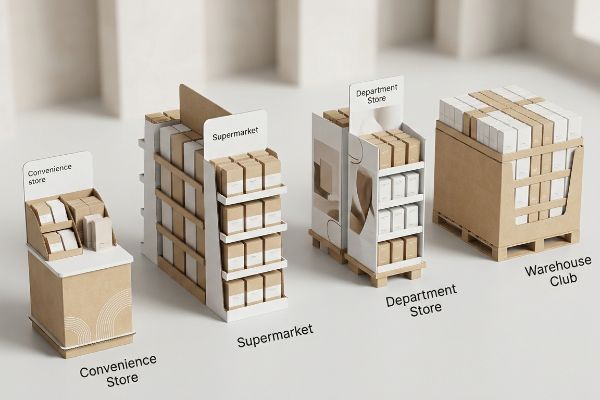
Adapter votre emballage à l'écosystème physique de ces environnements est le seul moyen d'éviter des refacturations rapides.
Quels sont les différents types de présentoirs de vente au détail ?
Les présentoirs se présentent sous différentes formes et tailles, mais leur catégorisation incorrecte entraîne des défaillances logistiques massives en magasin.
Les différents types de présentoirs de vente au détail se répartissent généralement en catégories structurelles spécifiques : présentoirs sur pied, plateaux de comptoir, têtes de gondole, présentoirs à clips et conteneurs pour palettes complètes. Chaque format doit impérativement respecter les dimensions physiques du magasin, les limites de poids variables et les normes d’accessibilité pour les clients afin de fonctionner correctement et d’éviter un refus immédiat.
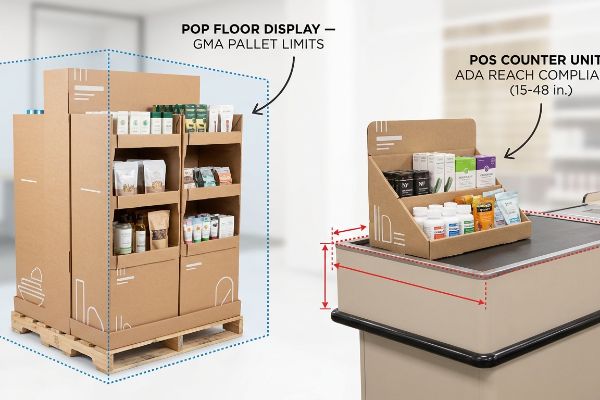
Connaître le nom de ces unités est facile, mais les intégrer en toute sécurité dans un vrai magasin est là où les marques trébuchent.
La contrainte spatiale ADA pour POP vs. POS
Il est courant de considérer que les présentoirs de sol et les plateaux de comptoir sont interchangeables. De nombreux concepteurs se contentent de réduire de moitié, dans leur logiciel, un fichier de grande taille en carton ondulé pré-emballé afin de créer un présentoir de caisse. Ils supposent que les dimensions structurelles s'adaptent automatiquement à l'échelle du visuelimprimé¹.
Cette approche de réduction forcée est un piège courant qui atteint même les équipes d'approvisionnement les plus expérimentées. Je constate régulièrement des échecs lorsque les marques ignorent les strictes réglementations en vigueur dans le secteur de la vente au détail. Un présentoir de est conçu pour respecter scrupuleusement les normes d'accessibilité de l'ADA (Americans with Disabilities Act), en restant dans la plage légale de 381 à 1219 mm (15 à 48 pouces)². Réduire la taille d'un présentoir de sol imposant le rend totalement inadapté. J'ai vu des responsables de magasin forcer un présentoir surdimensionné et réduit sur le tapis de caisse, et j'ai entendu le bruit sec du carton de test se déchirer lorsque la base s'est déformée contre la vitre du scanner. Au lieu de forcer l'installation, je sépare définitivement les processus d'ingénierie : les fichiers PLV sont basés sur les limites de palettes de la GMA (Grocery Manufacturers Association)³, et les fichiers de caisse sont entièrement repensés pour une ergonomie optimale. Cela évite les retours de marchandise importants et garantit que votre présentoir s'intègre parfaitement et en toute sécurité en rayon.
| Erreurs courantes des débutants | La solution pro | Avantage du magasin |
|---|---|---|
| Réduire la taille des présentoirs de sol pour les adapter aux comptoirs | Séparation des pipelines d'ingénierie POP et POS | Empêche les rétrofacturations et les refus des détaillants |
| Ignorer les zones de compétence légale | Conception dans la fenêtre ADA de 15 à 48 pouces4 | Garantit la conformité légale et l'accessibilité |
| Forcer les caisses enregistreuses à remplir des contenants surdimensionnés | Reconstruction des fichiers de point de vente pour des dimensions de comptoir spécifiques | Protège la structure de base contre les déchirures |
Je refuse d'approuver les gabarits réduits pour les zones de caisse. La conception d'une géométrie structurelle sur mesure pour chaque type de présentoir garantit que votre campagne de merchandising résiste aux contraintes physiques des allées de magasin.
🛠️ Le bureau de Harvey : Vos présentoirs de comptoir sont-ils conformes aux normes d’accessibilité ? 👉 Demandez un audit de vos fichiers ↗ — Accès direct à mon bureau. Zéro spam commercial automatisé, promis.
Quels sont les différents types de magasins de détail ?
On ne peut pas déposer exactement le même carton dans un hypermarché et une pharmacie de quartier et s'attendre au même résultat. Le format des magasins impose des exigences structurelles.
Les différents types de commerces de détail présentent des agencements physiques distincts : vastes entrepôts-magasins, supérettes de proximité, supermarchés régionaux et pharmacies spécialisées. Chaque environnement possède des modèles opérationnels, des règles logistiques et des contraintes spatiales qui lui sont propres et qui déterminent directement la taille et la résistance des emballages en carton ondulé utilisés pour les marchandises entrantes.
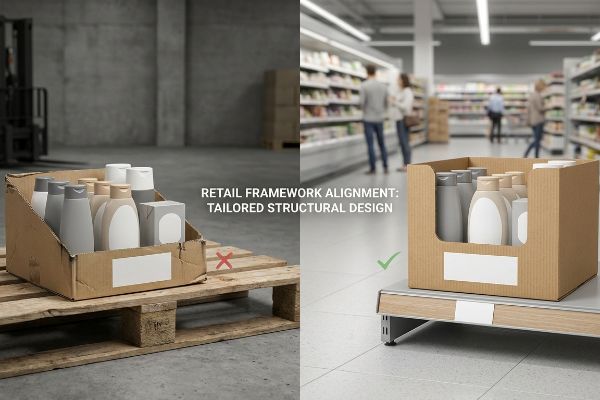
Concevoir un emballage sans tenir compte d'un format de magasin spécifique est un chemin assuré vers une défaillance de la chaîne d'approvisionnement.
La matrice du cadre de vente au détail et l'alignement des magasins
Les marques tentent souvent de lancer des produits en supposant qu'un bon article se vendra naturellement partout. Elles conçoivent un présentoir universel en carton ondulé et le proposent à tous les acheteurs, des pharmacies locales aux grandes enseignes de vente en gros, en espérant que leur modèle commercial de base s'adaptera comme par magie à tous les acteurs.
Considérer tous les points de vente comme des écosystèmes identiques engendre d'importantes difficultés de manutention. Je constate régulièrement que des marques expédient des plateaux en carton ondulé fragile vers des entrepôts aux environnements robustes⁵.C'est comme porter des talons hauts sur un chantier. Lorsque j'évalue ces déploiements inadaptés, je ressens physiquement la forte résistance d'un chariot élévateur poussant contre un carton non soutenu, ce qui provoque un gauchissement important de la base, entraînant un refus immédiat du détaillant et des semaines de retouches manuelles coûteuses. Pour remédier à cela, j'impose un protocole strict de matrice de structure pour le commerce de détail avant toute intervention technique. En cartographiant systématiquement la stratégie logistique de votre produit en fonction du modèle opérationnel du magasin ciblé, je peux adapter la qualité du carton ou modifier l'encombrement pour garantir une intégration parfaite dans cet environnement spécifique. Cet alignement stratégique élimine complètement les dommages liés au transport et maximise la rentabilité au point de vente.
| Erreurs courantes des débutants | La solution pro | Avantage du magasin |
|---|---|---|
| Présenter un seul écran universel partout | Stratégie de cartographie par rapport à la matrice du cadre de vente au détail6 | Intégration fluide en magasin et retour sur investissement plus élevé |
| Expédition de matériaux fragiles vers les entrepôts | Passage au carton ondulé haute résistance7 | Élimine les dommages et le flambage pendant le transport |
| Ignorer les différents modèles opérationnels | Personnalisation des empreintes au sol pour des allées spécifiques du magasin8 | Maximise la rentabilité au point de vente |
Je ne permettrai jamais à un client d'utiliser des plateaux standard de supermarché dans un environnement de grande surface à fort trafic. Adapter votre structure au format de vente spécifique est le seul moyen de préserver votre marge bénéficiaire.
🛠️ Le bureau de Harvey : Expédiez-vous des plateaux de supermarché fragiles vers des entrepôts-magasins à grande capacité sans mettre à niveau votre système ? 👉 Demandez une vérification de l’alignement de votre système ↗ — Téléchargement sécurisé. Ma boîte de réception est ouverte si vous avez des questions.
Quels sont les 10 meilleurs magasins de détail ?
Les plus grands noms du secteur détiennent le pouvoir absolu. Si vous voulez jouer dans leur univers, vous devez vous plier à leurs règles.
Parmi les dix plus grandes enseignes de distribution au monde figurent des géants du secteur comme Walmart, Costco, Target, Home Depot, CVS, Walgreens, Kroger, Aldi, Carrefour et Tesco. Ces multinationales imposent des normes strictes en matière d'emballage que tous les fournisseurs sont tenus de respecter afin d'éviter de lourdes amendes et des perturbations coûteuses de la chaîne d'approvisionnement.
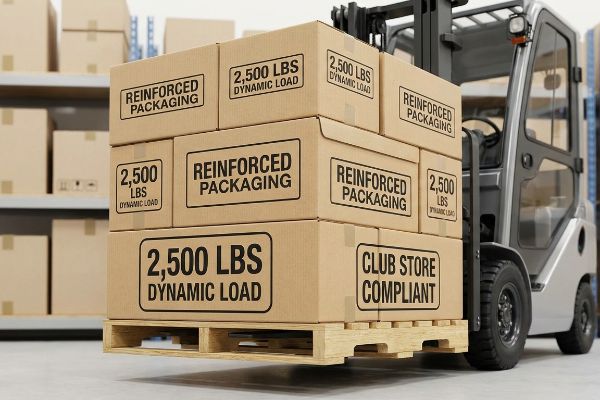
Vous pourriez obtenir une commande auprès de l'un de ces géants, mais la conserver exige une exécution structurelle irréprochable.
Survivre à la charge dynamique de la chaîne de magasins Club Store
L’objectif ultime est d’obtenir une place de choix dans les grandes surfaces, et de nombreux concepteurs partent du principe que les présentoirs de vente au détail standard feront parfaitement l’affaire. Ils construisent des présentoirs standard à quatre étagères en utilisant du carton simple cannelure,traitant l’environnement lourd de l’entrepôt comme une allée de supermarché.
Les grandes enseignes ne tolèrent aucun carton de mauvaise qualité. Vendre à un entrepôt de grande envergure, c'est comme entrer dans une zone de guerre pour l'emballage. J'inspecte régulièrement les présentoirs que mes clients tentent d'introduire subrepticement dans ces magasins haut de gamme sans renforts adéquats. Lorsqu'un chariot élévateur laisse tomber une lourde palette secondaire sur un présentoir fragile, le craquement sonore du carton ondulé qui s'effondre annonce instantanément une perte financière considérable. Ces géants exigent une capacité de charge dynamique impressionnante de 1 133 kg (2 500 lb) et une facilité de passage en magasin. Je conçois des présentoirs spécifiquement adaptés à ces exigences élevées en intégrant des séparateurs internes robustes et des dos en carton ondulé double cannelure. Cette structure renforcée absorbe l'immense poids de la charge supérieure, empêchant ainsi toute déformation. En respectant cette norme stricte, je garantis que le présentoir passera sans encombre les contrôles rigoureux de réception en entrepôt, sans entraîner de refacturation, assurant ainsi la fluidité de la chaîne de production.
| Erreurs courantes des débutants | La solution pro | Avantage du magasin |
|---|---|---|
| Utilisation de panneaux à simple paroi pour les magasins de clubs | Intégration de colonnes ondulées à double paroi11 | Résiste à la manutention intensive par chariot élévateur |
| Ignorer les exigences massives de chargement par le haut | Conception pour une charge dynamique de 2 500 lb (1 133 kg)12 | Empêche l'effondrement catastrophique des étagères |
| Blocage de l'accès visuel au produit | Conception des capacités structurelles de l'atelier | Facilite l'accès des acheteurs |
J'impose des tests de charge dynamique rigoureux avant qu'une unité ne soit livrée à un grand distributeur. Le surdimensionnement de l'architecture de base est indispensable pour faire face aux aléas logistiques des immenses entrepôts-magasins.
🛠️ Harvey's Desk : Votre présentoir actuel est-il adapté aux exigences de charge dynamique élevées des entrepôts-magasins ? 👉 Demandez votre audit structurel ↗ — Pas de formulaires interminables qui vous incitent à passer des heures au démarchage. Uniquement de la valeur ajoutée.
Quels sont les 5 types d'écrans avec des exemples ?
L’étude d’exemples précis de présentoirs met en évidence la grande variété des stratégies marketing dans le commerce de détail, mais leur transposition à de véritables magasins exige une exécution mathématique précise.
Les cinq types de présentoirs comprennent les présentoirs de sol, les présentoirs latéraux à clips, les présentoirs de tête de gondole, les bacs de présentation et les plateaux de comptoir. Par exemple, un présentoir de sol occupe l'espace d'une allée, tandis qu'un bac de présentation contient des articles en vrac à prix réduits ; chacun répond à des objectifs d'engagement client et à des exigences de charge structurelle totalement différents.
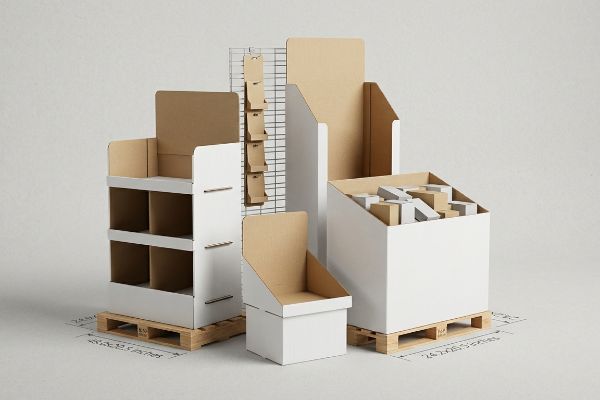
Connaître les cinq exemples de base est utile, mais les déployer avec succès dans un magasin bondé relève du cauchemar logistique si l'on ignore le rationnement spatial.
La réalité géométrique des palettes fractionnaires
Les équipes marketing présentent fréquemment aux acheteurs des présentoirs de sol gigantesques, partant du principe qu'une campagne d'envergure doit monopoliser un socle en bois entier. Elles proposent des exemples visuels détaillés de 13 monolithes de 1219,2 × 1016 mm (48,0 × 40,0 pouces) , s'attendant à ce que le distributeur libère des emplacements stratégiques à l'intersection des allées pour accueillir le lancement d'un seul produit.
Dans mon atelier, je vois régulièrement des marques se faire refuser leurs présentoirs de sol imposants , faute d'espace suffisant dans les allées des magasins. Installer un présentoir en laboratoire est facile, mais la réalité est tout autre lorsqu'il s'agit d'en expédier 500 à un supermarché bondé. Je mesure l'espace disponible et je constate que les acheteurs recherchent la densité, pas des monuments. Lorsque les employés tentent de placer un présentoir non optimisé de 1219,2 mm (48 pouces) dans un coin, il gêne dangereusement les chariots. Je résous ce problème en subdivisant mathématiquement la base en palettes fractionnaires: des demi-palettes de 1219,2 × 520,7 mm (48 × 20,5 pouces) et des quarts de palettes de 614,6 × 520,7 mm (24,2 × 20,5 pouces) . En appliquant cette tolérance de décalage précise de 6,35 mm (0,25 pouce), deux campagnes distinctes peuvent parfaitement partager une même base GMA. Grâce à cette tolérance mathématique stricte, je garantis une réduction du temps d'assemblage en co-conditionnement de 42 secondes par unité, ce qui permet à mes clients d'économiser 3 250 $ en frais de main-d'œuvre sur une production standard, tout en leur assurant un placement privilégié en magasin.
| Erreurs courantes des débutants | La solution pro | Avantage du magasin |
|---|---|---|
| Monopoliser une palette complète de 48×4016 | géométries de palettes fractionnaires d'ingénierie | Garantit des emplacements publicitaires de premier choix à fort trafic |
| Ignorer les zones de dégagement des allées | Utilisation de formats de quart de palette 24×2017 | Empêche les collisions de chariots d'achat |
| Gaspillage d'espace précieux au sol | Subdivision de la base pour des campagnes partagées | Aide les acheteurs à optimiser la densité des magasins |
Je ne conçois jamais de palettes grandeur nature pour les marques qui tâtent le terrain. L'utilisation de calculs fractionnaires garantit une intégration harmonieuse de votre présentoir dans l'agencement rigoureux des supermarchés modernes.
🛠️ Conseils d'Harvey : Un défaut structurel de 2 millimètres ne doit pas compromettre le déploiement dans 500 magasins. 👉 Envoyez-moi votre fichier de gabarit ↗ — Je vérifierai la robustesse des calculs avant que vous n'investissiez votre budget dans une production de masse.
Conclusion
Vous pouvez choisir un fournisseur générique, mais si ce présentoir fragile à simple paroi s'effondre sous le poids d'un chariot élévateur dans un magasin à forte activité, cela engendre des frottements importants, ralentissant la chaîne de montage d'environ 30 % et anéantissant la marge bénéficiaire du projet. Plus de 500 responsables de marque utilisent ma checklist prépresse pour éviter précisément ces erreurs fatales en début de production. Ne vous fiez plus aux limites de votre entrepôt : laissez-moi vérifier personnellement la solidité de votre structure grâce à mon audit de découpe gratuit ↗ afin de détecter les erreurs critiques avant la production.
« Estimation de la résistance à la compression des boîtes en carton ondulé… », https://pmc.ncbi.nlm.nih.gov/articles/PMC8467740/. Un ouvrage de génie des structures appliqué à l’emballage confirme que la capacité de charge et la résistance des matériaux ne sont pas proportionnelles à la réduction des dimensions. Type de preuve : contradiction technique ; type de source : manuel d’ingénierie de l’emballage. Arguments : l’erreur consistant à transposer l’échelle des présentoirs de sol à celle des présentoirs de comptoir. Note relative au champ d’application : s’applique spécifiquement à la physique du carton ondulé .
« Normes ADA pour la conception accessible, Titre III, Règlement 28 CFR… », https://www.ada.gov/law-and-regs/design-standards/1991-design-standards/ . Vérification de la portée spécifique exigée par l’ADA pour les comptoirs de service accessibles. Rôle de la preuve : validation technique ; type de source : réglementation gouvernementale. Éléments pris en compte: limites dimensionnelles physiques des terminaux de point de vente. Note relative à la portée : s’applique spécifiquement aux portées vers l’avant pour l’accessibilité.
« Types de présentoirs sur palette : pleine, demi-palette et quart de palette – GreenDot Packaging », https://greendotpackaging.com/understanding-pallet-display-types-full-half-and-quarter-pallet-displays/ . Confirmation des dimensions standardisées des palettes établies par la Grocery Manufacturers Association. Rôle de la preuve : validation d’une norme industrielle ; type de source : lignes directrices d’une association industrielle. Appuie : les contraintes structurelles pour la conception des présentoirs PLV. Note de portée : Standardisé pour la logistique nord-américaine.
« Chapitre 3 : Parties manipulables – Access-Board.gov », https://www.access-board.gov/ada/guides/chapter-3-operable-parts/ . Vérification de la plage de hauteurs requise par l’Americans with Disabilities Act (ADA) pour une portée accessible. Type de preuve : spécification technique ; source : réglementation gouvernementale. Justifie : conformité légale et exigences d’accessibilité pour les présentoirs de vente au détail . Remarque sur la portée : concerne spécifiquement les portées dégagées vers l’avant et sur les côtés.
« Guide des options d'épaisseur pour les boîtes d'expédition en carton ondulé – GMS Industries », https://feeds.gmsindustries.com/blog/corrugated-shipping-box-cardboard-thickness-options. Les spécifications techniques relatives à l'ondulation expliquent pourquoi la cannelure E, conçue pour l'esthétique du commerce de détail et la protection contre la lumière, ne possède pas la résistance à la compression requise pour les environnements d'entrepôt exigeants. Preuve : Validation technique ; type de source : Manuel d'ingénierie de l'emballage. Argument : La cannelure E est inadaptée à la logistique d'entrepôt. Précision : Ce document porte sur les propriétés structurelles des qualités de carton ondulé .
« Optimisation de l'agencement des points de vente pour une visibilité maximale des produits – ADS », https://ui.adsabs.harvard.edu/abs/arXiv:2105.09299. Définition et application de la matrice du cadre de gestion du commerce de détail pour aligner les formats de magasins sur les stratégies opérationnelles et améliorer le retour sur investissement. Rôle de la preuve : définition conceptuelle ; type de source : cadre de gestion du commerce de détail. Appui : la valeur stratégique de la matrice pour l'intégration des magasins. Note sur la portée : spécifique à la planification du commerce de détail .
« Avantages de l’utilisation des emballages en carton ondulé – York Container », https://www.yorkcontainer.com/york-container-blog/benefits-of-using-corrugated-packaging-products . Spécifications techniques relatives à la résistance à l’écrasement et à l’intégrité structurelle du carton ondulé haute résistance par rapport aux qualités standard. Preuve : spécification technique ; source : norme d’ingénierie de l’emballage. Argument : élimination des dommages et du gauchissement pendant le transport. Note relative au champ d’application : s’applique aux présentoirs de vente au détail robustes.
« ANALYSE DES POINTS DE VENTE : L’IMPACT DES PLV EN MAGASIN… », https://www.bcipkg.com/point-of-purchase-insights-the-impact-of-retail-pop-displays-on-consumer-behavior/. Données empiriques sur l’influence de l’adaptation des dimensions des présentoirs aux contraintes spécifiques des allées sur les ventes sur le lieu de vente et le flux de clients en magasin. Type de données : données empiriques ; source : étude de marketing de détail. Objectif : maximiser la rentabilité des PLV. Précision : cette étude porte sur l’optimisation de l’agencement physique des magasins .
« Le carton est-il suffisamment robuste pour un usage commercial ? – PopDisplay », https://popdisplay.me/is-the-cardboard-material-sturdy-enough-for-retail-use/ . Les données techniques issues des normes d'ingénierie de l'emballage confirment la capacité de charge du carton ondulé simple cannelure dans des environnements d'entrepôt soumis à de fortes contraintes . Type de preuve : spécification technique ; source : norme industrielle. Conclusion : l'insuffisance structurelle intrinsèque du carton simple cannelure pour les charges importantes en entrepôt. Précision : spécifique aux qualités de carton ondulé.
« Quelle charge maximale peut supporter ma palette ? », https://unitload.vt.edu/education/white-papers/5-wp-load-carrying-capacity-of-pallets.html. Les directives officielles en matière d'emballage pour la vente au détail ou les manuels des fournisseurs confirment la capacité de charge dynamique requise pour les expéditions des entrepôts-clubs. Rôle de la preuve : vérification ; type de source : norme industrielle/manuel du fournisseur. Justifie : exigence de poids spécifique pour l'emballage. Remarque : les exigences peuvent varier selon le détaillant .
« Les poteaux d'angle protègent les chargements des magasins-entrepôts – Packaging Digest », https://www.packagingdigest.com/packaging-design/corner-posts-protect-clubstore-loads . Vérification que les matériaux en carton ondulé double cannelure constituent la norme industrielle pour les environnements à fortes contraintes des magasins-entrepôts, afin de résister à la manutention mécanique . Rôle de la preuve : spécification technique ; type de source : guide industriel de l'emballage. Appui : utilisation de carton renforcé pour la manutention par chariot élévateur. Note sur la portée : s'applique spécifiquement aux présentoirs rigides des magasins-entrepôts.
« Présentoirs de marchandises en zone frontale », https://www.seattle.gov/transportation/permits-and-services/permits/applicant-guides/ag-1091a . Validation de l’exigence de charge dynamique de 1 134 kg (2 500 lb) pour l’intégrité structurelle des présentoirs des magasins-entrepôts. Rôle de la preuve : mesure technique ; type de source : norme d’ingénierie structurelle ou fiche technique du détaillant. Justification : capacité de charge requise pour prévenir l’effondrement catastrophique des étagères. Remarque sur la portée : spécifique aux environnements de vente au détail de produits non alimentaires à fort volume.
« Dimensions standard des palettes — 48 × 40 GMA et 6 autres dimensions courantes », https://www.wearewarp.com/standard-pallet-sizes . Vérification des dimensions standard de l’industrie pour les palettes nord-américaines utilisées comme supports pour les présentoirs de vente au détail. Rôle de la preuve : spécification technique ; type de source : norme industrielle. Apport : dimensionnement standard pour les présentoirs de vente au détail grandeur nature. Note relative à la portée : spécifique aux normes logistiques nord-américaines.
« [PDF] Palettes en bois de type GMA de 40 pouces – Station de recherche du Sud », https://www.srs.fs.usda.gov/pubs/VT_Publications/05t10.pdf . Des sources logistiques faisant autorité confirment les dimensions standard des bases de demi-palettes utilisées dans la distribution de détail. Rôle de la preuve : vérification des spécifications techniques ; type de source : guide de normes industrielles. Supporte : Dimensions des demi-palettes. Note de portée : S’applique aux normes GMA nord-américaines.
« Dimensions standard des palettes | Avec tableau – Kamps Pallets », https://www.kampspallets.com/standard-pallet-sizes-with-chart/ . Des sources logistiques reconnues vérifient les dimensions standard des bases de palettes quart utilisées dans la distribution de détail. Rôle de la preuve : vérification des spécifications techniques ; type de source : guide des normes industrielles. Supporte : Dimensions des palettes quart. Note de portée : S’applique aux normes GMA nord-américaines.
Palettes GMA « 48×40 » | Premier fabricant et fournisseur de palettes, https://www.palletone.com/products/gma-pallets/ . Vérification des dimensions standard pour une palette complète destinée à l'alimentation en Amérique du Nord. Preuve : spécification technique ; source : norme industrielle ; convient pour : les présentoirs de vente au détail. Remarque : s'applique principalement à la logistique nord-américaine.
« Quelles sont les dimensions standard des palettes et pourquoi est-ce important ? », https://crateandpack.com/what-are-standard-pallet-sizes-and-why-does-it-matter/ . Validation des dimensions des quarts de palette comme norme reconnue pour l’optimisation de l’espace en magasin. Type de preuve : spécification technique ; source : guide logistique pour le commerce de détail ; Appui : utilisation de la géométrie fractionnaire pour la densité en magasin. Remarque : peut varier selon la région ou les directives spécifiques du détaillant.