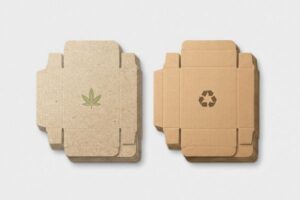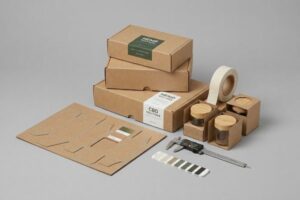
Choosing the right substrate for beauty products isn't just about aesthetics; it is about surviving harsh retail environments while maintaining a flawless brand image on the floor.
Cosmetics display stands are primarily made from corrugated cardboard and paperboard, serving as the mainstream choice for retail rollouts. Additional premium materials often include SBS (Solid Bleached Sulfate) board for high-end graphics, while internal structures utilize E-flute to prevent visual warping under heavy beauty products.

But knowing the theoretical material list is only the first step before your design hits the actual manufacturing line.
What are display cases made of?
Walk into any major US retailer, and you will see countless temporary marketing vessels holding up heavy merchandise.
Display cases are made of highly engineered corrugated testliner and virgin kraft paper. These substrates form the structural foundation, utilizing fluted paper sandwiched between flat linerboards to achieve incredible vertical compression strength while remaining lightweight for nationwide logistics.
Understanding the base paper is simple, but selecting the exact grade dictates whether your campaign stands tall or collapses.
Navigating Virgin Kraft vs. Recycled Testliner
Most brand managers assume all brown cardboard acts exactly the same under pressure. They simply request standard recycled board to check a sustainability box and keep material costs as low as possible. In a controlled office environment, a small white sample made from standard recycled fibers feels perfectly rigid and ready for a national rollout.
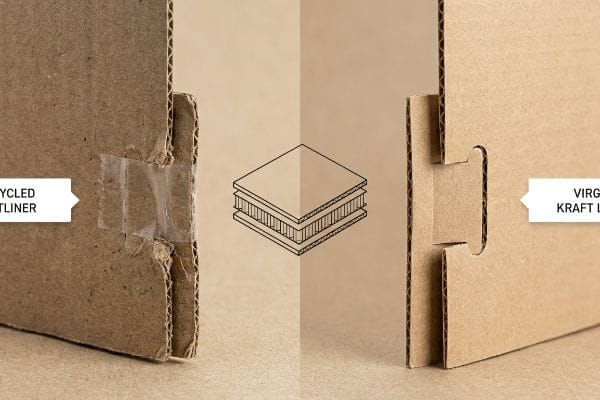
I see this trap constantly when veteran buyers try to put heavy cosmetic glass jars on cheap recycled testliner. The recycled fibers are naturally shorter and weaker1. When you fold a display base out of standard recycled board, you can physically feel the mushy resistance instead of a crisp, sharp snap. I once watched a co-packing team try to assemble bases made of weak recycled board; the tabs just mushed and tore, forcing them to use clear packing tape to hold the walls together. Always spec virgin kraft liner for the load-bearing outer walls of your cosmetic bases, as the longer raw paper fibers drastically increase your compression strength2 and prevent the base from buckling in humid warehouses, effectively stopping costly retailer chargebacks.
| Common Rookie Mistake | The Pro Fix | Retail-Floor Benefit |
|---|---|---|
| Specifying 100% recycled board | Use virgin kraft for outer walls | Prevents bottom buckling |
| Ignoring warehouse humidity | Add virgin fiber moisture resistance | Stops mushy tab tearing |
| Taping broken base tabs | Engineer crisp structural locks | Saves 30s co-packing time |
I never let a heavy cosmetics rollout rely entirely on recycled fibers for the load-bearing structure. Upgrading to a virgin kraft outer layer ensures the structural integrity survives the entire retail lifecycle without awkward tape fixes.
🛠️ Harvey's Desk: Not sure if your current cardboard spec can handle heavy glass cosmetic jars? 👉 Request a Material Audit ↗ — Direct access to my desk. Zero automated sales spam, I promise.
Which elements does a display stand usually consist of?
A successful merchandiser is essentially a modular architecture project built entirely out of folded paperboard.
A display stand usually consists of a load-bearing base, vertical side panels, product-holding shelves, structural dividers, and a branded header card. These interconnected elements work as a cohesive system to distribute weight evenly while maximizing product visibility in high-traffic retail aisles.
While the outer branding catches the eye, the invisible internal elements do all the heavy lifting.
The Hidden Physics of Cosmetic Shelves
When designers lay out a multi-tiered floor unit, they usually focus entirely on the graphical artwork wrapping the exterior. They assume a standard folded shelf lip will naturally support multiple rows of heavy 20 lbs (9.07 kg) liquid foundations. On a digital 3D rendering, those shelves look perfectly straight and strong.
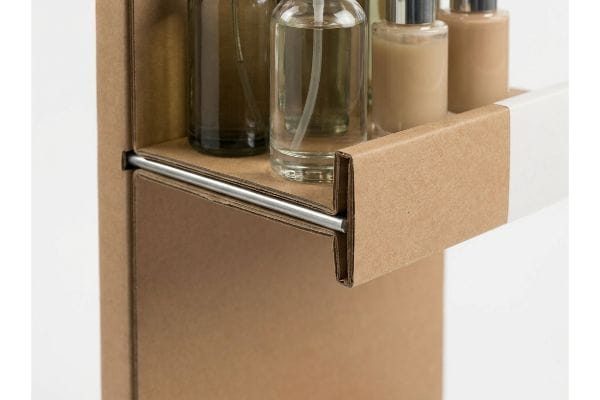
Clients frequently ask me why their shelves bow downward after just a week in the store. The truth is, dense beauty products concentrate massive parasitic weight in the center of the shelf. If you just fold a piece of cardboard over, the center will eventually sag, and you will hear the faint creak of paper fibers giving up under the constant load. To fix this tier sag, you must integrate a hidden metal support bar—usually thin steel tubing—directly beneath the front lip of the corrugated shelf. This invisible element transfers the dynamic weight to the vertical side panels, keeping your cosmetic rows perfectly level and eliminating the sloppy presentation that ruins premium brand equity.
| Common Rookie Mistake | The Pro Fix | Retail-Floor Benefit |
|---|---|---|
| Relying on standard paper lips | Hide steel tubing under the shelf3 | Prevents ugly shelf sag |
| Overloading center panels | Transfer weight to vertical sides4 | Keeps products perfectly level |
| Ignoring dense liquid weight | Calculate dynamic load per tier5 | Eliminates stock tipping |
I always reinforce wide cosmetic shelves with hidden structural supports because gravity never takes a day off. A straight, rigid shelf communicates high-end brand value far better than a sagging piece of cardboard.
🛠️ Harvey's Desk: Worried your dense beauty liquids will cause an embarrassing shelf collapse in the store? 👉 Get a Structural Review ↗ — Download safely. My inbox is open if you have questions later.
Which material is used for makeup?
Beauty shoppers expect a premium tactile experience, meaning your physical merchandiser must reflect the luxury of the product itself.
The material used for makeup displays is predominantly E-flute corrugated board combined with a litho-laminated SBS top sheet. This specific micro-flute combination provides high structural rigidity for heavy cosmetics while offering an ultra-smooth surface for premium, high-resolution brand printing.
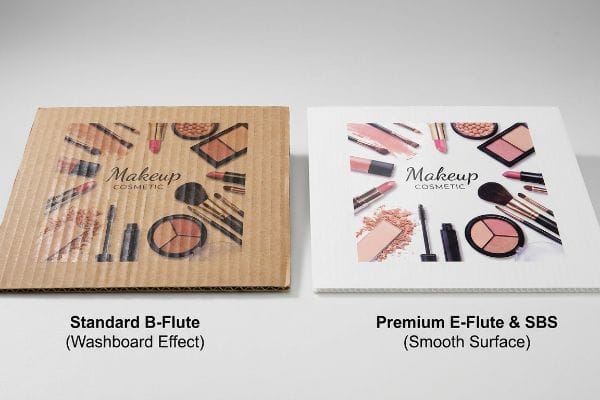
You might select the highest quality artwork, but the underlying substrate can completely ruin the visual effect.
Eradicating the Washboard Effect
A common approach for beginner cosmetic brands is to print their elegant, minimalist graphics on standard C-flute or B-flute corrugated boards to save money. They assume the commercial printer will simply lay the ink down smoothly over the brown cardboard. They fail to realize that standard flutes have large, distinct ridges beneath the top liner6.
Think of it like trying to paint a beautiful portrait on a bumpy brick wall. When you laminate a thin printed sheet over thick B-flute, the adhesive pulls the paper tight into the gaps, creating terrible vertical lines known as the washboard effect. If you run your hand across it, you can physically feel the bumpy, ribbed texture disrupting your glossy makeup graphics. For makeup, the rule of thumb is to strictly use E-flute or micro-flute, combined with a solid bleached top sheet. This premium combination delivers an entirely flat, glass-like surface for your litho-lamination, ensuring your luxury branding looks flawless under harsh store lighting while retaining the strength to hold inventory.
| Common Rookie Mistake | The Pro Fix | Retail-Floor Benefit |
|---|---|---|
| Printing on thick B-flute | Switch to E-flute or micro-flute7 | Delivers a premium flat surface |
| Using cheap top liners | Laminate with solid SBS board8 | Enhances color vibrancy |
| Ignoring substrate texture | Run visual washboard checks9 | Maintains luxury brand image |
I refuse to let premium beauty brands print their high-end campaign imagery over bumpy standard flutes. Upgrading to a micro-flute structure is a marginal cost difference that completely rescues your retail presentation.
🛠️ Harvey's Desk: Are bumpy corrugated lines destroying the premium feel of your cosmetic graphics? 👉 Claim a Surface Spec Guide ↗ — No forms that trigger endless sales calls. Just pure value.
Are acrylic display cases good?
High-end cosmetic brands naturally gravitate toward clear plastics, assuming it is the only way to achieve a permanent, luxurious aesthetic on the beauty counter.
Yes. Acrylic display cases are good for permanent retail installations requiring a premium, glass-like aesthetic and extreme durability. However, they are heavy, expensive to ship, and notoriously difficult to recycle, making corrugated paperboard a far superior choice for seasonal cosmetic campaigns and fast-paced retail rollouts.
But knowing the theory isn't enough when the machines start running and the logistical bills come due.
The Mixed Material Trap on the Factory Floor
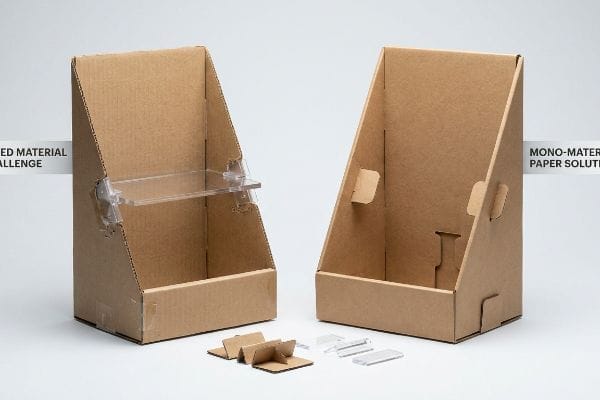
Many designers attempt a hybrid approach, creating a standard corrugated floor unit but bolting on heavy acrylic shelves or plastic clips to make it look expensive. They assume this mixed-material strategy gives them the best of both worlds: cheap cardboard logistics with a high-end plastic touch.
In my facility, I routinely see these mixed-material dreams turn into absolute nightmares during the co-packing phase. When you combine rigid acrylic components with a porous paperboard base, you introduce completely different tolerance behaviors. Paper swells slightly in humidity, but acrylic remains strictly static10. When my team attempts to lock a 3.17 mm (0.12 inches) thick acrylic tray into a corrugated slot that has swollen to 3.25 mm (0.127 inches) in a humid warehouse, the resulting friction is brutal. The rigid plastic ends up tearing the litho-laminated top sheet right off the board, creating massive visual defects. I completely strip out these plastic elements and engineer mono-material origami-style paper locks instead. By strictly enforcing a 100% paperboard construction, I ensure the assembly time drops by over 30 seconds per unit, drastically cutting labor fees and guaranteeing zero retail rejections over complex recycling rules11.
| Common Rookie Mistake | The Pro Fix | Retail-Floor Benefit |
|---|---|---|
| Mixing acrylic with cardboard | Engineer mono-material paper locks | Eliminates component friction |
| Ignoring material swell rates | Design for paper moisture expansion | Stops tearing during assembly |
| Paying high plastic labor fees | Use origami-style cardboard tabs | Cuts co-packing costs |
I strip out expensive plastic components whenever possible because paper engineering can achieve the exact same structural locking force. A pure mono-material design always flows through assembly and logistics with zero friction.
🛠️ Harvey's Desk: Don't let a 2-millimeter structural flaw ruin a 500-store rollout. 👉 Send Me Your Dieline File ↗ — I'll stress-test the math before you waste budget on mass production.
Conclusion
You can gamble on mixed materials and bumpy standard flutes, but when that weak recycled testliner buckles under the weight of heavy cosmetic jars, slowing down the co-packing assembly line by an estimated 25% and triggering an immediate retailer rejection, your entire campaign ROI is wiped out. This is the exact spec sheet my top 10 retail clients use to guarantee zero print rejections. Stop guessing on board grades and let me personally audit your cosmetic structural files through my Free Dieline Audit ↗ to catch these material friction points before you print.
"Changing quality of recycled fiber material. Part 1. Factors affecting …", https://bioresources.cnr.ncsu.edu/resources/changing-quality-of-recycled-fiber-material-part-1-factors-affecting-the-quality-and-an-approach-for-characterisation-of-the-strength-potential/. [A comparative analysis of virgin and recycled pulp fibers demonstrates that repeated recycling shortens fibers, reducing overall tensile strength]. Evidence role: technical specification; source type: material science publication. Supports: structural inferiority of recycled testliner. Scope note: Specifically refers to cellulose fibers in corrugated linerboard. ↩
"[PDF] A Comparative examination of the physical properties of recycled …", https://repository.rit.edu/cgi/viewcontent.cgi?article=1299&context=theses. [Packaging engineering standards confirm that the longer fibers in virgin kraft provide superior vertical compression and load-bearing capacity]. Evidence role: technical specification; source type: industry engineering manual. Supports: benefits of virgin kraft for load-bearing walls. Scope note: Relative to recycled testliner alternatives. ↩
"Hide steel tubes in thin shelves to prevent sagging – FineWoodworking", https://www.finewoodworking.com/2023/03/20/hide-steel-tubes-in-thin-shelves-to-prevent-sagging?srsltid=AfmBOopikE0XnngqDN9V8cGOw8CXQTOvWl9pr9I-seIJrVgEiOXvKau_. [Industry manufacturing guides for POP displays explain how integrating steel tubing prevents structural deformation and sagging in paperboard shelves]. Evidence role: technical validation; source type: manufacturing guide. Supports: prevention of shelf sag. Scope note: specific to heavy-duty cardboard displays. ↩
"Display Stand Support Element Vertical 1002.0 – plastic-handles.com", https://www.plastic-handles.com/POS-display-stand-support-element-1002.0.php. [Structural engineering principles for modular displays demonstrate that shifting load from center spans to vertical members reduces bending moments and prevents dipping]. Evidence role: mechanical principle; source type: engineering manual. Supports: structural stability and leveling. Scope note: applies to modular paperboard architecture. ↩
"Design Factors for Dynamic Loads – Schaefer", https://schaefer-inc.com/design-factors-dynamic-loads/. [Retail fixture safety standards specify the calculation of dynamic loads to ensure the center of gravity remains stable when stocking dense liquids]. Evidence role: safety requirement; source type: industry standard. Supports: elimination of stock tipping. Scope note: applies to high-density liquid products. ↩
"[PDF] Washboarding of Corrugated Cardboard – RMIT Research Repository.", https://research-repository.rmit.edu.au/articles/thesis/Washboarding_of_corrugated_cardboard/27576537/1/files/50744808.pdf. [Technical specifications of standard corrugated fluting demonstrate the depth and spacing of the medium, which creates surface irregularities known as the washboard effect during printing]. Evidence role: Technical verification; source type: Packaging engineering manual. Supports: The structural cause of printing ridges on standard corrugated boards. Scope note: Applies specifically to non-micro-flute boards. ↩
"E Flute and B Flute: Which One Fits Your Packaging Needs? – BoxLark", https://boxlark.com/what-are-the-e-flute-and-b-flute/. An authoritative source on corrugated packaging would explain how smaller flutes like E or micro-flute reduce the visible ribbing effect compared to thicker B-flute. Evidence role: Technical specification; source type: Packaging industry standard. Supports: Use of thinner fluting for a premium flat surface. Scope note: Applicable to corrugated board selection. ↩
"Mastering SBS C2S Paper Board: The Ultimate Guide for Packaging …", https://www.epackprinting.com/support/mastering-sbs-c2s-paper-board-the-ultimate-guide-for-packaging-and-printing/. Technical guides on paperboard would detail how Solid Bleached Sulfate (SBS) board provides a high-white, smooth surface that enhances color vibrancy during printing. Evidence role: Material property; source type: Paper science manual. Supports: Improvement of color vibrancy through SBS lamination. Scope note: Specific to luxury packaging liners. ↩
"With corrugated boxes, you can measure success – Billerud", https://www.billerud.com/products/packaging-materials/corrugated-materials/knowledge-center/washboarding. Industry manuals on print quality would define the "washboard effect" and the necessity of visual checks to ensure flute lines do not telegraph through the surface. Evidence role: Quality control process; source type: Manufacturing standard. Supports: Method for maintaining luxury brand appearance. Scope note: Limited to corrugated substrate printing. ↩
"Properties of Paperboard Coated with Natural Polymers and … – PMC", https://pmc.ncbi.nlm.nih.gov/articles/PMC10379446/. [Material science data confirms that cellulose-based paperboard is hygroscopic and undergoes dimensional changes based on ambient humidity, whereas acrylic (PMMA) is relatively stable. Evidence role: Technical validation; source type: Material science datasheet. Supports: The claim regarding tolerance discrepancies in mixed-material construction. Scope note: Focuses on moisture-induced swelling rather than thermal expansion.] ↩
"Pros and Cons of Mono and Multi-Layer Materials for Packaging", https://www.packworld.com/leaders-new/materials/flexible-packaging/video/22793392/pros-and-cons-of-mono-and-multilayer-materials-for-sustainable-packaging. [Environmental guidelines and retail sustainability mandates typically favor mono-material packaging because mixed-material constructions often fail recyclability tests or violate 'easy-to-recycle'certifications. Evidence role: Regulatory compliance; source type: Sustainability standards/industry guidelines. Supports: The advantage of 100% paperboard construction for retail compliance. Scope note: Specific rules may vary by geographic region.] ↩