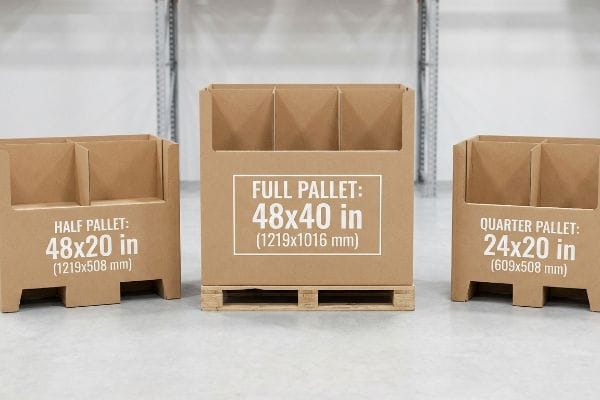
Entrer dans un grand magasin implique de respecter des règles d'espace strictes. Si votre présentoir en carton ondulé ne respecte pas les dimensions standard, les responsables du magasin refuseront tout simplement votre livraison.
Les dimensions disponibles pour les présentoirs sur palettes dépendent largement de l'empreinte standard du secteur de 48 × 40 pouces (1219 × 1016 mm). Les détaillants acceptent fréquemment des variations fractionnaires, notamment des demi-palettes de 48 × 20 pouces (1219 × 508 mm) et des quarts de palettes de 24 × 20 pouces (609 × 508 mm), afin d'optimiser au maximum la densité d'exposition dans les allées de leurs magasins.
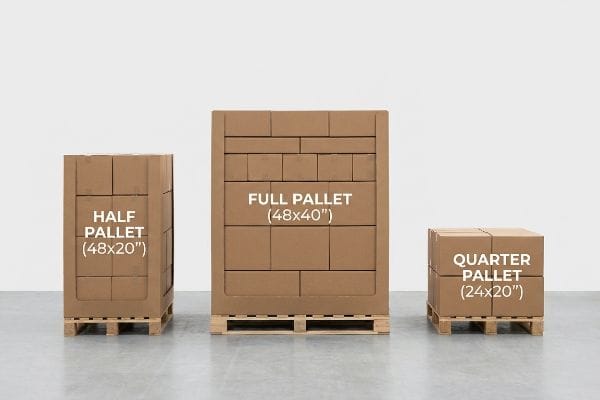
La connaissance de ces dimensions fondamentales, notamment les normes de la GMA (Grocery Manufacturers Association), n'est qu'un premier pas. Voyons maintenant comment le choix des dimensions influence l'ingénierie structurelle et la logistique.
Quelles sont les différentes tailles de palettes ?
Un réseau monolithique n'est pas la seule option pour un déploiement national. Comprendre le modèle de distribution fractionnée permet aux marques émergentes d'obtenir un emplacement privilégié en magasin sans monopoliser d'immenses surfaces.
Les palettes sont disponibles en différentes tailles : palette standard de 1219 × 1016 mm (48 × 40 pouces), demi-palette de 1219 × 508 mm (48 × 20 pouces) et quart de palette de 609 × 508 mm (24 × 20 pouces). Ces configurations permettent à plusieurs campagnes promotionnelles de partager une même structure d’expédition en bois.
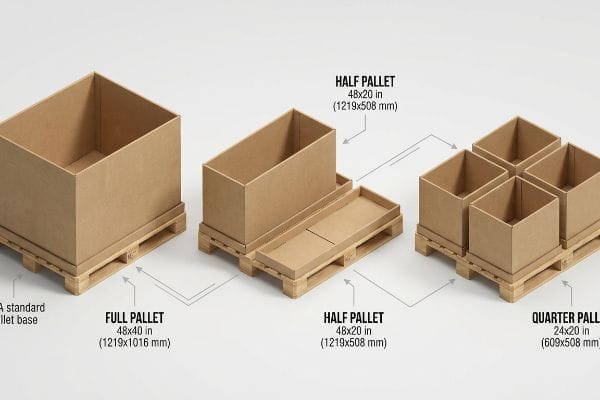
Il n'est pas toujours nécessaire d'occuper une surface immense pour obtenir l'approbation des détaillants, surtout lorsque l'espace disponible est précieux.
Tirer parti des présentoirs à palettes fractionnées pour obtenir l'approbation du commerce de détail
Les marques proposent souvent aux grandes surfaces des présentoirs de sol de 1219 x 1016 mm (48 x 40 pouces) , mais se heurtent systématiquement à un refus catégorique des services d'approvisionnement. Elles partent du principe erroné qu'une campagne promotionnelle doit occuper toute la surface en bois pour être visuellement efficace. Cette approche binaire ignore totalement la gestion rigoureuse de l'espace précieux des allées par les responsables de magasin, qui doivent présenter plusieurs marques simultanément.
Même les directeurs marketing les plus expérimentés tombent dans ce piège, soumettant des fichiers graphiques volumineux qui nécessitent une surface au sol excessive. Lorsque j'examine ces conceptions trop imposantes, j'entends littéralement le frottement du carton ondulé épais contre les angles étroits des allées lors des tests physiques. En concevant mathématiquement des présentoirs de grande capacité avec une précision extrême – par exemple, un quart d'unité de 609 × 508 mm² –nousgarantissons que votre présentoir s'emboîtera parfaitement avec celui d'une autre marque. Cette subdivision spatiale exacte permet aux acheteurs d'optimiser la densité d'exposition au sol, augmentant considérablement vos chances d'approbation tout en réduisant drastiquement vos coûts de matières premières.
| Erreurs courantes des débutants | La solution pro | Avantage du magasin |
|---|---|---|
| Installation uniquement d'écrans pleine grandeur | d'ingénierie 24×20 pouces (609×508 mm)3 | Augmente les taux d'approbation des acheteurs |
| Ignorer les zones de dégagement des allées | Conception de demi - palettes pour têtes de gondole | Prévient les risques de blocage des chariots |
| Gaspillage de carton ondulé brut | Partage d'une base GMA avec d'autres marques4 | Réduit les coûts des matériaux de construction |
Je ne laisse jamais un client présenter un présentoir complet sans prévoir de solution de repli. Opter pour une demi-palette permet de garantir son placement dans les allées encombrées sans compromettre sa solidité ni la visibilité de la marque.
🛠️ Le bureau d'Harvey : Vous hésitez entre une répartition complète ou partielle pour votre campagne ? 👉 Demandez un audit spatial ↗ — Accès direct à mon bureau. Zéro spam commercial automatisé, promis.
Quelles sont les dimensions d'un présentoir demi-palette ?
Réduire de moitié l'empreinte au sol modifie bien plus que votre identité visuelle. Cela introduit de sérieuses contraintes logistiques verticales qui prennent régulièrement les équipes de création au dépourvu.
Un présentoir demi-palette mesure exactement 1219 mm de long sur 508 mm de large. Ce format rectangulaire occupe exactement la moitié d'une base d'expédition standard, ce qui permet aux détaillants de le positionner à plat contre les rayonnages ou de placer deux présentoirs promotionnels de marques différentes dos à dos.
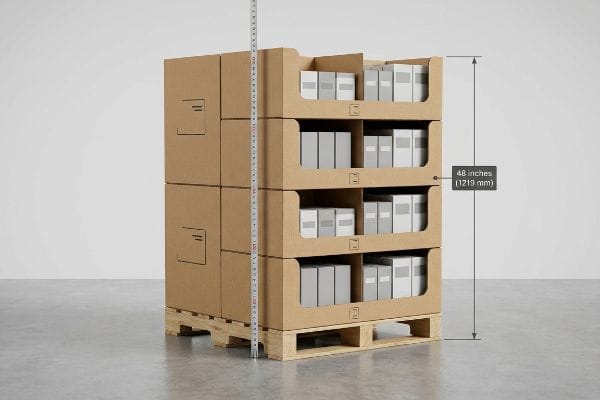
Calculer la largeur et la profondeur correctement est simple, mais c'est au niveau de la hauteur totale que la plupart des campagnes promotionnelles ambitieuses échouent.
La limite de hauteur cachée pour le transport par camion des demi-palettes
On me demande souvent si un présentoir deux fois plus petit peut avoir la même hauteur qu'un présentoir. Les concepteurs cherchent naturellement à maximiser la visibilité pour le consommateur en étendant l'en-tête graphique jusqu'à 1524 mm (60 pouces)⁵. Ils conçoivent de magnifiques structures imposantes dans des logiciels de CAO (conception assistée par ordinateur) sans se soucier de la façon dont l'unité sera physiquement transportée dans une remorque commerciale.
« Peut-on l'agrandir pour qu'il soit plus visible ? » C'est la première question que se posent les acheteurs lorsqu'ils examinent un présentoir de 1219 × 508 mm (48 × 20 pouces). Or, une demi-palette trop haute empêche tout empilage double. Je me souviens d'avoir vu une équipe d'entrepôt tenter de charger un présentoir surdimensionné de 1651 mm (65 pouces) ; le craquement douloureux du panneau supérieur en carton ondulé brut contre le plafond du camion a entraîné des réparations immédiates et coûteuses. Pour éviter cela, j'impose une limite stricte de hauteur pour les palettes expédiables, comprise entre 1219 et 1270 mm (48 et 50 pouces6 pouces). Cette limite verticale précise permet aux équipes logistiques d'empiler les marchandises en toute sécurité dans un conteneur 40HQ, réduisant ainsi considérablement les frais d'expédition tout en garantissant une stabilité structurelle optimale.
| Erreurs courantes des débutants | La solution pro | Avantage du magasin |
|---|---|---|
| Conception au-delà de 60 pouces (1524 mm)7 | Hauteur maximale d'expédition : 48 pouces (1219 mm)8 | Permet le transport de marchandises empilées en double9 |
| Sans tenir compte de la garde au toit de la remorque | Ingénierie des en-têtes modulaires rabattables | Prévient les dommages causés par l'écrasement de la tête de lecture |
| Répartition verticale instable du poids | Renforcement de la base ondulée inférieure | Empêche le basculement pendant le transport |
Je limite rigoureusement les dimensions verticales dès la phase de conception CAO. En préservant la possibilité de double empilage, je garantis que votre demi-palette sera expédiée efficacement et arrivera intacte au magasin.
🛠️ Le bureau d'Harvey : Vos dimensions verticales actuelles doublent-elles sans que vous le sachiez vos coûts de transport sortant ? 👉 Obtenez un diagnostic d'optimisation du transport ↗ — Téléchargement sécurisé. Ma boîte de réception reste ouverte si vous avez des questions.
Quelle est la taille d'une palette ?
Qu’on l’écrive « palette » ou « palet », confondre les nuanciers artistiques avec les robustes socles de transport en bois n’est qu’un simple couac terminologique. Le véritable danger réside dans la méconnaissance des règles d’agencement.
La taille d'une palette correspond généralement à l'empreinte au sol standard nord-américaine de 48 pouces sur 40 pouces (1219 × 1016 mm). Si les artistes utilisent une palette de couleurs, la logistique de la vente au détail s'appuie sur cette plateforme en bois précise pour transporter en toute sécurité les lourds emballages en carton ondulé directement dans les rayons des grandes surfaces.
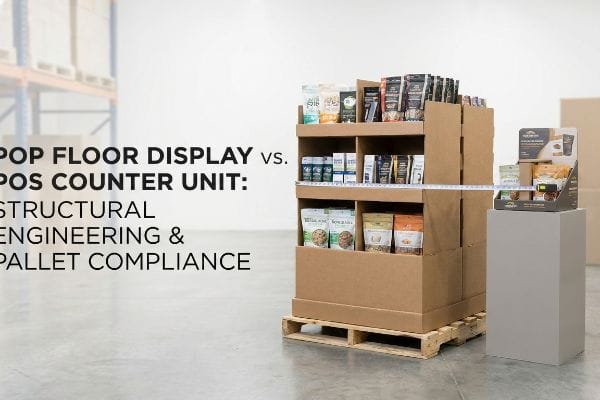
Une fois la terminologie clarifiée, nous devons nous confronter aux règles juridiques et logistiques strictes qui dictent où ces imposantes bases en bois peuvent être placées à l'intérieur d'un magasin très fréquenté.
Contrainte spatiale ADA vs. GMA
Les entreprises commerciales proposent souvent un concept de conception hautement modulable, selon lequel un présentoir de sol PLV (publicité sur le lieu de vente) de grande taille peut être réduit de moitié pour servir de comptoir de caisse. Elles supposent à tort qu'un socle de 1219 × 1016 mm (48 × 40 pouces)peut se réduire parfaitement à un boîtier prêt à accueillir une caisse sans que l'on ait à repenser entièrement sa structure.
Imaginez essayer de miniaturiser le moteur d'un poids lourd pour l'intégrer dans une voiture compacte : le châssis ne supporterait tout simplement pas une telle transformation. Je constate régulièrement que les tracés de découpe sont mal ajustés, les concepteurs ayant simplement abaissé le curseur d'échelle à l'écran. Lorsque je plie le prototype obtenu, le carton épais de type cannelure B offre une forte résistance, les languettes de verrouillage s'ouvrant avec un claquement sonore et frustrant, car les tolérances de pliage internes n'ont pas été recalibrées. Nous séparons définitivement les processus de fabrication : les modèles grandeur nature sont solidement fixés à la base en bois massive pour résister aux charges dynamiques, tandis que les unités de registre réduites doivent respecter des limites d'accessibilité strictes, allant de 381 à 1219 mm (15 à 48 pouces11 ). Cette séparation stricte évite les coûts liés à l'accessibilité et garantit un assemblage en co-packing sans accroc.
| Erreurs courantes des débutants | La solution pro | Avantage du magasin |
|---|---|---|
| Réduction aveugle des fichiers 3D | Séparation de l'ingénierie des points de vente et des points de vente | Empêche la défaillance de l'assemblage des onglets |
| Ignorer la conformité aux exigences de l'ADA | Fixation de petits éléments à une fenêtre de 15 pouces (381 mm)12 | Garantit l'accessibilité légale |
| En utilisant la même épaisseur de cannelure | Spécifier une cannelure E plus fine pour les unités mises à l'échelle13 | Crée des plis nets et précis |
Je refuse d'approuver sans réserve les conceptions bâclées et standardisées des agences de création. En dissociant les calculs structurels des grands socles de ceux des petits comptoirs, nous éliminons totalement les risques de défaillances catastrophiques lors de l'assemblage.
🛠️ Harvey's Desk : Vos terminaux de point de vente compacts rencontrent-ils des problèmes d'assemblage sur la chaîne d'emballage ? 👉 Demandez votre analyse structurelle ↗ — Pas de formulaires interminables qui vous inondent d'appels commerciaux. Uniquement de la valeur ajoutée.
Quelles sont les dimensions des palettes disponibles ?
Connaître les dimensions standard disponibles n'est que théorie. Les réaliser parfaitement sous la pression de plusieurs tonnes exercée par un entrepôt est le véritable défi de fabrication.
Les palettes destinées à la distribution et à la présentation en magasin sont disponibles en trois formats : palettes complètes (1219 × 1016 mm), demi-palettes (1219 × 508 mm) et quarts de palettes (609 × 508 mm). Les acheteurs veillent scrupuleusement au respect de ces dimensions afin d’assurer une gestion optimale des rayonnages rigides et une circulation aisée dans les allées étroites des entrepôts.
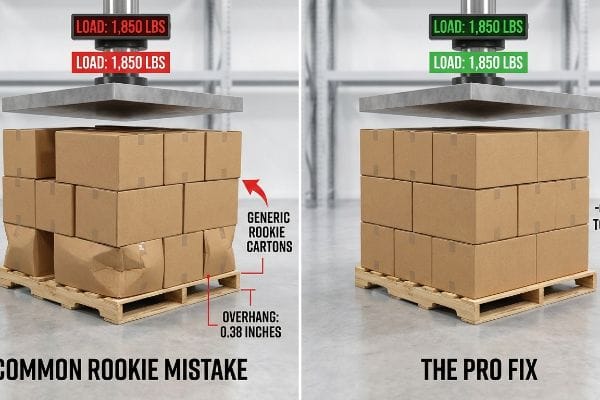
Cependant, les dimensions standard ne signifient absolument rien lorsque les machines de découpe automatisées se mettent en marche et que vos cartons principaux sont chargés pour un transport maritime mouvementé.
Pourquoi les empreintes standard ne fonctionnent pas en usine
Les équipes d'approvisionnement augmentent souvent les dimensions des cartons d'expédition pour optimiser la densité du chargement, partant du principe que la résistance à la compression du carton ondulé renforcé protégera automatiquement les marchandises. Elles conçoivent un emballage qui correspond parfaitement aux dimensions du carton ondulé de 1219 × 1016 mm (48 × 40 pouces) affichéessur leurs écrans d'ordinateur, persuadées que cet alignement précis garantit une efficacité maximale.
Il ne s'agit pas que de théorie : je le constate sur le terrain lors des simulations de compression. La résistance d'une boîte en carton ondulé, mesurée par le test de compression (BCT), dépend à 60 % del' alignement vertical parfait de ses quatre coins. Si un carton principal dépasse du plateau en bois de seulement 9,6 mm (0,38 pouce)en raison d'erreurs mineures de chargement manuel sur le quai, ces coins structurels ne supportent aucune charge. Après une simulation de transport de conteneur, j'ai relevé les mesures au micromètre et j'ai observé que le niveau inférieur, non soutenu, se courbait visiblement vers l'extérieur et se déformait sous une pression de 839 kg (1 850 lb). Pour corriger ce problème, je réduis artificiellement l'encombrement maximal autorisé des cartons dans notre logiciel de 12,7 mm (0,5 pouce). Grâce à cet ajustement de tolérance rigoureux, je garantis que les coins du carton ondulé restent toujours parfaitement soutenus par le bois, éliminant ainsi tout dommage pendant le transport lors des chargements de conteneurs à double empilement à l'étranger et permettant à nos clients d'économiser des milliers d'euros en marchandises de remplacement.
| Erreurs courantes des débutants | La solution pro | Avantage du magasin |
|---|---|---|
| Conception de caisses d'expédition épousant parfaitement les contours du bois | Réduction de la boîte englobante de 0,5 pouce (12,7 mm) | Conserve 100 % de la résistance BCT des coins17 |
| S'appuyant entièrement sur la force brute de la planche | Assurer l'alignement vertical des 4 coins | Empêche l'écrasement du niveau inférieur |
| Dépassant le périmètre en bois | Tolérances de verrouillage inférieures à 48×40 pouces (1219×1016 mm)18 | Élimine les dommages coûteux liés au transport |
Je préviens mathématiquement tout débordement avant même qu'une seule lame ne touche la planche. Réduire l'encombrement de 1,25 cm est un micro-ajustement qui évite l'effondrement catastrophique d'entrepôts lors de chargements entiers.
🛠️ Le bureau d'Harvey : Savez-vous si vos gabarits d'expédition actuels compromettent la résistance à la compression de vos angles ? 👉 Envoyez-moi votre fichier de gabarits ↗ — Je vérifierai la robustesse des calculs avant que vous n'investissiez inutilement dans une production en série.
Conclusion
Vous pouvez choisir un fournisseur d'emballages qui néglige les contraintes de compression verticale des palettes pour économiser quelques centimes sur le carton brut, mais lorsque le niveau inférieur, non soutenu, cèdera inévitablement sous la pression de l'entrepôt, vous vous exposerez à un refus immédiat du détaillant et à des semaines de retouches manuelles coûteuses qui anéantiront la marge bénéficiaire de votre projet. Plus de 500 responsables de marque utilisent ma checklist prépresse pour éviter précisément ces erreurs fatales en début de production. Ne vous fiez plus aux estimations des limites de compression verticale : laissez-moi auditer personnellement vos fichiers CAO grâce à mon Audit de Moulage Gratuit ↗ afin de détecter les tolérances structurelles critiques avant le lancement de la production en série.
« Palette en bois traité thermiquement GMA – 48 x 40 po H-1260 – ULINE », https://www.uline.com/Product/Detail/H-1260/Pallets/Heat-Treated-Wood-GMA-Pallet-48-x-40 . [Une norme industrielle faisant autorité, établie par la Grocery Manufacturers Association (GMA), définit la palette standard nord-américaine comme étant de 48 x 40 pouces]. Rôle de la preuve : spécification technique ; type de source : norme industrielle. Permet : la vérification des dimensions standard des palettes. Remarque sur la portée : s’applique principalement au marché nord-américain.
« Types de présentoirs sur palette : pleine, demi-palette et quart de palette – GreenDot Packaging », https://greendotpackaging.com/understanding-pallet-display-types-full-half-and-quarter-pallet-displays/ . [Une norme industrielle relative à la logistique des palettes et à l’encombrement des présentoirs en magasin confirme les dimensions spécifiques des unités fractionnaires, comme le quart de palette]. Rôle de la preuve : vérification technique ; type de source : norme industrielle du secteur de la logistique. Permet de fournir des mesures précises pour les présentoirs de quart de palette. Remarque : les dimensions peuvent varier légèrement en fonction des normes d’expédition régionales.
« Guide des dimensions de palettes », https://miami-pallets.com/pallet-sizes. [Un manuel technique sur les normes d'affichage en point de vente confirmerait ces dimensions comme étant une unité de mesure fractionnaire reconnue pour les présentoirs sur le lieu de vente]. Rôle de la preuve : spécification technique ; type de source : manuel sectoriel. Appuie : dimensionnement standard pour les présentoirs fractionnaires. Remarque : les dimensions peuvent varier selon les exigences des détaillants régionaux .
« Dimensions standard des palettes — 48 × 40 GMA et 6 autres dimensions courantes », https://www.wearewarp.com/standard-pallet-sizes. [Les guides logistiques basés sur les normes GMA (Grocery Manufacturers Association) définissent le cadre des socles de palettes standardisés utilisés pour optimiser l’espace de vente]. Niveau de preuve : norme industrielle ; type de source : guide logistique. Appui : utilisation des socles GMA dans les agencements multimarques. Remarque : principalement applicable aux environnements de vente au détail nord-américains .
« Comment choisir la hauteur de votre présentoir ? », https://popdisplay.me/how-to-choose-your-retail-display-height/. [Les recommandations du secteur concernant les supports PLV (publicité sur le lieu de vente) fournissent des plages de hauteur typiques pour les présentoirs autoportants conçus pour optimiser la visibilité à hauteur des yeux]. Type de preuve : spécification technique ; type de source : publication professionnelle. Références : hauteurs cibles standard pour les concepteurs. Remarque : les hauteurs maximales sont souvent limitées par les exigences d’expédition spécifiques des détaillants. ↩
« Combien de palettes peuvent être chargées dans des conteneurs maritimes de 20 et 40 pieds ? – Boxhub », https://boxhub.com/blog/how-many-pallets-fit-in-shipping-containers?srsltid=AfmBOoqJqyJ3I8qGa2NKd-Gkub97MDmQOhFABkqt7YhZb3VZfYMWNjYI. [Les spécifications d'expédition pour les conteneurs High Cube de 40 pieds indiquent la hauteur libre intérieure, confirmant la hauteur maximale autorisée pour le double empilage de marchandises]. Preuve : spécification technique ; source : norme du secteur de la logistique. Supporte : la hauteur maximale de 48 à 50 pouces. Remarque : le calcul doit inclure la hauteur de la base de la palette .
« Hauteur maximale des palettes pour le fret aérien : explication des limites de taille », https://ship4wd.com/logistics-shipping/pallet-height-air-freight . [Références sectorielles concernant le seuil de hauteur à partir duquel les présentoirs palettisés dépassent les limites de stabilité optimale ou les limites de hauteur standard des transporteurs pour les palettes simples]. Rôle de la preuve : contrainte de conception ; type de source : directives relatives aux présentoirs de vente au détail. Justifie : le risque de dépassement des limites de hauteur. Remarque concernant la portée : peut varier selon les règles spécifiques des transporteurs.
« Expédition et dimensions standard des palettes », https://ntslogistics.com/knowledge_base/pallet-shipping-dimensions/ . [Directives logistiques faisant autorité concernant les hauteurs maximales de palettes autorisées pour permettre l’empilage de deux unités dans une semi-remorque standard]. Niveau de preuve : spécification technique ; type de source : manuel de logistique. Références: norme industrielle relative à la hauteur d’expédition. Précision : concerne spécifiquement les configurations à double empilage.
« Dimensions et capacités des semi-remorques bâchées : 53 pi, 48 pi, + 40 pi… – Hale Trailer », https://haletrailer.com/blog/dry-van-dimensions-capacities/. [Normes de transport spécifiant la hauteur intérieure des semi-remorques standard de 53 pieds, qui déterminent la hauteur maximale pour le chargement en double empilement]. Rôle de la preuve : contrainte logistique ; type de source : norme de l’industrie du transport routier. Appuie : l’efficacité du transport maritime à hauteur limitée. Note de portée : suppose des dimensions de semi-remorques standard .
« Palettes GMA 48×40 » | Premier fabricant et fournisseur de palettes », https://www.palletone.com/products/gma-pallets/. [Les normes industrielles de la Grocery Manufacturers Association (GMA) confirment que la dimension 48×40 pouces est la dimension standard pour les palettes nord-américaines]. Preuve : spécification technique ; source : norme industrielle. Éléments pris en compte : dimensions des palettes. Remarque : concerne spécifiquement la palette standard GMA .
« Chapitre 3 : Parties utilisables – Access-Board.gov », https://www.access-board.gov/ada/guides/chapter-3-operable-parts/. [Les normes ADA relatives à la conception accessible définissent des portées maximales et minimales spécifiques afin de garantir l’accessibilité aux utilisateurs de fauteuils roulants]. Rôle de la preuve : Vérification réglementaire ; type de source : Norme gouvernementale. Éléments pris en compte : Contraintes spatiales pour les unités de caisse enregistreuse. Note relative à la portée : Concerne spécifiquement les limites d’accessibilité de la portée vers l’avant .
« Normes d’accessibilité ADA – Access-Board.gov », https://www.access-board.gov/ada/ . [Les normes d’accessibilité ADA définissent les portées et les dégagements spatiaux spécifiques requis pour permettre aux personnes handicapées d’accéder aux éléments de vente au détail]. Rôle de la preuve : spécification technique ; type de source : réglementation gouvernementale. Conformité : conformité légale en matière d’accessibilité. Note relative à la portée : s’applique spécifiquement aux contraintes spatiales des présentoirs de point de vente et des présentoirs PLV.
« Explication des types de cannelures de carton ondulé : A, B, C, E et F », https://www.onyxpackaging.com/blog/corrugated-box-flute-types.php. [Les normes industrielles relatives à l’emballage en carton ondulé précisent que le profil plus fin de la cannelure E est optimal pour obtenir des plis nets et précis dans les présentoirs de petite taille]. Preuve : spécification des matériaux ; type de source : manuel industriel. Contribue à : la précision de fabrication et l’intégrité structurelle. Remarque : limité à l’ingénierie du carton ondulé .
« Dimensions standard des palettes | Avec tableau – Kamps Pallets », https://www.kampspallets.com/standard-pallet-sizes-with-chart/. [Un guide standard de l'industrie confirme que 48 × 40 pouces est la dimension standard des palettes GMA en Amérique du Nord]. Rôle de la preuve : vérification factuelle ; type de source : norme industrielle ; Supporte : dimensions standard des palettes ; Note de portée : spécifiquement pour les marchés nord-américains .
« Estimation de la résistance à la compression des boîtes en carton ondulé… », https://pmc.ncbi.nlm.nih.gov/articles/PMC8467740/ . [Une étude d’ingénierie de l’emballage ou une norme industrielle quantifierait la proportion de résistance à la compression attribuable à l’alignement vertical des coins]. Rôle de la preuve : validation technique ; type de source : étude universitaire ou manuel d’ ingénierie. Arguments : perte d’intégrité structurelle due à un défaut d’alignement. Note relative au champ d’application : s’applique aux cartons ondulés standard à simple ou double cannelure.
« Modélisation prédictive de l'influence du débordement des palettes sur la résistance à la compression des cartons », https://vtechworks.lib.vt.edu/items/d6fb70fe-bf11-40d2-a44c-3ba7918d06e3 . [Des études logistiques ou des essais structurels permettraient de vérifier la distance précise de débordement entraînant une perte de soutien des angles]. Preuve : spécification technique ; type de source : rapport d'essai d'emballage. Appui : seuil précis de rupture structurelle due au débordement des palettes. Remarque: les résultats peuvent varier selon la qualité du carton et la hauteur d'empilement.
"[DOC] Version soumise (672,09 Ko) – VTechWorks", https://vtechworks.lib.vt.edu/bitstreams/359cd5e6-7099-48a8-9a3b-60aeee6db278/download. [Les normes techniques d'emballage démontrent que l'élimination du débordement de la palette garantit que la charge verticale est entièrement supportée par les coins ondulés, maintenant ainsi une résistance maximale du carton ondulé]. Rôle de la preuve : vérification technique ; type de source : manuel d'ingénierie. Appuie : l'avantage de réduire la taille du carton d'expédition. Note de portée : Spécifique aux conteneurs d'expédition en carton ondulé.] ↩
« Quelle est la taille standard d'une palette ? 48 po x 40 po – PalletOne Inc. », https://www.palletone.com/what-is-the-standard-pallet-size/. [Les normes logistiques de l'industrie définissent l'empattement de 48 po x 40 po comme la norme nord-américaine, en précisant que tout débordement au-delà de ces dimensions augmente considérablement le risque de rupture structurelle et de dommages pendant le transport]. Rôle de la preuve : spécification factuelle ; type de source : norme logistique. Appuie : l'exigence de tolérances strictes sur les empattements standard des palettes. Note sur la portée : s'applique aux palettes standard GMA.] ↩