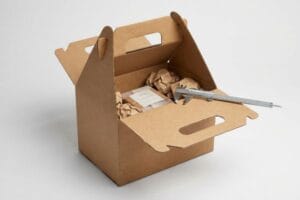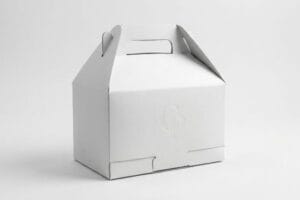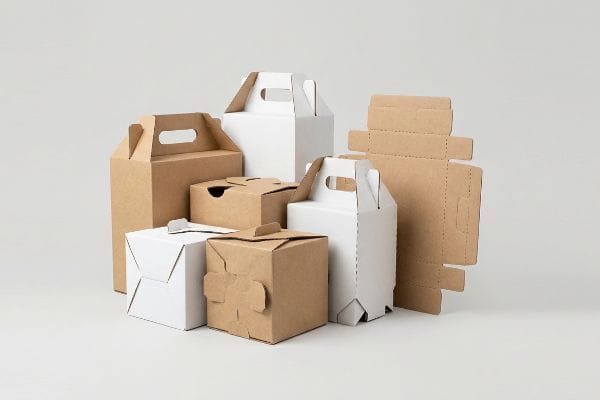
Pour les lancements haut de gamme en grande distribution, les emballages en carton préfabriqués ne suffisent pas. Lorsqu'il est essentiel d'avoir une structure précise et une présence visuelle marquante dans un espace de vente encombré, la conception sur mesure devient la seule solution viable.
Une boîte en carton découpée à l'emporte-pièce est une structure d'emballage de haute précision, fabriquée à l'aide d'une matrice en acier sur mesure permettant de découper des formes précises, des languettes d'emboîtement et des trous de ventilation. Ce procédé de fabrication avancé transforme des feuilles de carton ondulé standard en présentoirs complexes, prêts pour la vente au détail et conçus pour un assemblage automatisé et des contraintes d'espace spécifiques.
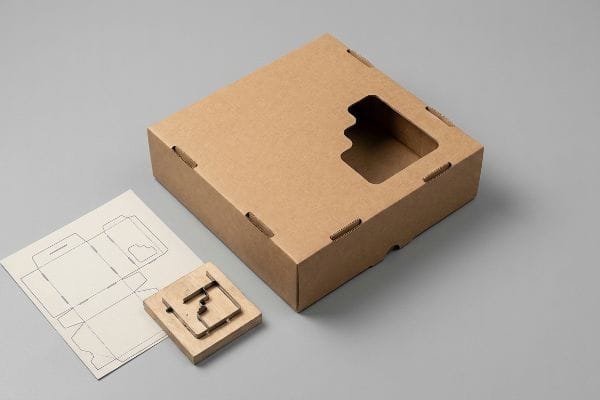
Au-delà des simples conteneurs d'expédition, ces structures sur mesure déterminent comment votre produit résiste aux vibrations du transport et capte l'attention des clients dans les rayons.
Quels sont les inconvénients de la découpe à l'emporte-pièce ?
Bien que ces structures sur mesure offrent une flexibilité de conception illimitée, elles introduisent de graves vulnérabilités mécaniques si votre usine ignore le cycle de vie physique de l'équipement de fabrication lui-même.
Les inconvénients de la découpe à l'emporte-pièce comprennent des coûts d'outillage initiaux élevés, des phases de prototypage plus lentes et le risque important de déformation des matrices de découpe en bois dégradées dans un stockage humide, ce qui provoque finalement des bords irréguliers et des défaillances d'assemblage catastrophiques lors des réassorts de production en série si ce problème n'est pas géré.
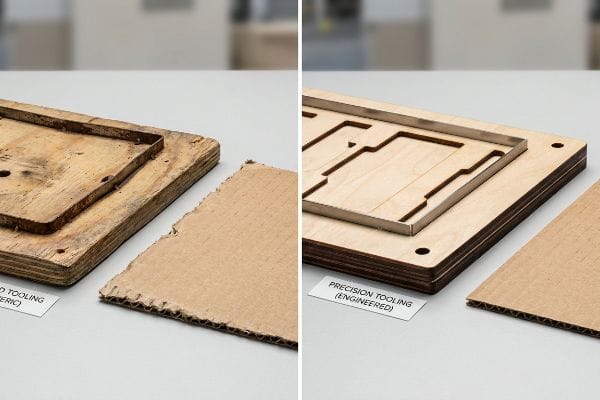
Ces inconvénients théoriques sont insignifiants comparés à la dure réalité physique que représente la réutilisation d'outillage endommagé pour des déploiements massifs en grande distribution.
Le piège de la « dégradation de l'outillage » dans les opérations de réapprovisionnement
Lors de mes audits des historiques de production de mes clients, je constate fréquemment que les équipes d'approvisionnement considèrent qu'un investissement unique dans l'outillage garantit un équipement en acier permanent et indestructible. Elles traitent les outils de coupe standard comme des éléments fixes, ignorant que ces lames sont littéralement encastrées dans des panneaux de contreplaqué brut¹.Dans mon atelier, je constate régulièrement comment les supports en bois poreux absorbent l'humidité ambiante au fil du temps. Cette absorption d'humidité déforme physiquement le panneau²,ce qui entraîne un désalignement et une corrosion des lames en acier encastrées entre les cycles de production.
Il ne s'agit pas que de théorie : je constate ce problème en atelier lorsque des clients tentent de réutiliser d'anciens outillages pour une nouvelle production saisonnière. Nous chargeons la matrice usée dans la presse, et les lames déformées produisent des découpes irrégulières sur le banc d'essai 32ECT (Edge Crush Test), ne respectant pas les tolérances micrométriques requises pour le pliage automatisé³.Pour remédier à cela, j'applique un protocole strict d'outillage neuf. J'élimine complètement le vieux bois et j'exige la gravure d'une nouvelle matrice au laser pour chaque lot de production important. Grâce à cette norme rigoureuse, mon carton ondulé haute résistance passe parfaitement l'étape d'assemblage, réduisant le temps de conditionnement d'environ 20 %⁴ et permettant à mes clients d'économiser d'importants frais de retouche manuelle en atelier.
| Métrique/Fonctionnalité | Approche générique | Réalité artificielle |
|---|---|---|
| Base d'outillage | panneaux de contreplaqué réutilisés5 | Matrice découpée au laser neuve6 |
| Qualité du bord | Coupures irrégulières et déchirées | Précision extrême |
| Vitesse d'assemblage | friction manuelle élevée | Pliage automatisé sans frottement7 |
Je refuse qu'un morceau de bois déformé compromette une campagne nationale. Investir dans une infrastructure de découpe irréprochable garantit que votre géométrie personnalisée fonctionnera exactement comme prévu, même sous des charges dynamiques extrêmes.
🛠️ Harvey's Desk : Vos lourds plateaux de caisse impactent-ils négativement votre retour sur investissement en expédition à cause de languettes d'assemblage irrégulières et à forte friction ? 👉 Obtenez un audit gratuit de vos plans de structure ↗ — J'examine personnellement chaque fichier de structure sous 24 h.
La découpe à l'emporte-pièce est-elle plus chère ?
Les coûts unitaires initiaux détournent souvent l'attention des équipes d'approvisionnement des économies massives réalisées en aval grâce à l'ingénierie de précision, faisant ainsi des véritables dépenses une question d'efficacité globale de la chaîne d'approvisionnement.
Cela dépend. Les boîtes en carton découpées à l'emporte-pièce engendrent des coûts initiaux de mise en place et d'outillage plus élevés que les conteneurs à fentes standard, mais elles réduisent considérablement les dépenses totales en accélérant les vitesses d'assemblage du co-emballage, en éliminant le besoin de clips en plastique coûteux et en maximisant la densité des conteneurs d'expédition grâce à une ingénierie d'emballage à plat précise.
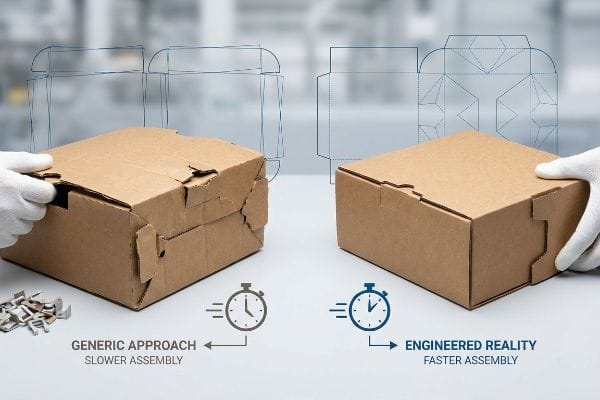
Comparer les prix des cartes électroniques brutes est un jeu dangereux qui ignore complètement le coût caché d'une mauvaise conception structurelle sur la chaîne de montage.
Vérification des faits concernant la « compensation des étriers »
Dans mon atelier, je vois régulièrement des marques soumettre des gabarits de découpe vectoriels CAO (Conception Assistée par Ordinateur) qui ignorent complètement l'épaisseur et le diamètre physique du carton ondulé. Même les concepteurs expérimentés négligent souvent cet aspect, créant des encoches emboîtables à la largeur exacte du panneau correspondant. Ils supposent qu'un trait numérique sur un écran se traduit instantanément par un pli sans frottement dans le monde physique, oubliant complètement que le papier épais absorbe de la matière lorsqu'il est plié à 90 degrés .
Il ne s'agit pas que de théorie : je le constate en production lorsque nous utilisons ces fichiers non ajustés sur notre table de découpe CNC Kongsberg. Le panneau de cannelure B de 3 mm (0,12 pouce) se dilate physiquement, et les rainures deviennent instantanément trop étroites. Les opérateurs d'emballage sont alors contraints d'écraser les cannelures et de déchirer la feuille supérieure pour forcer l'assemblage des languettes. Mes vingt années d'expérience sur le terrain m'ont appris à modéliser mathématiquement chaque rainure dans notre logiciel de calcul de structures, en appliquant des tolérances de pliage précises pour compenser le diamètre physique. En imposant cette tolérance de 3,2 mm, je garantis un assemblage parfait des mécanismes d'emboîtement, réduisant ainsi le temps de main-d'œuvre d'emballage de près de 40 secondes par unité et éliminant complètement les goulots d'étranglement coûteux de l'assemblage .
| Métrique/Fonctionnalité | Approche générique | Réalité artificielle |
|---|---|---|
| Calcul des lignes de découpe | Vecteurs plats 1:1 | Compensation stricte de l'étrier11 |
| Assemblage d'onglets | Risque élevé de déchirure12 | Insertion sans frottement |
| Coûts de main-d'œuvre | Frais de retouche importants | débit rapide optimisé13 |
Je conçois chaque fichier en tenant compte de la réalité physique, car les économies théoriques réalisées sur des cartes bon marché disparaissent toujours dès que vos sous-traitants doivent utiliser du ruban adhésif pour maintenir ensemble des languettes déchirées.
🛠️ Harvey's Desk : Votre présentoir de comptoir actuel, avec ses fentes de pliage mal calibrées et sujettes à de fortes frictions, nuit-il à vos marges bénéficiaires ? 👉 Demandez une évaluation de précision ↗ — Confidentialité garantie. Vos maquettes non commercialisées sont en sécurité.
Pourquoi parle-t-on de découpe à l'emporte-pièce ?
Cette terminologie provient directement des machines industrielles brutales nécessaires pour estamper des motifs complexes et détaillés dans des substrats robustes sans détruire les cannelures internes.
Ce procédé est appelé découpe à l'emporte-pièce car il utilise un outil métallique spécialisé, appelé matrice de découpe en acier, pour découper des feuilles de carton ondulé. Cette matrice agit comme un emporte-pièce géant, permettant de réaliser des formes complexes et des plis en un seul mouvement mécanique.
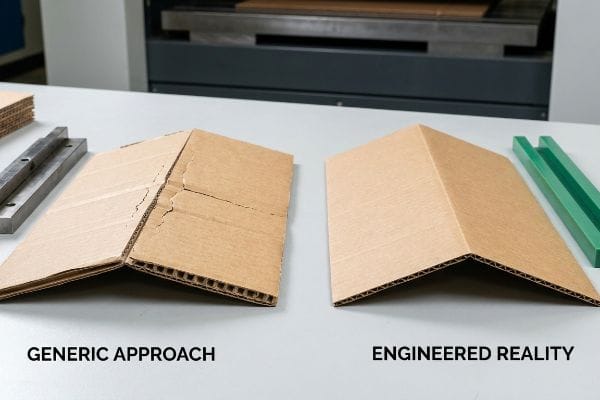
Il est essentiel de comprendre ce violent impact mécanique, car des matrices mal contrôlées briseront instantanément l'intégrité structurelle de votre emballage.
Rupture de fibre de la « matrice de pli »
Lors de mes audits des normes de production, je constate fréquemment que les marques se fient à des listes de contrôle de conformité génériques fournies par les détaillants, considérées comme une vérité technique absolue. Elles exigent des cartons épais pour réussir des tests de chute théoriques, mais ignorent complètement l'interaction réelle entre la matrice en acier et les fibres denses du papier. Frapper un carton kraft vierge rigide avec une règle de pliage en acier nue provoque souvent le gondolage des cannelures internes et la fissuration de la feuille supérieure imprimée , anéantissant ainsi la résistance même exigée par la liste de contrôle.
Ce n'est pas qu'une théorie : j'en ai fait l'amère expérience le mois dernier en testant un socle de présentoir robuste pour une grande surface. En 2023, j'ai demandé à Mark, mon ingénieur packaging principal, de passer un carton 44ECT haute densité dans la presse avec une enclume plate standard. Le claquement sec et violent de la règle en acier frappant le carton a résonné dans le sol, et j'ai vu la feuille supérieure litho-laminée se décoller et se micro-fissurer le long d'une ligne de pliage critique de 469,9 mm (18,5 pouces), chutant instantanément sa capacité de résistance à la compression (BCT)25 %. J'ai immédiatement arrêté la machine, pris mon micromètre et installé des matrices femelles en polymère spécifiques directement sur la plaque de découpe. Cette matrice d'enclume a permis de contrôler précisément l'étirement des fibres pendant la frappe,éliminant ainsi complètement les fissures et restaurant la résistance à la compression dynamique nécessaire pour supporter le transport maritime en double empilement. Je consacre du temps et de l'argent à mes tests en laboratoire pour que vous n'ayez pas à subir de pertes en magasin.
| Métrique/Fonctionnalité | Approche générique | Réalité artificielle |
|---|---|---|
| Outillage de pliage | enclume plate standard | Canal de matrice polymère17 |
| Réaction des fibres | Microfissures sévères | Étirement structurel contrôlé18 |
| Capacité BCT19 | Défaillance sous charge | Résiste à l'empilage de palettes |
Je refuse que des frappes mécaniques bâclées gâchent des matières premières de première qualité. La maîtrise de la pression et de la tension exactes lors de la découpe distingue les boîtes fabriquées par des amateurs de celles prêtes à la vente.
🛠️ Harvey's Desk : Vos en-têtes graphiques imprimés présentent-ils des craquelures disgracieuses sur les bords lorsqu'ils sont pliés pour être présentés en rayon ? 👉 Demandez une analyse de tension des fibres gratuite ↗ — Pas d'intermédiaire. Vous parlez directement à des ingénieurs en structure.
Quels sont les différents types de boîtes découpées à l'emporte-pièce ?
La polyvalence des outils sur mesure permet aux ingénieurs de transformer des feuilles de carton ondulé brutes en géométries très spécifiques, allant des enveloppes de protection aux présentoirs de vente au détail de grande taille.
Les différents types de boîtes découpées comprennent des présentoirs interactifs pour points de vente, des plateaux empilables prêts à la vente, des présentoirs de comptoir, des bacs pour palettes fractionnées et des cartons d'emballage complexes. Chaque type est conçu sur mesure pour optimiser la visibilité des produits, résister aux fortes vibrations liées au transport et s'adapter parfaitement aux contraintes spécifiques des surfaces de vente.
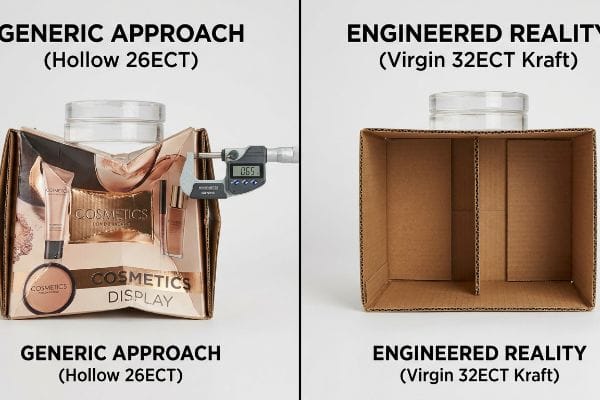
Choisir le bon type de boîte ne représente que la moitié du travail ; si le matériau de base est compromis pour payer des finitions esthétiques, toute la structure finira inévitablement par s'affaisser.
Le risque d'écrasement lié à la « dégradation cosmétique »
Dans mon service, je vois régulièrement des équipes d'approvisionnement soumettre des demandes de devis (RFQ) qui sous-estiment systématiquement la résistance thermique (ECT) du noyauà 20 dB pour économiser quelques centimes par unité. Elles souhaitent des présentoirs de sol , recouverts de laminations métalliques coûteuses, mais elles réduisent la résistance thermique du noyau pour respecter le budget. Même les équipes d'approvisionnement expérimentées tombent dans ce piège, supposant que la géométrie complexe d'un présentoir compensera comme par magie une résistance thermique du substrat mathématiquement faible.
Il ne s'agit pas que de théorie : je le constate en conditions réelles de test lorsque nous soumettons ces plateaux, visuellement impressionnants mais structurellement creux, à nos simulations de vibrations ISTA 3A (International Safe Transit Association)<sup>21</sup>. Le plateau 26ECT de qualité inférieure<sup>22</sup> est tout simplement dépourvu des arceaux internes ondulés nécessaires à la dispersion de l'énergie cinétique, ce qui entraîne une déformation visible des panneaux latéraux de 16,5 mm (0,65 pouce) sous une charge dynamique supérieure de 81,6 kg (180 lbs). J'ai effectué des mesures au micromètre et prouvé que je n'avais pas besoin de coûteux clips de support en plastique : il m'a suffi de retirer le film aluminium gonflé et de réintégrer un revêtement kraft vierge 32ECT robuste dans la nomenclature. Une fois que l'équipe des achats m'a autorisé à modifier la composition des matériaux, les cannelures améliorées ont parfaitement absorbé le choc cinétique, stoppant net les rejets des détaillants et évitant ainsi un effondrement catastrophique des entrepôts pour le lancement du quatrième trimestre.
| Métrique/Fonctionnalité | Approche générique | Réalité artificielle |
|---|---|---|
| Priorité au budget | gonflement de la lamination de la feuille | résistance du matériau de base |
| Qualité du substrat | Carte creuse 26ECT23 | Vierge 32ECT kraft24 |
| Survie en transit | Déformation catastrophique des panneaux | Amortissement des chocs cinétiques25 |
Je privilégie systématiquement la robustesse de la structure brute à l'esthétique superficielle. Un plateau découpé et soin est totalement inutile s'il arrive en magasin tout écrasé.
🛠️ Le bureau de Harvey : Vos présentoirs à plusieurs niveaux fléchissent-ils sous le poids de vos marchandises liquides ? 👉 Obtenez un audit structurel gratuit ↗ — J’examine personnellement chaque dossier structurel sous 24 h.
Conclusion
Pour éviter que des présentoirs trop lourds et des fentes de pliage mal calibrées ne réduisent drastiquement vos marges bénéficiaires, il est essentiel de respecter scrupuleusement les principes de la physique des matériaux et de la logistique du transport de marchandises. Ce type d'analyse technique a récemment permis de déceler une erreur de tolérance critique de 2 mm avant la mise en production d'un important déploiement national. Afin de garantir la réussite de votre prochaine campagne face aux aléas du transport maritime et de l'entreposage par un prestataire logistique, je vous propose un audit gratuit de vos fichiers de structure ↗.
« Matrices de découpe en acier : Introduction, utilisations et avantages », https://fremontcuttingdies.com/steel-rule-dies-101-intro-uses-benefits/. Confirmation technique que les matrices de découpe en acier sont généralement encastrées dans des supports en contreplaqué ou en MDF. Type de preuve : spécification technique ; source : manuel d’outillage industriel. Sujet : la composition physique des outils de découpe. Remarque : s’applique principalement à la découpe à l’aide de matrices en acier .
« Pourquoi une planche à découper se déforme-t-elle ? Humidité, bois et fabrication », https://rune-jakobsen.com/en-us/blogs/rune-jakobsen-design/cutting-board-stirs-moisture-balance?srsltid=AfmBOopE_1CO9CKfLijAG0o1ez2t20ngB9qhdSfNWrFMJcwC8fRGYwR0 . Explication scientifique de la façon dont les manches d'outils en bois réagissent à l'humidité par gonflement et déformation. Rôle de la preuve : mécanisme causal ; type de source : référence en science des matériaux. Appuie : le lien entre les conditions environnementales et la défaillance des outils. Note sur la portée : axé sur les matériaux hygroscopiques.
« Qu’est-ce que la découpe à l’emporte-pièce dans l’emballage ? Guide des boîtes découpées à l’emporte-pièce – Gentlelever », https://gentlever.com/die-cutting-in-packaging/. Les spécifications techniques des systèmes de pliage automatisés définissent les tolérances micrométriques précises requises pour éviter les bourrages et les erreurs de fonctionnement. Type de preuve : spécification technique ; source : manuel d’utilisation de la machine ; argument : nécessité de découpes précises pour l’automatisation. Précision : spécifique aux équipements de pliage automatisés à grande vitesse .
« Automatisation du conditionnement avec découpe numérique – Highcon », https://highcon.net/packaging-automation-digital-2-2/ . Les études comparatives du secteur de l’assemblage d’emballages démontrent comment la découpe de précision réduit les retouches manuelles et accélère la phase de co-emballage. Type de preuve : analyse comparative quantitative ; type de source : étude opérationnelle ; avantages : gains d’efficacité grâce à la mise en œuvre de nouveaux protocoles d’outillage. Remarque : les résultats varient en fonction de l’échelle de production.
« Conditions de coupe et usure des outils lors de l’usinage de matériaux à base de bois », https://bioresources.cnr.ncsu.edu/resources/cutting-conditions-and-tool-wear-when-machining-wood-based-materials/. Explication technique de la déformation ou de la perte d’intégrité structurelle des panneaux de contreplaqué réutilisés, entraînant des erreurs d’alignement. Rôle de la preuve : validation technique ; type de source : manuel de fabrication. Appui : les risques liés aux approches d’outillage génériques. Note de portée : applicable à la découpe à l’emporte-pièce en grande série .
« La science de la découpe laser dans la conception d'emballages – CarePac », https://www.carepac.com/blog/the-science-of-laser-cutting-in-packaging-design/?srsltid=AfmBOoon9xYDi2l3mc0HmFshMdOVaszl1id6SxHFzaGkgxt4DaYKghpI . Données comparatives montrant comment les matrices découpées au laser améliorent la précision dimensionnelle et réduisent le gaspillage de matériaux. Type de preuve : comparaison des performances ; type de source : étude d'ingénierie. Appuie : les avantages de l'outillage technique. Note sur la portée : se concentre sur les applications de haute précision.
« Découpe de précision – JBC Technologies », https://www.jbc-tech.com/capabilities/precision-die-cutting/ . Preuve que des tolérances de pliage exactes permettent un pliage robotisé à grande vitesse sans intervention manuelle. Rôle de la preuve : indicateur de productivité ; type de source : livre blanc sur l’automatisation industrielle. Appuie : le lien entre la qualité de l’outillage et la vitesse d’assemblage. Note sur la portée : limité aux lignes d’emballage automatisées.
« Détermination analytique de la rigidité en flexion d'un matériau à cinq couches… », https://pmc.ncbi.nlm.nih.gov/articles/PMC8777652/ . Les manuels d'ingénierie de l'emballage définissent la tolérance de pliage et l'influence de l'épaisseur du matériau sur la longueur de pliure afin de garantir la précision structurelle . Rôle de la preuve : vérification technique ; type de source : manuel industriel. Sujet : physique de la consommation de matériau lors du pliage. Note de portée : s'applique spécifiquement au carton ondulé et au carton épais.
« Carton ondulé et qualités de matériaux – Stratégies d'emballage », https://www.packagingstrategies.com/articles/96269-corrugated-board-and-material-grades. Confirmation des mesures standard de l'industrie pour le carton ondulé de cannelure B afin de valider l'épaisseur de référence mentionnée. Rôle de la preuve : spécification technique ; type de source : norme de l'industrie de l'emballage. Appuie : les propriétés physiques du matériau. Note sur le champ d'application : s'applique au cannelage standard du carton ondulé .
« Comprendre l’importance des niveaux de tolérance dans la fabrication de précision… », https://resources.hartfordtechnologies.com/blog/understanding-the-importance-of-tolerance-levels-in-precision-manufacturing . Données ou études de cas démontrant comment les tolérances de précision dans les emballages découpés à l’emporte-pièce réduisent le temps d’assemblage par rapport aux ajustements standard. Rôle de la preuve : indicateur de performance ; type de source : étude d’efficacité opérationnelle. Appuie : l’affirmation de réduction du temps de main-d’œuvre. Remarque : les gains d’efficacité peuvent varier selon la complexité du produit.
« Influence des lignes de pliage analogiques et numériques sur les propriétés mécaniques… – PMC », https://pmc.ncbi.nlm.nih.gov/articles/PMC9268991/ . Les guides techniques de référence sur la découpe expliquent l'importance de la compensation de l'épaisseur du matériau (calibre) pour un pliage et un ajustement précis. Type de preuve : spécification technique ; source : manuel technique. Justifie : la nécessité d'une compensation du calibre pour les vecteurs plats à rapport 1:1. Remarque : s'applique particulièrement aux supports rigides ou épais.
« 4 défaillances courantes de découpe et comment les corriger », https://www.sblmachinery.com/4-common-die-cutting-failures-and-how-to-fix-them/ . Une étude en science des matériaux sur l'intégrité structurelle lors de l'assemblage identifie des points de défaillance courants dans les conceptions de languettes non compensées lors de l'insertion manuelle. Rôle de la preuve : affirmation factuelle ; type de source : étude en science des matériaux. Appuie : le risque de déchirure dans les assemblages de languettes génériques. Note de portée : les niveaux de risque varient en fonction du grammage et du sens du grain du matériau.
« Combien coûte une découpe à l'emporte-pièce ? », https://www.cn-koten.com/How-Much-Does-A-Die-Cut-Cost-id41068785.html. Des études sur l'efficacité de la production démontrent que l'ingénierie de précision réduit le temps d'assemblage et les taux d'erreur, augmentant ainsi la production horaire totale. Élément de preuve : indicateur de performance ; type de source : rapport d'ingénierie industrielle. Convainc : le lien entre les découpes à l'emporte-pièce optimisées et l'augmentation du débit. Note sur la portée : se concentre sur la vitesse de la chaîne d'assemblage et l'efficacité de la main-d'œuvre .
« US5221249A – Règle de rainage pour matrice de découpe à lames d'acier », https://patents.google.com/patent/US5221249A/en. La documentation technique relative à la transformation du carton ondulé explique comment une compression excessive exercée par des lames d'acier nues provoque l'affaissement des cannelures et la fissuration de la surface des matériaux à haute rigidité. Rôle de la preuve : Vérification technique ; type de source : Manuel de norme industrielle. Cas d'application : Défaillance mécanique du carton kraft vierge lors de la découpe. Remarque concernant la portée : Les spécificités dépendent de la profondeur de la matrice de rainage .
« Estimation de la résistance à la compression des boîtes en carton ondulé pour… », https://pmc.ncbi.nlm.nih.gov/articles/PMC9864211/. Les normes d'ingénierie d'emballage faisant autorité expliquent comment les défaillances structurelles telles que le délaminage diminuent les valeurs de résistance à la compression. Rôle de la preuve : validation technique ; type de source : norme industrielle. Appuie : le lien entre les microfissures et la perte de capacité de charge. Note sur la portée : spécifique aux matériaux en carton ondulé .
« C&T ajoute une matrice de rainage Anvil », https://www.thepackagingportal.com/industry-news/ct-adds-anvil-crease-matrix/ . Les manuels techniques de découpe expliquent comment les canaux de la matrice préviennent les fissures de surface en gérant la compression et l'étirement des fibres. Rôle de la preuve : explication mécaniste ; type de source : manuel de fabrication. Appuie : l' utilisation de matrices pour préserver l'intégrité structurelle. Note sur la portée : applicable aux substrats robustes.
« Matrice de rainage – Fournitures pour la fabrication d’outils », https://www.bj-industries.co.uk/die-making-supplies/creasing-matrix/. Vérification de l’utilisation de matériaux polymères dans les matrices de rainage pour faciliter un pliage précis sans écraser les cannelures. Rôle de la preuve : spécification technique ; type de source : manuel d’ingénierie industrielle. Contribue à : la transition des enclumes plates aux canaux polymères. Note sur le champ d’application : s’applique à la découpe de carton ondulé .
« Pourquoi les boîtes en carton ondulé se fissurent-elles lorsqu'on les plie ? – LinkedIn », https://www.linkedin.com/pulse/why-do-corrugated-boxes-crack-when-folded-practical-moss-6nqyc. Explication du mécanisme physique par lequel une matrice de pliage gère la déformation des fibres pour éviter les microfissures. Rôle de la preuve : vérification du mécanisme ; type de source : revue de science des matériaux. Appuie : l'affirmation selon laquelle l'outillage de fabrication entraîne un étirement structurel. Note de portée : spécifique au comportement du carton de couverture .
« Estimation de la résistance à la compression du carton ondulé… », https://pmc.ncbi.nlm.nih.gov/articles/PMC8467740/ . Données démontrant la corrélation entre l’utilisation de matrices de pliage et des résultats plus élevés au test de compression de boîtes (BCT). Rôle de la preuve : indicateur de performance ; type de source : document technique de l’industrie de l’ emballage. Appuie : l’affirmation selon laquelle les solutions techniques permettent aux boîtes de résister à l’empilage sur palettes. Note sur la portée : axée sur la résistance à la compression verticale.
« Étude de l’effet des perforations sur la capacité de charge de… », https://pmc.ncbi.nlm.nih.gov/articles/PMC11396172/. La documentation technique relative aux normes d’essai de résistance à l’écrasement des bords (ECT) permettrait de vérifier comment la réduction de la valeur nominale affecte la capacité de charge verticale des supports en carton ondulé. Rôle de la preuve : validation technique ; type de source : norme industrielle/manuel d’ingénierie. Sujet : risque de rupture du support lorsque la valeur ECT est réduite. Remarque concernant la portée : spécifique au carton ondulé .
« Procédures de test – Association internationale pour la sécurité du transport », https://ista.org/test_procedures.php . Vérification des protocoles de la norme ISTA 3A pour la simulation des contraintes et vibrations liées au transport. Rôle de la preuve : Vérification d’une norme technique ; type de source : Documentation normative industrielle. Justifie : La validité de la méthodologie de test utilisée pour simuler les risques liés au transport. Remarque sur la portée : Spécifique aux simulations de livraison de petits colis.
« Explication des valeurs ECT : leur importance pour vos emballages… », https://epackagesupply.com/blogs/packaging-guide/ect-ratings-explained-what-they-mean-for-your-corrugated-packaging?srsltid=AfmBOop9AX3Tgq6X2pJPACONliDW71nXGVF_oml6b1jc2xQC2iy7q_yz. Explication technique des valeurs ECT (Edge Crush Test) et de la corrélation entre les valeurs ECT les plus faibles et la résistance à la compression verticale réduite. Preuve : Vérification des spécifications techniques ; source : Manuel d’ingénierie de l’emballage. Argument : Affirmation selon laquelle le matériau 26ECT est structurellement inférieur aux cartons de résistance supérieure sous charge. Note de portée : Propriétés générales des matériaux ondulés .
« Qu’est-ce que le carton ondulé ? Profils de cannelure, ECT, impact sur les performances », https://www.insitepackaging.com/blog/corrugated-board-flute-profiles-ect/. Vérification des valeurs de résistance à l’écrasement des bords (ECT) et des vulnérabilités structurelles des cartons de qualité 26ECT dans les emballages soumis à de fortes contraintes. Preuve : spécification technique ; source : norme industrielle. Supports : profil de résistance inférieur des qualités de substrat génériques. Remarque : les valeurs ECT peuvent légèrement varier selon le fabricant .
« Résistance à la compression des emballages en carton ondulé à faible… », https://pmc.ncbi.nlm.nih.gov/articles/PMC10054506/ . Une source faisant autorité en matière de matériaux d'emballage confirme que le kraft vierge 32ECT offre une résistance à la compression verticale supérieure à celle des krafts de qualité inférieure. Preuve : spécification technique ; type de source : fiche technique du matériau. Appuie : l'affirmation selon laquelle le kraft 32ECT améliore la qualité du substrat. Remarque: s'applique à la capacité de charge verticale.
« Étude sur les caractéristiques d'absorption d'énergie du carton ondulé… », https://pmc.ncbi.nlm.nih.gov/articles/PMC11840120/. La recherche en ingénierie de l'emballage explique comment des géométries de découpe et des orientations de cannelures spécifiques sont conçues pour dissiper l'énergie cinétique pendant le transport. Rôle de la preuve : principe d'ingénierie ; type de source : manuel universitaire. Appuie : l'affirmation selon laquelle les boîtes conçues empêchent le cintrage des panneaux grâce à l'absorption des chocs. Remarque : l'efficacité dépend de la géométrie spécifique de la boîte .