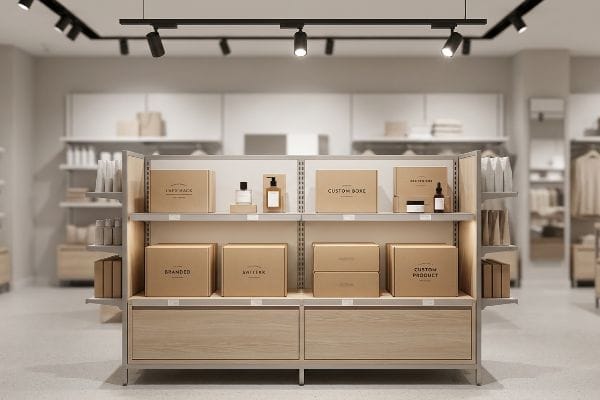
Vous passez des mois à perfectionner votre produit, mais un mauvais emplacement nuit aux ventes. Les magasins sont des lieux impitoyables où des dimensions non optimisées mènent directement à l'arrière-boutique plutôt qu'à la caisse.
L'aménagement des points de vente consiste en la planification stratégique des espaces commerciaux physiques afin d'optimiser la circulation des clients et la visibilité des produits. Il combine ingénierie structurelle, psychologie comportementale et respect rigoureux des contraintes spatiales pour garantir une intégration harmonieuse du mobilier dans les allées existantes, tout en influençant positivement les décisions d'achat des consommateurs sans créer de difficultés logistiques.
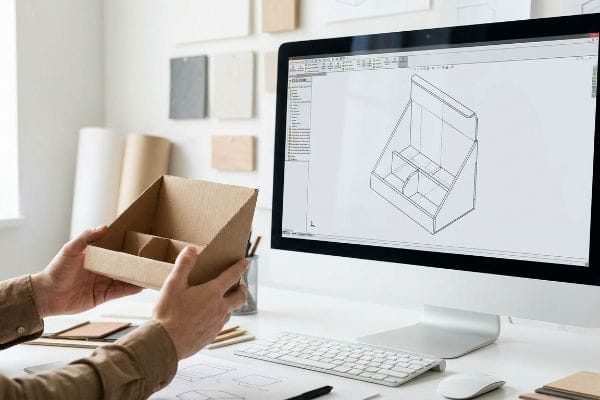
Connaître la configuration théorique n'est que le point de départ. Pour que votre présentoir soit homologué par les grandes chaînes, il faut traduire ces plans d'ensemble en une réalité structurelle d'une précision millimétrique.
Comment les détaillants choisissent-ils l'aménagement de leurs magasins ?
Les grandes chaînes de magasins ne se fient pas aux préférences esthétiques ; elles appliquent des calculs logistiques rigoureux. Chaque mètre carré de surface de vente est régi par des manuels de conformité stricts conçus pour optimiser le flux de clientèle.
Les détaillants conçoivent leurs magasins en fonction de directives légales strictes et de cadres d'efficacité logistique. Les grandes chaînes privilégient des agencements qui permettent d'accueillir en toute sécurité les palettes standard de la GMA (Grocery Manufacturers Association) et qui respectent les normes d'accessibilité précises, garantissant ainsi que les zones de vente à fort trafic génèrent un chiffre d'affaires maximal au mètre carré sans risques opérationnels.
On pourrait croire qu'un excellent design graphique garantit le placement au sol, mais la conformité physique détermine si l'on atteint un jour l'allée.
Pourquoi la contrainte spatiale ADA vs GMA dicte le placement
Même les équipes marketing les plus expérimentées proposent souvent une conception « modulable » où un grand présentoir de point de vente peut être réduit de moitié pour servir de comptoir de caisse .Elles partent du principe que l'homogénéité esthétique est la seule chose qui importe au détaillant. Or, elles ignorent complètement les règles juridiques et spatiales strictes qui régissent ces deux zones distinctesdans le commerce de détail nord-américain.
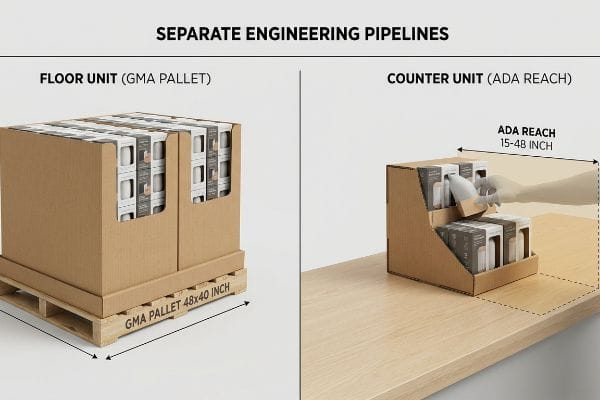
Dans mon atelier, je reçois constamment des fichiers graphiques imprimés de haute qualité qui tentent de forcer une adaptation forcée aux dimensions souhaitées. Réduire la taille d'un présentoir de sol ne respecte pas la plage de portée avant de 38,1 à 121,9 cm (15 à 48 pouces) exigée par l'ADA (Americans with Disabilities Act) pour les comptoirs. Je me souviens d'un client qui a essayé cette méthode : le présentoir de caisse obtenu était tellement encombrant qu'on entendait le bruit du carton ondulé raclant le sol lorsque les vendeurs le repoussaient furieusement du comptoir. Je sépare définitivement les processus techniques : les présentoirs de sol sont strictement limités aux dimensions des palettes GMA (121,9 × 101,6 cm / 48 × 40 pouces) pour les charges dynamiques, tandis que les présentoirs de comptoir sont mathématiquement contraints aux limites de portée. Cela évite les refacturations massives et garantit que les responsables de magasin déploieront effectivement votre campagne, vous évitant ainsi un taux de vente catastrophique.
| Erreurs courantes des débutants | La solution pro | Avantage du magasin |
|---|---|---|
| Unités de plancher rétractables pour comptoirs | Séparation des processus d'ingénierie ADA et GMA | Empêche le rejet du détaillant |
| Ignorer les limites de portée avant de l'ADA | Maintenir les zones interactives à une distance de 15 à 48 pouces (38,1 à 121,9 cm) | Garantit une interaction client accessible |
| Dépassant la base en bois | Fixation des unités de plancher sur des palettes de 48×40 pouces (121,9×101,6 cm) | Élimine les risques liés à la circulation dans les allées |
Je refuse de laisser mes clients dans l'incertitude quant à la conformité spatiale. En dissociant clairement les contraintes logistiques liées aux palettes des limites d'accessibilité au niveau du comptoir, je garantis que votre présentoir passera avec succès les contrôles d'approbation du détaillant et sera disponible en rayon.
🛠️ Le bureau de Harvey : Vous hésitez sur la conformité de votre unité réduite aux normes REACH ? Envoyez-moi vos dimensions et je les comparerai aux spécifications des grandes enseignes avant impression. 👉 Demander un audit spatial ↗ — Accès direct à mon bureau. Zéro spam commercial automatisé, promis.
Qu’est-ce que le concept de design de vente au détail ?
La philosophie de base va au-delà de l'image de marque ; elle se concentre sur l'ergonomie humaine. Les environnements de vente efficaces anticipent précisément la façon dont le regard et les mains du consommateur moyen parcourent naturellement les allées d'un magasin.
Le concept d'aménagement des points de vente repose sur la conception de points de contact physiques qui captent naturellement l'attention du consommateur. Il associe les présentoirs aux données biométriques humaines, en privilégiant un placement stratégique des produits à hauteur de regard naturelle afin de fluidifier le parcours d'achat, d'accélérer la reconnaissance de la marque et d'influencer directement les achats impulsifs en rayon.

Une palette de couleurs magnifique ne sert à rien si la structure physique oblige le client à se tordre le cou pour lire votre message principal.
Atteindre la « zone de frappe » à hauteur humaine
Les responsables marketing ont souvent tendance à optimiser l'espace vertical des présentoirs en carton ondulé, plaçant leurs logos les plus importants ou leurs produits phares tout en haut d'une banderole de 182,8 cm (72 pouces). Ils partent du principe que les grands présentoirs captent naturellement davantage l'attention dans un magasin bondé. Malheureusement, ce raisonnement ignore la réalité biométrique du consommateur moyen qui déambule dans une allée fréquentée.
Il faut tenir compte de la posture d'un client poussant un chariot métallique lourd. Si on l'oblige à regarder brusquement vers le haut ou vers le bas, il passe son chemin. Je vois des marques reléguer leurs meilleures références au bas des présentoirs, obligeant les clients à fouiller à l'aveuglette et transformant un bac en carton en désordre dès midi. J'applique systématiquement la « carte thermique de la hauteur humaine », en plaçant les articles à plus forte marge dans la « zone cible », située précisément entre 127 et 137,1 cm du sol. Lorsque j'ajuste le gabarit d'un client pour positionner le produit phare dans cette zone ergonomique optimale, l'interaction devient fluide, ce qui accélère considérablement la rotation des stocks et préserve la marge bénéficiaire.
| Erreurs courantes des débutants | La solution pro | Avantage du magasin |
|---|---|---|
| Placer les logos principaux trop haut | Centrer les graphiques à 50-54 pouces (127-137,1 cm)4 | Capte l'attention naturelle au niveau des yeux |
| Stocker les articles à forte marge à bas prix | Déplacer les références premium vers le niveau intermédiaire | Réduit les efforts de recherche et de flexion inconfortables |
| Ignorer la posture de poussée de chariot | Inclinaison des étagères inférieures vers le haut de 15 degrés5 | Permet de garder les articles du bas bien visibles |
Je conçois systématiquement l'agencement de vos produits en fonction des données biométriques humaines. Viser la zone cible de 137,1 cm (54 pouces) n'est pas qu'une question d'esthétique ; c'est une stratégie structurelle éprouvée qui transforme directement le passage des clients en ventes immédiates.
🛠️ Le bureau de Harvey : Vos produits à plus forte marge sont-ils accidentellement invisibles pour le consommateur moyen ? 👉 Obtenez votre analyse structurelle ↗ — Téléchargement sécurisé. Ma boîte de réception reste ouverte si vous avez des questions.
Quels sont les quatre principaux types d'agencement de magasins de détail ?
Les configurations en grille, à chevrons, en boucle et en flux libre dominent le secteur. Quel que soit le motif choisi par un détaillant, l'encombrement au sol de son présentoir promotionnel doit s'intégrer harmonieusement sans entraver la circulation.
Les quatre principaux types d'agencement de magasins sont la grille, la boucle, le flux libre et le chevron. Ces configurations architecturales distinctes déterminent la circulation des clients dans les allées, obligeant les marques à concevoir des présentoirs fractionnés sur mesure qui s'adaptent aux contraintes spécifiques des intersections sans obstruer les passages ni enfreindre les normes strictes de sécurité incendie.
Comprendre le plan d'ensemble est utile, mais le véritable combat consiste à se battre pour la part qui vous est allouée dans ce bien immobilier de premier choix.
Survivre à la grille avec une géométrie de palette fractionnaire
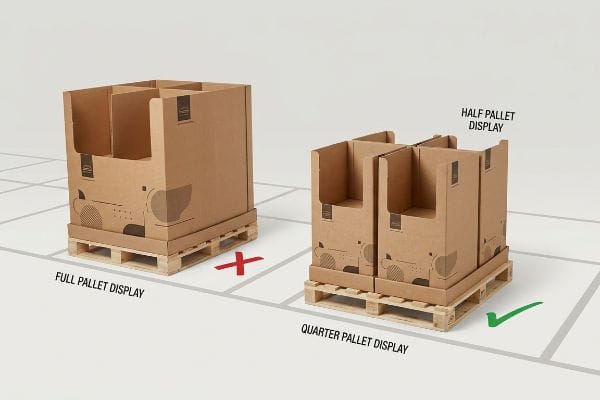
Les marques émergentes proposent souvent aux acheteurs des grandes surfaces des présentoirs de sol imposants, partant du principe que leur lancement de produit nécessite l'occupation d'un socle en bois standard entier pour marquer les esprits. Elles conçoivent ces structures volumineuses en imaginant une flexibilité infinie dans l'agencement du magasin. En réalité, dans une disposition rigide en grille ou en boucle, l'espace disponible dans les allées est strictement limité au centimètre près .
Imaginez l'espace de vente comme un parking de luxe : impossible d'y garer un camping-car. Il m'arrive souvent que des clients arrivent paniqués, car le responsable du magasin a catégoriquement refusé leur présentoir monolithique de 121,9 × 101,6 cm (48 × 40 pouces) sous prétexte qu'il bloquait un passage stratégique. On ressent alors la résistance du carton ondulé épais lorsque les vendeurs sont obligés de démonter manuellement un présentoir tout simplement trop large pour l'allée. Pour remédier à cela, je subdivise mathématiquement la campagne en « fractionnaires de palettes », en concevant des quarts de palette de 60,9 × 50,8 cm (24 × 20 pouces) ou des demi-palettes de 121,9 × 50,8 cm (48 × 20 pouces). Cette géométrie permet à deux marques distinctes de partager parfaitement un même support, optimisant ainsi la densité de vente tout en garantissant un emplacement promotionnel stratégique sans contraintes logistiques.
| Erreurs courantes des débutants | La solution pro | Avantage du magasin |
|---|---|---|
| Déposer uniquement des palettes complètes | Nous proposons des options de quart et de demi-palette | Augmente les chances d'approbation de l'acheteur |
| Blocage des intersections principales du réseau | Empreintes au sol de 24 × 20 pouces (60,9 × 50,8 cm)8 | Maintient un dégagement conforme des voies d'accès pour les pompiers |
| En supposant une surface au sol infinie | Partage d'une base GMA standard9 | Optimise l'immobilier commercial fortement rationné |
Je conçois des présentoirs de grande surface qui optimisent l'espace de vente. Grâce à des dimensions précises et compactes, je vous propose un outil modulaire qui s'intègre facilement à tous les plans d'aménagement, évitant ainsi tout refus de la part des distributeurs.
🛠️ Le bureau de Harvey : Votre dernier présentoir imposant a-t-il été refusé par l’acheteur car il bloquait l’allée ? Je peux le repenser pour qu’il occupe une surface réduite conforme aux normes. 👉 Demandez votre audit d’agencement ↗ — Pas de formulaires interminables qui génèrent des appels commerciaux à n’en plus finir. Uniquement de la valeur ajoutée.
Quelle est la hauteur d'un magasin de détail ?
Bien que les plafonds des entrepôts puissent dépasser six mètres de hauteur, la hauteur utile pour la présentation des produits est strictement limitée. Votre aménagement doit pouvoir supporter les contraintes liées au transport depuis le quai de chargement de l'usine jusqu'à l'allée concernée.
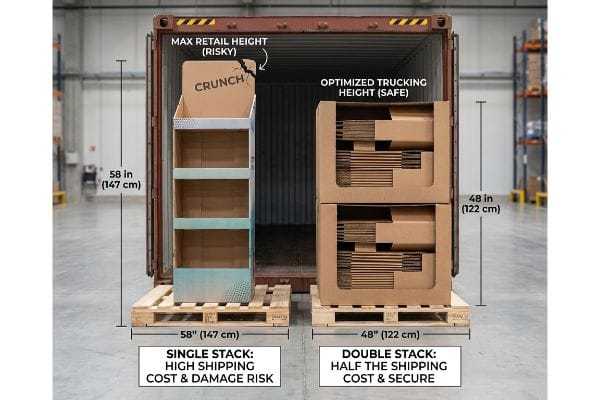
Les limites de hauteur en magasin imposent des contraintes strictes sur les dimensions des présentoirs, limitant leur installation en fonction des contraintes logistiques de transport plutôt que de la hauteur sous plafond. Les présentoirs doivent généralement ne pas dépasser 150 cm de hauteur pour éviter tout risque de basculement et garantir leur passage en toute sécurité dans les semi-remorques à double étage lors du déchargement.
Mais connaître la théorie ne suffit pas lorsque les machines se mettent en marche et que les camions de marchandises arrivent au quai de chargement.
Pourquoi les butées verticales standard échouent-elles en usine ?
Les agences de design conçoivent souvent de magnifiques présentoirs imposants, optimisant au maximum l'espace vertical autorisé en magasin, et se concentrent exclusivement sur l'aspect visuel sous éclairage. Elles partent du principe que si un magasin autorise un présentoir de 152,4 cm (60 pouces)¹⁰, il convient de concevoir un caisson de cette hauteur précise. Or, ce modèle CAO (Conception Assistée par Ordinateur), parfaitement théorique, ignore les contraintes physiques du réseau logistique tiers chargé de la livraison.
Il ne s'agit pas que de théorie : je constate ce problème en atelier lorsque des unités entièrement assemblées ne peuvent pas être chargées. Dans mon entrepôt, je rencontre régulièrement des problèmes de découpe lorsque la hauteur du carton d'expédition final atteint 139,7 cm (55 pouces). Lorsque j'intègre ces dimensions dans mon logiciel de palettisation, je constate qu'il est impossible de les empiler deux par deux dans un conteneur maritime standard de 40 pieds HQ ou une remorque nationale¹¹,ce qui oblige l'équipe logistique à expédier des milliers de pieds cubes d'air vide. Lorsqu'on tente de forcer un carton d'expédition surdimensionné par une porte de quai, on entend le craquement violent des coins en cannelure B qui se déforment, détruisant instantanément l'intégrité interne lors du test de résistance à la compression des bords¹².Pour éviter cela, j'applique rigoureusement la « limite de hauteur de chargement », plafonnant artificiellement la hauteur totale des palettes expédiables à moins de 121,9 à 127 cm (48 à 50 pouces). En supprimant ce gaspillage vertical et en repensant la carte d'en-tête pour qu'elle se plie à plat, je vous garantis que vous pourrez empiler vos marchandises en toute sécurité, réduisant ainsi de moitié vos coûts d'expédition longue distance et éliminant complètement les dommages liés au transport.
| Erreurs courantes des débutants | La solution pro | Avantage du magasin |
|---|---|---|
| Conception optimisée pour la hauteur maximale du magasin | Conception adaptée à la hauteur des remorques à double étage13 | Réduit considérablement les frais de transport de marchandises |
| En-têtes de grande hauteur expédiées entièrement assemblées | En-têtes d'ingénierie à replier à plat | Empêche le basculement du poids vers le haut pendant le transport |
| Gaspillage de l'espace vertical des conteneurs | Coiffage des palettes à 50 pouces (127 cm)14 | Optimise le nombre d'unités par chargement de camion |
Je ne conçois pas seulement pour l'espace de vente ; je conçois aussi pour le transport routier. En imposant mathématiquement des limites de hauteur strictes pour le transport, je préserve l'intégrité de votre structure tout en réduisant considérablement vos frais de transport.
🛠️ Le bureau d'Harvey : Connaissez-vous la hauteur totale exacte de votre emballage palettisé avant son chargement dans le camion ? 👉 Envoyez-moi votre fichier de gabarit ↗ — Je vérifierai vos calculs avant que vous n'investissiez dans une production en série.
Conclusion
Vous pouvez choisir un fournisseur moins cher, mais si ce présentoir surdimensionné et non conforme se déforme sous la pression du camion, vous risquez un refus immédiat du détaillant et l'anéantissement total de la marge bénéficiaire de votre campagne. Voici la fiche technique exacte utilisée par mes 10 principaux clients du secteur de la distribution pour garantir zéro refus d'impression. Ne vous laissez plus aller à des approximations concernant les tolérances verticales : laissez-moi analyser personnellement vos fichiers de structure grâce à mon Audit gratuit de transport et d'espace ↗ afin de détecter les erreurs dimensionnelles critiques avant le lancement de la production en série.
« Chapitre 9 : Éléments intégrés – Access-Board.gov », https://www.access-board.gov/ada/chapter/ch09/. [Les normes ADA et les codes du bâtiment relatifs au commerce de détail précisent des exigences distinctes en matière de hauteur et de dégagement pour les comptoirs de caisse accessibles par rapport aux autres agencements d’espace de vente]. Rôle de la preuve : validation technique ; type de source : norme juridique. Appuie : l’affirmation selon laquelle des réglementations spécifiques empêchent la simple mise à l’échelle des agencements entre différentes zones de vente. Note de portée : spécifique aux lois d’accessibilité nord-américaines .
« [PDF] Ergonomie et conception : Guide de référence », https://ehs.oregonstate.edu/sites/ehs.oregonstate.edu/files/pdf/ergo/ergonomicsanddesignreferenceguidewhitepaper.pdf . [Les normes industrielles en matière de merchandising de détail définissent la hauteur optimale des yeux pour maximiser la visibilité et l’accessibilité pour le consommateur]. Rôle de la preuve : spécification technique ; type de source : directives de conception de points de vente. Appui : la mesure précise de la hauteur optimale des étagères. Note de portée : Les recommandations de hauteur peuvent varier légèrement en fonction des données biométriques du public cible.
« Analyse de la rotation des stocks comme indicateur de performance… – MDPI », https://www.mdpi.com/2227-9717/7/10/760. [Des études sur le comportement du consommateur montrent que la réduction des frottements physiques lors de la prise de produits est corrélée à une augmentation de la vitesse des ventes]. Rôle de la preuve : lien de causalité ; type de source : étude sur le comportement du consommateur. Confirme : la relation entre l’agencement ergonomique et le taux de rotation des stocks. Remarque : les résultats peuvent varier selon qu’il s’agit d’achats impulsifs ou planifiés .
« L’équation ergonomique – Ergotron », https://www.ergotron.com/en-us/ergonomics/ergonomic-equation. Les normes ergonomiques du secteur de la conception de points de vente spécifient la « zone de contact » pour les éléments graphiques à hauteur des yeux, en fonction de la taille moyenne d’un adulte, afin d’optimiser l’engagement visuel. Preuve : spécification technique ; type de source : étude ergonomique. Éléments à prendre en compte : hauteur optimale de placement du logo. Remarque : basé sur les mesures de la taille moyenne d’un adulte .
« L’avenir de la visibilité en rayon : comment la science du commerce de détail et… », https://www.inuru.com/post/shelf-visibility-future-retail-2030 . Les recommandations en matière de merchandising visuel et d’ingénierie commerciale suggèrent des angles d’inclinaison spécifiques pour les étagères inférieures afin d’améliorer la visibilité pour les clients. Type de preuve : spécification technique ; type de source : manuel de conception commerciale. Objectif : améliorer la visibilité des étagères inférieures. Précision: s’applique spécifiquement aux étagères du bas.
« Dimensions standard des palettes : liste complète – Nelson Company », https://www.nelsoncompany.com/blog-post-industry-standard-pallet-sizes-a-complete-list.cfm. [Les normes industrielles relatives aux palettes d’expédition et de présentation, telles que la norme GMA, définissent les dimensions fixes des socles en bois standard utilisés dans la grande distribution]. Rôle de la preuve : spécification technique ; type de source : norme logistique. Appui : définition de l’emprise au sol d’un présentoir. Remarque sur la portée : concerne principalement les normes de palettes nord-américaines .
« Guide de conception de magasins – Agencement, idées et stratégies – TruRating », https://trurating.com/blog/how-to-design-a-retail-store-layout/. [Les guides professionnels de planification des commerces et les normes de sécurité incendie précisent les tolérances exactes pour la largeur des allées afin de maintenir la fluidité de la circulation et les issues de secours]. Rôle de la preuve : vérification opérationnelle ; type de source : manuel de gestion de commerce ou code de sécurité. Appuie : l’affirmation selon laquelle l’espace des allées est strictement limité. Note de portée : s’applique aux environnements de vente au détail organisés utilisant des planogrammes .
« [PDF] Voies d’évacuation incendie – Ville de San Antonio », https://www.sa.gov/files/assets/main/v/1/safd/documents/fire-lane-info-ifc.pdf. [Une source faisant autorité en matière de codes de sécurité incendie ou de directives de gestion des commerces de détail permettrait de vérifier si les dimensions de ces installations sont conformes aux exigences minimales d’évacuation]. Rôle de la preuve : vérification technique ; type de source : code réglementaire. Appuie : le lien entre l’emprise au sol de l’installation et la conformité aux normes de sécurité. Remarque : les codes de sécurité incendie peuvent varier selon les juridictions .
« Palette américaine GMA. Dimensions, types et bien plus encore. », https://acrosslogistics.com/blog/en/american-pallet-gma. [Les normes industrielles de la Grocery Manufacturers Association (GMA) spécifient les dimensions uniformes des palettes d'expédition utilisées pour l'aménagement des surfaces de vente]. Rôle de la preuve : spécification technique ; type de source : norme industrielle. Appui : utilisation de palettes standardisées pour l'optimisation de l'espace. Remarque sur le champ d'application : principalement applicable à la logistique de détail nord-américaine .
« Hauteur moyenne des étagères de vente au détail – Magasin Great Northern », https://www.greatnortherninstore.com/2022/01/choosing-retail-display-height/ . [Une norme industrielle ou un manuel de conception de points de vente spécifie les contraintes de hauteur courantes pour les présentoirs de points de vente afin de garantir la visibilité et la sécurité ] . Rôle de la preuve : spécification technique ; type de source : guide industriel. Appuie : limites verticales courantes dans le commerce de détail. Remarque : les limites exactes peuvent varier selon le détaillant ou le format du magasin.
« Conteneur intermodal – Wikipédia », https://en.wikipedia.org/wiki/Intermodal_container. [Un guide logistique faisant autorité sur les dimensions des conteneurs ISO confirme que la hauteur intérieure d'un conteneur High Cube de 40 pieds est d'environ 106 pouces, rendant impossible le double empilage d'unités de 55 pouces de hauteur]. Rôle de la preuve : Spécification technique ; type de source : Norme de l'industrie du transport maritime. Justifie : Contraintes logistiques liées à la hauteur des aménagements. Note relative au champ d'application : S'applique aux conteneurs maritimes ISO standard .
« Le rôle du flambage dans l’estimation de la résistance à la compression de… », https://pmc.ncbi.nlm.nih.gov/articles/PMC7602429/. [Les normes d’ingénierie de l’emballage définissent l’essai d’écrasement des bords (ECT) comme la principale mesure de la résistance à l’empilement du carton ondulé, en précisant que le flambage des coins entraîne une perte catastrophique de la capacité de charge verticale]. Rôle de la preuve : Principe technique ; type de source : Manuel d’ingénierie de l’emballage. Sujets : Défaillance structurelle des emballages surdimensionnés. Note de portée : Spécifique aux matériaux en carton ondulé .
« Dimensions et capacités des semi-remorques bâchées : 53′, 48′, + 40′… – Hale Trailer », https://haletrailer.com/blog/dry-van-dimensions-capacities/. [Un manuel de logistique ou de transport faisant autorité fournit les dimensions standard de hauteur intérieure des semi-remorques à double étage afin d’optimiser la capacité de chargement. Niveau de preuve : spécification technique ; type de source : norme industrielle. Appui : contraintes de conception pour le transport. Remarque : Applicable aux semi-remorques bâchées standard américaines.] ↩
« Expédition et dimensions standard des palettes », https://ntslogistics.com/knowledge_base/pallet-shipping-dimensions/. [La documentation relative à l'expédition et à la logistique confirme qu'une hauteur de palette de 50 pouces permet un empilage double efficace dans les remorques de hauteur standard afin d'optimiser le nombre d'unités par chargement. Type de preuve : mesure quantitative ; type de source : manuel de logistique. Objectif : optimisation du fret. Remarque : basé sur les dimensions standard des palettes de 48 × 40 pouces.] ↩