Les marques me demandent souvent comment protéger leurs présentoirs en magasin sans compromettre leurs objectifs de développement durable. La solution réside généralement dans la maîtrise de la chimie des finitions de surface.
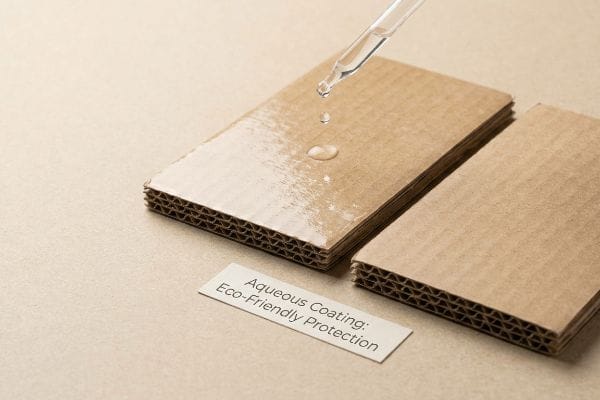
Le vernis aqueux est une finition liquide transparente à base d'eau, à séchage rapide, appliquée sur le carton ondulé imprimé. Il protège les emballages des salissures, des taches et des empreintes digitales, tout en étant entièrement recyclable. Ce traitement de surface écologique offre un fini brillant ou mat discret, sans recourir à des laminations plastiques nocives à base de pétrole.
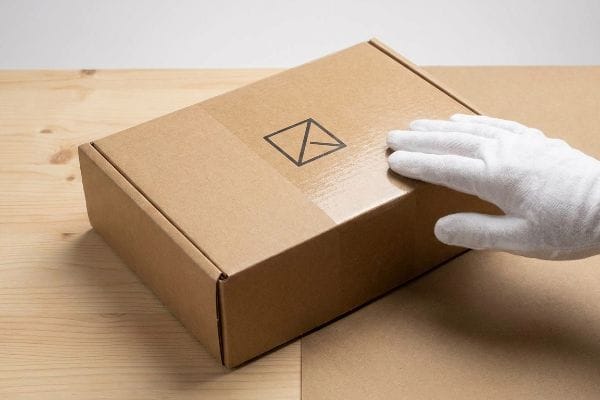
Il est essentiel de comprendre cette barrière chimique avant de finaliser vos spécifications d'impression, car un mauvais choix aura des répercussions sur votre logistique et la conformité de vos détaillants.
Que signifie « revêtement aqueux » ?
Lors de l'évaluation des finitions protectrices, les acheteurs se basent souvent sur des hypothèses chimiques obsolètes qui compromettent leur mise en vente.
Le revêtement aqueux consiste à utiliser un liquide polymère à base d'eau pour sceller et protéger les surfaces imprimées des emballages. Il forme une barrière invisible contre les éraflures pendant le transport. Grâce à l'utilisation d'eau plutôt que de composés organiques volatils comme liant, il sèche rapidement et respecte pleinement l'environnement.
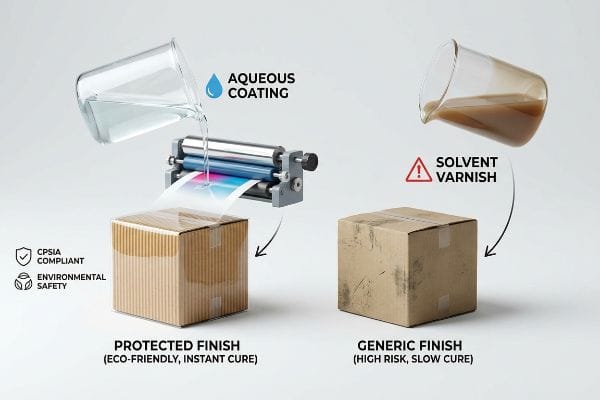
En nous éloignant de la définition chimique de base, nous devons examiner comment cette finition se comporte lorsqu'elle est soumise aux réalités physiques brutales du conditionnement et du transport.
La réalité de la conformité à la CPSIA et des transporteurs de produits chimiques
Lors de mes audits des cahiers des charges clients, je constate fréquemment que les équipes d'approvisionnement spécifient des vernis protecteurs génériques sans vérifier leur composition chimique. Elles partent du principe que n'importe quel vernis transparent suffira à sceller efficacement leurs présentoirs de sol. Ce raisonnement théorique ignore totalement les exigences strictes de conformité chimique imposées par les grandes enseignes de distribution américaines¹,notamment pour les produits alimentaires, d'hygiène ou pour enfants. L'utilisation d'une finition non réglementée et riche en solvants transforme un présentoir pourtant sûr en un véritable danger.
Ce n'est pas qu'une simple théorie : je le constate en test lorsque des marques tentent d'imposer des vernis bon marché à base de solvants sur ma presse lithographique 6 couleurs. Les équipes d'approvisionnement recherchent souvent une réduction de coût de 1,5 % en optant pour des vernis génériques, sans tenir compte de leur impact chimique. Lors d'une récente préproduction pour une marque de produits de santé, les émanations du vernis générique spécifié ont dépassé nos seuils de tolérance olfactive, atteignant un taux inacceptable de 4,2 parties par million d'émissions de composés organiques volatils (COV). Je suis immédiatement intervenu et l'ai remplacé par un revêtement AQ (aqueux) à base d'eau, associé à des encres à base de soja conformes à la loi CPSIA (Consumer Product Safety Improvement Act). Mon matériel d'impression a permis un séchage rapide en ligne du solvant aqueux, laissant une couche protectrice de polymère acrylique impeccable et inodore. En imposant cette tolérance chimique précise à 100 % à base d'eau, je garantis une accélération du délai de conditionnement en évitant les jours de dégazage forcé, ce qui permet aux clients d'économiser des milliers d'euros en pénalités de retard tout en garantissant que les présentoirs réussissent les audits de sécurité les plus stricts dès la première fois.
| Terminer le système métrique | Vernis à solvant générique | Revêtement AQ technique |
|---|---|---|
| Base porteuse | Composés organiques volatils2 | Formule 100% à base d'eau3 |
| Audit des détaillants | Risque élevé de rejet | Conformité garantie aux normes de sécurité CPSIA4 |
| Vitesse de guérison | Chronologie de dégazage plus lente | Séchage instantané en ligne |
Je refuse que des produits chimiques toxiques gâchent une conception structurelle brillante. L'utilisation de finitions à base d'eau réglementées garantit à mes clients de ne jamais perdre leur espace de vente en raison d'un manquement à la conformité évitable.
🛠️ Le bureau d'Harvey : Les risques de non-conformité chimique menacent-ils discrètement le déploiement de votre prochain produit dans une grande surface ? 👉 Demandez un audit gratuit des spécifications des matériaux ↗ — J'examine personnellement chaque dossier de structure sous 24 heures.
Quelle est la différence entre un revêtement de film aqueux et un revêtement de film non aqueux ?
Le choix entre les revêtements liquides et les films solides modifie considérablement les performances mécaniques de votre emballage.
La différence entre un revêtement aqueux et un revêtement non aqueux réside dans leur état physique et leur élasticité. Le revêtement aqueux est un liquide qui s'imprègne dans les fibres du papier et sèche à plat, tandis que le revêtement non aqueux est une feuille de plastique solide laminée sur le support, offrant une meilleure résistance à la déchirure mais complexifiant le processus de recyclage.
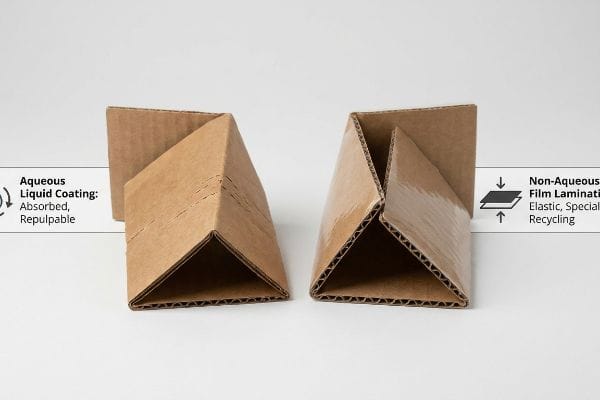
Comprendre cette distinction est essentiel pour concevoir des structures pliables capables de résister à des variations de température extrêmes lors du transport océanique.
Le seuil mécanique de lithographie-fissuration
Un vernis liquide à base d'eau pénètre la couche supérieure du carton poreux⁵,se liant directement aux fibres de papier et à l'encre de soja sous-jacente. À l'inverse, un pelliculage non aqueux applique une couche distincte de polymère sur la feuille imprimée à l'aide d'un adhésif. Ceci crée une barrière solide et très résistante qui augmente considérablement la résistance à la déchirure du supportondulé⁶. Lorsqu'un écran nécessite une protection absolue contre l'eau ou une brillance extrême, ce film plastique offre une barrière qu'un polymère liquide mince ne peut tout simplement pas égaler.
Cependant, le comportement structurel de ces deux finitions diverge nettement lorsqu'elles sont soumises aux contraintes mécaniques de la découpe et du pliage automatisés. Lorsqu'un carton épais 32 ECT (Edge Crush Test) est rainuré et plié à 90 degrés, une finition liquide sèche standard peut se microfissurper sous une tension extrêmenotamment dans les climats très secs ; ce phénomène est connu sous le nom de fissuration lithographique. Afin d'éviter que le papier blanc brut ne soit exposé sous l'encre au niveau des angles vifs, les ingénieurs préconisent souvent un pelliculage élastique anti-fissuration pour les en-têtes ou les plateaux emboîtables. Le film plastique s'étire harmonieusement avec les fibres du papier au lieu de leur résister. En adaptant mathématiquement la flexibilité du film non aqueux à l'épaisseur du carton ondulé, les ingénieurs garantissent un assemblage parfait des présentoirs complexes à plusieurs niveaux sur la ligne de conditionnement, sans compromettre l'esthétique de la marque.
| Propriétés structurelles | Revêtement liquide aqueux | Lamination de film non aqueux |
|---|---|---|
| État physique | Polymère liquide absorbé | Couche de plastique collée solide |
| Élasticité au pliage | Sujet aux microfissures sèches | Grande marge d'étirement et de flexion |
| Profil de recyclage | 100 % repulpable en bordure de trottoir | Nécessite une séparation spécialisée |
Je choisis systématiquement le revêtement en fonction de la complexité du tracé. L'utilisation d'un film élastique adapté, appliqué sur une finition liquide pour les plis structurels marqués, évite les défauts esthétiques et accélère l'assemblage automatisé.
🛠️ Le bureau d'Harvey : Vos emballages en carton pliant se fissurent-ils au niveau des coutures à cause d'une incompatibilité chimique de surface ? 👉 Demandez votre évaluation structurelle gratuite ↗ — Confidentialité garantie à 100 %. Vos maquettes non commercialisées sont en sécurité.
Quelle est la différence entre le PLA et le revêtement aqueux ?
L’emballage durable exige des définitions claires, notamment lorsqu’il s’agit de comparer les bioplastiques aux produits chimiques traditionnels à base d’eau.
La différence entre le PLA et le vernis aqueux réside dans l'origine des matériaux et leur application. Le PLA est un bioplastique solide biodégradable dérivé de l'amidon de maïs, laminé sur du papier. Le vernis aqueux est un polymère liquide à base d'eau, pulvérisé sur l'encre encore humide pour former une couche protectrice recyclable à séchage rapide.
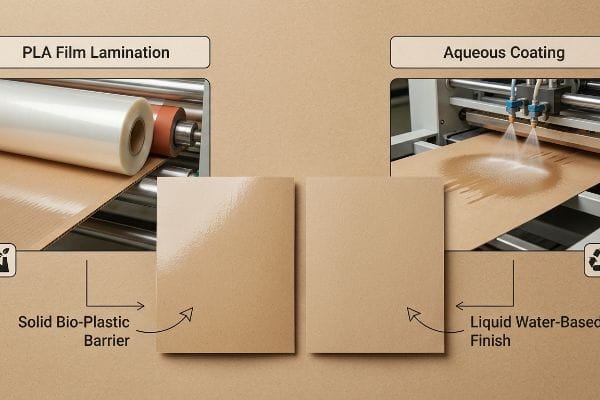
Le choix entre ces deux options écologiques nécessite une analyse approfondie des capacités mécaniques des presses d'imprimerie de votre fournisseur.
La formule de recyclage Soft Touch
Les films PLA (acide polylactique) constituent une barrière bioplastique physique robuste,idéale pour le contact alimentaire grâce à leur excellente résistance à l'humidité. Se présentant sous forme de feuille solide, ils doivent être collés au carton imprimé par thermocollage ou lamination humide. Bien que compostables industriellement, leur présence sur le carton ondulé complexifie les filières de recyclage domestiques classiques. La couche de bioplastique solide peut perturber les machines de tri automatisées et nécessiter des procédés de repulpage spécifiquespour séparer le film des fibres de papier brutes.
Une finition liquide à base d'eau repose sur un principe mécanique totalement différent, notamment pour la conception de finitions tactiles haut de gamme telles que le toucher doux ou le velours. Au lieu de laminer une feuille de bioplastique solide, des presses lithographiques de pointe appliquent un revêtement liquide à haute viscosité directement sur les encres humides. L'évaporation de l'eau sous des lames d'air chaud laisse des polymères caoutchoutés microscopiques qui s'intègrent parfaitement à la structure du papier. On obtient ainsi le toucher suédé haut de gamme requis pour les cosmétiques de luxe ou les écrans électroniques, sans ajout de lamelle solide distincte. Grâce à cette méthode liquide, les ingénieurs garantissent un recyclage à 100 % en collecte sélective, permettant à l'ensemble de la structure de se décomposer naturellement dans les centres de recyclage de papier classiques, tout en préservant l'image de marque premium.
| Métrique des éco-matériaux | Lamination de film PLA | Revêtement aqueux |
|---|---|---|
| Format du matériau | plastique solide d'origine végétale | dispersion liquide à base d'eau10 |
| Méthode d'application | collage thermique hors ligne | Pulvérisation en ligne et séchage à la chaleur |
| Fin de vie | Compostage industriel requis11 | rénovation résidentielle standard12 |
Je privilégie la pureté des matériaux utilisés. L'emploi de dispersions liquides avancées plutôt que de biofilms solides permet à mes clients d'obtenir des finitions tactiles luxueuses sans engendrer de pénalités en matière de développement durable pour les distributeurs.
🛠️ Le bureau d'Harvey : Vos emballages sont-ils involontairement disqualifiés des programmes d'homologation des grands distributeurs en raison de la présence de films plastiques invisibles ? 👉 Obtenez un audit gratuit de vos matériaux en fin de vie ↗ — Aucun intermédiaire. Vous échangez directement avec des ingénieurs en structure.
Quelle est la différence entre un revêtement aqueux et un revêtement UV ?
Pour maximiser l'impact visuel, il est essentiel de comprendre comment les différentes technologies de séchage modifient l'adhérence physique et la réflexion de votre écran.
La différence entre un vernis aqueux et un vernis UV réside dans leur méthode de séchage et leur coefficient de frottement. Le vernis aqueux sèche par évaporation de l'eau, offrant une finition subtile et résistante aux rayures. Le vernis UV, quant à lui, sèche instantanément sous l'effet des rayons ultraviolets, créant une surface extrêmement brillante et ultra-lisse qui rehausse considérablement l'éclat et le contraste des couleurs.
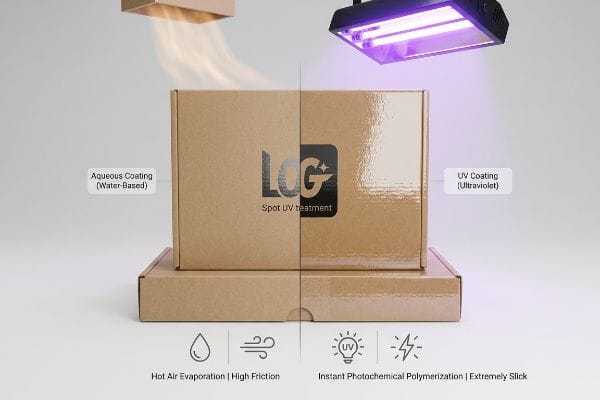
Si la finition brillante est du plus bel effet à l'écran, son extrême douceur engendre de graves problèmes logistiques lors du transport de palettes en vrac.
Le risque de friction lié au durcissement aux ultraviolets
Les finitions UV (ultraviolettes) offrent les niveaux de brillance les plus élevés possibles en impression commerciale, transformant l'encre standard en une surface semblable à du verre. Ce résultat est dû aux photo-initiateurs contenus dans le liquide, qui polymérisent et durcissent instantanément en une couche solide de type plastique dès la milliseconde d'exposition aux lampes ultraviolettes intenses. Ce durcissement immédiat élimine le temps de séchage et offre une protection impénétrable contre les rayures. À l'inverse, une finition à base d'eau sèche beaucoup plus lentement par évaporation de l'air , ce qui donne une surface microscopiquement poreuse, légèrement plus douce au toucher et nettement moins réfléchissante sous un éclairage commercial intense.
Cependant, la surface extrêmement lisse, semblable à du verre, d'une finition ultraviolette modifie considérablement le coefficient de frottement de surfaced' une structure en carton ondulé, ce qui représente un danger important lors de la logistique. Lors de la conception de plateaux empilables ou de bacs à alimentation par gravité, les ingénieurs comptent sur l'adhérence naturelle du papier pour empêcher les niveaux empilés de glisser de la palette lors du freinage d'un chariot élévateur. Si une marque opte pour un vernis ultraviolet brillant recouvrant toute la base, le coefficient de frottement chute brutalement. Sous la charge dynamique d'une palette de 121,9 × 101,6 cm (48 × 40 pouces) en mouvement, ces boîtes lisses se comportent comme des patins à glace, provoquant des déplacements de charge catastrophiques et l'effondrement des niveaux. Pour pallier ce problème, j'utilise une approche hybride : un traitement ultraviolet sélectif est appliqué uniquement sur les logos de la marque en façade pour un impact visuel maximal, tandis que la base et les languettes d'emboîtement sont recouvertes d'une finition mate à base d'eau à haute adhérence afin de maintenir les unités empilées en toute sécurité.
| Propriétés du revêtement | Finition à base d'eau | Finition ultraviolette |
|---|---|---|
| Mécanisme de guérison | Évaporation de l'air chaud16 | polymérisation photochimique17 |
| Coefficient de frottement | Adhérence optimale pour un empilage stable | Extrêmement glissant et dangereux18 |
| Impact visuel | Fini mat subtil ou satiné | Brillant maximal semblable à du verre |
Je ne sacrifie jamais la stabilité structurelle pour une surface brillante. L'association d'un marquage sélectif à haute brillance avec des bases structurelles à haute adhérence garantit la résistance de la palette au transport tout en lui permettant de se démarquer dans les rayons.
🛠️ Le bureau d'Harvey : Vos cartons d'expédition ultra-brillants glissent-ils des palettes et causent-ils d'importants dégâts dans votre entrepôt ? 👉 Demandez un calcul gratuit du coefficient de frottement ↗ — J'examine personnellement chaque dossier de structure sous 24 h.
Conclusion
Utiliser un revêtement chimique inadapté nuit non seulement à votre image de marque, mais compromet également la stabilité de vos palettes et entraîne des non-conformités immédiates avec les distributeurs en raison des émanations toxiques. Le mois dernier, mon audit structurel a permis à trois marques d'éviter plus de 10 000 $ de pertes liées à la mise au rebut des stocks et aux refacturations des distributeurs. Si vous craignez que votre revêtement chimique actuel ne résiste pas aux contraintes extrêmes du transport ou aux audits de sécurité des grandes surfaces, je vous propose d'analyser gratuitement vos fichiers structurels (spécifications des matériaux et analyse de la friction) afin de garantir vos marges.
« Produits pour enfants | CPSC.gov », https://www.cpsc.gov/Business–Manufacturing/Business-Education/Childrens-Products . [Une source faisant autorité sur les normes de vente au détail ou la réglementation CPSIA permettrait de vérifier les exigences spécifiques en matière de sécurité chimique des emballages pour ces catégories de produits]. Rôle de la preuve : vérification factuelle ; type de source : ligne directrice réglementaire. Appuie : exigences de conformité pour la vente au détail. Note sur la portée : se concentre sur la réglementation américaine en matière de vente au détail.
« COV en suspension dans l’air intérieur provenant des revêtements à base d’eau – PMC – NIH », https://pmc.ncbi.nlm.nih.gov/articles/PMC12734227/ . [Les données environnementales et chimiques confirment que les vernis traditionnels à base de solvants utilisent des composés organiques volatils (COV) comme principal vecteur d’évaporation ] . Type de preuve : fait chimique ; type de source : données techniques EHS. Appui : comparaison des vecteurs. Remarque : les niveaux de COV peuvent varier selon le solvant utilisé.
« [PDF] GUIDE DES REVÊTEMENTS AQUEUX – Fujifilm », https://asset.fujifilm.com/master/americas/files/2020-03/ddf86f4fdba06e415a7c184160fea61f/AqueousCoatingGuide.pdf . [Les spécifications techniques chimiques confirment que les revêtements aqueux techniques utilisent l'eau comme principal vecteur de résine]. Rôle de la preuve : définition technique ; type de source : manuel de génie chimique. Éléments à prendre en compte : composition du matériau. Remarque : concerne le solvant vecteur et non la structure du polymère durci.
« Loi sur l’amélioration de la sécurité des produits de consommation (CPSIA) | CPSC.gov », https://www.cpsc.gov/Regulations-Laws–Standards/Statutes/The-Consumer-Product-Safety-Improvement-Act . [Une source faisant autorité en matière de réglementation sur la sécurité des produits de consommation permettrait de vérifier comment les formulations à base d’eau respectent les seuils de plomb et de phtalates exigés par la Loi sur l’amélioration de la sécurité des produits de consommation]. Rôle de la preuve : validation réglementaire ; type de source : réglementation gouvernementale. Appuie : allégations de sécurité en vente au détail. Note de portée : la conformité dépend de la formulation chimique spécifique du revêtement.
« Comprendre et améliorer la barrière huile-eau… – PMC », https://pmc.ncbi.nlm.nih.gov/articles/PMC9379909/ . [La littérature scientifique sur les matériaux et les technologies de revêtement explique comment les finitions à base d’eau utilisent la capillarité pour s’infiltrer dans les fibres cellulosiques poreuses]. Rôle de la preuve : explication technique ; type de source : manuel universitaire. Éléments justifiant le mécanisme de liaison. Précision : spécifique aux finitions à base d’eau.
« Résistance à la déchirure des matériaux d’empreinte non aqueux – PubMed », https://pubmed.ncbi.nlm.nih.gov/6582097/ . [Les données d’ingénierie de l’emballage fournissent des comparaisons quantitatives montrant que le laminage par film polymère augmente significativement la résistance à la déchirure du carton ondulé par rapport aux revêtements aqueux ]. Rôle de la preuve : vérification ; type de source : spécification technique. Appui : allégation de performance mécanique. Note de portée : s’applique aux substrats laminés polymères.
« Revêtements aqueux pour blisters : la nouvelle norme en matière d’emballage sous carte », https://corkindustries.com/aqueous-blister-coatings-the-new-standard-in-carded-packaging/ . [Les guides techniques d’emballage expliquent comment les revêtements aqueux perdent de leur flexibilité en climat sec, ce qui entraîne des microfissures lors du pliage.] Rôle de la preuve : vérification technique ; type de source : manuel d’ingénierie de l’emballage. Justification : défaillance mécanique des finitions liquides. Note relative au champ d’ application : s’applique spécifiquement aux conditions de faible humidité.
« Synthèse des propriétés barrières du poly(acide lactique)/argile… – PMC – NIH », https://pmc.ncbi.nlm.nih.gov/articles/PMC7285356/. [Données techniques sur le taux de transmission de la vapeur d’eau (MVTR) et les performances barrières de l’acide polylactique dans les emballages alimentaires]. Niveau de preuve : spécification technique ; type de source : revue scientifique des matériaux. Appui : efficacité barrière du PLA. Note de portée : étude portant sur la résistance à l’humidité comparée à celle d’autres bioplastiques .
« Faire progresser le recyclage du plastique : défis et opportunités… », https://pmc.ncbi.nlm.nih.gov/articles/PMC10575100/. [Études expliquant comment les revêtements bioplastiques interfèrent avec le tri par proche infrarouge (NIR) et les procédés chimiques spécifiques nécessaires à la séparation du PLA et des fibres de cellulose]. Rôle des preuves : analyse des procédés ; type de source : rapport sur la gestion des déchets. Sujets abordés : difficultés liées au recyclage. Note de portée : spécifique aux infrastructures de recyclage mécanique .
« Dispersion aqueuse et composition de revêtement la comprenant », https://patents.google.com/patent/WO2015157950A1/en. [Les spécifications chimiques confirment que les revêtements aqueux sont constitués de particules de polymère dispersées dans l'eau et non dans des solvants organiques]. Rôle de la preuve : définition technique ; type de source : manuel de génie chimique. Supports : Format des matériaux des revêtements aqueux. Note de portée : Classification chimique générale .
« Matériaux à base de PLA/PHB entièrement biodégradables dans les deux conditions… – PMC », https://pmc.ncbi.nlm.nih.gov/articles/PMC9572414/. [Une source faisant autorité sur les bioplastiques confirmerait que le PLA nécessite les conditions spécifiques de haute température des installations de compostage industriel pour se biodégrader]. Rôle de la preuve : vérification factuelle ; type de source : revue scientifique sur les matériaux. Appuie : exigences de fin de vie du PLA. Note de portée : fait la distinction entre le compostage industriel et le compostage domestique .
« [PDF] Guide SPC : Comment savoir si votre emballage papier est recyclable », https://sustainablepackaging.org/wp-content/uploads/2023/01/SPC_Paper-Pkg-Report_FINAL.pdf. [Les normes industrielles de recyclage du papier confirment que les revêtements aqueux peuvent être éliminés lors du procédé d’hydropulpage standard dans les filières de recyclage municipales]. Rôle de la preuve : vérification technique ; type de source : lignes directrices de l’industrie du recyclage. Appui : Recyclabilité des revêtements aqueux. Note de portée : S’applique aux dispersions aqueuses standard .
« Photopolymérisation radicalaire pour le durcissement de produits de finition… », https://pmc.ncbi.nlm.nih.gov/articles/PMC9324147/ . [Un manuel technique sur la chimie de l'impression explique comment les photo-initiateurs déclenchent une polymérisation rapide sous l'effet des rayons UV]. Rôle de la preuve : Mécanisme technique ; type de source: Manuel technique. Éléments justificatifs : Le processus chimique du durcissement UV. Note de portée : Spécifique aux résines durcissables aux UV.
« Différences entre les revêtements aqueux et UV – Cork Industries », https://corkindustries.com/differences-between-aqueous-and-uv-coatings/. [Les spécifications industrielles des revêtements aqueux décrivent l’évaporation de l’eau comme principal mécanisme de séchage]. Rôle de la preuve : Description du procédé ; type de source : Fiche technique du matériau. Éléments d’appui : Le mécanisme de séchage des finitions à base d’eau. Note de portée : Comparaison basée sur la vitesse de polymérisation .
« Essais de coefficient de frottement | Centre d'emballage et de charge unitaire… », https://www.unitload.vt.edu/facilities/corrugated-packaging-lab/cof-testing.html . [Une source technique faisant autorité en matière de matériaux d'emballage fournirait le coefficient de frottement comparatif du carton ondulé avec et sans revêtement UV]. Rôle de la preuve : spécification technique ; type de source : revue scientifique sur les matériaux. Appuie : l'affirmation selon laquelle les revêtements UV réduisent l'adhérence. Note sur la portée: porte sur les propriétés physiques du revêtement.
« WO2004069428A1 – Procédé de séchage rapide des peintures à l'eau », https://patents.google.com/patent/WO2004069428A1/en . [Les guides d'impression industriels décrivent comment les revêtements aqueux utilisent l'élimination de l'eau par la chaleur et la circulation d'air pour obtenir la finition]. Rôle de la preuve : vérification du procédé ; type de source : manuel d'impression industrielle. Supports : mécanisme de séchage des finitions à base d'eau. Note de portée : décrit le processus de séchage physique.
« Polymérisation UV – Wikipédia », https://en.wikipedia.org/wiki/UV_curing. [Une source technique sur la chimie des polymères expliquerait comment la lumière ultraviolette initie une réaction chimique pour réticuler les monomères en un polymère solide]. Rôle de la preuve : définition technique ; type de source : manuel de chimie ou norme industrielle. Appuie : mécanisme de polymérisation de finition UV. Note de portée : se réfère spécifiquement à la phase d’initiation de la polymérisation UV .
« Les 5 principaux facteurs influençant l’adhérence des revêtements », https://www.croccoatings.com/top-5-factors-affecting-slip-resistance-in-coatings/ . [Les données scientifiques sur les matériaux ou les rapports de sécurité documentent le faible coefficient de frottement associé aux revêtements UV brillants et les risques de glissade qui en résultent]. Rôle de la preuve : vérification de la sécurité ; type de source : étude technique ou fiche de données de sécurité. Sujet : risque de frottement des finitions UV. Note de portée : se réfère à l’interaction physique entre les surfaces UV polymérisées.