Vous investissez des milliers d'euros dans le développement de vos produits, et pourtant, les clients passent devant sans même les remarquer. L'écart entre un excellent produit et une vente conclue se résume presque toujours à un problème de visibilité.
Les clients apprécient les présentoirs en magasin car ils captent immédiatement l'attention et simplifient leurs décisions d'achat dans les allées encombrées. En structurant efficacement la présentation des produits, ces points de contact physiques réduisent les obstacles cognitifs, permettant aux acheteurs d'interagir facilement avec la marchandise et de satisfaire directement leurs envies d'achat impulsif dans les environnements commerciaux classiques.

Sans un merchandising structuré pour attirer l'attention, votre produit n'est qu'une boîte de plus cachée sur une étagère métallique encombrée.
Quel est l'objectif des présentoirs de vente au détail ?
La conception d'un présentoir de vente au détail nécessite de comprendre précisément comment les clients se déplacent physiquement dans les allées.
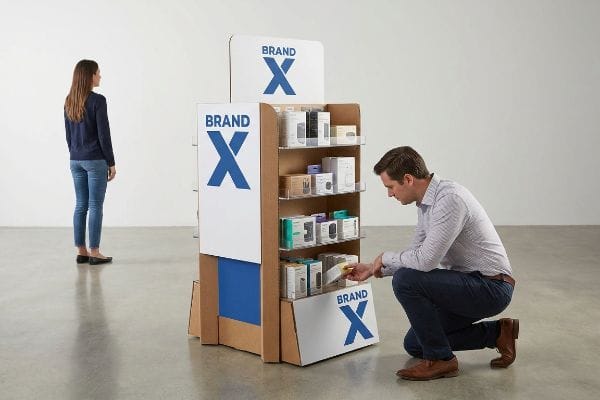
L'objectif des présentoirs en magasin est de stimuler les ventes dans les allées à fort passage. Ces structures conçues attirent l'attention du consommateur de loin, l'informent à mi-chemin et offrent un accès tactile intuitif pour les achats impulsifs, optimisant ainsi la visibilité des produits et l'espace de vente global.
Comprendre cet objectif théorique ne signifie rien si l'on ne tient pas compte des distances physiques en jeu dans un magasin réel.
La stratégie d'engagement spatial 3-3-3
Nombre de marques émergentes conçoivent leurs présentoirs en se basant uniquement sur des écrans d'ordinateur rétroéclairés. Elles approuvent des visuels complexes qui paraissent magnifiques à soixante centimètres de distance, ignorant complètement le fait qu'une allée de grande surface est un environnement spatial immense et extrêmement concurrentiel.
C’est précisément là que je vois les campagnes marketing échouer. Un designer m’envoie un fichier magnifique, mais surchargé de texte, qui enfreint totalement la règle des 3-3-3 en matière d’engagement clientvente¹. Cette règle stipule que le marchandiseur doit capter l’attention à 9,14 m (360 pouces), susciter l’intérêt à 0,91 m (36 pouces) et inciter à la prise en main à 7,62 cm (3 pouces). Je reçois fréquemment des fichiers conçus exclusivement pour la zone des 7,62 cm. Lorsque nous imprimons une maquette physique, le client se retrouve à plisser les yeux devant un visuel CMJN (Cyan, Magenta, Jaune, Noir) délavé, sous un éclairage fluorescent agressif, et réalise que le message principal est invisible de loin. Pour remédier à cela, j’oblige les marques à isoler leur logo principal à l’aide d’une couleur Pantone unie et à découper de manière drastique le bord avant du produit afin de garantir une visibilité de 85 %² pour une prise en main optimale.
| Erreurs courantes des débutants | La solution pro | Avantage du magasin |
|---|---|---|
| Conçu exclusivement pour une observation rapprochée | Appliquer la règle spatiale 3-3-3 | Capte l'attention à 360 pouces (9,14 m)3 |
| Utilisation de l'impression standard en quadrichromie pour les logos | Appliquer des aplats de couleur Pantone4 | Élimine le grain des demi-teintes à distance |
| Bords hauts retenant dissimulant l'objet | Découper les lèvres pour un dégagement visuel de 85 %5 | Augmente les prises impulsives immédiates |
Je ne laisse jamais un client approuver un PDF sans me tenir physiquement à 9 mètres d'un prototype imprimé pour vérifier que le point focal structurel fonctionne.
🛠️ Le bureau d'Harvey : Vos couleurs de marque sont-elles délavées par l'éclairage agressif des grandes surfaces ? 👉 Demandez un audit gratuit de vos gabarits ↗ — Accès direct à mon bureau. Zéro spam commercial automatisé, promis.
Pourquoi les présentoirs sont-ils si importants dans un environnement de vente au détail ?
Un magasin physique, c'est un véritable déluge de messages marketing qui se disputent l'attention du consommateur.
Les présentoirs sont essentiels en vente au détail car ils permettent de lutter efficacement contre la surcharge cognitive des consommateurs. En mettant en valeur les offres marketing principales grâce à des structures physiques à fort contraste, ils structurent les rayons et facilitent la circulation. Ce merchandising visuel stratégique garantit que les produits suscitent des achats impulsifs avant même que les consommateurs ne passent devant la zone promotionnelle ciblée sans s'y attarder.
Éliminer ce chaos visuel exige une discipline rigoureuse lors de la phase d'ingénierie structurelle.
Comment éviter le piège de la surcharge cognitive
Les responsables marketing des marques élaborent souvent des profils de consommateurs complexes, en cartographiant les occasions saisonnières, les cibles démographiques et les caractéristiques détaillées des produits. Ils tentent ensuite d' imprimer chaque élément de cette étudedirectement sur les parois extérieures de leurs présentoirs de point de vente.
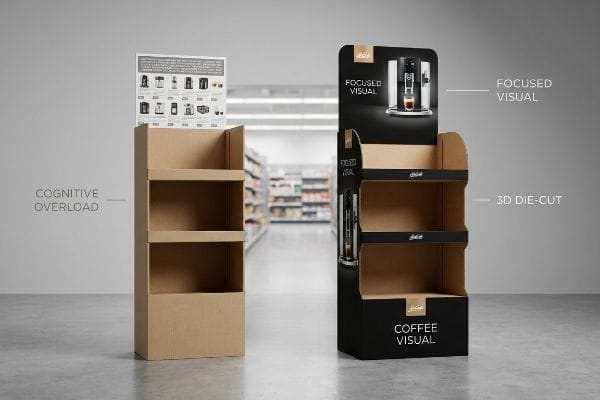
Même les équipes marketing les plus expérimentées tombent dans le piège de la surcharge cognitive. Elles tentent de transformer un présentoir temporaire en carton ondulé en un manuel d'instructions indigeste. J'ai moi-même constaté, dans les rayons des magasins, le bruit incessant des chariots qui passaient en trombe devant ces présentoirs surchargés de texte, car les consommateurs pressés sont incapables de traiter des paragraphes entiers en trois secondes<sup>7</sup>. Pour éviter cela, je supprime les éléments marketing secondaires et conçois une bannière 3D découpée à l'emporte-pièce. En isolant un seul élément visuel à fort contraste<sup>8</sup>, nous activons instantanément la psychologie de l'acheteur. Si le présentoir nécessite plus d'un coup d'œil pour comprendre l'offre principale, il ne parviendra pas à attirer les clients.
| Erreurs courantes des débutants | La solution pro | Avantage du magasin |
|---|---|---|
| Impression de paragraphes de texte de fond | Isoler une seule offre visuelle centrale | Prévient la surcharge cognitive des consommateurs9 |
| Cartes d'en-tête plates et génériques | Points focaux découpés en 3D par l'ingénieur | Crée une perturbation visuelle immédiate10 |
| Cibler plusieurs profils d'acheteurs | Concentrez-vous strictement sur une seule occasion d'achat | Accélère les conversions physiques11 |
Je supprime systématiquement 60 % du texte proposé par une marque sur ses gabarits avant la production en série, simplement pour éviter que sa campagne ne soit complètement ignorée.
🛠️ Le bureau de Harvey : Vos visuels actuels surchargent-ils l’attention des clients pressés ? 👉 Découvrez comment nous optimisons les visuels ↗ — Téléchargement sécurisé. Ma boîte de réception reste ouverte si vous avez des questions.
Quels sont les 4 P du merchandising visuel ?
Le succès du lancement d'un produit exige une parfaite maîtrise des mécanismes commerciaux standards.
Les quatre P du merchandising visuel représentent le Produit, le Prix, la Place et la Promotion. Ce cadre commercial fondamental détermine la manière dont les stocks physiques sont présentés, positionnés de façon économique, placés géographiquement dans le magasin et commercialisés activement afin de s'intégrer parfaitement aux mécanismes opérationnels spécifiques de la grande surface choisie.
Il est impossible de mener à bien une campagne sans adapter la structure physique à l'empreinte géographique spécifique du détaillant.
Alignement de la matrice du cadre de vente au détail
Les nouveaux fournisseurs partent souvent du principe qu'un produit de qualité se vendra de lui-même, quel que soit son emplacement. Ils conçoivent un présentoir unique et générique et tentent de livrer exactement le même modèle à un immense entrepôt et à une petite épicerie de quartier.
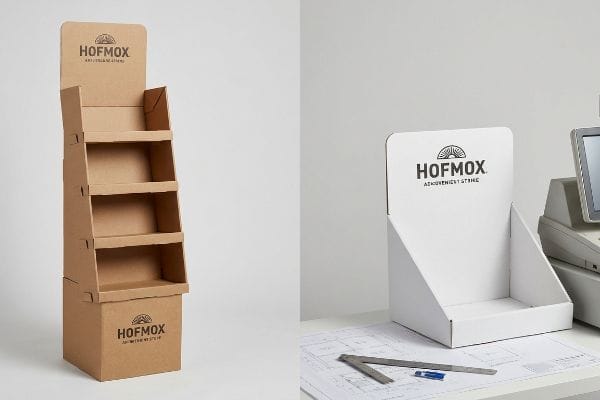
Cette approche standardisée contrevient totalement au principe fondamental du merchandising, à savoir l'emplacement. J'ai vu des gérants de magasin refuser catégoriquement des livraisons parce qu'une marque tentait d'imposer un présentoir autoportant (FSDU) de taille standard dans un magasin qui n'accepte que des plateaux de comptoir de 30 cm conformes aux normes d'accessibilité . On ressent aisément la forte résistance physique lorsqu'un vendeur essaie de forcer un socle en carton ondulé surdimensionné dans une allée étroite. Avant même de découper une seule feuille de carton, j'analyse en profondeur la campagne de la marque en fonction des contraintes d'espace spécifiques de chaque distributeur. En adaptant l'encombrement au modèle opérationnel du magasin, nous éliminons totalement les refus de livraison.
| Erreurs courantes des débutants | La solution pro | Avantage du magasin |
|---|---|---|
| Taille structurelle unique | Associer l'empreinte des magasins à des types de magasins spécifiques13 | Élimine les refus de quai |
| Ignorer les limites de hauteur des registres | Appliquer la conformité à la loi ADA en matière de portée avant14 | Maintient les produits en sécurité dans la zone de frappe |
| Négliger la métrique « Lieu » | Adaptez l'affichage au flux de circulation dans les allées | S'intègre parfaitement aux opérations en magasin |
Je sépare rigoureusement mes processus d'ingénierie en fonction des catégories de détaillants afin de garantir que votre déploiement physique ne soit jamais économiquement incompatible avec le magasin.
🛠️ Le bureau de Harvey : Réduisez-vous la taille de vos présentoirs au sol sans tenir compte de leur centre de gravité ? 👉 Faites un audit de conformité spatiale ↗ — Pas de formulaires qui déclenchent des appels commerciaux interminables. Uniquement de la valeur ajoutée.
Quelles sont les 7 règles du merchandising ?
Le respect des règles de structure garantit que vos produits arrivent en toute sécurité en rayon et attirent activement l'attention des consommateurs.
Les sept règles du merchandising régissent l'exécution optimale en magasin, englobant le placement stratégique des UGS (unités de gestion des stocks), la tension visuelle asymétrique, les réapprovisionnements sans friction, la gestion stricte des couleurs, la conformité aux normes ADA, la stabilité dynamique de la charge et l'engagement immédiat du consommateur afin de garantir une rentabilité maximale sur le lieu de vente et une valeur de marque maximale.
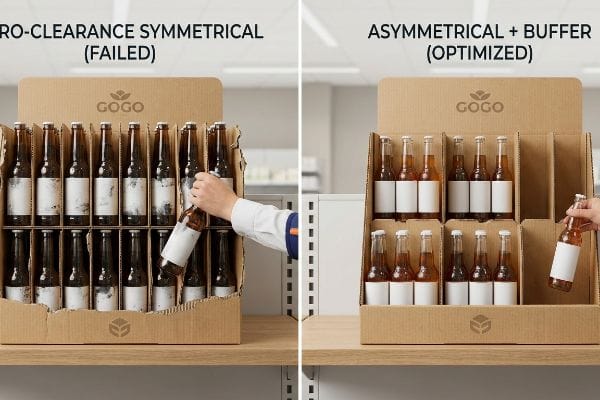
Créer un présentoir pour accueillir des produits à partir d'un fichier de conception statique est facile, mais voici la dure réalité lorsque vous expédiez 500 unités pré-remplies dans un écosystème de vente au détail en constante évolution.
Pourquoi les agencements symétriques échouent-ils en usine ?
Les équipes d'approvisionnement partent souvent du principe qu'un rangement optimal des marchandises dans une grille parfaitement symétrique garantit un retour sur investissement maximal. Elles divisent mathématiquement la largeur d'une étagère en carton ondulé par la largeur exacte de leurs bouteilles, ne laissant aucun espace vide. Si cette méthode paraît très efficace sur un dessin CAO (Conception Assistée par Ordinateur), elle engendre un goulot d'étranglement logistique considérabledès que les stocks physiques sont mis en contact avec les emballages.
Ce n'est pas qu'une simple théorie : je le constate sur le terrain lorsqu'un client exige une densité maximale. Une grille parfaitement dense ne laisse absolument aucune marge de manœuvre pour les opérations de réapprovisionnement rapides en magasin. Lorsque je mesure l'espace entre les produits sur ces plateaux surchargés, il est souvent inférieur à 2,79 mm. Lors de nos essais de préproduction, j'observe les vendeurs peiner à faire passer les pots en verre au-delà du rebord serré. On entend le craquement caractéristique du papier test 32ECT (Edge Crush Test)16 qui se déchire lorsqu'ils forcent les pots en verre au-delà du rebord de retenue.
J'effectue les mesures au micromètre et démontre qu'il est nécessaire d'abandonner la grille symétrique. J'applique plutôt la règle d'asymétrie 3-5-7<sup>17</sup>, en intégrant des séparateurs modulaires pour regrouper les produits en nombre impair. En calculant mathématiquement un espacement minimal absolu de 6,35 mm (0,25 pouce)<sup>18</sup> entre les groupes, nous éliminons le blocage. Ceci crée une présentation visuellement attrayante pour le client tout en réduisant le temps d'assemblage du conditionnement d'environ 42 secondes par unité, ce qui permet aux clients d'économiser des milliers d'euros en frais de main-d'œuvre directe et d'éviter les présentoirs endommagés.
| Erreurs courantes des débutants | La solution pro | Avantage du magasin |
|---|---|---|
| Emballage symétrique à jeu nul | Injecter une couche tampon de 0,25 pouce (6,35 mm)19 | Prévient les déchirures des lèvres ondulées de rétention |
| Grilles de produits à nombre pair | Appliquer les groupes asymétriques 3-5-720 | Crée une tension visuelle pour capter l'attention des acheteurs |
| En négligeant les frottements physiques liés au réapprovisionnement, | Utiliser des séparateurs modulaires flottants pour les références SKU21 | Accélère le réapprovisionnement des rayons en magasin |
Je refuse d'optimiser un plateau uniquement pour la densité de chargement si cela garantit que le vendeur détruira votre présentoir rien qu'en essayant de le charger.
🛠️ Conseils d'Harvey : Un défaut structurel de 2 millimètres ne doit pas compromettre le déploiement dans 500 magasins. 👉 Envoyez-moi votre fichier de gabarit ↗ — Je vérifierai la robustesse des calculs avant que vous n'investissiez votre budget dans une production de masse.
Conclusion
Vous pouvez choisir l'imprimeur le moins cher, mais si une mise en page trop dense engendre des problèmes de réapprovisionnement importants, vous entendrez inévitablement le bruit des rouleaux de testliner 32ECT qui se cassent, ralentissant la chaîne de production d'environ 30 % et provoquant des refus immédiats de la part des détaillants. Plus de 500 responsables de marque utilisent ma checklist prépresse pour éviter précisément ces erreurs fatales en début de production. Ne laissez plus les marges de sécurité au hasard : laissez-moi analyser personnellement la géométrie de votre projet grâce à mon Audit de découpe gratuit ↗ afin de détecter ces blocages invisibles avant qu'ils ne ruinent la rentabilité de votre campagne.
« Sujet 120-3-3 : RÈGLES ET RÉGLEMENTATIONS POUR… – GA R&R », https://rules.sos.ga.gov/gac/120-3-3. Vérification des indicateurs de distance spécifiques associés à la règle 3-3-3 pour l’engagement spatial en point de vente. Rôle de la preuve : spécification technique ; type de source : norme industrielle ou manuel de conception. Appuie : seuils d’engagement basés sur la distance. Note de portée : spécifique au merchandising physique en point de vente .
« Comment améliorer la visibilité en point de vente grâce aux présentoirs PLV », https://www.industrialpackaging.com/blog/increased-retail-visibility . Confirmation de la norme sectorielle relative au pourcentage minimal de visibilité des produits dans la conception des présentoirs de vente au détail afin de faciliter la prise en main. Type de preuve : validation métrique ; source : guide de merchandising. Éléments pris en compte : exigences de conception pour les languettes de maintien. Remarque concernant la portée : peut varier selon la catégorie de produits.
« L’importance de la règle des 3 pour vos présentoirs personnalisés », https://mcintyredisplays.com/blog/custom-store-displays/. Vérification des mesures de distance spécifiques associées à la stratégie d’engagement spatial 3-3-3 en merchandising de détail. Rôle de la preuve : vérification de la mesure ; type de source : guide de conception de points de vente. Éléments pris en compte : distances d’engagement visuel. Note de portée : spécifique à la stratégie 3-3-3 .
« Impression en tons directs vs quadrichromie – Pantone », https://www.pantone.com/articles/technical/spot-vs-process-color?srsltid=AfmBOopUofVREFhXE_r3RnQnJuGakHf9MjUAkLiPKepU0ux9sh37iJo5 . Explication technique de la manière dont les aplats de tons directs permettent d'éviter le grain des trames dans l'impression grand format pour le commerce de détail, améliorant ainsi la lisibilité à distance. Rôle de la preuve : validation technique ; type de source : norme de l'industrie de l' imprimerie. Contribue à : la qualité d'impression pour les écrans. Note sur la portée : se concentre sur la clarté visuelle des grands formats.
« 14 types de présentoirs de vente au détail | Chicago, IL – Wertheimer Box », https://wertheimerbox.com/types-of-retail-displays/ . Données probantes concernant la corrélation entre la hauteur du rebord de l'étagère, le pourcentage de visibilité du produit et les taux d'achats impulsifs. Rôle des données probantes : appui empirique ; type de source : étude du comportement du consommateur ou manuel de marchandisage. Appuie : indicateurs d'accessibilité des produits. Note sur la portée : concerne la géométrie physique du présentoir.
« L’impact de la surcharge informationnelle des plateformes de commerce électronique sur… », https://pmc.ncbi.nlm.nih.gov/articles/PMC9265496/. Études sur le principe « moins, c’est plus » en signalétique commerciale et le coût cognitif d’une information excessive sur les présentoirs PLV. Rôle des preuves : validation d’un écueil de conception ; type de source : étude universitaire. Appuie : l’affirmation selon laquelle les spécialistes du marketing surchargent les murs d’affichage. Note de portée : merchandising visuel .
« Exploration du comportement de navigation et du niveau d'attention des consommateurs avec… », https://pmc.ncbi.nlm.nih.gov/articles/PMC6895988/. Une source faisant autorité en matière de comportement du consommateur ou de neuromarketing fournirait des données empiriques sur le temps limité que les consommateurs consacrent à consulter les présentoirs sur le lieu de vente. Rôle des preuves : vérification factuelle ; type de source : étude sectorielle ou universitaire. Appuie : l'affirmation selon laquelle un excès de texte entraîne une surcharge cognitive dans le commerce de détail. Note sur la portée : se concentre sur les environnements de vente au détail à forte fréquentation .
« Comment le merchandising visuel influence le comportement d'achat », https://blog.vomela.com/how-visual-merchandising-influences-buying-behavior-strategies-for-retail-graphics . Les recherches en perception visuelle et en psychologie cognitive confirment que les indices à contraste élevé réduisent la charge cognitive et facilitent le traitement rapide de l'information. Type de preuve : validation technique ; source: revue de psychologie à comité de lecture. Conclusion : l'efficacité d'un merchandising visuel minimaliste à contraste élevé. Précision : l'étude porte sur le traitement visuel pré-attentif.
« Préférences des consommateurs pour les paniers alimentaires en situation de charge cognitive – PMC », https://pmc.ncbi.nlm.nih.gov/articles/PMC8997493/. Les recherches en psychologie du consommateur démontrent qu'un excès d'informations dans les points de vente accroît la charge cognitive et nuit à la prise de décision. Type de preuve : mécanisme causal ; type de source : revue scientifique. Conclusion : avantage de mettre en avant les offres principales plutôt que de se perdre dans un texte long. Précision : concerne spécifiquement la fatigue décisionnelle au point de vente .
« Efficacité des présentoirs sur le lieu de vente : quels sont les avantages de… », https://www.vanguardpkg.com/point-of-purchase-display-effectiveness-what-are-the-benefits-of-pop-displays/. Des études sur la saillance visuelle indiquent que les éléments tridimensionnels perturbent plus efficacement les schémas visuels génériques que la signalétique 2D pour attirer l’attention. Rôle de la preuve : mécanisme technique ; type de source : étude de conception. Appuie : l’utilisation de découpes 3D pour créer des points focaux. Note sur la portée : se concentre sur le suivi oculaire et les mesures de l’attention .
« Comment augmenter les conversions en magasin – MRI Software », https://www.mrisoftware.com/blog/how-to-increase-conversions-in-retail/ . Les données marketing montrent qu’un ciblage précis pour une occasion d’achat unique réduit les obstacles et accélère le parcours client. Élément de preuve : indicateur de performance ; type de source : rapport sectoriel . Confirme : l’affirmation selon laquelle se concentrer sur un profil d’acheteur spécifique augmente la vitesse de conversion. Précision : s’applique aux commerces physiques.
« [PDF] Guide ADA pour les petites entreprises », https://archive.ada.gov/smbusgd.pdf. Ce document explique brièvement comment l’Americans with Disabilities Act (ADA) impose des normes spécifiques d’espace et d’accessibilité pour le mobilier commercial afin de garantir la libre circulation des clients handicapés. Rôle de la preuve : vérification juridique ; type de source : norme réglementaire. Appuie : l’affirmation selon laquelle le mobilier des magasins doit respecter les exigences d’accessibilité de l’ADA. Note relative à la portée : applicable aux environnements de vente au détail américains .
« Solutions de cross-docking pour le commerce de détail | Améliorer les délais de livraison et réduire les coûts de transport… », https://www.odwlogistics.com/resources/retail-cross-docking-solutions-improve-otif-reduce-freight-costs. La documentation relative à la chaîne d'approvisionnement et à la logistique explique comment l'alignement des dimensions des équipements avec l'infrastructure spécifique du magasin permet d'éviter les erreurs de livraison et de réception. Niveau de preuve : bonnes pratiques opérationnelles ; type de source : manuel de logistique. Ce document met en évidence la corrélation entre la cartographie de l'espace disponible et la réduction des rejets de quai. Remarque : la portée varie selon les protocoles opérationnels des chaînes de magasins .
« Normes d’accessibilité de l’ADA – Access-Board.gov », https://www.access-board.gov/ada/. Les directives d’accessibilité officielles de l’ADA précisent les profondeurs et hauteurs maximales d’accès pour les environnements de vente au détail accessibles. Rôle de la preuve : exigence réglementaire ; type de source : réglementation gouvernementale. Justifie : la nécessité technique de respecter les normes d’accessibilité pour les produits. Remarque sur la portée : s’applique spécifiquement aux normes américaines de l’ADA .
« Ce que les dirigeants du secteur de la distribution disent de la généralisation des goulots d'étranglement dans la chaîne d'approvisionnement… », https://www.retaildive.com/news/what-retail-executives-are-saying-about-widespread-supply-chain-bottlenecks/605431/. Brève explication de la manière dont les normes de logistique et de conception industrielle du secteur de la distribution mettent en évidence les limites des agencements sans espace vide lors de la mise en place physique des stocks. Rôle de la preuve : Validation technique ; type de source : Manuel de logistique ou guide de conception pour le commerce de détail. Appuie : L'affirmation selon laquelle l'élimination de l'espace vide entrave le réapprovisionnement physique. Note sur la portée : Concerne spécifiquement la transition des modèles CAO aux présentoirs physiques en carton .
« [PDF] Spécifications du carton ondulé – Fibre Box Association », https://www.fibrebox.org/assets/2025/09/Walmart_Corrugated-Board_Specifications_Automation_Packaging_Standards.pdf. Vérification de la norme d'essai de résistance à la rupture par écrasement des bords (ECT) afin de confirmer la capacité de charge et les seuils de rupture du carton ondulé 32ECT. Rôle de la preuve : spécification technique ; type de source : norme industrielle. Appuie : l'affirmation selon laquelle ce type de matériau est susceptible de se rompre sous une force excessive. Note relative au champ d'application : concerne les matériaux d'emballage en carton ondulé standard .
« La règle des impairs en design d'intérieur : pourquoi les groupes de 3, 5 et 7 fonctionnent », https://www.tidbitsandtwine.com/rule-of-odds-interior-design/. Ouvrage de référence sur les principes du merchandising visuel expliquant la règle des impairs et le regroupement asymétrique pour capter l'attention du consommateur. Niveau de preuve : fondement théorique ; type de source : manuel professionnel. Conclusion : efficacité des regroupements en nombre impair. Portée : application générale au commerce de détail .
« Shorr a tiré parti de ses capacités de co-emballage pour résoudre un problème de goulot d'étranglement dans le secteur des biens de consommation… », https://www.shorr.com/resources/blog/shorr-leveraged-copacking-capabilities-to-resolve-a-cpgs-bottleneck-and-optimize-operations/ . Normes techniques relatives aux dégagements d'emballage et de présentation afin de prévenir le blocage par friction et l'endommagement des matériaux. Niveau de preuve : spécification technique ; type de source : manuel d'ingénierie. Objectif : dégagement optimal pour une efficacité d'assemblage accrue. Remarque : s'applique aux présentoirs modulaires pour la vente au détail.
« Le guide ultime des boîtes en carton ondulé – Shorr Packaging », https://www.shorr.com/resources/blog/ultimate-guide-corrugated-boxes/. Les spécifications techniques des normes d'emballage en carton ondulé vérifient le jeu optimal requis pour éviter la rupture des rabats de retenue pendant le transport. Preuve : spécification technique ; type de source : manuel d'ingénierie de l'emballage. Permet : la mesure précise des zones tampons. Remarque : applicable aux qualités de carton ondulé standard .
« Services et stratégie de merchandising visuel | T-ROC Global », https://trocglobal.com/visual-merchandising/. Des études en psychologie du consommateur et en merchandising visuel démontrent que les regroupements en nombre impair créent une tension visuelle plus forte et un engagement accru par rapport aux grilles symétriques. Base de la preuve : principe psychologique ; type de source : étude de marché en distribution. Confirme l’efficacité du regroupement 3-5-7. Remarque : l’efficacité varie selon la catégorie de produits .
« Emballage prêt à la vente (APV) – Commerce de détail – Smurfit Westrock », https://www.smurfitwestrock.com/products/packaging/retail/retail-ready-packaging. Cette étude, menée dans le cadre de recherches sur la logistique et les opérations de vente au détail, analyse comment les systèmes de séparation modulaires réduisent les frictions et les délais lors du réapprovisionnement. Éléments de preuve : efficacité opérationnelle ; type de source : revue de gestion de la chaîne d’approvisionnement. Conclusion : gain de temps grâce aux séparateurs modulaires. Précision : cette étude concerne spécifiquement la mise en œuvre en magasin .