
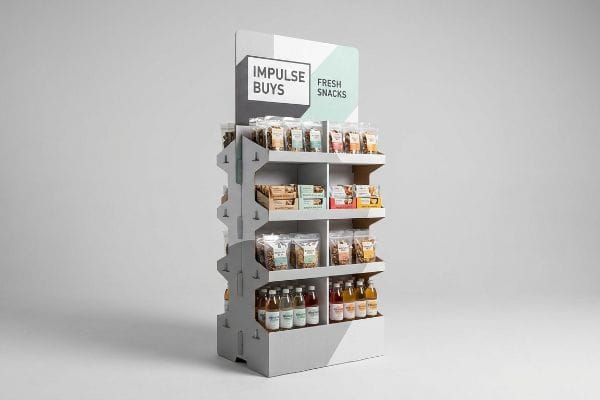
Les marques investissent massivement dans les campagnes marketing en point de vente, mais le simple fait de placer des boîtes en carton dans un rayon ne garantit pas les retours. Un présentoir bien conçu est un vendeur discret et efficace.
Oui. Bien conçus, les présentoirs sur le lieu de vente sont extrêmement efficaces : ils stimulent les achats impulsifs et renforcent la visibilité de la marque. Véritables points de contact stratégiques en magasin, ils captent l’attention du consommateur dans les allées les plus fréquentées, facilitant ainsi la transition entre la simple prise de conscience et l’acte d’achat.

Mais s'appuyer sur la théorie de la conception ne suffit pas ; analysons comment la fabrication physique et l'ingénierie structurelle déterminent réellement votre succès commercial.
Quels sont les avantages et les inconvénients des présentoirs sur le lieu de vente ?
Concilier impact visuel et contraintes de production est notoirement difficile. Un design graphique attrayant ne sert à rien si la structure sous-jacente cède avant même la mise en rayon.
Les avantages d'un présentoir sur le lieu de vente incluent une forte augmentation des ventes impulsives et une communication de marque renforcée. Cependant, des inconvénients majeurs apparaissent lorsque les marques privilégient le coût des matériaux à la solidité de la structure : il en résulte des visuels abîmés, des problèmes logistiques et des campagnes de merchandising ruinées, nuisant ainsi à l'image de marque.

Trouver le juste équilibre entre les avantages et les inconvénients exige une stricte adéquation entre la vision marketing et la réalité physique de la chaîne d'approvisionnement.
Le déséquilibre des « 4 C » : quand les réductions de coûts nuisent à la communication
De nombreuses équipes d'approvisionnement utilisent le modèle des 4 C — Coût, Concept, Commodité et Communication¹—pour orienter le déploiement de leurs points de vente physiques. L'approche classique des débutants consiste à concevoir un concept marketing brillant, puis à isoler drastiquement le pilier « Coût » en éliminant les matériaux de base bon marché. Cela crée un déséquilibre majeur : on attend de matériaux bon marché qu'ils accomplissent des prouesses logistiques complexes.
Je constate régulièrement ce piège : des clients tentent de financer des laminations à feuille coûteuses en optant secrètement pour un substrat de base de qualité inférieure, un simple panneau 26ECT (Edge Crush Test)². Dès que je passe mon micromètre sur cette fine cannelure, je sais que la structure se déformera sous le poids d'une palette lourde, produisant un craquement sourd et distinct lorsque les arches internes s'écraseront. Cela compromet la facilité d'assemblage pour les prestataires logistiques et rend totalement inutilisables les supports marketing en rayon, car les visuels arrivent déformés. Le processus d'assemblage est ainsi ralenti d'environ 30 %³ , ce qui engendre des retours clients coûteux pour les distributeurs.
| Erreurs courantes des débutants | La solution pro | Avantage du magasin |
|---|---|---|
| Réduction de l'ECT pour des raisons esthétiques | Rendre obligatoire l'évaluation unifiée des 4 C | Élimine les refacturations liées aux dommages survenus pendant le transport4 |
| Traiter le coût comme une mesure isolée | Lier la solidité du plateau à la praticité | Gain de 30 % sur le temps d'assemblage5 |
| En négligeant la pression dynamique de charge supérieure | Utilisation de doublures en kraft vierge 32ECT6 | Garantit une communication parfaite en rayon |
Je refuse qu'un simple indicateur de coût compromette le lancement d'une campagne de grande envergure en magasin. Un véritable travail d'ingénierie consiste à trouver un équilibre entre la robustesse de la structure et une esthétique haut de gamme afin de garantir un retour sur investissement rentable pour vos emballages.
🛠️ Le bureau d'Harvey : Vous vous demandez si votre carton de qualité inférieure résistera à un empilage lourd sur palettes ? 👉 Déposez votre fichier ici ↗ — Accès direct à mon bureau. Zéro spam commercial automatisé, promis.
Qu'est-ce qu'un exemple de présentoir sur le lieu de vente ?
Trouver le bon emplacement est essentiel pour être accepté par les grandes enseignes. On ne peut pas se contenter de construire d'immenses bâtiments et espérer que les gérants de magasin cèdent les meilleurs emplacements dans les allées.
Un exemple de présentoir sur le lieu de vente est un présentoir de sol occupant un quart de palette fractionnée. Cette configuration spécifique divise mathématiquement une base logistique standard en bois en quatre zones distinctes, permettant ainsi aux lancements de produits plus modestes de bénéficier d'un emplacement privilégié dans les rayons à fort trafic, sans monopoliser une allée entière du magasin.
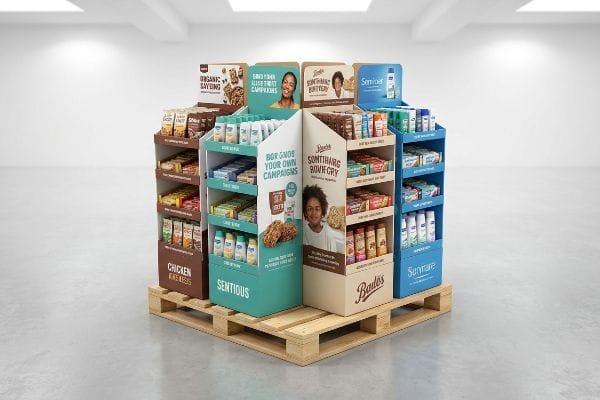
Le choix du bon exemple structurel déterminera si votre campagne parviendra à se retrouver en rayon ou sera rejetée dès la réception.
Vérification de la réalité de la géométrie des palettes fractionnaires
Les marques proposent fréquemment des présentoirs de sol imposants de 1219 x 1016 mm (48 x 40 pouces)qu'une campagne doit occuper tout un espace en bois pour être efficace. Cette approche classique, tout ou rien, empêche les lancements de produits plus modestes d'obtenir un emplacement privilégié aux intersections les plus fréquentées des magasins, car les acheteurs gèrent leur espace de vente avec parcimonie.
Même les concepteurs les plus expérimentés négligent souvent cette contrainte d'espace, créant de magnifiques présentoirs géants de 1219 mm (48 pouces) qu'un acheteur de Costco rejette d'emblée. Je me souviens d'avoir vu, sur un quai de réception, un employé déplacer brutalement un présentoir massif et surdimensionné, le carton brut crissant sur le béton car il bloquait une voie d'accès essentielle pour les pompiers. Ma solution ? Concevoir des présentoirs de grande capacité aux dimensions fractionnaires standard – comme des demi-palettes ou des quarts de palettes – garantissant ainsi que deux ou quatre campagnes promotionnelles distinctes puissent parfaitement partager une même base GMA (Grocery Manufacturers Association) , multipliant la densité au sol et réduisant considérablement l'encombrement lié au transport de marchandises.
| Erreurs courantes des débutants | La solution pro | Avantage du magasin |
|---|---|---|
| Lancer des bases de taille réelle exclusives | Ingénierie des quarts de palettes fractionnaires9 | Garantit un emplacement privilégié dans les allées à fort trafic |
| Ignorer le rationnement spatial des détaillants | Division mathématique de la base GMA10 | Augmente la densité de surface de vente |
| Concevoir des géants de sol surdimensionnés | Partager une seule plate-forme en bois | Empêche les refus instantanés des acheteurs |
Avant même de dessiner le moindre graphique, j'ancre toujours mes fichiers CAO (Conception Assistée par Ordinateur) structurels dans des réalités concrètes. Un prototype, aussi brillant soit-il, ne vaut rien si le détaillant ne peut pas l'intégrer à sa rentabilité.
🛠️ Le bureau de Harvey : Vos présentoirs actuels sont-ils conçus pour partager mathématiquement une seule palette GMA ? 👉 Vérifiez vos spécifications ici ↗ — Téléchargement sécurisé. Ma boîte de réception est ouverte si vous avez des questions.
Que doivent faire les présentoirs PLV efficaces sur le lieu de vente ?
Un point de vente physique réussi doit agir comme un déclencheur psychologique. Il ne s'agit pas simplement d'un contenant ; il doit transformer systématiquement le passage passif en achat actif.
Les présentoirs PLV (Publicité sur le Lieu de Vente) efficaces doivent capter l'attention du consommateur à une distance de neuf mètres, susciter son intérêt spécifique à un mètre et inciter à l'achat final à quelques centimètres. Ils doivent se démarquer de la saturation visuelle et surmonter la surcharge cognitive pour déclencher des achats impulsifs immédiats.

Pour parvenir à cet engagement à plusieurs niveaux, il est nécessaire de respecter scrupuleusement les principes de la psychologie spatiale plutôt que ceux d'une simple conception graphique de base.
La règle d'engagement spatial 3-3-3
Les équipes marketing junior conçoivent souvent des présentoirs exclusivement pour une visualisation rapprochée sur des écrans d'ordinateur rétroéclairés, en trouvant un équilibre parfait entre petits caractères et dégradés subtils. Elles ne comprennent pas comment les clients pressés se déplacent dans les allées sombres et éclairées par des néons, ce qui signifie que sans éléments structurels adaptés aux différentes distances de vision,le présentoir physique se fond dans le décor.
C'est un piège courant qui atteint même les équipes d'approvisionnement les plus expérimentées : elles impriment un mur de texte CMJN (Cyan, Magenta, Jaune, Noir) minuscule, et je vois les clients passer leur chemin sans même y prêter attention. Lorsque j'examine ces fichiers, je choisis immédiatement un de couleur Pantone12 ; il offre le pigment intense et uniforme nécessaire pour une visibilité optimale à 9 mètres, sans les points de trame flous. En isolant rigoureusement l'offre principale et en optimisant la visibilité du produit à 85 %pour une préhension tactile finale de 7,5 cm, je garantis un déclenchement psychologique fluide, augmentant sensiblement le taux de conversion impulsif sans surcoût structurel.
| Erreurs courantes des débutants | La solution pro | Avantage du magasin |
|---|---|---|
| Conception pour les écrans de proximité | Application de la règle spatiale 3-3-314 | Attire l'attention à 9 mètres |
| Utilisation de dégradés CMJN subtils | Inondation de couleurs Pantone unies15 | Empêche le mélange graphique brouillé |
| Cacher des objets derrière de hautes lèvres | Découpe des lèvres pour une visibilité de 85 %16 | Entraîne la conversion physique de 3 pouces |
Je conçois chaque présentoir pour qu'il réponde précisément à cette continuité spatiale. Si votre design ne parvient pas à détourner l'attention d'un client de son parcours prédéfini à une distance de dix mètres, vous payez simplement pour du stockage inutile.
🛠️ Le bureau de Harvey : Vos visuels sont-ils trop chargés visuellement à moins d’un mètre ? 👉 Demandez un audit structurel ↗ — Pas de formulaires qui déclenchent des appels commerciaux incessants. Uniquement de la valeur ajoutée.
Quels sont les avantages de l'affichage PLV ?
La plupart des marques partent du principe que les matériaux permanents garantissent de meilleures performances à long terme, mais elles ignorent complètement les contraintes logistiques liées à la chaîne d'approvisionnement nécessaire au transport de matériel lourd.
Les présentoirs PLV offrent de nombreux avantages, notamment une optimisation considérable de la chaîne logistique et la suppression des pénalités liées au volume du transport. Grâce à l'utilisation de structures temporaires en carton ondulé haute performance, au lieu de supports soudés permanents, les marques peuvent conditionner des milliers d'unités à plat par conteneur, réduisant ainsi drastiquement les coûts logistiques tout en répondant aux exigences de charge dynamique élevées du commerce de détail.
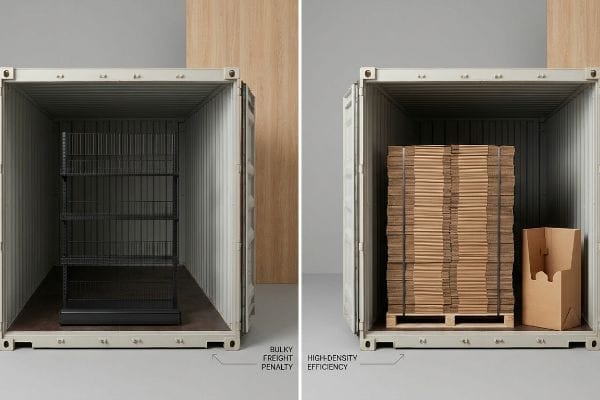
Mais connaître la théorie ne suffit pas lorsque les machines se mettent en marche et que d'énormes factures de transport arrivent sur votre bureau.
Pénalité de transport pour « matériel permanent »
les équipes d'approvisionnement privilégient souvent les présentoirs , partant du principe que l'acier robuste garantit automatiquement un meilleur retour sur investissement. Elles spécifient sans hésiter des rayonnages métalliques rigides, convaincues que le surdimensionnement du matériau est la solution la plus sûre pour les environnements à fort trafic. Cette hypothèse, en apparence raisonnable, ignore la dure réalité mathématique du transport international.
Installer un présentoir en laboratoire est facile, mais la réalité est tout autre lorsqu'il s'agit d'en expédier 500 à travers le Pacifique. Dans mon entrepôt, je constate régulièrement que des marques perdent de l'argent à cause du transport inutile de marchandises ; un conteneur 40HQ ne peut contenir qu'environ 235 présentoirs métalliques soudés entièrement assemblés<sup>17</sup>. J'ai calculé le volume et démontré qu'en optant pour une structure en carton ondulé vierge 32ECT, conçue pour être livrée à plat<sup>18</sup>, nous pouvions loger exactement 1 480 unités démontées dans ce même conteneur. Le bruit métallique et lourd du chargement sur le quai est remplacé par le silence et l'efficacité du carton haute densité, évitant ainsi la majoration de 300 % du volume de fret et permettant aux clients d'économiser des milliers d'euros en frais de transport inutiles, sans compromettre la stabilité des présentoirs.
| Erreurs courantes des débutants | La solution pro | Avantage du magasin |
|---|---|---|
| Spécification des FSDU métalliques soudés lourds | Passage aux unités temporaires en tôle ondulée | Élimine les pénalités importantes liées au volume de fret |
| Payer pour expédier du vide | Conceptions structurelles en kit d'ingénierie | Peut contenir 1 480 unités par conteneur 40HQ19 |
| Surdimensionnement pour des campagnes de 12 semaines | Utilisation de cartes vierges 32ECT haute résistance20 | Respecte les limites de charge dynamiques du commerce de détail |
Pour les campagnes de courte durée, je supprime les structures métalliques permanentes et encombrantes car elles réduisent considérablement l'efficacité du transport. Une ingénierie intelligente remplace l'acier lourd par des pliages ondulés d'une précision mathématique afin d'optimiser votre marge bénéficiaire logistique.
🛠️ Le bureau d'Harvey : Connaissez-vous le surcoût exact lié au transport de vos présentoirs pré-assemblés ? 👉 Envoyez-moi votre fichier de gabarit ↗ — Je vérifierai la rentabilité de vos calculs avant que vous n'investissiez inutilement dans une production de masse.
Conclusion
Vous pouvez certes isoler les indicateurs de coût et exiger des supports moins chers, mais si ce panneau 26ECT de qualité inférieure se déforme sous une forte pression dans un entrepôt humide, ralentissant l'assemblage par le prestataire logistique d'environ 30 %, vous anéantissez complètement la marge bénéficiaire de votre campagne. Plus de 500 responsables de marque utilisent ma checklist prépresse pour éviter précisément ces erreurs fatales en début de production. Cessez de deviner les tolérances structurelles et laissez-moi analyser personnellement vos fichiers grâce à mon Audit de découpe gratuit ↗ afin de détecter ces erreurs invisibles qui affectent la structure avant le lancement de la production en série.
« Le mix marketing des 4C (Solution client, Coût, Commodité…) – Umbrex », https://umbrex.com/resources/frameworks/marketing-frameworks/4cs-marketing-mix-customer-solution-cost-convenience-communication/ . Vérification du cadre des 4C en tant que méthodologie spécifique utilisée par les équipes d'approvisionnement pour les déploiements en points de vente. Rôle de la preuve : vérification ; type de source : livre blanc sectoriel ou manuel d'approvisionnement. Appuie : l'existence de ce cadre stratégique spécifique. Note de portée : distinction avec les 4C standard du marketing.
« Étude de l’influence de la rigidité du plateau supérieur des palettes sur le carton ondulé… », https://pmc.ncbi.nlm.nih.gov/articles/PMC8585293/. Spécification technique relative à la résistance du carton ondulé et à sa capacité de charge pour les présentoirs de vente au détail. Type de preuve : spécification technique ; source : norme de l’industrie de l’emballage. Appuie : l’affirmation selon laquelle le 26ECT est un substrat de qualité inférieure, susceptible de se déformer sous le poids des palettes. Remarque sur le champ d’application : s’applique au carton ondulé simple cannelure .
« Les risques cachés d'un mauvais assemblage des présentoirs PLV (et comment les éviter…) », https://www.eliteprintingandpackaging.com/blog/the-hidden-risks-of-poor-pos-display-assembly-and-how-to-avoid-them/. Données sectorielles relatives aux pertes de temps en logistique 3PL lorsque des défauts structurels entraînent des distorsions graphiques et un assemblage difficile. Type de preuve : indicateur de performance ; source : rapport logistique/chaîne d'approvisionnement. Confirme : l'affirmation d'une baisse de 30 % de la vitesse d'assemblage due à la mauvaise qualité des matériaux. Note : moyenne estimée basée sur les non-conformités constatées dans le secteur du commerce de détail .
« [PDF] Manuel des opérations d'évaluation des dommages | FEMA », https://www.fema.gov/sites/default/files/2020-07/Damage_Assessment_Manual_April62016.pdf. Documentation de gestion de la chaîne d'approvisionnement démontrant comment une évaluation globale des coûts, de la communication, de la commodité et de la construction permet de prévenir les dommages liés au transport. Rôle de la preuve : lien de causalité ; type de source : étude de cas logistique. Appuie : l'affirmation selon laquelle une évaluation unifiée réduit les refacturations au détail. Note de portée : axé sur le transport interentreprises (B2B) .
« Comment réduire les coûts des présentoirs PLV sans compromettre la qualité », https://brownpackaging.com/how-to-reduce-pop-display-costs-without-downgrading-quality/ . Étude sectorielle ou rapport logistique de référence fournissant des données sur la façon dont l'intégration de la robustesse structurelle et de la facilité d'assemblage réduit le temps d'installation en point de vente . Type de preuve : données quantitatives ; source : livre blanc sectoriel. Démonstration : gain d'efficacité grâce à l'association de la robustesse du carton et de la facilité d'assemblage. Précision : spécifique aux présentoirs de point de vente.
« Estimation de la résistance à la compression des boîtes en carton ondulé… », https://pmc.ncbi.nlm.nih.gov/articles/PMC8467740/. Spécifications techniques issues d'un manuel d'ingénierie de l'emballage détaillant les propriétés de résistance à la charge et à la compression des doublures en kraft vierge 32ECT. Rôle de la preuve : validation technique ; type de source : manuel de science des matériaux. Appuie : l'utilisation de doublures de haute qualité pour résister à la pression dynamique en surface. Note de portée : s'applique aux normes relatives au carton ondulé .
« 14 types de présentoirs pour points de vente | Chicago, IL – Wertheimer Box », https://wertheimerbox.com/types-of-retail-displays/. Confirmation que le format standard de 48 × 40 pouces (122 × 102 cm) est utilisé pour les présentoirs sur palettes grand format en Amérique du Nord. Type de preuve : spécification technique ; source : manuel de conception logistique ou de vente au détail. Supporte : les dimensions standard des présentoirs. Portée : axée sur la logistique des grandes surfaces .
« Dimensions standard des palettes — 48 × 40 GMA et 6 autres dimensions courantes », https://www.wearewarp.com/standard-pallet-sizes. Vérification des normes de dimensions de palettes de la Grocery Manufacturers Association (GMA) utilisées comme référence pour les présentoirs en magasin. Type de preuve : spécification technique ; source : norme industrielle ; argument : une base standardisée permet une division proportionnelle. Remarque sur le champ d’application : principalement applicable à la logistique nord-américaine .
« Types de présentoirs sur palette : pleine, demi-palette et quart de palette – GreenDot Packaging », https://greendotpackaging.com/understanding-pallet-display-types-full-half-and-quarter-pallet-displays/ . Vérification des pratiques courantes du secteur pour des palettes plus compactes afin d’améliorer leur acceptation par les détaillants. Rôle de la preuve : validation technique ; type de source : guide sectoriel. Apport : stratégie pour optimiser l’espace dans les allées à fort trafic. Remarque : s’applique principalement aux grandes surfaces.
« Guide complet des palettes GMA : tout ce qu’un acheteur doit savoir », https://www.meridianpkg.com/feeds/blog/gma-pallets. Documentation des normes de palettes GMA (Grocery Manufacturers Association) démontrant la faisabilité du découpage mathématique. Type de preuve : spécification technique ; source : norme industrielle. Avantages : augmentation de la densité de vente au détail. Portée : limitée à la logistique normalisée GMA .
« L’ART DES PRÉSENTOIRS EN MAGASIN : CAPTIVER L’ATTENTION EN POINT DE VENTE… », https://www.bcipkg.com/the-art-of-retail-pop-displays-captivating-in-store-audiences/. Des recherches faisant autorité sur la hiérarchie visuelle et la psychologie environnementale confirment la nécessité d’éléments de design adaptés à différentes échelles pour capter l’attention à diverses distances. Rôle des preuves : validation technique ; type de source : étude de marché ; Arguments : nécessité d’une conception structurelle prenant en compte la distance pour une visibilité optimale. Note relative au périmètre : étude axée sur les espaces de vente physiques .
« Impression en tons directs vs quadrichromie – Pantone », https://www.pantone.com/articles/technical/spot-vs-process-color?srsltid=AfmBOoqcZUfrsIKq1teTbpD97m36ZyOxQbpS_hAGh6x3-c3e0w76ytjK. Explication technique montrant comment les tons directs offrent une saturation et un contraste supérieurs aux trames CMJN pour une visibilité à longue distance. Rôle de la preuve : vérification technique ; type de source : norme de l’industrie de l’imprimerie. Appui : Utilisation des tons directs pour créer un effet de rupture visuelle. Remarque sur le champ d’application : S’applique aux supports imprimés physiques .
« ANALYSE DU POINT DE VENTE : L’IMPACT DES PLV EN MAGASIN… », https://www.bcipkg.com/point-of-purchase-insights-the-impact-of-retail-pop-displays-on-consumer-behavior/ . Données empiriques ou recommandations de conception en point de vente établissant le pourcentage optimal de visibilité des produits pour déclencher des achats impulsifs. Rôle des preuves : validation métrique ; type de source : étude de psychologie du commerce de détail ou manuel de conception. Appuie : Relation entre la visibilité et la conversion tactile. Note de portée : Spécifique aux unités physiques de point de vente.
« [PDF] Directives de conception commerciale pour les points de vente – Westminster, CO », https://www.westminsterco.gov/DocumentCenter/View/4258 . Ces directives de conception, faisant autorité en la matière, expliquent les zones spatiales à privilégier pour attirer et convertir les clients. Niveau de preuve : spécification technique ; type de source : manuel sectoriel. Elles confirment l’efficacité de la règle 3-3-3 pour la gestion de l’attention à distance. Remarque : les mesures peuvent varier en fonction de la largeur des allées.
« CMJN vs. Couleurs d'accompagnement dans l'impression d'emballages – Meyers Printing », https://meyers.com/meyers-blog/cmyk-vs-spot-colors-in-packaging-printing-what-cpg-brands-need-to-know/ . Normes de l'industrie de l'impression concernant la saturation et le mélange des couleurs sur la signalétique grand format pour la vente au détail afin de garantir un contraste élevé. Rôle de la preuve : norme technique ; type de source : guide d'impression. Appuie : l'utilisation de couleurs d'accompagnement pour éviter le flou des graphismes. Note sur la portée : spécifique aux applications d'encre physique.
« Comment améliorer la visibilité en point de vente grâce aux présentoirs PLV », https://www.industrialpackaging.com/blog/increased-retail-visibility . Études de psychologie du consommateur et d'ergonomie sur la visibilité des produits et la distance d'accès pour les présentoirs de vente au détail. Type de preuve : mesure empirique ; source : étude d'ergonomie en point de vente. Confirme : la corrélation entre la hauteur du rebord et les taux de conversion physique. Remarque : s'applique principalement aux présentoirs de bord de rayon.
« Rayonnages empilables pour entrepôt et usine… », https://sunlighthardware.en.made-in-china.com/product/RZsGaIAlJYUb/China-Stackable-Storage-Cage-Factory-Warehouse-Display-Racks.html. Données logistiques sur l’utilisation du volume cubique pour les présentoirs de vente pré-assemblés dans des conteneurs grand volume. Rôle de la preuve : indicateur de référence ; type de source : guide de logistique d’expédition. Constat : l’inefficacité du transport de « volume mort » pour le matériel permanent. Remarque : les chiffres exacts varient selon les dimensions spécifiques des rayonnages .
« [PDF] Spécifications du carton ondulé – Fibre Box Association », https://www.fibrebox.org/assets/2025/09/Walmart_Corrugated-Board_Specifications_Automation_Packaging_Standards.pdf . Normes d'ingénierie d'emballage pour le carton vierge soumis à un test de résistance à la compression sur les bords (ECT) de 32 cm, afin de vérifier sa capacité de charge pour une utilisation intensive en grande distribution. Rôle de la preuve : spécification technique ; type de source : norme de l'industrie de l'emballage. Appuie : la viabilité du carton haute performance comme alternative au métal. Remarque: les performances dépendent de la conception structurelle.
« Conteneur high-cube sec de 40 pieds | Spécifications et dimensions », https://www.bws.net/toolbox/container-specifications/40-foot-dry-high-cube. Données quantitatives démontrant la capacité d'expédition des présentoirs en kit par rapport aux unités assemblées dans des conteneurs high-cube standard de 40 pieds. Rôle de la preuve : Vérification quantitative ; type de source : Données logistiques et de chaîne d'approvisionnement. Contribue à : L'efficacité des conceptions structurelles en kit. Remarque : La capacité réelle varie selon les dimensions du présentoir .
« Comprendre la résistance des cartons d'expédition – EcoEnclose », https://www.ecoenclose.com/blog/understanding-shipping-box-strength/?srsltid=AfmBOoqNUp3HDQcoXemD8_oxTSleTkkIUoCNe_JeB_KTHSKiyXTYSFNo. Spécifications techniques de la résistance du carton 32ECT (test d'écrasement des bords) et de sa capacité à respecter les limites de charge pour les présentoirs temporaires destinés à la vente au détail. Rôle de la preuve : Vérification des spécifications techniques ; type de source : Norme d'ingénierie de l'emballage. Appui : Utilisation de qualités de carton ondulé spécifiques pour une meilleure durabilité. Note de portée : Normalisée dans l'ensemble du secteur de l'emballage en carton ondulé .


